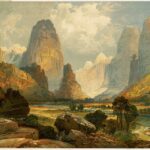
Utah’s art history begins not in studios or salons, but in its immensity—its vertical geology, dry skies, and moral gravity. Here, artists were never just decorators or innovators. They were interpreters, often missionaries of visual meaning, compelled to wrestle with a landscape that felt ancient, untouched, and somehow already sacred. From the start, Utah’s art has reflected two elemental forces: the weight of faith and the enormity of place.
A distinct regional character emerges
Unlike the coastal art centers that absorbed European fashions and ideologies in waves, Utah’s artistic identity was forged from isolation, both geographical and cultural. Bounded by deserts and mountains, early Utahns—most notably members of the Church of Jesus Christ of Latter-day Saints—had little access to the established art world. But what they lacked in exposure, they made up for in purpose. Art in Utah was not a matter of leisure or vanity. It was woven into the practical and spiritual lives of settlers who saw beauty as inseparable from labor and belief.
By the mid-19th century, when painters in New York were arguing over realism versus romanticism, artists in Utah were painting murals inside temples and sketching the Wasatch Front with a devotional eye. In this environment, artistic excellence was not judged by novelty or intellectual complexity but by fidelity—to scripture, to the land, to the community. As a result, even as art schools developed and styles evolved, Utah art retained a kind of moral weight that set it apart.
This seriousness did not exclude experimentation, but it channeled it. Artists in Utah had to negotiate between outside influence and local expectation, between individual vision and communal values. From this tension emerged a style that favored clarity over ambiguity, craftsmanship over theory, and feeling over fashion. It was regional in the strongest sense: not parochial or second-tier, but grounded, specific, and enduring.
Faith, settlement, and artistic ambition
No force shaped Utah art more profoundly than the settlement mission of the Latter-day Saints. Arriving in the Salt Lake Valley in 1847, Brigham Young and his followers came not to escape the world, but to build a new one. They envisioned a Zion—both literal and symbolic—and in that vision, art played a central role. From temple murals to hand-carved furniture, visual expression became an extension of the theological project.
This religious foundation gave Utah art an unusual intensity from the outset. Murals inside the Salt Lake Temple—begun in the 1850s and completed in the decades following—were not merely decorative. They were doctrinal, cosmological, and pedagogical. Their creators were often self-trained or part-time artists, but the work demanded seriousness, preparation, and above all, belief. In many ways, these early efforts formed Utah’s first true school of art—not institutional but devotional.
The idea that art could serve higher purposes was not unique to Utah, but here it was sustained over generations. Even as artists traveled to Paris or Munich for formal education, many returned to Utah to create work that aligned with their community’s values. The goal was not escape or rebellion but refinement—a kind of visual sanctification of frontier life.
This dual allegiance—to technical excellence and spiritual integrity—remains one of Utah’s defining artistic legacies. It gave rise to a generation of painters who were both ambitious and restrained, who sought mastery not for acclaim but for contribution. Their legacy can still be seen today, not just in museums but in meetinghouses, homes, and the quiet persistence of representational art in Utah studios.
Art as a response to vastness and silence
The other dominant presence in Utah’s art—equal in force to faith—is the land itself. Towering rock formations, impossible canyons, and the stark clarity of desert light have shaped artistic practice for over 150 years. Unlike the densely wooded Eastern states or the fertile gentleness of the Midwest, Utah presents the eye with extremes. It demands scale, invites awe, and punishes sentimentality.
Artists coming west with exploration teams in the 19th century—such as Albert Bierstadt or Thomas Moran—treated Utah’s terrain as sublime theater, a stage on which to project the grandeur of American destiny. But for artists who lived here, the relationship was more intimate, even reverent. The land was not only spectacle but presence—silent, enduring, and moral.
Painters like Alfred Lambourne, who walked the entire shoreline of the Great Salt Lake and recorded his impressions in both words and images, understood the landscape not as scenery but as scripture. Later artists, including LeConte Stewart, would continue this tradition, painting unassuming farm roads and distant mountain ranges with an eye trained on stillness and clarity.
This tendency toward direct observation—away from stylization and toward quiet realism—became a hallmark of Utah art. It was not a rejection of modern trends but a reflection of environment. In a place where the horizon is infinite and the seasons stark, art naturally bends toward patience, modesty, and attention.
Surprisingly, this fidelity to the landscape has allowed for a wide range of expression. Utah’s desert minimalism pairs well with abstraction, its stratified canyons invite formal analysis, and its high-altitude light sharpens every edge. But even when styles shift—from impressionism to modernism to contemporary realism—the land remains. It is the constant subject, the unspoken reference, and the testing ground of artistic seriousness.
Utah’s art history cannot be divorced from its physical and spiritual terrain. It is a tradition shaped by moral seriousness, visual discipline, and the strange grandeur of a high desert state that has always stood a little apart from the artistic mainstream. In that apartness lies its strength. From the first murals inside a temple to the latest plein air painter setting up an easel near Capitol Reef, Utah art speaks in a voice shaped by conviction and silence. It does not shout, but it endures.
The First Images: Explorers, Surveyors, and the Romantic West
Before the local artists of Utah began to define their own visual language, others came first—outsiders with sketchbooks and mandates. These early image-makers were not residents but emissaries, attached to expeditions, military surveys, or geological field teams. Their task was not to express a feeling but to render a report. And yet, through their work, the land began to speak.
Government-sponsored artists and early impressions
The first artists to record Utah’s landscape were part of a larger national agenda. During the mid-19th century, as the United States pushed westward following the Louisiana Purchase and the annexation of Mexican territory, the federal government commissioned detailed surveys of its vast, unknown holdings. These were not idle ventures. They were logistical and strategic exercises—assessing routes, cataloging minerals, and, crucially, documenting terrain.
To aid in this process, artists were brought along to make visual records in an age before widespread photography. Their sketches and watercolors served as official documentation, but also as propaganda—proof of the grandeur and potential of the American West. Utah, with its jagged mountains, dry plateaus, and monumental rock formations, figured prominently in these efforts.
One of the most significant early figures was Richard Hovey Kern, a topographical artist who accompanied expeditions through the region in the 1850s. His drawings of the Wasatch Mountains and Utah’s desert basins were restrained but precise—rendered not with artistic flourish but with the discipline of a surveyor. These images were reproduced in government reports and circulated in Washington, shaping eastern perceptions of the territory long before most Americans had seen it for themselves.
Kern was not alone. Albert Bierstadt and Thomas Moran, while not officially assigned to Utah survey teams, visited nearby regions and painted scenes that echoed the scale and drama of Utah’s topography. Moran’s images of neighboring Yellowstone and the Grand Canyon, for instance, prepared the public to receive Utah’s geology as part of a sublime continental narrative. Even when Utah itself was not the specific subject, the surrounding aesthetic context—high cliffs, glowing light, immense silence—cast its shadow.
Landscape as documentation and propaganda
The fusion of aesthetics and imperial intent was not accidental. The 19th-century American government understood that visual art could make claims more persuasive than legal documents. A well-placed painting or engraving could transform remote terrain into a realm of destiny—ready for railroads, settlements, and statehood. In this sense, art functioned as argument.
Utah’s peculiar status within this vision added an extra layer of intrigue. It was both a place of national ambition and religious separation. For many outsiders, the territory was exotic, and not entirely trustworthy. Images of Utah’s landscape, therefore, did double work. They had to domesticate the strange and elevate the familiar. The towering buttes and intricate rock formations of southern Utah, for instance, were rendered with a combination of technical fidelity and theatrical lighting—evidence of natural wonder, but also of latent promise.
In illustrated periodicals like Harper’s Weekly or Frank Leslie’s Illustrated Newspaper, engravings based on field sketches began to appear, bringing the Utah wilderness into parlors and libraries in Boston, Philadelphia, and New York. These were not romanticized in the European sense—they lacked shepherds or ruins—but they were composed with intention. A valley might be deepened for effect, a peak sharpened, a river widened. These changes were not lies. They were choices made in service of an idea: that this land was part of something larger.
And yet, some of these early artists could not help but be personally moved by the territory. Though employed as technicians, they often wrote about Utah with a quiet awe. In field journals and private letters, they described the peculiar hush of the desert, the stark transitions between red rock and snow-covered peaks, the uncanny sensation of being dwarfed by stone. Their official images may have obeyed bureaucratic standards, but the private response was often near-mystical.
Topographical art and visual conquest
The visual mapping of Utah was never a neutral act. By rendering the land comprehensible, artists also rendered it claimable. The process of converting wilderness into image was, implicitly, an act of order—and of power. The grid of the surveyor, the measured contour of a canyon, the elevation chart of a plateau: these were tools not only of knowledge but of governance.
In this sense, topographical art became a subtle but powerful instrument of American expansion. The more complete the image, the more inevitable the control. And yet, paradoxically, some of the most successful artistic representations of Utah during this period resisted total legibility. The best drawings and paintings hinted at scale without flattening it, captured texture without simplifying it, and preserved the mystery even as they revealed the form.
This tension—between mapping and reverence—would become central to Utah’s later artists. But even in the earliest images, the land refused to be merely illustrated. In many lithographs and engravings, there is a discernible sense that the landscape pushed back. Its shapes defied neat perspective. Its silence overwhelmed narrative. It presented itself not as background, but as subject.
A vivid example appears in an 1873 engraving titled View Near Kanab, Southern Utah, based on sketches from John Wesley Powell’s Colorado River expedition. The image shows a narrow path winding through towering red walls, the figures of men and mules barely discernible in the lower corner. The proportions are unmistakable: man dwarfed by creation, detail overwhelmed by mass. This was not propaganda. It was humility in image form.
Such works did not disappear after the survey era ended. They remained in circulation, reprinted in textbooks and atlases, referenced by painters and educators. They formed a visual vocabulary that future Utah artists inherited, revised, or rejected. But they were never ignored. The first image is never forgotten.
The art of exploration in Utah was not sentimental. It did not seek to flatter or to please. It sought to understand—and, in the process, to assert. And yet, despite its official function, it left behind something stranger and more enduring: a record of first encounters between the American eye and a landscape that would never quite yield to comprehension. In the quiet lines of a survey sketch or the exaggerated shadow of a lithograph, we find not just documentation, but the first hints of a long conversation between image and place—a conversation that continues still.
Mormon Aesthetics: The Role of Art in the Latter‑day Saint Vision
The visual culture that arose alongside Utah’s settlement was less an afterthought than an instrument: an organized effort to shape houses of worship, communal spaces, and private interiors so that they embodied a set of shared convictions. In that process, painting, architecture, and decorative craft became means of instruction as much as ornament—tools to fix history, scripture, and aspiration into everyday view.
Temples, murals, and scriptural imagery
When communities set about building temples and meetinghouses, the brief for artists was narrowly defined and uncompromising. Walls were not neutral surfaces but stages for narratives—parables, histories, and cosmologies rendered in paint. Murals in public religious spaces combined didactic function with a high standard of finish: allegory needed clarity, and iconography needed to be immediately legible to congregations who encountered it as part of ritual life.
Artists accepted commissions with the understanding that their work had to serve a public purpose. That requirement altered both subject and method. Instead of private experiments with abstraction or personal symbolism, painters worked within an inherited visual language: scenes that depicted sacred events, pastoral images that reinforced moral values, and stylized landscapes that suggested providence rather than mere scenery. The decorative vocabulary drew on familiar Western sources—neoclassical composition, academic figure work, and fresco technique—but it was adapted to local conditions, materials, and budgets.
This imperative of legibility produced a distinct conservatism evident across many commissions: clear modeling, steady perspective, and a preference for narrative closure. It also fostered craftsmanship. Many murals and ecclesiastical fittings were executed by artists who had earned their skills in workshops or itinerant trade, and who prized technique as the surest route to persuasion.
Patronage within the early Church hierarchy
Support for art in Utah took institutional form. Leaders and local boards allocated funds, organized competitions, and sometimes recruited artists from outside the territory. Patronage was pragmatic: works were commissioned because they served congregational and civic aims—teaching, commemorating, or beautifying public life—rather than to promote avant-garde experimentation.
This system generated stable careers for a number of regional practitioners. Some worked almost exclusively on religious or civic projects; others balanced these commissions with easel painting, portraiture, and decorative work for private patrons. The advantage of such patronage was tangible: artists could practice their craft at scale, collaborate with skilled trades, and produce durable works integrated into architecture and daily life.
At the same time, patronage carried constraints. Committees sometimes dictated subject matter; materials were chosen for durability rather than novelty; and the aesthetic profile of commissioned works tended toward consensus. The result was a body of art that emphasizes clarity, moral directness, and a visible link between principle and practice. It also created an archive of work—murals, stained glass, altarpieces, ornamental woodwork—that offers historians a rare continuity between civic faith and material culture.
Sacred architecture and artisan labor
Architecture was the most public and lasting expression of the region’s aesthetic priorities. Temples, meetinghouses, and civic buildings were designed to manifest order and permanence. Their exteriors signaled stability—stone and brick, balanced proportions, steeples and pediments—while interiors were crafted to host ritual and instruction. The architectural program dictated the decorative one: frescoes and canvases had to fit bays and domes, stained glass had to mediate light without distraction, and carved woodwork had to withstand frequent handling.
This produced a robust demand for artisans—stonemasons, gilders, glassworkers, muralists—who worked in collaboration rather than isolation. Workshops formed around congregational needs, apprentices learned trades through practice, and local economies benefited as commissions circulated. The workmanship was often conservative in style, but precise in execution: carved capitals, neatly composed murals, and fitted furnishings that married utility and finish.
A surprising consequence was the elevation of certain crafts to near-art status. Ceramic tiles, hand-turned pews, and carved altarpieces acquired reputations for quality and longevity; they were not merely contractor work but visible expressions of communal standards. Within this ecosystem, artistic ambition found realistic forms: excellence did not have to be radical to be consequential.
Mid-section surprise: secular craft and civic life
It is easy to assume that art commissioned by religious institutions remained confined to sanctuaries. In practice, the same aesthetic preferences migrated into civic buildings, schools, and private homes. Murals commissioned for public schools echoed the moral narratives seen in temples; public monuments favored representational figuration over abstraction; local festivals showcased craftspeople whose techniques were honed in ecclesiastical workshops.
Three short examples illustrate the cross-pollination:
- Decorative tilework originally ordered for temple interiors later appeared in municipal buildings.
- Portrait artists who painted leaders for church halls were frequently the same painters contracted for city hall portraits.
- Workshop-trained woodworkers produced both meetinghouse pews and elaborate domestic furniture.
These overlaps ensured that an identifiable regional style—craftsmanlike, narrative, and durable—became common currency across public and private spheres.
Micro-narrative: a painter on scaffolding
A telling scene repeats in surviving recollections: an artist on a scaffold with daylight thinning, steadying a brush as figures on the mural acquire the last lines of expression. The work is collaborative—helpers mix pigments, a mason steadies the ladder, a patron stops by to inspect progress. There is no lone genius manifesting a private vision; there is a public act, measured by requirements and by the demands of ritual. The image completed will be seen by generations in the course of ordinary life—marriages, meetings, funerals—imbuing the painting with a slow, civic afterlife.
Durable effects on local practice
The long-term consequence of this period was not merely a large inventory of murals and ecclesiastical fittings, but a set of professional norms: respect for technique, an emphasis on legible narrative, and an expectation that art should serve an intelligible end. These norms persisted even as training opportunities increased and some artists sought instruction in metropolitan academies. Returning artists often adapted what they had learned to local templates rather than abandoning them.
As a result, Utah’s art history contains a steady thread: the integration of craft into public life. Whether through a painted dome, a carved pulpit, or a hand-laid tile floor, the aesthetic came to signify civic values—order, care, and permanence—more than fashionable experiment. That emphasis helps explain why representational art retained such a strong place in the region’s museums and private collections well into the 20th century.
The Utah Territorial Style: Folk Forms and Vernacular Art
From the moment settlers put down roots, utility and beauty grew together. The so‑called Utah Territorial style is not an elite school or a manifesto; it is a practical idiom—an approach to making that treated everyday objects as occasions for design. In households, on the frontier, and in small workshops, craft became the most visible form of art: quilting, furniture carving, painted signage, and metalwork all carried a common sensibility—durable, plainspoken, and quietly elegant.
Quilts, carvings, and domestic decoration
Household objects provide the clearest testimony to how a community sees itself. In Utah, quilts were never merely bedcovers. Patchwork and appliqué preserved scraps of clothing, marked family histories, and turned thrift into pattern. Quilts combined economy with compositional ingenuity: irregular pieces assembled in rhythmic grids, borders worked with a steady hand, and color choices reflecting available dyes rather than aesthetic theory. The result was a folk modernism—a set of solutions that look inevitable in retrospect because they are so perfectly fitted to need.
Wood carving followed much the same logic. Cabinet doors, mantelpieces, and bedheads were opportunities for modest ornament: reeding, rosettes, stylized foliage, and restrained inlay. The carving vocabulary favored clarity of line over overwrought detail. Where classical ornament might have been learned from a pattern book, local carvers simplified, adapted, and sometimes merged motifs to suit local tools and timbers. The emphasis was on joinery that would endure and carving that would not distract from use.
Domestic painting—signs, hearthboxes, and small framed pictures—completed the circuit. A painted cupboard door or a stencil around a window became a focus in a modest room. These works were not isolated gestures of self‑expression; they were woven into a household rhythm. Their makers judged success not by novelty but by proportion, finish, and how well the object performed its task for decades.
Functional objects with aesthetic intent
Function dictated form, but intent disciplined ornament. The Territorial style demonstrates how artisans treated practicality as an aesthetic principle. Tools of daily life—wrought‑iron hinges, wooden churns, kitchenware—were often made to last and, when possible, to please the eye. A blacksmith who forged a hinge might put a pleasing curve at its terminal; a wheelwright would sand and varnish a wheel so it did not flake on the next trip across rough ground. This intersection of utility and care created objects that looked good because they persisted.
Three brief categories illustrate how utility shaped design:
- Structural craft: beams, doorframes, and stair rails finished with clean chamfers and restrained moldings.
- Household ornament: stenciling and painted borders that emphasize symmetry without fuss.
- Portable vessels: turned bowls and bowls with simple carved bands to prevent slipping.
Because these objects circulated through ordinary life—gifted, repaired, repurposed—they developed layered patinas and stories. A carved bedpost that survived several generations would accumulate not only wear but approval, becoming a reference for local taste.
Self-taught artists and frontier craftsmanship
Most of the people who made this work were not professional artists in the modern sense. They were craftsmen: carpenters who learned carving because a client asked; a woman who invented a quilt pattern to use limited scraps; a tinsmith who adapted an imported motif to local shapes. Their training was informal—apprenticeship, observation, copying a neighbor’s device—but it resulted in a clear, repeatable repertoire.
This environment had several consequences. First, stylistic change was slow. Innovations traveled by word of mouth and by seeing a neighbor’s successful piece. Second, regional coherence emerged from shared materials and similar conditions: the same timber species, the same workshops, the same panels and tools. Third, the line between art and labor remained thin; an excellent carpenter could be as respected as a painter. Craftsmanship was public virtue.
A micro‑narrative can make this concrete: imagine a wagonmaker’s shop in a small town. The proprietor shapes axles while a journeyman sands a small chest lid for a commission. The chest will be finished in linseed oil and delivered the next morning for a wedding. The maker has never studied design in a city but knows how proportion reads in daylight and how a fine dovetail makes a client trust the object. This tiny scene repeats across counties, and the cumulative effect is a durable, local aesthetic.
Midway through the period, a practical surprise appears: techniques invented for economy become sought after for their look. A simple herringbone inlay once devised to cover a flaw in a board becomes a prized regional motif. A stencil pattern designed to mask uneven plaster morphs into a recognizable local emblem. These accidental inventions move from necessity into identity.
How vernacular art fed public taste
Domestic and workshop practices did not remain isolated. When local leaders commissioned municipal buildings, schools, or meetinghouses, they expected a level of finish informed by these vernacular standards. The same carpenters who made a chest were often called upon to craft pews or school desks. The standard for municipal ornamentation tended toward familiar restraint rather than imported flamboyance.
Local exhibitions, fairs, and parades amplified this effect. A prize for the “best quilt” or the “most durable plow” reinforced what mattered: workmanship, utility, and plain design. Over time, collectors and museums would look back and recognize the Territorial style as a coherent chapter precisely because it left so many physical traces in everyday objects. What was once ordinary became historically valuable because it survived.
Rock Walls and River Stones: Native American Visual Traditions in Utah
Long before murals adorned temple interiors or oil paintings captured desert light, Utah’s earliest art was already etched, pecked, and painted into stone. These works—spanning millennia—are neither primitive nor decorative. They form one of the oldest and most sophisticated visual records in North America: layered, coded, rhythmic, and deeply embedded in the physical terrain. From canyon walls and basalt cliffs to woven baskets and painted hides, Native American artistic traditions in Utah reflect a continuity of presence, belief, and form that endured long before written history began.
Fremont, Ancestral Puebloan, and Barrier Canyon imagery
Utah is home to some of the most important concentrations of ancient rock art in the United States. The most immediately striking examples belong to three major visual traditions: Fremont, Ancestral Puebloan, and the even older and more enigmatic Barrier Canyon Style.
The Barrier Canyon Style, dating to as early as 2000 BC and found in sites like Horseshoe Canyon (now part of Canyonlands National Park), features ghostlike human forms—elongated figures with no arms, wide eyes, and halo-like head markings. These are not casual doodles or hunting records. Their placement in remote alcoves and their careful execution suggest ritual, cosmology, or storytelling. They appear to be less about events and more about presence—symbolic figures stationed in silence on canyon walls, resisting interpretation but commanding attention.
The Fremont Culture, active from roughly AD 300 to 1300, left a visual language rooted in abstraction and stylized human and animal figures. Common motifs include trapezoidal-bodied people with ornate headdresses, bighorn sheep in procession, and patterned shapes that appear to represent textiles, footprints, or weapons. Fremont petroglyphs are typically carved rather than painted and are often clustered near water sources, travel routes, or significant terrain features.
The Ancestral Puebloans, known for their sophisticated architecture further south, also left painted and incised works in Utah’s southeastern region. These images, more geometric in composition, often reflect patterns echoed in pottery and weaving: step motifs, spirals, checkerboards. They show a developed sense of balance and design—art integrated with architecture, not isolated from it.
What unites these traditions is not a single style, but a shared seriousness. These images are carefully sited, repeat certain motifs across generations, and clearly served more than decorative purposes. Their creators had a sense of composition, rhythm, and scale that rivaled anything produced in the early Mediterranean or Near East. The wall was not a canvas—it was part of the message.
Ute and Paiute craft, decoration, and symbolic design
By the time European settlers arrived in Utah in the 19th century, the region was home primarily to Ute, Paiute, Shoshone, and Navajo communities—each with distinct artistic languages grounded in mobility, material adaptation, and symbolic economy. Their art was not fixed to rock walls but moved with them: onto baskets, tools, hides, beadwork, and clothing.
Among the most celebrated traditions in Utah is Southern Paiute basketry—tight, durable, and exquisitely patterned. These baskets were made for practical use—carrying seeds, storing grain, winnowing, cooking—but the artistry involved was no afterthought. Geometric patterns in natural dyes formed concentric rings, stepped diamonds, or subtle spirals. Each form had a practical logic (flat for winnowing, deep for carrying), but the decoration elevated the ordinary into something enduring.
The Ute people produced painted hides and beadwork that showed a deep sensitivity to color and repetition. Buckskin clothing, moccasins, and ceremonial objects were decorated not to impress outsiders but to reinforce internal coherence: lineage, status, and spiritual affiliation. A shirt might carry rows of quillwork and beads with symbolic reference, while tools and saddle gear bore incised or burnt motifs passed down through kin or band tradition.
While 19th-century observers often misunderstood these objects as merely “folk” or “ethnic,” they are best understood as mobile artworks—highly structured and aesthetically rigorous. They reflect a logic of use, beauty, and memory inseparable from the lives of those who made and used them.
Three distinct visual features stand out in this period:
- Color restraint: A focus on earth tones, ochres, and vegetal dyes, with high-contrast accents.
- Geometric control: Patterns based on symmetry, mirroring, and rotation.
- Symbolic compression: Visual motifs that conveyed stories, spiritual links, or group identity in minimal space.
In short, these works are small in size but dense in meaning. They reveal a design culture that was deeply connected to natural resources and ritual structures—composed not for galleries but for grounded, daily use.
Survival, adaptation, and artistic continuity
The 20th century brought disruption to all of these traditions. As Utah developed industrially and urbanized, Native communities faced economic pressure, cultural displacement, and direct suppression of traditional practices. And yet, artistic forms persisted—adapted, revised, and in some cases, revived through new channels.
Petroglyph and pictograph sites were preserved not through outside interest alone, but often through the vigilance of tribal communities who understood their significance long before archaeologists did. Basketry, too, survived not as nostalgic craft but as a living discipline. In some Paiute and Goshute communities, traditional coiling techniques continued in use well into the 20th century, with new generations of weavers adapting forms for exhibition and sale.
Mid-century tourist markets brought both opportunities and distortions. Craftsmen had to navigate between economic need and artistic integrity. Some produced decorative versions of traditional objects—pottery, jewelry, baskets—for outside buyers, while others maintained ceremonial production within the community. The distinction between “authentic” and “commercial” is often less useful than the distinction between tradition and invention. Many artists managed both, preserving core techniques while adapting surface forms to new contexts.
One lesser-known story involves the use of petroglyph motifs in contemporary metalwork and printmaking. Several Native artists working in Utah in the late 20th century began incorporating Fremont and Barrier Canyon imagery into their own compositions—not as revival, but as dialogue. These were not copies, but echoes: new forms built from old symbols, presented in modern media. In this way, continuity was not a matter of preservation, but of reworking.
This refusal to vanish is, in its own way, an artistic gesture. Despite archaeological framing or tourist reduction, these traditions remain active, not as museum pieces but as working languages.
And unlike many historical art forms, Utah’s Native traditions were never abandoned. Their visual logic—pattern, placement, balance—continues in family homes, community centers, and in the land itself. What remains is not a closed past, but an open sequence.
The Arrival of Formal Training: Paris, Munich, and the Utah Academics
By the late 19th century, a shift was underway in Utah’s visual culture. What had begun as a locally driven, community-oriented tradition—murals, folk craft, functional art—began to intersect with the broader ambitions of academic painting. A new generation of Utah artists, determined to refine their skills and gain legitimacy, traveled abroad to train in the great ateliers of Europe. They returned not as imitators, but as disciplined craftsmen carrying foreign technique into a uniquely Western setting.
The influence of European ateliers
Paris and Munich were the twin capitals of 19th-century academic training. Each city offered rigorous technical instruction, particularly in anatomy, perspective, and historical painting. For Utah artists seeking professional status, study in these centers was a declaration of seriousness. Their goal was not simply to acquire skills, but to elevate the perception of art in their home state.
James T. Harwood, one of the first Utah-born painters to study at the Académie Julian in Paris, brought back a methodical approach to form and color. His works, often portraits and domestic scenes, reflect the compositional precision and tonal balance taught in the Paris studios. Harwood absorbed the French taste for softened light and subtle emotional restraint—qualities that marked a sharp departure from the bold religious murals or folk-decorated interiors of earlier Utah art.
Edwin Evans, another early figure, studied in Paris at roughly the same time. A talented draftsman, Evans specialized in figures and historical scenes. He would later become an influential teacher, helping to establish formal instruction in Utah and shape a local standard of academic realism. These men were not stylistic radicals; they believed in clarity, structure, and beauty achieved through training rather than inspiration alone.
Meanwhile, in Munich, a smaller group of Utah artists absorbed the German academic tradition: darker palettes, dramatic chiaroscuro, and a preference for solemn subject matter. The Munich influence tended to emphasize mood and atmosphere, contrasting with the airy elegance of the French style. Artists exposed to both would later blend these tendencies in ways that shaped early 20th-century painting across Utah.
The critical effect of this European training was not imitation, but elevation. Returning artists began to teach, organize exhibitions, and set standards. They helped found institutions such as the University of Utah’s art department and played leading roles in developing curriculum that balanced technical mastery with local relevance.
James T. Harwood, Edwin Evans, and their circle
Harwood and Evans were not alone. They were part of a circle that included John Hafen, Lorus Pratt, and Herman Haag—painters who studied abroad and returned with a shared sense of artistic responsibility. Their mission was twofold: to bring sophistication to Utah art, and to reconcile academic technique with subjects drawn from local life.
Hafen, for instance, had studied in Paris but turned his attention to the Utah landscape and religious mural work upon returning. He helped execute murals in temples, blending formal European composition with distinctly Western themes—figures in Biblical robes placed in settings that uncannily resembled the red rocks of southern Utah. His work avoided irony or affectation. It aimed at synthesis.
Lorus Pratt, another Paris-trained artist, painted with care and conviction but remained rooted in the moral seriousness of the culture he came from. He, too, worked on temple murals and landscapes, balancing natural detail with symbolic overtones. His canvases lack the flamboyance of French salon painting but achieve their effect through steadiness and restraint.
These men formed the backbone of what could be called Utah’s first professional generation of artists. They taught at institutions, judged competitions, and set the tone for what art in Utah could and should look like. Through them, formal training became a community asset, not a private pursuit. Students were expected to learn to draw before they painted, to study anatomy and composition, and to aspire to a kind of visual literacy that aligned moral clarity with visual order.
Their legacy was less about style than standard. They introduced the idea that art could be measured—by its structure, finish, and seriousness. That standard would persist well into the 20th century.
The struggle between academic realism and regional identity
The challenge facing these early academics was not just technical. It was cultural. Their training prepared them to paint mythological or historical scenes, but their surroundings offered barns, deserts, and small towns. The question they faced—consciously or not—was how to apply the tools of a European tradition to a distinctly Western environment without falsifying either.
Some resolved this by adapting grand technique to local subject. They painted Utah’s landscapes as if they were classical settings, treating the Oquirrh Mountains or the Provo River with the same gravity a French painter might apply to the Roman Campagna. Others remained focused on figure work but chose models from their community, subtly transforming frontier life into fine art.
This produced a tension that would remain in Utah painting for decades: how to be serious without becoming grandiose, how to be local without becoming provincial. The early academic painters navigated this by emphasizing discipline over gesture, order over novelty, and finish over fashion. Their works were never radical, but they were quietly confident.
An illustrative case is Harwood’s The Old Woman, a portrait of an elderly figure rendered with technical precision, subdued color, and immense dignity. There is no exoticism or sentimentality. The sitter is unadorned, her face lined, her posture exact. The painting asks nothing of the viewer but attention—and rewards it through craft.
That kind of work set the tone for Utah’s early art institutions, which prized skill over theory. Exhibitions at the turn of the century favored work that demonstrated finish and fidelity. Landscape, portraiture, and figure painting dominated. Abstraction, expressionism, and modernist play were not yet part of the vocabulary—and would only arrive with some resistance.
The irony is that in trying to bring European sophistication to Utah, these artists ended up reinforcing a distinct local style: measured, representational, and grounded. Their European training did not dissolve regional identity—it sharpened it.
Utah Impressionism: Light, Landscape, and Loose Brushwork
By the early 20th century, something began to shift in the visual temperament of Utah artists. The heavy tonalities and solemn narratives of academic realism gave way to an airier, more spontaneous mode of seeing. Utah Impressionism did not announce itself as a movement—it emerged almost organically as painters responded to local light, vast spaces, and the sheer visual novelty of their surroundings. The result was not French Impressionism transplanted westward, but a hybrid idiom: structured, luminous, and unmistakably regional.
The Springville and Salt Lake painters
The foothills of the Wasatch and the quiet streets of Springville may seem distant from the artistic ferment of Paris, but in the hands of Utah’s early impressionist painters, they became subjects worthy of careful observation and lively interpretation. These artists, many trained in academic techniques, began experimenting with broken brushwork, brighter palettes, and plein air methods not as rebellion but as natural evolution.
Among the central figures in this transition was Cyrus Edwin Dallin, better known nationally as a sculptor, but whose influence as a Utah-born artist shaped ideas of form and naturalism. In painting, however, it was artists like John B. Fairbanks, Lee Greene Richards, and Alma B. Wright who began to translate local views into impressionist terms. They painted tree-lined streets in early spring, sloping pastures under afternoon haze, and cloud-strewn skies above scattered homesteads.
These artists were less interested in urban life or psychological portraiture than in the atmosphere of a place. In many of their canvases, human presence is reduced to a figure walking a road, a house at the edge of the frame, a plowed field curving off into distance. The land itself becomes the subject—not as sublime spectacle, but as intimate, changing surface.
Springville, in particular, became a center for this kind of work. The town’s commitment to art education and its early development of a community art collection (which would later evolve into the Springville Museum of Art) provided both institutional support and a sense of audience. Painters could count on exhibitions, civic engagement, and a degree of respect not always available in larger cities where modernism had taken firmer hold.
American Impressionism with a Rocky Mountain accent
While these Utah painters shared many techniques with their East Coast or California counterparts—high-key color, loose handling, fleeting effects of light—they were never entirely aligned with the national impressionist movement. Their subject matter, for one, was notably different. The beaches of Gloucester or the gardens of Pasadena had no equivalent in Utah. Instead, painters had to adapt their vision to arid hills, hard light, and long winter shadows.
The result was a version of Impressionism marked by structure and restraint. Sky and soil are given equal weight; color is applied in confident strokes, but rarely dissolves into abstraction. Many Utah painters retained the underlying drawing habits of academic training. Even the most luminous scenes—sunlight on melting snow, gold fields under purple ridges—retain compositional firmness.
In this sense, Utah Impressionism occupies a curious middle ground between late realism and early modernism. It lacks the decorative stylization of Childe Hassam, but also avoids the expressive fragmentation of early modernist landscape. It is a painter’s Impressionism—focused on seeing clearly and working quickly, but never indulgent or romanticized.
Consider Lee Greene Richards’ portraits and landscapes. Trained in Paris, Richards brought to his Utah scenes a careful eye for proportion and an elegant, sometimes melancholic sense of mood. His brushwork is loose but intentional; his figures seem both present and distant, as if aware of being watched. In his landscapes, light moves across surface slowly, with a kind of deliberateness rarely found in more flamboyant Impressionist canvases.
Three features set Utah Impressionism apart from its coastal cousins:
- Topographical honesty: Mountains are not softened into hills; they maintain their mass and structure.
- Atmospheric discipline: Haze, shadow, and seasonal light are rendered with observational rigor rather than optical dazzle.
- Subdued palette: While Impressionism elsewhere tended toward chromatic exuberance, Utah painters often favored a reduced, earthy spectrum, true to their surroundings.
These choices made the work feel closer to home—not just geographically, but emotionally. The landscapes do not dazzle; they settle. They do not mystify; they confirm.
Alfred Lambourne and the poetic approach to nature
While many Utah Impressionists leaned toward observational fidelity, Alfred Lambourne stood slightly apart. Born in England and raised in Utah, Lambourne combined painterly instinct with literary ambition. He was a writer as well as a painter, and his journals and essays often read like visual compositions—descriptions of sky and desert, of silence and form.
Lambourne’s paintings, many of them views of the Great Salt Lake or the Wasatch Range, reveal a different mode of seeing: not atmospheric in the French sense, but meditative. His brushwork was lighter than the early realists, but his aim was never optical thrill. Instead, he painted as if recording moments of quiet revelation. His clouds are often monumental, his horizons low, his palette dominated by grays, blues, and rusts.
One of Lambourne’s most distinctive practices was solitary walking—long treks across the salt flats or up into the canyons, sketchbook in hand. These were not exploratory ventures in the romantic sense, but exercises in attentiveness. In his journals, he described light with the precision of a scientist and the patience of a monk. His paintings echo this discipline: skies that feel still, not frozen; water rendered with a quiet sheen.
Lambourne’s approach—part painter, part poet—offered a template for other artists seeking a more introspective alternative to the social bustle of the art world. His works lack spectacle, but they also lack sentimentality. They offer something rarer: a sustained gaze at the world, without illusion.
This mix of academic training, impressionist adaptation, and personal temperament gave Utah’s early 20th-century painting a distinct voice. It was not loud, but it was confident. It refused to flatter either trend or viewer. It trusted the land—and the eye—to do the work.
The Great Institutions: Museums, Schools, and Collectors
Art in Utah has always had a civic dimension. Even in its earliest expressions—temple murals, frontier craft, academic landscapes—there was a sense that visual culture should not remain private. It belonged in schools, churches, and town halls, where it could educate, elevate, and endure. By the early 20th century, this impulse matured into institutions: museums, university departments, and collecting societies that provided structure and permanence to a once-scattered tradition.
The founding of the Utah Museum of Fine Arts
Among the most significant turning points was the establishment of the Utah Museum of Fine Arts (UMFA), which traces its origins to 1914 when the University of Utah’s art collection began to take shape under the stewardship of faculty and administrators who understood that visual education required more than textbooks. Initially housed in modest quarters, the museum gradually grew into a serious regional institution, acquiring works by both Utah artists and European masters.
The mission of the UMFA was never limited to gallery presentation. It was designed from the start as a pedagogical and civic tool—supporting university instruction, providing public exhibitions, and creating a space where art could be seen as an essential part of cultural life. As the collection expanded in the mid-20th century, it began to reflect both the ambitions of Utah artists and the tastes of its collectors: academic realism, western landscapes, early modernist experiments, and religious imagery all found a place on its walls.
What makes the UMFA distinctive is not just its holdings, but its tone. It has consistently balanced local representation with international perspective. Its curators and directors resisted the temptation to provincialize Utah art or to treat it as a folkloric curiosity. Instead, they placed it in dialogue—with Europe, with the American West, with larger movements of form and subject. This balance helped Utah artists to be taken seriously outside the region, and it gave the museum a steady footing in an era when many local institutions struggled for relevance.
The museum also benefitted from a series of carefully cultivated relationships with artists and donors. Painters often donated work directly, seeing the museum not as a gatekeeper but as a partner. That collaborative spirit has remained one of the UMFA’s defining strengths.
Springville Art Museum and the education of taste
If the UMFA represents the state’s flagship institution, the Springville Museum of Art embodies something more intimate: the belief that art should be a living part of community life, accessible and rooted. Founded in 1937 and housed in a Spanish Colonial Revival building designed by Claud S. Ashworth, the museum was created not by a wealthy patron or university, but by a group of teachers, artists, and townspeople who believed their children—and their neighbors—deserved to live with art.
What began as a modest collection soon grew into one of the most significant regional museums in the Intermountain West. Its emphasis on Utah artists was not parochial but focused. The museum became a home for those painters who might otherwise have been overlooked by larger institutions: serious landscape painters, portraitists, illustrators, and educators who remained committed to representational art even as the national scene shifted toward modernism.
Springville’s exhibitions developed a strong curatorial identity: rotating shows that emphasized technical skill, clarity of subject, and regional connection. These values made the museum a favorite among traditional painters and collectors, but they also created a unique space for intergenerational dialogue. Students from local schools visited regularly. Emerging artists saw their work hung alongside masters. Art was not a distant, urbane product but something integrated into town life.
Three things made Springville’s approach unusually effective:
- Consistent institutional taste: A focus on representational excellence rather than avant-garde experimentation.
- Community integration: Schools, families, and local artists were directly involved in programming.
- Artist patronage: Painters and sculptors frequently donated their best work to build the permanent collection.
This sense of continuity gave the museum credibility and loyalty. Artists saw it not as a stepping stone but as a destination. For many Utah painters, inclusion in Springville’s annual exhibitions marked not just recognition, but belonging.
Private collectors and community exhibitions
Beyond museums, the growth of Utah’s art institutions depended heavily on collectors—many of them quiet, modest, and local. These were not speculative investors or international tastemakers. They were schoolteachers, doctors, business owners, and clergy who saw value in hanging Utah art on their walls. Their choices shaped careers. Their purchases provided livelihood. And their bequests often became the backbone of public collections.
In some cases, collectors focused on a single artist or medium—assembling dozens of paintings by LeConte Stewart or entire portfolios of Utah printmakers. In other cases, their collections formed organically: a landscape bought from a friend, a portrait acquired at a county fair, a sculpture traded for professional services. Over time, these scattered acts of support formed an informal infrastructure—a kind of invisible patronage system that sustained artists even in years when institutional support lagged.
Equally important were community exhibitions—state fairs, church shows, school competitions, and traveling exhibitions sponsored by civic groups. These venues rarely made headlines, but they played an outsized role in establishing reputations. A ribbon at the State Fair could lead to sales. A solo show in a library gallery could launch a teaching appointment. These shows also helped define local taste: they emphasized clarity, craftsmanship, and connection to place.
This network of private and public support helped maintain Utah’s unique aesthetic ecosystem: serious art, modestly presented, broadly accessible.
A vivid anecdote captures this ecosystem in miniature. In the 1950s, a small-town pharmacist in central Utah began collecting landscapes from painters he met through Springville shows. He hung them in his shop. Over the years, his collection grew, and young customers began to ask about the paintings. Decades later, one of those customers—now a professional artist—cited those visits as formative. The pharmacist eventually donated the entire collection to a rural school district. No press release, no auction. Just a quiet chain of attention and care.
That ethos still underpins much of Utah’s institutional art world. It is less concerned with novelty than with stewardship—of artists, of community, and of the land that continues to inspire both.
Depression-Era Art: The WPA, the Land, and the People
The 1930s brought pressure and purpose in equal measure to Utah’s artists. As the Great Depression eroded markets, employment, and institutional budgets, painters, sculptors, and craftsmen faced the same material anxieties that gripped the rest of the country. But out of that economic strain came one of the most significant chapters in Utah’s art history—an era when federal programs, regional pride, and social necessity converged to put artists to work across the state.
Federal support and regional artists
The Works Progress Administration (WPA) and its art programs—particularly the Federal Art Project (FAP) and the Section of Painting and Sculpture—were designed to provide employment for artists during a time of widespread joblessness. These programs didn’t just preserve livelihoods; they encouraged the creation of public art that spoke to local life. Utah, like many Western states, received its share of commissions, and its artists seized the opportunity to merge aesthetic ambition with civic duty.
Among the painters who participated in WPA projects in Utah were Florence E. Ware, Henri Moser, Avard Fairbanks, and LeConte Stewart. Some had already achieved local recognition, while others were younger or emerging artists. What unified them was their willingness to take on large-scale public commissions in schools, post offices, courthouses, and civic buildings.
Ware, for instance, completed several murals for the University of Utah and local schools. Her compositions combined classical draftsmanship with a distinctly regional color sense—burnished earth tones, sage greens, and pale golds. Moser, trained in Munich, applied his technical precision to murals and oil paintings that portrayed Utah’s labor force with dignity and calm. These artists brought seriousness to subjects often overlooked: fieldwork, domestic life, transportation, and education.
This work was not ideological. It was documentary and celebratory—recording the daily rhythms of Utah’s communities with warmth but without sentimentality. These artists did not dramatize poverty or rail against industry. Instead, they showed people working, resting, praying, and persisting.
Federal support also extended to sculptors. Avard Fairbanks, who had already begun to gain attention for his figurative bronzes, created several major commissions during this period, including reliefs and public monuments. His work combined a neoclassical sensibility with Western subject matter—pioneers, frontiersmen, and civic leaders rendered with precision and gravitas.
The WPA’s impact on Utah art was not merely financial. It legitimized public art as a serious undertaking. It brought artists into the public square—not as entertainers or protestors, but as skilled contributors to civic identity.
Murals, schools, and civic beautification
One of the most visible legacies of the WPA in Utah is its murals—many still visible today in post offices, libraries, and schools across the state. These works typically followed a set of guidelines: scenes had to be locally relevant, uplifting, and legible. But within those boundaries, Utah artists produced work of remarkable range and technical quality.
A notable example is the Tooele Post Office mural, completed in 1938 by Everett C. Thorpe. Titled Pioneers and Indians, it presents a narrative of early settlement, rendered in a balanced, formal style. While some contemporary eyes may read the scene with unease, Thorpe’s treatment is illustrative rather than polemical: figures are positioned with clarity, gestures are subdued, and the color palette reflects the tonal harmony of the surrounding landscape.
In other communities, murals depicted mining, farming, railroads, and school life. These scenes provided visual coherence to public spaces and helped embed local history into daily routines. A child attending a WPA-built school might see a mural of threshing wheat or surveying land every day—an image that quietly reinforced work, community, and rootedness.
Three patterns recur in Utah’s WPA murals:
- Figures arranged in balanced tableaux, reminiscent of classical friezes, suggesting order and continuity.
- Emphasis on local industry: agriculture, livestock, railroads, and mining take central positions.
- Natural integration: landscapes are rendered not as background but as structural elements—fields, mountains, and skies shape the action.
Artists were expected to work quickly, stay within budget, and accept the judgment of review boards. While this could be restrictive, it also imposed a useful discipline. The result was art that prized clarity over flourish and made beauty accessible rather than exclusive.
The WPA also encouraged art education. Workshops, traveling exhibitions, and local exhibitions were organized across the state. Students who might never visit a major museum were introduced to drawing, printmaking, and mural design. These programs planted seeds that would later flourish in Utah’s high schools, community colleges, and university art departments.
Public art in a conservative culture
Utah in the 1930s was a conservative state in terms of both religion and politics. The success of the WPA art programs here owed much to the fact that the art itself aligned with local values: discipline, modesty, and work ethic. There was little tolerance for experimental abstraction or radical themes, and Utah’s WPA artists—many of them trained in academic traditions—did not attempt to challenge that consensus.
Instead, they used their commissions to reinforce shared ideals. A mural in a town hall might celebrate irrigation, not as metaphor but as fact. A sculpture in a schoolyard might depict a pioneer family, not as myth, but as memory. In doing so, the artists created a civic mirror—one that reflected Utah’s historical self-image without distortion.
This is not to say the art was bland. On the contrary, the best of it achieved a kind of quiet strength: firm outlines, resolved compositions, and restrained but evocative use of color. The scale of the works—large walls, public spaces—also demanded architectural understanding. Murals had to complement windows and cornices; sculpture had to fit civic proportions. These were not easel works enlarged, but designs created for their environment.
A striking example survives in the Salt Lake City Council Chambers, where murals completed under federal guidance depict both early settlement scenes and natural vistas. They form a kind of civic catechism—visual affirmations of order, resilience, and attachment to place.
Unlike the flamboyant murals in New York or San Francisco, Utah’s WPA art avoided allegory, parody, or political critique. But in doing so, it achieved something rare: it gave visual dignity to ordinary life, without resorting to cliché or propaganda.
The Depression may have passed, but many of the works created under its pressure remain—quietly asserting that art can be both public and serious, both modest and enduring.
Utah Modernism: Abstraction in a Conservative State
Modernism arrived late in Utah, and when it did, it did not arrive gently. Abstract painting, experimental form, and conceptual exploration had already transformed art centers in New York, Chicago, and San Francisco by the 1930s and ’40s. In Utah, however, a powerful tradition of representational realism, religious restraint, and regional pride created resistance—not only to stylistic change, but to the assumptions that came with it. For many Utah artists, the challenge was not whether to modernize, but how to do so without severing ties to place, purpose, or community.
LeConte Stewart’s realism vs. Douglas Snow’s abstraction
If any single artist stands at the symbolic hinge between old and new in Utah art, it is LeConte Stewart. A deeply influential teacher and painter, Stewart rejected abstraction outright. He championed clarity, discipline, and close observation of the land. His paintings—desolate farmhouses, weathered roads, empty fields—are not nostalgic, but austere. He removed human figures, bright color, and sentimentality. What remained was silence, structure, and truth.
Stewart’s art was thoroughly modern in temperament, if not in technique. His work avoided narrative, dramatization, or theatricality. The restraint he practiced carried emotional weight, precisely because it was unadorned. In a sense, he embodied a kind of native modernism: not shaped by the Parisian avant-garde, but emerging from a Calvinist work ethic applied to paint.
A generation later, Douglas Snow would take a different path. Trained at the Cranbrook Academy of Art and exposed to the Abstract Expressionists, Snow returned to Utah in the 1950s with a mission to reconcile bold form with regional identity. His large canvases drew on the shapes of southern Utah’s canyons and plateaus, but exploded them into fields of jagged color and gestural line.
Snow was not an imported modernist. He lived in Teasdale, near Capitol Reef, and knew the land intimately. His paintings did not reject place—they fractured it, filtered it, reassembled it. To many Utah audiences in the mid-20th century, his work seemed shocking, even aggressive. But over time, Snow earned respect not by softening his vision, but by anchoring it to a serious, physical encounter with the desert.
Stewart and Snow were not opponents in public debate, but they represent a deep philosophical split: whether the truth of the land is best expressed through observation or transformation. Their works form parallel arguments—one seeking control through depiction, the other seeking truth through abstraction.
Religious restraint and aesthetic experimentation
One of the most distinctive aspects of Utah’s modernist movement was its negotiation with religious culture. While many 20th-century American artists felt free—or compelled—to rebel against traditional beliefs, Utah artists lived and worked within a cultural majority that valued moral clarity, visual modesty, and scriptural grounding.
This produced a specific kind of modernism: not hostile to belief, but wary of obscurity. The most successful modernist experiments in Utah did not defy religion; they worked around it. Artists developed vocabularies that echoed sacred forms—light, geometry, landscape, silence—without overtly religious imagery.
James Christensen, for example, mixed surrealism with medieval allegory, producing fantastical scenes that hinted at parable and moral insight. Though not an abstractionist in the pure sense, Christensen’s work captured a spirit of invention rooted in tradition.
Others, like Lee Deffebach, embraced abstraction more directly. Her paintings in the 1950s and ’60s drew on the influence of New York School artists, but her use of landscape forms and earthy palettes tied her back to Western terrain. Deffebach was one of the first Utah artists to explore color field painting in earnest, and her canvases retain a sense of tension—between open space and emotional pressure, between national trends and regional grounding.
In all these cases, Utah modernists were not reactionaries, but they were selective. They chose which aspects of modernism to adopt, and which to ignore. The result was a slower, more deliberate evolution—a modernism shaped by constraint, not explosion.
Three key characteristics defined this evolution:
- Spatial abstraction: Drawing from Utah’s massive geologic forms, many painters abstracted space without abandoning reference.
- Color as structure: Rather than expressive splatter or optical dazzle, color was used to define form, echoing stained rock and desert light.
- Moral reserve: Even in abstraction, the work often displayed a kind of ethical caution—eschewing shock, irony, or provocation.
This mixture of formal daring and tonal restraint gave Utah modernism a distinctive character—less about rebellion, more about reconfiguration.
Institutions and resistance
Modernism’s path in Utah was not just aesthetic; it was institutional. University departments were often the battlegrounds. At the University of Utah and Brigham Young University, faculty debates over curriculum, exhibitions, and hiring reflected deeper tensions about art’s purpose. Should the university promote avant-garde experimentation or uphold regional tradition? Should students be encouraged to break with the past or refine its lessons?
At BYU especially, modernism faced stiff resistance. The school’s aesthetic standards were shaped by religious expectations, and many faculty and administrators viewed abstraction as too ambiguous—or too spiritually diffuse—to be compatible with moral teaching. Nevertheless, some modernist painters found ways to work within the system, producing abstracted landscapes, stylized religious subjects, and non-representational forms that retained a kind of spiritual gravity.
Snow, Deffebach, and others often showed their work outside the state, where it was sometimes more easily understood. Exhibitions in New York, Los Angeles, and even Europe provided affirmation that Utah’s modernism, while quieter than its coastal counterparts, was nonetheless serious, original, and hard-won.
The internal resistance to modernism in Utah also had unintended consequences. It forced artists to articulate their purposes more clearly, to ground their experiments in real encounters with the land and their community. In doing so, they avoided many of the pitfalls of postmodernism: irony, detachment, and aesthetic fatigue.
Today, the best modernist works from Utah—especially those of Snow and Deffebach—no longer read as anomalies. They have become essential parts of the state’s visual tradition: bold, rigorous, and rooted not in fashion, but in form.
The Landscape Endures: Red Rock, Desert Light, and Eternal Horizons
In Utah, the land is never neutral. It shapes not only the way people live but the way they see. While much of 20th-century American art turned inward—toward psychology, theory, and urban alienation—Utah’s painters and photographers kept returning to the land. Not out of nostalgia, but necessity. The vastness, geometry, and light of Utah’s deserts, mountains, and plateaus demanded continued attention. And for many artists, the land remained not just a subject, but a test: of vision, of endurance, and of meaning.
Painters of Zion, Bryce, and the Colorado Plateau
By the mid-20th century, southern Utah’s canyon country had become more accessible—and more visually iconic. National parks like Zion, Bryce Canyon, Capitol Reef, and Arches were not just tourist destinations; they were pilgrimage sites for painters. The rock formations were unlike anything in Europe or the eastern United States: striated cliffs, deep slot canyons, and vast amphitheaters of wind-carved stone. These places did not suggest allegory or idealized beauty. They demanded formal response.
Artists such as Maynard Dixon, though technically based outside Utah, spent long periods painting in and around the state. Dixon’s stripped-down compositions and subdued colors captured the scale and emotional dryness of Utah’s deserts with precision. He abandoned the soft haze of impressionism and instead used flat planes and simplified color to emphasize the monumentality of form. In works like Shapes of Fear and Cloud World, Dixon transformed desert space into something elemental: silence arranged as shape.
Utah-native painters continued this tradition, often developing lifelong relationships with specific locations. Conrad Buff, for instance, produced a series of blocky, geometric renderings of southern Utah’s cliffs that verge on abstraction while remaining rooted in observation. His brushwork is dry, his color palette restricted, but the forms are unmistakable—massive, sunlit, enduring.
Others treated the landscape more lyrically. V. Douglas Snow, whose abstraction was already grounded in desert geometry, used the cliffs and skies of Capitol Reef not as reference, but as fuel. His large canvases explode with color and gesture, but the forms beneath remain geological—plateaus, arroyos, cloud shadows moving over sandstone. These were not symbolic gestures; they were reimagined weather systems, painted with knowledge and awe.
Three enduring characteristics define Utah’s desert landscape art:
- Verticality and mass: Even in abstraction, the rock walls and formations assert themselves as primary forms.
- High-desert light: A palette of ochres, purples, rusts, and pale blues creates a specific atmospheric effect—dry, distant, but vivid.
- Spatial compression: Unlike the endless horizons of the plains, Utah’s landscapes often feel enclosed, canyoned, and directional.
These qualities make southern Utah a hard place to paint well. The temptation is always toward spectacle or literalism. The best painters resist both, rendering the land not as postcard or symbol, but as a kind of visual grammar—hard to learn, but deeply expressive once mastered.
The mystique of geological time
One reason the landscape remains so central to Utah art is its temporal scale. Rock layers expose millions of years in cross-section. Arches form over centuries. Dry riverbeds hint at past cataclysms. For artists, this sense of geologic time presents both a challenge and a lure: how to represent something that outlasts not only the artist, but the idea of art itself?
Painters respond to this differently. Some—like Alvin Gittins, though better known for portraiture—occasionally turned to landscape with a reverence akin to religious painting. In these canvases, the rock formations are not animated or personified; they simply are. They assert presence, and the painter’s task is to acknowledge rather than interpret.
Others approach geological time through abstraction. Lee Deffebach’s color fields, though non-representational, often echo the stratified layers of rock. The horizontal bands, subtle shifts in hue, and dry texture suggest erosion, sediment, and accumulation—not as metaphor, but as visual process.
Photography, too, became a powerful tool in this conversation. Don Busath, Tom Till, and others used large-format cameras and deliberate exposure techniques to capture the scale and clarity of Utah’s land without resorting to visual cliché. Their images, often used in environmental preservation campaigns, also function as formal compositions—balancing shadow and light, surface and void.
The persistence of landscape in Utah art cannot be explained merely by geography. It is existential. The land does not illustrate an idea; it imposes one. Painters and photographers must confront not only what they see, but what it means to see it. The cliffs do not care whether they are painted. But the act of painting them is a kind of reckoning with scale, with patience, and with permanence.
Landscape as spiritual encounter, not spectacle
What distinguishes Utah’s landscape art from the more theatrical western genre paintings of the 19th century is its tone. These are not narrative scenes with cowboys or settlers; they are visual meditations. The best works from the late 20th century treat the land not as a backdrop for human drama, but as an autonomous presence—immense, silent, and morally indifferent.
For some artists, this evokes religious feeling. Without depicting anything overtly sacred, their work conveys a sense of encounter: the viewer stands before the canvas as one might stand before a canyon rim—humbled, quiet, alert. Valoy Eaton, whose realist paintings include both figures and landscapes, often composes his outdoor scenes with that kind of stillness. A single horse in a field, a dirt road leading nowhere, a stand of cottonwoods before dusk—each rendered with precise attention, but no intrusion.
In this way, the landscape serves not as setting but as character. It is not background, but agent—shaping mood, composition, and meaning. The best artists don’t invent Utah’s terrain; they listen to it.
This quality—austere, impersonal, enduring—is what gives Utah’s landscape art its unusual strength. It resists fashion, ignores ideology, and refuses sentimentality. It speaks in dry light and slow forms. And it keeps speaking, long after the viewer has left the gallery.
Sculpture, Craft, and the Three-Dimensional Tradition
While Utah is most often associated with painting—particularly landscapes and murals—the state’s sculptural and craft traditions form a parallel history of equal depth. These three-dimensional forms have always carried distinct weight in Utah: literal, tactile, and symbolic. From monumental bronze figures to hand-thrown pottery, from religious statuary to modernist steel constructions, the sculptural arts in Utah have developed along two clear paths—one rooted in narrative and reverence, the other in form and material logic.
Religious sculpture and civic monuments
Sculpture entered Utah’s public consciousness early, primarily through religious and civic commissions. Perhaps no figure looms larger in this tradition than Avard T. Fairbanks, who began sculpting as a child in Salt Lake City and eventually became one of the most prolific American sculptors of the 20th century. Fairbanks trained at the Art Students League in New York and later in Paris, but his career was shaped by the needs and ambitions of Utah’s institutions.
His style was unmistakably classical—structured anatomy, idealized forms, clear narratives. But his subject matter was entirely local: pioneer mothers, frontier leaders, religious figures, and civic allegories. His work includes the Angel Moroni statues atop Latter-day Saint temples, military memorials, and dozens of bronze plaques and busts throughout the state. Fairbanks saw sculpture as public service, a way to memorialize conviction through form.
One of his most significant pieces, Tragedy of Winter Quarters, now at the University of Nebraska, reflects Utah themes even in exile: pioneer endurance, familial sacrifice, moral clarity. In Utah, his sculptures often appear in transitional spaces—between buildings, in courtyards, flanking entrances—integrated into institutional life rather than separated as gallery objects.
Other sculptors followed in his path, though with stylistic variation. Ortho Fairbanks, his son, continued the family tradition, and other contemporaries such as Maurice Brooks and Stan Watts worked in related idioms. Their sculptures typically occupied religious, commemorative, or educational contexts and were often cast in bronze for permanence and authority.
Three characteristics define this line of Utah sculpture:
- Figurative clarity: Human forms rendered with anatomical fidelity and emotional restraint.
- Monumental scale: Works designed for public spaces, often integrated into architecture.
- Moral seriousness: Subjects treated not as dramatic episodes but as dignified statements of principle.
This tradition, while often conservative in style, has remained influential—especially in civic and religious art, where clarity of meaning is still prized over experimentation.
Ceramic arts and the influence of BYU’s program
While bronze dominated public sculpture, ceramics developed in quieter but no less influential ways—especially at Brigham Young University, which became a center for clay arts in the Mountain West during the mid-20th century. The university’s program fostered an environment where craftsmanship, material sensitivity, and spiritual symbolism could intersect.
Potters like Ted Wassmer, Dale H. Parsons, and later Brian Jensen approached clay not merely as craft but as expressive medium. Their work combined traditional forms—bowls, vessels, platters—with experimental glazing techniques and occasional symbolic motifs. Unlike the heroic scale of public monuments, these works were intimate and tactile: objects meant to be held, used, or displayed in domestic spaces.
The best Utah ceramics from this period achieve a kind of quiet precision. Surfaces are carefully controlled, shapes balanced, and glazes often restrained in color. Earth tones dominate—rust, slate, ochre, off-white—reflecting both local materials and a regional preference for understatement. These pieces rarely demand attention, but reward close observation.
A distinct aesthetic emerged:
- Functional minimalism: Forms that respected the object’s purpose—nothing extraneous, nothing decorative for its own sake.
- Surface intelligence: Glazes applied with deliberate irregularity, allowing the process to speak through the finish.
- Natural reference: Colors and textures that echo Utah’s terrain—clay hills, riverbeds, basalt outcroppings.
Ceramicists in Utah often operated between two poles: the demands of function and the pull of abstraction. A teapot could reference both Japanese raku traditions and high-modernist sculpture. This tension kept the work lively, even as it remained grounded in utility.
The BYU ceramics program produced not only strong individual artists but a regional school—students trained in method, committed to material, and alert to context. Many went on to teach in secondary schools, community colleges, or open their own studios, further embedding ceramics into Utah’s cultural fabric.
Metalwork, stone, and the sculptural West
Beyond bronze and clay, Utah’s sculptors have increasingly explored other materials—steel, stone, glass, and found objects—especially in the second half of the 20th century and into the 21st. This expansion did not abandon tradition; it reframed it. Artists sought new forms and vocabularies to address the same underlying concerns: space, permanence, and the moral undertones of form.
Neil Hadlock, for example, became known for large-scale steel sculptures that maintain a monumental presence without figuration. His works, often installed in public or institutional settings, use industrial materials with surprising elegance—plates curved into arching forms, surfaces weathered into warm patinas. While the shapes are abstract, they resonate with Utah’s landscape: cliff lines, canyon walls, and the sense of geologic lift.
Similarly, George Smith, based for a time in Utah, created sculpture that walked a fine line between architecture and abstraction—clean lines, rhythmic forms, and a kind of structural humility that echoes both craft and theory.
In stone, artists continued to exploit the material resources of the region. Marble, granite, and sandstone—all available locally—were shaped into minimal or symbolic forms that made use of their mass and texture. These works often speak not of myth or identity, but of balance: the discipline of aligning weight, cut, and light.
By the late 20th century, sculpture in Utah had diversified, but its underlying temperament had not changed. The best three-dimensional work—whether cast, carved, or constructed—still emphasized clarity, integrity of material, and an aversion to flamboyance.
A quiet micro-narrative completes the scene: in a small foundry in central Utah, a sculptor works alone to finish a bronze cast of a seated figure. The heat from the furnace, the weight of the mold, the slow burnishing of the surface—each step is methodical. The figure is not famous. It is a man at rest. The sculpture will sit outside a rural library, where no one will ask who made it, but many will see it daily. That is the logic of sculpture in Utah: not spectacle, but persistence in form.
The Persistence of Regionalism: Utah Art Since 1980
In the decades after 1980, much of the American art world fragmented—geographically, stylistically, and philosophically. The coastal centers fractured into micro-movements and international markets, while theory-laden conceptual art displaced technique in many institutions. But Utah’s art culture moved differently. Even as its artists engaged with contemporary methods and media, a deep commitment to regional identity, representational craft, and connection to place remained intact. What emerged was not resistance to the outside world, but a steady insistence on relevance through rootedness.
Figurative tradition in a postmodern era
One of the most defining aspects of post-1980 Utah art has been the durability of figurative painting and drawing, even as abstraction and conceptualism became dominant elsewhere. At a time when many art departments in American universities distanced themselves from life drawing and perspective instruction, Utah schools—especially Brigham Young University, Utah State University, and the University of Utah—maintained rigorous foundations in drawing, composition, and anatomy.
Artists like Valoy Eaton, Gary Ernest Smith, and William Whitaker continued to work in a realist idiom, depicting figures in landscapes, domestic interiors, or moments of quiet reflection. Their work does not reject modern life, but it filters it through a distinctly Western lens—marked by stillness, proportion, and an avoidance of spectacle.
Smith, for example, painted agricultural laborers and rural landscapes with simplified forms and large color planes, often bordering on stylization but always anchored in observation. Eaton, on the other hand, painted ranch scenes and small-town life with a sensitivity to light and spatial rhythm that recalls 19th-century luminism. Whitaker, best known for his portraiture, achieved national acclaim for his precise draftsmanship and classical finish, often applied to Utah subjects.
What unites these artists is not style, but commitment to an idea: that figures still matter, that place still shapes experience, and that painting remains a viable language for those willing to practice it seriously.
This was not nostalgia. It was a deliberate aesthetic stance—modern in thought, traditional in form. And it produced a generation of younger artists who saw no contradiction in working with old methods toward new ends.
Religious and rural themes in contemporary practice
Throughout the late 20th and early 21st centuries, Utah artists continued to explore religious and rural subject matter without falling into sentimentality or kitsch. These were not Sunday School illustrations or tourist images. Rather, they were visual investigations into the enduring tensions of faith, land, and work.
Brian Kershisnik became one of the most distinctive voices in this space. His paintings—flattened compositions filled with idiosyncratic, often symbolic figures—are unmistakably contemporary but carry echoes of medieval and early Renaissance devotional art. Kershisnik’s use of narrative, muted color, and ambiguous space allows his works to function simultaneously as private allegories and public reflections.
Similarly, artists like J. Kirk Richards and Caitlin Connolly have explored religious themes with quiet seriousness, avoiding polemic while embracing ambiguity. Their works address belief not as doctrine, but as interior atmosphere—full of longing, doubt, and subtle revelation. These paintings speak clearly to local audiences but are accessible to those outside Utah culture as well, precisely because they resist dogma and sentimentality.
In rural imagery, Utah artists have remained attentive to the changing realities of land use, small-town economies, and environmental pressure. This is not the West of idealized cowboys or Manifest Destiny—it is a lived-in, sometimes fraying space where tradition coexists with erosion, drought, and cultural transition.
Three recurring subjects in post-1980 Utah art:
- The solitary figure: Often placed in vast, open spaces—symbolizing interiority, endurance, or watchfulness.
- Buildings under duress: Abandoned farmhouses, grain silos, and sheds that signal both memory and decline.
- Ritual in daily life: Moments of labor, gathering, or rest rendered with liturgical quietness.
These themes suggest a region not locked in time, but deeply aware of its temporal layers—where the past is not nostalgia, but pressure.
Local markets, local patrons, and the global art world
One of the key factors behind the persistence of regionalism in Utah has been the presence of an engaged local audience. Unlike many places where artists rely on distant collectors, Utah artists have often found support close to home. This support comes through galleries, festivals, cooperative studios, and collector networks that value skill, clarity, and emotional resonance.
Galleries in Salt Lake City, Park City, Springville, and St. George have provided steady platforms for representational and landscape art. The Springville Museum of Art, in particular, continues to host major annual shows that showcase both emerging and established artists committed to traditional media. These events draw collectors from across the state and the Intermountain West, reinforcing a shared vocabulary of value: finish, discipline, and connection to place.
At the same time, many Utah artists have successfully entered national and international markets—often by presenting their work not as regional specialty, but as serious art made in a specific place. The key has been authenticity, not novelty. The work speaks for itself: rooted in the land, informed by belief or ritual, crafted with care.
Some have also used new media and digital platforms to expand their reach, without abandoning traditional techniques. Painters, sculptors, and craftspeople maintain strong social media followings, online sales, and video documentation—all while remaining based in Utah.
This mixture—regional practice, national visibility, and digital adaptation—has created a kind of hybrid art economy: decentralized, self-reliant, and aesthetically consistent. Artists are not waiting for validation from New York or Los Angeles. They are showing, selling, and teaching within a coherent tradition that continues to evolve without losing its center.
What this has produced is rare: a living regionalism that is neither isolationist nor reactive. It draws from broader trends, absorbs what’s useful, and discards what isn’t. It holds the line where it matters—on discipline, seriousness, and connection to the physical world.
Conclusion: A State Apart—Art Rooted in Soil and Spirit
Utah’s art history is not a minor branch of the American tradition. It is a fully developed, internally coherent system of seeing and making—one shaped by land, belief, and discipline more than by fashion or theory. Across two centuries, from petroglyphs to plein air painting, from temple murals to abstract desert landscapes, the throughline is not ideology or style but seriousness. Art in Utah, even at its most experimental, has remained tethered to something beyond itself: a place, a people, a purpose.
This has made the state’s visual culture unusually durable. In an art world that often prizes disruption, irony, or transience, Utah has instead cultivated continuity. Artists here return to the same mountains, the same light, the same visual problems, not because they lack imagination, but because they know those forms are not yet exhausted. They demand to be worked out over time—through drawing, through revision, through patience.
This is a region where technical skill is not dismissed as outdated, where clarity is not mistaken for conservatism, and where beauty is still considered a meaningful artistic goal. Even artists who challenge the old frameworks often do so from within them: not by rejecting landscape, but by abstracting its shapes; not by discarding faith, but by testing its visual forms; not by avoiding tradition, but by working it until it yields something new.
There are tensions, of course. The distance from cultural capitals means some artists must work harder to be seen. Institutions have their limits, and local tastes can at times narrow the range of accepted expression. But the strengths outweigh the constraints. Utah’s art community remains one of the few in the United States where regionalism is not a nostalgic label, but an active principle—flexible, rigorous, and alive.
A final observation: the best Utah art often carries a kind of stillness—not passivity, but equilibrium. Whether in the weathered realism of LeConte Stewart, the fractured abstraction of Doug Snow, or the subdued figuration of Brian Kershisnik, there is a shared sense that the land holds steady, and that the artist’s role is to meet it, not conquer it. The work that emerges from this encounter is often quiet, but never shallow. It may be modest in scale, but it contains depth earned through labor.
Utah’s art tradition stands apart not because it resists change, but because it knows what is worth keeping. It holds a shape. It speaks plainly. It endures.