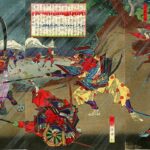
The story of Tokyo’s art begins in the marshes and riverbanks of a provincial backwater—a settlement known simply as Edo, long before it became the political heart of Japan. In its earliest centuries, what would become the capital was a fishing village of limited artistic reputation. But even then, the visual language of the area was already in motion, shaped by religious pilgrimage, feudal control, and a topography that invited both reverence and record. Edo’s pre-capital years are often overshadowed by the brilliance of its later ukiyo-e prints and modernist upheavals, but this period laid the groundwork for Tokyo’s distinctive fusion of nature, ritual, and image. It begins with painted scrolls, temple iconography, and maps of land both real and imagined.
The Sumida River Schools
The Sumida River, winding through what is now northeastern Tokyo, was more than a lifeline of commerce and transportation. It was a subject of early artistic expression, frequently depicted in painting and poetry. Before Edo came under direct control of the Tokugawa shogunate in the early 1600s, the region had already seen the influence of courtly art from Kyoto and religious commissions from Kamakura.
By the Kamakura period (1185–1333), the Tōkyō region had become strategically valuable. Religious centers such as Sensō-ji in Asakusa—founded in the 7th century—became pilgrimage destinations, which meant not just devotional activity, but also visual commemoration. Pilgrims would purchase or be gifted ema (votive paintings), woodblock talismans, and illustrated travel scrolls. These were early indicators of Edo’s future as a city of reproduced image culture.
Among the most compelling early works are anonymous scrolls and folding screens showing the Sumida River in various seasons—carrying small boats, cherry blossoms, and watchtowers. These were not “school” productions in the formal sense, but clusters of style and subject emerged among painters working in temple workshops or itinerantly across the Kantō region. Over time, a loose visual grammar of Edo’s geography developed—foreshadowing later masterworks by Hokusai and Hiroshige.
By the Muromachi period (1336–1573), regional leaders such as the Uesugi and Later Hōjō clans were patrons of both Buddhist art and landscape painting. Ink wash painting (sumi-e), introduced through Zen traditions, made its way into Edo, though Kyoto remained the cultural epicenter. But what distinguished early Edo work was its growing attention to cartographic specificity. The city was being drawn even before it truly existed.
Religious Iconography in Kamakura-Era Edo
Temples and shrines were the first art institutions of the Tokyo plain. The dominant styles of this era came from Buddhist visual culture—particularly esoteric schools such as Shingon and Tendai. Gilded statues of Fudō Myōō and scrolls of mandalas circulated from centers like Mount Kōya and Enryaku-ji, reaching outposts like the Edo area through monastic networks.
These works were not merely didactic or devotional—they established aesthetic expectations for scale, symmetry, and sensory intensity. The visual language of Japanese Buddhist art in this period emphasized power made visible: wrathful deities surrounded by flames, multi-armed bodhisattvas, and mountain mandalas mapped onto real landscapes. This fed directly into later depictions of Edo’s topography as spiritually charged and spatially meaningful.
Sensō-ji, still one of Tokyo’s most visited temples, functioned as both religious center and artistic patron. It commissioned hanging scrolls, votive paintings, and iconographic blueprints for devotional spaces. The temple’s association with the bodhisattva Kannon encouraged the production of feminine, compassionate imagery alongside more martial deities. Its collections—some of which survive in fragmentary form—reveal the diversity of Edo’s early visual sensibilities.
There was also a nascent tradition of ema painting unique to the region: small wooden tablets depicting stories of divine intervention in natural disasters. These objects served dual roles—thank-offerings and visual narratives—often created by anonymous folk artists. The city’s vulnerability to fire and flood made such works potent cultural artifacts, encoding local fears and hopes in stylized, dramatic forms.
Landscapes of Power
Maps in early Edo were not tools of navigation but instruments of perception. Land was drawn to show hierarchy, memory, and sacredness—qualities that would shape the emerging visual logic of the city. Before Edo was designated the shogunal seat, it appeared in provincial land surveys and pilgrim scrolls as a cluster of place-names—Asakusa, Ueno, Shinagawa—linked more by water routes than roads.
One of the most fascinating early cartographic images is the Edo Meisho Zue (“Illustrated Guide to Famous Places in Edo”), a multi-volume compendium first published in the late 18th century but based on much older oral and visual traditions. Its roots lie in medieval “famous places” poetry scrolls that identified spiritually or emotionally significant locations, often tied to imperial verse or courtly tales.
These premodern maps often collapsed time, showing historical and legendary scenes alongside the current landscape. A single view of the Sumida might show both the contemporary ferry and a legendary battle from the Heian period. This layered visual logic would become a hallmark of Edo’s later print culture and remains a key trait of Tokyo’s image-making today: the coexistence of multiple temporalities in one frame.
Such representations weren’t merely picturesque. They declared authority. Daimyo-sponsored temples used elaborate garden designs and symbolic plantings as visual claims to cultural status. Fortifications were drawn not just as military structures but as aesthetic forms, echoing the mountain shapes revered in Chinese landscape painting. Even in its most functional images, early Edo art was making a case for the city’s destiny.
A micro-narrative survives in a scroll from the early 1500s, showing a noble family from Kai Province approaching Edo by boat. The brushwork is simple, but the details are telling: a figure points toward what would become Nihonbashi; another shields their eyes from the sun, looking across a low skyline. The future capital is not yet there—but in the image, it is already beginning.
The Shogun’s Capital: The Aesthetic Regime of Edo
When Tokugawa Ieyasu established his military government in Edo in 1603, he did more than shift the seat of power from Kyoto—he initiated one of the most meticulously managed urban transformations in history. Over the course of just a few generations, the city was reshaped from a loosely organized riverine town into a capital of a million people, the largest in the world by the 18th century. This rapid political and infrastructural expansion had an equally dramatic effect on art. What emerged in Edo was not simply a new style or school, but an entire aesthetic regime—an integrated system of taste, production, and hierarchy that filtered through architecture, clothing, publishing, theatre, and daily objects. The Tokugawa era was not merely a period of peace; it was a period of immense visual regulation and creative response.
Ukiyo-e and the Merchant Class
At the core of Edo’s artistic dynamism stood the rise of the merchant class—a group with money but no formal power. Denied political influence under the rigid four-tiered Tokugawa caste system (samurai, farmers, artisans, merchants), these townspeople redirected their cultural energy into the world of ukiyo—the “floating world” of entertainment, pleasure, and aesthetic display. This world was both real and imaginary, situated in physical places like Yoshiwara (the licensed red-light district), Kabuki theatres, and tea houses, but also propagated through books, prints, and illustrated calendars.
The artform most associated with this class was ukiyo-e, or “pictures of the floating world.” At first, these were modest single-color woodblock prints, often depicting courtesans and actors. But by the late 18th century, nishiki-e (full-color prints) had emerged, achieving technical complexity and dazzling beauty. Artists like Suzuki Harunobu, Torii Kiyonaga, and later Utamaro and Sharaku elevated the medium into something far more than cheap decoration. Their work documented not only idealized beauty and popular figures, but also emerging fashions, urban moods, and coded social commentary.
These prints circulated widely and cheaply, sometimes sold in sets, other times pasted onto folding screens or collected in albums. In Edo, they were the first mass visual medium—precursors in many ways to both magazine illustration and advertising. More than court paintings or temple scrolls, they defined the visual consciousness of early modern Tokyo.
• A 1796 triptych by Kitagawa Utamaro shows a group of courtesans posing before a spring festival screen—each bearing the seasonal emblems of cherry, plum, and willow. These were not just aesthetic signifiers; they hinted at temporal roles in the social theater of the pleasure quarters.
• Actor prints by Sharaku—issued for less than a year—present Kabuki performers with such intensity of expression that contemporary viewers found them unsettling. Today, they are celebrated for their psychological immediacy.
• Landscape ukiyo-e evolved in parallel, particularly in the hands of Utagawa Hiroshige and Katsushika Hokusai, who used the medium to explore the expanding geography of Edo and its routes of escape, particularly via the Tōkaidō road to Kyoto.
The printing houses of Edo—privately run but strictly monitored—emerged as de facto art institutions. They controlled who was published, which themes were promoted, and how images were edited to conform to censorship laws. Yet within these constraints, artists found room for astonishing invention.
Kabuki and Costume Design
Edo’s visual culture was inseparable from performance. Kabuki theatre—originally developed in Kyoto—took on a distinctive life in Edo, where actors were treated as celebrities and their roles as archetypes of social fantasy. This was theatre as visual spectacle: elaborate sets, striking poses, stylized makeup, and above all, the costumes—flamboyant constructions of color, pattern, and symbolism.
Theatrical design was one of the great unsung arts of early modern Tokyo. Costume makers worked closely with actors and directors to create ensembles that not only signified character and class, but also incorporated seasonal themes, references to poems or legends, and visual puns. A robe might feature a wave pattern echoing a famous poem or a print motif from a known artist. Audiences prided themselves on recognizing such signs.
Actors themselves often contributed to these designs. The onnagata (male actors who played female roles) collaborated with designers to create feminized personas that exaggerated grace, refinement, or tragedy. Prints of these performances served as both souvenirs and trendsetters. A new costume onstage might inspire fashion among real women—or be satirized in parody prints the following week.
Kabuki also influenced painting and sculpture. Folding screens with theatrical scenes became popular among wealthy merchants. Some Buddhist temples even borrowed Kabuki aesthetics in festival decorations, recognizing the style’s popular hold on the urban imagination. In Edo, the boundary between sacred and profane was not impermeable—it was continually negotiated through art.
Unexpectedly, Kabuki theatre also functioned as a site of architectural innovation. Theatres were among the first buildings in Edo to experiment with retractable roofs, revolving stages, and audience-seating arrangements that resembled a panopticon—a structure reflecting the urban desire to see and be seen, to become both viewer and image.
Craft Guilds and Status Symbols
Alongside the image-based arts, Edo developed one of the most intricate craft economies in the world. Every item in a samurai household—from the tansu chest to the lacquered hairpin—was a product of an artisan guild, each with strict hierarchies, regional specialties, and visual codes. These were not humble objects but status items, deeply embedded in the politics of appearance.
In Edo society, clothing and accessories functioned as silent declarations of rank, restraint, or defiance. Samurai were expected to display frugality, yet the quality of a scabbard or the pattern of a kimono lining could signal lineage or loyalty. Merchants, forbidden from ostentation, responded with hidden luxuries—exquisite undergarments, finely dyed indigo textiles, or folding fans painted by well-known artists.
Three notable examples of Edo craft aesthetics:
- Edo-Kiriko glass: Introduced in the 1830s and refined by local craftsmen, this cut-glass technique became prized for its geometric elegance, often used in sake cups and household altars.
- Tsujigahana dyeing: A resist-dyeing method that produced subtle gradations of color on silk, associated with refined taste among women of the merchant elite.
- Makie lacquer: The high art of sprinkling gold powder onto wet lacquer to create shimmering surface designs. Edo workshops pushed the technique to ever greater precision, even on tiny inro medicine cases.
The control of these crafts was centralized through za guilds, which functioned like proto-industrial unions and artistic gatekeepers. They ensured standards, regulated prices, and limited access to tools and designs. At times, this created artistic stagnation—but it also produced a consistency and refinement that defined Edo’s aesthetic character.
Even architecture was subjected to aesthetic discipline. Rooflines were regulated, shop signs standardized, and color palettes restricted by class. And yet within these limits, beauty flourished. Like a haiku written in seventeen syllables, Edo art discovered vast expressive range within narrow boundaries.
The aesthetic regime of Edo was not merely about what could be made or shown. It was about what could be seen, by whom, and under what circumstances. This regime shaped a visual order so pervasive that its traces can still be felt in Tokyo’s streets, from the quiet severity of temple walls to the exuberant signage of contemporary Shibuya. The city, once a tool of governance, became a crucible of expression.
Print, Pleasure, and Protest: The Subversive Power of Edo Art
At first glance, the art of Edo appears to revel in surface: delicate courtesans glancing coyly from behind screens, actors in frozen poses, landscapes framed like stage sets. But beneath the stylization, the Tokugawa era’s visual culture concealed a network of subversion, eroticism, and coded dissent. The same woodblock technologies that mass-produced commercial beauty also enabled satire, philosophical inquiry, and veiled political critique. Artists learned to speak through masks—sometimes literally—developing a symbolic language that allowed viewers to read between the lines without ever breaking the rules. This was not resistance in the modern revolutionary sense, but a sustained, sophisticated negotiation with authority and decorum. Edo art, at its most brilliant, knew how to smuggle danger into elegance.
Erotica and Censorship
Perhaps no genre demonstrates this better than shunga—the erotic prints and paintings that flourished throughout the Edo period. Often dismissed in the West as mere pornography, shunga was, in its own time, a complex hybrid of humor, technical virtuosity, folklore, and sexual instruction. It was also immensely popular. Nearly every major ukiyo-e artist produced it: Hokusai, Utamaro, Eizan, even Hiroshige. The most famous example, Hokusai’s “Dream of the Fisherman’s Wife” (c. 1814), with its fantastical depiction of interspecies eroticism, has become an icon of both Japanese surrealism and the cultural contradictions of Edo.
The Tokugawa government oscillated between tolerating and suppressing such works. Officially, shunga violated the laws of moral rectitude; in practice, it was produced in enormous quantities and often gifted to newlywed couples as educational or auspicious objects. Bans were occasionally enforced—most severely in 1722, 1790, and during the Tenpō reforms of the 1840s—but these crackdowns tended to be short-lived and unevenly applied.
What makes shunga particularly fascinating is its merging of pleasure with visual sophistication. The compositions echo classical narrative scrolls, using flowing diagonals, overlapping textiles, and calligraphic flourishes. Characters often speak in humorous or ironic dialogue scrawled across the page, creating a theatrical, self-aware tone. Genitals are exaggerated, yes—but so too are gestures of affection, curiosity, even awkwardness. Many prints feature elderly couples, same-sex encounters, or mythological interludes, indicating a broader range of erotic imagination than one might expect.
The cultural function of shunga extended beyond titillation. It often parodied religious imagery or turned well-known literary scenes into erotic tableaux. A common format was the pastiche: reinterpreting scenes from The Tale of Genji or Noh drama in sexual terms. In this way, shunga served as both homage and deflation—injecting pleasure into what were otherwise elite narratives.
What survived was an aesthetic of ambivalence. Viewers were encouraged to enjoy, laugh, and decode—but never quite to trust what they saw.
Political Satire in Disguise
While overt political dissent was severely punished in Tokugawa Japan, visual art provided channels for subversive commentary, often disguised as humor or allegory. The artists of Edo developed a repertoire of signs, puns, and tropes that could signal discontent or critique without crossing the line into rebellion.
One of the most effective vehicles for this was the mitate, or visual parody. In this technique, artists depicted historical or legendary subjects using contemporary figures or settings, allowing viewers to infer pointed analogies. For example, a print might show a famous general from the Taiheiki epic represented by a Kabuki actor, his costume bearing the crest of a disliked shogunal official. A viewer in the know could read this as commentary on current corruption; a censor could see only historical fiction.
Landscape prints also carried covert messages. In Hiroshige’s famous “One Hundred Famous Views of Edo,” subtle shifts in weather, unusual framing, or human figures at odds with their surroundings can be read as meditations on change, loss, or even state surveillance. These weren’t outright protests but reflective interventions—using the safe subject of nature to express unease with urban transformation.
An especially rich example comes from Utagawa Kuniyoshi, whose prints of cats forming human scenes or fish arranged as warriors are celebrated for their wit. But many of these also referenced banned plays, political gossip, or clan rivalries. One print shows octopuses mimicking a shogunal procession, complete with parasols and palanquins—an unmistakable parody if one knew where to look.
The risk was not imaginary. Artists and publishers were fined, imprisoned, or forced to change careers. The 1842 Tenpō Reforms banned actor prints altogether, resulting in a brief but intense period of symbolic imagery: actors shown as birds, flowers, or landscape features. The coded language of Edo art became even more elaborate.
Three common techniques of visual deflection:
- Anthropomorphism: Using animals or objects to stand in for people, especially public figures.
- Wordplay: Titles or inscriptions that used homophones to disguise double meanings.
- Historical substitution: Referencing ancient stories to comment on contemporary issues.
These were not just tricks—they were forms of literacy. To engage fully with Edo prints required not only aesthetic appreciation but cultural fluency. The public became collaborators in reading against the grain.
The Rise of the Individual Artist
As the art world of Edo matured, another quiet revolution occurred: the emergence of the artist as an individual figure—named, branded, and celebrated. While earlier Japanese art had emphasized school lineages and anonymous craftsmanship, the Edo period saw artists cultivate personal styles and signatures that became part of their market identity.
Katsushika Hokusai, for example, changed his name more than 30 times over his career, each phase marking a new aesthetic experiment or public persona. His famous “Thirty-Six Views of Mount Fuji” was both a commercial venture and a philosophical project—elevating landscape from background to protagonist, and asserting his own vision over the classical conventions of Yamato-e or Chinese-derived ink painting.
Hiroshige’s late-career prints, often produced rapidly in response to popular demand, display an increasing abstraction of form—misty bridges, flattened space, sudden bursts of color. These weren’t just images of Edo—they were emotional renderings of urban mood.
This individuality extended to women artists as well, though they faced greater constraints. Katsushika Ōi, Hokusai’s daughter and assistant, is now recognized as a major talent in her own right. Her surviving works show extraordinary control of light, fabric, and expression—most notably in her intimate portraits of women reading or grooming, unmoored from conventional beauty types.
The cult of the artist even bled into the theatre. Actor prints frequently showed performers offstage, in private moments, or rehearsing—blurring the line between role and self. In a culture where roles were often inherited, Edo artists and actors alike asserted their personhood through mastery, experimentation, and visual voice.
By the 1850s, foreign visitors were astonished to find ordinary townspeople collecting art not only for decoration, but with critical discernment. One Dutch envoy wrote that in Edo, “the fisherman may know the name of the printmaker, and the seamstress the year of its issue.” Art had become both intimate and communal—a mirror in which the city saw and critiqued itself.
Cataclysm and Contact: Fire, Earthquake, and the Arrival of the West
Edo was a city in constant danger of being undone. Its material beauty—wooden theatres, paper screens, ink-drenched prints—was matched by its volatility. Fires, floods, and earthquakes were regular catastrophes, some so destructive they reshaped the entire city. Yet Edo never dissolved into chaos; it rebuilt, again and again, its resilience mirrored in its art. And when Western powers arrived in the 19th century, opening Japan by force to global exchange, the visual culture of Edo met the encounter with fascination, anxiety, and hybrid invention. The combination of internal cataclysm and external contact fractured the city’s aesthetic order, creating space for new styles, materials, and ideas. The old world didn’t vanish overnight, but it began to refract—and sometimes shatter—under foreign light.
The Great Fires of Edo
Of all the disasters Edo endured, fire was the most frequent and the most feared. Known as the “City of Fires” (hi no miyako), Edo burned dozens of times across its history. The most devastating was the Great Meireki Fire of 1657, which reportedly killed over 100,000 people and destroyed vast sections of the city, including the shogun’s castle and much of the Yoshiwara pleasure district.
But fire was not only an erasure—it was a recurring narrative. Each reconstruction brought architectural changes, urban re-zoning, and new artistic commissions. Temples were rebuilt with more open courtyards; theatres were redesigned to allow faster evacuation; neighborhoods were relocated or realigned to prevent future infernos.
Artists responded with a mix of realism and moralizing spectacle. Prints depicting fires often showed thick black clouds swallowing wooden towers, with terrified citizens fleeing in diagonal motion—an inversion of the static serenity found in typical ukiyo-e landscapes. Some woodblock artists specialized in such scenes, turning disaster into genre.
Beyond documentation, fires also altered aesthetic choices. Paintings and prints made after major conflagrations often emphasized themes of transience—burnt trees, ruined bridges, figures walking into mist. In this sense, the Buddhist idea of impermanence (mujo) took on practical urgency. Beauty had to be portable, perishable, reproducible.
Three immediate artistic effects of fire culture in Edo:
- Miniaturization: Increased popularity of netsuke, inro, and other small, wearable artworks that could be grabbed in a fire.
- Color symbolism: Use of fire-repelling colors (like indigo) in clothing and print design, believed to carry protective power.
- Theatrical framing: A tendency to dramatize destruction as visual spectacle, often borrowing from Kabuki conventions of crisis and resolution.
These disasters did not merely interrupt Edo’s cultural life—they shaped its emotional timbre. The city’s visual rhythm was built on interruption.
The Black Ships and the Brush
In 1853, four American warships appeared off the coast of Edo Bay, demanding trade under threat of bombardment. Commodore Matthew Perry’s “Black Ships” were the visible shock of Western imperialism, and their sudden appearance catalyzed one of the most turbulent transformations in Japanese history. The Tokugawa government, unable to maintain its policy of isolation, signed a series of unequal treaties that opened ports to foreign trade and ended nearly two centuries of controlled contact.
This geopolitical rupture had immediate visual consequences. Artists rushed to depict the Black Ships and their foreign crews—sometimes with fearful accuracy, more often with caricatured fascination. These images, known as Yokohama-e, portrayed Westerners with exaggerated features, unfamiliar postures, and strange instruments: telescopes, steam engines, umbrellas. They were both documentary and surreal, charting an encounter that felt like science fiction.
Printmakers like Utagawa Yoshitora and Utagawa Sadahide became pioneers of this genre. Their compositions mixed accurate technical detail—naval cannons, top hats, gas lamps—with fantasy elements, such as Westerners shown taming exotic beasts or communing with demons. It was a visual attempt to absorb the shock, to narrativize the intrusion.
Some of the most vivid images show:
- Western women walking dogs or playing pianos—domestic scenes rendered uncanny.
- Sailors drunkenly fighting in Yokohama—both feared and mocked.
- Comparative maps showing Western and Japanese cities, often with Edo proudly oversized.
These prints weren’t just about novelty. They were about boundaries: who could be drawn, how they could be represented, and what it meant to visualize the foreign. The West became a subject of art, but also a mirror for Japanese self-perception—at once curious and cautious, admiring and defensive.
Rangaku and the Fusion Eye
Even before Perry’s arrival, contact with Western science and art had trickled into Japan through limited Dutch trade at Nagasaki. This body of knowledge, known as Rangaku (“Dutch learning”), encompassed medicine, astronomy, botany, and visual techniques, particularly in perspective and anatomy.
Some Edo artists had already begun experimenting with Western-style shading, vanishing points, and realistic figure proportions. Shiba Kōkan, active in the late 18th century, was among the first to produce oil paintings and copperplate etchings in a hybrid European-Japanese style. His works, like his 1799 “View of Mimeguri Shrine,” combined aerial perspective with ukiyo-e composition, blending linear depth with flat color fields.
The result was neither European nor entirely Japanese. It was an unstable but fertile fusion—foreshadowing the modernism to come. In painting schools, particularly the Yōga (Western-style) movement, artists like Takahashi Yuichi and Kawakami Tōgai began studying foreign materials and techniques more systematically. They copied Dutch engravings, dissected imported anatomical models, and practiced oil painting in secret.
But this wasn’t a straightforward embrace. Traditionalists in the Nihonga (Japanese-style) camp pushed back, arguing for preservation and refinement of classical methods. The result was a new visual dialectic: East and West, ink and oil, brush and pen.
One telling moment came with the arrival of photography. Early Japanese photographers—often trained by Westerners—created portraits and landscapes that mimicked ukiyo-e compositions while employing cutting-edge technology. The first studios opened in Yokohama, but by the 1860s they had reached Edo, where samurai, geisha, and commoners alike sat for posed photographs that soon found their way into painted scrolls and printed albums.
What emerged from this period was not just aesthetic change but epistemological challenge. The camera, the sketchbook, and the microscope disrupted older hierarchies of seeing. The artist was no longer just a transmitter of beauty or morality, but an observer, interpreter, and translator of a widening world.
In these final decades of the Tokugawa era, Edo’s visual culture became a site of tension and transformation. Art became a field of negotiation—between destruction and invention, foreignness and belonging, image and information. The old city was burning down, but its embers sparked something new.
Meiji Modernity: Industry, Imperialism, and Institutional Art
The year 1868 marked the death of Edo and the birth of Tokyo—not only in name but in political structure, urban design, and artistic direction. With the Meiji Restoration, imperial rule was formally reinstated under Emperor Meiji, but the transformation went far beyond symbolism. Japan launched a rapid, state-driven program of modernization aimed at catching up with Western powers. In Tokyo, this meant tearing down feudal structures, importing foreign technologies, and establishing new systems for education, industry, and art. The era’s cultural policy was ambitious and often contradictory: it sought to “civilize” Japan in Western terms while defining and preserving a national identity. Tokyo’s visual culture became the battleground where these tensions played out. The aesthetic shifts of the Meiji period were not just stylistic—they were institutional, ideological, and industrial.
Art Schools and National Identity
One of the most significant acts of the Meiji government was the establishment of official art institutions. The Tokyo School of Fine Arts (Tōkyō Bijutsu Gakkō), founded in 1887 under the direction of Okakura Kakuzō, became the flagship of state-sanctioned artistic training. It was joined by the Tokyo School of Industrial Arts and the Tokyo School of Music, creating a triumvirate of elite education modeled partly on European academies but with a distinctly national mission.
Okakura, educated both in classical Japanese literature and English philosophy, walked a careful line between nationalism and cosmopolitanism. He advocated for the preservation and refinement of traditional Japanese painting (Nihonga) in the face of growing enthusiasm for Western techniques. His writings, particularly The Ideals of the East (1903), argued that Asia—not Europe—was the spiritual wellspring of civilization, and that Japan had a special role as its artistic guardian.
The result was a system that elevated Nihonga to official status, while also admitting the study of Yōga (Western-style painting) under controlled conditions. The distinction between these two tracks defined artistic discourse in Tokyo for decades.
Yet even within the Nihonga camp, modernity intruded. Artists like Yokoyama Taikan and Hishida Shunsō developed a “new Japanese style” that incorporated European techniques of shading, depth, and movement while retaining traditional materials like ink and silk. Their landscapes and portraits, misty and emotional, became visual emblems of Meiji ideology: modern, refined, and proudly national.
The tension between tradition and innovation also extended to crafts. Government-run exhibitions such as the Domestic Industrial Expositions (beginning in 1877) promoted lacquerware, ceramics, and textile design as both heritage and export product. In these shows, Meiji Japan displayed its aesthetic lineage not just for internal pride, but as evidence to Western visitors that it belonged among the civilized nations of the world.
Three structural features of Meiji institutional art:
- State patronage: Funding, curriculum, and recognition flowed through government channels, shaping both style and career paths.
- Dual tracks: Artists were expected to choose between Yōga and Nihonga, with little room for synthesis in official contexts.
- Public exhibition: Art moved from private appreciation to public display, reinforcing the nationalizing agenda.
Art, in other words, was no longer a matter of personal expression or commercial entertainment—it was a tool of policy.
Westernization and Its Discontents
Despite the official support for Nihonga, the pull of Western art grew stronger in Tokyo’s urban culture. Oil painting, realism, linear perspective, and academic portraiture became signs of sophistication, particularly among elite patrons and young artists seeking relevance in a rapidly changing world. The first great wave of Yōga artists studied under foreign instructors brought to Tokyo by the government, most notably the Italian painter Antonio Fontanesi and the American sculptor Vincenzo Ragusa.
These instructors taught students how to mix oil paints, construct human anatomy, and conceive of the canvas as a window into three-dimensional space. The novelty was exhilarating. Painters like Kuroda Seiki, who later studied in Paris and absorbed Impressionism, returned to Japan with a radical vision for art education. His “Reading” (1891) and “Lakeside” (1897) introduced plein-air light and the female nude to Japanese audiences—causing admiration, scandal, and debate.
For conservatives, such paintings threatened moral and cultural boundaries. For reformers, they signaled Japan’s rightful place in the modern world. Either way, Yōga became a lightning rod for discussion about identity.
Yet even as Western techniques were embraced, they were not adopted wholesale. Many artists hybridized their training—applying chiaroscuro to Buddhist themes, or using oil on silk. The binary between East and West began to blur in practice, if not in pedagogy.
Sculpture and architecture also reflected this synthesis. While Tokyo gained neoclassical government buildings and domed banks inspired by Paris and London, it also saw the invention of the Imperial Crown Style—a hybrid that combined Western structural techniques with traditional Japanese roofing and ornament. It was an aesthetic of authority, invented to reconcile imported modernity with invented tradition.
Among Tokyo’s visual elite, this period produced a strange duality: artists who dressed in Western suits, painted in oils, and traveled abroad—yet returned to build careers on their Japaneseness. Identity became a performed aesthetic, not an inherited given.
Expositions and Empire
The Meiji government understood that art could project power, both internally and internationally. Beginning with the Vienna World’s Fair of 1873, Japan became a regular participant in international expositions, using architecture, design, and painting to demonstrate its modernity and cultural depth. At the same time, domestic exhibitions promoted industrial arts and technical education as patriotic duties.
Tokyo’s role in these events was central. The National Industrial Exhibition of 1877, held in Ueno Park, featured not only engineering marvels but also displays of painting, sculpture, and applied arts. These exhibitions offered the public unprecedented access to elite art and were instrumental in cultivating a mass art audience.
They also reinforced imperial narratives. Art was used to depict Japan’s growing reach in Asia—through allegorical paintings, imperial portraits, and triumphalist designs. Folding screens showed Japanese soldiers bringing “civilization” to Taiwan; statues of emperors were erected in public squares. As the empire expanded, so did its iconography.
This led to the politicization of style. Nihonga became a way to assert cultural continuity, while Yōga was often used to signal global participation. Artists who traveled to the colonies—Korea, Taiwan, later Manchuria—created idealized images of “harmonious” rule, often glossing over violence or exploitation. The role of art as propaganda intensified.
One unexpected consequence of these exhibitions was the elevation of mingei (folk craft) as a category. Faced with the abstraction and alienation of modern painting, some curators began to valorize the handmade, the anonymous, and the rural. This was the seed of the mingei movement that would blossom in the Taishō era, but its roots lay in Meiji anxiety: the fear that something vital was being lost in the rush to progress.
By the early 20th century, Tokyo had become a city of galleries, academies, and exhibition halls. Its art was both tool and theater: a spectacle of national ambition and cultural doubt. The transition from Edo to Tokyo was not simply a political revolution—it was an aesthetic one, measured in brushstrokes and blueprints, scandals and salons.
Taishō Avant-Garde: The City and the New Self
From 1912 to 1926, Tokyo entered its Taishō phase, a short but astonishingly fertile period in which the city’s aesthetic sensibility began to fracture, diversify, and radicalize. The rigid binaries of Meiji—East versus West, tradition versus modernity—gave way to more fluid, experimental modes of expression. Japan’s imperial ambitions continued to grow, but domestically, the capital became a stage for self-invention and cultural dissent. Artists began turning inward, exploring subjectivity, psychology, and abstraction. The urban crowd, the café intellectual, the gender-nonconforming flâneur: these were new archetypes populating Tokyo’s visual field. While much of the city still functioned under official Meiji legacies, its cultural undercurrents were shifting rapidly. The art of the Taishō period reveals Tokyo as a city no longer merely imitating the West or preserving the past, but grappling with itself in real time.
Dada in Ginza
The Ginza district, once home to Western-style brick buildings erected in the wake of the 1872 fire, became the symbolic and actual heart of Tokyo’s avant-garde. By the 1910s, its streets were lined with cafés, bookstores, and galleries. The most influential of these, Nika-kai (The Second Section Society), broke away from the state-sponsored art salons to champion new movements in European modernism: Fauvism, Cubism, Expressionism. Tokyo’s intellectual elite—writers, critics, musicians—congregated in Ginza not just to consume new styles but to debate their meaning.
One of the most disruptive influences was Dada. Though Tokyo never produced a full-fledged Dada movement on the scale of Zurich or Paris, its ideas filtered quickly through imported journals, translated manifestos, and republished artworks. In 1920, the Mavo group, founded by Murayama Tomoyoshi and Yanase Masamu, declared war on bourgeois aesthetics. Inspired by Russian Constructivism and German Dada, Mavo staged public performances, published zines, and constructed anti-art objects. They built installations with found materials—tin, rope, broken glass—and torched traditional art in public protests.
Mavo’s most notorious moment came in 1923, when they glued a real alarm clock onto a painting and exhibited it under the title Construction of Time. The piece, now lost, became legendary not for its form but for its challenge: What is art, and who gets to define it? The Tokyo authorities shut down the show, citing obscenity and anarchist messaging.
But even outside radical circles, Dada’s shadow fell across mainstream art. Collage, photomontage, and absurdist typography appeared in advertisements, magazine covers, and architectural proposals. The city itself began to resemble a collage—layered, disjunctive, vibrating with new energies.
A few characteristic details from this moment:
- Art journals like Mizue and Hōsun introduced European modernism to Japanese readers alongside traditional brush painting and Buddhist sculpture.
- Café society portraits: Oil paintings and photographs began to depict artists, actresses, and dancers as self-consciously urban subjects, posed with cigarettes, radios, and jazz instruments.
- Typography as form: Designers treated kanji and katakana not just as letters but as visual elements, bending and breaking them into geometric abstraction.
Ginza during the Taishō period was not just a place—it was a mood: unstable, electric, performative.
Photomontage and Mass Print
Tokyo’s 1920s media landscape exploded with new print technologies and a public hungry for stimulation. Cheap magazines, illustrated novels, serialized manga, and advertising inserts formed a vast visual ecosystem, one that artists quickly infiltrated. Photomontage, in particular, became the bridge between avant-garde experimentation and mass consumption.
Japanese artists like Genzō Kitazawa and Masao Horino combined documentary photography with surreal or abstract elements, echoing the influence of El Lissitzky, Man Ray, and Moholy-Nagy. These works appeared not only in gallery spaces but in design journals, department store catalogues, and theatre programs. The fusion of text and image gave artists a new arena in which to construct meaning—and deconstruct authority.
Photomontage also fed into a broader interest in the machine aesthetic. Tokyo’s urban identity was increasingly defined by railways, telephones, and electric signage. Artists used montage to explore the emotional ambivalence of mechanization—celebrating speed and modernity while warning of fragmentation and alienation.
Masao Horino’s photographic book Camera, Eye, and Tokyo (1932) includes a now-famous image of a steel bridge framed as a symmetrical latticework, collapsing into abstraction. Another series, Documentary of Urban Shadows, captures schoolchildren under factory smokestacks—visions of innocence dwarfed by progress.
This visual rhetoric was echoed in graphic design. Posters for Mitsukoshi and Matsuzakaya department stores—some created by artists trained in oil painting—used flattened color fields, simplified silhouettes, and Constructivist diagonal lines. The modern Tokyo woman (or modan gaaru) became a recurring figure: bobbed hair, European shoes, eyes turned toward a horizon of consumption.
• A Mitsukoshi advertisement from 1926 shows a woman walking alone with a fur stole and a leather handbag. She is not looking at the viewer. Instead, she seems absorbed in a future of her own making.
• In Shinkenchiku, an architecture journal, photomontages proposed cities of glass towers, aerial walkways, and electric grids—visions that far exceeded the realities of Tokyo’s infrastructure.
• Children’s picture books like Kodomo no Kuni integrated Cubist composition and Bauhaus design into nursery rhyme illustrations, planting avant-garde aesthetics in the most quotidian spaces.
Print culture in Taishō Tokyo wasn’t a separate art world. It was the bloodstream of the city itself.
Women Artists and the Modern Body
One of the most profound shifts in Taishō visual culture was the emergence of women as both subjects and producers of art. While female figures had long dominated the erotic and decorative arts of Edo, they were rarely allowed authorial voice. Taishō Tokyo changed this, albeit unevenly.
Art schools began admitting women—slowly, and often with restrictions—and a handful of female painters, illustrators, and designers began to gain visibility. Among the most significant was Uemura Shōen, who blended Nihonga technique with portraits of self-possessed women, often depicted in moments of inwardness: playing instruments, reading, reflecting. Her work was acclaimed both for its refinement and for its quiet resistance to the ornamental passivity expected of female subjects.
At the same time, popular magazines like Fujin Gahō and Shufu no Tomo employed female illustrators to create images of modern domesticity. These were not revolutionary in content—images of shopping, sewing, or childrearing—but they were part of a visual shift: women representing women in public space.
And then there were the performers. Dancers like Baku Ishii and actresses like Sumako Matsui became muses for photographers and painters alike. Their bodies, disciplined by modern movement and freed from the kimono, became symbols of transformation. Some artists, like Takehisa Yumeji, fetishized this shift, painting thin, wide-eyed women in melancholic settings. Others, like Tsuneko Kumagai, painted self-portraits that challenged both aesthetic and gender conventions.
The body—especially the female body—became a contested site:
- Posture: Straight spines and angled hips suggested new physical freedoms but also new constraints.
- Clothing: The fusion of kimono and Western dress raised questions about authenticity, rebellion, and class.
- Gaze: Women began to look back—at the artist, at the mirror, at the city itself.
These shifts weren’t without backlash. Conservative critics derided the modan gaaru as decadent or rootless, and women artists faced persistent marginalization. Yet their images entered the city’s visual fabric, asserting that modernity was not only a matter of industry or technology, but of personal transformation.
Taishō Tokyo, with all its contradictions, marked a decisive pivot in Japanese art. It embraced chaos, courted ambiguity, and began to fracture the polished surfaces of Meiji’s order. The city’s artists no longer sought to represent the nation—they sought to represent themselves, and in doing so, discovered new ways to see.
From Rubble to Rebirth: Postwar Art and the Tokyo Olympics
The devastation of Tokyo at the end of World War II was total in a way few modern capitals have experienced. Between the firebombing campaigns of 1945 and the exhaustion of prolonged militarism, the city emerged from the conflict not merely defeated but physically gutted and morally uncertain. Nearly half its structures were destroyed, its population displaced, its government in foreign hands. But this void, paradoxically, allowed for a creative rebirth. In the decades that followed, Tokyo became one of the world’s most vibrant laboratories for new art—not in spite of its destruction, but because of it. From performance collectives in bombed-out lots to architectural utopias built atop ruins, the postwar city did not simply rebuild. It reimagined what art could be. And nowhere was this transformation more vividly displayed than in the run-up to the 1964 Tokyo Olympics, when Japan staged a spectacular reentry onto the world stage—through concrete, chrome, and color.
Zero Hour Aesthetics
The term zero hour—rei-dō in Japanese—came to symbolize the psychic and cultural state of the nation immediately following surrender in 1945. It implied not only an end but a beginning at point zero: a clearing of the slate. For Tokyo artists, this was not an abstract metaphor. Many had lost studios, archives, families. What remained was a cityscape of scorched foundations and open lots, strange in its emptiness and charged with possibility.
Into this vacuum stepped the Gutai Art Association, founded in Osaka in 1954 but profoundly influential in Tokyo’s emerging avant-garde. Though not strictly based in the capital, Gutai’s exhibitions and manifestos found fertile ground among Tokyo’s younger artists, who were looking to move beyond the European oil-painting tradition inherited through Meiji and Taishō institutions.
Gutai artists rejected the static object in favor of gesture, impermanence, and physical engagement. Kazuo Shiraga painted with his feet while swinging from ropes. Saburō Murakami leapt through paper screens, destroying his canvases as he created them. These performances weren’t just aesthetic provocations—they were philosophical acts. In a society grappling with trauma, they asked what could be made from action rather than memory, from movement rather than permanence.
Parallel to Gutai, the Mono-ha (“School of Things”) movement emerged in Tokyo by the late 1960s. Artists like Lee Ufan and Nobuo Sekine placed raw materials—stone, earth, glass—into minimally manipulated arrangements. Their works emphasized presence over illusion, relation over composition. In Mono-ha, art was not something to look at, but something to be among. This sensibility echoed a broader shift: away from representation, toward encounter.
• Phase—Mother Earth (1968), by Sekine, consisted of a massive cylinder of dug earth and its negative hole. The piece was both object and process, a monument to subtraction.
• In Tokyo, Mono-ha exhibitions often took place in unrenovated war-era buildings, where rusted beams and exposed concrete interacted with the “art” itself.
• Gutai’s influence was felt at the Tokyo Biennale of 1970, where performance, video, and installation overtook painting as the dominant modes.
What unified these divergent movements was a shared distrust of established systems—whether political, aesthetic, or material. The blank spaces of Tokyo’s postwar geography became, paradoxically, sites of liberation.
Architecture as National Metaphor
While the avant-garde explored the ephemeral, another realm of Tokyo’s postwar visual culture was doing the opposite: building the monumental. Architecture became a tool for national self-reinvention, blending engineering bravado with subtle allusions to Japanese tradition. No figure exemplified this more than Kenzō Tange.
Tange, trained in both modernist rationalism and classical Japanese proportion, was given the task of designing the Yoyogi National Gymnasium for the 1964 Olympics. His solution—swooping steel cables suspending a dramatic, tent-like roof—was as much a statement of intent as a functional venue. It combined the daring of Eero Saarinen with the resonance of Shinto shrine geometry.
Yoyogi was not an isolated project. The 1960s saw an explosion of Metabolist proposals: visionary architectural schemes by figures like Kisho Kurokawa and Arata Isozaki that imagined Tokyo as a living organism, constantly regenerating itself. Their designs often featured modular towers, plug-in capsules, and floating cities—proposals too complex or expensive to build, but immensely influential as aesthetic statements.
Three emblematic structures of this postwar moment:
- Nakagin Capsule Tower (1972) by Kurokawa: a high-rise of prefabricated pods, each designed to be replaceable and independent—a metaphor for urban adaptability.
- St. Mary’s Cathedral (1964) by Tange: a gleaming, winged form of stainless steel, uniting Catholic iconography with Zen spatial dynamics.
- Tokyo Metropolitan Government Building (1991) by Isozaki: conceived as both fortress and symbol, with split towers evoking a cathedral of bureaucracy.
Tokyo’s new buildings were not just places—they were images. Photographed for global magazines, printed on stamps, turned into models—they became a way for the world to see a different Japan: not feudal, not defeated, but futuristic.
This architectural rhetoric extended to infrastructure. The Tōkaidō Shinkansen (bullet train), completed in time for the Olympics, linked Tokyo to Osaka in record time and was touted as a triumph of precision and speed. Its streamlined form—metallic, aerodynamic, almost abstract—was an aesthetic as much as an engineering feat. The railway station became a gallery of movement; the city itself, a kinetic sculpture.
1964 and the New Image of Japan
The 1964 Tokyo Olympics were more than a sports event—they were a national exhibition, a visual and logistical performance of rebirth. For the first time, television broadcast the Games live around the world, offering an image of Tokyo not as a smoldering ruin, but as a modern, orderly metropolis. The city’s design—its signage, stadiums, uniforms, even its tickets—was crafted with the same care as its ceremonies.
Art director Masaru Katsumi and designer Yūsaku Kamekura created a minimalist, black-on-white Olympic logo: stark, symmetrical, universal. It was paired with a bright red circle—a direct reference to the Japanese flag, but also a subtle act of reclamation. Where once the Rising Sun had symbolized militarism, now it stood for global welcome.
The Olympic design language, from typefaces to transportation maps, pioneered the field of graphic identity. It merged Bauhaus clarity with Japanese restraint, influencing everything from airport signage to museum branding in the decades to come.
Three dimensions of the 1964 design ethos:
- Modularity: Posters and signage used repeating geometric motifs to create coherence across diverse media.
- Legibility: Emphasis on visual clarity regardless of language, anticipating Tokyo’s increasing global traffic.
- Soft power: Use of aesthetics to convey openness, competence, and peace.
Artists were enlisted as well. Painters and sculptors contributed works to Olympic-related exhibitions and installations, often blurring the line between fine art and urban design. Taro Okamoto’s massive mural The Myth of Tomorrow—conceived for a hotel complex—depicted a nuclear explosion rendered in primal brushstrokes. Though not completed until later, its spirit reflected the ambivalence beneath the surface celebration.
The Games succeeded. Japan’s economy soared. Tokyo’s population surged. And yet, the euphoria of 1964 carried an undertow. For many artists, the official narrative of recovery felt overly smooth, suspiciously coherent. They turned again to disruption, to ambiguity, to critique.
By the early 1970s, Tokyo’s art world was split: between institutions basking in international legitimacy, and radicals probing the unhealed wounds beneath the Olympic glow. The rubble had been cleared, but the memory remained. And in that space between image and history, Tokyo’s next artistic chapter would take shape.
Underground and Hypervisible: 1970s–1980s Tokyo
The decades following the 1964 Tokyo Olympics were marked by dramatic contradictions. On one hand, Japan entered a golden era of economic growth, consumer abundance, and global visibility. Tokyo became a metropolis of neon, mass transit, and rising skylines—a city whose image was broadcast in global media as the face of Asia’s modernity. On the other hand, beneath this surface shimmer, a darker and more volatile art scene took shape. In the wake of the 1970 Osaka Expo—a government-orchestrated spectacle of progress and technology—many artists rejected the rhetoric of optimism, turning instead to subcultures, political withdrawal, and radical experimentation. This was a period when Tokyo’s avant-garde moved into basements, alleyways, and abandoned buildings. It wasn’t invisibility they sought, but control over how they could be seen.
Art in the Shadow of Protest
The political ferment of the 1960s did not end with the Olympic torch. In fact, the late 1960s and early ’70s witnessed some of the most intense protest movements in postwar Japan. The most significant was the Anpo movement—mass demonstrations against the renewal of the U.S.-Japan Security Treaty in 1970, which cemented America’s military presence in the region. For many in Tokyo’s artistic vanguard, the failure to stop the treaty was a psychic rupture. It marked the end of faith in collective action, and a turn inward—toward introspection, ambiguity, and art as a form of refusal rather than revolution.
One of the clearest responses came from conceptual and performance artists who began withdrawing from institutional spaces. The collective Hi-Red Center, formed by Genpei Akasegawa, Natsuyuki Nakanishi, and Jirō Takamatsu, enacted “non-events” in public and private spaces—cleaning the streets of Ginza in white lab coats, sealing invitations in capsules of hair and wax, and staging invisible exhibitions. These acts weren’t meant to shock. They were intended to dislocate meaning, to point to the absurdity of a city obsessed with control, cleanliness, and surface decorum.
Jirō Takamatsu’s solo practice pushed this even further. His Shadow series—a suite of drawings, sculptures, and installations that depicted absent bodies only by their silhouette—became haunting metaphors for absence and surveillance. In one 1971 piece, he traced the shadow of a missing figure onto a white gallery wall, then left the room empty. The result was a work about presence by way of erasure.
Simultaneously, the Mono-ha artists (already active by the late 1960s) began moving their work into increasingly anti-art spaces. Their installations, made from raw materials like glass, stone, rope, and dirt, were presented in derelict warehouses, temple grounds, and even outdoors in Tokyo’s shrinking natural margins. Nobuo Sekine, Lee Ufan, and Kishio Suga asked what it meant to simply place rather than make—an act of stillness in a city rushing forward.
• Kishio Suga’s In the State of Equal Dimension (1973) placed wooden beams across a rubble-strewn floor in a way that made viewers uncertain whether they were encountering art or debris.
• Akasegawa’s Model 1,000 Yen Note Incident, in which he was prosecuted for printing realistic facsimiles of currency as art, became a cause célèbre about artistic freedom and state authority.
• Tatsumi Hijikata’s butoh dance, though rooted in performance, had a parallel impact on visual art: his white-painted, contorted body—performed in cramped, shadowy rooms—offered a counter-image to the clean, bright vision of Olympic Tokyo.
If the 1960s asked how art could change the world, the 1970s asked whether art could survive it.
Subculture as Aesthetic
While official museums and corporate galleries aligned themselves with modernism and national prestige, a parallel culture was growing in the cracks of the city. This was the world of Tokyo’s zoku—subcultures defined by fashion, music, and attitude more than ideology. These groups didn’t just live in Tokyo; they looked like Tokyo: loud, layered, fast, contradictory.
Punk arrived in Tokyo as both sonic and visual assault. Venues like Shinjuku’s Loft and Koenji’s 20,000V nurtured underground bands whose album art and posters borrowed heavily from collage, graffiti, and photocopied detritus. Artists associated with this scene—such as Tetsuya Ichimura and Tomoo Gokita—rejected clean surfaces in favor of abrasion, distortion, and bodily noise.
Manga, which had long coexisted with high art, took a radical turn in the hands of creators like Suehiro Maruo and Yoshiharu Tsuge. Their illustrated narratives featured grotesque bodies, urban malaise, and dreamlike disjunctions. The line between manga and visual art began to dissolve, especially as galleries started exhibiting original drawings and manga publishers employed avant-garde illustrators.
Harajuku, meanwhile, became an epicenter of youth-driven fashion that blurred costume, art, and urban intervention. The rise of gyaru, visual-kei, and Lolita substyles wasn’t merely sartorial. It was performative urban art, enacted daily on street corners and in shopping arcades. Photographers like Shoichi Aoki documented these evolving micro-aesthetics in magazines such as Fruits, creating a visual archive of Tokyo’s generational self-styling.
Three vectors of subcultural visuality:
- Deliberate excess: Layering of fabrics, symbols, references—more as defiance than style.
- Anatomy as medium: Tattoos, piercings, hair dye used as extensions of visual identity.
- Spatial disruption: Occupation of space not just physically but aesthetically—transforming Shibuya crossings and backstreets into galleries without walls.
Tokyo’s subcultures did not simply reflect the city—they authored alternative versions of it.
Corporate Patronage and the Bubble Economy
In the 1980s, Japan’s economic bubble reached delirious heights, and with it came unprecedented corporate investment in the arts. Tokyo’s skyline was transformed by postmodern towers, its museums expanded by foundation money, and its artists pulled—willingly or reluctantly—into systems of market visibility. The irony was sharp: a generation raised on anti-commercial rebellion now found itself featured in auction catalogs and sponsored biennials.
The Mori Art Museum, although founded in 2003, owes much of its existence to this period of corporate-led cultural planning. In the 1980s, companies like Seibu, PARCO, and Saison began hosting serious art exhibitions in department stores and private complexes. The Seibu Museum of Art, for instance, showed contemporary Japanese and international artists side by side, making no hard distinction between art and retail, gallery and brand.
Design became the language of luxury. Graphic artists like Ikko Tanaka and Eiko Ishioka brought modernist clarity and theatrical boldness to everything from fashion ads to Olympic posters. Their work blurred commerce and culture, turning Tokyo’s consumer spaces into aesthetic experiences.
Tatsuo Miyajima, active since the late 1980s, developed LED-based installations that visualized time through blinking numerical displays. These pieces were purchased by corporate collectors and installed in lobbies and offices—art not as ornament but as spatial mood. Another example, Hiroshi Sugimoto’s photographic series Seascapes and Theatres, found an international audience via Tokyo galleries funded by financial conglomerates.
The bubble made room for paradox:
- Art as asset: Works were purchased for investment rather than appreciation.
- Space as commodity: Galleries were opened not only in art districts, but in real estate developments and shopping malls.
- Visibility as value: To be seen—glossy, published, collectable—was itself the mark of artistic legitimacy.
Yet even within this slick environment, Tokyo’s artists often retained a note of critique. The gleaming surface became a mirror: dazzling, distorted, and not always flattering. As the decade ended and the bubble burst, those reflections would take on new weight.
By 1990, Tokyo stood between two mirrors: the underground’s dim, flickering image of withdrawal and rebellion, and the overlit showroom of corporate spectacle. Art was everywhere—but its meaning, its authority, and its future were all in question.
The Digital Turn: 1990s Media Art and the Technological Sublime
In the 1990s, Tokyo entered a phase of visual transformation that was neither strictly political nor purely aesthetic. It was technological. As Japan emerged from the collapse of its economic bubble and faced a “lost decade” of recession and introspection, Tokyo’s artists turned to digital media not only as a tool, but as a subject of inquiry. The city’s screens—once surfaces for advertising or spectacle—became portals into new modes of perception. Art embraced code, algorithm, and interface. The digital turn wasn’t simply about using computers; it was about asking what happens to the body, the image, and the city when mediation becomes total. And nowhere did this question manifest more forcefully than in Tokyo’s art of the 1990s, a decade suspended between the ruins of modernism and the glowing surfaces of a virtual sublime.
Postmodern Pastiche in Shibuya
Shibuya, with its scramble crossings, LED billboards, and cacophonous street noise, emerged in the 1990s as the visual epicenter of Tokyo’s postmodern imagination. No longer just a shopping district, Shibuya became an aesthetic in itself—defined by overload, fragmentation, and simulated glamour. It was here, amidst department stores and record shops, that the boundary between fine art and pop culture dissolved completely.
Takashi Murakami, arguably the most internationally recognized Japanese artist of his generation, crystallized this moment with the concept of “Superflat”—a theory and visual style that fused the flat planes of traditional ukiyo-e with the visual logic of anime, manga, and consumer branding. Superflat wasn’t merely an homage or critique; it was a diagram of Japanese culture after the collapse of grand narratives.
Murakami’s early works—acid-colored paintings of smiling flowers, mushroom clouds, and mutated cartoon characters—used cuteness (kawaii) as a rhetorical weapon. His character DOB, a round-eyed mouse-hybrid with a maniacal grin, was designed as a self-parody of the artist’s role in post-bubble Japan: a producer of commodity images both marketable and monstrous.
This was art that understood itself as product. Murakami collaborated with Louis Vuitton, produced limited-edition figurines, and staged exhibitions where the gift shop was as carefully curated as the gallery. Critics accused him of selling out; he replied that the distinction between high and low art had been obsolete for decades—and that Tokyo had simply recognized the fact earlier than the West.
Around him, a constellation of artists blurred pop culture and critical discourse:
- Yoshitomo Nara painted deceptively innocent children with weapons and vacant expressions, tapping into a latent tension between vulnerability and violence.
- Aya Takano, part of Murakami’s Kaikai Kiki collective, painted ethereal female figures in futuristic, weightless spaces—half-dream, half-cosmic eroticism.
- Mr., another Kaikai Kiki artist, created hypersexualized depictions of manga-style girls, provoking fierce debate about the boundaries of desire, exploitation, and self-image in digital Japan.
These artists did not emerge from nowhere. Their visual language was steeped in the logic of Tokyo’s consumer landscape—CD covers, video games, television idents. But in reframing those surfaces within gallery contexts, they asked how visual culture could remain critical even as it became omnipresent.
Superflat was not a style. It was a condition.
Net Art and Interactivity
While Superflat dominated Tokyo’s commercial galleries, another strain of digital art developed in less conspicuous venues: browser windows, code libraries, and experimental labs. In the 1990s, Japanese artists began to explore interactivity as the core of a new aesthetic logic—one that resisted the fixed image in favor of process, interface, and audience participation.
Ryoji Ikeda, trained as a composer, began producing visual installations that combined high-frequency sound, numerical data, and minimalist geometry. His 1999 work Matrix, installed at the ICC (NTT InterCommunication Center) in Tokyo, used rows of bright white lights, synchronized pulses, and granular digital noise to overwhelm the senses. It wasn’t something to look at—it was something to endure, a sensory flood that simulated immersion in raw information.
Another key figure, Toshio Iwai, worked at the intersection of video game design and media installation. His interactive piece Piano – As Image Media (1995), invited viewers to play a keyboard that triggered a projection of corresponding animations—a literal translation of gesture into light. For Iwai, interactivity wasn’t just novelty; it was a metaphor for contemporary subjectivity, fragmented and recomposed in real time.
Artists in this realm often worked in close dialogue with Japan’s consumer electronics industry. The ICC, funded by Nippon Telegraph and Telephone Corporation, provided residencies and exhibitions for media artists, and helped position Tokyo as a global center for digital experimentation. Here, art emerged from circuits and code rather than canvas and brush.
Three defining features of 1990s net art in Tokyo:
- Time-based forms: Art as duration, feedback loop, or evolving system.
- Non-object orientation: Works that existed temporarily, in digital space, or as user interaction.
- Hybrid authorship: Artists as coders, composers, engineers—blurring traditional disciplinary boundaries.
By the late 1990s, net art had moved from the margins to the syllabus. Universities, galleries, and tech companies began sponsoring digital art festivals. But even as institutions took note, the works themselves often resisted commodification. There was nothing to hang on a wall—only experiences to be logged, scripts to be run, impressions to be recalled.
In a city defined by constant flow—of people, light, data—this new aesthetic made perfect sense. Tokyo’s art no longer simply depicted the city; it behaved like it.
Designing the Future City
The digital revolution wasn’t limited to screens and networks. Tokyo’s architects and urbanists embraced new technologies as means to imagine—and in some cases build—the city of tomorrow. This didn’t mean turning away from Tokyo’s material reality. It meant reconfiguring that reality through sensors, algorithms, and speculative design.
Toyō Itō’s Tower of Winds (1986), though slightly predating the 1990s, became an icon of this shift. Covered in thousands of aluminum panels, the tower was equipped with sensors that responded to wind, noise, and light, producing constantly shifting color patterns. It was a building that reacted—a structure with mood, or at least syntax.
Other projects explored Tokyo’s tendency toward self-organization. The architect Arata Isozaki collaborated with artists and computer scientists to simulate urban growth patterns, treating the city not as a fixed plan but as an emergent system. These efforts culminated in hybrid exhibitions—part architecture, part speculative fiction—where virtual Tokyo unfolded across immersive screens.
The 1990s also witnessed the rise of media architecture: buildings designed to display information as part of their surface. The Shibuya QFRONT building, with its massive LED façade, and the Sony Building in Ginza, with its modular showroom and interactive displays, became prototypes for a city where walls could talk and lights could think.
In speculative and practical terms, Tokyo’s architecture now performed two tasks:
- Visualization: Making abstract forces—data, traffic, weather—visible and aesthetic.
- Adaptability: Buildings that could respond, morph, or simulate other forms, rejecting permanence as a virtue.
Artists were part of this shift. Daisuke Ishida’s sound installations transformed vacant lots into reactive fields. Interdisciplinary groups like Dumb Type, formed in Kyoto but active in Tokyo, staged performances and installations that combined surveillance footage, interactive projections, and live coding to critique technology’s pervasiveness.
For many, this wasn’t techno-utopianism. It was a confrontation with the limits of perception. What happens when the city becomes too fast, too dense, too mediated to grasp? The answer, for Tokyo’s artists, lay not in nostalgia or resistance, but in embracing complexity as a form.
By the end of the decade, Tokyo had become not just a city of images, but a city-as-image—a shifting matrix of screens, reflections, loops, and feedbacks. Its artists did not try to clarify this chaos. They learned to compose within it.
Earthquakes, Memory, and Contemporary Response
Tokyo is a city perpetually aware of what can’t be controlled. The land beneath it shifts. The skies occasionally blacken. Most of its historical buildings are reconstructions—replicas born from fire, war, or natural disaster. This geography of instability has profoundly shaped the city’s art, not only as subject but as medium, method, and ethic. Nowhere is this more starkly felt than in the wake of major earthquakes, especially the 2011 Tōhoku disaster. Though centered in the northeast, far from Tokyo’s core, the event triggered a profound reckoning across Japan’s cultural sphere. In Tokyo, artists responded with works that were quiet, searing, and often provisional. These were not declarations, but reckonings: explorations of loss, recovery, and the limits of representation itself. In a city where trauma often hides behind perfect infrastructure, art became a way to make absence visible.
3/11 and the Aesthetic of Rupture
On March 11, 2011, a magnitude 9.0 earthquake struck off the coast of Japan, triggering a massive tsunami and the meltdown of the Fukushima Daiichi nuclear power plant. While Tokyo escaped direct devastation, its proximity to the event and its central role in national discourse meant that the city’s artists were soon engaged—some reluctantly, some urgently—with the implications of the disaster.
The immediate responses were not monumental. There were no vast public sculptures or patriotic murals. Instead, Tokyo’s art scene turned to small, fragmented, often ephemeral gestures. Some artists collected debris. Others documented silence. A few created works from contaminated materials, inviting danger into the gallery.
One emblematic example is Chim↑Pom, a Tokyo-based collective known for their anarchic energy. Just days after the disaster, they created Real Times, an intervention that inserted the iconic “nuclear” symbol into Tokyo’s skyline by photographing the city’s buildings with a cloud of smoke rising behind them—referencing Hiroshima’s mushroom cloud and Fukushima’s reactor leaks in one stroke. It was a volatile image: part mourning, part accusation.
Another artist, Kōhei Nawa, responded with quiet abstraction. His work Foam (2013), a sculptural installation of frothing polyurethane, seemed to freeze a moment of transformation—solid, liquid, gas—unfixed and uncertain. It was not a literal reference to the tsunami, but a meditation on form undone.
Many Tokyo galleries shifted their programming entirely after 3/11. Some became centers for community response; others took on curatorial strategies grounded in listening, waiting, and witnessing. There was a sense that the usual metrics of success—innovation, spectacle, market value—had become irrelevant. What mattered now was attention.
• Art Tower Mito, while outside Tokyo, hosted exhibitions that deeply influenced the capital’s artists—such as Silent Echo, which explored the impossibility of adequate response.
• Maki Ueda used smell as her medium, recreating the scent of irradiated soil, then placing it in sealed glass vessels.
• Teppei Kaneuji’s Teenage Fan Club sculptures, cobbled together from discarded plastics and toy fragments, began to feel more like archaeological ruins than pop assemblage.
Tokyo’s artists did not claim to heal the wound. But they refused to ignore it.
Memory Museums and Trauma Aesthetics
The events of 3/11 also triggered a broader reexamination of how Tokyo—and Japan more widely—deals with memory. The city has no shortage of historical museums, but few that address trauma head-on. War, colonialism, environmental collapse—these have often been marginalized in official narratives. Contemporary artists responded by building counter-memories: installations, archives, and participatory works that invited viewers to remember not what was sanctioned, but what was unresolved.
Kenji Yanobe’s work stands at the uneasy intersection of spectacle and remembrance. His Sun Child (2011), a large, yellow-suited boy with a radiation meter in his chest, toured Japan as a symbol of ambiguous optimism. Though initially criticized for its perceived naiveté, it later gained resonance as a symbol of exposure: both literal and psychological.
Other artists focused on testimony. Tadasu Takamine staged installations based on recorded conversations with Fukushima evacuees, replaying their voices over hospital intercoms and abandoned radio signals. The audience did not view these works so much as enter them—immersed in sound, suspended between private confession and public record.
In Tokyo, the absence of a central disaster memorial has been echoed by a profusion of micro-commemorations:
- Temporary exhibitions held in vacant storefronts or transit stations, offering flash exhibitions of letters, drawings, and found objects from disaster zones.
- Participatory projects, such as Mapping the Invisible, where Tokyo residents placed pins on maps to mark places they had fled to—or from—after the quake.
- Digital archives, created by artists and coders, that tracked radiation, misinformation, and migration patterns through interactive visualizations.
These works do not offer closure. They disturb it. They point to the ways in which Tokyo’s surface of normalcy can obscure deep, unresolved dislocation.
The trauma aesthetic in post-3/11 Tokyo is not solemn or grand. It is intimate, residual, and often difficult to look at. Which is precisely why it matters.
Environmental Consciousness in Art
In the decade after the disaster, environmental themes surged in Tokyo’s contemporary art, not as green utopianism, but as confrontation: with toxicity, entropy, and human error. Artists asked how a city as technologically advanced as Tokyo could still be so vulnerable—so unprepared to protect itself from its own progress.
Rikuji Makabe, working with organic decay and reclaimed materials, built kinetic sculptures that decomposed visibly during exhibition. His Fungus Machine—a mechanical apparatus designed to grow mold in real time—turned the pristine white cube of the gallery into a microbial theatre.
Katsuhiko Hibino, best known for his exuberant painting and design work, began leading community-based art projects focused on coastal regeneration, working with fishermen, children, and displaced families to rebuild cultural as well as ecological structures. His Asatte Asagao Project, which involved planting morning glories as living sculptures, became a poetic form of slow resistance.
More pointed was Yuko Mohri, whose installations incorporated malfunctioning electronics, evaporating water, and tangled wiring. Her work I/O used magnetism, vibration, and chance operations to simulate systems that had broken down—elegant, futile machines mimicking collapsed infrastructure.
Tokyo’s artists were no longer just imagining the future. They were asking if it had already failed.
Three recurring strategies in this environmental turn:
- Material honesty: Using rust, soil, plastic, and organic decay not as metaphors, but as agents of meaning.
- Process visibility: Artworks that unfold, collapse, or evolve visibly over time—refusing the illusion of stability.
- Network awareness: Emphasizing interdependence between human, animal, machine, and weather system—without romanticism.
This was not the pastoralism of earlier nihonga landscapes. It was something grittier, more anxious, and more ethically charged.
In Tokyo, a city always threatened by its own acceleration, the post-3/11 art scene marked a pivot point: from futurism to fragility, from spectacle to sediment. The aesthetic of the earthquake is not heroic. It is cumulative. It doesn’t dazzle; it insists.
Tokyo as Global Art Capital: Institutions, Markets, and Biennials
By the early 21st century, Tokyo had completed a quiet transformation. No longer just a national cultural center or site of avant-garde experimentation, it had entered the circuits of global contemporary art. Galleries in Roppongi Hills vied for attention with those in London and New York. Tokyo-based artists were fixtures at international biennials. Auction houses, art fairs, and corporate collections reshaped the relationship between aesthetics and capital. But unlike cities that merely hosted the global scene, Tokyo absorbed it into its existing complexities. The result was a new kind of art capital—not defined by scale or spectacle alone, but by contradiction, simultaneity, and strategic opacity. In Tokyo, global art doesn’t dominate the city. It hides, gleams, and mutates within it.
The Rise of Roppongi Hills
When the Mori Art Museum opened atop the Mori Tower in 2003, it signaled a shift not just in Tokyo’s museum landscape, but in its urban logic. Situated in the hypermodern complex of Roppongi Hills—a vertical city of offices, residences, luxury stores, and corporate art collections—the museum was conceived as both cultural institution and economic catalyst. It offered a view of Mount Fuji from the sky deck and rotating exhibitions that ranged from Ai Weiwei to teamLab. It was art as lifestyle, experience, and commodity.
The Mori Art Museum’s founding director, David Elliott, had previously led institutions in Oxford and Stockholm. His programming reflected Tokyo’s new ambition: to become not just a site of production, but of global reception. Exhibitions blended Asian contemporary with Western postmodernism, always accompanied by sleek catalogs, bilingual texts, and Instagram-ready installations.
Corporate money had long shaped Tokyo’s art world—since at least the Seibu and Saison Foundation years of the 1980s—but the 2000s refined this model. Roppongi became the epicenter of a privatized cultural sphere, where art institutions were embedded within real estate ventures. The Art Triangle Roppongi—comprising the Mori Art Museum, the National Art Center Tokyo, and the Suntory Museum of Art—offered branded routes, ticket packages, and multilingual guided tours.
Yet even in this polished setting, unexpected works found space. The Mori hosted retrospectives of figures like Takashi Murakami that examined rather than celebrated his market dominance. It collaborated with scholars of urban studies and design theorists. Its architecture, by Richard Gluckman, emphasized circulation and transparency, creating spaces that could be both monumental and provisional.
Three features define the Roppongi cultural ecosystem:
- Corporate integration: Galleries, museums, and cafes co-exist within financial and real estate frameworks—blurring art, commerce, and leisure.
- Urban elevation: Institutions are housed not in public plazas, but in towers—art as ascent, both literal and symbolic.
- Strategic cosmopolitanism: Exhibitions emphasize cross-cultural dialogue, but carefully avoid political controversy or regional tension.
Roppongi Hills did not invent global art in Tokyo. But it consolidated its infrastructure—and monetized its presence.
Tokyo Gendai and the International Scene
The arrival of Tokyo Gendai—a contemporary art fair launched in the 2020s—marked a further step in Tokyo’s integration into the global market system. Held in the massive Pacifico Yokohama convention center but targeting Tokyo’s collectors and institutions, the fair positioned itself as Japan’s answer to Art Basel and Frieze.
Tokyo Gendai featured blue-chip galleries like Gagosian and Perrotin alongside Japanese powerhouses such as Taka Ishii Gallery and Blum & Poe. But unlike its Western counterparts, the fair placed strong emphasis on regional networks—bringing in galleries from Seoul, Taipei, Manila, and Jakarta. The result was a map of East and Southeast Asian art ecosystems, with Tokyo as an infrastructural hub.
The fair’s impact rippled outward. Independent galleries timed solo shows to coincide with Gendai; collectors from Singapore and Hong Kong extended their visits; Tokyo’s local scene, often described as insular, opened new pathways of exchange.
Yet skepticism lingered. Some artists and curators questioned whether Gendai served Tokyo’s creative community or simply its investor class. Others worried that the fair model, focused on sales and networking, would marginalize non-commercial practices and smaller collectives.
Still, the fair succeeded in one of Tokyo’s perpetual challenges: visibility. By anchoring itself in the region’s financial and logistical networks, Tokyo Gendai positioned the city not just as a source of talent, but as a market node.
Three broader consequences of Tokyo’s art-fair integration:
- Curatorial standardization: Emphasis on themes like “post-humanism,” “climate futures,” and “digital hybridity” that echo Western fair discourse.
- Market validation: Rising prices for Japanese artists previously seen as marginal or domestic-only.
- Event clustering: Concentration of satellite shows, panels, and parties around fair weekends—generating short-lived but high-intensity art moments.
Tokyo became not just a city with a fair. It became a fair-shaped city.
Artists as Curators, Spaces as Canvases
Even as Tokyo’s art world globalized, many of its most compelling energies remained off-grid. Artist-run spaces, apartment galleries, and collective studios persisted—not as resistance, but as a parallel operating system. These micro-scenes emphasized intimacy, ephemerality, and control over context. They also reflected a growing skepticism toward institutionalization.
XYZ collective, run out of a modest space in Setagaya, curated exhibitions that rejected gallery polish in favor of raw experimentation. Their shows might include malfunctioning projectors, collapsing sculptures, or works that existed only for the duration of a conversation. The artists weren’t interested in branding. They were interested in exchange.
3331 Arts Chiyoda, housed in a former junior high school, operated as a hybrid space: part residency, part gallery, part community center. Its programming spanned from experimental sound art to political zines, providing a counterweight to Roppongi’s gloss.
Perhaps the most iconic example of artist-as-curator is Koki Tanaka, who represented Japan at the 2013 Venice Biennale. His socially engaged installations, often involving groups performing collective tasks, emphasized process over product. One work had Tokyo residents cook together in silence; another recreated the act of a group walking through a disaster-struck neighborhood. His practice blurred the line between facilitation, documentation, and authorship.
Tokyo’s built environment facilitated this kind of art. The city’s density and zoning flexibility meant that small galleries could thrive in back alleys, above bars, or beneath train tracks. Pop-up exhibitions, curated walks, and “invisible” shows—announced by word-of-mouth—became part of the cultural vocabulary.
Three characteristics of Tokyo’s independent art scene:
- Spatial modesty: Preference for tight, low-cost venues that emphasize proximity over spectacle.
- Temporal intensity: Short exhibition runs, often just a few days, maximizing immediacy and dialogue.
- Curatorial fluidity: Artists curate each other; roles shift between maker, writer, documentarian, and host.
In a city where even major institutions can feel unmoored from their publics, these spaces offered something rarer: art not as product or position, but as relation.
By the 2020s, Tokyo had become a paradox: one of the most infrastructurally mature art cities in the world, and one of the least reliant on institutional validation. Its global presence was real—but so was its underground vitality. In Tokyo, art moves in many directions at once: upward into towers, outward into fairs, and inward into rooms so small they can only hold five people at a time. And all of it is the city.
Local Futures: Neighborhoods, Narratives, and the Fragmented City
For all its global reach and infrastructural polish, Tokyo remains at heart a city of neighborhoods—discrete, sometimes insular, always idiosyncratic. From the quiet alleyways of Koenji to the reclaimed industrial edges of Kōtō-ku, Tokyo’s art future is not being written solely in museums or biennials. It is being lived, daily, in the city’s fragmented spaces: pop-up galleries in narrow apartments, workshops held in converted storefronts, performances staged under elevated highways. These local scenes are not resistant to the global art world—they coexist with it. But they prioritize different values: intimacy over scale, continuity over visibility, shared memory over spectacle. In these micro-geographies, the art history of Tokyo loops back on itself—not in repetition, but in return. The city that has burned, rebuilt, technologized, and globalized still finds renewal in its smallest rooms.
Koenji, Kōtō, and the Micro-Gallery Boom
Koenji, a western Tokyo neighborhood long associated with punk music and vintage clothing, has in recent years become a hub for micro-galleries—spaces so compact they could be mistaken for residential kitchens or bike repair shops. These venues are often run by artists themselves, who curate tightly themed shows that last just a weekend or two, relying on foot traffic and word-of-mouth.
TAV Gallery, for example, operates in a narrow corridor space and programs exhibitions that often interrogate otaku culture, internet subcultures, and gender performance. One recent show consisted entirely of modified figurines, each transformed through hand-sculpting and digital manipulation into unsettling hybrids. Another featured live-streamed performance art conducted from a futon on the gallery floor, confronting both domesticity and voyeurism.
Kōtō, an eastern ward once dominated by warehouses and docks, has seen a quieter transformation. Here, reclaimed buildings now house community-centered art spaces like Art Lab Tokyo, which offers residencies, neighborhood archives, and exhibitions that often emerge from oral history interviews and site-specific research. One recent project, Estuary Studies, traced the memory of rivers now buried beneath concrete, combining photography, urban sound mapping, and local testimonies.
These local practices share several traits:
- Ecological attention: Many works respond to specific features of their neighborhoods—trees, train lines, demolished schools, forgotten shrines.
- Temporal layering: Artists don’t just show works—they stage investigations. Exhibitions often emerge after months of embedded presence.
- Anti-scalability: Success is measured not in attendance but in depth of encounter. An opening with ten visitors may be deemed a triumph if the conversation is rich.
What connects these micro-galleries is not a shared ideology but a shared rhythm: slow, recursive, neighborhood-bound. In a city famous for speed and scale, these scenes offer a different model—not reactionary, but recalibrated.
Art in the Everyday
One of the most notable developments in 21st-century Tokyo art has been the turn toward everyday materials, spaces, and gestures—not as metaphors, but as mediums. This is not simply minimalism or conceptualism by other means. It is a practice rooted in the city’s spatial density, cultural nuance, and rhythm of daily life.
Akira the Hustler, an artist and activist, stages performances and interventions that often resemble mundane tasks: cooking, walking, cleaning. But each action is situated with precision—in contested spaces, public transit, or sites of trauma. His 2017 project Toilet Poetry, which installed verses about grief and desire in public restrooms around Shinjuku, transformed one of the city’s most anonymous spaces into a site of fleeting intimacy.
In another register, Yoko Ono’s legacy has gained renewed attention in Tokyo’s younger art scenes, not just through major retrospectives but through grassroots re-enactments of her Instruction Pieces. Small groups gather in parks or empty apartments to “Listen to a sound the Earth makes” or “Draw a map to get lost.” These are not ironic. They are affectively serious, rituals of attention in a city of distraction.
Artists working in this idiom often foreground interaction over objecthood:
- Futoshi Miyagi’s Strangers in Tokyo combines walking tours with personal storytelling, leading participants through queer histories hidden in ordinary streets.
- Kubra Khademi’s temporary interventions in public spaces—like unannounced singing performances or altered signage—turn the familiar strange, opening up moments of shared disorientation.
- Natsuko Kiura creates tactile, paper-based installations in Tokyo’s commuter corridors, inviting hurried passersby to stop, fold, or mark a surface before moving on.
These works don’t strive to impress. They seek to register. They insist that art can be light, brief, and still profoundly moving. Tokyo, with its compressed architecture and layered timelines, lends itself to such fleeting intensities.
What emerges is a city not as backdrop, but as collaborator.
City as Palimpsest?
To call Tokyo a palimpsest is tempting. Its many pasts—erased, rewritten, buried, resurfaced—seem to echo the term’s metaphor: a document endlessly overwritten, still bearing traces of prior texts. But the metaphor fails in one key respect. A palimpsest implies coherence, a legible layering. Tokyo offers something stranger: a simultaneity of incompatible narratives that do not collapse into one another.
In some neighborhoods, Edo-period shrines sit next to glass towers. In others, postwar concrete blocks house VR arcades. Shitamachi (the traditional downtown) aesthetics survive in corner stores and tatami workshops, while just blocks away, AI startups work on image-recognition software trained on ukiyo-e.
Artists have responded not by reconciling these layers, but by inhabiting their friction.
Kohei Nawa’s PixCell sculptures, made by coating taxidermied animals in thousands of transparent glass beads, evoke this tension: history preserved, distorted, and re-presented through a digital logic. The animal is still visible—kind of. But it flickers, refracted, like memory itself in the age of algorithm.
Tabaimo’s animated installations often depict Tokyo interiors unraveling: walls bleed ink, furniture collapses into shadow, figures dissolve. These are not dystopias, exactly. They’re interior landscapes where historical residue leaks into the present.
Perhaps the most eloquent visual metaphor comes from Naoya Hatakeyama, whose photographic series Blast and Underground depict Tokyo’s infrastructural bones—tunnels, quarries, explosive demolitions. His images are surgical, serene, and devastating. They suggest that to understand Tokyo’s surface, one must look at its absences: what was dug, destroyed, buried.
Tokyo’s art future will not be centralized. There will be no dominant school, no singular movement. Instead, it will continue to radiate outward—through networks of rooms, routes, screens, and memories. Its strength lies in dispersion, in refusal to cohere. That is not a flaw. It is a form.
The city, like the art it fosters, is not a statement. It is a set of possibilities—unfolding, recomposing, and flickering at the edges of what can be seen.