When Yokohama opened to foreign trade in 1859, it did more than admit steamships and diplomats—it disrupted centuries of visual tradition with a sudden flood of unfamiliar faces, machines, and customs.
For over two hundred years, Japan’s artistic world had developed in relative seclusion. The Tokugawa shogunate’s policy of sakoku had largely sealed the country from outside influence, with only minimal contact allowed through tightly controlled trade outposts. Artists during this period worked within well-defined conventions, producing refined ink landscapes, scenes of everyday pleasure in the floating world, or richly decorative court paintings. Western techniques such as linear perspective, anatomical proportion, or oil painting were virtually absent, known only through imported books or a handful of Dutch curios.
The opening of Yokohama, however, shattered this long visual equilibrium. Situated just south of the shogunal capital of Edo (now Tokyo), the city was chosen as a designated treaty port—a place where foreign diplomats, merchants, and sailors could reside, trade, and travel. Almost overnight, its harbor filled with steamships, its streets with unfamiliar garments, and its shop windows with imported materials. For Japanese artists—particularly those working in the commercial woodblock print industry—this new subject matter was electrifying. And for the viewing public, it was irresistible.
A New Subject: Foreigners as Visual Material
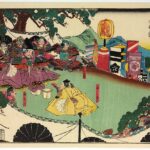
The earliest artistic response to Yokohama’s transformation came from the printmakers of Edo, who began producing colorful depictions of the foreigners now living and working just down the coast. These images, soon categorized under the name Yokohama-e (literally “Yokohama pictures”), were at once documents, caricatures, and speculative fantasies. They showed British naval officers on horseback, French women in crinolines, Chinese traders with long queues, and American schoolteachers reading books to their children. In many cases, the scenes were drawn from imagination or hearsay, and the details were often incorrect. But that hardly mattered to the audience. These were images of the unknown, made visible for the first time.
A typical print might show a group of Westerners in formal dress attending a dinner party, surrounded by unfamiliar furniture, tableware, and lighting. Another might depict a duel between two foreign men, interpreted through a kabuki-style lens of high drama and exaggerated motion. Still others featured new technologies: cameras, stoves, locomotives, gas lamps. Everything about the foreign presence in Yokohama—its appearance, behavior, tools—became material for rapid visual adaptation.
These prints sold well, not only for their novelty but for their ability to compress distant realities into graspable forms. For most Japanese at the time, Yokohama was not a place they would visit. It was a concept. And the artists who fed that concept with pictures were shaping how the country understood its changing place in the world.
Commerce, Curiosity, and Print Culture
The production of Yokohama-e was not driven by imperial policy or official commissions—it was propelled by popular interest and market demand. Print studios operated as businesses: publishers selected subjects based on public appetite, hired artists to design them, and employed teams of carvers and printers to produce the final works. The system had long functioned to provide images of kabuki actors, seasonal landscapes, and famous beauties. Now it turned its machinery toward the foreign.
Among the most prolific artists of this genre was Utagawa Sadahide, who produced hundreds of Yokohama-e over the span of two decades. His prints stood out for their attention to architectural detail and for their efforts to label and explain what was shown. In one work, he offers a panoramic view of the foreign settlement, complete with street names and flagpoles. In another, he diagrams the interior of a Western-style house, including a piano, fireplace, and hanging portrait—features previously unknown in Japanese domestic life.
While many of these images trafficked in exaggeration, they were not intended to mock. Rather, they reflected the same mixture of fascination and caution that defined the era itself. What kind of people were these? What did they eat, wear, believe? Yokohama-e answered these questions in color, line, and caption, providing a visual education for a nation undergoing forced contact with a world it had long kept at arm’s length.
At times, the speculative nature of these works led to amusing distortions. A print might show a foreign woman walking a lion on a leash, or a steamship festooned with impossible ornamentation. But there were also quieter works—studies of foreign families, street vendors, or shopkeepers—that suggest an emerging effort to see these strangers not just as curiosities but as inhabitants of a shared civic space.
The Port as a Studio of First Impressions
Yokohama’s physical landscape changed just as rapidly as its visual culture. New buildings went up in brick and stone. Streets were widened. Warehouses, telegraph lines, and watchtowers dotted the skyline. For artists, the city itself became a kind of outdoor studio—an environment filled with unfamiliar forms and devices. Artists began experimenting with visual techniques imported from the West, such as shading, cast shadows, and fixed-point perspective. Some studied illustrations from foreign books or copied photographic images that had begun to circulate in small numbers.
This technical cross-pollination yielded unexpected results. In one print, a foreign warship is rendered with remarkable attention to its cannons, smokestacks, and rigging—but floats on a stylized, almost abstract sea rendered in traditional Japanese wave patterns. In another, a group of foreign men are shown playing croquet, the field compressed in steep perspective while the figures retain the elongated elegance of Edo-period portraiture. These visual hybrids may not have satisfied academic standards, but they spoke vividly to a moment of improvisation, adaptation, and trial.
The artists of Yokohama were not trying to become European painters. Nor were they dismissing their own heritage. They were, in effect, feeling their way forward—using their existing tools to represent new realities. The result was not synthesis in any formal sense, but something looser and more immediate: a record of first impressions as they were filtered through brush, block, and ink.
Closing Reflection
By the late 1870s, the craze for Yokohama-e began to fade. Photography had become more affordable and accessible, offering a different kind of documentary accuracy. Western-style oil painting, promoted in government exhibitions and art schools, began to reshape elite artistic standards. But the prints left their mark. They had opened up a visual vocabulary for depicting change itself—new faces, new machines, new customs—and in doing so, they laid the groundwork for a modern Japanese art that could respond to the world beyond its shores.
Yokohama did not invent this transformation. But it accelerated it. On its docks, in its markets, and on the pages of its woodblock prints, the old pictorial order met the new realities of global trade, foreign presence, and technological surprise. What emerged was not just a new genre, but a new function for art: to help a society see what had never been seen before, and to make sense of it—quickly, vividly, and in full color.
Yokohama-e and the Art of First Contact
The Yokohama-e prints that flooded the market in the 1860s were not meant to last. Produced quickly, sold cheaply, and often discarded after viewing, they were rooted in the moment—timely rather than timeless. Yet for a brief span of years, they formed the visual frontier of Japan’s contact with the outside world, shaping how a nation imagined its foreign guests and, by extension, its own changing identity.
Unlike earlier ukiyo-e, which dealt in themes of entertainment, beauty, or legend, Yokohama-e introduced a new genre of subject: the foreign as fact. These prints were topical and observational, focused not on archetypes but on specific people, events, and technologies. At the same time, they retained the ukiyo-e visual language—bright pigments, flat perspective, and elegant line work—creating an uneasy but fascinating tension between old form and new content.
Woodblock Traditions Meet the Telegraph
The technology of woodblock printing in the 1860s remained essentially the same as it had been for centuries. Artists designed on paper, carvers etched blocks in reverse, and printers applied colors layer by layer. But the demands placed on that technology had changed. Yokohama-e had to respond to current events, often within days or weeks. This was visual journalism in an era before mass photography—handcrafted, but immediate.
Print publishers operated like newsrooms. A foreign delegation might arrive by ship, prompting a rush to produce images of its members. An unusual event—a duel, a horse race, a circus act—could lead to an entire print series. Some designs were based on rumor or secondhand sketches. Others involved direct observation, though from a respectful distance. Artists were rarely allowed into consulates or private homes, but they could sketch in the streets, observe through shop windows, or question local interpreters.
The telegraph itself, introduced to Japan in the 1860s, became both subject and metaphor. It appeared in prints as a symbol of communication and speed, and also echoed the function of the print industry itself: delivering information rapidly across distances. That the images were hand-printed did not make them less immediate. They were the fastest pictures the public could get, and for several years, they held a monopoly on the visual representation of modernity.
Exoticism in Reverse
In the European tradition, “Orientalist” painting often framed non-Western cultures as picturesque, decadent, or mysterious. Yokohama-e inverts this mechanism. Here, the Japanese artist becomes the observer of foreign peculiarities: excessive facial hair, voluminous skirts, pipe-smoking women, ballooning coats. The West, not the East, is rendered as spectacle.
Yet these prints did not simply parody or mock. Many show a kind of tentative admiration—toward Western science, engineering, and order. A widely circulated print by Utagawa Yoshitora shows a foreign hospital interior, with Western doctors tending to patients in neatly separated beds. The medical instruments are carefully labeled. Another depicts a steam train loaded with passengers and cargo, rolling across a bridge outside Yokohama. These were images of strength and discipline, seen from a respectful distance.
Of course, misunderstanding was common. Artists sometimes conflated nationalities, placing Dutch, British, and Russians in the same scenes without clear distinction. They invented customs that didn’t exist or misinterpreted gestures and clothing. One print shows a group of foreigners attending a Japanese-style tea ceremony, with hilariously confused expressions on their faces. Another shows a Western family eating sushi, apparently oblivious to their host’s etiquette. These works reveal not only gaps in knowledge but the productive energy of visual speculation.
Three recurring subjects stand out across many Yokohama-e:
- The circus or street performer, often shown juggling, balancing, or taming animals—images likely drawn from traveling foreign troupes.
- The schoolroom, in which Western teachers instruct foreign or Japanese children using blackboards and Western books.
- The promenade, where finely dressed foreign couples stroll arm-in-arm along harbor streets, often under imported gas lamps or moonlit skies.
Each of these settings allowed artists to stage interactions between cultures—some imagined, some real—but always treated as events worth picturing.
Short-Lived Genre, Long-Lasting Impact
By the late 1870s, Yokohama-e had largely disappeared from the market. Its decline was due to several converging factors. First, the novelty of foreigners began to fade. What had once seemed strange became more familiar. Second, the Meiji government began promoting Western-style oil painting and photography as official artistic media, shifting taste and institutional support away from woodblock prints. Third, the prints themselves were never built for permanence. They were ephemeral—light-sensitive, printed on cheap paper, sold in markets, and often discarded after use.
But their influence was more durable than their materials. Yokohama-e served as a training ground for artists learning how to picture the present. It taught printmakers to adapt quickly, to observe keenly, and to render technology and fashion as subjects in their own right. It also reshaped what Japanese audiences expected from visual media—not just beauty or narrative, but information.
The legacy of Yokohama-e can be seen in several later developments. In journalism, illustrated newspapers that emerged in the Meiji period borrowed their visual style and sense of urgency. In painting, the attention to modern dress and machinery carried over into genre scenes and even historical compositions. And in photography, which overtook printmaking by the 1880s, one can still detect the same compositional instincts: the frontal pose, the labeled objects, the small human figure dwarfed by new technology.
Most of all, Yokohama-e captured the bewildering early years of Japan’s entry into the global world system—not from the perspective of government elites or foreign diplomats, but from the crowded, competitive studios of working artists. Their images were imperfect, often speculative, but unflinching. They looked at the unfamiliar without flinching, and in doing so, trained a generation to do the same.
The Camera Arrives — Yokohama and Early Photography
When the camera first appeared in Japan, it arrived not as a curiosity but as a profession. In the early 1860s, just as Yokohama-e was reaching its height, photography began to take root in the very same city—Yokohama, the open port that had already become Japan’s gateway to foreign technology, commerce, and culture. Within a decade, the city transformed into the country’s most active photographic center, hosting foreign and Japanese studios alike, and exporting thousands of images each year to tourists, traders, and collectors.
Photography, in this context, was more than a new medium—it was a commercial system, a cultural encounter, and a visual regime. It promised precision where woodblock printing had offered interpretation, and it reshaped the relationship between image, subject, and viewer. Nowhere was this shift felt more quickly or more intensely than in Yokohama.
Hand-Colored Photographs and Tourist Markets
The earliest prominent photographer to establish himself in Yokohama was the Italian-born, British-naturalized Felice Beato. Arriving in 1863, Beato brought with him not only technical expertise but a commercial model. His studio offered posed portraits of foreigners and Japanese alike, along with landscape views and architectural studies. These photographs—often large-format albumen prints—were prized by diplomats, visiting officers, and wealthy tourists.
Beato’s success inspired others. Charles Wirgman, an illustrator for The Illustrated London News, collaborated with Beato for a time, while other foreign photographers—including Wilhelm Burger and Baron Raimund von Stillfried—set up their own shops nearby. They recognized the appetite among Western visitors for images of “exotic” Japan: temples, bridges, geisha, and street scenes, rendered not in brush and ink but in silver nitrate and paper.
To make these photographs more appealing to foreign eyes, studios developed the practice of hand-coloring. Teams of trained artisans—usually Japanese—applied watercolor or aniline dyes to the monochrome prints, carefully tinting kimonos, skies, and foliage. The effect was often striking, creating a hybrid object: half photograph, half painting. These prints sold in bound albums, sometimes containing fifty or more images, and were exported by the thousands.
Yet these were not ethnographic records in the modern sense. They were products shaped by expectation. Many of the scenes—peasants planting rice, blacksmiths at work, women pouring tea—were staged. Subjects wore selected clothing and adopted standardized poses. The aim was not realism but recognizability. Foreign clients wanted images that confirmed their idea of Japan, and Yokohama’s photographers, whatever their origin, supplied them.
Local Studios, Foreign Audiences
Japanese photographers quickly entered the field. Among the first and most successful was Shimooka Renjō, a former painter who trained in photography in Nagasaki before opening a studio in Yokohama in 1862. Renjō’s shop, located near the bustling Benten-dōri commercial district, attracted samurai, officials, and eventually ordinary townspeople. He offered portraits in a variety of formats and sizes, often mounted on painted backdrops or elaborate paper frames.
Renjō, like Beato, employed colorists and assistants, building his studio into a full-service image factory. He trained several apprentices, some of whom would go on to found important studios of their own. His work reflects a fusion of photographic formality with Japanese aesthetic sensitivity: clients are posed with care, dressed in their finest garments, sometimes holding fans, swords, or scrolls that hint at their roles or aspirations.
What made Yokohama unique was the mixed nature of its clientele and market. A single street might contain European-owned studios catering to foreigners, Japanese-run studios serving local customers, and hybrid shops doing both. The city’s foreign settlement—one of the few places in Japan where Japanese and non-Japanese could live and work in visible proximity—allowed for an unusually high degree of cultural interchange in photographic practice.
Studios competed fiercely. Some emphasized speed: portraits delivered within the day. Others focused on craftsmanship, touting imported lenses, German chemicals, or French paper stock. Advertising played a role as well. Trade cards, sample albums, and exhibition displays drew customers, and studios often kept glass plate negatives on file, allowing repeat orders years later. This industrial dimension of photography—reproducibility, branding, volume—was first honed in Yokohama before spreading elsewhere.
The Origins of Japanese Photographic Technique
Technically, early Yokohama photography was difficult work. Long exposures, fragile glass plates, and unreliable chemicals made each image a gamble. Lighting had to be controlled, poses held still for up to 30 seconds. And yet, despite these challenges, Yokohama’s photographers produced images of astonishing clarity and richness.
Several technical refinements were pioneered in the city. Japanese colorists developed distinctive styles of hand-tinting that balanced subtlety with vibrancy. Studios experimented with different mounting techniques, incorporating Japanese paper, silk, and decorative borders. Even the packaging—lacquered cases, embroidered folders, ornate album covers—became part of the photographic experience.
This attention to craft did not go unnoticed. By the 1880s, Yokohama was internationally recognized for the quality of its photo albums. Collectors in Europe and the United States prized them as both souvenirs and art objects. Exhibitions in Paris and Vienna included works by Yokohama-based studios, and some prints were even used in official diplomatic gifts.
The influence ran in both directions. Japanese photographers learned from Western techniques, but they also adapted them to local tastes. Portraits, for instance, often retained a sense of asymmetry and negative space familiar from Japanese painting. Landscapes emphasized mist, layered depth, and seasonal contrast—elements drawn not from photographic manuals, but from centuries of visual tradition.
Three characteristics defined Yokohama’s early photographic aesthetic:
- Softness in light and color, especially in hand-colored prints, which avoided harsh tonal contrasts.
- Emphasis on surface and texture, particularly in the rendering of textiles, hair, and patterned objects.
- Narrative staging, in which even static portraits suggested a moment—arrival, reflection, parting.
These traits persisted even as newer technologies emerged. Dry plate negatives, faster shutters, and gelatin prints gradually replaced the older methods, but the sensibility remained.
By the turn of the century, Yokohama had helped launch not only Japan’s photographic industry but its photographic eye—one attuned to precision, beauty, and the strange balance between documentation and display. In this respect, the city’s early photographers were not simply technicians. They were interpreters, responding to the visual demands of a changing nation and a watching world.
Schools and Institutions — Training the Modern Artist
The modernization of Japanese art was not only a matter of subject or style—it required new systems for producing artists themselves. Nowhere did this process unfold more visibly than in Yokohama. As a gateway for foreign influence and industrial development, the city became an early site for imported artistic methods, new educational models, and the institutional reshaping of what counted as art. In the span of just a few decades, Yokohama evolved from a port town of itinerant craftsmen to a regional center of formal instruction, technical design, and visual standardization.
This transformation was neither seamless nor uniform. The Meiji government’s push to modernize the country’s infrastructure and industry included a deliberate effort to realign art education with national goals. But much of the actual experimentation, improvisation, and early pedagogy took place in ports like Yokohama—where foreign instructors taught at commercial schools, private ateliers trained artists in Western media, and local craftsmen adjusted to a market that now demanded both utility and innovation.
Imported Models and Domestic Adaptation
Art instruction in the traditional Japanese setting was largely apprenticeship-based. A student studied under a master, learning by imitation, repetition, and gradual refinement. The skills passed down this way were subtle and specialized, embedded in particular schools or lineages. But by the 1870s, the Meiji state—eager to produce engineers, draftsmen, architects, and product designers—sought a faster, more systematic method. It looked to Europe.
Yokohama, with its ready access to foreign residents and international shipping, became an early testing ground. Foreign teachers, often employed by the government or hired privately, began offering instruction in Western drawing techniques. These classes emphasized perspective, geometry, and anatomical proportion—skills considered essential for technical fields like architecture, industrial design, and civil engineering.
One of the earliest such efforts was the establishment of drawing classes at the Yokohama School of Commerce (Yokohama Shōgyō Gakkō), which introduced French-style figure drawing and mechanical drafting. The goal was not to create oil painters or sculptors, but to develop a workforce visually literate enough to work in manufacturing, publishing, and applied arts. Still, the exposure to these techniques created a generation of artists who were comfortable working across media—moving between fine art, illustration, and design as needed.
The curriculum often mirrored European academy models: copying from plaster casts, shading forms, drawing still-lifes, and producing measured plans. Yet Japanese students brought their own habits and assumptions to these exercises. Even as they sketched in charcoal and graphite, they retained a sensitivity to line, empty space, and tonal restraint—remnants of the brushwork traditions they had grown up with.
Drawing, Design, and Industry
As Japan’s export economy expanded, visual skill became an industrial asset. Decorative objects—lacquerware, textiles, ceramics—needed patterns. Packaging required lettering and labels. Trade exhibitions demanded posters and printed materials. Art was no longer just a courtly or spiritual practice; it became part of a functioning economy. Yokohama played a key role in training the people who could supply that need.
Private design studios and commercial workshops flourished in the city. Some were affiliated with manufacturers; others were independent enterprises offering lessons in “Western-style painting” (yōga), lithography, or copperplate engraving. Students might spend the morning drafting designs for a porcelain workshop and the afternoon sketching scenes for a postcard company. This versatility was not optional. The visual demands of modern life—newspapers, manuals, advertisements, technical drawings—required practitioners who could work fast, accurately, and across styles.
One important influence during this period was the Tokyo School of Fine Arts (founded 1887), which, while based in the capital, shaped the instructional models adopted in Yokohama and other major cities. The school emphasized a division between traditional Japanese-style painting (nihonga) and Western-style (yōga), a split that would dominate debates about artistic identity for decades. Yokohama’s studios, however, tended to blur this line. They were practical rather than doctrinal. A single artist might work in sumi ink one day and oil the next—depending on the client.
Three types of visual training stood out in Yokohama’s expanding art scene:
- Technical drawing, taught to prepare students for roles in engineering and manufacturing.
- Decorative design, focused on export-oriented crafts, including textile patterning and ceramic ornamentation.
- Pictorial illustration, used in commercial publishing, packaging, and advertising.
Together, these formed a constellation of practical skills that supported both economic and aesthetic innovation. The city’s artists became not just image-makers, but visual technicians—able to apply their skills wherever needed.
The Formation of Artistic Authority
The emergence of formal training also redefined what it meant to be an “artist.” In the Tokugawa period, artistic status depended on lineage, court association, or affiliation with a recognized school. But the Meiji reforms introduced new categories: student, graduate, certified teacher. Yokohama’s role in this shift was foundational. The city’s early studios and foreign instructors helped normalize the idea that art could be taught in classrooms, assessed through examinations, and rewarded with credentials.
This process brought legitimacy, but also hierarchy. Institutions decided which styles and skills were considered advanced. Exhibitions organized by the government or civic groups awarded medals, set standards, and divided genres. Artists with formal training found themselves at an advantage in a competitive and increasingly bureaucratic field. Meanwhile, traditional craftsmen—though still active—were often recast as “folk” or “decorative” producers, their work reclassified along lines imported from European museum categories.
Yet not all institutional influence came from above. Local art societies, formed in Yokohama from the 1880s onward, played a crucial role in shaping taste and providing exhibition space. These groups, often organized around former students or workshop colleagues, held regular salons, offered critiques, and developed their own teaching networks. They became alternatives to state-run institutions, allowing younger or more unconventional artists to find audiences and training outside official channels.
By 1900, the outlines of Yokohama’s art education system were clear. Formal instruction had replaced most informal apprenticeship. Studios had professionalized. Craft had become design. The artist was now both creator and worker—trained in observation, capable of draftsmanship, and increasingly defined by schooling rather than background.
What began as a port of exchange had, within a generation, become a place of instruction. Yokohama’s contribution to Japanese art history is not only visible in its prints or photographs, but in the very way artists were trained to see: precisely, purposefully, and with one eye always turned toward a changing world.
The 1923 Earthquake — Destruction and Artistic Consequence
At precisely 11:58 a.m. on September 1st, 1923, the earth beneath Yokohama ruptured. In less than a minute, much of the city was reduced to ash, rubble, and twisted metal. The Great Kantō Earthquake, registering an estimated magnitude of 7.9, killed over 140,000 people across the region and left Yokohama—a city of merchants, studios, publishers, and schools—effectively flattened. Its harbor boiled with fire. Its downtown was gone. Its art scene, like its infrastructure, had to be rebuilt from almost nothing.
The physical destruction was total. But its cultural and artistic consequences were more complex. In the years that followed, the disaster would trigger a wave of reconstruction, provoke a reassessment of what cultural memory should look like, and plant the seeds for a new kind of urban modernism. Artists responded not just by recording the ruins, but by redefining the kind of city Yokohama might become—and what role art might play in that transformation.
Lost Archives and Cracked Canvases
Before the earthquake, Yokohama had developed a dense artistic ecosystem: photographers’ studios, printmakers, design workshops, art schools, commercial publishers, and exhibition spaces. Much of this was concentrated in areas like Kannai and Bashamichi—districts that were among the hardest hit. Stone buildings crumbled. Wood-frame houses collapsed and caught fire. In many cases, what the earthquake did not destroy outright, the fires finished.
The loss of primary material was staggering. Thousands of glass negatives stored in basements and cabinets shattered from falling beams or exploded in the heat. Print inventories vanished. Personal libraries, sketchbooks, portfolios, and archives were destroyed in minutes. Even artists who survived the quake often lost their life’s work. Some studios, like that of Ogawa Kazumasa—the pioneering photographer and printer—were reduced to scorched ruins. Others disappeared entirely, with no records of their location or contents ever recovered.
This devastation was more than a matter of lost objects. It ruptured a generational chain. Students who had trained under masters no longer had access to their examples. Publishers could not reissue popular illustrated books or commercial prints. Private art collections, many of them held by foreign residents, were either destroyed or hastily sold during the chaotic months that followed. What had been a vibrant, if eclectic, art scene was reduced to scattered fragments.
Yet amid the wreckage, artists began to record. Some sketched what they saw as they walked the streets—twisted girders, collapsed towers, bodies laid out in schoolyards. Others painted from memory in the days that followed. A few photographers managed to document the ruins with salvaged equipment, capturing the eerie stillness of a port city that had lost its form but not its presence.
Artists Respond to Catastrophe
The first wave of artistic response was immediate and visceral. Local newspapers commissioned illustrations of the destruction. Publishers, operating out of Tokyo, requested scenes of the disaster for news pamphlets and albums. These works, while commercial, also served as memorials—visual testimonies of a moment too large for words alone. Artists who had previously worked on advertisements or decorative panels now found themselves drawing collapsed buildings, burned-out trolleys, or mass cremations in the outskirts.
One of the most haunting images to survive from this period is a charcoal drawing by the painter Kiyokata Kaburaki, showing a woman crouching beside the remnants of a wooden home, her face obscured. Nothing remains of the house but a blackened beam and scattered embers. There is no narrative, no moral framing—only the moment, rendered with quiet, almost unbearable clarity.
Other artists took a longer view. In the years that followed, painters and architects began to engage with the earthquake as a cultural rupture, not just a geological one. For some, it marked the end of Meiji-era romanticism—the final blow to a city that had once promised the harmonious blending of tradition and modernity. For others, it became a call to reinvention: to design a new Yokohama that would be stronger, bolder, more forward-looking.
Three artistic shifts emerged in the decade following the quake:
- An increased interest in urban realism, as painters and printmakers turned to documentary-style depictions of street life, construction sites, and working-class subjects.
- A surge in architectural drawing and design, with visual artists contributing to reconstruction plans, advertisements, and building campaigns.
- The rise of memorial art, including woodblock series, illustrated books, and commemorative prints that depicted the disaster in personal or symbolic terms.
These changes reflected not just artistic choices, but survival strategies. Artists needed work. The city needed to see itself again. And so, drawing became a form of rebuilding—line by line, canvas by canvas.
Reconstruction and the Modernist Imprint
In the years after the earthquake, Yokohama underwent a massive reconstruction effort, led by city officials, foreign advisors, and private developers. New zoning laws were introduced. Roads were widened. Brick and timber were replaced with steel and concrete. This new Yokohama was more linear, more industrial, and more vertical—its skyline increasingly shaped by smokestacks, warehouses, and reinforced structures.
Artists were deeply involved in this reconstruction. Architects such as Antonin Raymond brought early modernist ideas into the city’s design, influencing how buildings looked and how space was used. Painters documented the construction process, while designers and illustrators created promotional materials for new housing projects, civic buildings, and infrastructure developments.
The city also saw a shift in its artistic institutions. Several new art societies and exhibition halls opened during the reconstruction years, offering platforms for younger artists influenced by European modernism. The rigid divide between traditional nihonga and Western-style yōga painting began to soften, as artists collaborated across styles and disciplines. Photography, which had suffered heavily in the disaster, reemerged as a tool not only for portraiture but for documenting modern life and progress.
In the 1930s, a number of artists began to explore the contrast between old and new Yokohama: shrines and cranes, fishing boats and steamships, street vendors beside electrical poles. Their work captures the unease of a city rebuilt but not yet reconciled with its past—a place where memory and industry shared the same streets, uneasily but undeniably.
The Great Kantō Earthquake did not end Yokohama’s artistic life. It interrupted it, shattered it, and forced it to begin again on unfamiliar terms. What emerged in the wake of that devastation was not a return to what had been lost, but a recalibration of what could be built: art not as ornament or afterthought, but as part of the structure of recovery itself.
The Interwar Years — Cosmopolitanism and Control
Between the end of the earthquake’s immediate aftermath and the rise of wartime restrictions in the late 1930s, Yokohama entered a complex and often contradictory phase in its cultural life. Rebuilt in concrete and ambition, the city tried to reassert its place as an international port—welcoming foreign ships, commercial interests, and artistic influences—while also navigating a growing climate of state surveillance, ideological pressure, and cultural standardization.
The artists who worked in Yokohama during this interwar period did so in a city of mirrors: reflecting foreign styles but under domestic scrutiny, practicing experimental techniques under the quiet pressure of conformity. Some embraced the new internationalism with enthusiasm. Others worked quietly at the margins, aware that boundaries—both political and artistic—were narrowing.
Western Techniques, Japanese Subjects
In the 1920s and early 1930s, a new generation of artists emerged in Yokohama trained in Western-style oil painting (yōga) but often grounded in Japanese materials or subject matter. These painters had studied in Tokyo, Kyoto, and occasionally abroad. When they returned to Yokohama, they brought with them techniques adapted from French, German, and Italian schools: chiaroscuro modeling, fixed-point perspective, and compositional balance borrowed from academic realism or early modernist abstraction.
Yet what they painted was rarely Parisian or allegorical. Yokohama artists tended to focus on the urban environment—harbors, cranes, street vendors, and modern interiors. Some works document the rise of the working class: dockhands carrying crates, factory girls on break, or aging rickshaw drivers waiting under gas lamps. Others explored more introspective scenes: a quiet room, a child with a toy, a contemplative self-portrait.
This was not decorative art. It was observational, precise, and usually serious. What these artists offered was a visual record of an industrial port still haunted by the memory of disaster, still caught between cultures, and still unsure of its identity.
One notable painter, Nakamura Tetsuya (active 1920s–30s), specialized in scenes of factory yards and train stations. His muted palette and rigid geometry gave his canvases a sense of weight and distance—less like snapshots, more like monuments to ordinary labor. Another figure, Suda Chieko, painted interiors of mixed cultural signals: tatami mats under gas chandeliers, paper screens beside imported furniture. Her work reflected the double consciousness of the time—a Japan eager to modernize but rooted in its own textures and rhythms.
Yokohama, by its nature, resisted uniformity. It was too open, too practical, too mixed. Even so, the pressures of national identity and cultural coherence were growing, and artists increasingly had to account for them.
Art Societies and Competition Culture
During the interwar years, Japan’s exhibition system expanded rapidly. State-sponsored salons such as the Imperial Art Exhibition (Teiten) and regional competitions became crucial gatekeepers of artistic success. Yokohama artists participated in both national and local contests, submitting works in multiple genres—oil, ink, watercolor, and sculpture.
But while these exhibitions offered visibility, they also imposed hierarchy. Jurors favored certain themes: loyalty, harmony, and technical excellence. Painters of urban life sometimes found their work marginalized in favor of nostalgic landscapes or patriotic historical scenes. Even when accepted, their works were often confined to lesser-known sections of exhibition halls or omitted from official catalogues.
To counter this, several Yokohama-based art societies formed during the 1920s. These were independent groups, often run by artists themselves, that held annual or semi-annual exhibitions, taught informal classes, and circulated newsletters. Some of the more prominent included the Yokohama Bijutsukai (Yokohama Art Association), Seirōsha, and Gendai Bijutsu Kyōkai (Contemporary Art Society).
These groups functioned as protective zones. Artists could exhibit work without ideological filtering, experiment with media, and critique each other in open forums. In some cases, they invited foreign consuls or visiting European painters to view their exhibitions—an echo of Yokohama’s 19th-century port cosmopolitanism. Yet their influence remained limited. The central government’s cultural apparatus—centered in Tokyo—maintained final authority over national exposure and recognition.
Three typical features of these local societies defined their approach:
- Shared workshops, where artists of varying skill levels practiced together and critiqued each other’s work in-person.
- Joint exhibitions, often held in rented halls, department stores, or even disused factories, allowing for a wider range of styles and content.
- Printed circulars, which included essays, reproduction prints, and exhibition reviews—serving as informal art criticism outside the capital.
These modest institutions kept alive a culture of independent experimentation, even as broader political conditions grew more restrictive.
Urban Studios and Private Patrons
Yokohama’s artists worked in conditions shaped by both proximity and distance. Close to Tokyo, but not controlled by it. Surrounded by global traffic, but often confined to small studios or repurposed buildings. Many artists maintained modest rooms in rebuilt neighborhoods like Noge, Yamashita-chō, or Motomachi—spaces carved from post-earthquake construction, outfitted with canvas racks, paint boxes, and sometimes small darkrooms.
Private patronage played a major role. Yokohama’s merchant families and ship-owning firms occasionally sponsored artists directly—commissioning portraits, supporting exhibitions, or funding print runs. Some of these patrons had studied abroad or maintained business ties in London, San Francisco, or Shanghai. Their tastes were eclectic. They valued technique over ideology, and they expected their commissioned work to reflect both tradition and competence.
A few studios thrived on teaching. Some artists opened private schools, teaching small groups in Western oil technique, perspective drawing, or preparatory sketching. Others taught at design schools, preparing students for careers in advertising or publishing. This blend of artistry and pedagogy sustained a generation of working artists who, though rarely celebrated in national discourse, maintained a professional and civic presence.
The interwar period in Yokohama was a time of balance—between innovation and caution, visibility and retreat. Art was still practiced, still taught, and still shown. But the frame had narrowed. The shadows of ideology lengthened. And by the late 1930s, the government’s control over cultural production had begun to harden.
Yokohama’s artists, once at the frontier of contact and experimentation, now found themselves working in an atmosphere that was at once open to global aesthetics and closed to political ambiguity. The city remained visually alert—but its gaze had grown more guarded.
War and the Postwar City
By the late 1930s, Yokohama was no longer simply a port city—it was a militarized node in Japan’s wartime infrastructure. Its shipyards, warehouses, and transport networks were folded into the machinery of the Pacific War, and its visual culture was pressed into service along with everything else. Art became propaganda, or silence. Censorship, conscription, and surveillance extinguished much of the independent artistic activity that had survived the interwar years. By 1945, Allied bombing had flattened the city once again, and with it, much of the physical residue of its artistic life.
Yet as in 1923, destruction did not mean disappearance. In the early postwar years, Yokohama became a zone of improvisation—raw, unstable, and visually strange. Under American occupation, the city’s cultural economy rebooted in unlikely places: black markets, photography studios, repurposed barracks. Artists returned—or emerged anew—not with manifestos, but with practical questions: what could be painted, sold, documented, or remembered in a city half rebuilt and half occupied?
Loss, Displacement, and Improvised Practice
The final years of the war brought censorship so complete that even privately circulated drawings were monitored. Artists were expected to produce works that supported national unity, military valor, or rural idealism. Anything abstract, foreign-influenced, or socially critical became suspect. Yokohama’s artists, many already marginal within the Tokyo-dominated art world, had few options. Some complied, producing landscapes or innocuous still lifes. Others stopped exhibiting altogether, retreating into private sketching or workshop teaching.
Meanwhile, the city’s infrastructure was increasingly redirected toward war. Factories converted to munitions production. Schools were commandeered for logistics. Paper, canvas, and pigments became scarce or unavailable. By 1944, Yokohama was a target. Between May and August 1945, Allied air raids destroyed nearly half the city, including many remaining art studios, homes, and institutions.
Those who survived often found themselves displaced, their neighborhoods gone. The disruption was not only material. Networks of students, patrons, critics, and peers were scattered. Exhibitions were canceled. Galleries collapsed or vanished. Even for those who continued to paint or draw, there was no frame—no audience, no market, no reason beyond compulsion.
And yet, in the ruins, practice resumed. Artists sketched the devastation, the refugee camps, the makeshift shelters. Some turned to drawing as a form of private record-keeping: a burnt tree, a flooded cellar, a man carrying scrap wood under a U.S. flag. These early postwar drawings and photographs, many now lost or stored in family archives, form a ghost archive of Yokohama’s cultural survival.
Studios Near the Bases
With the arrival of American occupation forces in late 1945, Yokohama became a key logistics base for U.S. operations in Japan. Warehouses were converted into barracks and administrative centers. Port facilities buzzed with troop movement and supply chains. But alongside this military presence came a kind of unintentional cultural exchange.
American soldiers and officers, some bored, some genuinely curious, began to visit local shops, buy art, and commission portraits or souvenirs. Artists adapted. They set up small studios near the bases—in Naka-ku, Honmoku, and Motomachi—offering portraits, signs, and customized calligraphy. These were not avant-garde works. They were transactional: ink drawings of geisha, watercolor landscapes of Mt. Fuji, caricatures in the American style. But they kept brushes moving.
Some photographers returned to work too. Studio portraits of mixed families—Japanese women and their American husbands or boyfriends—became a distinct postwar genre. Other photographers took street scenes, documenting the unusual coexistence of Japanese rebuilding and American military life. A street might feature a Japanese grocer, a Coca-Cola sign, a row of Quonset huts, and a jeep parked beside a bicycle.
A few artists—more independent, more ambitious—sought patrons among American civilians stationed in Japan as teachers, journalists, or administrators. These foreigners sometimes supported small exhibitions, bought local paintings, or helped publish sketchbooks and portfolios that could not have been produced under Japan’s wartime regime.
Three notable aspects defined the Yokohama art scene of the late 1940s:
- Work created for sale rather than exhibition, often produced quickly and in formats suited to foreign consumption—postcards, fans, portraits.
- Hybrid iconography, mixing Japanese motifs with Western formats, such as geisha in oil paint or sumo wrestlers rendered in pastel.
- Provisional space, with exhibitions held in tea shops, storefronts, or even on sidewalks.
There was little ideology—just necessity and adaptation.
Murals, Posters, and Commission Work
Public art returned not through galleries but through infrastructure. American occupation authorities commissioned murals, posters, and signage from local artists. These works appeared in schools, bases, hospitals, and public offices. The messages were often vague but hopeful: reconstruction, cooperation, hygiene, modernity. Japanese artists were hired for their skill, not their symbolism. Payment was prompt. The subject matter was simple. And the works, though rarely preserved, helped sustain livelihoods.
Meanwhile, a small group of artists and architects began participating in early reconstruction projects. Their contributions were less visible than those of engineers, but no less real. They designed typography for public signage. They painted decorative panels in waiting rooms. They helped layout small libraries or community spaces sponsored by the occupation government.
Printmakers also reemerged. With access to cheap paper and small presses, some began producing limited-run books or print series—often modest in scale, sometimes distributed through local bookstores or art collectives. These works marked the quiet return of idea-driven art: not quite protest, not propaganda, but reflection.
By the end of the 1940s, Yokohama’s artistic community had returned to life, though in altered form. Gone were the formal salons and established galleries. In their place stood flea-market exhibitions, base-side studios, and private gatherings in cramped apartments. The work was varied, inconsistent, but vital—proof that the city’s visual culture, while battered, had not been extinguished.
Art in wartime Yokohama was a matter of hiding or compliance. Art in postwar Yokohama was a matter of scraping together the means to continue. And yet, from that provisional ground, something new began to stir—not a revival of the old, but the slow birth of a modernity shaped not by imported ideals or state doctrine, but by survival.
1950s–1970s — Experiment and Rebuilding
In the two decades following the end of the American occupation, Yokohama’s art world underwent a transformation that was quiet, local, and far more inventive than its modest public profile would suggest. While Tokyo attracted the spotlight—home to national museums, universities, and the avant-garde’s more theatrical displays—Yokohama became a testing ground for artists who worked without fanfare: building collectives, staging site-specific actions, and experimenting with media that fell outside institutional frameworks. It was not a movement in the conventional sense. It was something looser: a zone of experimentation formed in the interstices of reconstruction.
During this period, Yokohama saw the rise of independent studios, experimental exhibitions, documentary photographers, and informal networks that refused to conform to the dominant styles of either traditional Japanese painting (nihonga) or state-sanctioned Western realism (yōga). These artists were not necessarily anti-academic. They were simply indifferent to prestige. Theirs was a practice rooted in material conditions—cheap rent, abandoned spaces, shared tools—and driven by a quiet defiance of central control.
Makeshift Galleries and Experimental Groups
In the 1950s, Yokohama remained economically fragile but spatially rich. The scars of war and occupation left behind vacant lots, underused buildings, and unclaimed zones near the waterfront. Artists took advantage. Warehouses, schoolrooms, and even disused bathhouses became temporary galleries. Exhibitions were often held without official backing, sometimes advertised only by word of mouth or hand-drawn flyers. What they lacked in visibility, they made up for in urgency.
One such group was the Yokohama Bijutsu Dōkōkai (Yokohama Art Circle), an informal collective of painters, printmakers, and poets who mounted yearly exhibitions in non-traditional venues during the late 1950s and early ’60s. Their work ranged from abstract expressionist canvases to assemblage and early performance documentation. They were not interested in promoting a school or style. Instead, they treated the act of exhibiting itself as a form of resistance to stagnation.
Another initiative, the Benten Club, took shape in the early 1970s as a rotating salon of younger artists influenced by the international conceptual art movement. They staged ephemeral interventions in the urban landscape—chalk drawings on dock walls, photographic installations in abandoned train cars, or sound performances staged under expressway ramps. These works rarely survived. They weren’t meant to. What mattered was presence, risk, and immediacy.
These groups functioned with three core principles:
- No permanent venue, allowing flexibility and freedom from institutional oversight.
- Shared authorship, with many works created collaboratively or without fixed attribution.
- Urban engagement, treating Yokohama’s changing landscape not as backdrop but as medium.
Such principles positioned Yokohama’s postwar experimental artists at odds with the market, but deeply embedded in the life of the city itself.
Photography Clubs and Documentary Work
While painters explored abstraction and installation, photographers in Yokohama pursued a different kind of inquiry: the systematic recording of a city in transition. Throughout the 1960s and early ’70s, local photography clubs flourished, some tied to camera manufacturers, others to community centers. These were not hobbyist groups, though some began that way. They developed into a serious visual archive of postwar urban life—factories, working-class neighborhoods, dockworkers, train stations, street festivals, and the layered life of the port.
One of the most prolific figures was Kuwabara Kineo, a Tokyo-born photographer who spent significant time in Yokohama during the 1950s. His images—grainy, low-contrast, and tightly composed—capture the city in quiet flux: a boy playing beside a rusted hull; a woman walking past an imported washing machine; American soldiers drinking beer under paper lanterns. These are not grand images. They are precise, human, and strangely tender.
Later, photographers like Moriyama Daidō passed through Yokohama briefly, absorbing its textures into their broader photographic vocabulary: pavement, neon, waste, gesture. But the city’s real visual memory during this period belonged to lesser-known locals whose work was often shared only within clubs or printed in small editions. Their photographs, now increasingly valued by scholars, formed a parallel canon—one that looked not for art history’s big moments, but for the overlooked residue of daily life.
Photography in Yokohama during this period was marked by:
- Horizontal attention, focusing not on towering icons but on everyday scenes and marginal spaces.
- Material modesty, using inexpensive cameras, low-grade paper, and simple formats.
- Archival instinct, a desire to document rather than dramatize.
These images did not seek to mythologize the city. They sought to understand it—piece by piece, frame by frame.
Sculpture, Steel, and Urban Edges
Alongside painting and photography, sculpture became a crucial but underrecognized part of Yokohama’s postwar experimentation. With scrap metal readily available from shipyards and industrial sites, a number of artists began producing large welded works—some installed temporarily in open spaces, others quietly left behind in parks, alleys, or harbor lots.
One of the key figures in this movement was Okamoto Tadashi, who in the 1960s created a series of untitled steel assemblages using materials salvaged from defunct cranes and maritime equipment. His works were geometric but weathered—forms that resisted monumental grandeur in favor of quiet force. He rarely exhibited formally. Instead, he preferred to place works outdoors, where they would rust, shift, and be seen by accident rather than design.
Public response was mixed. Some sculptures were mistaken for construction debris. Others were quietly removed by municipal crews. But among fellow artists, Okamoto and his peers were regarded as essential: sculptors who treated the city as both studio and collaborator.
By the mid-1970s, a few official programs began to engage with this informal energy. The city sponsored small-scale public art projects in conjunction with port redevelopment. A few artists were invited to participate in planning discussions for waterfront renewal. But even as Yokohama began to formalize its cultural policies, the postwar generation of improvisers continued to operate just beyond reach—more comfortable in the unclaimed zones than on curated platforms.
What emerged in Yokohama from the 1950s to the 1970s was not a movement, manifesto, or unified school. It was a pattern of survival and innovation shaped by necessity, collaboration, and spatial freedom. These artists had little interest in fame, less still in ideology. What they had was the city—open, unfinished, and still full of edges.
The Yokohama Museum of Art and Public Collections
When the Yokohama Museum of Art opened its doors in 1989, it marked a turning point in the city’s cultural self-definition. For over a century, Yokohama had been a site of artistic activity—lively, experimental, international—but it lacked a major civic institution to consolidate, preserve, and project that legacy. The museum was built not just to exhibit art, but to establish a new visual identity for the city: one that was modern, ambitious, and no longer peripheral to Japan’s national cultural map.
Situated near the redeveloped Minato Mirai waterfront, the museum was conceived as both symbol and instrument. It embodied a confidence Yokohama had not shown since before the 1923 earthquake. And it signaled that the city, long defined by trade, war, and improvisation, would now invest in memory, collection, and prestige.
A Museum for a Port City
The decision to build a major municipal art museum in the 1980s was not inevitable. Yokohama, while large and economically significant, had long been overshadowed by Tokyo in terms of cultural infrastructure. The idea gained traction in the 1970s, as the city government pursued broader urban redevelopment, particularly in the Minato Mirai 21 district—a project aimed at transforming old industrial land into a modern commercial and cultural hub. The museum was envisioned as an anchor: a structure that would attract visitors, signal seriousness, and offer a public face for the city’s artistic life.
The building itself, designed by architect Kenzo Tange, is monumental but austere. Its wide entrance plaza, long axial gallery, and soaring atrium speak the language of international modernism filtered through a Japanese sensibility of symmetry and scale. Inside, the space is divided into a main exhibition hall, several smaller galleries, a spacious reading room, and an archive. It is not ornate. It is designed for clarity.
From the outset, the museum’s mission was not limited to Japanese painting. Its scope included modern and contemporary art from Europe, North America, and Asia, with an emphasis on visual connections between Japan and the outside world. This cosmopolitan mandate reflected the city’s history. After all, Yokohama was where many foreign influences had first arrived; it made sense for the museum to address art as a form of exchange as much as heritage.
From Oil Paint to Video Installation
The early acquisitions strategy at the Yokohama Museum of Art was broad and forward-looking. While the collection includes significant works by Japanese painters—such as Kishida Ryūsei, Fujita Tsuguharu, and Yokoyama Taikan—it also features major international figures like Constantin Brâncuși, Paul Klee, Max Ernst, and Marcel Duchamp. The goal was not encyclopedic coverage, but dialogue: to present Japanese and non-Japanese artists as participants in a shared, if uneven, history of modernity.
Photography received particular emphasis. Given Yokohama’s foundational role in the history of Japanese photography, the museum collected extensively in this medium—both 19th-century hand-colored prints by Felice Beato and contemporary works by figures such as Moriyama Daidō and Miyako Ishiuchi. The result is a photography collection unmatched by many national institutions.
Contemporary art, especially in experimental media, also found space. Installations, video works, and large-scale conceptual pieces—once shown only in temporary or independent venues—were now part of the museum’s permanent narrative. Artists such as Shigeo Anzai, Tatsuo Miyajima, and Yasumasa Morimura were featured in rotating exhibitions, connecting the city’s avant-garde traditions to newer global currents.
Three key themes shaped the museum’s collection and programming:
- Transnational modernism, emphasizing the circulation of styles, ideas, and materials across borders rather than isolated national schools.
- Port-city aesthetics, exploring how Yokohama’s maritime identity—trade, migration, industry—influenced its visual culture.
- Medium as history, with photography and installation art treated not as novelties but as central forms in the modern tradition.
This framework gave the museum coherence without rigidity. It allowed for historical retrospectives, experimental commissions, and thematic group shows to coexist.
Building a Civic Collection
Beyond its exhibitions, the Yokohama Museum of Art has played a critical role in building a civic memory. Through acquisitions, archives, and education programs, it has gathered work by artists long active in the city but underrepresented in major institutions. These include documentary photographers, commercial illustrators, and lesser-known painters who contributed to Yokohama’s local visual landscape across the 20th century.
The museum also sponsors research initiatives. Its archives contain rare books, exhibition catalogues, and personal papers that scholars use to reconstruct Japan’s modern art history—not just the canonical narratives centered in Tokyo and Kyoto, but the regional variations that give the national story its real texture.
Public engagement has been central from the beginning. The museum’s education wing offers workshops for children and adults, artist talks, lectures, and film screenings. In doing so, it has fostered a broader visual literacy in the city and cultivated a public for art that extends beyond the specialized elite.
At times, the museum has also functioned as a site of negotiation. Debates over acquisition policy, the role of foreign art in a Japanese institution, or the inclusion of politically sensitive works have occasionally surfaced. But the institution’s leadership has generally maintained a commitment to intellectual seriousness and artistic freedom—rare qualities in a public museum under local government jurisdiction.
By the end of the 1990s, the Yokohama Museum of Art had established itself not just as a building or a collection, but as a cultural presence. It gave form and continuity to a city whose artistic life had often been defined by improvisation. And in doing so, it gave Yokohama something it had lacked since the 19th century: a permanent place for its visual history to be gathered, considered, and seen.
Waterfront Renewal and Site-Specific Art
The history of art in Yokohama has always been inseparable from the physical contours of the city—its docks, canals, bridges, and open expanses of reclaimed land. In the late 20th century, as shipping activity shifted and heavy industry declined, these spaces were no longer strictly utilitarian. They became available, for the first time in decades, as open ground—not for trade or transit, but for culture. What followed was not simply a beautification campaign, but a sustained effort to make the city’s geography part of its artistic life again.
This was not art placed into a finished environment. It was art made with the site, made for the site, and in some cases, made to disappear within it. Temporary installations, architectural experiments, and civic sculptures all reshaped the relationship between Yokohama’s waterfront and its inhabitants. The result was a subtle but lasting shift: a port that once received foreign images now became a site where new images were made—large, local, and public.
The Red Brick Warehouse as Exhibition Space
A key moment in Yokohama’s cultural redevelopment came with the restoration of the Red Brick Warehouses (Aka-renga Sōko), originally constructed in the early 20th century as customs buildings. Damaged during the 1923 earthquake and again during wartime bombings, the warehouses stood unused for decades—a hollow monument to the city’s industrial past. In the 1990s, city planners reimagined them not as historical relics, but as spaces for contemporary culture.
The renovation preserved the original brick façades and steel frameworks while inserting minimalist interior infrastructure—clean walls, open ceilings, polished concrete floors. What emerged was a pair of flexible, unpretentious exhibition spaces, capable of hosting large installations, performances, and experimental shows.
Artists quickly seized the opportunity. The warehouses’ uneven floors, exposed beams, and wide sightlines offered possibilities not found in traditional white-cube galleries. Sculptors suspended works from the rafters. Video artists projected across entire walls. Sound installations echoed through the structure’s long corridors. The site shaped the work, and the work in turn reframed the site.
Beyond individual exhibitions, the Red Brick Warehouse also became a recurring venue for festivals and art fairs, attracting a cross-section of audiences: tourists, students, families, and collectors. It helped shift the perception of contemporary art from niche pursuit to public encounter, without sacrificing complexity or ambition.
Three qualities defined the warehouse’s artistic utility:
- Material contrast, with old industrial textures amplifying the physicality of contemporary installations.
- Scale adaptability, allowing for both small experimental works and large environmental pieces.
- Urban immediacy, positioned within walking distance of shopping districts, the harbor, and historic landmarks.
The warehouses became more than just exhibition halls. They were a declaration that Yokohama’s past could support—not constrain—its artistic present.
Art Linked to Urban Planning
As the Minato Mirai district evolved through the 1990s and early 2000s, art began to appear not just in museums and galleries but in the built environment itself. Office plazas, transit corridors, and reclaimed waterfront zones featured permanent and temporary works designed in tandem with architects, developers, and city planners. These were not decorative afterthoughts. They were integrated from the beginning.
One emblematic project was the placement of large-scale sculptures along the waterfront promenade between Sakuragichō Station and the Osanbashi Pier. These included works by Japanese and international artists—abstract forms in stone, interactive structures in steel, and kinetic pieces that responded to light or wind. They were not framed or fenced off. Children climbed on them. Workers ate lunch beside them. They became part of the city’s rhythm.
Other initiatives were more temporary. During periods of development, artists were invited to create site-specific responses to construction zones—installations using scaffolding, tarps, shipping pallets, or industrial waste. These works commented not only on aesthetics, but on labor, transformation, and impermanence. They turned the city’s in-between moments into stages for creative reflection.
At the policy level, Yokohama’s municipal government began to incorporate cultural considerations into its planning documents—offering small budgets for public art, creating artist-in-residence programs tied to redevelopment sites, and encouraging private developers to commission works as part of their building projects. The city did not attempt to imitate Tokyo’s gallery ecosystem. Instead, it cultivated a culture of site-responsiveness: art that grows from where it stands.
Temporary Installations, Permanent Effects
Perhaps the most significant consequence of this period was the normalization of temporary art as civic experience. Unlike traditional monuments or permanent murals, these projects made no claim to endure. A structure might stand for three months. A mural might be painted over. A sound installation might be heard once. Yet they altered how people saw the city—and what they expected from it.
One example was the “Floating Platform” project of 2002, where artists created a walkable installation on an unused dock. Visitors could move through modular rooms built of industrial detritus—each containing a different visual or sonic experience. It was part sculpture, part architecture, part event. When dismantled, it left no trace—only recollection.
Such works created a mental map of the city layered over its physical one. People remembered where they had seen a film projected on a warehouse wall, where a dancer had performed on a rooftop, where a temporary light sculpture had flickered against the bay. These memories outlasted the objects themselves, reshaping urban identity in quiet ways.
The effect on Yokohama’s cultural psyche was significant. The waterfront was no longer a sealed-off zone of trade. It was a porous edge, open to reflection and invention. Artists no longer had to ask where to exhibit. The city itself could become the answer.
In its shift from industrial port to cultural field, Yokohama did not abandon its past. It built on it—brick by brick, beam by beam, work by work. What was once a space of departure and arrival became a space of presence: a site where art could exist not in spite of the city’s form, but because of it.
The Yokohama Triennale — Global Art in a Japanese City
When the first Yokohama Triennale opened in 2001, it did so not with cautious modesty, but with the full weight of international ambition. Organized by the Japan Foundation and the City of Yokohama, the exhibition was intended to establish the city as a serious player in the world of contemporary art—not a regional stopover, but a recurring site of global attention. Its very name, “Triennale,” echoed Venice, São Paulo, and other major cyclical exhibitions. But its location—set in a port shaped by trade, loss, migration, and improvisation—gave it a different energy.
In the years since, the Triennale has become one of Japan’s most prominent recurring art events, bringing together dozens of countries, hundreds of artists, and an ever-shifting set of curators, themes, and formats. Yet it has remained firmly anchored in the geography and atmosphere of Yokohama itself. Unlike the fixed grandeur of the Venice Giardini or the art-fair sheen of Basel, the Yokohama Triennale offers something more difficult to define: contemporary art woven into a city that never stops changing.
Rotating Directors, Shifting Visions
One of the Triennale’s defining features has been its curatorial diversity. Each edition is led by a different artistic director or team, often drawn from both Japanese and international circles. This structure resists aesthetic homogeneity and allows for a degree of conceptual freshness rare among major exhibitions. But it also introduces instability—each edition effectively reinvents the exhibition’s tone, focus, and even purpose.
The inaugural 2001 edition, curated by the director of the Japan Foundation’s visual arts division, emphasized large-scale works by internationally recognized figures such as Cai Guo-Qiang and Louise Bourgeois, presented in the spacious warehouse interiors of the Yamashita Pier. The theme, loosely centered on the port as a metaphor for cultural transit, aligned naturally with the city’s identity. It drew strong attendance and cautious praise.
Subsequent editions varied widely. The 2005 Triennale brought in the critic and curator Akira Tatehata, who took a more theoretical approach, balancing installation, performance, and politically tinged conceptual work. Later iterations featured international curators from the Middle East, Southeast Asia, and Europe, each bringing different priorities—social practice, anti-monumentalism, postcolonial narrative, or ecological urgency.
This rotating model resulted in sharp contrasts between editions. One year might focus on immersive installations; another on archival material or speculative fiction. Some shows were elegant and spare. Others were chaotic, crowded, and difficult to navigate. But this inconsistency was not a flaw. It reflected the exhibition’s willingness to take curatorial risk.
Three recurrent themes emerged across the Triennale’s history:
- Mobility and transit, explored not just as movement of goods, but of people, memories, and images.
- Fragility and repair, referencing both global crises and Yokohama’s own long history of rebuilding.
- Multiplicity of voices, with curators often seeking out artists who work outside traditional art centers or challenge established categories.
These themes, while global in scope, often found their sharpest resonance in Yokohama’s particular urban texture.
Artists from Japan and Abroad
Over the course of two decades, the Triennale has hosted a wide range of artists—from globally established names to lesser-known regional figures. Japanese artists such as Shinro Ohtake, Tabaimo, and Takashi Kuribayashi have used the platform to experiment with scale or concept, often producing new work that responds directly to Yokohama’s environment. Foreign artists, too, have taken the city’s specific conditions as their material: old shipping containers, public squares, empty buildings, and open air.
One memorable example came in the 2011 edition, just months after the Tōhoku earthquake and tsunami. Several participating artists responded directly to the event—not with overt memorials, but with quiet, process-based work. Chilean artist Alfredo Jaar’s installation of empty bookshelves and blank books referenced both the loss of knowledge and the silence that follows catastrophe. Japanese artists, meanwhile, created works focused on water, soil, and decay—elements long present in Yokohama’s landscape, now infused with new meaning.
Another edition featured large-scale participatory works: visitors walking through textile labyrinths, contributing drawings to evolving murals, or sitting for meals prepared by the artists themselves. These projects blurred the line between viewer and participant, and underscored the Triennale’s reputation as less rigid, more porous than comparable exhibitions.
The presence of younger artists—often working in film, sound, or social environments—has helped the Triennale avoid stagnation. While some critics have noted uneven quality or thematic vagueness, most agree that the event continues to serve as an essential platform for experimentation.
Local Response to International Art
Despite its scale and prestige, the Yokohama Triennale has never been a purely elite event. One of its consistent aims has been public access. Most editions have used multiple venues across the city—former warehouses, museums, temporary structures, and open-air sites—encouraging visitors to move between districts and encounter art in unexpected places. Maps, multilingual guides, and modest pricing further democratized attendance.
Local reaction has been mixed but engaged. Some residents embrace the Triennale as a civic celebration—proof that Yokohama can host serious cultural events without deferring to Tokyo. Others have expressed ambivalence, especially when installations are abstract or esoteric. But even these criticisms reflect a kind of ownership. The Triennale is not seen as an imported spectacle, but as something embedded in the city’s life.
For younger artists and curators based in Yokohama, the exhibition provides both inspiration and opportunity. Side events, unofficial satellite shows, and related programming often spring up in galleries, schools, and cafes. These tangents sometimes outshine the main exhibition, offering sharper insights or more coherent themes. But they are part of the same ecosystem.
Importantly, the Triennale has never tried to fix a single identity for Yokohama’s art. It treats the city not as a brand, but as a host: a place where multiple temporalities, sensibilities, and trajectories can briefly intersect.
The Yokohama Triennale did not invent the city’s artistic relevance. But it made it visible—locally, nationally, and internationally. By tying its future to the uncertain, shifting forms of contemporary art, the Triennale reaffirmed what Yokohama had always quietly understood: that to be a port is not just to receive, but to absorb, reshape, and send back out into the world.
Present Tense — Yokohama Artists Today
Yokohama has never had a single artistic identity. It has had ports, people, pictures, and periods of reinvention—but not an orthodoxy. Unlike Kyoto, which often guards its artistic past, or Tokyo, which broadcasts its centrality, Yokohama continues to operate in the middle distance: visible, engaged, but unconcerned with spectacle. Its contemporary artists inherit this atmosphere not as a burden, but as freedom. They work quietly, across forms and traditions, in a city that has always allowed for quiet work.
Today, Yokohama supports a spectrum of artistic practices: from installation and video to traditional painting, from socially embedded projects to studio-based craft. Many artists choose to live here precisely because it lacks the suffocating institutional pressure of larger art centers. Others find in its portside emptiness—its warehouses, underpasses, and wide skies—a kind of visual and spatial breathing room. What unites them is neither style nor program, but a shared understanding that art in Yokohama does not need to announce itself. It can simply persist.
Working Outside the Tokyo Sphere
While Tokyo remains Japan’s undisputed cultural capital, the proximity of Yokohama allows it to draw on the capital’s networks without being dominated by them. Artists can exhibit in Tokyo, collaborate with Tokyo-based peers, and engage with curators and critics who travel between the two cities. Yet they remain grounded in a different context: one shaped less by institutions and more by geography.
In neighborhoods like Koganechō and Hinode-chō, once known more for street markets and nightlife than for art, new galleries and studios have taken root. These are not polished spaces. They often exist in former shops or disused apartments. Their programs are varied—some focused on emerging artists, others on community collaboration or media-specific experimentation.
The Koganecho Area Management Center, for example, organizes artist residencies and small exhibitions that connect directly with the surrounding community. Participants are often given storefronts or alley-side rooms to use as studios, resulting in an unusually porous relationship between artist and neighbor. Work is shown in daylight, in passing, without the filter of elite artworld protocol.
Elsewhere, independent collectives continue to thrive. Some host temporary exhibitions in empty lots or converted warehouses. Others produce zines, podcasts, or ephemeral events—often documented only in fragments. Their focus is rarely on permanence. It is on presence.
Independent Studios and Maritime Influence
For many working artists in Yokohama, the port remains more than metaphor. It is material reality. Ships come and go. Cranes move slowly in the distance. The salt air corrodes faster than in inland cities. This proximity to water and transit has influenced not only the content of artworks, but the pace and tone of artistic life.
Ceramicists fire with a sensibility toward wind and weather. Painters incorporate dust, rust, and maritime hues. Sound artists record dockyard rhythms or ferry horns. The city is a texture before it is a subject.
Several independent studios—such as BankART Studio NYK and Steep Slope Studio—have provided platforms for large-scale works that respond directly to the surrounding environment. These spaces often host artists working in performance, installation, or time-based media. Their ethos remains rooted in experimentation: art not as product, but as rehearsal, as testing.
Yokohama’s municipal government has also continued to support artistic initiatives, albeit with restraint. Grants, residencies, and site access are occasionally provided, but rarely with the fanfare or bureaucracy seen elsewhere. This light-touch governance has allowed a number of smaller practices to survive without overexposure.
Three tendencies define current artistic production in the city:
- Modularity, with works often designed to be rearranged, adapted, or re-sited.
- Material pragmatism, using found, repurposed, or inexpensive resources.
- Temporal modesty, with projects conceived for weeks or months, not years.
This is not austerity by necessity. It is a chosen economy of scale—one that matches the city’s temperament.
Tradition, Technique, and Invention
Yokohama’s contemporary artists are not cut off from tradition. Rather, they treat it as a tool: something to be used, altered, even challenged. Nihonga painters still work here, as do calligraphers and lacquer artisans. But they rarely adhere to fixed boundaries. A traditional ink artist might incorporate digital projection. A kimono dyer might collaborate with industrial designers. These are not gestures of novelty. They are habits of flexibility.
Art schools in the area, such as the Yokohama College of Art and Design, produce students who are often hybrid in skill and restless in medium. They exhibit in stairwells, tunnels, shopping arcades. Their audience may be incidental—a passerby, a neighbor, a child walking home from school. But the work persists.
At the same time, Yokohama’s role in the broader ecosystem of Japanese art continues to expand quietly. Alumni of local studios now show abroad. Photographers trained in its clubs are represented in national collections. Installations first tested in Red Brick Warehouse reappear in larger iterations elsewhere. Yet few of these artists choose to relocate. The city offers something that is not easily replicated elsewhere: the freedom to work without declaration.
Yokohama today is not a city that demands to be seen. It is a city that allows for seeing—to look slowly, attentively, without instruction. Its art reflects that condition. It does not shout. It lingers.
Here, at the water’s edge, a tradition of visual practice continues—not fixed, not famous, but alive. That may be the most honest legacy the city has ever offered.