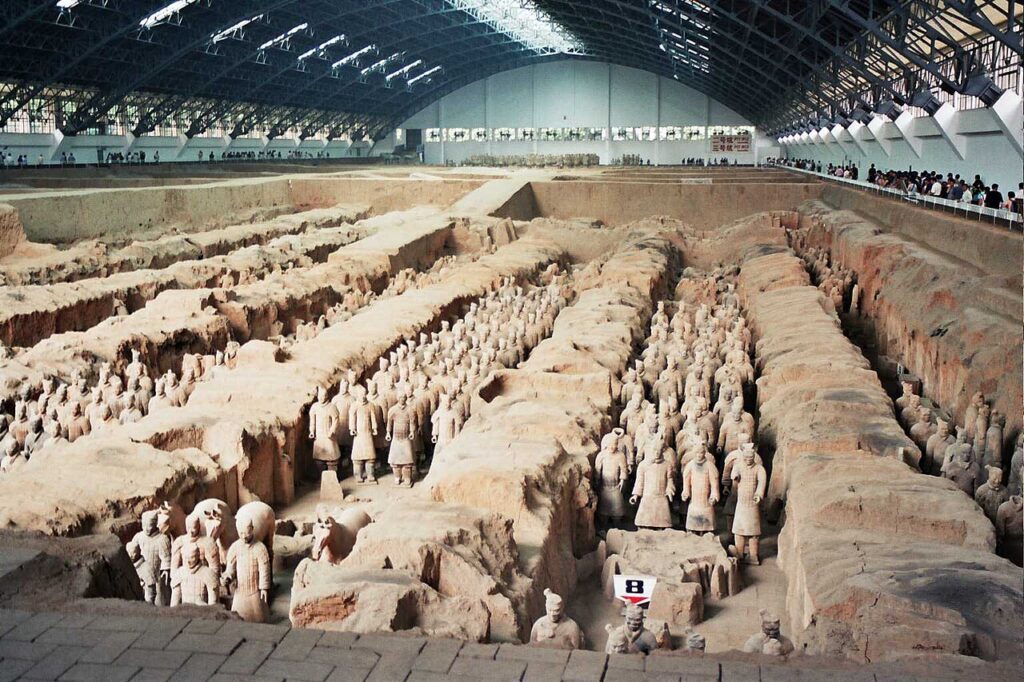
Long before Xi’an acquired its imposing walls, before emperors traced avenues across the plain and armies of clay stood guard beneath earthen mounds, the land around the Wei River was already a place of unusual human ambition. The valley appears modest at first glance: a broad, fertile basin enclosed by distant mountains, watered by tributaries that descend from the loess plateau. Yet few landscapes in East Asia proved more hospitable to early settlement. Here, in villages of packed earth and timber, communities began to shape not only tools and dwellings, but images—patterns, symbols, and forms that suggest the first stirrings of artistic consciousness in north China.
Chapter 1: Before the Walls — Prehistoric Cultures of the Wei River Valley
Xi’an, known in antiquity by other names and not yet a city in any recognizable sense, occupies one of the most consequential geographic positions in Chinese history. The Guanzhong plain offered rich soil, manageable rivers, and natural defensive barriers. It invited settlement and rewarded patience. Wheat and millet flourished. Clay was abundant. Timber could be gathered from nearby uplands. The same practical conditions that later supported imperial capitals first sustained small farming villages whose artistic legacy still feels surprisingly fresh.
The Painted Potters of Banpo
In 1953, construction workers on the eastern outskirts of Xi’an uncovered one of the most important prehistoric sites in China: the village now known as Banpo. Dating to roughly 4800–3600 BC, Banpo belonged to the Yangshao culture, a Neolithic society of farmers, fishers, and potters. Its discovery transformed understanding of early Chinese civilization.
Banpo was not a primitive encampment but a carefully organized settlement. Houses were arranged in clusters around communal spaces. A moat enclosed the village. Kilns stood in designated areas, suggesting specialized production. Storage pits, tools, and burials reveal a society with established rituals and practical order. Yet the most arresting objects were not the houses themselves, but the pottery.
The painted ceramics of Banpo possess a directness that still commands attention. Bowls and jars were coated with red slip and decorated in black mineral pigment. Fish motifs glide across curved surfaces. Triangles, zigzags, circles, and net-like patterns create rhythmic compositions that balance clarity and mystery. Some vessels bear stylized human faces, their expression reduced to a few confident lines.
These images likely carried practical and symbolic meanings at once. Fish may have referred to abundance, clan identity, or spiritual protection. Geometric motifs could echo woven baskets, nets, or cosmic order. Whatever their original significance, they reveal an extraordinary visual intelligence. The potters of Banpo understood that utility did not preclude beauty. A bowl for grain could also become a field for invention.
Geometry Before Writing
The art of Banpo predates Chinese writing by several millennia, yet it demonstrates a sophisticated sense of abstraction. This is one of the most striking features of Neolithic art worldwide: long before alphabets or formal scripts, humans organized visual marks into meaningful systems.
Banpo pottery often relies on repetition and symmetry:
- Interlocking triangles
- Concentric circles
- Alternating bands of black and red
These are not idle decorations. They impose order on the surface of the vessel, transforming a hand-built container into a coherent visual object. The painter thinks structurally, using shape and contrast to guide the eye around curved forms.
The designs also reveal a tension that would remain central to Chinese art: the relationship between disciplined order and expressive freedom. Each motif follows recognizable conventions, yet every brushstroke carries the slight irregularity of the human hand. Precision and spontaneity coexist.
The Village as an Artistic System
It is tempting to isolate pottery as “art,” but in Banpo aesthetic thinking was woven into daily life. The village itself was a designed environment. Houses were semi-subterranean, their floors sunk below ground level for insulation. Roofs were supported by wooden posts. Hearths occupied central positions. Storage pits and workspaces were arranged with evident practicality.
This organization reflects the same intelligence visible in painted ceramics. Form follows function, but function is never merely mechanical. Human beings shape materials in ways that express values: order, continuity, and communal identity.
Children were buried in painted urns, a practice that lends these objects profound emotional resonance. A vessel made from local clay, decorated by skilled hands, became both container and memorial. The ordinary object entered the realm of ritual. Art and grief met quietly in the earth.
Jiangzhai and the Expanding Horizon
Not far from Xi’an, the Jiangzhai site extended the picture revealed by Banpo. Occupied between roughly 4000 and 3000 BC, Jiangzhai contained multiple residential zones arranged around central spaces. The scale suggests increasingly complex social organization.
Pottery from Jiangzhai continues the Yangshao tradition but displays new variations in shape and ornament. Certain vessels become more specialized; decorative systems grow more elaborate. The changes are subtle, but they indicate experimentation and regional exchange. Ideas moved between communities long before formal states or roads connected them.
A visitor looking at these ceramics in the Shaanxi History Museum may notice something unexpectedly modern. The bold black lines, the spare compositions, and the confidence of abstraction recall twentieth-century design. This resemblance is coincidental, yet revealing. Human beings separated by thousands of years often discover similar solutions when working with line, color, and form.
Black Pottery and the Taste for Refinement
By the late Neolithic period, the Longshan culture introduced ceramics of remarkable technical sophistication. Thin-walled black pottery, sometimes polished to a lustrous sheen, represents a dramatic shift in aesthetic priorities.
Where Yangshao vessels are warm and painterly, Longshan wares are sleek and controlled. Decoration recedes. Shape becomes the central expressive element. Tall stems, delicate walls, and precise silhouettes demonstrate extraordinary craftsmanship.
This evolution marks one of the great transitions in Chinese art. Attention moves from painted surface toward the inherent elegance of form itself. The contour of an object becomes its principal statement. Later Chinese bronzes, porcelains, and monochrome ceramics would pursue this principle with enduring devotion.
The First Sense of Continuity
What connects a painted Banpo bowl to a Tang sancai horse or a Song celadon vase? The materials differ; the social worlds are separated by millennia. Yet certain artistic instincts remain surprisingly consistent.
Three tendencies appear at the very beginning:
- Respect for material properties.
- Preference for balanced, ordered composition.
- Integration of beauty with practical use.
These principles would shape Chinese art across dynasties. They are already present in the Neolithic villages of the Wei River valley, where anonymous artisans transformed earth and pigment into enduring forms.
A Morning in Banpo
Imagine a potter at dawn. Millet fields shimmer beyond the settlement. Smoke rises from hearths. Clay, kneaded by hand, is rolled into coils and smoothed into a broad bowl. After drying to a leathery firmness, the vessel is painted with black lines—two fish, perhaps, circling in measured symmetry.
The image is neither purely decorative nor self-consciously artistic in the modern sense. It belongs to life. The bowl will hold food, accompany a burial, or mark family identity. Yet in the act of painting, the potter asserts something unmistakably human: the desire to make the useful memorable.
No name survives. No inscription records intention. The hand is anonymous, but the gesture remains visible after six thousand years.
Earth as Memory
Prehistoric art around Xi’an survives largely because it was buried. Tombs, storage pits, and collapsed houses sealed objects within the loess soil. The ground that later supported imperial capitals also became an archive of humble beginnings.
This buried continuity is one of Xi’an’s defining characteristics. Again and again, the city would construct new worlds atop older ones. Qin mausoleums, Han tombs, Tang pagodas, and modern museums all rest upon layers of accumulated memory. The earliest layer is neither imperial nor monumental. It consists of villages, kilns, and painted bowls.
The story of Xi’an begins not with walls, but with clay shaped by careful hands. Before there was an empire to standardize scripts or armies to guard emperors, there was a potter tracing black lines across red earth, discovering that order could be beautiful and that beauty could endure beneath the soil for thousands of years.
Chapter 2: Bronze and Divination — Xi’an and the Rise of Early Chinese Civilization
The first great works of art in the Xi’an region were not meant to be admired in silence. They were lifted with both hands, warmed by sacrificial fire, and filled with millet wine while priests addressed the dead.
Between the 11th and 8th centuries BC, the Guanzhong plain west of present-day Xi’an became the heartland of the Western Zhou dynasty. If the painted pottery of Banpo reveals the earliest stirrings of artistic order, the bronzes of Zhou society announce something far more formidable: art as an instrument of political authority, ancestral memory, and cosmic legitimacy. Here, in a landscape of walled settlements and ritual compounds, metal became a language of power.
The Zhou Homeland
The Zhou people emerged from the fertile valleys of what is now Shaanxi Province. Their power base lay at Zhouyuan, a vast archaeological region west of Xi’an. Although less visually famous than the Terracotta Army, Zhouyuan is among the most important sites in Chinese history. Excavations have uncovered palace foundations, workshops, chariot pits, and large caches of inscribed bronzes.
When the Zhou overthrew the Shang dynasty around 1046 BC, they inherited a highly developed bronze tradition and transformed it into the visual grammar of a new political order. Their kings claimed to rule under the “Mandate of Heaven,” a doctrine that linked moral conduct with cosmic approval. Art became one of the principal means through which this abstract idea was made tangible.
Bronze vessels stood at the center of that effort.
Fire, Clay, and Liquid Metal
The making of a Zhou bronze was a technical and logistical achievement of extraordinary complexity. Copper, tin, and lead had to be mined, transported, and proportioned with care. Artisans first modeled the vessel in clay, then created sectional molds from which molten metal could be cast.
Unlike the lost-wax method used in many other ancient cultures, early Chinese founders relied on piece-mold casting. This process allowed decorative patterns and inscriptions to be carved directly into the mold before casting, producing sharp, controlled surfaces.
The result was both durable and precise. A bronze ding (tripod cauldron) or gui (food vessel) could weigh dozens of kilograms and survive nearly three thousand years underground.
Yet technical mastery was only the beginning. What mattered most was what these objects represented.
Vessels for the Ancestors
Western Zhou society revolved around ancestral rites. The living maintained a relationship with deceased forebears, who were believed to influence the fortunes of the family and state. Sacrificial ceremonies involved offerings of food and drink presented in bronze vessels arranged according to strict hierarchies.
A nobleman’s status could be measured by the number and type of vessels he possessed. To own bronzes was to possess recognized authority.
The principal forms included:
- Ding — tripod vessels used for meat offerings.
- Gui — round bowls for grain.
- Zun and You — containers for wine.
- Pan — basins used in ritual ablutions.
Each type had its own visual logic. Thick walls conveyed permanence. Loop handles provided balance. Feet lifted the vessel above the altar surface, granting it both practical stability and symbolic elevation.
To modern eyes, these objects can appear austere, even severe. But in the flicker of firelight, their surfaces would have glowed with a living presence.
The Surface as a Sacred Skin
Zhou bronzes inherited many decorative motifs from the Shang dynasty, including the famous taotie mask—a symmetrical composite face whose precise meaning remains uncertain. Bulging eyes, curling horns, and angular jaws emerge from the metal as if summoned from another realm.
These motifs were not illustrations in the ordinary sense. They hover between abstraction and figuration, their forms unfolding through repeated lines and low relief.
The effect is psychological rather than narrative. A bronze vessel seems inhabited.
The decoration served several functions at once:
- It transformed utilitarian containers into sacred objects.
- It signaled continuity with revered traditions.
- It suggested the invisible forces addressed during ritual.
The designs resist easy interpretation, and that ambiguity is part of their enduring power.
Writing Cast in Metal
One of the most remarkable features of Zhou bronzes is the presence of inscriptions inside the vessels. These texts, sometimes only a few characters and sometimes several hundred, commemorate royal gifts, military victories, appointments, and acts of filial devotion.
The inscriptions are among the earliest substantial written records in Chinese history.
A noble recipient might record that the king bestowed land, horses, or ceremonial privileges. In gratitude, he commissioned a vessel to honor his ancestors and preserve the event for future generations.
This fusion of text and object established a pattern that would remain central to Chinese art. Writing was not merely informational. It was visual, commemorative, and morally charged.
The vessel became a document in three dimensions.
The Shi Qiang Pan
Among the most celebrated bronzes from the Zhou world is the Shi Qiang Pan, a large water basin inscribed with a long historical text praising royal ancestors and the achievements of the Zhou house.
Its inscription reads like a compressed chronicle, linking private devotion with public history. The patron honors his lineage, but he also affirms the legitimacy of the dynasty itself.
What is striking is the confidence of the enterprise. Historical memory is not left to oral tradition alone. It is cast in bronze, meant to endure as long as the metal survives.
In this sense, the Shi Qiang Pan is both artwork and archive.
Art and Bureaucracy
The Western Zhou dynasty did more than produce beautiful objects. It institutionalized relationships between craft, rank, and governance.
Bronze production required:
- Access to mineral resources.
- Control over specialized labor.
- Systems of patronage and redistribution.
- Shared visual conventions.
This organizational sophistication foreshadows later imperial structures. The same capacity to mobilize labor and standardize forms would eventually shape roads, palaces, tombs, and armies.
The bronzes are therefore evidence not only of aesthetic achievement, but of administrative imagination.
Divination and Cosmic Order
Although the most famous oracle bones belong to the earlier Shang dynasty, the Zhou inherited and adapted divinatory practices. Rulers sought to understand Heaven’s will through ritual consultation and moral interpretation.
Art played a central role in this process. Vessels were used during ceremonies that linked the visible and invisible worlds. Their forms expressed permanence, while their inscriptions translated fleeting political events into durable memory.
The bronzes stand at the intersection of three realities:
- Material wealth.
- Sacred obligation.
- Historical consciousness.
Few artistic traditions have united these dimensions so completely.
A Workshop Near the Capital
Imagine a bronze foundry in the Zhou heartland. Furnaces roar. Clay molds dry in orderly rows. Artisans incise spirals and animal masks into the mold surface with practiced hands. Nearby, a scribe copies the text to be cast inside the vessel.
When molten bronze is poured, there is no opportunity for improvisation. The proportions must be exact; the molds must align. Weeks of labor culminate in a few decisive moments.
When the vessel is broken free from its casing, polished, and presented to its patron, it enters a world of ceremonies, alliances, and ancestral obligations.
The object is at once industrial and sacred.
The Birth of Historical Art
The bronzes of the Xi’an region mark one of the decisive turning points in Chinese art. For the first time, objects survive that unite technical mastery, symbolic design, written language, and explicit historical intent.
Their significance extends far beyond ritual use. They establish several enduring principles:
- Art can embody political legitimacy.
- Writing and image can function as a single medium.
- Beauty can reside in weight, proportion, and restraint.
- Objects can preserve history.
These ideas would shape Chinese artistic culture for more than three millennia.
Metal and Memory
To stand before a Western Zhou bronze in the Shaanxi History Museum is to confront an unsettling kind of permanence. Dynasties fell, capitals shifted, and the rituals that gave these vessels meaning disappeared long ago. Yet the objects remain astonishingly intact.
Their surfaces still carry every incised line. Their inscriptions still name patrons and kings. Their forms still project authority.
The painted bowls of Banpo revealed the first desire to organize the world visually. The bronzes of the Zhou transformed that desire into a state-supported language of memory and power.
In the Xi’an region, art had become something larger than decoration. It had become a way of persuading Heaven, honoring the dead, and casting history into metal.
Chapter 3: The First Emperor’s Vision — Qin Art and the Invention of Empire
The most famous work of art in Xi’an was created by a man who trusted no one—not his ministers, not the conquered kingdoms he ruled, not even death itself.
When the king of Qin declared himself Qin Shi Huang in 221 BC, he did more than unite rival states. He introduced a new idea of political authority: centralized, standardized, and vast enough to absorb the known world. Roads were straightened, weights and measures unified, and written characters regulated. Yet his most extraordinary project was hidden beneath the earth near modern Xi’an, where an underground empire was built to accompany him into eternity.
The Mausoleum of the First Qin Emperor is not simply a tomb. It is one of history’s most ambitious artistic undertakings, a landscape-scale work in which sculpture, architecture, engineering, and ideology merge into a single statement: the empire would continue after death.
Xianyang and the Theater of Power
Before Xi’an bore its later names, the Qin capital stood at Xianyang, just northwest of the present city. Contemporary accounts describe grand palaces connected by elevated walkways and aligned according to principles of cosmic order. Much of the architecture has vanished, but archaeology suggests a city designed to overwhelm.
Qin rule was austere and relentless. Laws were strict; punishments severe. But this hardness was paired with extraordinary organizational talent. The same administrative discipline that mobilized armies also coordinated artisans, laborers, engineers, and scribes.
Art in the Qin world served a singular purpose: to make authority visible.
This was a radical shift. Zhou bronzes had affirmed lineage and ritual continuity. Qin art proclaimed the supremacy of one ruler over all competing traditions.
The Tomb as an Underground Empire
Construction of the First Emperor’s mausoleum began in 246 BC, when he ascended the Qin throne as a teenager, and continued until his death in 210 BC. Ancient historians claimed that hundreds of thousands of workers participated. Although such figures may be exaggerated, the scale of the site remains astonishing.
The central burial mound rises over a vast necropolis covering dozens of square kilometers. Archaeologists have identified stables, administrative offices, bronze birds, acrobats, and numerous satellite pits. The famous terracotta soldiers represent only one part of a much larger vision.
According to the historian Sima Qian, the sealed burial chamber contained a miniature empire, with rivers of mercury and a celestial ceiling representing the heavens. Scientific studies have detected unusually high mercury concentrations near the mound, lending some credibility to the ancient account.
Whether literal or symbolic, the message is unmistakable. The emperor intended to govern forever.
The Discovery That Changed Archaeology
In 1974, farmers digging a well near Lintong struck fragments of fired clay. Their accidental discovery led to one of the greatest archaeological finds of the twentieth century: the Terracotta Army Museum.
The first excavation pit revealed ranks of life-sized infantry, arranged in military formation. Subsequent pits uncovered cavalry, chariots, archers, and command officers. Thousands of figures have been excavated, and many more remain buried.
The initial impression is overwhelming. Rows of soldiers extend toward the horizon, each standing in poised silence. The experience is less like entering a museum than like intruding upon an army suspended between worlds.
Every Face, One Empire
One of the most celebrated aspects of the Terracotta Army is the individuality of the figures. Their hairstyles, armor, postures, and facial features vary widely. Some appear youthful and alert; others look seasoned and severe.
For years, observers described each face as a portrait of a specific soldier. The truth is more complex. Artisans worked from a repertoire of standardized components—heads, torsos, arms, and legs produced in modular fashion—then refined details by hand. The result is a balance between mass production and individual variation.
This method mirrors the political logic of the Qin state:
- Standardized systems
- Controlled diversity
- Central authority expressed through uniform structure
The soldiers appear unique, but they belong to an ordered whole.
The Lost Color of the Army
Today the warriors are the color of earth, but they were originally painted in vivid pigments. Armor was highlighted in reds and browns; garments shimmered in greens, blues, and purples. Faces were carefully modeled and colored to appear lifelike.
The purple pigment known as “Han purple,” developed in ancient China, remains one of the most technically intriguing substances of the early world.
When the figures were excavated, exposure to dry air caused much of the paint to flake away within minutes. What modern visitors see is therefore both magnificent and incomplete—a monumental sculpture stripped of its original brilliance.
This loss reminds us that archaeology often reveals not intact masterpieces, but survivors bearing the marks of time.
Bronze, Clay, and Precision
The terracotta figures were only one component of a broader artistic program. Excavations have uncovered bronze chariots of astonishing delicacy, cast and assembled with extraordinary sophistication. Half-scale and intricately detailed, they include umbrellas, harnesses, and ornamented fittings.
Other pits contain:
- Stone armor made from thousands of limestone plaques.
- Bronze waterfowl arranged in a subterranean park.
- Sculptures of acrobats and strongmen modeled with startling naturalism.
Together these works reveal a court willing to mobilize every medium—clay, bronze, stone, pigment—to construct an all-encompassing vision of imperial order.
Realism and Control
The Terracotta Army is often praised for its realism, and rightly so. Muscles tense beneath armor. Clothing folds respond to bodily movement. Standing archers and kneeling bowmen occupy convincingly balanced poses.
Yet realism was not pursued for its own sake. Unlike Greek sculpture, which often celebrated the individual body as an ideal, Qin sculpture subordinates individual presence to administrative order.
The warriors are convincing as human beings, but they are even more convincing as a system.
This distinction is crucial. The ultimate subject of the mausoleum is not the soldier. It is the state.
A Workshop of Thousands
Imagine the workshops near the imperial tomb. Kilns blaze day and night. Teams shape legs, torsos, and heads. Supervisors inspect components and stamp them with workshop marks. Painters apply lacquer and mineral pigments. Bronze smiths assemble chariots while scribes record inventories.
The atmosphere is industrial, but the results are profoundly artistic.
Each worker contributes to a project too vast for any individual to grasp in full. Art becomes collaborative on a national scale, coordinated with the precision of a military campaign.
The mausoleum is the sculptural equivalent of empire itself.
The Fear Beneath the Grandeur
For all its grandeur, the mausoleum also reveals profound anxiety. Qin Shi Huang searched obsessively for elixirs of immortality. He sent expeditions across the seas and consulted magicians and alchemists. The greatest ruler in China could command armies and laborers, yet he could not command time.
The underground empire is therefore both triumphant and haunted.
Its silent soldiers embody a paradox: absolute confidence in human organization, and equally absolute fear of death.
That tension gives the mausoleum much of its emotional force. Beneath the spectacle lies a deeply personal act of resistance against mortality.
The First Monument of Unified China
The artistic significance of the mausoleum is difficult to overstate. It established several enduring ideas:
- Art can operate on a territorial scale.
- Standardization can coexist with expressive individuality.
- Sculpture can serve political ideology directly.
- The state can mobilize art as a demonstration of total power.
Later dynasties would build magnificent tombs and capitals, but none would surpass the audacity of the First Emperor’s project.
Clay Soldiers, Human Ambition
Standing before the Terracotta Army, one is struck not only by the number of figures, but by the contradictory emotions they evoke. The warriors appear disciplined, calm, and almost patient. They are products of a regime famous for severity, yet they possess undeniable dignity.
Their creator sought immortality and failed. His dynasty collapsed only a few years after his death. The empire he forged endured, but the man himself vanished into legend.
The soldiers remain.
Fashioned from local earth and arranged beneath the fields outside Xi’an, they embody one of history’s most extraordinary acts of artistic will. In them, clay becomes bureaucracy, sculpture becomes politics, and mortality becomes a project of monumental imagination.
Chapter 4: Tombs Beneath the Earth — Han Dynasty Art in Chang’an
When the Han rulers established their capital at Chang’an in 202 BC, they inherited the ruins of the Qin experiment and turned them into something more durable, more humane, and in many ways more imaginative. If Qin art expressed a single ruler’s will to dominate, Han art reveals a broader ambition: to understand how the living, the dead, the heavens, and the state might be bound together in a coherent universe.
The Han dynasty lasted more than four centuries. During that long span, Chang’an became one of the largest and most sophisticated cities in the world. Broad avenues, palace compounds, markets, and administrative quarters filled the plain west of present-day Xi’an. Envoys departed toward Central Asia, bringing with them silk and returning with new ideas, materials, and beliefs. Yet the most eloquent surviving works from Han Chang’an are not the vanished palaces above ground, but the carefully furnished tombs below.
A Capital of Ordered Grandeur
Chang’an was conceived on an immense scale. Walled precincts enclosed imperial palaces and government offices. The city’s layout reflected a confidence in planning that had deep roots in the Qin state, but Han rulers softened that legacy with a governing philosophy influenced by Confucian ethics and a more measured view of authority.
Art flourished in this environment not as an isolated pursuit but as part of an integrated culture of scholarship, ritual, and technical refinement. Court workshops produced lacquerware, jades, bronzes, textiles, and architectural ornaments of remarkable quality. At the same time, tomb art expanded dramatically in scope and complexity.
The Han elite did not think of death as an abrupt severance. The dead were believed to inhabit an afterlife that mirrored earthly existence and required continued provision. Tombs became residences, storehouses, and cosmic diagrams.
The Underground Household
A Han tomb was designed as a complete environment. Pottery granaries, wells, kitchens, livestock, servants, musicians, and guardians were placed inside to ensure comfort and protection. The practice echoes the Qin mausoleum but on a more intimate and varied scale.
At Han Yang Ling Mausoleum, the burial complex of Emperor Jing and Empress Wang, archaeologists uncovered thousands of miniature figures and objects. Unlike the armored soldiers of Qin, these attendants are smaller, more understated, and often originally clothed in real textiles.
Their reduced scale changes the emotional tone. The figures are less intimidating and more domestic. They populate a world of cooks, officials, animals, and entertainers—an afterlife organized not solely around military power, but around the rhythms of court and household life.
The Quiet Power of Miniatures
One of the distinctive achievements of Han art is its use of miniaturization. A pottery pig, a model tower, or a tiny servant may fit comfortably in the hand, yet each stands in for an entire category of life.
These objects possess a subtle charm. Their simplified forms are economical but expressive. A kneeling attendant tilts forward attentively. A ceramic dog appears alert. A granary model with detailed roof tiles evokes abundance and stability.
Miniatures perform several functions at once:
- They provide symbolic substitutes for real goods.
- They compress large ideas into manageable forms.
- They transform burial chambers into populated worlds.
This taste for the evocative model would persist throughout Chinese funerary art.
Lacquer and the Art of Surface
If Qin art favored monumental scale, Han craftsmen developed extraordinary sensitivity to surface. Lacquerware became one of the dynasty’s greatest artistic achievements.
Made by applying repeated layers of resin from the lacquer tree to wooden cores, these objects required immense patience. Each layer had to cure before the next could be added and polished. The finished surfaces gleamed with deep reds and blacks, sometimes enriched with gold and incised designs.
Cups, boxes, and trays display motifs of clouds, dragons, and flowing lines that seem to drift across the surface like animated calligraphy.
Lacquer embodies a central Chinese aesthetic principle: refinement achieved through accumulated labor so meticulous that the process disappears into apparent ease.
Silk as Painting
Although fragile and rarely preserved, silk was among the most important artistic media of the Han dynasty. Textiles were practical commodities, diplomatic gifts, and vehicles for painting.
The famous painted banner from the tomb of Lady Dai in Hunan, though discovered far from Chang’an, reflects the same visual imagination that flourished in the Han world. It arranges heavenly beings, human figures, and underworld creatures in a vertical cosmology linking earth and sky.
Such compositions reveal a profound interest in structure. The universe is not chaotic but ordered, layered, and navigable.
Silk paintings introduced pictorial conventions that would shape Chinese art for centuries: flowing contours, symbolic space, and the integration of narrative with cosmic meaning.
Jade and the Dream of Preservation
Han elites attributed protective and life-extending qualities to jade. This luminous stone, cool to the touch and difficult to carve, was prized for its durability and moral associations.
The most spectacular examples are jade burial suits sewn together with gold, silver, or copper wire. Although these have been found mainly outside the Xi’an region, they reflect beliefs shared across Han aristocratic culture.
Even smaller jade objects—discs, plugs, and pendants—served as barriers against decay.
The fascination with jade suggests a recurring theme in Chinese art: beauty and permanence are deeply intertwined. The most admired materials are those that appear to resist time.
Stone Reliefs and the Storytelling Impulse
By the later Han period, carved stone reliefs became increasingly important in tomb architecture. Scenes of hunts, processions, filial exemplars, and mythological beings unfold across lintels and wall slabs.
These reliefs are more than decoration. They educate, commemorate, and protect.
A typical sequence might include:
- Historical figures embodying moral virtue.
- Daily activities such as banquets and chariot rides.
- Winged creatures and heavenly symbols.
The arrangement suggests that ethical conduct, social status, and cosmic order are parts of a single continuum.
Art becomes a visual form of philosophy.
Chang’an and the Opening of the Silk Roads
During the reign of Emperor Wu (141–87 BC), Han envoys pushed westward, initiating the long exchange routes later called the Silk Roads. Chang’an stood at the eastern terminus of these networks.
Foreign horses, glass, gemstones, and new ideas entered the capital. Artistic motifs began to circulate more widely, although Han art retained a strongly indigenous structure and sensibility.
The opening to the west did not dilute local traditions. Instead, it expanded the range of materials and imagery available to court workshops and elite patrons.
Xi’an’s later cosmopolitan brilliance under the Tang dynasty was foreshadowed in these early connections.
A Burial Prepared
Imagine the preparations for a Han noble’s funeral. Artisans deliver lacquer cups, painted figurines, bronze mirrors, and jade ornaments. Scribes label inventories. Family members arrange objects with care, knowing that each item has practical and symbolic significance.
A musician figurine kneels with an instrument across his lap. A model granary promises inexhaustible food. A polished mirror reflects the last flicker of lamplight before the chamber is sealed.
The scene is intimate rather than overwhelming.
Where the Qin mausoleum astonishes through scale, Han tombs move through detail and tenderness.
The Humanization of Imperial Art
The Han dynasty did not abandon grandeur. Palaces were vast, armies formidable, and state workshops highly organized. But Han art introduced a more varied and emotionally nuanced vision.
Its characteristic achievements include:
- Domestic miniatures rich in observational detail.
- Luxurious lacquer surfaces.
- Cosmological paintings on silk.
- Narrative reliefs combining morality and myth.
Together these works suggest a world in which administration, family life, and metaphysical speculation coexist.
The result is one of the most intellectually fertile periods in Chinese art.
The Afterlife as a Mirror
To walk through Han galleries in the Shaanxi History Museum is to encounter objects of unusual poise. Even the smallest figurines possess a calm assurance. They were made for a future no living person could see, yet they remain eloquent in the present.
The Han transformed burial into an art of continuity. Tombs were not merely repositories for the dead but carefully composed worlds in which memory, morality, and cosmic order were given material form.
If the Qin dynasty imagined eternity as an empire guarded by soldiers, the Han envisioned it as a household sustained by beauty, ritual, and thoughtful design. Beneath the soil of Chang’an, the dead were not abandoned. They were furnished with a universe.
Chapter 5: Buddhism Arrives — Caves, Monks, and New Sacred Images
The first Buddhist images to reach Chang’an must have seemed both familiar and profoundly strange. They depicted serene figures seated in meditation, haloed with light, clothed in robes unlike those worn by Chinese officials or sages. Their faces suggested calm rather than authority, inwardness rather than command. Yet they promised something that resonated deeply with the Chinese imagination: a path beyond suffering, a vast cosmology of heavens and hells, and a visual language capable of making the invisible tangible.
Buddhism entered China gradually, beginning in the first centuries AD, carried by merchants, monks, and translators along the routes that connected Central Asia to the Han empire. By the 4th and 5th centuries, Chang’an had become one of the principal centers where this foreign religion was translated—linguistically, intellectually, and artistically—into Chinese form. The transformation would alter the history of East Asian art as profoundly as the introduction of perspective transformed Renaissance painting in Europe.
Caravans from the Western Regions
The Silk Roads were not a single highway but a network of routes linking China to Central Asia, India, Persia, and beyond. Along these roads traveled silk, horses, spices, gemstones, and religious ideas.
Buddhism was perhaps the most consequential import.
The earliest Buddhist objects entering China likely included:
- Portable statues in bronze or stone.
- Painted banners and manuscripts.
- Reliquaries containing sacred remains.
- Texts written in Sanskrit and related languages.
These works introduced new iconographic conventions: the seated Buddha, the lotus throne, the halo, and the wheel symbolizing the teaching of the Dharma.
For Chinese viewers accustomed to ancestral rites, Confucian ethics, and Daoist cosmology, Buddhism offered both continuity and novelty. It preserved reverence for moral order while opening a far larger spiritual horizon.
Chang’an as a Translation Capital
Religions survive when they find new words. They flourish when they also find new images.
In AD 401, the celebrated monk and scholar Kumārajīva arrived in Chang’an after a dramatic journey from Central Asia. Under imperial patronage, he led teams of monks and scribes in translating Buddhist scriptures into lucid Chinese prose.
These translations were literary masterpieces. More importantly, they established the conceptual vocabulary through which Buddhist art could be understood.
Terms for emptiness, compassion, enlightenment, and the bodhisattva ideal entered Chinese thought. Artists, patrons, and worshippers now possessed both images and words capable of conveying a coherent religious universe.
Kumārajīva’s work influenced not only theology but aesthetics. Chinese representations of Buddhas and bodhisattvas gained increasing clarity and emotional resonance as artists absorbed the meanings embodied in these forms.
The First Chinese Buddhas
Early Buddhist sculptures in China reveal a fascinating process of adaptation. Some retain features inherited from Indian and Central Asian models: elongated ears, draped robes, and broad halos. Others begin to soften into more distinctly Chinese types.
Faces become rounder. Drapery falls in gentler rhythms. Expressions grow quieter and more introspective.
The Buddha is not portrayed as a conquering god. He sits with measured stillness, one hand raised in reassurance or lowered toward the earth in witness. The body is idealized but not muscular. The emphasis lies on spiritual presence rather than physical force.
This new artistic ideal had immense consequences. It introduced a mode of sacred representation based on serenity, balance, and inward authority.
Yungang, Longmen, and the Northern Imagination
Although the most famous early Buddhist cave temples lie far from Xi’an, the artistic currents that shaped them were closely connected to Chang’an and its translation culture.
At sites such as Yungang and Longmen, colossal Buddhas were carved into cliffs, accompanied by bodhisattvas, guardians, and donor figures. These cave sanctuaries turned mountains into sculptural scriptures.
Their impact on Chinese art was profound:
- Monumental stone carving became a central medium of devotion.
- Narrative reliefs illustrated episodes from the Buddha’s life.
- Repeated iconographic forms created a shared visual language across vast territories.
Chang’an served as one of the key intellectual centers that made such projects meaningful and coherent.
The Bodhisattva and the Art of Compassion
Among Buddhism’s most powerful contributions to Chinese art was the bodhisattva—an enlightened being who postpones final liberation in order to aid others.
Bodhisattvas are often represented with crowns, jewelry, and flowing garments. Their appearance combines princely splendor with profound gentleness.
These figures introduced a new emotional register into Chinese art. They are neither stern ancestors nor commanding emperors. Their beauty is inseparable from compassion.
The visual ideal they established would endure for centuries: graceful posture, lowered gaze, and an expression that suggests complete attentiveness.
In many later sculptures, the slightest tilt of the head conveys more feeling than a dramatic gesture ever could.
Painting the Invisible
Buddhism also transformed painting. Murals and silk banners depicted paradises, sermons, miracles, and protective deities. Narrative cycles invited viewers to contemplate vast spiritual stories.
For Chinese artists, this posed new challenges.
How could one depict:
- Infinite heavens?
- Multiple realms of rebirth?
- Moral cause and effect unfolding across lifetimes?
The solution was a flexible pictorial space in which symbolic scale and narrative sequencing mattered more than strict naturalism.
This approach aligned naturally with existing Chinese preferences for conceptual rather than optical order.
Monasteries as Artistic Workshops
Buddhist monasteries became major centers of production and patronage. Sculptors, painters, calligraphers, and builders collaborated on images, murals, scriptures, and ritual objects.
The monastery was simultaneously:
- A religious institution.
- A scholarly community.
- A workshop.
- A repository of artistic knowledge.
Imperial patronage, aristocratic donations, and popular devotion supported increasingly ambitious projects.
The relationship between art and religion became more intimate than ever before. Images were not merely decorative. They were objects of meditation, prayer, and ritual encounter.
A Monk Before a New Image
Imagine a newly completed statue in a Chang’an temple in the 5th century AD. The lacquer on the wooden core has dried. Gold leaf catches the light of oil lamps. Incense drifts upward in slow curls.
A monk recites a scripture recently translated into Chinese. Worshippers bow before a figure whose features reflect influences from India, Central Asia, and the Chinese heartland.
The statue is still and silent, yet it changes the atmosphere of the room. The viewer feels observed by a gaze that does not judge or command, but understands.
This was a new artistic experience in China: the encounter with a sacred image designed to embody boundless compassion.
The Chinese Transformation of Buddhism
Buddhism did not remain foreign for long. Chinese thinkers interpreted it through local philosophical traditions, and artists adapted its forms to native sensibilities.
Several changes became especially important:
- Greater emphasis on facial calm and compositional balance.
- Integration of Buddhist imagery with Chinese architectural settings.
- Increasing refinement in line, drapery, and gesture.
- Harmonization with existing ideals of moral cultivation.
The result was not imitation but creative transformation.
Buddhism gave Chinese art new subjects, new emotions, and new conceptions of sacred presence.
Foundations for Tang Splendor
By the time the Tang dynasty began in AD 618, Chang’an was already one of the world’s great Buddhist capitals. Temples filled the city, scriptures circulated widely, and artistic conventions were firmly established.
The magnificent Buddhist sculpture and architecture of Tang Xi’an—including the Great Wild Goose Pagoda—would build upon centuries of experimentation and translation.
The cosmopolitan brilliance of Tang art was rooted in these earlier encounters between foreign faith and Chinese form.
Images That Changed Vision
The arrival of Buddhism altered Chinese art at every level. It introduced monumental sculpture, expanded narrative painting, inspired vast architectural projects, and placed compassion at the center of sacred representation.
More subtly, it changed the emotional expectations of viewers. Art could now console as well as impress, guide as well as commemorate.
In Chang’an, monks and artisans collaborated to make invisible truths visible. Stone, silk, wood, and pigment became vehicles for meditation and hope.
The painted pots of Banpo, the bronzes of the Zhou, and the armies of Qin had all sought permanence. Buddhism introduced a different aspiration: not simply to endure, but to awaken.
Chapter 6: Cosmopolitan Splendor — Tang Dynasty Chang’an at the Height of the World
At its height, Chang’an was less a city than a map of the known world.
In the 8th century AD, caravans arrived from Samarkand, monks traveled from India, musicians came from Central Asia, and merchants from Persia and Arabia established communities within its wards. Envoys from Korea and Japan studied its institutions and copied its architecture. Foreign languages echoed in the markets. Silk, glass, silver, spices, and manuscripts changed hands beneath regimented avenues wide enough to astonish even seasoned travelers.
No city on earth better embodied the confidence of a civilization at full strength. Under the Tang dynasty, Chang’an became the greatest artistic center in Asia and one of the most cosmopolitan capitals in world history. Its art was expansive, technically brilliant, and remarkably open to influences from afar. Yet despite its international character, Tang art remained unmistakably Chinese: disciplined in structure, assured in execution, and animated by a deep pleasure in the visible world.
The Greatest City on Earth
Tang Chang’an occupied a carefully planned grid of monumental scale. Imperial palaces stood to the north, while markets and residential wards filled the vast rectangle of the city. Temples, monasteries, gardens, and administrative compounds punctuated the urban fabric.
The order was exacting, but the life within it was exuberant.
Visitors encountered:
- Buddhist monasteries filled with paintings and sculpture.
- Markets selling Persian silver and Central Asian textiles.
- Official workshops producing lacquer, ceramics, and metalwork.
- Entertainers, scholars, diplomats, and soldiers from across Eurasia.
This combination of strict planning and cultural abundance shaped the visual arts of the period.
Court Painting and the Pleasure of Observation
Tang painters expanded the range and confidence of Chinese figural art. Court scenes, portraits, horses, hunting expeditions, and elegant women became favored subjects.
Among the most celebrated artists was Wu Daozi, famed for dynamic brushwork and monumental Buddhist murals. Though his original works are lost, later accounts describe figures so vividly rendered that they seemed to move across the walls.
Tang painting valued both line and presence. A few fluid strokes could define a robe, a horse’s musculature, or the tilt of a noblewoman’s head.
The subject matter reveals a culture increasingly interested in worldly life. Rather than avoiding luxury and movement, Tang artists often embraced them.
Horses and the Energy of Empire
No animal better symbolizes Tang art than the horse.
The dynasty relied heavily on cavalry, and superior horses imported from Central Asia were treasured as strategic assets and objects of admiration. Artists depicted them in paintings, reliefs, and ceramics with extraordinary vitality.
Tang horses are broad-chested, muscular, and alert. Their bodies convey contained force.
The fascination was practical and aesthetic at once. To represent a horse well was to celebrate:
- Military strength.
- International trade.
- Natural beauty.
- Imperial prestige.
Some of the most memorable sculptures in Chinese art are simply horses standing in poised silence.
Sancai: The Colors of the Tang Imagination
Tang funerary ceramics are among the most recognizable works in Chinese art. Known as sancai (“three-color”) wares, these earthenware figures were coated with lead glazes in amber, green, cream, and occasional blue.
The colors flow unpredictably during firing, creating surfaces that feel both controlled and spontaneous.
Typical subjects include:
- Horses and camels.
- Grooms and musicians.
- Foreign merchants.
- Court ladies and officials.
These figures were placed in tombs, yet they radiate animation and delight. Camels twist their necks; horses stand proudly; musicians seem caught in performance.
The glazes transform clay into something almost painterly, with rivulets of color suggesting movement and chance.
Foreign Faces in Chinese Clay
One of the most striking features of Tang art is its frank depiction of foreigners. Sogdian merchants, Central Asian grooms, and musicians with distinctive features appear frequently in sculpture and painting.
These figures are not hidden at the margins. They occupy central roles in the visual narrative of Tang life.
Their presence testifies to a remarkable cultural confidence. Chang’an did not fear outside influence; it absorbed and reinterpreted it.
The cosmopolitanism of Tang art was visible in:
- Clothing styles.
- Musical instruments.
- Metalworking techniques.
- Decorative motifs such as grape vines and pearl roundels.
Foreign forms became part of the Chinese visual vocabulary without dissolving its essential character.
Gold, Silver, and Luxurious Surfaces
Tang metalwork reached extraordinary levels of refinement. Gold and silver vessels were hammered, engraved, and gilded with motifs that often reveal Persian and Central Asian inspiration.
Wine cups shaped like lotus petals, ewers adorned with animals, and dishes framed by scrolling vines combine technical mastery with sensual elegance.
These objects suggest a court culture that delighted in sophisticated craftsmanship and the pleasures of banquet life.
Their surfaces shimmer with the same assurance found in Tang poetry: formal discipline paired with emotional richness.
Women in Tang Art
Tang representations of women are notable for their dignity and variety. Court ladies appear riding horses, playing polo, arranging flowers, or standing in quiet elegance.
The ideal of beauty shifted over time, but many works emphasize rounded forms, elaborate hairstyles, and richly colored robes.
These figures project composure rather than fragility.
They also reflect the relative prominence of women in Tang elite society, particularly under the remarkable reign of Wu Zetian, whose patronage of Buddhist art and monumental projects left a lasting mark.
Poetry and Painting
The Tang dynasty is often considered the golden age of Chinese poetry, with masters such as Li Bai and Du Fu. Their work profoundly influenced visual culture.
Poetry and painting shared core values:
- Precision of observation.
- Emotional restraint.
- Suggestive rather than exhaustive description.
- Harmonious balance.
A painted horse, a mountain landscape, and a poem of exile all pursued the same ideal: to reveal the inner resonance of the world through carefully controlled form.
A Tomb Filled with Motion
Imagine a Tang noble’s burial. Artisans place glazed camels carrying silk bales, musicians with lutes, proud horses, and elegant attendants into the tomb chamber.
The figures are still, but they imply movement.
A camel opens its mouth as if singing. A foreign merchant leans forward. Amber glaze spills over a horse’s saddle like molten sunlight.
The afterlife is imagined not as austere stillness, but as an extension of worldly brilliance.
The tomb becomes a theater of empire.
Emperor Xuanzong and the Peak of Refinement
Under Emperor Xuanzong of Tang, court culture reached extraordinary heights. Music, dance, painting, and poetry flourished. The emperor himself was an accomplished patron deeply involved in the arts.
This brilliant era ended abruptly with the An Lushan Rebellion in AD 755, which devastated the empire and permanently altered Tang society.
The art of the high Tang therefore carries a poignant duality. It celebrates abundance and confidence, yet modern viewers know how fragile that world proved to be.
The Tang Legacy in Xi’an
The Shaanxi History Museum preserves many of the finest Tang objects ever discovered. To walk through its galleries is to encounter a civilization at ease with grandeur, diversity, and technical perfection.
Tang art established enduring models in:
- Ceramics.
- Figure painting.
- Metalwork.
- Religious sculpture.
- Urban architecture.
Its influence extended across East Asia, shaping Japanese, Korean, and later Chinese traditions.
The City That Welcomed the World
The Tang transformed Chang’an into one of the supreme artistic capitals of human history. Here, disciplined urban planning coexisted with extraordinary cultural openness. Clay figures wore foreign boots; Chinese poets celebrated Persian music; Buddhist temples housed images rooted in Indian thought and Chinese craftsmanship.
The result was art of unusual vitality—confident, curious, and deeply pleasurable.
If earlier dynasties sought permanence, the Tang achieved something rarer: a vision of civilization expansive enough to include the wider world without losing its center.
In the glowing glazes of a sancai horse and the poised line of a court painting, Chang’an appears as it once was: the place where the roads of Eurasia converged and turned into art.
Chapter 7: Pagodas and Scripture — Monumental Architecture of Tang Xi’an
Some works of art are meant to be held in the hand. Others are meant to be entered. The great monuments of Tang Xi’an were meant to orient the soul.
Rising above the orderly wards of Chang’an, pagodas and temple compounds gave architectural form to ideas that had traveled thousands of miles from India and Central Asia. They housed scriptures, relics, and images, but they also served a larger purpose. Their vertical lines translated religious aspiration into brick and stone. Their carefully proportioned tiers turned abstract doctrines into visible order. To approach one of these structures was to feel that the city itself had become a diagram of the cosmos.
The Tang dynasty inherited centuries of Buddhist devotion and elevated it to a scale and refinement unmatched in earlier periods. In Xi’an, monumental architecture became one of the supreme achievements of Chinese art. The result was not simply a set of impressive buildings, but a durable synthesis of engineering, theology, and aesthetic restraint.
The Pagoda as a Chinese Invention
The pagoda originated as a transformation of the Indian stupa, a mound built to enshrine relics of the Buddha and revered teachers. As Buddhism entered China, this form was reimagined according to local architectural traditions.
The hemispherical stupa became a tower.
Chinese builders adapted timber construction methods, axial planning, and a longstanding taste for tiered vertical structures. The result was a distinctly East Asian monument: a rising sequence of stories, each slightly smaller than the one below, creating a sense of upward motion and measured stability.
The pagoda united several functions:
- Repository for sacred texts and relics.
- Landmark visible across the city.
- Symbol of spiritual ascent.
- Demonstration of architectural mastery.
It is one of the most recognizable forms in Asian art, yet its mature expression owes much to Tang Chang’an.
Xuanzang and the Journey for Scriptures
No figure is more closely associated with Buddhist architecture in Xi’an than Xuanzang.
In AD 629, he departed Chang’an on a perilous journey to India in search of authoritative Buddhist texts. After years of travel across deserts and mountain passes, he returned with hundreds of manuscripts and sacred images. His translations transformed East Asian Buddhism and inspired one of the great literary works of later Chinese culture, Journey to the West.
Architecture became the physical counterpart to his scholarly achievement.
A monumental structure was needed to preserve the scriptures he had brought back from the heartlands of Buddhism.
The Great Wild Goose Pagoda
The Great Wild Goose Pagoda was first built in AD 652 within the Temple of Great Maternal Grace. Originally designed to house scriptures and relics, it remains one of the defining monuments of Xi’an.
Its silhouette is austere and powerful. Built of brick, the tower rises in receding stories whose regular rhythm produces a sense of disciplined elevation.
Unlike many religious structures that rely on ornate decoration, the pagoda derives its beauty primarily from proportion.
Each level contributes to a visual progression:
- Broad, stable foundation.
- Repeated horizontal courses.
- Gradual reduction in mass.
- Concentrated upward thrust.
The effect is both monumental and calm.
Architecture as Stored Knowledge
The Great Wild Goose Pagoda was not only a devotional monument. It was also an archive.
Within its walls were preserved texts that reshaped philosophy, ritual, and artistic practice throughout East Asia. The building thus united two forms of permanence: physical and intellectual.
This dual function reveals a central feature of Chinese civilization. Buildings often serve as vessels for memory, just as bronzes and inscriptions did in earlier ages.
The pagoda is, in essence, a vertical library.
Its brick mass protects ideas as carefully as a lacquer box protects its contents.
The Small Wild Goose Pagoda
The Small Wild Goose Pagoda, built between AD 707 and 709, offers a more delicate variation on the same architectural theme.
Slightly more slender in proportion, it conveys a lyrical rather than monumental character. Its tiers taper gracefully, and its surviving form reflects centuries of repairs, earthquakes, and restorations.
The pagoda famously developed a large crack after an earthquake, only for the fissure to close over time. Whether embellished in popular retelling or not, the story captures the monument’s remarkable resilience.
Its survival lends it an almost human presence: wounded, repaired, and still upright.
Brick as a Medium of Art
Chinese architecture is often associated with timber, much of which has disappeared because of fire and decay. Brick pagodas survive in part because their materials are more durable.
Brick offered specific aesthetic advantages:
- Sharp, clean edges.
- Repetition of modular units.
- Subtle play of light across recessed openings.
- Structural solidity.
Tang builders used these qualities with great sophistication. The surfaces are restrained, yet never dull. Shadows collect beneath projecting courses, emphasizing each story and reinforcing the sense of measured ascent.
The architecture rewards close attention. What appears simple at a distance reveals exquisite control.
The Forest of Stone
Tang Xi’an also gave enduring form to another monumental art: the carved stele.
At the Beilin Museum, known as the Forest of Stone Steles, hundreds of inscriptions preserve Confucian classics, imperial decrees, religious texts, and masterworks of calligraphy.
These monuments transform writing into architecture.
Characters carved in stone possess a dual nature. They communicate language, but they also create visual rhythm through line, proportion, and spacing.
To move among the steles is to experience Chinese script as sculptural form.
Calligraphy in Stone
No art form occupies a higher place in Chinese aesthetics than calligraphy. Tang masters such as Ouyang Xun and Yan Zhenqing established styles admired to this day.
When their writings were engraved on stone, the fluid gesture of brush and ink was translated into enduring relief.
The transformation is conceptually profound. A fleeting motion of the wrist becomes permanent.
The engraved stele preserves not only words, but the moral force associated with the writer’s character. In Chinese tradition, the quality of a script reflects the quality of the person who produced it.
A City of Vertical Markers
In Tang Chang’an, pagodas and steles served related purposes.
Both were designed to:
- Preserve authoritative teachings.
- Organize memory.
- Create visible landmarks.
- Connect the present with enduring truth.
The pagoda rises upward; the stele stands upright. One houses texts; the other embodies them directly.
Together they transformed the city into a landscape of structured meaning.
A Scholar at the Base of the Pagoda
Imagine a scholar-monk in the early 8th century. At dawn he ascends the steps of the Great Wild Goose Pagoda carrying freshly copied scriptures. Below him, the city stretches outward in ordered grids. Temple bells sound in the distance. Dust from caravans settles over the western roads.
Inside the tower, manuscripts rest in the dim light.
Each text represents years of travel, translation, and debate. Each brick around him was placed to safeguard those ideas for generations yet unborn.
The building is silent, but charged with intellectual and spiritual ambition.
The Tang Ideal of Monumental Restraint
The architecture of Tang Xi’an demonstrates a distinctive aesthetic principle: grandeur achieved through disciplined simplicity.
Rather than relying on overwhelming ornament, these monuments derive power from:
- Exact proportion.
- Structural clarity.
- Repetition with variation.
- Material honesty.
This preference for measured restraint would influence East Asian architecture for centuries.
The Great and Small Wild Goose Pagodas remain among the clearest expressions of this ideal.
Towers of Memory
Many imperial palaces of Chang’an have vanished. Wooden halls burned, roofs collapsed, and entire precincts returned to earth. Yet the pagodas endure, still visible against the skyline of modern Xi’an.
They survive because they were built to protect what a civilization valued most: sacred teachings, disciplined writing, and the conviction that truth deserves durable form.
The art of Tang Xi’an is often celebrated for its color, movement, and cosmopolitan energy. Its architecture reveals another side of the same culture—patient, exacting, and profoundly serious.
In these brick towers and stone inscriptions, the city gave shape to its highest aspirations and left them standing for more than thirteen centuries.
Chapter 8: Faiths in Conversation — Buddhist, Daoist, Christian, and Islamic Art
A city becomes truly cosmopolitan when it can imagine the sacred in more than one form.
In Tang Chang’an, the world’s religions did not merely pass through the markets as curiosities. They built temples, carved inscriptions, translated scriptures, and left enduring marks on the visual culture of the city. Buddhist monks debated doctrine with Daoist priests. Christian missionaries from the Church of the East presented sacred texts to the imperial court. Muslim merchants established communities that would survive for centuries. Each tradition arrived with its own architecture, symbols, and artistic habits. Each was transformed by contact with Chinese materials and aesthetics.
The result was not a melting pot in the modern sense, nor a utopia of perfect harmony. Religious life in China was shaped by shifting political fortunes, official patronage, and occasional repression. Yet for long stretches of time, Xi’an fostered one of the most remarkable artistic conversations in world history: a dialogue in which distinct faiths learned to speak through Chinese form.
Buddhist Art as the Dominant Language
By the Tang dynasty, Buddhism had become the most visually influential religion in Chang’an. Temples housed sculptures, murals, sutra repositories, and pagodas. Monks supervised workshops and translation bureaus. Imperial patronage sustained projects of extraordinary scale.
Buddhist art provided the city with:
- Monumental architecture.
- Sculptural ideals of serenity and compassion.
- Narrative paintings of paradise and rebirth.
- An immense textual tradition preserved in script and stone.
Its success established a flexible visual language that other faiths would encounter and, in some cases, adapt.
The halo, the frontal sacred figure, and the use of architecture as a container for revelation became familiar features of the urban landscape.
Daoism and the Native Cosmology
If Buddhism was imported and transformed, Daoism was rooted in China’s own religious and philosophical traditions. By the Tang period, Daoism enjoyed strong imperial support. The ruling family claimed symbolic descent from Laozi, lending the faith considerable prestige.
Daoist art differs from Buddhist art in both mood and subject matter.
Where Buddhist images often emphasize stillness and compassion, Daoist imagery delights in transformation. Immortals ride cranes, sages traverse mountain paths, and celestial officials preside over layered heavens.
Common motifs include:
- Cloud-borne deities.
- Mountains as sites of transcendence.
- Talismans and cosmic diagrams.
- Animals associated with longevity.
The aesthetic is expansive and imaginative, rooted in a universe alive with unseen forces.
The Nestorian Stele
Among Xi’an’s most extraordinary monuments is the famous Christian inscription known as the Nestorian Stele, erected in AD 781 and now preserved in the Xi’an Stele Forest Museum.
The stone records the arrival of missionaries from the Church of the East in the 7th century and describes Christian teachings using terms intelligible to Chinese readers. A cross rises above the text, blending Christian symbolism with decorative forms familiar in East Asia.
The monument is remarkable for several reasons:
- It confirms a thriving Christian community in Tang China.
- It demonstrates sophisticated translation between cultures.
- It transforms theology into monumental calligraphy.
The stele stands as one of the most eloquent artifacts of intercultural exchange in premodern history.
Christian Art in Chinese Dress
Very few physical remains of Tang Christian art survive, but the evidence suggests a creative adaptation to local forms.
Crosses were incorporated into lotus motifs. Sacred concepts were expressed through Chinese philosophical vocabulary. Buildings likely resembled Chinese religious structures more than Near Eastern churches.
This accommodation reveals an important principle. Foreign religions survived in China not by rejecting local aesthetics, but by entering into them.
The visual language changed, while core beliefs remained recognizable.
The result was neither purely Chinese nor purely Syriac, but something historically unique.
The Great Mosque of Xi’an
The Great Mosque of Xi’an offers one of the most compelling examples of Islamic architecture adapted to Chinese tradition.
Although founded in the Tang period according to local tradition, most surviving structures date from later dynasties. The complex unfolds as a sequence of courtyards, pavilions, and gardens that resemble a Confucian temple or scholarly retreat more than the domed mosques of the Middle East.
Yet Arabic inscriptions, mihrab decoration, and Qur’anic calligraphy make the building unmistakably Islamic.
The fusion is elegant and intellectually satisfying. Structural forms are Chinese; devotional orientation and script are Islamic.
Calligraphy Across Traditions
One of the deepest points of connection among Xi’an’s religions is the art of writing.
Buddhists copied sutras.
Daoists inscribed talismans.
Christians carved doctrinal texts.
Muslims adorned architecture with Arabic calligraphy.
In each case, script was more than a vehicle for words. It possessed visual and spiritual authority.
This shared reverence for writing encouraged mutual intelligibility. Religions differed in doctrine, but all recognized that the written mark could embody truth.
The city’s stone steles and inscribed walls testify to a common belief in the sanctity of form.
Sacred Architecture Without Uniformity
Xi’an’s religious monuments reveal a striking fact: different faiths can occupy the same urban landscape without erasing their distinctions.
Consider the contrast:
- A Buddhist pagoda rising in tiered brick.
- A Daoist temple filled with celestial imagery.
- A Christian stele topped by a cross.
- A mosque organized around tranquil courtyards.
Each structure expresses a different understanding of the divine, yet all are shaped by Chinese principles of axial order, balanced proportion, and material restraint.
The city becomes a shared framework rather than a single creed.
A Merchant at Evening Prayer
Imagine a Muslim trader in Tang Chang’an. After months on caravan routes from Central Asia, he enters a quiet courtyard at dusk. Wooden roofs curve above him. Chinese pines sway in the evening wind. Nearby, Buddhist bells sound from a monastery and a Daoist priest tends incense.
He turns toward the west to pray.
The architecture around him is unmistakably Chinese, but the words he recites are Arabic. Geography and devotion no longer coincide. A foreign faith has found a home without surrendering its identity.
This scene, repeated across centuries, captures Xi’an’s unusual capacity to absorb and preserve difference.
Tension and Fragility
Religious pluralism was never guaranteed. Imperial support could shift rapidly. The suppression of Buddhism and other foreign religions in AD 845 under Emperor Wuzong of Tang disrupted many communities.
Temples were closed, monasteries dissolved, and artistic production curtailed.
Yet even periods of repression did not erase what had already been created. Monuments survived, communities adapted, and visual traditions continued to evolve.
The art of Xi’an records both openness and vulnerability.
The Aesthetics of Translation
What unites the city’s diverse religious art is not doctrinal agreement, but a shared process of translation.
Each faith learned to express itself through Chinese media:
- Brick and timber architecture.
- Monumental inscriptions.
- Courtyard planning.
- Calligraphic refinement.
The process required humility and creativity. Imported ideas became legible by taking on local form.
This artistic translation is one of Xi’an’s greatest historical achievements.
Many Roads to the Sacred
Xi’an is often celebrated as the eastern terminus of the Silk Roads, but roads matter because they bring minds and symbols into contact. In Chang’an, religions from India, Arabia, Persia, and the Chinese heartland met in durable works of art.
A Christian cross could be carved on a Chinese stele. Arabic script could flow across wooden pavilions. Buddhist pagodas and Daoist temples could rise within the same city walls.
The result was neither confusion nor uniformity. It was a layered and deeply intelligent visual culture in which difference became a source of artistic enrichment.
In Xi’an, the sacred learned to speak with many accents, all of them carved into stone, brick, and wood.
Chapter 9: After the Golden Age — Song, Yuan, and Ming Transformations
When a city has once stood at the center of the world, what follows can look like decline. Chang’an after the Tang dynasty no longer commanded the same global attention. Foreign embassies ceased to crowd its avenues. Imperial courts shifted eastward. Palaces fell into ruin. Entire districts were abandoned to dust and cultivated fields.
Yet artistic history rarely proceeds in simple rises and falls. Xi’an did not become irrelevant after the Tang. It became quieter, more reflective, and in some respects more layered. During the Song, Yuan, and Ming dynasties, the city changed from a dazzling imperial capital into a regional stronghold and guardian of memory. New artistic ideals emerged elsewhere, but Xi’an remained a place where the physical remains of earlier greatness continued to shape the imagination.
The art of this period is marked by retrospection. The city looked backward and inward, preserving monuments, rebuilding walls, and cultivating traditions of scholarship and calligraphy that treated the past not as a burden but as a living resource.
The Song Turn Toward Inwardness
The Song Dynasty is often regarded as one of the most intellectually sophisticated periods in Chinese history. Political power shifted to capitals farther east, but the artistic revolution of the age transformed painting, ceramics, and philosophy across the empire.
Song art favored restraint and contemplation. Monumental landscapes suggested a universe in which human beings occupied a modest position within larger natural orders. Scholars prized calligraphy, ink painting, and ceramics of extraordinary subtlety.
This aesthetic differed markedly from Tang exuberance.
Where Tang art often celebrated worldly abundance, Song artists pursued:
- Quiet surfaces.
- Sparse compositions.
- Moral self-cultivation.
- Heightened sensitivity to atmosphere.
Xi’an, though no longer the principal court center, remained part of this broader cultural transformation.
The Scholar and the Rubbing
One of Xi’an’s enduring contributions during this period was the preservation of inscriptions. Scholars traveled to examine ancient steles, taking ink rubbings that reproduced carved characters on paper.
The process was painstaking. Dampened paper was pressed into the incised surface, then inked so that the recessed lines appeared white against a black ground.
These rubbings served several purposes:
- They preserved texts vulnerable to erosion.
- They transmitted calligraphic models across great distances.
- They turned stone monuments into portable works of art.
The practice encouraged a new relationship with antiquity. The past became something that could be studied intimately and copied with devotion.
Yuan Rule and Cultural Continuity
Under the Yuan Dynasty, founded by the Mongols, political structures changed dramatically, but many artistic traditions persisted.
Scholar-painters increasingly used landscape and calligraphy to express personal character rather than official grandeur. Brushwork became a vehicle for subtle individuality.
Xi’an retained strategic importance as a western administrative center and crossroads. Its mosques, temples, and surviving monuments continued to attract pilgrims and scholars.
The city’s role during the Yuan was less about innovation than continuity. Earlier layers of history remained visible, providing a reservoir of forms and inscriptions that later generations would reinterpret.
Xi’an Reborn Under the Ming
The most visible artistic legacy of this era is the Xi’an City Wall, largely constructed between 1374 and 1378 during the early Ming Dynasty.
The walls transformed the medieval city into one of the most formidable fortified urban centers in China.
Built of tamped earth faced with brick, the enclosure includes gates, towers, ramparts, and a broad parapet. Its proportions are massive yet measured. Military engineering and architectural rhythm combine to produce an object of unexpected beauty.
The walls do not rely on decorative excess. Their power lies in repetition, geometry, and scale.
Geometry as Monument
Seen from above, the Ming walls form a near-rectangular frame enclosing the historic core of Xi’an. Seen from the ramparts, they offer long perspectives punctuated by towers and battlements.
Their aesthetic force derives from several qualities:
- Strict symmetry.
- Rhythmic intervals.
- Monumental mass.
- Harmonious integration with the urban plan.
The walls function as sculpture on the scale of a city.
They also embody a recurring Chinese principle: practical structures can achieve great artistic dignity through proportion alone.
Temples and Reconstruction
The Ming period saw extensive rebuilding of religious monuments. Wooden halls, gates, and pavilions were repaired or reconstructed according to inherited models.
Many structures standing today at sites such as the Great Mosque and numerous Buddhist temples owe much of their visible fabric to Ming craftsmanship.
This rebuilding raises important questions about authenticity.
In Chinese architectural tradition, continuity often resides in form, plan, and ritual use rather than in original materials. A hall rebuilt several times can remain historically continuous if its proportions and functions are preserved.
The art lies as much in faithful renewal as in first creation.
The Literati Ideal
During the Song and Yuan periods, and continuing into the Ming, the scholar-amateur emerged as one of the defining figures of Chinese art.
These men—officials, teachers, collectors, and poets—treated painting and calligraphy as expressions of cultivated character rather than commercial skill.
Their preferred subjects included:
- Mountains and rivers.
- Bamboo and plum blossoms.
- Ancient inscriptions.
- Quiet studios and gardens.
Xi’an’s rich archaeological and epigraphic heritage made it a natural setting for this antiquarian sensibility.
The city itself became an object of contemplation.
A Scholar on the Ramparts
Imagine a Ming scholar walking atop the newly completed city wall at dusk. Beyond the gates lie fields and distant mountains. Within the enclosure rise pagodas, temple roofs, and market streets.
In his sleeve he carries an ink rubbing taken from a Tang stele. The fresh black paper still smells faintly of ink.
Below him is the rebuilt city; in his hand, the preserved trace of an older one.
Past and present coexist with unusual clarity.
Art as Preservation
The defining artistic achievement of Xi’an in this era was not a single painting or monument, but a broader cultural practice of preservation.
This practice included:
- Rebuilding major structures.
- Copying inscriptions.
- Studying ancient calligraphy.
- Maintaining sacred sites.
The city’s identity shifted from imperial innovation to historical stewardship.
That change may appear modest beside the spectacle of Tang Chang’an, yet it was indispensable. Without these generations of scholars, builders, and caretakers, much of Xi’an’s earlier heritage would have vanished.
The Beauty of Reticence
The Song, Yuan, and Ming periods introduced a quieter aesthetic to Xi’an. Grand cosmopolitan gestures gave way to careful rebuilding and thoughtful study. The emphasis moved from expansion to consolidation, from dazzling novelty to measured continuity.
This restraint produced works of lasting significance. The city walls, restored temples, and traditions of epigraphy all reveal confidence without extravagance.
The art of these centuries asks viewers to notice what endures when the center of attention has moved elsewhere.
A City That Learned to Remember
Tang Chang’an had dazzled the world. Later Xi’an learned a different art: the art of remembering.
Its walls enclosed not merely streets, but accumulated centuries of monuments and meanings. Scholars pressed paper onto ancient stone to rescue the gestures of long-dead calligraphers. Builders renewed temples without severing them from their origins.
In this period, Xi’an ceased to be the world’s brightest stage and became something perhaps more durable—a custodian of China’s artistic memory, preserving the forms of the past while quietly adding new ones of its own.
Chapter 10: Imperial Persistence — Qing Dynasty Patronage and Urban Craft
By the time the Qing dynasty began in AD 1644, Xi’an was no longer the political center of China, but it remained something perhaps equally valuable: a city dense with memory, scholarship, and durable craft traditions. Its walls still enclosed pagodas, temples, mosques, markets, and schools. Travelers entered through monumental gates and encountered a city where the imperial past was not a distant abstraction but a visible and daily presence.
The Qing era did not produce a single defining monument in Xi’an comparable to the Terracotta Army or the Great Wild Goose Pagoda. Its achievement was more distributed and, in some ways, more intimate. Temples were repaired, inscriptions copied, woodblocks carved, paper cut, ceramics fired, and household objects fashioned with remarkable skill. Art moved through the city not only in museums and religious complexes, but in shops, courtyards, and festival streets.
If earlier chapters have focused on emperors and dynasties, the Qing period brings attention to artisans, merchants, and scholars whose work sustained Xi’an as a living artistic environment.
A Walled City of Trades and Temples
The Xi’an enclosed by Ming walls continued to grow during the Qing Dynasty. Markets expanded, guilds organized production, and religious institutions maintained their role as centers of communal life.
Different quarters specialized in particular crafts:
- Woodblock printing and bookbinding.
- Stone carving and rubbing production.
- Metalwork and lacquer.
- Textile embroidery and paper-cutting.
The city’s economy and artistic culture were tightly intertwined. Objects intended for worship, study, and daily use were made within walking distance of one another.
Xi’an was no longer the empire’s capital, but it remained a city where artistic skill was woven into ordinary life.
Temple Fairs and the Art of the Crowd
One of the most vivid artistic experiences of Qing Xi’an occurred during temple fairs. On festival days, religious observance merged with trade, theater, and popular entertainment.
Visitors encountered:
- Painted lanterns glowing after dusk.
- Paper offerings destined for ritual burning.
- New Year prints depicting gods and auspicious symbols.
- Masks and costumes for operatic performances.
These temporary arts were often fragile, intended to last only days or even hours. Yet they played a central role in shaping the visual imagination of the city.
Art was not confined to elite collections. It animated the public square.
The Scholar’s Reverence for Stone
The Xi’an Stele Forest Museum, and its predecessor collections, attracted generations of Qing scholars devoted to the study of inscriptions.
The production of rubbings reached a high level of refinement. Collectors prized rare examples not only for the texts they preserved but for the visual qualities of the calligraphy itself.
This scholarly culture helped fuel the epigraphic movement, in which artists and calligraphers drew inspiration from ancient scripts carved in bronze and stone.
The influence was profound. Brushwork became stronger, more angular, and more closely tied to archaeological study.
The past was not merely admired; it was absorbed into contemporary practice.
Printing and the Democratization of Form
Woodblock printing flourished throughout the Qing dynasty. Religious texts, manuals, calendars, and illustrated books circulated widely.
The process demanded coordinated labor:
- A calligrapher prepared the text.
- A block cutter incised the design in reverse.
- Printers inked and pressed the sheets by hand.
The resulting pages combined utility and elegance. Even modest publications often display beautiful typography and carefully balanced layouts.
Printing expanded access to artistic models, enabling students far from major cultural centers to study canonical calligraphy and painting.
In Xi’an, with its rich epigraphic resources, printing became a crucial bridge between ancient forms and contemporary learning.
The Great Mosque and Quiet Continuity
At the Great Mosque of Xi’an, Qing restorations maintained one of the city’s most remarkable architectural ensembles.
The courtyards, carved wooden panels, and Arabic inscriptions embody centuries of layered craftsmanship. Repairs were undertaken not as acts of reinvention, but of careful continuity.
This approach reflects a broader Chinese understanding of preservation. Buildings survive through periodic renewal, and craftsmanship serves as a vehicle of historical fidelity.
The mosque remained both a functioning religious space and an enduring work of art.
Paper-Cutting and Domestic Ornament
Not all significant art was monumental. In Qing Xi’an, women and household artisans created intricate paper-cuts for windows, festivals, and weddings.
These designs often featured:
- Fish symbolizing abundance.
- Peonies representing prosperity.
- Zodiac animals.
- Characters conveying blessings.
Cut from red paper with astonishing dexterity, the images transformed humble materials into lively patterns of positive and negative space.
Their delicacy belies their conceptual sophistication. A single sheet could contain balance, rhythm, and symbolic density equal to that of far more expensive media.
Folk Sculpture and Clay Figurines
Markets offered painted clay figures, guardian images, and toys for children. Though modest in scale, these objects preserved deep traditions of modeling and color.
A village artisan shaping a theatrical hero or auspicious animal participated in a lineage stretching back to Han funerary figurines and Tang tomb ceramics.
The materials were simple. The artistic intelligence was not.
Xi’an’s popular arts demonstrate how historical continuity often survives most vividly in inexpensive, widely used forms.
A Calligrapher at Dawn
Imagine a Qing scholar seated near the city wall before sunrise. On the table lies a rubbing from a Tang stele. Its white characters emerge sharply against the black field.
He studies the strength of each stroke, then lifts his brush.
The gesture is at once analytical and devotional. He does not seek novelty for its own sake. He seeks to enter into conversation with the dead.
Outside, vendors prepare market stalls and temple bells sound faintly across the city.
Scholarship and everyday life begin together.
The Aesthetics of Maintenance
The Qing period teaches an important lesson about art history: civilizations are sustained not only by dramatic innovation, but by ongoing acts of maintenance.
These include:
- Re-roofing a temple hall.
- Recutting a weathered inscription.
- Printing a classic text.
- Renewing festival decorations.
Such work may appear routine, yet it preserves the forms through which cultural memory remains legible.
In Xi’an, the artistic significance of the Qing era lies largely in this disciplined continuity.
Between Empire and Modernity
By the 19th century, the Qing empire faced internal rebellions and foreign pressures. Yet Xi’an retained its character as a center of scholarship, religion, and craft.
Its artisans continued to carve wood, print books, and fashion ritual objects even as the imperial system approached its end.
This persistence gave the city an unusual resilience. When archaeology and modern museums emerged in the 20th century, they encountered not a forgotten relic but a living urban culture already accustomed to preserving its past.
The Crafts That Kept the City Alive
The Qing dynasty did not reinvent Xi’an. It kept it alive.
Within the old walls, countless hands sustained an artistic ecosystem: scholars studying stone inscriptions, printers carving blocks, worshippers commissioning repairs, women cutting festive paper designs, and craftsmen shaping wood, clay, and metal into useful and beautiful forms.
Their work lacked the spectacular scale of imperial mausoleums, yet it performed a quieter miracle. It ensured that Xi’an remained not only a city of ruins, but a city of practice.
By the time the last dynasty ended, the artistic inheritance of more than three millennia was still visible, still legible, and still being made by hand.
Chapter 11: Revolution and Rediscovery — Xi’an in the Twentieth Century
In the twentieth century, Xi’an experienced one of the most dramatic transformations in its long history. For centuries, the city had lived largely within the shelter of memory. Pagodas, steles, temples, and walls testified to dynasties long gone, while artisans and scholars maintained traditions whose origins reached back to antiquity. Then came revolution, war, ideological upheaval, and modern archaeology. The city was compelled to become something new without ceasing to be old.
This tension between rupture and continuity defines Xi’an’s modern artistic story. Ancient monuments were threatened and preserved, scholarly traditions were interrupted and revived, and buried masterpieces emerged to astonish the world. The twentieth century did not simply reinterpret Xi’an’s past; it excavated it, institutionalized it, and projected it onto the global stage.
The Fall of Empire and the Search for National Identity
The collapse of the Qing dynasty in 1912 ended more than two millennia of imperial rule. Across China, artists and intellectuals debated what should be retained from the past and what should be discarded.
Xi’an occupied a special place in these discussions. It was one of the oldest urban centers in East Asia and the former capital of multiple dynasties. To study Xi’an was to confront the deep foundations of Chinese civilization itself.
Modern scholarship increasingly turned toward archaeology, epigraphy, and art history as tools for understanding national identity. Ancient bronzes, inscriptions, and tombs were no longer viewed only as objects of connoisseurship; they became evidence in a larger narrative about the origins and achievements of China.
War and Cultural Survival
The first half of the twentieth century brought severe disruption. Political instability, civil conflict, and war with Japan threatened cultural institutions across the country.
Xi’an was not spared hardship, but many of its major monuments survived. The city walls remained standing. Pagodas endured. Religious sites continued to function, though often under difficult conditions.
The preservation of these structures was not inevitable. Their survival depended on the efforts of local custodians, scholars, and officials who recognized their historical value even in times of uncertainty.
The fact that Xi’an retained so much of its built heritage is one of the quiet miracles of modern Chinese history.
The Xi’an Incident and the Symbolic Weight of the City
In 1936, the Xi’an Incident brought national attention to the city when Chiang Kai-shek was detained by his own generals. The event reshaped Chinese politics and underscored Xi’an’s continued strategic importance.
Although primarily political, the episode reinforced the city’s symbolic stature. Xi’an was not merely a repository of antiquities. It remained a stage upon which national history unfolded.
This dual identity—ancient and modern, archaeological and political—would shape its cultural development throughout the century.
Art Education and New Institutions
Following the establishment of the People’s Republic of China in 1949, modern art education expanded significantly. Xi’an Academy of Fine Arts became one of the country’s major centers for artistic training.
Students studied:
- Traditional ink painting.
- Oil painting and drawing.
- Sculpture.
- Printmaking.
- Design.
The academy played a crucial role in connecting historical traditions with contemporary practice. Artists could engage both with European techniques and with the extraordinary archaeological heritage surrounding the city.
Xi’an thus became a place where ancient and modern visual languages met in formal education.
Ideology and Cultural Disruption
The Cultural Revolution (1966–1976) brought profound upheaval to Chinese cultural life. Many works were damaged, and traditional practices were denounced.
Yet Xi’an’s historical depth made complete erasure impossible. Even when scholarly interpretation was constrained, the physical presence of monuments persisted. Walls, pagodas, and buried sites remained.
In the long arc of history, this period appears as a severe interruption rather than a definitive break.
The city’s artistic inheritance endured, awaiting rediscovery and renewed study.
The Discovery of the Terracotta Army
In 1974, farmers digging near Lintong uncovered fragments of what would prove to be one of the greatest archaeological discoveries in modern history: the Discovery of the Terracotta Army.
The find transformed both scholarship and public imagination.
Thousands of life-sized soldiers, horses, and chariots emerged from the earth, revealing the astonishing scale of the First Emperor’s mausoleum. International audiences encountered a vision of ancient China at once technically sophisticated and emotionally compelling.
The discovery altered Xi’an’s global identity almost overnight.
The city was no longer known chiefly to historians and pilgrims. It became one of the world’s premier archaeological destinations.
Museums and the Architecture of Memory
The opening of the Shaanxi History Museum in 1991 marked a decisive institutional achievement.
Designed to evoke the dignity of Tang architecture, the museum gathers masterpieces spanning from Neolithic pottery to Tang goldwork and beyond. Its galleries allow visitors to experience Xi’an’s history as a coherent visual narrative.
Museums changed the meaning of ancient objects.
A bronze vessel once used in ancestral rites, or a tomb figurine once sealed underground, now entered a public educational setting. The object became accessible to students, scholars, and travelers from around the world.
Archaeology as a Modern Art of Seeing
Twentieth-century archaeology did more than recover artifacts. It introduced new methods of observation and interpretation.
Excavation demanded:
- Patience and precise documentation.
- Scientific analysis of materials.
- Collaboration across disciplines.
- Respect for context as well as object.
This approach transformed the understanding of art. A pottery shard, pigment fragment, or burial arrangement could reveal as much as a fully intact masterpiece.
Xi’an became one of the central laboratories for this modern way of seeing the past.
Artists Confront Antiquity
Modern painters and sculptors in Xi’an lived in unusual proximity to ancient achievements. The Terracotta Army, Han tombs, and Tang monuments were not abstract historical references but local realities.
This closeness encouraged artists to ask enduring questions:
- What does scale communicate?
- How can line preserve memory?
- What is the relationship between individual expression and collective history?
Some responded by reinterpreting calligraphy and ink traditions. Others embraced modernist or experimental forms while drawing conceptual strength from archaeology.
The city’s past became both subject and material.
A Visitor in the New Museum
Imagine a student entering the Shaanxi History Museum in the 1990s. In one gallery she sees a painted bowl from Banpo. In another, a Zhou bronze inscribed with early writing. Then the vivid glazes of Tang horses and the solemn faces of Han figurines.
The sequence compresses six thousand years into a single afternoon.
For the first time, the layers of Xi’an become visible within a unified institutional setting. The city’s history is no longer scattered across excavation sites and ruined monuments. It can be grasped as an interconnected whole.
Rediscovery as Creation
The twentieth century did not simply preserve Xi’an’s heritage; it re-created its significance for the modern world.
Archaeologists unearthed lost empires. Museums organized vast historical narratives. Art academies trained new generations to engage with both tradition and innovation.
The process was not passive. Interpretation itself became a creative act.
The Buried City Speaks Again
Xi’an entered the twentieth century as an ancient city of extraordinary but partially hidden importance. It emerged as one of the world’s great centers of archaeological and artistic knowledge.
Its walls still stood. Its pagodas still rose above the streets. But now the earth beneath the surrounding fields had begun to yield armies, tombs, bronzes, and painted ceramics that transformed global understanding of Chinese art.
In an age of revolution and uncertainty, Xi’an discovered a new role. It became the place where the buried past spoke again—and where modern China learned to listen.
Chapter 12: The Academy and the Avant-Garde — Contemporary Art in Xi’an
In Xi’an, the past is never far away. A student leaving a studio critique at the Xi’an Academy of Fine Arts can, within the same afternoon, stand before a Neolithic bowl, a Zhou bronze, a Han figurine, a Tang horse, and the brick mass of a 7th-century pagoda. Few cities offer artists such immediate access to six thousand years of visual invention.
This proximity creates both a burden and a gift. Contemporary artists in Xi’an work under the shadow of one of the richest archaeological landscapes on earth. The challenge is not merely to preserve tradition, but to discover what can still be said after so much has already been made. The most compelling responses neither imitate the past nor reject it. They treat history as a material—something to be quoted, transformed, dismantled, and reassembled.
Xi’an’s modern art scene is therefore characterized by a distinctive tension: respect for continuity combined with a persistent urge to experiment.
The Role of the Academy
Founded in 1949, the Xi’an Academy of Fine Arts became one of the most important institutions for artistic education in western China. Its influence extends far beyond the city itself, shaping generations of painters, sculptors, printmakers, designers, and theorists.
The academy’s curriculum traditionally combines several strands:
- Classical ink painting and calligraphy.
- Drawing from life and oil painting.
- Sculpture and public art.
- Graphic design and digital media.
- Art history and theory.
This breadth reflects a central reality of modern Chinese art: tradition and international practice are not treated as mutually exclusive.
Students may study Song landscapes in the morning and contemporary installation art in the afternoon.
Ink Painting Reconsidered
One of the most significant developments in contemporary Chinese art has been the reinvention of ink painting. Xi’an artists have played an important role in this process.
Rather than reproducing orthodox landscapes, many painters use ink to explore abstraction, urban life, and archaeological memory. Ancient calligraphic gestures become expressive marks untethered from legible text. Washes suggest eroded walls, excavated strata, or the blurred outlines of modern construction.
The medium retains its historical associations, yet its meanings expand.
Ink remains attractive because of its paradoxical qualities:
- Extreme simplicity of means.
- Infinite variation of tone.
- Direct connection between hand and surface.
- Deep cultural resonance.
A single brushstroke can feel both ancient and immediate.
Archaeology as Inspiration
For artists in Xi’an, archaeology is not an abstract discipline but a local presence. Museum collections and excavation sites continually return images of buried worlds to public view.
This has inspired works that incorporate:
- References to the Terracotta Army.
- Fragments resembling unearthed ceramics.
- Layered surfaces evoking stratigraphy.
- Installations exploring memory and disappearance.
The influence is often conceptual rather than literal. The act of excavation itself becomes a metaphor for artistic practice.
To make a work of art is to dig through accumulated forms, searching for what remains vital.
Sculpture After the Warriors
The Terracotta Army casts a long shadow over sculptural practice in Xi’an. Its combination of serial production and individual variation continues to provoke questions about identity, labor, and power.
Contemporary sculptors respond in varied ways. Some use repeated figures to explore anonymity in modern urban life. Others fragment or distort the human body, turning archaeological completeness into deliberate incompletion.
The lesson of the warriors is not merely technical. It is philosophical.
A sculpture can be one thing and many things at once—individual presence and collective system.
Printmaking and Graphic Traditions
Xi’an has long supported strong traditions in printmaking and graphic art. The city’s historical engagement with woodblock printing and stone rubbings provides a natural foundation for contemporary experimentation.
Modern printmakers exploit contrasts between:
- Positive and negative space.
- Sharp lines and tonal fields.
- Mechanical repetition and handmade variation.
These concerns resonate with both ancient inscription culture and modern design.
The resulting works often possess a clarity and structural rigor that feel distinctly suited to Xi’an’s historical temperament.
Design and the Commercial City
Contemporary Xi’an is also a center of graphic design, fashion, animation, and digital culture. Designers regularly draw upon historical motifs—Tang patterns, calligraphic forms, and architectural silhouettes—while adapting them for branding, packaging, and public events.
This process can be superficial, but at its best it reveals the continuing vitality of traditional forms.
A Tang horse may appear on a poster. Bronze motifs may inform a logo. Pagoda outlines may shape a visual identity for a technology company.
History becomes part of everyday visual language.
Independent Voices and Experimental Media
Beyond formal institutions, artists in Xi’an work in photography, video, installation, and performance. Some address rapid urban development and the tension between conservation and demolition. Others investigate personal memory, social change, or the experience of living amid monumental history.
Recurring themes include:
- The layering of time.
- The relationship between body and city.
- The instability of historical narratives.
- The persistence of material traces.
These artists extend Xi’an’s long tradition of using objects and spaces to think about permanence and transformation.
A Student in the Museum
Imagine a young painter standing alone in the Shaanxi History Museum sketching a Tang camel. The glaze has pooled in amber and green rivulets. The animal’s raised head suggests motion and song.
Later, in the studio, the sketch dissolves into broad washes of ink and fragments of calligraphic marks. The camel is no longer depicted directly, but its energy remains.
The ancient object has become a catalyst rather than a model.
This is how tradition often survives—not through repetition, but through transformation.
Public Art and Urban Identity
As Xi’an has modernized, public sculpture and architectural design have increasingly incorporated historical themes. Museums, metro stations, plazas, and parks use visual references to the city’s dynastic heritage.
The results vary in quality, but they reflect a widespread conviction that history should remain visible in contemporary life.
Public art helps mediate between two realities:
- Xi’an as a rapidly developing metropolis.
- Xi’an as one of the world’s great archaeological capitals.
The city’s identity depends on maintaining both.
The Freedom and Weight of Inheritance
Artists in Xi’an inherit an unusual concentration of historical achievement. This inheritance can be intimidating. How does one create something new in a place where the ground itself yields masterpieces?
Yet the burden is also liberating. History provides not a script to obey, but an immense vocabulary of forms, materials, and ideas.
Clay, ink, inscription, architecture, and excavation all remain available as conceptual tools.
The contemporary artist need not begin from nothing.
A City Still Making Art
Xi’an is sometimes imagined as a museum-city, defined chiefly by what has survived from the past. That view is incomplete.
The city continues to produce painters, sculptors, designers, and experimental artists who engage directly with the conditions of the present. Their work reflects digital technologies, global influences, and contemporary social realities, even as it remains shaped by the extraordinary depth of local history.
The Present as Another Layer
From Banpo pottery to Tang pagodas, from Qing paper-cuts to modern installations, the art of Xi’an forms a continuous but never static tradition. Each generation receives inherited forms and tests them against new circumstances.
Contemporary artists add another layer to this long accumulation. Some work with ink, some with video, some with industrial materials or code. What unites them is an acute awareness that every image enters a city already saturated with memory.
In Xi’an, innovation does not require forgetting. It begins by recognizing that the past is not behind us, but under our feet and still available to the hand.
Chapter 13: The Museum City — Heritage, Tourism, and the Politics of Preservation
There are cities that preserve the past, and there are cities that perform it. Modern Xi’an does both.
Few places in the world have converted historical depth into a civic identity as completely as Xi’an. Museums, restored monuments, archaeological parks, themed cultural districts, and public festivals present the city as a living archive of Chinese civilization. Visitors can begin the day before Neolithic pottery, stand at noon among the Terracotta Army, walk the Ming walls at sunset, and watch evening lights illuminate a reimagined Tang landscape.
This abundance is exhilarating, but it also raises difficult questions. What does it mean to preserve a past that has become a major economic resource? When does restoration clarify history, and when does it turn into spectacle? Can authenticity survive in a city where historical memory is both sacred inheritance and commercial asset?
These questions define the artistic and cultural significance of Xi’an in the 21st century.
The Rise of the Museum City
The term “museum city” is particularly apt for Xi’an because the city itself functions as an interconnected network of historical experiences.
Among its central institutions are:
- Shaanxi History Museum
- Terracotta Army Museum
- Xi’an Stele Forest Museum
- Han Yang Ling Mausoleum
Together they present a nearly continuous visual history extending from the Neolithic era to the modern period.
Museums organize time. They transform scattered discoveries into legible narratives and invite the public to encounter ancient objects as part of a coherent story.
The Architecture of Historical Experience
Museum buildings in Xi’an are often designed to echo traditional forms. The Shaanxi History Museum, for example, draws upon Tang architectural principles without attempting literal reconstruction.
This strategy reflects a larger tendency in Chinese cultural design: contemporary structures adopt historical proportions, rooflines, and materials to evoke continuity.
The effect can be highly successful when the reference remains disciplined and respectful. Visitors feel connected to the past without being deceived into believing the building itself is ancient.
Architecture becomes an interpretive medium.
Tang Paradise and the Reimagined Past
Tang Paradise exemplifies a different approach. Opened in 2005, the vast cultural park recreates an idealized vision of Tang court life through architecture, gardens, performances, and illumination.
The site is not an archaeological reconstruction. It is a contemporary interpretation inspired by historical motifs.
Critics sometimes view such projects as theatrical or overly commercial. Yet they also reveal a genuine desire to make history emotionally accessible.
The park offers visitors not a scholarly argument, but an atmosphere—a chance to imagine the sensory richness of Tang Chang’an.
Archaeological Parks and In Situ Preservation
Modern conservation increasingly emphasizes preserving remains in their original context.
At the Terracotta Army Museum, excavation pits remain visible beneath large protective structures. Visitors see not only the restored warriors, but the archaeological setting itself.
This approach underscores several important ideas:
- Art is inseparable from context.
- Discovery is part of the object’s meaning.
- Preservation requires ongoing scientific work.
- The earth itself is a historical archive.
The museum becomes both exhibition and laboratory.
Tourism and the Economics of Memory
Xi’an’s heritage sites attract millions of visitors each year, generating substantial economic benefits for the city.
Tourism supports:
- Conservation funding.
- Museum expansion.
- Hospitality and transportation industries.
- Public interest in historical education.
At the same time, popularity can place pressure on fragile sites and encourage simplified historical narratives.
The challenge is not whether to welcome visitors, but how to balance access, scholarship, and preservation.
Authenticity and Reconstruction
Chinese preservation practices often differ from Western assumptions about originality. In many traditions, rebuilding with faithful methods and forms is considered a legitimate continuation rather than a loss of authenticity.
This perspective helps explain why restored gates, temple halls, and pagodas can remain historically meaningful even when substantial materials are modern.
Yet reconstruction becomes problematic when imaginative embellishment overwhelms documentary evidence.
The central question is whether restoration clarifies the historical record or replaces it with fantasy.
Heritage as Civic Identity
For residents of Xi’an, historical monuments are not merely tourist attractions. They shape daily life and local identity.
Children study dynastic history in school. Families stroll atop the city wall. Public festivals reference Tang music and costume. Subway stations incorporate archaeological imagery.
The city’s visual environment continually reminds inhabitants that they live within one of the world’s oldest urban traditions.
Heritage becomes a shared civic language.
A Conservator at Work
Imagine a conservator examining a fragment of pigment on a terracotta warrior. Under magnification, tiny traces of purple and green cling to the clay surface.
The work is painstaking. Humidity must be controlled. Adhesives are tested. Every intervention is documented.
The goal is not to make the object appear new, but to stabilize what survives.
In this quiet labor, one sees a modern counterpart to the artisans who first created the work more than two thousand years ago.
The Politics of Historical Narrative
Every museum arranges objects into stories, and stories imply choices. Which dynasties receive emphasis? Which interpretations are foregrounded? How are foreign influences described?
Xi’an’s institutions generally present the city as a central thread in the history of Chinese civilization. This narrative is well supported by evidence, but it is also shaped by contemporary educational and cultural priorities.
Recognizing this does not diminish the museums’ value. It deepens our understanding of how history is continually interpreted.
The Visitor’s Experience of Time
One of Xi’an’s greatest achievements is its ability to make long stretches of history emotionally intelligible.
In a single day, a visitor may encounter:
- Painted pottery from 5,000 years ago.
- Bronze inscriptions from the Zhou.
- Qin soldiers buried underground.
- Tang horses glazed in flowing color.
- Modern installations responding to these traditions.
The sequence compresses millennia without flattening them.
Time becomes something that can be walked through.
Between Scholarship and Spectacle
The best heritage institutions in Xi’an succeed because they embrace both rigorous scholarship and public engagement.
They recognize that historical understanding requires evidence, but also that people learn through wonder. The sight of thousands of clay soldiers or the silhouette of a pagoda at dusk can spark curiosity that leads to deeper study.
Emotion and analysis need not be enemies.
The City as Curator
Xi’an no longer serves as the imperial capital of China, yet it performs another role of immense significance: it curates one of the longest and richest artistic histories on earth.
Museums, archaeological parks, restored monuments, and educational institutions together preserve not only objects, but the capacity to understand them.
This work is necessarily imperfect. Preservation involves choices, compromises, and occasional theatricality. But the underlying achievement remains extraordinary.
Xi’an has turned memory into a public art.
In doing so, it offers a rare experience: a city where the past is neither sealed away nor reduced to ruin, but continually interpreted, debated, and made visible for each new generation.
Chapter 14: Living Layers — Xi’an’s Art in the Present Tense
On spring mornings in Xi’an, elderly men and women arrive at the base of the city wall carrying long-handled brushes and plastic buckets of water. They bend over the pavement and write immense characters that shimmer briefly on the stone before evaporating in the sun. By noon, the words are gone. By evening, nothing remains but memory.
This modest practice captures something essential about Xi’an. The city contains some of the most durable works of art on earth: Neolithic pottery preserved for six thousand years, bronzes cast in the Western Zhou period, clay soldiers buried for more than two millennia, pagodas that have survived earthquakes and dynastic collapse. Yet it also cherishes forms of expression designed to vanish almost immediately. Permanence and transience coexist, not as opposites but as complementary aspects of artistic life.
The story of Xi’an does not end in a museum. It continues in parks, schools, workshops, markets, studios, and screens. The city’s greatest achievement may be that history remains available not only to scholars and tourists, but to ordinary citizens who still make, use, and reinterpret art in daily life.
Water Calligraphy and the Beauty of Disappearance
Water calligraphy is one of the most moving artistic practices in contemporary China. Using oversized brushes dipped in water, practitioners write poems, aphorisms, and classical characters on pavement.
The act is public but intimate.
Several themes converge in this practice:
- Calligraphy as bodily discipline.
- Writing as visual art.
- Acceptance of impermanence.
- Shared use of urban space.
In Xi’an, where stone inscriptions have preserved brush gestures for centuries, water calligraphy offers a poignant counterpoint. One form seeks endurance; the other embraces disappearance.
Both honor the expressive power of the written line.
Markets of Craft and Memory
Within the Muslim Quarter, near temple precincts, and in side streets beyond the most famous tourist routes, artisans continue to produce objects that connect contemporary life with long traditions.
Visitors encounter:
- Seal carvers shaping names into stone.
- Calligraphers writing commemorative scrolls.
- Paper-cut artists folding and trimming red designs.
- Ceramicists glazing vessels inspired by ancient forms.
These crafts vary in artistic ambition, but together they demonstrate that historical vocabulary remains active and adaptable.
The city is not merely displaying inherited forms; it is still using them.
Ceramics in a Land of Clay
The Wei River valley first entered art history through painted pottery, and clay remains one of Xi’an’s most resonant materials.
Contemporary ceramic artists draw consciously or unconsciously on local precedents:
- The bold geometry of Banpo.
- The sculptural clarity of Han figurines.
- The flowing glazes of Tang sancai.
Some produce utilitarian wares; others create sculptural installations that reference excavation, fragmentation, and restoration.
The medium retains a special symbolic force. Clay in Xi’an is never neutral. It carries the memory of millennia.
Design and Historical Motifs
Modern Xi’an is a major center of commerce, technology, and education. Graphic designers and architects frequently incorporate historical references into contemporary work.
A hotel logo may echo bronze patterns. Restaurant interiors may evoke Tang ornament. Packaging may use calligraphic forms inspired by ancient steles.
At their best, these designs avoid nostalgia and instead demonstrate how historical forms can remain visually potent.
The city’s past functions as a living design resource.
Fashion and the Revival of Tang Imagination
The popularity of historical costume, photography, and public festivals has brought renewed attention to Tang styles. Young residents pose in flowing robes near pagodas and reconstructed palace settings, transforming historical dress into a form of cultural play and self-expression.
Such revivals can be theatrical, but they also reveal sincere curiosity about the visual language of earlier periods.
The phenomenon highlights an enduring truth: art history survives most fully when people find personal meaning in it.
Museums as Everyday Spaces
For many residents, museums are not once-in-a-lifetime destinations but recurring places of study and leisure. Students sketch artifacts. Families return with children. Artists revisit favorite objects for inspiration.
The museum becomes part of ordinary cultural life.
This repeated contact has subtle consequences. Ancient works cease to be remote monuments and become familiar presences.
A Tang horse or Han figurine may occupy the imagination as naturally as a contemporary photograph.
Digital Xi’an
The latest layer in Xi’an’s artistic history is digital.
Artists and designers work with animation, game environments, augmented reality, and online exhibitions. Archaeological objects are scanned and modeled. Historic sites are interpreted through immersive media.
Digital tools offer new possibilities:
- Reconstruction of lost architecture.
- Preservation of fragile artifacts.
- Educational storytelling.
- Global dissemination of local heritage.
The city that once preserved scriptures in pagodas now stores and shares visual knowledge through code.
A Potter at the Wheel
Imagine a contemporary ceramic artist in a studio on the outskirts of Xi’an. Wet clay turns beneath her hands. Shelves nearby hold sketches of Banpo motifs and photographs of Tang tomb figures.
She shapes a vessel that resembles no ancient object exactly, yet carries echoes of many.
The form is modern. The material is ancient. The gesture belongs to both present and past.
Outside, traffic moves toward technology parks and university campuses. Inside, earth is still being transformed by hand.
Living with Monumentality
Residents of Xi’an move through a city where history is unusually tangible. Commutes pass city gates. Weekend walks circle walls built in the 14th century. School excursions visit sites older than many civilizations.
This proximity alters perception.
Historical time becomes spatially immediate rather than abstract. Antiquity is not “back then.” It is part of the route to work, the skyline at dusk, and the objects seen in childhood.
Few cities offer such continuous contact with the physical remains of long duration.
The Ethics of Inheritance
To live in Xi’an is to inherit more than monuments. It is to inherit responsibilities.
Each generation must decide:
- What to preserve.
- What to reinterpret.
- What to build anew.
- How to balance economic growth with historical care.
These decisions are practical, but they are also artistic and moral. They determine whether the city remains a living tradition or a static display.
The Present as Continuation
Art history often ends with the contemporary moment, as if the story has finally reached “now.” In Xi’an, the present feels less like an endpoint than another sedimentary layer.
The same underlying concerns recur across six thousand years:
- How can useful objects become beautiful?
- How should memory be preserved?
- What forms can express spiritual aspiration?
- How can new influences be absorbed without losing coherence?
From Banpo potters to digital designers, the questions remain surprisingly constant.
The City That Never Finished
Xi’an began with painted clay in a Neolithic village. It grew into the ritual center of bronze civilization, the capital of empire, the gateway of Buddhism, the cosmopolitan heart of the Tang world, and one of the greatest archaeological landscapes on earth.
Yet its artistic significance does not belong only to the past.
It lives in disappearing water calligraphy, in museum sketches, in ceramic studios, in restored monuments, in design work, and in the daily habits of a city that continues to converse with its own history.
Xi’an is not a completed masterpiece sealed behind glass. It is an unfinished work, layered with memory and still being shaped by human hands.