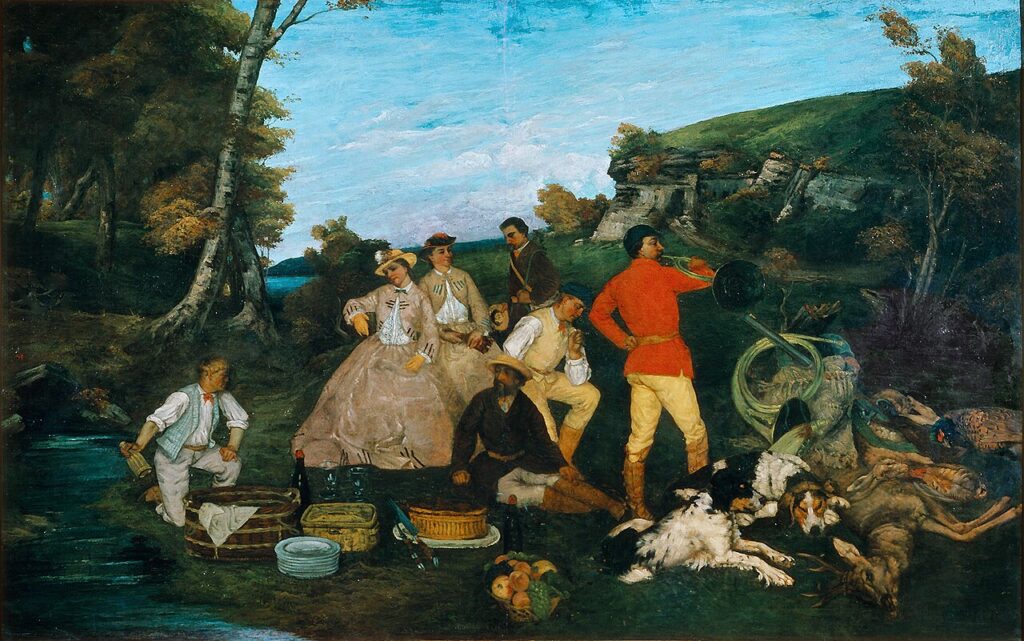
Gustave Courbet’s The Hunt Breakfast stands as one of the most atmospheric hunting scenes of nineteenth-century French painting. Created around 1858, the work captures a group of hunters resting in a forest clearing after a day outdoors, surrounded by dogs, weapons, and the fading quiet of the countryside. Unlike the idealized sporting paintings favored by aristocratic tradition, Courbet approached the scene with earthy realism and direct observation. The result was a painting that felt immediate, physical, and deeply connected to ordinary life in rural France.
The painting emerged during one of the most important periods in Courbet’s career. Born on June 10, 1819, in Ornans, France, Courbet became one of the leading figures of the Realist movement during the 1840s and 1850s. He rejected academic formulas and grand mythological fantasies in favor of scenes drawn from real laborers, ordinary people, and the French countryside. By the time he painted The Hunt Breakfast, he had already shocked critics with monumental works like A Burial at Ornans from 1849 to 1850 and The Stone Breakers from 1849.
The Hunt Breakfast also reveals a quieter side of Courbet’s personality. While he often gained attention for controversy and artistic rebellion, he remained deeply attached to his native Franche-Comté region throughout his life. Hunting excursions, walks through forests, and long meals with friends shaped much of his social world during the 1850s. The painting therefore feels personal rather than theatrical, almost like a memory preserved on canvas.
Today, The Hunt Breakfast continues to attract interest because it combines realism with atmosphere in a highly unusual way. The painting is not simply about hunting, food, or leisure, but about companionship and the physical presence of nature. Courbet transformed a simple outdoor meal into an image rich with texture, mood, and social meaning. More than 160 years later, the painting still offers a vivid glimpse into nineteenth-century French life.
Gustave Courbet and the Rise of Realism
Gustave Courbet was born on June 10, 1819, in Ornans, a small town in eastern France near the Swiss border. His father, Régis Courbet, owned vineyards and farmland, while his mother, Sylvie Oudot Courbet, came from a respected local family. The artist grew up surrounded by forests, rocky hills, rivers, and rural traditions that later appeared repeatedly in his paintings. These early surroundings deeply shaped his preference for rugged landscapes and ordinary working people.
Courbet studied at the Collège Royal in Besançon during the 1830s before moving to Paris in 1839. Although he briefly attended law courses to satisfy family expectations, his true interest remained painting. He copied works by Spanish, Dutch, and Venetian masters at the Louvre rather than fully committing to academic training. Painters such as Diego Velázquez, Rembrandt, and Frans Hals influenced his love of dramatic realism and thick, physical brushwork.
Courbet’s Early Life and Artistic Rebellion
During the late 1840s, Courbet became associated with the emerging Realist movement in France. Realism rejected idealized historical fantasies and instead focused on contemporary life and direct observation. His massive painting A Burial at Ornans, exhibited in 1850, caused controversy because it treated ordinary villagers with the scale usually reserved for kings or biblical scenes. Critics considered the work crude and unrefined, but younger artists saw it as revolutionary.
Courbet’s independent attitude often placed him in conflict with official art institutions during the reign of Napoleon III. In 1855, after several works were rejected from the Exposition Universelle, he created his own Pavilion of Realism near the exhibition grounds. This bold act strengthened his reputation as an artistic rebel willing to challenge Parisian authority. By the late 1850s, when The Hunt Breakfast was painted, Courbet had become both admired and feared within the French art world.
The Creation of The Hunt Breakfast
The Hunt Breakfast was painted around 1858 during a mature phase of Courbet’s career. At the time, France was experiencing major social and industrial changes under the Second Empire, yet many rural traditions remained deeply rooted in the countryside. Hunting excursions were especially important among landowners, professionals, and provincial social circles. Courbet frequently participated in these gatherings and understood their rituals from direct experience.
The painting reflects the slower rhythms of outdoor life before industrial modernity transformed much of Europe. Rather than presenting a triumphant hunting victory, Courbet focused on the quiet aftermath of the event. The men sit among trees with their dogs resting nearby while food and drink appear casually arranged around them. The atmosphere feels cool, damp, and earthy, almost as though the viewer can smell wet leaves and wood smoke.
When and Why Courbet Painted the Scene
Art historians believe Courbet may have used friends and acquaintances from his native region as models for the painting. Some scholars have speculated that the figures represented members of local hunting parties familiar to the artist during the 1850s. Documentation remains limited, so parts of these identifications remain uncertain and should be viewed as responsible historical speculation rather than confirmed fact. Courbet often blended portraiture and genre painting together in this manner.
The Hunt Breakfast also reveals the influence of older European traditions. Dutch and Flemish hunting scenes from the seventeenth century frequently depicted outdoor meals and sporting gatherings, though usually with aristocratic polish. Courbet stripped away much of that elegance and replaced it with realism and physical immediacy. The figures appear tired, weathered, and human instead of idealized symbols of privilege.
Visual Analysis of The Hunt Breakfast
The composition of The Hunt Breakfast immediately draws attention to the dense woodland environment surrounding the figures. Trees arch overhead while muted light filters through leaves and branches onto the hunters below. Courbet arranged the group in a natural but carefully balanced manner that guides the eye slowly across the scene. The setting feels enclosed and intimate, creating the sensation of entering a private moment in the forest.
Courbet’s use of color reinforces the earthy atmosphere of the painting. Browns, dark greens, blacks, and deep reds dominate the canvas, giving the scene a rich autumnal weight. His thick brushwork creates rough textures that resemble bark, fabric, mud, and animal fur. Instead of polished surfaces, the painting embraces the tactile qualities of the natural world.
Composition, Color, and Atmosphere
The figures themselves reveal Courbet’s commitment to realism. Their faces are individualized rather than idealized, and their clothing appears worn from practical outdoor use. Hunting dogs rest beside their owners with believable anatomy and calm expressions. Weapons, bags, and drinking vessels are scattered throughout the composition in ways that feel spontaneous rather than staged.
The emotional atmosphere remains one of the painting’s greatest strengths. Unlike Romantic hunting scenes filled with dramatic action, The Hunt Breakfast emphasizes stillness and exhaustion after physical activity. Some figures appear contemplative while others seem quietly satisfied after the day’s events. Courbet transformed an ordinary meal in the woods into a scene of remarkable psychological depth and sensory realism.
Hunting, Masculinity, and Social Identity in the Painting
During the nineteenth century, hunting carried strong social and cultural meaning throughout France. It represented skill, endurance, companionship, and a connection to the land. Sporting gatherings also reinforced bonds between men through shared rituals involving food, alcohol, storytelling, and outdoor activity. Courbet understood these traditions intimately and portrayed them without romantic exaggeration.
The hunters in The Hunt Breakfast are not aristocratic heroes posed in glamorous fashion. Instead, they appear grounded, practical, and physically present within their environment. Their boots, jackets, and equipment show signs of actual use rather than decorative elegance. This realism reflected Courbet’s broader artistic mission to portray ordinary life honestly.
What the Scene Reveals About Nineteenth-Century Society
The relationships between the figures also contribute to the painting’s emotional richness. Their relaxed postures suggest familiarity and long-standing companionship developed through repeated excursions into the countryside. The dogs resting nearby reinforce the sense of loyalty and shared routine. Courbet captured not only a meal but an entire social atmosphere built around rural traditions.
The painting can also be interpreted as a document of a disappearing way of life. During the 1850s and 1860s, industrial growth increasingly transformed French society and pulled people toward expanding cities. Courbet’s rural hunting scenes preserved older customs tied to forests, farms, and provincial identity. The work therefore functions both as a realistic observation and as a quiet defense of regional tradition.
Critical Reception and Artistic Influence
Courbet’s hunting paintings received mixed reactions from critics during the nineteenth century. Conservative reviewers often complained about the roughness of his technique and the absence of idealized beauty. Others praised the physical realism and emotional honesty of his work. Even critics who disliked Courbet admitted that his paintings possessed extraordinary power and presence.
By the late 1850s, Courbet had already become one of the most controversial painters in France. His conflicts with the Paris Salon and official institutions made him a symbol of artistic independence. The Hunt Breakfast did not generate the same scandal as some earlier works, yet it reinforced his reputation as a painter unwilling to flatter elite expectations. He preferred truthful observation over polished fantasy.
How Critics and Artists Responded
Courbet’s influence extended far beyond Realism itself. Younger painters admired his willingness to paint directly from life and to use thick, visible brushstrokes. Artists associated with Impressionism during the 1860s and 1870s respected his outdoor methods and rejection of rigid academic standards. Édouard Manet in particular recognized Courbet as an important modern predecessor.
Hunting scenes also changed after Courbet’s example. Earlier sporting paintings often focused on aristocratic spectacle and decorative elegance. Courbet instead emphasized atmosphere, fatigue, mud, weather, and companionship. His approach encouraged later artists to treat rural subjects with greater honesty and psychological realism.
The Hunt Breakfast in Modern Art History
Today, The Hunt Breakfast occupies an important place within discussions of nineteenth-century French Realism. Art historians frequently study the painting as an example of Courbet’s ability to combine landscape, portraiture, and genre painting within a single composition. The work demonstrates his fascination with physical texture and natural light. It also reveals his deep attachment to the countryside of eastern France.
Modern viewers often respond strongly to the painting’s atmosphere. The forest setting feels immersive and believable rather than theatrical. Courbet’s earthy colors and textured surfaces continue to appear remarkably modern compared to many polished academic works from the same decade. The painting rewards slow viewing because small details emerge gradually from the dark surroundings.
Preservation, Scholarship, and Continuing Interest
Scholars have also explored how The Hunt Breakfast reflects broader social concerns of the nineteenth century. Themes of masculinity, leisure, companionship, and regional identity all appear within the scene. Some historians interpret the work as a subtle response to industrial modernization and urban growth. Others emphasize its connection to older European hunting traditions dating back centuries.
Courbet died on December 31, 1877, in La Tour-de-Peilz, Switzerland, after years of political controversy and exile. Despite the turbulence of his later life, his reputation grew steadily after his death. Paintings such as The Hunt Breakfast helped establish him as one of the major innovators of modern art. Today, museums and scholars continue to view his work as a turning point between traditional painting and modern realism.
The Lasting Legacy of The Hunt Breakfast
The Hunt Breakfast remains significant because it captures ordinary life with unusual emotional depth and honesty. Courbet did not attempt to glorify his subjects through mythological symbolism or theatrical poses. Instead, he trusted direct observation and physical presence to carry the painting’s emotional weight. This approach helped reshape the direction of European art during the nineteenth century.
The painting also preserves aspects of rural French culture that were beginning to disappear by the late 1800s. Hunting parties, forest meals, and close provincial communities formed an important part of regional identity for generations. Courbet painted these traditions not as sentimental fantasies but as lived experiences rooted in everyday life. The result feels authentic rather than nostalgic.
Why the Painting Still Matters
Modern audiences continue to admire The Hunt Breakfast because of its atmosphere and humanity. The figures appear believable, imperfect, and physically connected to their environment. Courbet’s rough brushwork gives the painting tremendous energy even during moments of stillness. Few artists of his era captured texture, mood, and companionship with such convincing realism.
The legacy of The Hunt Breakfast ultimately lies in its honesty. Courbet believed that artists should paint the world they truly knew rather than artificial ideals disconnected from ordinary experience. His commitment to realism influenced generations of painters who followed him into modern art. More than a century and a half later, the painting still invites viewers into a quiet forest clearing where time seems briefly suspended.
Key Takeaways
- Gustave Courbet painted The Hunt Breakfast around 1858 during the height of the French Realist movement.
- The painting focuses on realism, companionship, and rural hunting traditions rather than aristocratic spectacle.
- Courbet was born on June 10, 1819, in Ornans, France, and died on December 31, 1877, in Switzerland.
- The work combines landscape painting, portraiture, and genre scenes within a single atmospheric composition.
- The Hunt Breakfast helped strengthen Courbet’s reputation as one of the pioneers of modern realism.
FAQs
What is The Hunt Breakfast by Courbet about?
- The painting depicts hunters resting and sharing a meal in a wooded setting after a day outdoors.
- It emphasizes realism and ordinary life instead of heroic fantasy.
- Courbet focused on atmosphere, texture, and companionship.
- The scene reflects nineteenth-century rural French culture.
- The work is considered an important example of French Realism.
When did Gustave Courbet paint The Hunt Breakfast?
- Most historians date the painting to around 1858.
- It belongs to Courbet’s mature artistic period.
- The work came after major paintings like A Burial at Ornans.
- It was created during the reign of Napoleon III.
- The painting reflects Courbet’s growing confidence as a Realist painter.
Why was Courbet considered controversial?
- Courbet rejected idealized academic painting traditions.
- He portrayed ordinary people on a monumental scale.
- His brushwork appeared rough compared to Salon standards.
- He challenged official art institutions during the 1850s.
- Many critics considered his realism too direct and unpolished.
What artistic movement is associated with Courbet?
- Courbet became one of the leading figures of Realism.
- Realism emphasized everyday life and direct observation.
- The movement rejected mythological fantasy and idealization.
- Courbet influenced later Impressionist and modern painters.
- His work helped change the direction of nineteenth-century art.
Why does The Hunt Breakfast still matter today?
- The painting captures a disappearing rural culture with honesty.
- Modern viewers admire its atmosphere and realism.
- It reveals important social traditions of nineteenth-century France.
- The work influenced generations of later artists.
- It remains one of Courbet’s most immersive outdoor scenes.