The history of the Paris Salon is one of power, ambition, rebellion, and artistic transformation. For nearly two centuries, a single exhibition in Paris could decide whether an artist became wealthy or disappeared into obscurity. The Salon stood at the center of French cultural life, drawing aristocrats, critics, collectors, and ordinary citizens into crowded halls filled with massive paintings and marble sculptures. The smell of varnish, candle smoke, and damp wool coats mixed with heated debate as artists fought for recognition beneath towering ceilings.
At its height during the eighteenth and nineteenth centuries, the Paris Salon acted as the supreme authority in Western art. Acceptance into the exhibition often meant commissions, royal favor, and financial security. Rejection, by contrast, could destroy years of labor and leave painters struggling to survive in cramped Paris apartments. The institution shaped artistic standards across Europe and influenced everything from portraiture to history painting.
The Salon also became the battleground where tradition clashed with innovation. Academic artists defended strict rules rooted in classical ideals, while younger painters sought to capture modern life with greater honesty and emotion. This struggle eventually produced some of the most famous artistic revolutions in history, including Realism and Impressionism. Few institutions have had such an enormous impact on the development of art.
Even today, the legacy of the Paris Salon still echoes through museums, galleries, and art schools around the world. Modern debates about artistic standards, public taste, and cultural authority often resemble arguments first fought in nineteenth-century Paris. The Salon’s story is therefore much more than a chapter in French history. It is the story of how art itself entered the modern age.
The Origins of the Paris Salon in Royal France
The Paris Salon began in 1667 during the reign of King Louis XIV, who ruled France from 1643 until his death in 1715. Louis XIV believed culture reflected the strength and dignity of the French state. His finance minister, Jean-Baptiste Colbert, born in 1619 and deceased in 1683, worked closely with the crown to centralize artistic control. Together they expanded royal institutions that could shape public taste and strengthen national prestige. The Académie Royale de Peinture et de Sculpture became one of the monarchy’s most important cultural tools.
Charles Le Brun, born in 1619 and deceased in 1690, emerged as one of the academy’s most influential figures. Le Brun served as court painter to Louis XIV and helped establish strict artistic standards based on classical ideals. Under his leadership, artists were encouraged to create orderly compositions that celebrated heroism, religion, and royal authority. The monarchy viewed art as a weapon of influence, much like military victories or architectural grandeur. Historians believe the crown understood that images could shape public loyalty more effectively than speeches alone.
From Court Patronage to Public Exhibition
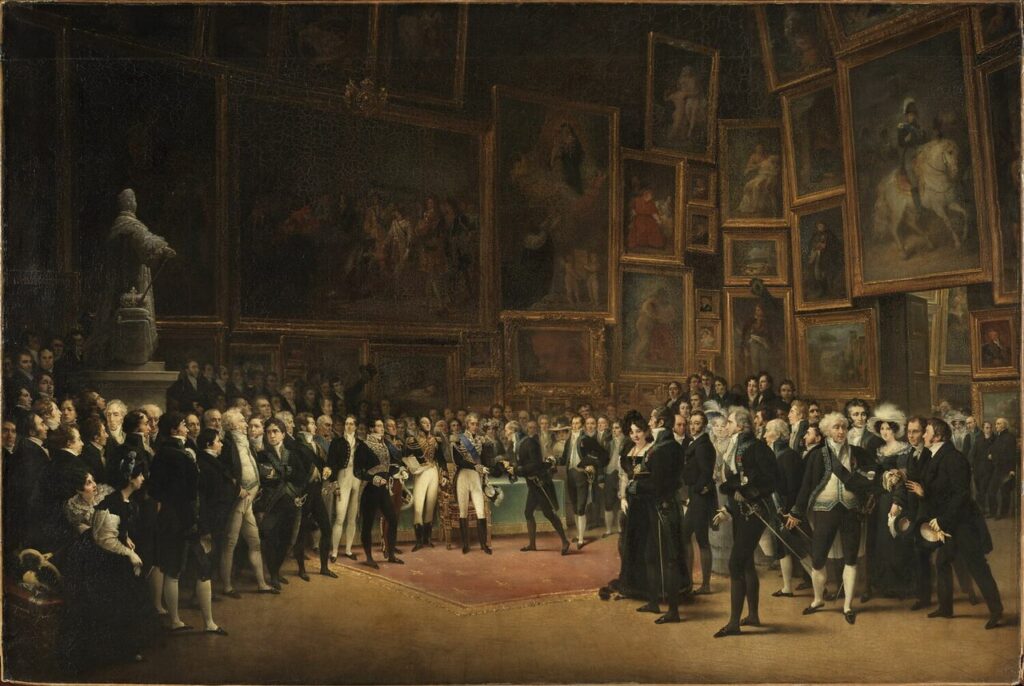
The Salon received its name from the Salon Carré inside the Louvre Palace, where many early exhibitions were held. These exhibitions allowed selected artists to display their work before influential audiences that included nobles, wealthy merchants, and visiting diplomats. The walls were often crowded from floor to ceiling with enormous canvases framed in gold leaf. Viewers walked slowly through the packed rooms while discussing brushwork, symbolism, and political meaning. Attendance gradually became a major social event in Parisian life.
The earliest versions of the Salon were not entirely open to ordinary citizens, though access expanded over time. By the eighteenth century, members of the public increasingly attended exhibitions and formed strong opinions about artistic quality. Some scholars speculate that royal officials underestimated how vocal these crowds would become in later decades. Public criticism eventually weakened the academy’s total control over artistic reputation. Still, during its early years, the Salon successfully reinforced the monarchy’s vision of order, discipline, and cultural supremacy.
How the Salon Became the Gatekeeper of Artistic Success
During the eighteenth century, the Paris Salon evolved into the most important art exhibition in Europe. Acceptance into the Salon could transform an unknown painter into a celebrated public figure almost overnight. Wealthy collectors visited the exhibition searching for fashionable artists to commission portraits or decorative works. Young painters trained for years in academy workshops with hopes of impressing Salon juries. Rejection often meant financial hardship, damaged reputation, and professional isolation.
The academy established strict standards that artists were expected to follow carefully. History painting occupied the highest level within the official hierarchy of genres because it portrayed heroic events from religion, mythology, or classical history. Portraiture ranked beneath history painting, while landscapes and still lifes occupied lower positions. This hierarchy reflected the academy’s belief that intellectual subjects deserved greater respect than scenes from ordinary life. Artists who wished to succeed usually adapted their work to fit these expectations.
Fame, Fortune, and Official Approval
Denis Diderot, born in 1713 and deceased in 1784, became one of the first major art critics associated with the Salon. His written reviews described paintings in vivid detail and helped shape public opinion across France. Diderot admired emotional honesty and often criticized works that felt cold or artificial. His criticism demonstrated that artistic reputation no longer depended solely on royal approval. Public debate had become an increasingly powerful force within French cultural life.
Jacques-Louis David, born in 1748 and deceased in 1825, rose to prominence through the Salon during the late eighteenth century. David mastered Neoclassical painting, producing dramatic scenes inspired by ancient Rome and Greece. His works reflected discipline, sacrifice, patriotism, and moral clarity, qualities admired during the years leading to the French Revolution. Students gathered around David’s studio, hoping to learn his methods and gain academy support. The Salon had become both a cultural spectacle and a fierce competition where ambition shaped every brushstroke.
Revolution, Empire, and the Transformation of French Art
The French Revolution of 1789 changed nearly every aspect of French society, including the Paris Salon. Royal authority collapsed, aristocratic patronage weakened, and artists suddenly faced a transformed political landscape. Revolutionary leaders recognized the power of visual imagery and continued using art to shape public opinion. The Salon survived, though its purpose shifted from glorifying monarchy to promoting national identity and revolutionary ideals. Crowds still gathered in exhibition halls, but the mood had become far more political and emotional.
Jacques-Louis David embraced the Revolution enthusiastically and formed close political ties with revolutionary leaders. David supported Maximilien Robespierre during the Reign of Terror and used his art to celebrate republican virtue. His famous paintings depicted martyrs of the Revolution with almost religious intensity. After Robespierre’s fall in 1794, David himself was imprisoned briefly because of his political involvement. His career demonstrated how deeply intertwined art and politics had become in revolutionary France.
Art During Political Upheaval
Napoleon Bonaparte, born in 1769 and deceased in 1821, understood the importance of artistic propaganda. After rising to power in 1799 and crowning himself Emperor in 1804, Napoleon commissioned grand paintings that presented him as a heroic leader restoring order to France. Artists portrayed him crossing mountain passes, leading armies, and presiding over magnificent ceremonies. These images appeared throughout France and reinforced his political authority. The Salon became a showcase for imperial ambition as much as artistic skill.
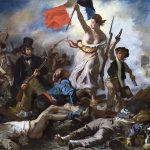
Romanticism emerged partly as a reaction against the rigid structure of Neoclassicism. Eugène Delacroix, born in 1798 and deceased in 1863, became one of the movement’s greatest painters. Delacroix favored emotional intensity, dramatic color, and scenes filled with movement and passion. His rivalry with defenders of classical order reflected broader tensions within French society after years of revolution and war. Some historians speculate that audiences were drawn to Romanticism because it captured the uncertainty and emotional exhaustion of the age more honestly than idealized classical imagery.
The Salon and the Rise of Realism in the Nineteenth Century
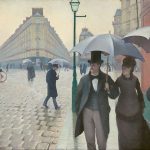
By the middle of the nineteenth century, France was changing rapidly because of industrialization and urban growth. Railroads expanded across the country, factories multiplied, and Paris itself underwent major reconstruction during the reign of Napoleon III. These transformations affected artistic taste as well as everyday life. Many younger painters believed traditional academic subjects no longer reflected the realities of modern society. They wanted art to depict ordinary people rather than distant heroes from mythology or ancient history.
Gustave Courbet, born in 1819 and deceased in 1877, became the leading voice of the Realist movement. Courbet rejected idealized imagery and insisted that painters should portray the world honestly, including laborers, farmers, and common citizens. His massive canvases shocked Salon audiences because they treated ordinary subjects with the scale and seriousness once reserved for kings or saints. Critics accused him of promoting ugliness and undermining artistic tradition. Courbet answered that art should reflect truth rather than fantasy.
Artists Begin Challenging Academic Tradition
Jean-François Millet, born in 1814 and deceased in 1875, also challenged academic expectations through scenes of rural labor. Millet painted peasants harvesting crops, gathering grain, and praying in fields at sunset. His works carried deep emotional dignity and reflected respect for hard work, faith, and family life. Some urban critics feared these paintings carried hidden political messages during a period of social unrest in France. Responsible historical speculation suggests that conservative elites worried realistic depictions of poverty might encourage public sympathy for revolutionary movements.
The Salon juries resisted many of these artistic changes because they feared losing control over standards and taste. Rejections became increasingly controversial as younger artists accused the academy of favoritism and intellectual rigidity. Meanwhile, middle-class audiences expanded due to economic growth and greater literacy. Newspapers covered Salon disputes in detail, turning artistic arguments into national conversations. The history of the Paris Salon during this period reveals a growing conflict between official authority and the unpredictable energy of modern culture.
The Salon des Refusés and the Birth of Modern Art
The year 1863 marked one of the greatest turning points in the history of the Paris Salon. That year, the official Salon jury rejected thousands of submitted works, provoking outrage from artists and the public alike. Complaints became so intense that Emperor Napoleon III authorized a separate exhibition for rejected paintings called the Salon des Refusés. Visitors arrived partly out of curiosity and partly to mock the unusual works on display. Instead, many witnessed the beginning of a revolution in modern art.
Édouard Manet, born in 1832 and deceased in 1883, became the central figure of the controversy. His painting Le Déjeuner sur l’herbe shocked audiences because it showed a nude woman casually seated beside fully dressed men in a contemporary setting. Critics considered the work morally offensive and artistically unfinished. Yet younger painters admired Manet’s bold brushwork and rejection of academic conventions. The scandal surrounding his paintings made him one of the most discussed artists in Paris.
Rejected Artists Change Art History
Claude Monet, born in 1840 and deceased in 1926, formed close friendships with Pierre-Auguste Renoir, born in 1841 and deceased in 1919, along with several other young painters frustrated by Salon restrictions. These artists often painted outdoors together along rivers, gardens, and crowded city streets. They focused on changing light, atmosphere, and fleeting moments rather than polished historical scenes. Their loose brushstrokes and bright colors appeared radical compared to traditional academic standards. Financial struggles forced many of them to depend on family support or small private sales.
The Salon des Refusés helped convince avant-garde artists that independence offered greater creative freedom than academy approval. Public ridicule remained harsh during the early years of Impressionism, but interest gradually grew among collectors and younger audiences. Some historians speculate that urban modernization itself encouraged Impressionist techniques because modern city life seemed fast, unstable, and constantly changing. By the 1870s, independent exhibitions outside the official Salon had become symbols of artistic rebellion. The authority of the academy was beginning to crack under pressure from a new generation determined to define art on its own terms.
The Decline of the Paris Salon and Its Lasting Influence
The decline of the Paris Salon accelerated during the late nineteenth century as independent exhibitions gained popularity. In 1874, a group of Impressionist painters organized their own exhibition outside official Salon control. Critics mocked the works harshly at first, especially Monet’s Impression, Sunrise, which inspired the term Impressionism. Yet these independent exhibitions allowed artists to experiment freely without worrying about academy approval. A new artistic culture began forming around private galleries, collectors, and dealers instead of state institutions.
Paul Durand-Ruel, born in 1831 and deceased in 1922, played a major role in supporting Impressionist painters during difficult financial years. Durand-Ruel purchased works by Monet, Renoir, Camille Pissarro, and Edgar Degas even when public demand remained weak. His willingness to invest in controversial artists helped sustain the movement long enough for wider acceptance to develop. The relationship between artists and private dealers transformed the economics of art forever. Success increasingly depended on market demand rather than government-sponsored exhibitions.
From Cultural Authority to Historical Legacy
By the early twentieth century, the Paris Salon no longer held unquestioned authority over artistic taste. New movements such as Post-Impressionism, Fauvism, and Cubism emerged outside traditional academy structures. Younger artists valued experimentation and personal expression more than strict technical rules. Museums and commercial galleries gradually replaced centralized exhibitions as the primary spaces where artistic reputations developed. The old Salon system appeared increasingly outdated in a rapidly changing world.
Despite its decline, the Salon’s influence never fully disappeared. Modern art schools still debate questions about standards, technique, and artistic freedom that once dominated Salon controversies. Large international exhibitions continue shaping careers much like the Salon did during the eighteenth and nineteenth centuries. The history of the Paris Salon remains important because it reveals how institutions can both support creativity and restrict it. Its legacy lives on wherever artists struggle between tradition and innovation, discipline and independence, public approval and personal vision.
Why the Paris Salon Still Matters
The history of the Paris Salon reveals far more than the evolution of a French art exhibition. It tells the story of how governments, critics, collectors, and artists competed to define beauty, morality, and cultural authority across centuries of political change. From the reign of Louis XIV to the rise of Impressionism, the Salon shaped careers and transformed public taste throughout Europe. Few institutions have influenced Western art so deeply or so dramatically.
The Salon succeeded because it created a centralized stage where artistic achievement could be publicly celebrated and judged. Crowded exhibition halls turned painting into a public spectacle that fascinated rich and poor alike. Ambitious artists traveled to Paris hoping to earn recognition beneath the bright lights of the Louvre. Acceptance often meant wealth and prestige, while rejection could lead to humiliation and poverty. The emotional pressure surrounding the exhibitions became legendary.
The Lasting Echo of Artistic Conflict
At the same time, the Salon unintentionally encouraged rebellion by enforcing rigid standards too aggressively. Younger artists eventually rejected academic traditions they considered lifeless or disconnected from modern reality. This tension produced some of the most influential artistic movements in history, including Realism and Impressionism. The conflict between innovation and authority remains familiar even today in debates about culture, education, and public values. Artistic freedom often grows strongest when challenged by powerful institutions.
Modern audiences continue visiting museums filled with works once condemned by Salon juries. Paintings mocked during the nineteenth century now attract millions of admirers each year. Responsible historical speculation suggests that even some academy officials privately recognized the talent of controversial painters but feared weakening institutional authority by supporting them openly. The story of the Paris Salon therefore carries a timeless lesson about creativity and courage. Great art often begins as an uncomfortable challenge to accepted ideas before becoming part of cultural tradition itself.
Key Takeaways
- The Paris Salon began in 1667 under King Louis XIV and became Europe’s most powerful art exhibition.
- Acceptance into the Salon often determined an artist’s financial success and public reputation.
- The French Revolution and Napoleon Bonaparte transformed the Salon into a political as well as cultural institution.
- Realist and Impressionist painters challenged academic standards and weakened Salon authority during the nineteenth century.
- The legacy of the Paris Salon still influences modern museums, galleries, and artistic debates today.
FAQs
- What was the Paris Salon?
- Why was the Paris Salon important to artists?
- Who organized the Salon des Refusés in 1863?
- How did Impressionism challenge the Paris Salon?
- Why did the Paris Salon decline in influence?