The earliest art in Colorado was not made for galleries or collectors. It was carved into the bones of the land itself—etched, pecked, and painted into sandstone cliffs, canyon walls, and high desert boulders. This was not art for show, nor was it art for art’s sake. It was sacred, symbolic, and serious—created by cultures that left few written records but whose visual language still survives in the rock. Long before easels or museums, before Denver was mapped or the Rockies were claimed, the Colorado Plateau echoed with the deliberate tap of stone on stone.
The Reach of Ancient Hands
The rock art of Colorado, particularly in the western and southern portions of the state, belongs to some of the oldest continuous artistic traditions on the continent. Sites such as Shavano Valley, Canyon Pintado, Picketwire Canyonlands, and Dinosaur National Monument contain petroglyphs—designs pecked, incised, or abraded into stone—dating as far back as 1000 BC, and possibly earlier. These images range from simple abstract marks to complex figural compositions, often executed in positions and locations that suggest ceremonial or territorial significance.
Many of these early carvings were made by hunter-gatherer cultures whose names are unknown to history. Later, from around AD 200 to 1300, more elaborate and structured imagery emerged from what archaeologists refer to as the Fremont and Ancestral Puebloan cultures. While modern anthropology classifies these groups based on pottery, architecture, and foodways, their art tells a subtler, often stranger story—one populated by horned figures, handprints, spirals, animals, and other symbolic forms that resist easy interpretation.
The petroglyphs were not random. They were carefully placed, often in prominent or acoustically resonant locations, suggesting that rock art was linked to rituals, storytelling, or spiritual encounters. Some panels are high above ground, reachable only by climbing—perhaps intentionally separating sacred images from casual view. Others align with solar cycles or geographic markers, hinting at a kind of prehistoric cosmology inscribed in stone.
Pigment and Pattern: The Painted Image
Alongside the carved traditions, there exists a quieter but equally powerful tradition of pictographs—images painted with natural pigments onto rock surfaces. These are rarer in Colorado, due to erosion and the fragility of pigment in high-altitude climates, but where they do survive, they demonstrate remarkable control and stylization. Red and ochre figures, geometric grids, or even what appear to be hunting scenes survive in the deeper, more protected alcoves of canyon walls.
These pigments were made from ground minerals, charcoal, and organic binders. The technique required knowledge of chemistry, geology, and the behavior of weathered stone. In some instances, multiple layers of images were added over time, creating palimpsests of overlapping figures that suggest not abandonment, but return: the same site being used and re-used across generations for purposes that likely blended mythology, memory, and geography.
Notable in some pictograph traditions are anthropomorphic figures—human-like forms with elaborate headdresses or extended limbs. These do not appear to be simple representations of ordinary people. Their scale, isolation, and stylized features suggest they may have represented spiritual beings, clan figures, or mythic ancestors. Whether literal or symbolic, they speak to a culture deeply concerned with its place in the unseen world.
Damage, Survival, and Meaning Across Time
These ancient works are not protected by walls or glass. They are exposed to wind, sun, vandals, and time. Some panels have survived for over a thousand years, while others have been chipped, defaced, or destroyed within the last few decades by careless hikers or graffiti. This fragility has made documentation critical: archaeologists and conservators have undertaken extensive surveys and photographic mapping to record panels before they are lost entirely.
What these images mean, in specific terms, is difficult to say. The cultures that created them left no written explanation, and modern speculation ranges from spiritual ritual to hunting magic to clan identity. Some symbols appear across vast regions, suggesting a shared visual vocabulary among disparate groups. Others seem local and unique—tied to a single canyon or cliff.
Yet whatever their specific meanings, the presence of this art—enduring, intentional, and unmistakably human—marks the beginning of Colorado’s artistic record. The earliest creators may have used only stone tools and pigment, but they worked with purpose and placed their visions where the land would hold them.
Prehistoric art in Colorado wasn’t decorative. It was declarative. It came before politics, before museums, and before the region had any name at all. But the instincts it reveals—the urge to record, to represent, to shape meaning into visible form—form the bedrock of every tradition that followed.
1500s–1700s: Spanish Contact and the Absence of Visual Art Institutions
If Colorado’s prehistoric art leaves a record carved in stone, the following centuries leave almost nothing behind. From the early 1500s through the 1700s, as the Spanish Empire extended its reach north from Mexico into the American Southwest, the region that would become Colorado remained a blank spot in terms of sustained visual culture. While Catholic missions and colonial towns blossomed in present-day New Mexico, Arizona, and Texas—each with their own iconography, altarpieces, and devotional objects—Colorado remained largely outside that sphere. What this period offers, therefore, is not a chapter of artistic flourishing, but a study in historical absence: a cultural vacuum where art could not yet take root.
Unsettled Land and Unbuilt Churches
By the mid-16th century, Spain had established a strong religious and military presence in Mexico and was gradually pushing north. Expeditions such as that of Francisco Vásquez de Coronado (1540–1542) brought Spaniards as far north as present-day Kansas, while Juan de Oñate’s 1598 colonization of New Mexico created the first permanent European settlements in the Southwest. The Franciscan missionaries who accompanied these conquests built churches, taught Catholic doctrine, and imported Spanish religious art—usually modest versions of European baroque styles, adapted for remote use.
But Colorado remained beyond the practical edge of this colonial zone. Harsh winters, difficult geography, and the lack of large indigenous settlements or mineral wealth kept Spanish influence peripheral. A few early explorers passed through what is now southern Colorado, but they left no towns, no chapels, and no schools of art. Without missions, there were no retablos or frescoes; without settlement, there were no commissions or patrons.
By contrast, nearby New Mexican communities such as Santa Fe and Taos began developing their own artistic traditions rooted in Spanish devotional art: carved santos (saints), painted panels, and religious processions. These visual customs would later drift northward—but during this period, the cultural border between northern New Mexico and southern Colorado remained firm. The art stopped where the missionaries did.
Trade Without Ornament
While visual art failed to gain a foothold, other forms of cultural contact did occur. From the 17th century onward, Spanish traders and military patrols traversed the Rio Grande corridor and sometimes ventured into southern Colorado in search of resources or alliances. These early contacts introduced horses, metal tools, and trade goods into the region—altering patterns of life and mobility for many nomadic and semi-nomadic groups.
Yet this exchange was utilitarian, not aesthetic. It brought change, but not ornament. Few, if any, visual records survive from these interactions. No decorative arts, no illustrations, and no paintings mark the trail. The artistic silence of the era reflects the harsh practicalities of frontier life: food, security, and navigation mattered more than decoration or record.
What Colorado experienced during this time was an invisible passage of influence—hints of European culture without the infrastructure to support artistic creation. Unlike more stable regions where cathedrals and town squares provided space for public art, this land offered no canvas beyond the horizon.
The Waiting Ground
The 1700s passed much as the 1600s had: with sparse contact, intermittent exploration, and no real cultural anchoring. Colorado remained a transition zone—a place passed through, not settled. Spain continued to focus its efforts on better-watered, more profitable regions, and by the time Mexican independence arrived in 1821, Colorado had seen nearly three centuries of nominal European claim with almost no visible artistic result.
This long silence matters. It sets the stage for what comes next. When the 19th century dawned, Colorado had no colonial architectural legacy, no painting traditions, no schools of art inherited from the Old World. Unlike Virginia or California, it began its formal artistic life not with imported styles or religious traditions, but with sketches made by soldiers, surveyors, and scouts—men whose task was not to beautify, but to document.
This absence of European tradition gave Colorado art a distinct beginning. When it did emerge, it was practical, often crude, and deeply tied to the landscape—not handed down from empire, but built from scratch in a raw and demanding place.
1800–1858: Exploration and the First Western Sketches
Colorado’s entrance into the visual record of American art did not begin with brushstrokes or finished paintings, but with field notebooks, graphite, and ink. The early 19th century brought explorers, military officers, and government surveyors into what was then a nameless and unclaimed portion of the American interior. Their drawings were not created for beauty or posterity but for logistics, navigation, and political knowledge. And yet, in these early, functional sketches, a tradition began. Long before the first art schools or galleries appeared, Colorado was seen and drawn by men tasked with describing the unknown.
The Land as Subject, Not Backdrop
The Louisiana Purchase of 1803 brought the central portion of North America under U.S. control, but much of the western interior remained unmapped. The Rocky Mountains were known in name but not in contour. Expeditions into this territory were often military or scientific in nature, designed to gather geographic information, locate resources, and assess the feasibility of future routes and settlements. Art was never the primary goal, but the inclusion of artists or draftsmen on such missions proved indispensable.
Among the earliest American expeditions to enter Colorado were those of Zebulon Pike (1806) and Stephen Harriman Long (1820). Pike, who gave his name to Pike’s Peak, made few sketches himself, but his reports described terrain that no official American eyes had yet seen. Long’s party included trained illustrators who produced more detailed records—drawings of mountain ranges, rivers, and plant life that served as both scientific documentation and visual testimony.
These artists, usually attached to military units or government agencies, were expected to work fast, often under poor conditions. Their materials were limited: ink, pencil, and perhaps watercolor if the weather permitted. Yet their sketches helped establish the first recognizable visual identity for the region. The sharp ridgelines of the Front Range, the expanse of the plains, and the narrow canyons of the Arkansas and Platte Rivers began to appear in federal reports and engravings published for public consumption in the East.
The land itself was the focus. There were no cities, no institutions, no permanent structures to speak of. These early drawings made no attempt at sentimentality or heroism—they were observational. The scale of the landscape, however, forced a kind of sublimity into the frame. It was clear to anyone viewing these images that Colorado was vast, rugged, and almost unmanageable. That sense of power and space would remain a hallmark of its visual culture for generations.
Topography, Not Romanticism
Unlike the studio painters of the East Coast who imagined the frontier as a place of myth and moral grandeur, the early sketchers of Colorado were far more literal. Their art came from the traditions of cartography and scientific illustration, not allegory or poetic idealism. Mountains were labeled with elevations. Rivers were noted for flow rate and navigability. The focus was factual, but in some cases, it achieved more.
One notable figure from this period was Charles Preuss, a Prussian cartographer who worked alongside John C. Frémont in the 1840s. While much of Preuss’s work dealt with maps and topographic measurements, his journals and visual notes offer striking glimpses of the mountain West, including parts of Colorado. Preuss’s charts combined mathematical accuracy with visual clarity, capturing not just land features but their personality: cliff faces, sloping valleys, and the interplay of water and stone rendered with precision.
These sketches were later turned into engravings and lithographs for published expedition reports, widely circulated by the U.S. government and academic societies. By the 1850s, Americans who had never seen the Rockies in person could study their profiles in government publications. These images were not artworks in the traditional sense, but they laid the groundwork for Colorado’s image in the American mind: wild, vertical, unyielding, and waiting to be measured.
The Artist as Explorer
The role of the artist on these expeditions was closer to that of a technician or assistant than an independent creator. He was expected to stay in the background, record data, and provide illustrations that conformed to the needs of surveyors and commanders. Yet some of these men, like Titian Ramsay Peale and James Wilkins, brought a personal eye to the task. They noticed light. They shaped shadow. They allowed their lines to do more than just record—they began to interpret.
In 1853, artist and explorer Richard Kern joined the Gunnison-Beckwith expedition, surveying a potential route for a transcontinental railroad. Kern’s illustrations of the San Juan Mountains, the Gunnison River, and various passes in western Colorado rank among the most detailed and atmospheric images from this early period. His drawings were later used by lithographers to produce official records for the Pacific Railroad Surveys, among the most ambitious scientific visual projects of the 19th century.
These efforts marked the first sustained attempt to see Colorado not as blank territory but as an environment with artistic potential—though no formal art scene yet existed. The drawings and engravings of this era remained tied to exploration, but their quiet precision and sometimes haunting perspective hinted at something more: that the land itself could be the subject of American art, not merely its setting.
By the time the Colorado Gold Rush erupted in 1858, the groundwork had been laid. The artists who followed the prospectors would have more freedom, better materials, and a growing audience eager for images of the West. But their inheritance came from these early field sketchers—men who drew not to impress, but to understand.
1858–1876: The Pike’s Peak Gold Rush and Territorial Art
The year 1858 marked a turning point in Colorado’s cultural and visual history. With the discovery of gold near present-day Denver and along the South Platte River, thousands of prospectors, merchants, and opportunists poured into the region. What followed was not only a mining boom, but the rapid transformation of an untamed frontier into a semi-organized territory with towns, industry, and—crucially—a demand for visual documentation and portraiture. As cabins became settlements and settlements became cities, artists emerged to record, advertise, and elevate the promise of the Pike’s Peak country. This period saw the birth of Colorado’s first locally produced art, created not by distant illustrators but by men who lived in the camps, knew the terrain, and often worked out of necessity.
Boomtown Studios and the Rise of Practical Art
Gold brought people, and people brought need—need for records, need for identity, and need for self-promotion. Photographers were among the earliest creative professionals to establish themselves in the booming towns of Central City, Denver City, Golden, and Leadville. Their services were in constant demand: miners wanted to send proof of their success to family back east; businessmen sought images to legitimize their ventures; civic leaders commissioned portraits to cement their reputations.
Daguerreotypes, ambrotypes, and later tintypes became commonplace. Portable studios cropped up along wagon routes, often housed in tents or hastily constructed wooden shacks. The images produced in these conditions may have lacked polish, but they possessed a striking directness. Portraits from this era show dirt under fingernails, crude tools held with pride, and a hard, honest light that captured the ambition—and exhaustion—of frontier life.
Painters also began to arrive, though more slowly. Many were self-taught, producing signs, decorative murals, or promotional paintings for hotels, saloons, and stagecoach companies. Some offered portrait commissions, painting prospectors with their picks and pans, or wives in their Sunday best against imagined backdrops of mountains and flowering meadows. These images were rarely masterpieces, but they served an essential function: they made the miner or merchant feel permanent in a world defined by flux.
One name worth mentioning is William Gunnison Chamberlain, a New York–trained artist who settled in Denver in the early 1860s. He painted civic figures, domestic scenes, and genre works based on frontier life. Though little of his work survives, contemporary reports note his efforts to instill “Eastern refinement” into a rough setting. His studio in Denver marked one of the first attempts to create an art career west of the Missouri River.
Illustrating the Rush: Newspapers, Lithographs, and Propaganda
The Pike’s Peak Gold Rush was as much a promotional enterprise as a mining event. Real estate speculators, stage lines, and railroad companies all sought to convince settlers and investors that Colorado was not just a place to strike it rich, but a territory with culture, order, and permanence. Artists and engravers played a crucial role in this image-making campaign.
Lithographs of the period show grand visions of Denver with broad boulevards, steeples, and railway lines—most of which did not yet exist. These images functioned like advertisements, exaggerating the urban sophistication of what were, in reality, muddy frontier towns with boardwalks and outhouses. The visual vocabulary of these prints borrowed heavily from Eastern cities, applying architectural symmetry and compositional balance to a landscape still in flux.
One of the most active firms producing such work was the Kollner & Son studio out of Philadelphia, which issued prints based on field sketches or secondhand reports. These were circulated widely in newspapers, travel guides, and promotional pamphlets aimed at potential settlers. In some cases, illustrations bore little resemblance to reality, but they served their purpose: they sold the dream of Colorado as both profitable and civil.
Alongside these idealized prints were more grounded images—sketches by journalists, itinerant artists, and government agents. Periodicals such as Harper’s Weekly and Frank Leslie’s Illustrated Newspaper featured woodcut engravings of frontier scenes, mining camps, and skirmishes, bringing Colorado into the national imagination. These illustrations, often based on on-site drawings, blended accuracy with dramatic flair, helping to shape the myth of the rugged West.
From Territory to Statehood: Art Catches Up
By the time Colorado became a territory in 1861 and moved toward statehood in 1876, its cultural infrastructure had begun to form. Denver hosted small exhibitions. Amateur art societies gathered in rented rooms or the back of general stores. The first art classes were taught not in academies but in private homes or by traveling instructors. The idea of art as an essential part of civic life had taken root—tentatively, but undeniably.
Sign painters and decorative artisans became increasingly important, too. With the rise of permanent buildings came the need for ornament: signs for shops and saloons, frescoes in theaters, decorative ceilings in hotels. The frontier aesthetic began to soften. Where once only utility mattered, now there was room for embellishment, for beauty, for visual pride.
In 1874, the short-lived Colorado School of Fine Arts opened in Denver, predating the state’s official recognition by two years. Though it struggled to maintain funding and faculty, its founding marked a symbolic shift. Art was no longer incidental. It had become, at least in some circles, a sign of civilization.
In the years leading to statehood, Colorado’s art remained provisional and mostly local. But its roots were set: a hybrid of necessity, ambition, and pride in place. What began in mining camps and printshops would soon evolve into something more stable—and far more sophisticated.
1876–1899: Statehood and the Romantic Landscape Tradition
When Colorado was admitted to the Union in 1876, it was a young state with old mountains—and artists saw an opportunity. The decades following statehood marked the beginning of Colorado’s engagement with the broader American art scene. Painters, particularly landscape artists, came west not merely to record, but to elevate. The Rockies were cast as subjects worthy of awe, grandeur, and even national pride. In this period, the Romantic tradition of landscape painting—already well developed in the East—took root in Colorado soil, producing some of the most ambitious and enduring images in the state’s artistic history.
The Rockies as the American Sublime
Throughout the 19th century, American painters had looked to nature for meaning. In the Hudson River School, figures like Thomas Cole and Frederic Edwin Church portrayed the Catskills and the Adirondacks as moral landscapes—pure, dramatic, and instructive. By the 1870s, however, attention had turned westward. The Sierra Nevada and Yosemite had already been painted by Albert Bierstadt and Thomas Hill; the next frontier was Colorado.
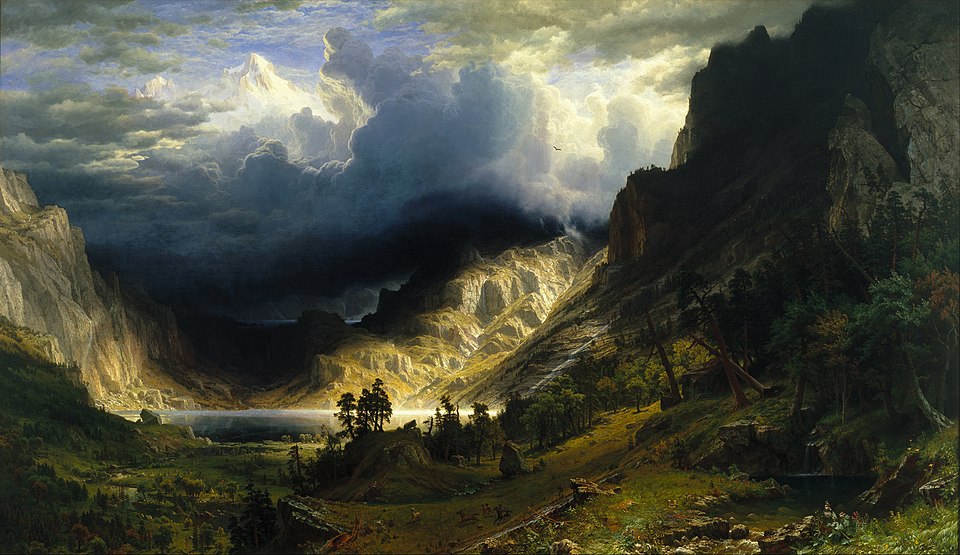
Albert Bierstadt, although not based in the state, played a central role in shaping its early image through art. His monumental painting Storm in the Rocky Mountains, Mt. Rosalie (1866)—based on sketches from earlier western journeys—set the tone. Towering peaks, sweeping valleys, dramatic skies, and tiny figures dwarfed by nature filled his canvases. Though composed in a studio and often embellished beyond realism, Bierstadt’s work created an archetype: Colorado as sublime, elevated, and spiritually charged.
Painters who followed took this model seriously. Some aimed to match Bierstadt’s theatrical scale; others brought a more intimate approach. What unified them was the sense that the Rockies deserved attention equal to any European mountain range—that the American West had its own majesty, not merely to be exploited, but to be admired.
The visual language of these artists included:
- Grand Vistas: Compositions anchored by distant peaks, with light breaking through storm clouds or warming alpine lakes.
- Tiny Figures: Hunters, trappers, or surveyors shown small against vast terrain, emphasizing the immensity of nature.
- Natural Detail: Careful rendering of trees, water, rock, and sky—each painted with reverence for form and atmosphere.
These works often toured eastern cities, presented in salons or sold as prints. Colorado, for many urban Americans, became known not through travel, but through oil paint.
Local Painters, Distant Patrons
While eastern painters like Bierstadt used Colorado as subject matter, a few artists began to settle in the state itself, drawn by the light, space, and isolation. Among them was Harvey Otis Young, who moved to Colorado Springs in the 1870s. A veteran of the California Gold Rush turned painter, Young produced landscapes of the Rockies with a quieter, more contemplative mood than Bierstadt’s operatic style. His works reveal the daily presence of the mountains—not just their drama, but their calm.
Another was Hamilton Hamilton (yes, that was his name), who spent time painting in Colorado during the late 1880s. Though based in New York, his Colorado canvases show a deep familiarity with local terrain, painted with fidelity and restraint. Unlike the symbolic overload of earlier Romanticism, his work suggested lived experience—nature not as spectacle, but as fact.
Art societies and salons in Denver, Central City, and Colorado Springs offered local painters a platform, albeit a modest one. Wealthy patrons from mining, rail, and cattle fortunes began to support art as a sign of refinement. A few commissioned portraits or decorative murals. But more often, landscape was what sold: it offered a statement of identity, proof that Colorado possessed not only resources, but beauty.
By the 1890s, art dealers in Chicago and St. Louis had taken notice. Paintings from Colorado circulated in urban markets, often labeled with dramatic titles to enhance their appeal. The state’s visual identity, once vague, now had features: snowy peaks, wildflowers, golden aspens, and high alpine lakes. These became tropes, but they also reflected reality. Colorado did look like that—especially when seen by someone seeking wonder.
The Tension Between Reality and Ideal
Despite the success of these landscape works, there was an underlying tension. The Colorado they portrayed was real, but not typical. Most residents lived in growing towns, surrounded by industry, railroads, and labor. The idealized scenes of untouched nature often ignored the visible scars of mining, timber, and expansion.
This dissonance was not lost on viewers, but it was tolerated—sometimes even embraced. Romantic landscape painting offered more than literal description; it gave form to aspiration. For settlers and locals, these paintings affirmed that they had chosen well. For distant patrons, they offered a vision of America still unspoiled.
Yet even within the genre, cracks began to show. Some artists began including evidence of human presence: fences, cabins, mining roads. Others experimented with looser brushwork or more muted color, anticipating the shifts of the next century. The Romantic ideal would not last forever—but in this closing quarter of the 19th century, it remained the dominant force in Colorado art.
With statehood came symbolism, and with symbolism came landscape. Colorado, newly official, presented its face to the world not through buildings or banners, but through canvas. The mountains became more than geology—they became emblematic of the state’s place in the American imagination.
1900–1918: Institutional Foundations and Artistic Colonies
As the 20th century dawned, Colorado’s visual culture began to shift from scattered individual efforts to something more stable and organized. What had once been a place of itinerant sketchers and landscape romantics slowly developed the scaffolding of a proper art world: schools, exhibitions, instructors, and patrons. Though still small in comparison to the coastal art centers, Colorado carved out a distinctive role—part retreat, part training ground, and part proving ground for artists seeking clarity, solitude, and instruction.
This period saw the founding of the state’s first serious art institutions, particularly the Broadmoor Art Academy in Colorado Springs. It also witnessed the rise of artist colonies—clusters of working painters drawn to the natural light, high elevation, and low cost of living. In a region known for rugged independence, these early cultural developments helped define art as a profession, not a pastime.
The Broadmoor Art Academy and the Colorado Springs Renaissance
In 1919, just outside the range of this section’s timeframe, the Broadmoor Art Academy was officially founded—but its roots lie firmly in the years leading up to World War I. Its creation was made possible by the philanthropy of Spencer and Julie Penrose, prominent Colorado Springs residents whose fortune derived from mining, hotels, and regional infrastructure. They purchased the former home of Edward Palmer—the city’s founder—and transformed it into a cultural outpost modeled loosely after European academies and East Coast art schools.
Before its formal opening, a community of instructors, patrons, and students had already begun gathering in Colorado Springs, drawn by its clean air, mountain views, and genteel aspirations. Artists including Robert Reid, John F. Carlson, and Ernest Lawson visited or taught in the region. Though not all settled permanently, they brought with them the techniques and expectations of classical training: life drawing, still life, perspective, and composition rooted in academic tradition.
The academy emphasized plein air painting—working directly from the landscape—but it also maintained a strong commitment to formal instruction. Casts, figure models, and drawing from observation were central. This emphasis on technical rigor distinguished the Broadmoor school from looser, more bohemian colonies elsewhere in the West. In Colorado Springs, art was not self-expression—it was skill.
The school’s location also allowed for uninterrupted focus. Far from urban distractions, students and teachers lived simply and worked intensely. The region’s altitude, weather, and dramatic light offered natural challenges that sharpened the eye and demanded discipline. Even visiting instructors from New York or Paris found themselves altered by the conditions, producing work marked by clarity and atmospheric precision.
Art Colonies and the Pull of Place
While Colorado Springs grew into a formal center of instruction, less structured artistic colonies also began to take shape across the state. The most prominent was in Estes Park, where painters and illustrators gathered during the summer months. Drawn by the grandeur of Rocky Mountain National Park and the relative ease of access from Denver, this area attracted working artists looking to combine labor and leisure.
These colonies were not utopian communes or countercultural experiments. They functioned more like seasonal guilds—groups of working professionals sharing lodging, models, materials, and meals. Daylight was spent painting outdoors; evenings were for critique, talk, or quiet study. While some participants returned year after year, others saw the experience as a retreat from commercial pressures.
Other informal colonies appeared in Manitou Springs, Salida, and parts of Western Colorado, especially near the San Juan Mountains. These were not formally organized, but word of mouth and local hospitality created pockets of artistic activity. In time, many of these regions developed small exhibitions, community shows, or even short-lived schools. The emphasis remained on landscape and realism—styles that matched the environment and honored its visual strength.
A key feature of these colonies was their geographic modesty. They weren’t designed to change the art world, but to support steady, durable practice. Artists came not to make noise, but to work. That ethos shaped Colorado’s reputation among serious painters: a place of craft, solitude, and respect for nature.
Training, Technique, and the Arrival of Taste
The period between 1900 and 1918 also witnessed the spread of formal art education beyond Colorado Springs. Denver saw a surge in amateur societies, sketch clubs, and private instructors. Though no major academy yet existed in the city, aspiring artists could find lessons in portraiture, still life, and decorative design. Art was increasingly seen as a legitimate path for the disciplined and talented—not just an avocation for the idle.
Instruction in this period was based on tradition. Students learned drawing from plaster casts, shading in graphite, and basic anatomy. They studied European masters, memorized proportions, and practiced under strict supervision. Impressionist influences filtered in through visiting teachers and periodicals, but the core remained classical.
At the same time, taste itself began to mature. Collectors—often from mining, cattle, or railroad wealth—started buying local art to decorate homes, offices, and hotels. These patrons were not chasing modernism or novelty; they wanted work that reflected place, skill, and restraint. Landscapes remained popular, as did portraits and regional scenes that conveyed a sense of settled dignity.
This demand encouraged quality. Artists who had once sold hasty sketches to tourists now found incentive to refine their technique. Exhibitions grew more competitive. Denver newspapers covered art events with increasing seriousness. By the eve of the First World War, Colorado no longer depended solely on visiting talent—it was cultivating its own.
By 1918, Colorado had moved beyond the era of raw invention. It had schools, exhibitions, colonies, and a growing public that saw art not as luxury, but as a civilizing force. The state’s artistic life was still young, but its foundations had been poured in stone and discipline, not fashion.
1919–1939: Realism, Muralism, and the Interwar Years
The years between World War I and World War II were defined by dramatic shifts in Colorado’s cultural landscape. The high hopes of the 1910s matured into a more civic-minded, public-facing art culture—driven in part by economic need, and in part by a changing national mood. Across the state, visual art became more institutional, more realistic, and more directly tied to the public square. Murals appeared in post offices and schools. Exhibitions gained municipal backing. Painters who once worked for private patrons now took on commissions from city governments or federal agencies. Art in Colorado during this period was no longer a quiet retreat; it was a tool of public life.
The Realist Ethos and the Shift from Romanticism
Though landscape painting remained a major focus, the lofty Romantic style that had dominated the late 19th century began to recede. In its place came a sturdier, more observational realism—one grounded in the everyday labor and local life of the West. The mood across the country favored function over fantasy, and Colorado artists adapted accordingly.
Painters depicted grain elevators, irrigation ditches, road crews, livestock pens, and storefronts. Trains figured prominently—crossing high trestles, steaming through passes, or parked alongside depots that had once defined a town’s very existence. Ranch scenes and quiet mountain towns replaced grand vistas. Composition tightened. Color palettes became more muted. The prevailing aesthetic was one of honesty and restraint.
One of the state’s most active figures during this period was Vance Kirkland, who founded the art department at the University of Denver in 1929. Though later known for abstract works, his early career was rooted in the traditional curriculum: still life, perspective, and architectural rendering. Under Kirkland’s direction, Denver began to rival Colorado Springs as an educational center for the visual arts, with a growing number of students remaining in the state after graduation to teach, exhibit, and build careers.
Denver and Colorado Springs also saw the rise of annual salons and juried exhibitions. These events, often held at museums, libraries, or civic halls, provided a stable marketplace for realist painters, many of whom focused on regional subjects. While few achieved national fame, their work gained steady respect among collectors who valued draftsmanship, regional pride, and visual coherence over experiment or shock.
Government Commissions and the Federal Mural Programs
The most significant artistic development of the interwar years in Colorado came not from private studios, but from Washington, D.C. With the economic collapse of 1929, the federal government launched a series of programs under the New Deal to employ artists, craftspeople, and designers. The two most important of these for visual artists were the Public Works of Art Project (PWAP), which began in 1933, and the Section of Painting and Sculpture (later called the Section of Fine Arts), launched by the U.S. Treasury Department in 1934.
These programs were not intended to promote avant-garde art or political messaging. Their mission was practical: to beautify public buildings, boost national morale, and provide work for skilled professionals. In Colorado, this meant murals for post offices, courthouses, and schools—many of which still survive.
Artists such as Allen Tupper True, born in Colorado Springs, became central figures in this movement. Trained at the Corcoran School and later in London under Frank Brangwyn, True brought a strong sense of design and historical accuracy to his murals. His works appeared in the Colorado State Capitol, the Denver Public Library, and numerous post offices across the West. Subjects included pioneers, stagecoaches, railroads, and indigenous imagery—rendered with bold outlines, earthy colors, and monumental forms.
Other artists followed suit, producing murals that celebrated agriculture, mining, ranching, and local history. These were not abstract or symbolic works. They told stories—about irrigation projects, cattle drives, harvests, and schoolteachers. Their purpose was to connect civic space with regional identity, to make public buildings feel rooted in place.
Some towns received multiple works: Trinidad, Pueblo, Boulder, and Sterling were particularly active in hosting federally commissioned art. In these towns, the post office became an unlikely cultural center—a place where residents encountered history not in textbooks, but on plaster and canvas.
Art as Civic Virtue
The interwar period in Colorado reinforced the idea that art was not luxury, but public good. Whether in schools, libraries, or post offices, visual culture became part of daily life. Students learned drawing in public schools. Cities commissioned sculptures and fountains. Businessmen sponsored exhibitions. The arts were no longer reserved for the wealthy or the eccentric—they were part of responsible citizenship.
Museums also expanded their roles during these decades. The Denver Art Museum continued to grow, both in its collections and its programming. Though still modest by national standards, it began to exhibit works by living American artists, often selected to reflect themes of craftsmanship, local color, or rural life. At the same time, small regional museums in towns like Greeley, Grand Junction, and Fort Collins opened community galleries and local history displays, some incorporating art into their offerings.
Art instruction, too, gained formal status. The University of Denver, Colorado College, and the University of Colorado all expanded their art departments, offering professional training in drawing, painting, and design. Instructors emphasized skill, tradition, and visual coherence. The goal was to produce not rebels or visionaries, but capable painters, illustrators, and teachers.
Between the wars, Colorado’s art became more public, more grounded, and more connected to civic life. The state no longer depended on imported talent or eastern validation. It had institutions, patrons, and above all, purpose. Art was no longer a visitor to Colorado. It had become a resident.
1940–1959: Postwar Growth and Early Modernist Currents
As the United States emerged from World War II into a new era of prosperity and cultural ambition, Colorado’s art world found itself both fortified by its earlier foundations and challenged by the changing tastes of a modernizing nation. The traditional realism, muralism, and civic-minded art of the interwar years had created a strong regional identity—but now, younger artists and new faculty at state universities began to engage with ideas that had taken root on the coasts: abstraction, expressionism, modern design, and international theory. Colorado did not abandon its classical base, but it entered into dialogue with broader movements. The result was a complex artistic landscape—half rooted in discipline, half reaching for experimentation.
The War Years and Their Aftermath
During the early 1940s, as much of the nation’s attention turned toward the war effort, formal art production slowed. Many artists served in the military or worked in wartime industries; public commissions declined. Still, Colorado’s academic institutions maintained basic programs, and a few key figures continued to teach, paint, and organize exhibitions—keeping the infrastructure of the state’s art world alive for the postwar revival.
That revival came quickly. By 1946, a flood of returning veterans began to enter colleges under the G.I. Bill. Many had seen Europe firsthand and returned with exposure to modernist art that had been largely absent from American university training before the war. Others came simply seeking discipline, stability, or a new profession, and found in studio art a combination of craftsmanship and freedom. Enrollment in art departments at the University of Colorado (Boulder), Colorado State University (Fort Collins), and the University of Denver surged.
Institutions responded by expanding faculty, building new facilities, and recruiting instructors who could teach both traditional and modern methods. These schools became crucibles for stylistic exchange, where realism, impressionism, abstraction, and design theory were no longer in conflict but in coexistence.
One example was the influence of Vance Kirkland, still active at the University of Denver, who began to experiment with abstraction in the 1950s after a career rooted in representational watercolor and oil. His personal trajectory mirrored that of the state: a movement from formality toward modernism, guided not by rebellion but by steady evolution.
Modernism at Altitude: Painting and Design
While New York dominated the headlines of the American art world with the rise of Abstract Expressionism, Colorado developed its own quieter strain of modernism—one shaped by elevation, light, and space rather than theory or ego. Artists worked more slowly. They engaged less in manifesto and more in method. What they shared with their coastal counterparts was a growing interest in the internal logic of painting: structure, gesture, surface, and rhythm.
In Boulder, Denver, and Colorado Springs, faculty and alumni experimented with abstraction, often grounded in nature. Mountain forms were reduced to planes of color. Trees became vertical rhythms. The high-altitude light—clear, harsh, and relentless—led painters to explore contrast and saturation in new ways. Even when abandoning representation, they retained a sense of place. Their canvases may not have depicted Colorado, but they carried its atmosphere.
At the same time, architecture and industrial design began to rise in prominence, particularly under the influence of returning veterans trained in engineering or drafting. The Bauhaus, which had scattered its faculty across the United States after its closure in Germany, made an indirect impact in Colorado through design courses, furniture making, and the integration of form and function in studio education.
This was evident in the development of Colorado’s mid-century public architecture, which often incorporated abstract mosaic panels, minimalist sculpture, or clean-lined murals. These works, though modest in scale, reflected a shift in sensibility: from depiction to construction, from representation to presence.
Design programs at the University of Colorado and later at smaller colleges fostered a generation of artists who moved easily between studio painting, poster design, commercial illustration, and environmental aesthetics. Their goal was clarity, not provocation. The best of their work combined the modernist faith in structure with a western sense of durability and restraint.
Institutions Grow, But With Caution
Throughout the 1940s and 50s, Colorado’s major museums and art societies remained cautious in their embrace of modernism. The Denver Art Museum, now a key regional institution, continued to focus on Western American art, Native American material culture, and traditional media. Its exhibitions favored craftsmanship, historic themes, and representational clarity.
Still, change crept in. Small shows of abstract or modernist work were sometimes hosted in auxiliary galleries or university spaces. Guest lectures by artists from New York or Chicago introduced new vocabulary to local audiences. Public reactions were mixed—some curious, some hostile, many indifferent—but the presence of modernist art in Colorado was no longer a novelty.
In Colorado Springs, the Fine Arts Center (founded in 1936) attempted to balance its collection of traditional painting with more experimental exhibitions, including works by regional artists influenced by European abstraction. The result was a careful dance between local expectation and national aspiration. Institutions grew, but they grew quietly.
Meanwhile, artist cooperatives and small galleries began to emerge in Denver and Boulder. These were often run by working artists or university alumni, and they offered space for experimental work that had no place in the official exhibitions. Here, young painters could show non-objective art, mixed media, and installations—often to modest but appreciative audiences.
By the end of the 1950s, Colorado had established itself as more than a regional outpost. It had universities with serious training, museums with growing collections, and a generation of artists who could speak both the language of tradition and the dialect of modernism. It remained apart from the center of American art—but not beneath it. The state’s visual culture had matured, slowly and on its own terms.
1960–1979: Modernism Peaks, Counterculture Arrives
In the 1960s and 70s, Colorado’s art scene reached a point of convergence. On one hand, the formal, disciplined strains of mid-century modernism—anchored in abstraction, structure, and design—continued to deepen and mature, particularly in university settings and museum acquisitions. On the other hand, the state began to feel the pressure of national cultural upheaval: the counterculture, the Vietnam era, student protests, psychedelic art, and environmental activism all arrived, often uninvited, in institutions that had prided themselves on stability and restraint.
Colorado, by virtue of its geography and cultural temperament, didn’t embrace the chaos of the era as fully as cities like San Francisco or New York. But it didn’t escape it either. Artists, students, and even museum directors found themselves navigating a shifting field: between tradition and provocation, between craftsmanship and rebellion, between permanence and protest. The result was a fractured but active period, full of experimentation, tension, and the beginnings of what would become Colorado’s more contemporary visual identity.
The High Plateau of Formalism
During the early 1960s, many of Colorado’s leading art departments and museums were still focused on refining the vocabulary of modernist abstraction. At the University of Colorado in Boulder, the University of Denver, and Colorado State University in Fort Collins, faculty emphasized studio rigor: color theory, printmaking, non-objective painting, and minimalist sculpture. Visiting lecturers brought insights from Chicago, New York, and Europe, but the atmosphere remained scholarly, methodical, and grounded in visual discipline.
Among the key figures in this period was Roland Reiss, who taught at the University of Colorado and later gained national attention for his intricate, small-scale sculptural environments—bridging conceptualism and craftsmanship in a uniquely personal style. Though much of his mature work came later in California, his Colorado years reflected the state’s enduring emphasis on structure, material, and clarity.
Artists continued to produce large-scale abstract canvases, shaped canvases, and sculptural installations, many of which were exhibited in university galleries or traveling regional shows. Painting in Colorado during this time often retained a connection to landscape—if not directly, then atmospherically. Even in abstraction, one could sense the impact of horizon lines, dry air, vast distances, and the isolation of the high plains or mountain valleys.
Museums followed suit. The Denver Art Museum gradually began to collect more modern work, especially through donors with ties to New York or California. But acquisitions were cautious. Much of the collecting remained focused on Western American painting, Native American arts, and historical collections. Modernism was tolerated, even appreciated, but rarely embraced with enthusiasm.
Counterculture on the Fringes
Despite the institutional conservatism of the early 1960s, Colorado became a significant destination for the American counterculture. The state’s open space, cheap land, and relative freedom from urban surveillance drew a wide range of outsiders: hippies, student radicals, back-to-the-landers, and experimental musicians and artists.
In Boulder, the presence of the university created a volatile mix of discipline and disruption. Art students in the late 1960s began to rebel against what they saw as the rigidity of formal training. Alternative media—including photography, film, collage, and performance—gained traction, even if faculty resisted. Experimental galleries popped up in apartments, warehouses, and student centers. The psychedelic aesthetic, heavily influenced by concert posters, Eastern religious imagery, and surrealist color schemes, became briefly fashionable.
Some of these movements had staying power. The rise of environmental art, which treated landscape not just as subject but as medium, took hold among younger Colorado artists in the 1970s. Large-scale works using earth, stone, or natural materials began appearing in more remote areas, aligning with the broader national trend of land art as pioneered by artists like Robert Smithson and Michael Heizer. Though few of the most famous projects were located in Colorado, the spirit of the movement—anti-gallery, anti-commodity, rooted in place—fit the state’s geography well.
The Anderson Ranch Arts Center, established in 1966 in Snowmass Village, became a key site for these new sensibilities. Originally a summer workshop program, it soon attracted serious instructors and students from across the country. Its emphasis on materials, craft, and hands-on engagement appealed to artists frustrated with the commercial art world. Over time, it would become one of the most respected artist residencies in the United States, known for its woodshop, printmaking studios, and ceramic kilns as much as its avant-garde programming.
Galleries, Collectors, and Cultural Crosswinds
In Denver, the commercial gallery scene struggled to keep up with the times. Most local galleries continued to show traditional landscapes, bronze sculptures, and western-themed work. The market for modernist or conceptual art was small and unstable. Still, a few spaces—such as the Z Art Department and the Saks Galleries—began to push boundaries, showing more adventurous work in limited runs.
The collector base in Colorado, while growing, tended to favor work that was technically accomplished and visually legible. For this reason, many Colorado modernists developed hybrid styles: abstract but suggestive of landscape, sculptural but rooted in recognizable form. These works sold better, traveled more easily, and were better received in juried exhibitions. Artists learned to balance innovation with presentation.
Meanwhile, the cultural divisions of the time made their way into classroom debates and museum controversies. Should a university art gallery show work with political messages? Could a museum justify using public funds to support experimental performance? Could a realist painter receive the same critical respect as a conceptualist? These questions emerged throughout the 1970s and would only deepen in the coming decades.
By the end of the 1970s, Colorado’s art world had changed. It was no longer a unified culture of realism, training, and civic decoration. It had splintered—into studios and workshops, into galleries and residencies, into disciplines and ideologies. But it had also grown. It now supported a wider range of media, ideas, and ambitions than ever before.
1980–1999: Urban Growth, Private Patronage, and Changing Tastes
The closing decades of the 20th century saw Colorado emerge from its status as a peripheral outpost into a confident, self-sustaining part of the American art map. What had once been defined by academic traditions, frontier nostalgia, or seasonal retreat was now taking on the contours of a modern cultural economy: galleries with serious reach, collectors with real influence, and museums with national ambition.
This period was shaped by demographic growth, economic expansion, and shifting tastes. Denver, in particular, transformed from a regional capital into a full-fledged metropolitan center. With that came investment in arts infrastructure—new galleries, expanded museum wings, and greater visibility for local artists. The mood was no longer one of isolation or resistance to trends, but of adaptation and strategic integration. Colorado didn’t just want to protect its artistic heritage—it wanted a seat at the contemporary table.
Galleries, Markets, and the Rise of the Denver Collector
During the 1980s and 90s, Denver’s commercial gallery scene reached a new level of professionalism. Longtime staples like Saks Galleries continued to serve traditional collectors—especially those interested in western landscapes and representational painting—but new entrants into the market focused on contemporary media: installation, photography, and mixed media sculpture.
Spaces such as Rule Gallery, founded in 1989, took bold steps toward showing national and international contemporary art, often bringing minimalist or conceptual works into dialogue with local talent. These galleries weren’t just selling—they were curating. Exhibitions came with essays, press outreach, and serious collector engagement. Artists with roots in Colorado now had the opportunity to build careers without leaving the state.
Meanwhile, the collector class expanded. Real estate, tech, and energy wealth began to shift local tastes. Affluent buyers, many newly arrived from the coasts, brought with them different expectations: they weren’t looking for nostalgic mountain scenes—they wanted conversation pieces, art fairs, and investment-grade works. A healthy middle tier developed in the market, supporting artists who blended technique with innovation and who could operate both within and beyond the Western idiom.
The result was a richer, more varied art economy. Older painters adapted, younger ones took risks, and a handful of names began to achieve serious national attention—often by fusing the visual language of the American West with postmodern themes, materials, or formats.
Museums Expand, Curators Strategize
Institutional change accelerated. The Denver Art Museum, under the leadership of directors like Lewis Sharp (appointed in 1989), expanded its scope and reach. Its acquisition strategy began to include more modern and contemporary works, even as it continued to honor its long-standing strengths in Native American and Western American art. The museum’s architecture—still a major attraction—was increasingly seen as a symbol of civic ambition. Plans for a major expansion (ultimately realized in the 2000s) were laid during this period.
The Museum of Contemporary Art Denver, though not formally founded until 1996, had its roots in these years, emerging from conversations among artists, collectors, and civic leaders who believed Denver needed a dedicated space for the art of the present. Its early exhibitions leaned heavily on emerging artists, often showing work that had no place in traditional museum galleries—installations, conceptual experiments, and socially engaged projects.
Other cities followed suit. Aspen, long a retreat for the wealthy, grew in importance as a site of summer exhibitions and small-scale collecting. The Aspen Art Museum, founded in 1979, began attracting major curators and donors, gradually shedding its reputation as a seasonal novelty. Meanwhile, regional museums in Boulder, Colorado Springs, and Fort Collins improved their facilities, professionalized their staff, and expanded their educational programs.
These changes weren’t just about physical growth. They reflected a shift in ambition. Curators no longer saw their role as merely preserving the past or showcasing regional pride—they wanted to connect Colorado to larger movements, ideas, and debates. The state’s institutions still honored their roots, but they had stopped thinking small.
New Media, New Forms, and the Colorado Identity
Technological change also began to reshape what artists could do—and where they could do it. Video art, digital photography, and installation became more common in Colorado studios, especially among artists emerging from university MFA programs. While early experiments had taken place in the 1970s, it was not until the 1990s that these forms became central to artistic education and presentation.
The University of Colorado at Boulder, in particular, developed a strong program in video and digital art, turning out artists who engaged with emerging tools without losing touch with physical media. Hybrid forms flourished: sculpture with embedded screens, painting combined with projection, sound incorporated into physical space.
Yet even amid this technological expansion, much of Colorado’s strongest work remained rooted in its environment—not in the sense of mere landscape, but in the habits of discipline, clarity, and craftsmanship shaped by the region’s older traditions.
A few common features defined the period’s best work:
- Material discipline: Even in experimental work, there was a preference for well-made objects, sound construction, and clarity of finish.
- Spatial awareness: Installations and sculptures often engaged with the architecture or landscape around them, rather than existing in pure conceptual space.
- Tone of restraint: Compared to the ironic or confrontational art trends on the coasts, much Colorado work retained a tone of seriousness—sometimes even quietness—that made it distinct.
The Colorado identity during this period was not a slogan or aesthetic—it was a sensibility. Artists could speak the language of modernism, but they did so with steadiness. They weren’t rushing to shock; they were building careers, bodies of work, and conversations.
By the end of the 20th century, Colorado had entered the modern art world on its own terms. It had infrastructure, collectors, institutions, and a growing number of artists with national visibility. It was no longer the quiet outpost of frontier lore, but a serious place to make and see contemporary art.
2000–2010: Street Art, New Media, and the Warehouse Renaissance
As the 21st century began, Colorado’s art world entered a period of spatial and stylistic transformation. While museums expanded and collectors continued to shape the market, much of the decade’s energy came from artists who moved outside the gallery system—literally. Industrial neighborhoods, aging warehouse blocks, and street-facing walls became new venues for serious work. At the same time, digital technology offered tools for creation and distribution that no previous generation of artists had enjoyed. The early 2000s in Colorado were marked by this dual shift: a movement into repurposed physical space, and a leap into new technological media.
If the 1980s and 90s had been defined by professionalization and institutional expansion, the first decade of the 2000s was more informal, more local, and often more raw. Artists sought independence, flexibility, and immediacy. They challenged the clean white walls of the museum, the carefully lit rooms of the gallery, and even the idea that art needed a frame or a pedestal at all.
The RiNo District and the Reclaiming of Space
Denver’s River North Art District—or RiNo, as it came to be known—was at the center of this renaissance. Located just north of downtown, the area had long been home to warehouses, machine shops, and light industrial businesses. As these uses declined, artists began to move in, attracted by large spaces, low rents, and the freedom to modify the buildings to suit their work. By the early 2000s, RiNo was becoming one of the most important studio and exhibition zones in the state.
Unlike older gallery districts, RiNo developed horizontally rather than vertically. There was no central institution or flagship gallery. Instead, the district evolved as a dense web of working studios, pop-up spaces, collective-run galleries, and live-work lofts. Events such as First Friday art walks allowed the public to engage directly with artists in their workspaces, eroding the formal distance between maker and viewer.
Muralism played a critical role in RiNo’s identity. Blank brick walls became canvases for large-scale, public-facing work—often commissioned, sometimes spontaneous. The murals blended influences: comic books, graffiti, commercial illustration, geometric abstraction, and WPA-era stylization. Many were painted by trained artists with academic degrees; others were created by self-taught painters with backgrounds in design or street tagging. The line between “high” and “low” art blurred—and largely disappeared.
The visual impact of RiNo spread quickly. Within a few years, the district became a destination not only for locals but for national visitors. Developers took notice, and the uneasy tension between organic artistic growth and commercial real estate interest began to define the neighborhood’s future.
Digital Tools and Studio Shifts
In parallel with this physical expansion into new neighborhoods, Colorado artists in the 2000s began to adopt and master digital tools that were reshaping the broader art world. The line between studio and screen blurred. Photographers went fully digital, designers began to incorporate video and animation, and even traditional painters used digital sketching tools in the early phases of their work.
University programs adjusted accordingly. Institutions like CU Boulder, Colorado State, and the Rocky Mountain College of Art + Design introduced new media concentrations—combining video, performance, interactive design, and digital fabrication. Students graduating from these programs entered a world where the gallery was no longer the sole endpoint. Work could be published, streamed, shared, or installed in unconventional venues: warehouses, rooftops, sidewalks, or projection walls.
Artists also began to explore installation and immersive media more fully. While installation had existed since the 1970s, the new century brought a deeper technical sophistication. Sound art, motion-triggered projections, and data-driven visualizations appeared in exhibitions across Denver and Boulder. Institutions experimented cautiously, while pop-up and artist-run spaces often led the way.
This turn to digital and spatial experimentation wasn’t a rejection of tradition—it was an expansion. Many artists continued to paint, sculpt, draw, and print, but they did so alongside new methods, or used those methods to present old forms in fresh ways. A sculptor might scan an object and manipulate it in 3D software before carving it in wood. A printmaker might create entire suites of screen prints designed for digital-only viewing. Colorado had never been allergic to craft—but it now welcomed complexity.
Audience, Access, and the New Public
A major theme of the 2000s in Colorado was accessibility—not just in economic terms, but in atmosphere. Artists and curators aimed to create spaces that felt open, informal, and participatory. This was a shift from the reverent quiet of older museum halls toward a livelier, more social art culture.
Projects like The Lab at Belmar (founded in 2004) embodied this change. Situated in a mixed-use development in Lakewood, The Lab functioned as a hybrid space: part gallery, part lecture hall, part classroom. It hosted performances, conversations, screenings, and interactive installations. The goal was not to show objects behind glass, but to generate dialogue and engagement.
Public art initiatives expanded as well. The Denver Public Art Program, which had existed since 1988, gained new energy in the 2000s, commissioning works for parks, libraries, and transportation hubs. Sculptures, murals, and integrated architectural works appeared across the city—many chosen through public review and designed to reflect the character of their neighborhoods.
In short, the early 2000s in Colorado marked a move away from hierarchy and toward encounter. Art was something you stumbled upon, walked through, interacted with—not just something you viewed from a polite distance.
By 2010, Colorado’s art world had changed shape. Its artists worked in warehouses, on laptops, in open air, and across platforms. Its audiences no longer wore formal clothes or whispered in galleries. Art had become part of city life—not hidden, but embedded. The groundwork had been laid for a more ambitious, more global, and more integrated future.
2011–Present: Contemporary Colorado in a Global Context
In the last decade-plus, Colorado has fully stepped onto the national and international stage as a serious player in contemporary art. Its institutions, artists, collectors, and curators operate with confidence, not only responding to outside movements but helping to shape them. What began as frontier portraiture, matured into regional landscape painting, passed through modernist formalism and countercultural experimentation, has now arrived at a point of pluralism: Colorado artists and museums are engaged in everything—digital media, conceptual art, representational revival, site-specific installation, and beyond.
This is a period without a single dominant style, school, or figure. Instead, it’s defined by mobility, flexibility, and visibility. Artists move between disciplines and platforms. Museums stage ambitious exhibitions that circulate internationally. Public art is no longer just decorative—it’s monumental, participatory, and often permanent. Colorado has not lost its identity in this transition. If anything, it has clarified it: a place of discipline without pretense, freedom without chaos, seriousness without self-importance.
Museums Expand and Reorient
The most visible sign of Colorado’s contemporary cultural ambition has been the growth and redefinition of its museums. The Denver Art Museum completed its long-awaited expansion and renovation in 2021, with the new Sie Welcome Center and a rethinking of its permanent collections. The architecture—forward-looking but in harmony with Gio Ponti’s earlier North Building—signaled a desire not only to accommodate larger crowds but to position the museum as an international destination.
More importantly, the curatorial program evolved. Exhibitions in the 2010s and early 2020s featured global contemporary artists, major retrospectives, and challenging thematic shows. Native American and Western American art remained central, but they were now presented as living traditions, not as static artifacts. The museum’s embrace of both tradition and innovation reflected Colorado’s broader cultural stance: rooted, but not provincial.
The Museum of Contemporary Art Denver (MCA), housed since 2007 in its sleek David Adjaye-designed building, leaned into its role as an incubator of emerging voices and experimental work. With exhibitions featuring both established international figures and regional up-and-comers, it offered a platform for risk-taking and critical dialogue. It also cultivated a younger audience through lectures, performances, and media outreach, helping bridge the generational divide that often plagues contemporary art spaces.
Beyond Denver, institutions like the Aspen Art Museum, Colorado Springs Fine Arts Center at Colorado College, and Boulder Museum of Contemporary Art (BMoCA) continued to grow in stature. These weren’t simply local venues anymore—they were nodes in an increasingly connected national network of medium-sized institutions that support ambitious work and exchange exhibitions.
Art at Altitude: The Studio Today
The working life of the Colorado artist today is defined by choice and complexity. Some operate traditional studios, producing sculpture, painting, or drawing for exhibition and sale. Others work digitally, remotely, or collaboratively, participating in a global art market without ever leaving the state.
Artist residencies remain a vital part of the ecosystem. The Anderson Ranch Arts Center, Art Students League of Denver, and Elsewhere Studios continue to attract serious talent from around the world. These residencies allow artists to leave the pressure of urban art centers and focus—quietly and intensively—on new work. The altitude, geography, and rhythm of life in Colorado offer a kind of psychological and material space that still feels rare in the American art world.
Art fairs, both in Denver and in nearby cities, have grown in scale and ambition. A younger generation of gallerists—some homegrown, some transplanted—have pushed into bolder territory, showing work that blends high craft with conceptual experimentation. Artists are no longer pressured to choose between “regional” and “contemporary.” They’re free to explore both—and many do.
At the same time, representational art—long a staple of Colorado’s aesthetic identity—has made a quiet comeback in both the commercial and academic spheres. Figurative painters, landscape artists, and draftsmen have found new audiences through online platforms and alternative markets. Once dismissed as conservative or passé, realism now coexists with the most cutting-edge media as one valid path among many.
A few current characteristics mark this new landscape:
- Cross-disciplinary practices: Artists routinely move between painting, video, performance, and writing without being confined by any one medium.
- Public and environmental engagement: Projects tied to land, architecture, or civic space have flourished, continuing Colorado’s long dialogue between art and place.
- Institutional collaboration: Museums, universities, and independent spaces increasingly work together, building more unified networks of support and visibility.
Colorado as Cultural Participant, Not Periphery
What distinguishes Colorado today is not that it mimics the art world’s centers, but that it speaks with its own voice—confidently, but without affectation. Its artists don’t need to explain where they’re from. Its institutions don’t need to apologize for their distance from the coasts. The state has matured past that point.
Colorado remains unique. Its visual culture still reflects the influence of its geography: the open space, the sharp light, the rhythm of its seasons. But that influence now filters through artists fluent in the language of contemporary art, through curators who understand global trends but honor regional strengths, and through collectors who know how to support serious work without chasing fashion.
There are, of course, challenges. Development continues to push artists out of affordable studio spaces. Public funding is uneven. The state’s rapid growth has brought cultural tensions. But the infrastructure is strong, and the institutions are led by professionals with vision. Colorado’s art world is no longer forming—it is active, present, and fully integrated into the larger cultural conversation.
Over the course of two centuries, Colorado has gone from rock-carved petroglyphs to international exhibitions. What defines that journey is not a single school, style, or ideology, but a consistent seriousness of purpose. Artists here have worked with discipline, with clarity, and often with humility. They have made the land visible, given form to settlement, recorded change, and invited reflection. That work continues.
The state’s art history is not just a story of pictures—it’s a record of how people have tried to live with meaning in a hard and beautiful place.