Long before Florence dazzled the world with domes, frescoes, and humanist philosophy, it was a modest settlement on the banks of the Arno River. To truly grasp the grandeur of Renaissance Florence, one must first trace its quieter, earth-toned origins—back to Etruscans, Romans, and the slow churn of medieval power. The story of Florentine art begins not with masterpieces but with mudbrick, mosaic, and monastic rule. This is the story of how a provincial outpost evolved into a city poised to ignite a cultural revolution.
Etruscan and Roman Beginnings: Laying the Groundwork
Florence’s earliest known inhabitants were Etruscans, the mysterious pre-Roman civilization that flourished in central Italy between the 8th and 3rd centuries BCE. While the city of Fiesole—just a few miles from Florence’s current center—served as the primary Etruscan hub in the area, archaeological traces suggest that a smaller settlement existed by the river, where artisans worked in bronze and terracotta. Though little visual art survives from this embryonic period in Florence itself, the Etruscan legacy of intricate metalwork, funerary art, and urban planning created a cultural subsoil that later art would grow from.
In 59 BCE, Julius Caesar founded Florentia as a Roman military colony. The city followed the classical Roman plan: a grid of streets centered on the cardo and decumanus, a forum, temples, and baths. Though not as grand as Rome or Ravenna, Florentia thrived thanks to its location at a crossroads of trade. Roman Florentia introduced the architectural and decorative traditions that would echo through the Renaissance—columns, arches, mosaics, and frescoes. In fact, remnants of Roman walls and baths still lie beneath the streets, like ancient brushstrokes beneath a palimpsest.
More symbolically, Rome bequeathed Florence the idea of the civitas—a structured, rule-bound urban society in which public and private life were tightly interwoven. This balance between order and innovation, civic duty and individual glory, would become a central motif in Florentine art centuries later.
The Fall of Rome and Rise of the Church
As the Western Roman Empire crumbled, so too did Florentia’s civic grandeur. The city shrank, its population fell, and its stone structures turned to ruin. But amid the decline, a different power began to rise: the Christian Church.
From the 5th century onward, Christian bishops became de facto rulers in Tuscany. Florence, like much of Italy, slipped into the early medieval pattern of fortified communities centered around cathedrals and monasteries. Artistic output during this period was primarily ecclesiastical—manuscripts, liturgical objects, and rudimentary frescoes created by anonymous craftsmen working within rigid iconographic traditions. Much of this early art has been lost to time, replaced or painted over in later centuries. But some echoes remain.
One of the oldest surviving churches in Florence is the Basilica of San Lorenzo, believed to have been consecrated in 393 CE. Though its current structure is Renaissance (thanks to Brunelleschi and the Medici), it marks the city’s long history of sacred architecture. Similarly, the Baptistery of San Giovanni, with its distinctive octagonal form and golden mosaics, hints at Byzantine and early Christian influences—art that was less concerned with naturalism than with conveying divine order.
Romanesque Florence: From Survival to Identity
By the 11th and 12th centuries, Florence began to reassert itself. Now a bustling commune in a feudal Italy fractured into city-states, it grew in wealth through wool, trade, and banking. Along with this economic muscle came a burst of civic and religious building, ushering in the Romanesque style.
The Romanesque period in Florence is often overshadowed by what came after, but it deserves its own spotlight. It was during this time that Florence began to visually define itself. Churches like San Miniato al Monte, with its geometric marble façade and majestic hilltop perch, embodied a new architectural confidence. The Baptistery, too, was refurbished and adorned with elaborate bronze doors and glittering mosaics. These works lacked the human realism of the Renaissance, but they shimmered with theological precision and symbolic intricacy.
Romanesque sculpture in Florence, inspired by classical reliefs and local craftsmanship, began to show signs of narrative depth and emotional expression. Artists such as Guido da Como and Master Guglielmo created sculptural programs rich in biblical storytelling. The figure was returning to the center of visual art—not yet anatomically correct or individual, but gesturing toward the human drama that Giotto would soon capture more fully.
Gothic Tensions and Guild Control
By the 13th century, Florence was entering a phase of intense political complexity. Guelphs and Ghibellines clashed in the streets. The papacy and the Holy Roman Empire vied for influence. Amid the chaos, the city’s burgeoning merchant class began to assert control, organizing themselves into powerful guilds (arti), each with their own patron saints, chapels, and visual symbols.
This guild structure became one of the engines of Florentine art. It fostered a sense of civic pride that translated into commissions—altarpieces, church renovations, and public statuary. The guilds understood that beauty was not just spiritual—it was strategic. Art could assert dominance, demonstrate piety, and attract business. This pragmatic patronage laid the groundwork for what would later become the engine of Renaissance creativity.
The Gothic style, with its pointed arches, tall windows, and lavish detail, began to dominate Florentine architecture and painting. The new cathedral, Santa Maria del Fiore (later crowned by Brunelleschi’s dome), was begun in 1296. Arnolfo di Cambio’s plans combined Gothic height with a geometric clarity unique to Florence. The project would take over a century to complete, but even in its foundations it signaled a city reaching for something beyond mere functionality—toward glory.
Toward a Renaissance: The Proto-Humanist Horizon
Florence, by the late 13th century, was teeming with poets, philosophers, and early humanists. Dante Alighieri, born in Florence in 1265, was already weaving classical references into Christian cosmology. Artists like Cimabue and the young Giotto were experimenting with space, volume, and human expression.
Though still bound by Byzantine conventions, their work hinted at a seismic shift: art as a reflection of lived experience. Florence’s artists were beginning to paint not just saints, but people—grieving mothers, curious children, exhausted travelers. It was here, in the tension between divine order and human feeling, that the Renaissance would germinate.
Giotto and the Dawn of Naturalism
In the art history of Florence, there is a before Giotto and an after Giotto. The Florentine painter Giotto di Bondone (c. 1267–1337) stands like a stone dropped into still water, sending ripples outward that would eventually swell into the Renaissance. He did not invent naturalism—elements of it existed in Roman art and were teased by his teacher Cimabue—but he made it central, human, and powerful. He replaced gold and pattern with gravity and grief. Through Giotto, figures began to walk, weep, embrace, and suffer. In Florence, art had found its first true modern voice.
A Life in Hazy Focus: Giotto the Man
Little is known for certain about Giotto’s life, and much of what we have comes from legend and later accounts. Giorgio Vasari, writing over 200 years later, portrayed him as a shepherd boy discovered sketching sheep on a rock—a story as apocryphal as it is poetic. What is clear is that Giotto trained under Cimabue, one of the last great masters of the Italo-Byzantine tradition. Cimabue’s work, with its gold backgrounds and stylized figures, represented the pinnacle of 13th-century religious art—but it was also a style nearing exhaustion.
Giotto’s earliest works already hinted at a departure. He painted saints with weight, robes that draped, and faces that turned. His compositions allowed space for silence and shadow. These were not just improvements in technique; they were philosophical shifts. Art was no longer a window to heaven—it was becoming a mirror of Earth.
The Arena Chapel and the Florence Awakening
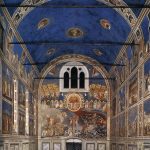
Although his most famous cycle—the frescoes of the Scrovegni (Arena) Chapel in Padua—was painted outside Florence, its impact was felt immediately in his home city. In that chapel, completed around 1305, Giotto told the story of Christ and the Virgin not as an iconographer, but as a dramatist. The Lamentation, one of the most beloved frescoes in the cycle, shows Mary cradling Christ’s lifeless body while the apostles bow, kneel, and collapse in grief around her. The sky is a flat blue, not gold, and the angels above twist and scream. Everything is directed toward human feeling.
Florence watched and learned. While Giotto’s innovations might seem subtle to modern eyes, they were revolutionary for the time. His mastery of chiaroscuro (light and shadow), his experiments in foreshortening, and his use of architectural framing created an illusion of depth that few had attempted since antiquity. For the first time in centuries, viewers could imagine entering a painted space and empathizing with its inhabitants.
Santa Croce and Public Art in Florence
Back in Florence, Giotto left his mark on several key churches, most notably Santa Croce, where he painted frescoes in the chapels of the Bardi and Peruzzi families. These cycles depicted the lives of St. Francis, St. John the Baptist, and St. John the Evangelist—again, with a theatrical sense of space and gesture.
In the Bardi Chapel, Giotto painted scenes from the life of St. Francis that combined the sacred and the psychological. One panel shows Francis renouncing his worldly goods by stripping naked in front of his father, a bishop, and a crowd of stunned witnesses. The human drama is unmistakable: a clash of authority, identity, and conviction rendered not through symbols but through expression and body language.
Giotto’s public works also signaled the rising power of Florence’s patrons. The Franciscan order, aligned with the values of poverty and humility, found in Giotto an artist who could honor their saints without the need for blinding gold or stiff halos. At the same time, wealthy merchant families were commissioning chapels and altarpieces that displayed both their piety and their social clout. Giotto was the perfect mediator between religious narrative and civic ambition.
Giotto and Architecture: Campanile as Monument
Giotto’s artistic influence extended into architecture—literally. In 1334, he was appointed Capomaestro (chief architect) of Florence’s Cathedral project. His design for the Campanile, or bell tower, remains a defining feature of the Florentine skyline. Though he died before it was completed, his design mixed Gothic verticality with a strong classical sensibility—marble inlays, geometric clarity, and narrative reliefs that wrapped around the base.
The Campanile was not just a bell tower; it was a statement. Florence was building for the ages, and Giotto had become an architect of the city’s future as well as its soul.
The Giotto Effect: What Changed
Giotto’s influence cannot be overstated. Painters throughout Florence—and Italy—rushed to adopt his methods. His students, such as Taddeo Gaddi, Maso di Banco, and later Andrea Orcagna, carried his innovations into new commissions. More importantly, his style triggered a cultural shift: artists began to see themselves as storytellers, thinkers, even celebrities.
Vasari credits Giotto with restoring art from its “long decay” after the fall of Rome. While this romanticism overlooks the value of medieval and Byzantine art, it does reflect a real perception: that with Giotto, art was reborn.
Thematically, Giotto brought focus to the human body, the emotional psyche, and the spatial world. These themes would dominate Florentine art for the next two centuries. He was not a humanist in the classical sense—that movement had not yet matured—but he made room for it. He provided the visual grammar that later artists would turn into full Renaissance language.
Legacy and Limits
Despite his profound impact, Giotto’s achievements were not immediately universal. Many artists continued to paint in the older, more stylized Gothic manner. But the seed had been planted. Within a few decades, Florence would explode with innovation—in perspective, anatomy, architecture, and philosophy. Giotto had given art a body and a soul. The Renaissance would soon give it reason and light.
He died in 1337, but in Florence, his presence lingered in frescoed chapels and rising towers. When the Medici began shaping the Renaissance a century later, they were building on ground that Giotto had already broken.
The Birth of Humanism and Artistic Patronage
Florence in the early 15th century was not just a city of artists—it was a city of ideas. Before oil paint touched panel or chisel struck marble, there was a quiet revolution stirring in its libraries, monasteries, and merchant palaces. This was the revolution of humanism: a return to classical thought, a celebration of human potential, and a new way of looking at the world. In Florence, humanism didn’t just inspire poets and scholars—it shaped the art itself. And standing behind this flowering of creativity were the patrons: the bankers, merchants, guilds, and rulers who saw in art a mirror of their intellect, power, and legacy.
Together, humanism and patronage would ignite the Renaissance. But their roots went deeper—into the civic pride of a republic, the ambitions of its elite, and the rediscovery of ancient Rome.
Humanism Defined: The Renaissance Reimagines the Ancients
At its core, humanism was a philosophical movement that prioritized the study of classical texts, emphasized moral and civic virtue, and placed humans—rather than solely God—at the center of inquiry. It wasn’t anti-religious; rather, it sought to reconcile Christian thought with the wisdom of antiquity. Humanists believed that knowledge of history, rhetoric, poetry, and ethics could cultivate a more virtuous and effective citizen.
Florence became the beating heart of this movement. Libraries expanded, translations flourished, and scholars like Coluccio Salutati, Leonardo Bruni, and Marsilio Ficino reinterpreted Plato and Cicero for a new age. Bruni, who served as Chancellor of Florence, even penned a history of the city in Latin, modeling it on the style of Roman historians. His work wasn’t just scholarship—it was propaganda for a civic humanism that linked Florence to the Roman Republic.
This intellectual climate provided the philosophical framework that would soon find expression in visual art. Artists began to engage with classical motifs, anatomical studies, and the idea that beauty could reflect divine harmony—but also human dignity.
The Rise of the Patron: Art as Status and Strategy
The rebirth of classical ideals in Florence coincided with a surge in economic prosperity. The city was becoming one of the richest in Europe, thanks in large part to its dominance in banking and textiles. Powerful families like the Medici, Strozzi, and Rucellai amassed fortunes and funneled their wealth into churches, civic buildings, and, increasingly, personal chapels and villas. But these weren’t acts of charity—they were calculated expressions of prestige.
Patronage was the engine of Florentine art. Unlike today’s notion of a passive art buyer, a Renaissance patron was deeply involved in the commission: choosing the subject matter, setting the tone, and often working directly with the artist. The patron’s name and coat of arms might appear subtly in the background of a fresco, or even emblazoned on the architecture itself.
Guilds also played a critical role. Each guild had its own chapel in churches like Orsanmichele, and they competed in commissioning statues for its exterior niches. These sculptural commissions—for which Donatello, Ghiberti, and others vied—were not just devotional. They were visual assertions of economic and civic identity.
Art as a Tool of Civic Humanism
In Florence, the intertwining of art, politics, and philosophy was uniquely potent. Civic leaders understood that art could serve as a form of public moral education. Frescoes in town halls and religious institutions often conveyed stories of justice, virtue, and divine reward for civic responsibility. A painting of a saint wasn’t just an act of devotion—it was a message to behave rightly in the eyes of the city.
This sense of civic humanism, as scholars have termed it, elevated artists to a new status. They were no longer seen as anonymous craftsmen but as thinkers—intellectuals with the capacity to shape culture. This shift made space for the rise of figures like Leon Battista Alberti, who not only designed churches but wrote theoretical treatises on art, emphasizing perspective, proportion, and the role of beauty in shaping the soul.
Alberti’s seminal work De pictura (1435), dedicated to Brunelleschi and referencing Giotto, laid out the theoretical underpinnings of Renaissance art. He called painting a “science,” rooted in geometry and optics, but also a form of poetic storytelling. The goal, Alberti wrote, was to imitate nature so convincingly that the viewer might believe they were seeing real life—and to use that imitation to inspire virtue.
Florentine Libraries, Workshops, and the Studio as Think-Tank
With humanism at its core, the Florentine workshop (or bottega) became more than just a site of manual labor—it became a space of learning. Young artists apprenticed not just in pigments and gesso but in drawing from antique sculpture, reading texts, and studying nature. They learned to think as well as paint.
Florence’s monasteries and libraries, like the one at San Marco under the direction of Cosimo de’ Medici and Fra Angelico, served as bridges between scholarly humanism and visual art. Artists were often commissioned to paint sacred stories in the light of classical composition and naturalistic observation.
Even in religious settings, the humanist influence is unmistakable. Saints began to appear not as otherworldly icons but as relatable figures: barefoot, expressive, caught in moments of doubt or revelation. Spaces opened up. Light entered windows. Horizons stretched behind holy figures.
The Medici and the Strategic Use of Culture
Perhaps no family understood the intersection of humanism and patronage better than the Medici. Cosimo de’ Medici, who ruled Florence unofficially but decisively, surrounded himself with philosophers, poets, and artists. He funded Ficino’s translation of Plato, helped establish the first public library, and bankrolled the construction of San Lorenzo and the Medici Palace.
But his most lasting contribution may have been the culture of intellectual patronage he created. For Cosimo and later Lorenzo “il Magnifico,” art was not merely ornament—it was an act of politics. It conveyed wisdom, stability, and lineage. The Medici carefully crafted their image as enlightened rulers, aligning themselves with classical virtue rather than feudal dominance.
This idealized self-image found physical form in the commissions they sponsored: Donatello’s David, for example, was the first freestanding nude since antiquity—a biblical hero, yes, but also a Florentine civic symbol of clever victory over tyranny.
The Artist Ascends: From Artisan to Intellectual
As humanism spread and patronage intensified, artists were elevated. Giotto had begun this process, but now it matured. Donatello, Brunelleschi, and later Masaccio and Botticelli were treated as men of learning, not mere decorators. Their studios were visited by scholars; their works discussed in philosophical terms.
The Renaissance artist became a creator, not just a craftsperson. And Florence, with its peculiar blend of republican ideals, classical revival, and economic power, offered the perfect environment for this transformation.
The Medici Effect: Power, Wealth, and the Arts
If Florence was the engine of the Renaissance, the Medici were its fuel. Few families in history have so strategically intertwined art, politics, and philosophy to shape not just a city but the entire trajectory of Western culture. For over a century, the Medici used their immense wealth and influence to commission churches, sponsor painters and architects, and cultivate a climate of learning that rippled across Europe. But their support of the arts was never simply aesthetic—it was deeply political, performative, and personal. This is the story of how power made beauty, and how beauty, in turn, preserved power.
Origins of a Dynasty: Banking and Quiet Power
The Medici did not begin as nobles. Their ascent began with Giovanni di Bicci de’ Medici, who founded the Medici Bank in the late 14th century. By creating a financial empire that stretched from London to Constantinople, Giovanni became one of the wealthiest men in Europe. But unlike the feudal lords of the past, the Medici operated from the shadows. Florence was technically a republic, and open displays of dominance could provoke backlash. So Giovanni pioneered a subtler strategy: artistic and civic patronage as a form of political soft power.
He commissioned religious works, funded charitable projects, and made gifts to monasteries and hospitals. He paid for renovations to churches like San Lorenzo, positioning his family as benefactors of the public good. This was the Medici formula: cultivate cultural capital to legitimize economic and political influence.
Cosimo de’ Medici: Patron Saint of the Renaissance
Giovanni’s son, Cosimo de’ Medici, known as Pater Patriae (Father of the Fatherland), was the true architect of the family’s legacy. Cosimo understood that art was a language of permanence—a way to inscribe one’s values, aspirations, and lineage into the fabric of the city. He did not seek titles; he sought buildings, books, and beauty.
He surrounded himself with artists, architects, and philosophers. Cosimo was the patron behind Filippo Brunelleschi’s reconstruction of San Lorenzo, commissioning what would become one of the first churches built in the Renaissance style. It was a radical departure from the Gothic: clean lines, harmonious proportions, columns modeled after ancient Rome. It was not just a religious space—it was an architectural argument for order, rationality, and human scale.
Cosimo also funded the Medici Palace, designed by Michelozzo, which set the tone for urban palaces in Florence and beyond. Its rusticated stone, fortress-like form, and orderly interior courtyard struck a delicate balance: strength without arrogance. The Medici were rich, yes, but they were citizens first—loyal servants of the Republic (at least in appearance).
Philosophy and Patronage: The Platonic Academy
Cosimo’s vision extended beyond architecture into the realm of ideas. In 1462, he established the Platonic Academy, a gathering of scholars dedicated to reviving the teachings of Plato in a Christian context. Headed by Marsilio Ficino, the Academy translated and interpreted ancient texts, developing a humanistic philosophy that would influence artists like Botticelli and thinkers like Pico della Mirandola.
This revival of Platonism had aesthetic consequences. It emphasized the ideal, the harmonious, and the spiritual essence of beauty—principles that shaped how artists conceived of the body, nature, and the divine. In this intellectual environment, even a mythological painting could become a moral allegory, a sacred reflection of cosmic love.
Lorenzo the Magnificent: Cultural Maestro of Florence
Cosimo’s grandson, Lorenzo de’ Medici, known as il Magnifico, elevated Medici patronage to new heights. His reign (1469–1492) marked the golden age of Renaissance Florence. A poet himself, Lorenzo cultivated a court culture where art and literature flourished. His patronage was deeply personal: he supported Sandro Botticelli, Leonardo da Vinci, Domenico Ghirlandaio, and a young Michelangelo Buonarroti, whom he even invited to live in the Medici household.
Under Lorenzo, Florence became a living gallery, with mythological, religious, and philosophical themes coexisting in the city’s visual culture. Botticelli’s Primavera and The Birth of Venus, for example, were likely commissioned for the Medici or their inner circle. These paintings were unprecedented: pagan, sensual, yet saturated with Neoplatonic meaning. They embodied the Medici vision—an art that was beautiful, learned, and above all, theirs.
Art as Political Theater
It’s important to remember that Medici patronage was never purely about the arts. It was a performance of power. Public processions, religious festivals, and the decoration of civic buildings all served to broadcast Medici influence.
Take, for instance, the Medici Chapel in San Lorenzo. Built as a family mausoleum, it was a statement of dynastic ambition, filled later by Michelangelo’s sculptures that balanced divine gravitas with psychological depth. Even the Medici coat of arms, with its distinctive balls (palle), appeared on countless buildings, subtly branding the city with their presence.
Patronage also served to neutralize opposition. By employing and elevating talented artists and architects, the Medici created a network of loyalty. To be chosen by the Medici was not just lucrative—it was a mark of prestige. Artists like Donatello and Ghiberti benefited enormously, and in return, they helped visualize and enshrine the Medici mythos.
Tensions and Backlash: The Fragility of Patron Power
Of course, such power bred resentment. The Medici were exiled twice (in 1433 and again in 1494), and during those periods, Florentine art took on a different tone. The Dominican friar Savonarola, who briefly seized control of the city in the 1490s, condemned secular art and orchestrated the infamous Bonfire of the Vanities, where books, paintings, and luxurious objects were burned in public squares. Botticelli himself may have cast some of his own works into the flames.
But even this backlash could not undo the Medici legacy. When they returned to power in the 16th century, now as Grand Dukes of Tuscany, they would continue to shape art—not through subtle patronage, but through overt imperial grandeur.
The Medici’s Enduring Influence
The Medici legacy is written into the streets of Florence. Their investment in the city’s infrastructure, churches, palaces, and art collections laid the foundation for what would become the modern museum culture. Today, the Uffizi Gallery, originally designed as Medici administrative offices, houses one of the most important art collections in the world—most of it amassed or commissioned by their ancestors.
More profoundly, the Medici demonstrated that art could be more than decoration. It could be ideological, philosophical, strategic. In their hands, the visual became rhetorical—a way to argue for order, to mask ambition in beauty, to mold public memory.
They didn’t just fund the Renaissance—they helped invent the very idea of the modern patron, and with it, the notion that culture itself could be a kind of power.
Brunelleschi and the Architecture of Innovation
There are few moments in architectural history as bold—or as improbable—as the construction of the dome over Florence’s Santa Maria del Fiore. At the heart of this astonishing feat stood Filippo Brunelleschi, a goldsmith turned architect whose brilliance fused ancient knowledge with modern daring. In a city already steeped in classical revival and intellectual ambition, Brunelleschi did more than solve a technical problem. He redefined the language of architecture, elevated engineering to an art form, and quite literally reshaped the skyline of the Renaissance.
Florence may have birthed the Renaissance spirit, but it was Brunelleschi who gave it form—in stone, proportion, and soaring perspective.
A Cathedral Without a Dome
The story begins with a paradox. In the late 13th century, Florence launched an ambitious project: the construction of a new cathedral, Santa Maria del Fiore, designed to rival those of Pisa, Siena, and Rome. The nave and transept were completed by 1380, and by 1418 the city was left with a yawning octagonal space—nearly 150 feet across—where a dome was meant to go.
The problem? No one knew how to build it.
Medieval builders had relied on wooden centering—scaffolding to support the structure as it was built. But the Florence dome was too wide and too high. To fill the void, the city announced a public competition for its design. Among the contenders was a man with no formal architectural training but a mind like no other: Filippo Brunelleschi.
Brunelleschi Before the Dome: Goldsmith, Sculptor, Thinker
Born in 1377, Brunelleschi trained as a goldsmith and sculptor. He famously competed (and lost) to Lorenzo Ghiberti for the commission of the Bronze Doors of the Baptistery in 1401. But it was this defeat that steered him toward architecture and, crucially, to Rome.
There, alongside Donatello, Brunelleschi immersed himself in the ruins of antiquity. He sketched the Pantheon, measured arches, and dissected columns. What he absorbed wasn’t just aesthetic—it was structural. He began to see how the Romans had balanced load, thrust, and weight without modern equipment. When he returned to Florence, he brought back not just drawings, but a radically new approach to architecture rooted in classical logic and geometric clarity.
The Dome: Genius in Brick and Rope
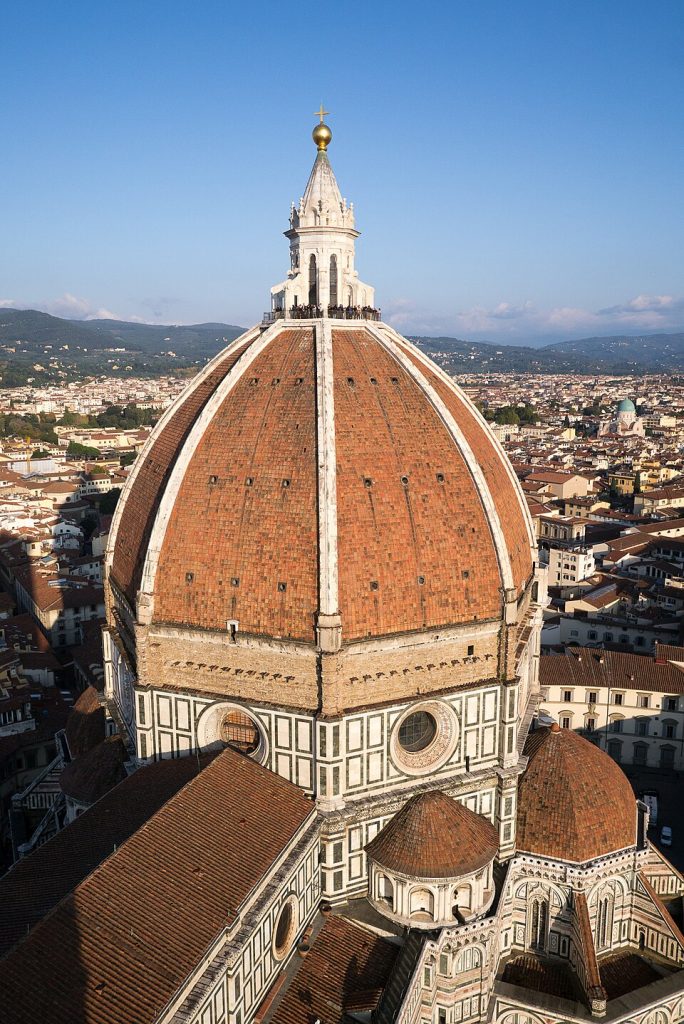
Brunelleschi’s winning design for the dome was both audacious and secretive. He refused to share full details with the cathedral committee, insisting only he could execute the plan. His solution involved building two concentric domes—an inner shell and a lighter outer shell—using a herringbone brick pattern to keep the structure self-supporting during construction. No centering required.
He invented a series of machines—hoists, pulleys, cranes—to lift the massive materials to unprecedented heights. These devices themselves were marvels, and his control over the building site was absolute. Workers were fined for damaging tools; he even designed lunch baskets that could be hoisted to reduce downtime.
Construction began in 1420 and continued for 16 years. When the dome was finally completed and topped with a lantern in 1436, it towered over Florence as the largest masonry dome in the world. It remains so today.
But the dome was more than an engineering triumph. It was a civic miracle, a spiritual metaphor, and a visual centerpiece. It crowned the city’s cathedral with celestial elegance, a symbol of divine order built by human hands.
The Language of Brunelleschi: Proportion, Perspective, and Harmony
While the dome is Brunelleschi’s most famous achievement, his true revolution was in architectural style. He rejected the Gothic in favor of classical purity. Inspired by Roman temples and basilicas, he reintroduced the rounded arch, the Corinthian column, and a modular system based on rational geometry.
His early masterpiece, the Ospedale degli Innocenti (1419), a children’s hospital funded by the Silk Guild, embodied this vision. Its elegant arcade of arches supported by slender columns with clear entablatures was the first fully Renaissance building in Europe. Everything was measured. Everything aligned.
Later, in San Lorenzo and Santo Spirito, Brunelleschi designed churches as intellectual spaces—dominated by proportion, natural light, and spatial clarity. The human body could be imagined within these buildings not as a subject of sin but as a noble participant in divine order.
His style influenced not only architects but also painters. By emphasizing linear perspective—the vanishing point, orthogonal lines, and mathematical depth—Brunelleschi offered artists a way to depict three-dimensional space on a two-dimensional plane. Masaccio, in his Holy Trinity fresco, applied Brunelleschi’s principles to create the illusion of a deep architectural niche—startling viewers with realism and depth.
Brunelleschi’s Rivals and Followers
Despite his brilliance, Brunelleschi operated in a competitive world. He clashed with Ghiberti, resented outside interference, and was known for being temperamental. Yet he left behind a cadre of architects and designers—Leon Battista Alberti, Michelozzo, and later Giuliano da Sangallo—who absorbed and expanded on his principles.
Alberti, in particular, formalized what Brunelleschi had intuited. In his treatise De re aedificatoria (On the Art of Building), Alberti called architecture a science rooted in reason. He praised Brunelleschi’s dome as a symbol of what could be achieved when intellect served both civic and spiritual ideals.
Florence as the Ideal City
Thanks to Brunelleschi, Florence came to see itself not just as a powerful republic but as a manifestation of order and harmony. Its skyline, once fragmented and Gothic, now had a center, a unity, a crown. The dome became an emblem of Renaissance ideals: human capacity, divine inspiration, and the revival of classical greatness.
Even Michelangelo, no stranger to ambition, would later call the dome of Santa Maria del Fiore “so beautiful that it looks more like the work of angels than of humans.”
Legacy in Stone and Idea
Brunelleschi died in 1446 and was buried in the cathedral he completed—an honor rarely granted to anyone outside the clergy. His epitaph declared him “the most excellent architect of this magnificent temple,” but his legacy went further.
He taught Florence that innovation could be ancient, that beauty could be rational, and that architecture was not merely construction, but expression.
The Renaissance had found its vault, and through Brunelleschi, it soared.
Masaccio and the Invention of Renaissance Painting
In the dim chapel of Santa Maria del Carmine in Florence, on the walls of the Brancacci Chapel, something astonishing happened in the early 1420s. Saints walked with weight. Light fell naturally across architecture. A naked Adam and Eve staggered from Eden in shame and sorrow. This was the work of Masaccio—a young painter who died before the age of 30 but transformed the trajectory of Western art forever.
With a brush and a deep grasp of perspective, Masaccio made painting modern. He wasn’t the first to explore realism, but he was the first to fully integrate space, light, emotion, and narrative in a way that felt immediate, psychological, and utterly human. In a single decade, he brought Giotto’s legacy to full bloom, absorbed Brunelleschi’s architectural breakthroughs, and paved the road for Michelangelo.
Who Was Masaccio?
Born Tommaso di Ser Giovanni di Simone in 1401 in San Giovanni Valdarno, Masaccio’s nickname—meaning “sloppy Tom” or “messy Tom”—belies his brilliance. We know little of his life, but records place him in Florence in the early 1420s, working alongside older and more established painters like Masolino da Panicale.
What set Masaccio apart was his fearlessness. While many painters of his time still worked within the Gothic style—decorative, symbolic, and flat—Masaccio reached for the visceral. His paintings do not merely depict—they embody. His figures are heavy with physicality and presence. His spaces recede logically. His light falls as if from a sun we cannot see but instinctively recognize.
The Brancacci Chapel: A Revolution on the Wall
Commissioned by the wealthy merchant Felice Brancacci, the chapel was meant to honor Saint Peter and glorify the family. Masaccio took over the work around 1425, collaborating initially with Masolino, whose graceful but more stylized hand can still be seen in some panels.
The contrast is striking. Masolino’s Temptation of Adam and Eve shows an idealized couple delicately reaching for the fruit. Masaccio’s Expulsion from the Garden of Eden—painted just opposite—shows two distraught figures howling in grief, Eve’s face distorted with anguish, Adam shielding his eyes in shame. The realism is raw. These are not symbols of sin, but human beings grappling with pain, guilt, and loss.
Other panels from the cycle, like The Tribute Money, demonstrate Masaccio’s full command of perspective and narrative sequencing. In one fresco, he shows a story in three parts—Jesus instructing Peter, Peter retrieving a coin from a fish, and Peter paying the tax collector. The entire composition is unified by atmospheric perspective, with mountains fading into the misty distance and architecture rendered with mathematical precision, learned directly from Brunelleschi.
But what’s revolutionary isn’t just the depth of space—it’s the psychological and spatial coherence. The figures stand together in believable relation. They cast shadows. They gesture in expressive dialogue. Christ is at once calm and commanding, a moral anchor in a world of economic pressure and civic responsibility.
Light, Gravity, and the Body
Masaccio introduced to Florentine painting what Brunelleschi had brought to architecture: a logical, measurable world. His figures are sculptural, built from planes of light and dark. He uses chiaroscuro not as decoration but as a means of modeling volume. His saints and sinners have bones and muscles, flesh and mass. They occupy space as real people do.
In The Holy Trinity, painted in the Dominican church of Santa Maria Novella, Masaccio crafted one of the most profound theological and perspectival experiments of the Renaissance. At first glance, it is a traditional image: God the Father holds the crucified Christ, flanked by Mary and Saint John, with kneeling donors below. But the space is astonishing—an illusionistic barrel vault recedes into deep space, calculated with mathematical accuracy. The vanishing point lies at the viewer’s eye level, drawing us into the divine architecture.
Beneath the fresco is a memento mori: a skeleton and the inscription, “I once was what you are, and what I am you also will be.” Here, art offers not just narrative or emotion, but philosophical confrontation—an experience both spatial and spiritual.
Masaccio’s Intellectual Circle and Influences
Masaccio was no isolated genius. He was working in a Florence transformed by Brunelleschi’s dome, Donatello’s sculpture, and the philosophical air cultivated by the Medici. He likely moved in circles where Leon Battista Alberti’s theories on proportion and beauty were discussed. He internalized Brunelleschi’s lessons on perspective, but unlike most artists of the time, he applied them with emotion.
He also absorbed Giotto’s legacy of psychological narrative, but moved beyond it. Giotto’s figures had weight and dignity; Masaccio’s had interiority—they felt. In this way, he bridged the world of religious storytelling with the emerging humanist fascination with the self.
A Short Life, A Long Shadow
Masaccio died suddenly in 1428 or 1429, likely in Rome, at just 26 or 27 years old. He left no large studio, no massive output. Yet his influence was immediate and profound.
Artists who saw the Brancacci Chapel were transformed. Filippino Lippi, who later completed the chapel, preserved Masaccio’s work and aesthetic. Michelangelo, as a young boy, copied Masaccio’s figures obsessively. Leonardo da Vinci praised his innovations, as did Vasari, who called him “the first great painter of the modern era.”
What Masaccio invented was not style, but structure—a way of organizing the visual field that made human life central and sacred narrative believable. In his hands, painting became a mirror of life and a window to the divine.
The Brancacci Chapel Today
Visitors to the Brancacci Chapel still feel the gravitational pull of Masaccio’s frescoes. The space humbles and moves. Though centuries of soot, political turmoil, and restoration have altered the work, its core remains untouched: an earnest attempt to show the divine in terms the human eye and heart can understand.
Botticelli and the Poetics of Myth and Religion
Among the many voices of the Florentine Renaissance, Sandro Botticelli speaks in a register entirely his own. While Masaccio grounded art in weight and perspective, Botticelli’s paintings seem to float—poetic, lyrical, and imbued with an otherworldly grace. His figures drift between the sacred and the sensual, draped in lines as fluid as verse. In Botticelli, Florence found not just the science of space, but the art of feeling.
Yet beneath the surface beauty of his paintings lies a complex network of humanist thought, Medici politics, and spiritual tension. Botticelli’s greatest works are not escapist fantasies—they are sophisticated visual poems that reflect the intellectual and emotional currents of late 15th-century Florence. His brush captured both the golden glow of Neoplatonism and the shadows of coming upheaval.
Early Life and Training: The Hand of the Master
Born Alessandro di Mariano di Vanni Filipepi in 1445, Botticelli grew up in a working-class district of Florence. His nickname, “Botticelli,” meaning “little barrel,” came from his elder brother. He trained under Fra Filippo Lippi, whose soft figures, curving lines, and emotional Madonnas left an indelible imprint on the young artist.
Later, Botticelli absorbed the sculptural drawing of Andrea del Verrocchio’s workshop and may have encountered the rigorous draftsmanship of Leonardo da Vinci. But from the beginning, Botticelli developed a personal visual language: stylized, linear, and emotionally rich. He favored contour over volume, grace over gravity.
His talent soon drew the attention of the Medici, whose patronage would shape the most iconic phase of his career.
The Medici Court and Neoplatonic Florence
Botticelli came of age during the rule of Lorenzo de’ Medici, known as il Magnifico, who transformed Florence into a court of philosophy, poetry, and refined sensuality. Under Lorenzo’s patronage, artists, scholars, and poets gathered in salons and gardens to discuss Neoplatonism—the idea that earthly beauty could lead the soul toward divine truth.
This synthesis of classical mythology and Christian spirituality provided the ideological framework for Botticelli’s most famous paintings. Mythological subjects were not merely decorative—they were allegories, coded with humanist meaning. Venus was not just the goddess of love; she was the personification of divine beauty, a Platonic ideal made flesh.
Primavera: A New Mythology
Painted around 1482, Primavera (“Spring”) is perhaps the most enigmatic painting of the Renaissance. Commissioned for a Medici wedding, it gathers a host of mythological figures in an orange grove: Venus at the center, flanked by the Three Graces, Mercury, Flora, Zephyrus, and Chloris.
The painting resists a single interpretation. Some scholars read it as an allegory of love’s transformative power; others see a celebration of marriage, fertility, or even the triumph of humanist philosophy over barbaric instinct. What is clear is Botticelli’s command of visual rhythm: the figures seem to dance in silence, suspended in a dream.
Unlike Masaccio’s solid, earthly figures, Botticelli’s characters are ethereal. Their bodies are elongated, their drapery impossibly delicate, their expressions serene. The emphasis is not on physical realism but on poetic atmosphere—a style sometimes called ars memorativa, meant to evoke mood and memory more than direct narrative.
The Birth of Venus: Beauty as Metaphysics
If Primavera is Botticelli’s ode to nature’s rebirth, The Birth of Venus is his hymn to divine beauty. Likely painted for another Medici residence, the painting shows Venus emerging from the sea on a shell, blown ashore by the wind gods Zephyrus and Aura, welcomed by a handmaiden with a floral robe.
Here, Botticelli dares a bold synthesis. A nude female figure—unthinkable in sacred art—becomes the embodiment of cosmic harmony. Her modest pose references both classical sculpture and Christian iconography of the Virgin. Yet she is not sensual in a carnal sense; she is idealized, distant, almost untouchable.
Venus stands not on earth, but in an eternal realm. The painting’s shallow space and linear precision enhance this sense of timelessness. It is not a scene to be entered, but one to be contemplated—like a philosophical vision.
Religious Work and Inner Complexity
Despite his fame for mythological scenes, Botticelli also produced profound religious works. His Madonna and Child paintings are tender, melancholic, and often infused with introspective sorrow. In The Madonna of the Magnificat, Mary crowns herself queen while writing a hymn of praise, her halo interlocking with those of angels in a golden burst.
Later in life, Botticelli’s art darkened. Under the influence of Girolamo Savonarola, the fiery Dominican friar who condemned secular art and called for a return to Christian austerity, Botticelli may have destroyed some of his earlier works and shifted his focus to apocalyptic themes.
His Mystic Crucifixion and Mystic Nativity are turbulent, visionary paintings filled with angels and demons, weeping figures, and eschatological dread. Gone is the calm elegance of Primavera; in its place is a raw urgency. Some scholars argue that Botticelli never fully recovered his creative equilibrium after the Medici fell from power and Savonarola rose.
Line Over Mass: Botticelli’s Technical Signature
What distinguishes Botticelli most technically is his use of line. While other painters pursued modeling through light and shadow, Botticelli drew with calligraphic clarity. His lines guide the eye, defining contours with a musical rhythm. His palette is luminous but restrained, often dominated by pale blues, soft pinks, and warm golds.
This emphasis on design—disegno, as the Florentines called it—placed Botticelli within the central current of Renaissance theory, where drawing was considered the intellectual foundation of painting. But his work also resists the cold rationality that sometimes accompanied perspective and proportion. His art remains emotive, lyrical, and deeply subjective.
Decline and Rediscovery
After the 1490s, Botticelli’s popularity waned. The High Renaissance, with its muscular realism and heroic drama, left little room for his more delicate vision. He died in 1510, relatively forgotten, buried in the church of Ognissanti, where his Saint Augustine still keeps watch from a frescoed wall.
Centuries later, the Pre-Raphaelite painters rediscovered him. His Venus, his lines, his wistful grace—they found in Botticelli a spiritual kin, a master of symbolic beauty in an age that had nearly forgotten him.
Today, he is recognized not only as a painter of myth, but as a poet of the human spirit, who transformed philosophical ideals into visual enchantments.
Leonardo da Vinci in Florence — The Apprentice and the Innovator
To trace the early life of Leonardo da Vinci is to wander through the corridors of a thousand questions. He was an illegitimate child, a painter, an engineer, a dreamer, a dissector of bodies and of nature’s laws. He was not Florence’s favorite son in his own time—not like Michelangelo or Botticelli—but Florence made him. In its studios, workshops, and libraries, he was formed. And in return, Leonardo gave Florence something no other artist quite did: the blueprint for a mind that would never stop questioning.
Though his most famous works would eventually leave the city, Leonardo’s Florentine years were the crucible of his thought and technique. Here, he learned to draw, to model, to think through his hands. And it was here, in the shadow of Brunelleschi’s dome and in competition with fellow artists, that he began to crack open the visual world—to look deeper, to study longer, to ask: What lies beneath the skin of nature and art alike?
Child of No One, Student of All
Leonardo was born in 1452 in Vinci, a small town just west of Florence. He was the illegitimate son of a notary, Piero da Vinci, and a peasant girl named Caterina. Because of his illegitimacy, he received no formal education in Latin or Greek—the pillars of humanist learning—but this would shape his mind in unexpected ways. Rather than dwell in texts, Leonardo learned by watching, drawing, experimenting.
By the early 1460s, he had been sent to Florence, where his father secured him an apprenticeship in the workshop of Andrea del Verrocchio—a polymath in his own right, skilled in painting, sculpture, and metalwork. This workshop was no quiet classroom; it was a bustling engine of Florentine creativity, serving patrons from all levels of society. Here, Leonardo learned everything from casting bronze to grinding pigments. But more importantly, he learned to be versatile.
It was under Verrocchio that Leonardo is said to have painted the angel in The Baptism of Christ—a contribution so skillful that, according to legend, Verrocchio put down his brush in awe and never painted again.
Drawing as Investigation
From the start, Leonardo’s drawing style was different. He didn’t copy; he inquired. His notebooks from this period are filled not just with figure studies, but with whirlpools, gears, horses, flying machines. He treated drawing not as a preliminary step to painting but as a way of understanding the mechanics of reality.
Leonardo brought this intensity to his study of the human body. At a time when most artists learned anatomy through secondhand diagrams, Leonardo sought direct experience. He dissected corpses in hospitals and monasteries, sketching every bone, muscle, and tendon with a precision unmatched for centuries. His anatomical drawings from the 1480s and 1490s read like an atlas of the body, far ahead of their time, both scientifically and artistically.
Florence, a city of workshops and inquiry, encouraged this kind of hybrid thinking. Here, Leonardo could find patrons who tolerated his strangeness and engineers who sparked his curiosity. He moved between disciplines not out of dilettantism, but because he saw no boundary between art and science.
Florence’s Competitive Pressure: A Proving Ground
Despite his talent, Leonardo struggled to secure major commissions in his early Florentine years. He was working in the shadow of established figures like Botticelli, Ghirlandaio, and Perugino. While his genius was evident, his reputation was that of a perfectionist who rarely finished anything.
One early work, The Adoration of the Magi, commissioned in 1481 for the San Donato a Scopeto monastery, shows his ambition in full force. The work, left unfinished, is a swirling composition of figures, animals, architecture, and gesture—all revolving around the central image of the infant Christ. The incomplete painting became famous not for what it lacked, but for what it offered: emotional intensity, psychological nuance, and compositional complexity never before seen.
Even in its raw state, it showed Leonardo’s belief that a painting was not just a surface, but a stage of layered meanings—a moment when motion, thought, and light converge.
From Florence to Milan: Seeking Freedom
In 1482, frustrated by limited opportunities and perhaps eager to escape Florence’s rigid guild structure, Leonardo moved to Milan. There, under the patronage of Ludovico Sforza, he would create The Last Supper, Lady with an Ermine, and his visionary notebooks on mechanics, flight, and military engineering.
But Florence remained the city that had formed him—and to which he would return.
The Return to Florence: Clashes with Michelangelo
Leonardo returned to Florence around 1500, a city that had changed in his absence. The Medici had been exiled; Savonarola had risen and fallen. A new generation of artists was emerging—none more formidable than Michelangelo Buonarroti, whose fierce intensity and sculptural drama would soon eclipse even Leonardo in Florentine eyes.
The two were famously antagonistic. Florence, ever a city of competition, seized the opportunity to pit them directly against each other in a fresco duel. Each was commissioned to paint one wall of the Great Council Hall in the Palazzo Vecchio—Leonardo’s Battle of Anghiari against Michelangelo’s Battle of Cascina.
Neither painting survived. Leonardo, experimenting with a new medium, abandoned the project after the pigments ran and faded. Michelangelo never got far beyond the cartoon. Yet even these fragments became legendary. They showed Florence that art was now a battlefield of ideas, a space where style, technique, and philosophy clashed in grand, unfinished gestures.
Innovation as Method
What defines Leonardo’s contribution to Florentine art is not the quantity of his work, but the depth of his process. He painted slowly, reworked endlessly, and insisted on observing before executing. He once wrote: “The painter must be solitary… for if he is accompanied by others, he will often be distracted from his study.”
He innovated in technique as well: using sfumato, a delicate layering of translucent glazes that created soft transitions between light and shadow. His figures emerged not with hard outlines but with atmospheric subtlety, as if emerging from fog or memory.
This became his hallmark—visible in works like The Virgin of the Rocks, where figures are enveloped in geological and botanical mystery, their gestures unfolding with choreographed clarity.
Legacy in Florence
Though Leonardo spent much of his later life in Milan, Rome, and France, Florence never forgot him. His notebooks circulated among artists, his experiments in anatomy and optics fed into later studies, and his rivalry with Michelangelo helped define an era.
Perhaps more than any other Florentine, Leonardo personified the ideal of the Renaissance man: curious, interdisciplinary, driven by observation rather than doctrine. Florence made him, and he remade the role of the artist—not as a craftsman, but as a visionary investigator of nature’s laws.
Michelangelo — Sculpture, Struggle, and Genius
If Leonardo was the Renaissance’s eye, Michelangelo Buonarroti was its fist. Where Leonardo pursued grace and observation, Michelangelo carved emotion and defiance into stone. In Florence, he emerged not just as an artist, but as a myth, forged by conflict, inspired by antiquity, and consumed by an inner fire that no patron, pope, or rival could fully control.
To speak of Michelangelo in Florence is to speak of the city itself—its ambitions, its politics, its devotion, and its unrelenting drive to transform human will into beauty. His works are not simply admired. They are confronted. And in them, Florence achieved its most sublime and terrifying vision of the human soul.
From Caprese to the Medici Court: A Precocious Talent
Michelangelo was born in 1475 in Caprese, a small town in the Tuscan hills. By age 13, he was already apprenticed in the workshop of Domenico Ghirlandaio, one of Florence’s leading painters. But painting never satisfied him. His true calling lay in sculpture—and in marble, he found his match.
Through Ghirlandaio, Michelangelo was introduced to the powerful Lorenzo de’ Medici, who brought the boy into his court. There, in the Medici gardens, surrounded by antique Roman statues and Florence’s brightest minds, Michelangelo honed not just his chisels, but his worldview. He read Dante, studied anatomy, and began to see the body not as burdened by sin, but as a container of divine force.
This idea would never leave him.
The Pietà and the Roman Breakthrough
Though not in Florence, Michelangelo’s Pietà, sculpted in Rome in 1499 when he was just 24, is key to understanding his maturity. Carved from a single block of Carrara marble, the sculpture shows Mary cradling the dead Christ—serene, sorrowful, impossibly graceful.
Its emotional power and technical perfection shocked contemporaries. His name, which he famously carved into the sash across Mary’s chest, became synonymous with brilliance.
But it was in Florence, just a few years later, that Michelangelo would deliver his most iconic—and perhaps his most political—work.
David: More Than a Hero
In 1501, the Florence Cathedral authorities commissioned Michelangelo to complete a colossal statue from a weathered, abandoned block of marble. The commission was nominally religious: a statue of David, the young shepherd who slew Goliath. But Michelangelo’s David, completed in 1504, was no simple biblical hero.
He is naked, alert, and tense. His brow is furrowed. His right hand hangs heavy, veins taut, as if moments from action. This is not David triumphant—this is David before the battle, concentrated, righteous, and terrifyingly human.
Florentines saw themselves in him. In the aftermath of Medici exile and political upheaval, the city saw David as a symbol of republican virtue, standing against tyranny. It was installed not at the cathedral, but in front of the Palazzo Vecchio, the seat of civic power—a clear statement of artistic and political identity.
The sculpture’s anatomical detail, expressive force, and monumental presence signaled a new standard in Renaissance art. David was not just a marvel of skill. He was a vision of Florence’s soul made stone.
Art and Agony: Michelangelo’s Inner Battle
What set Michelangelo apart, even from his towering contemporaries, was his conviction that art was struggle. He once wrote, “I am still learning” in his eighties, and his work bears this constant friction between perfection and torment.
Michelangelo carved with an almost violent intensity. He did not model in wax or draw detailed plans. He attacked the marble directly, revealing the form as if it were already trapped inside, waiting to be freed. He famously said, “The sculpture is already complete within the marble block, before I start my work. It is already there, I just have to chisel away the superfluous material.”
This approach gave rise to what are now called his non-finito works—figures emerging from rough marble, limbs caught in stone. These half-finished pieces feel haunted, echoing Michelangelo’s lifelong tension between spirit and matter.
The Medici Commissions: Mausoleums and Myths
After the Medici returned to power in Florence in the early 16th century, they turned to Michelangelo to design a fitting tribute: the Medici Chapel in San Lorenzo, with its tombs for Giuliano and Lorenzo de’ Medici.
The result is a fusion of sculpture and architecture, dominated by four allegorical figures: Dawn, Dusk, Night, and Day. Each nude figure contorts, twists, and sprawls across the sarcophagi, embodying the passage of time, the agony of mortality, and the eternal tension between movement and rest.
Unlike earlier Renaissance tombs, these are not portraits of peace or resurrection. They are dynamic, unsettled, almost apocalyptic. In Night, a female nude reclines in a pose of exhaustion; in Dawn, her counterpart stretches from slumber. These sculptures are not about death—they are about existence itself, caught between flesh and eternity.
Michelangelo the Architect and Painter
Though he saw himself first and foremost as a sculptor, Michelangelo also left his mark on Florence through architecture and drawing. His design for the Laurentian Library staircase—also at San Lorenzo—is a swirling, theatrical space that anticipates the Baroque.
His unfinished painting, The Doni Tondo (c. 1507), is his only surviving panel painting and is as muscular and sculptural as his marble works. It shows the Holy Family in a circular composition, surrounded by athletic nudes—perhaps a nod to the Neoplatonic idea of ideal beauty and physical perfection.
Exile, Rome, and Return
Michelangelo spent much of his later career in Rome, working on the Sistine Chapel ceiling (1508–1512) and The Last Judgment (1536–1541). But Florence remained his spiritual home—and the site of his most personal artistic evolution.
In 1527, during the brief restoration of the Florentine Republic, Michelangelo aligned himself with the anti-Medici cause and worked as a military engineer, designing fortifications for the city. His political courage nearly cost him his life when the Medici returned to power, but he was spared—perhaps because he was simply too valuable to execute.
Legacy: The Terribilità of Florence
Michelangelo’s legacy in Florence is emotional architecture. His works confront the viewer with grandeur and turmoil. They do not flatter; they challenge. In them, the Renaissance reaches its most intense self-awareness: beauty as struggle, divinity as human agony, form as fate.
His influence on art was seismic. Every sculptor and painter who came after—Cellini, Gian Lorenzo Bernini, even Rodin—had to reckon with the force of his vision. And every stone in Florence that catches sunlight, every shadow that falls across a church wall, still whispers of his presence.
Fra Angelico, Fra Filippo Lippi, and Sacred Art in the Cloister
While the Renaissance roared in Florence’s cathedrals and civic halls, another Renaissance unfolded in quieter corners—monasteries, convents, and chapels where the divine was not debated, but meditated upon. Here, a more intimate kind of art flourished—one that whispered rather than thundered, that guided the soul through color, light, and devotion. Among its greatest voices were Fra Angelico and Fra Filippo Lippi, two artists who fused religious commitment with painterly innovation to create some of the most moving sacred images of the 15th century.
Their work represents not an alternative to the grand narratives of Michelangelo or Botticelli, but a complement—art that speaks from within the cloister, yet shapes the wider currents of Renaissance vision.
Fra Angelico: The Devout Innovator
Born Guido di Pietro around 1395 in the Mugello region near Florence, Fra Angelico joined the Dominican Order and took the name Fra Giovanni. He would later be known as Beato Angelico—the “Blessed Angelic Brother”—a testament to both his art and his piety. Vasari said of him: “He would never take up his brush without first saying a prayer.”
Fra Angelico’s most enduring works are found in San Marco, the Dominican monastery in Florence where he lived and worked. When Cosimo de’ Medici funded its reconstruction in the 1430s, he also commissioned Angelico to paint its walls—not grand fresco cycles for public view, but private devotions for the friars’ cells and corridors.
These frescoes are masterpieces of contemplative clarity. In each cell, a scene from Christ’s life—his crucifixion, transfiguration, or resurrection—is painted with breathtaking simplicity. The compositions are spare. The colors are gentle. The figures do not shout or move theatrically; they gaze, kneel, and receive.
One of the most powerful is the Annunciation at the top of the dormitory stairs. Gabriel, in pink and gold, bows to the Virgin beneath a Romanesque archway. Light filters in softly. The Virgin’s face is serene, accepting, yet trembling. This is not a public performance—it is a silent miracle, unfolding in a space that mirrors the friar’s own cell. The message is clear: the sacred happens here, in stillness.
Yet for all his spiritual humility, Fra Angelico was a master of form. He absorbed the innovations of Giotto and Masaccio—modeling, light, and perspective—and softened them into a visual theology. He painted altarpieces with gilded majesty, saints with psychological depth, and heavenly hosts that feel both real and radiant.
His San Marco Altarpiece (c. 1438–1443), now in the museum of the same monastery, depicts the Madonna enthroned among saints in a serene, symmetrical space. It is a vision not of ecstatic revelation, but of ordered, eternal grace.
Fra Filippo Lippi: The Humanist Monk
In nearly every way, Fra Filippo Lippi was Angelico’s opposite. Born in Florence around 1406, Lippi also joined the Carmelite order, but his relationship to the cloth was, shall we say, complicated. He was notorious for bending vows, abandoning monastic duties, and famously eloping with a nun, Lucrezia Buti, who would become the mother of his son, the painter Filippino Lippi.
Despite (or because of) his unruly life, Lippi’s art brims with human warmth and sensuality. He was a student of Masaccio—indeed, he likely saw and studied the Brancacci Chapel firsthand—and carried that influence into a gentler, more decorative register.
His Madonnas are among the most beloved in Renaissance art. In The Madonna and Child with Two Angels (c. 1465), now in the Uffizi, the Virgin is no ethereal goddess. She is a young mother, introspective and tired, her veil slipping, her gaze soft and ambiguous. The Christ child reaches toward her, playful and twisting—modeled, some believe, after Lippi’s own son.
The angels are not impassive cherubs. They grin, squirm, and glance at the viewer with conspiratorial delight. This is sacred art rendered through the lens of human experience, and it resonated deeply with Florentine viewers, many of whom were merchants and artisans trying to balance piety with worldly life.
Lippi’s altarpieces, such as the Coronation of the Virgin in the Uffizi, blend Gothic splendor with Renaissance space. He loved elaborate detail: gilded halos, flowing drapery, architectural niches. But he also developed a keen eye for psychological interaction. In his works, saints talk, gesture, and look—not just upward, but at each other. His religious scenes feel lived in, like spiritual dramas enacted in the present tense.
Sacred Spaces and Patronage
Both Angelico and Lippi benefited from the changing role of religious institutions in Florence. Convents and monasteries were not isolated; they were embedded in civic and family networks. Wealthy patrons funded chapels not just for salvation, but for status. Cosimo de’ Medici’s support of San Marco, for example, was as much a public gesture as a private devotion.
Art in these settings had to balance the contemplative and the commemorative. It needed to inspire devotion, reflect theological ideals, and also serve as a monument to the donor’s piety and position. Artists like Angelico and Lippi mastered this balancing act, creating works that were both deeply spiritual and subtly political.
Moreover, these sacred artworks provided an important training ground for later artists. Botticelli, for instance, was Lippi’s pupil, and his early works bear the same delicate outlines and expressive Madonnas. Michelangelo studied Angelico’s frescoes at San Marco, internalizing their devotional gravity before infusing it with his own intensity.
Cloistered Yet Enduring
Today, to walk through San Marco is to enter not a museum, but a state of mind. Angelico’s frescoes still line the cells, untouched by centuries of upheaval. They do not dazzle with grandeur—they invite with humility. In a world of monumental altarpieces and sculptural drama, they remind us of the quiet power of visual prayer.
Lippi’s Madonnas, meanwhile, continue to shape our cultural image of maternal tenderness. His synthesis of sacred narrative and domestic realism made the divine touchable—a baby in arms, a glance between mother and child, a smile from an angel.
Together, Fra Angelico and Fra Filippo Lippi represent a crucial current in Florentine art: a vision of the holy that is not found in triumph or torment, but in stillness, softness, and everyday beauty.
Savonarola and the Bonfire of the Vanities
The Renaissance promised rebirth, but in Florence during the 1490s, it nearly burned. At the heart of this conflagration was Girolamo Savonarola, a Dominican friar whose sermons raged against the decadence of art, the corruption of the clergy, and the moral decay of the city itself. For a brief, fiery moment, Savonarola seized control of Florence, transforming it from a haven of humanist beauty into a stage for apocalyptic judgment.
His rule culminated in the Bonfire of the Vanities, an event as symbolic as it was literal—a mass burning of books, paintings, cosmetics, musical instruments, and luxurious clothing. It was a violent rejection of Renaissance ideals and a direct assault on the visual culture Florence had so carefully built.
Yet the story of Savonarola is not simply one of destruction. It also reveals how art and power, faith and fear, were deeply entangled in Renaissance Florence—and how even fire could not consume the city’s creative soul.
The Rise of a Prophet
Born in Ferrara in 1452, Savonarola joined the Dominican order and arrived in Florence in 1482. At first, his apocalyptic sermons went largely unnoticed, but by the late 1480s, amid political unrest and the death of Lorenzo de’ Medici, his message gained traction.
He denounced the Medici for their opulence and warned of divine punishment for Florence’s sins. He attacked the Papacy, calling it corrupt and worldly. And above all, he condemned the vanities of secular life—art, fashion, philosophy, and pleasure—as distractions from salvation.
In 1494, with the Medici expelled and the French King Charles VIII invading Italy, Savonarola seized his moment. He became Florence’s de facto ruler, and under his theocratic government, the city entered a new phase: a republic of piety and austerity, enforced through both charisma and fear.
The Bonfire: Art Under Judgment
On February 7, 1497—Shrove Tuesday—Savonarola’s followers, many of them young boys known as the Piagnoni (“Weepers”), went through the city collecting objects deemed sinful or frivolous. They gathered mirrors, musical instruments, cosmetics, carnival masks, secular literature, and, crucially, works of art.
All of it was piled into a great pyramid in the Piazza della Signoria and set aflame.
The Bonfire of the Vanities was both spectacle and sacrament. To Savonarola, it was a purging of false idols. But to artists, humanists, and secular citizens, it was a moment of terror—a sign that the Renaissance itself might be devoured by its own excesses.
The true extent of the loss is unknown. Some scholars believe Botticelli may have thrown some of his own mythological paintings into the flames, though this remains debated. What is certain is that the fire struck at the heart of Florence’s identity. It was a rejection of Neoplatonic beauty, of pagan allegory, and of the humanist ideal that art could elevate the soul.
Botticelli and the Turn Toward Devotion
The shift in Botticelli’s style in the 1490s is often linked to Savonarola’s influence. His later works, such as The Mystical Nativity (c. 1500), are darker, more emotional, and laden with eschatological imagery. In that painting, angels and mortals embrace as demons flee underground. The Christ child lies on the earth, surrounded not by mythological nymphs but by an apocalyptic vision of divine reconciliation and human repentance.
Gone are the graceful graces and nude Venuses. In their place is a trembling faith. It is as if Botticelli, once the painter of eternal spring, had watched the garden wither under a prophet’s gaze.
Savonarola’s Art: Paradox and Patronage
Ironically, even as he condemned secular art, Savonarola understood its power. He commissioned religious works, supported sacred music (in austere form), and approved of art that aligned with his spiritual goals. His followers painted devotional banners and altar panels in a newly purified style.
But the broader effect was chilling. Artists feared censorship—or worse. Many turned to more somber religious subjects, stripped of ornament and classical allusion. The rich color and sensual line that had defined Florentine painting gave way to a visual rhetoric of austerity.
Florence became, in these years, a city at war with itself: between piety and beauty, fear and freedom, prophecy and poetry.
The Fall of the Prophet
Savonarola’s reign could not last. His attacks on Pope Alexander VI (a Borgia) led to his excommunication in 1497. That same year, another bonfire took place—but this time it was effigies of Savonarola himself that were burned by angry Florentines.
In 1498, after being arrested, tortured, and condemned by both church and city, Savonarola was hanged and burned in the same Piazza della Signoria where his Bonfire of the Vanities had blazed. His ashes were scattered in the Arno, as if to erase his presence. But the questions he raised would echo for generations.
His memory lingered uneasily in Florentine consciousness. Some saw him as a martyr. Others, as a tyrant. For artists, he was both a warning and a wound.
After the Fire: A Changed Florence
The city that emerged from Savonarola’s flames was not the same as before. The Medici would eventually return. High Renaissance art would reach new heights. But something fundamental had changed. Florence had glimpsed the dark edge of its brilliance—the fine line between spiritual aspiration and cultural suppression.
Savonarola forced Florence to reckon with itself: What is art for? Is beauty dangerous? Can the human body, so lovingly rendered in stone and paint, coexist with a soul yearning for salvation?
These questions would haunt later Florentine art—now tinged with a deeper awareness of both mortal sin and divine mercy.
Legacy of the Renaissance and Florence Today
To walk through Florence is to walk through a living museum. The city that once birthed a revolution in painting, sculpture, and architecture continues to hold its past not as memory, but as presence. In its palaces and piazzas, its chapels and cloisters, the Renaissance is not a relic—it’s a rhythm. The works of Giotto, Botticelli, Leonardo, and Michelangelo still breathe, not behind velvet ropes, but in the very architecture of civic life. Florence today is both a guardian and a beneficiary of the Renaissance, a city sustained by art and by the centuries of reverence it has inspired.
But Florence is more than its past. Its legacy lives on not only in marble and fresco, but in how we understand art itself—as a mirror of culture, a tool of power, and a language of the human spirit.
Museums as Temples of Memory
Nowhere is Florence’s cultural legacy more visible than in its museums, many of which are repurposed Renaissance spaces. The Uffizi Gallery, originally designed by Giorgio Vasari as government offices (hence Uffizi, meaning “offices”), now houses the most comprehensive collection of Florentine Renaissance painting in the world.
Visitors stand in silent awe before Botticelli’s Birth of Venus, Michelangelo’s Doni Tondo, and Giotto’s altarpieces, tracing the arc of an entire era. Each canvas is more than an object—it is an encapsulation of worldview, a moment where theology, science, philosophy, and politics converged.
Nearby, the Bargello Museum—a former prison—holds some of the Renaissance’s greatest sculptures, including Donatello’s David and Michelangelo’s Bacchus. The Accademia, meanwhile, draws millions to view the original David, whose gaze still looks outward with defiance and grace.
Conservation and the Art of Preservation
Preserving Renaissance art is itself a kind of Renaissance craft. Florence has become a global center for art restoration, with institutions like the Opificio delle Pietre Dure leading the way in scientific conservation. Founded in the 16th century as a workshop for stone inlay, it now serves as a high-tech hub for the analysis and preservation of paintings, sculpture, and architectural materials.
After the devastating Arno River flood of 1966, which submerged thousands of artworks and rare books, Florence became a symbol of cultural rescue. Volunteers from around the world, known as the “Mud Angels,” rushed to save paintings and manuscripts from destruction. That spirit of guardianship endures today, and informs Florence’s identity as both an artistic beacon and a city deeply aware of the fragility of beauty.
The Renaissance Economy: Tourism and Global Pilgrimage
Today, art is not just Florence’s heritage—it is its economy. Tourism, driven largely by cultural pilgrimage, sustains thousands of jobs and businesses. From guided tours to artisan workshops, the Renaissance is marketed and reimagined daily.
There is some tension here. Florence’s center, once the workshop of the world, can now feel like a showroom. Crowds queue for hours outside the Uffizi and the Accademia. Souvenir stalls offer Venus tote bags and replica Davids in neon resin. And yet, the city walks a fine line between reverence and reinvention.
Florence’s art has become global, inspiring exhibitions, academic programs, and contemporary interpretations around the world. But it remains deeply local, too—woven into the civic pride of Florentines and protected by rigorous heritage laws.
Education and the Artistic Imagination
Florence’s artistic legacy also endures through education. Institutions like the Florence Academy of Art, SACI (Studio Arts College International), and Villa I Tatti (Harvard’s Renaissance studies center) draw students and scholars from around the globe.
In these classrooms and studios, young artists still draw from plaster casts, study perspective, and debate Alberti’s treatises. They walk the same streets as Leonardo and Michelangelo, sketch under Brunelleschi’s dome, and climb the hills above San Miniato to glimpse the city as Dante once did.
Florence, in this sense, is not just a repository of the Renaissance. It is an engine of continuity, where past and present meet in the act of learning.
Modern Florence and the Spirit of Innovation
Although often defined by its past, Florence is not frozen in time. Its contemporary art scene—though smaller than those of Rome or Milan—thrives in pockets, with institutions like Centro Pecci, Museo Novecento, and various artist-run spaces offering a modern counterpoint to Renaissance classicism.
Local artisans continue to practice age-old crafts—goldsmithing, bookbinding, marbling, fresco painting—keeping alive not just objects but ways of seeing and making. These traditions are not museum pieces; they are living practices, passed down in workshops and family studios.
Florence’s global influence also extends into fashion, design, and digital media. The Renaissance spirit of blending aesthetics with function, form with philosophy, lives on in these newer modes of creativity.
The Renaissance as a Lens on the Present
Finally, Florence’s Renaissance legacy invites us to ask timeless questions: What is the role of beauty in public life? Can art make us better citizens? Where is the boundary between creativity and ideology?
In an age of artificial intelligence, mass image production, and cultural fragmentation, the Renaissance model of the artist as thinker, the artwork as argument, and the viewer as participant feels more relevant than ever.
Florence teaches us that art is not merely decoration. It is a form of memory, a mode of resistance, and a vision of possibility.
The Eternal City of Becoming
The story of Florentine art history is not a linear ascent but a spiral—from Giotto’s first hesitant gestures of realism to Brunelleschi’s dome, from Botticelli’s floating Venus to Michelangelo’s tormented marble, from Bonfires of the Vanities to global museums filled with rebirth.
Florence contains contradictions—sacred and profane, visionary and violent, restrained and radiant. But perhaps that is its secret: it is not a finished work. It is a city in dialogue with itself, with its past, and with us.
And so the Renaissance continues—not as a chapter closed, but as a question still open.