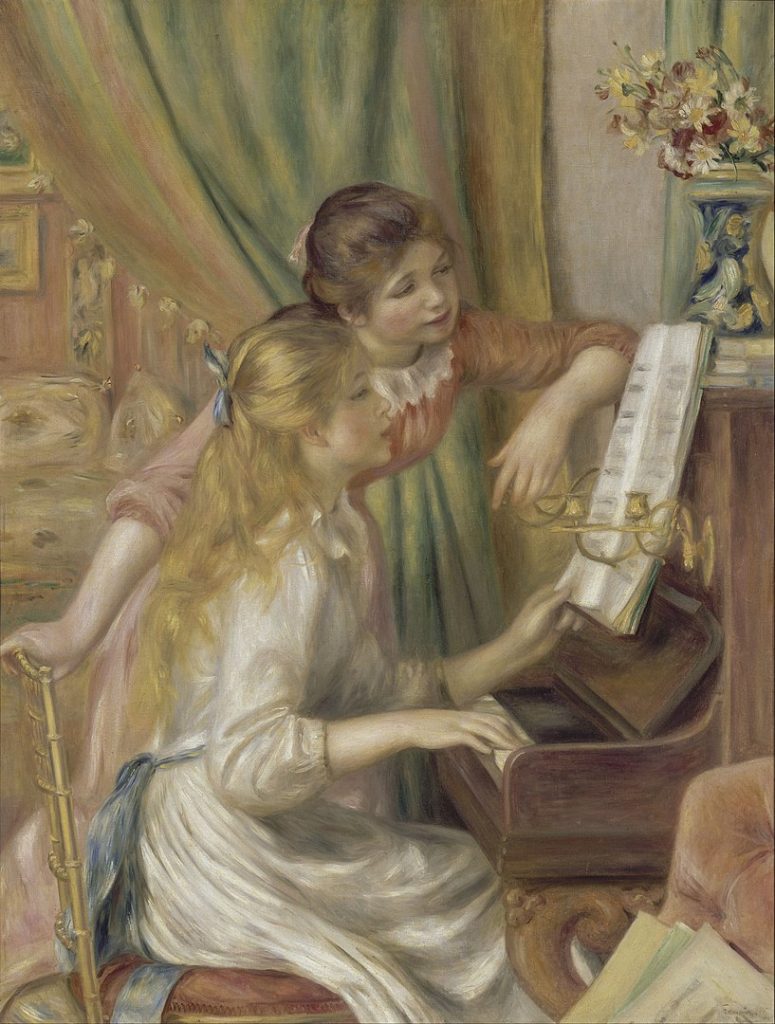
Pierre-Auguste Renoir was born on February 25, 1841, in Limoges, France, and he died on December 3, 1919, in Cagnes-sur-Mer. Few artists have left behind such a warm and instantly welcoming body of work. Renoir paintings glow with soft light, rosy skin tones, and a deep love for human beauty. That emotional warmth continues to draw collectors more than a century after his death.
Renoir moved with his family to Paris in 1844, where his father worked as a tailor. As a teenager, he painted porcelain at a factory, mastering delicate brush control and ornamental precision. In 1862, he enrolled at the École des Beaux-Arts and entered the studio of Charles Gleyre. There he met Claude Monet, Frédéric Bazille, and Alfred Sisley, friendships that shaped the future of Impressionism.
Why Viewers Instantly Recognize a Renoir
Renoir paintings are easy to recognize because of their softness and warmth. Faces often glow with peach and rose tones, and fabrics shimmer in natural light. Unlike Monet, who focused heavily on landscape effects, Renoir centered his work on people and shared moments. His brushwork feels alive, yet never harsh or aggressive.
Collectors respond to that gentleness. Even during his painful battle with rheumatoid arthritis in his later years, Renoir continued painting, sometimes with brushes strapped to his hands. Responsible historical speculation suggests that this perseverance adds emotional depth to late works, though documentation on specific studio methods is limited. What remains clear is that Renoir paintings communicate joy, and joy rarely goes out of style.
Renoir’s Role in the Impressionist Movement
Renoir was a founding participant in the first Impressionist exhibition of April 1874 in Paris. This exhibition, organized outside the official Salon, challenged academic tradition and shocked conservative critics. Renoir showed several works, standing alongside Monet, Degas, and Camille Pissarro. At the time, critics mocked their loose brushwork and modern subject matter.
In the summer of 1869, Renoir and Monet painted side by side at La Grenouillère, capturing sparkling water and leisure culture. Their collaboration helped define Impressionism’s focus on fleeting light. Unlike Edgar Degas, who preferred interior scenes and sharp compositions, Renoir emphasized softness and sociability. His scenes of dancing and open-air gatherings became icons of modern life.
The First Impressionist Exhibition and Market Impact
The 1874 exhibition initially damaged reputations rather than enhancing them. Renoir struggled financially during the 1870s and relied on portrait commissions to survive. By the 1880s, however, tastes began to shift. Responsible historical speculation suggests that the art market’s gradual acceptance mirrored broader cultural confidence in modern French society after the turmoil of the Franco-Prussian War.
Renoir’s stylistic shift around 1883, often called his “Ingres period,” demonstrated his independence. After traveling to Italy in 1881 and 1882, he studied Renaissance masters such as Raphael. He adopted firmer outlines and clearer structure, showing that he was not confined to one technique. This evolution strengthened his long-term historical importance, which today supports the collectibility of Renoir paintings.
The Market Performance of Renoir Paintings
Renoir paintings have long been considered blue-chip assets in the global art market. Major auction houses such as Sotheby’s and Christie’s regularly feature his works. Prices have reached tens of millions of dollars for major canvases. Smaller works on paper and portraits occupy lower but still strong price tiers.
A significant portion of Renoir’s major paintings now reside in institutions such as the Musée d’Orsay in Paris and the Metropolitan Museum of Art in New York. This institutional ownership reduces available supply. When fewer masterpieces circulate, demand increases among serious collectors. The finite number of works, fixed since 1919, reinforces scarcity.
Why Renoir Is Considered a Blue-Chip Artist
The term blue-chip refers to artists with stable long-term value and international recognition. Renoir shares this category with Monet and Degas. His name carries immediate historical weight, supported by catalogues raisonnés and scholarly research. Collectors often view Renoir paintings as relatively steady compared to trend-driven contemporary art.
Global demand spans North America, Europe, and Asia. Responsible historical speculation suggests that Renoir’s emphasis on beauty over controversy protects him from dramatic market swings. Because his imagery avoids political statements, it remains broadly acceptable across cultures. Stability, prestige, and limited supply combine to sustain his strong market performance.
Subject Matter That Never Goes Out of Style
Renoir’s subjects focus on joy, family, leisure, and community. His 1876 masterpiece Bal du moulin de la Galette captures dancing couples beneath dappled sunlight. Children, mothers, and friends populate his canvases with warmth and intimacy. These themes resonate across generations.
Portraiture played a major role in his career, especially during the late 1870s and early 1880s. Wealthy patrons commissioned likenesses, providing steady income. Renoir painted women with luminous skin and soft expressions, emphasizing grace rather than drama. That respectful portrayal appeals to traditional collectors.
The Power of Optimism in Renoir’s Imagery
Unlike Realist painters who highlighted hardship, Renoir emphasized pleasure. His palette sparkles with light blues, creamy whites, and soft pinks. Responsible historical speculation suggests that this optimism offered comfort in a rapidly industrializing society. Even today, viewers sense a break from modern noise when standing before Renoir paintings.
Domestic scenes and outdoor gatherings reflect stability and social harmony. These are universal themes rooted in family life and shared celebration. Collectors often prefer works that enhance living spaces with calm and beauty. Renoir’s focus on happiness helps explain why his paintings remain desirable.
Craftsmanship, Technique, and Artistic Evolution
Renoir mastered color harmony and layered brushwork. Early works from the 1860s show darker tones influenced by Gustave Courbet. By the 1870s, his brush became looser, capturing flickering light. His control over texture gives flesh and fabric convincing softness.
After his 1881 trip to Italy, Renoir sought greater structure. He admired Raphael’s clarity and classical balance. The shift toward firmer drawing marked a new chapter in his evolution. This versatility strengthens his artistic reputation.
Renoir’s Late Period and Its Collector Appeal
In his later years, especially after 1900, Renoir painted large nudes with glowing skin and rounded forms. Arthritis severely limited his mobility, yet he continued working in Cagnes-sur-Mer. Family members assisted him, and his son Jean Renoir, born September 15, 1894, later became a noted filmmaker. The image of the aging master painting despite pain adds to his legend.
Scholars debate the quality of late works compared to his 1870s masterpieces. Some argue that earlier Impressionist pieces are stronger. Others appreciate the lush color and serenity of the late period. This debate itself keeps Renoir paintings central in art historical conversation.
Provenance, Scarcity, and Institutional Validation
Provenance plays a crucial role in determining value. A well-documented ownership history enhances trust and price stability. Many Renoir paintings passed through respected dealers in Paris during the late 19th century. Detailed records support authentication.
Major museums reinforce his standing. The Louvre exhibited Renoir’s work during his lifetime, a rare honor. Today, the Musée d’Orsay holds significant examples. Such validation strengthens collector confidence.
Why Museum Presence Increases Market Confidence
Institutional ownership signals scholarly approval. When curators include Renoir in major retrospectives, it confirms ongoing relevance. Responsible historical speculation suggests that collectors feel reassured when museums safeguard similar works. Insurance appraisals and estate planning also rely on established museum recognition.
Forgery risks exist with any famous artist. However, catalogues raisonnés and scientific analysis help protect buyers. Renoir’s extensive documentation reduces uncertainty. Scarcity and institutional endorsement together support collectibility.
Why Renoir Paintings Continue to Attract Modern Collectors
Renoir paintings appeal across generations because they blend technical mastery with emotional warmth. Interior designers often favor his light-filled canvases for elegant spaces. International exhibitions continue to introduce his work to new audiences. His legacy remains strong more than 100 years after his death.
His family legacy adds cultural depth. Jean Renoir became one of France’s most respected film directors in the 20th century. This artistic lineage reinforces the Renoir name. The connection between painting and cinema widens public recognition.
Is Renoir Still a Smart Acquisition Today?
Collectors today face a fast-changing art market. Trend-driven contemporary works can rise and fall quickly. Renoir paintings, by contrast, carry long-established historical authority. Their cultural recognition spans continents.
Responsible historical speculation suggests that stability and beauty remain attractive in uncertain times. While no investment is guaranteed, Renoir’s record shows resilience. Buyers often balance emotional enjoyment with financial prudence. For many, Renoir represents both heart and heritage.
Key Takeaways
- Pierre-Auguste Renoir (1841–1919) was a founding figure of Impressionism.
- His focus on warmth, family, and light gives his paintings timeless appeal.
- Institutional validation and limited supply strengthen market demand.
- Renoir’s stylistic evolution adds depth to his artistic reputation.
- Stability and beauty keep Renoir paintings collectible today.
FAQs
- When was Pierre-Auguste Renoir born and when did he die?
- What makes Renoir paintings different from Monet’s works?
- Why are Renoir paintings considered blue-chip art?
- Did Renoir continue painting despite illness?
- Are Renoir paintings still a strong investment today?