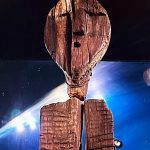
In 1848, during a period of unusual drought, a limestone statue was pulled from the shallow waters of the Zbruch River near the village of Lychkivtsi, in what is now western Ukraine. The man credited with its recovery was a local peasant, but the artifact quickly drew the attention of Count Mieczysław Potocki, a Polish nobleman and antiquarian with estates in the area. Potocki preserved the statue and alerted scholars, initiating one of Eastern Europe’s longest-running archaeological debates. The discovery occurred in Austrian-controlled Galicia, a region then experiencing a wave of romantic nationalism, particularly among Poles and Ukrainians seeking historical continuity with a pre-Christian Slavic past.
The statue was soon moved to Kraków, then part of the Austrian Empire, where it was studied by early Polish archaeologists such as Tadeusz Czacki and later interpreted by scholars including Wacław Nałkowski. From the beginning, debate centered on the age, origin, and meaning of the figure. Was it truly a relic from pagan times, or a product of 19th-century folk art and imagination? These questions have never fully been put to rest. However, the figure became a central exhibit at the Archaeological Museum of Kraków, where it remains today under cautious interpretation.
Physical Characteristics and Material Facts
The Zbruch Idol is a 2.67-meter-tall monolith made of gray limestone. It has a roughly square cross-section, with carvings on all four faces. The sculpture is divided into three horizontal tiers, each representing distinct iconographic elements. The top tier shows a four-faced human-like figure with a headdress, while the middle and bottom levels depict a range of symbolic elements that have fueled both religious and anthropological interpretations.
Its limestone surface has been weathered, but not so severely as to obscure the carved figures, raising questions about how long it may have been submerged before discovery. The sides of the idol are uneven in wear, suggesting that it may have stood exposed for a period before being buried or submerged. While there is no known inscription on the sculpture, the level of detail in the carvings has made it a valuable object of study for scholars of Slavic paganism. The statue remains in Kraków’s Archaeological Museum and is cataloged under inventory number 1587, where it is displayed with interpretative signage but without a definitive claim of authenticity.
Key physical features of the Zbruch Idol:
- Height: 2.67 meters
- Material: Gray limestone
- Shape: Square cross-section
- Carvings: Four sides, three distinct levels
- Location: Archaeological Museum of Kraków, Poland
Artistic Style and Iconography
The top tier of the idol is generally interpreted as depicting a high deity—likely the supreme god of the pre-Christian Slavic pantheon. This four-faced figure has often been linked to Svantevit, a god known from later chronicles who was worshipped with a quadrilateral idol at Arkona, a stronghold on the island of Rügen. Others argue the figure represents Perun, the god of thunder and war, due to the presence of a sword or horn-like object in one of the hands. The four faces likely symbolized omnipresence or cosmic surveillance, a common motif in Indo-European religious iconography.
The middle tier features three figures on each side, some holding objects that may represent agricultural tools, religious items, or ritual offerings. One figure appears to hold a ring or wreath, possibly a symbol of authority or fertility. The figures’ proportions and poses are stylized rather than naturalistic, with large heads and rigid stances, which has led some scholars to classify the idol as folk-religious art rather than high craftsmanship. The bottom level, showing a single kneeling or crouching figure, is often interpreted as representing the underworld, an ancestor spirit, or a chthonic deity. Each level may represent the heavens, the earthly realm, and the underworld—mirroring tripartite cosmologies found in many early religions.
Historical and Religious Interpretations
The Idol as a Representation of Slavic Deities
Scholars have proposed that the Zbruch Idol depicts four distinct Slavic gods: Perun, the god of war and lightning; Mokosh, the goddess of fertility and women; Dažbog, a solar deity; and Lada, often associated with love and marriage. This interpretation, however, remains speculative due to the lack of inscriptions or direct textual evidence linking the idol to specific deities. The four faces of the top tier might simply represent a single all-seeing god, as in the case of Svantevit, rather than four separate divine figures.
One theory holds that the idol embodies the entire cosmos as perceived by early Slavs. This cosmological model suggests that the three levels of the statue correspond to heaven (the gods), earth (human life and ritual), and the underworld (the dead or spirits). The tripartite design has parallels in Indo-European mythologies, including Norse, Celtic, and Vedic traditions. However, such interpretations are often based on symbolic analysis rather than direct evidence from early Slavic sources. Since pre-Christian Slavs left no written records of their own religion, most interpretations rely heavily on Christian chroniclers, such as those behind the Primary Chronicle, compiled around AD 1113.
Perun, the Thunder God: Real or Projected Onto the Idol?
Perun, the thunder god of the Eastern Slavs, is one of the few pre-Christian deities for whom we have relatively solid historical evidence. The Primary Chronicle records that Grand Prince Vladimir of Kiev erected a statue of Perun in AD 980, only to destroy it when he converted to Christianity in AD 988. This statue reportedly stood with a silver head and a golden mustache—features not present in the Zbruch Idol but suggestive of the kind of monumental sculpture that could have existed at the time.
In the Zbruch Idol, one of the figures on the top tier holds a sword and another item that could be interpreted as a solar disk or horn. These attributes align loosely with known symbols of Perun—particularly the sword or axe, which were often used in his worship. While tempting, the identification of this figure as Perun remains hypothetical. Later nationalists in the 19th and 20th centuries leaned heavily on this reading to promote a vision of ancient Slavic unity and strength, particularly in opposition to foreign cultural influence. Yet serious historians remain cautious about projecting known deities backward onto ambiguous visual forms without contemporary textual support.
Was the Idol a Cult Object or Symbolic Monument?
There is still no clear consensus on the original function of the Zbruch Idol. Some believe it stood at a shrine or sacred grove, serving as a cult object for ritual offerings. If so, its recovery near the Zbruch River may suggest that it was deliberately buried or thrown into the water during the Christianization of the region, perhaps as a symbolic act of rejection. Others theorize it could have served a more secular purpose, such as marking a tribal boundary or functioning as a local monument of cultural identity.
Some archaeologists have even proposed that it may have been created in the Christian era as a stylized commemoration of a lost pagan past. This would explain the hybrid nature of its iconography, which some see as containing elements both pagan and Christian. The absence of any associated artifacts—no altar, no cult tools, no building foundations—makes it difficult to situate the idol in any concrete religious context. In contrast to other well-documented sacred sites, like the temple of Perun in Novgorod, the Zbruch Idol stands alone, physically and archaeologically.
Scholarly Debate: Authentic Artifact or 19th-Century Hoax?
Arguments for Authenticity
Those who argue for the Zbruch Idol’s authenticity point to several key features. First, the style and carving technique are consistent with rural artistic traditions known from the 9th to 10th centuries AD. The simplicity of the carving, combined with the vertical, tiered structure, resembles forms found in other Indo-European wooden cult idols, particularly in regions like Pomerania and Polabia. The wear and patina on the stone are also cited as natural, suggesting an age of several centuries, if not a full millennium.
Supporters also note the obscurity of the idol’s discovery location. The village of Lychkivtsi was a remote agricultural community with little connection to major centers of learning or cultural politics in 1848. It seems unlikely that locals could have produced such a sophisticated forgery, especially at a time when Slavic mythology had only recently begun to be studied seriously in academic circles. The idol’s emergence predates major waves of archaeological fraud in the region, making its timing important in arguing for authenticity.
Claims of Forgery or Misinterpretation
Despite these arguments, there remains a significant body of scholarship that questions the idol’s age and authenticity. Some scholars argue that the Zbruch Idol was created in the 19th century to serve a romantic vision of Slavic antiquity popular among Polish and Ukrainian nationalists. The mid-1800s saw a flourishing of Pan-Slavic sentiment across Galicia, and numerous fabricated folk artifacts were produced during this time to satisfy both patriotic and antiquarian interest. The idea of a lost pagan past was emotionally and politically powerful, especially under Austrian and Russian rule.
Doubts also arise from the idol’s relatively pristine condition. While its surface is worn, the clarity of the carvings—particularly the fine details on the top tier—seems incongruous with centuries of exposure to water and soil. Critics also point to the absence of any carbon-datable material or stratigraphic context. The idol was not uncovered during a professional excavation but found by chance. As such, its placement, depth, and surrounding sediments were not recorded with archaeological rigor.
Main arguments against authenticity:
- No secure archaeological context
- Romantic nationalist environment in 1848 Galicia
- No possibility of radiocarbon dating
- Unclear symbolism and inconsistent iconography
Methodological Challenges in Dating the Idol
Determining the age of the Zbruch Idol remains notoriously difficult due to its material. Limestone, unlike organic material or ceramics, cannot be directly dated using radiocarbon or thermoluminescence methods. This leaves scholars reliant on stylistic analysis and comparative dating, both of which are inherently subjective. For example, some features of the carving resemble early medieval Christian sculpture, while others are more primitive and echo Bronze Age designs.
Another complicating factor is the lack of comparable finds from the same region. While wooden idols have been recovered from northern Slavic territories—such as the 9th-century idol of Svantevit from Arkona—they are generally less complex and more clearly associated with ritual sites. The Zbruch Idol remains unique in its structure and iconography, which has made it hard to classify. The Archaeological Museum of Kraków itself labels the object as “possibly 9th or 10th century,” reflecting the cautious stance most institutions have taken.
Cultural Legacy and Modern Appropriation
The Idol in 20th–21st Century Neo-Pagan Movements
In recent decades, the Zbruch Idol has taken on a second life in modern spiritual and cultural movements, particularly among practitioners of Rodnovery, or Slavic neo-paganism. These groups regard the idol as a sacred remnant of the pre-Christian faith of the Slavs. Replicas have been erected in Russia, Poland, and Ukraine, where they are used in festivals, religious ceremonies, and seasonal celebrations, especially around Kupala Night and other solar holidays.
The idol’s tiered symbolism—representing the heavens, earth, and underworld—resonates strongly with the cosmology of modern Rodnover beliefs. In this context, the artifact serves less as a historical curiosity and more as a living emblem of spiritual continuity. While many Rodnover leaders acknowledge that the idol’s provenance remains disputed, they assert that its symbolism holds value regardless of origin. For them, the Zbruch Idol functions as both a symbol of national heritage and a blueprint for personal religious identity.
Museum Presentation and Public Engagement
Today, the original Zbruch Idol is housed in the Archaeological Museum of Kraków, where it is displayed in a climate-controlled exhibit with minimal interpretive signage. The museum maintains a neutral stance on the artifact’s authenticity, describing it as “believed by many to be a relic of the 9th or 10th century.” Informational plaques reference both the pagan interpretation and the forgery hypothesis, allowing visitors to draw their own conclusions.
Replicas of the idol have been placed in various institutions, including the Museum of Slavic Mythology in Moscow and cultural centers in Kyiv and Warsaw. These copies are often used in educational exhibits about early Slavic belief systems. However, the museum community remains divided on how to present the idol—should it be framed as a sacred object, a historical mystery, or a cautionary tale in archaeological interpretation? Public interest in the idol remains strong, and it often features in tourist literature, school curricula, and Slavic folk festivals.
Symbolism in National and Ethnic Identity Discourse
The Zbruch Idol has also become a potent symbol in discussions of national and ethnic identity, especially in countries like Ukraine and Poland. For many, it serves as a tangible connection to a distinctly Slavic pre-Christian heritage, free from foreign influence. Its four-faced god is sometimes seen as an emblem of unity among the East, West, South, and North Slavs—an idea that echoes 19th-century Pan-Slavic ideals.
At the same time, critics argue that the idol has been politicized and overinterpreted. Some scholars warn that assigning too much symbolic weight to a single artifact risks distorting the historical record. While the idol may represent a genuine vestige of an ancient religious tradition, it is equally possible that it was crafted to serve the needs of a modern narrative. As with many ancient relics, its meaning is often shaped more by those who study it than by those who may have once worshipped it.
Key Takeaways
- The Zbruch Idol was discovered in 1848 in the Zbruch River near Lychkivtsi, modern-day Ukraine, and is currently housed in the Archaeological Museum of Kraków, Poland.
- It stands 2.67 meters tall and is carved from gray limestone, with three symbolic tiers and four carved faces believed to represent deities or cosmological concepts.
- Scholars remain divided on whether the idol is an authentic 9th–10th century pagan artifact or a 19th-century creation meant to promote romantic Slavic nationalism.
- Interpretations of its iconography often link the idol to major Slavic gods like Perun or Svantevit, but these connections are speculative and lack direct historical confirmation.
- Modern Slavic neo-pagan groups have embraced the idol as a religious symbol, regardless of its disputed origins, making it a living icon of cultural and spiritual identity.
Frequently Asked Questions (FAQs)
What is the Zbruch Idol made of?
The Zbruch Idol is carved from gray limestone and stands 2.67 meters tall. It has a square cross-section with carvings on all four sides.
Where is the Zbruch Idol located today?
The original sculpture is held by the Archaeological Museum of Kraków in Poland, where it is a key item in their collection of early Slavic artifacts.
Is the Zbruch Idol considered authentic?
There is no consensus. Some scholars believe it dates to the 9th or 10th century AD, while others suspect it was made in the 19th century during a wave of Pan-Slavic romanticism.
Which gods are shown on the idol?
There are no inscriptions, so identifications are speculative. Scholars have proposed Perun, Mokosh, Dažbog, Lada, or a four-faced Svantevit, but none of these claims are confirmed.
How is the idol used today?
Many Slavic neo-pagan groups use replicas of the Zbruch Idol in rituals, festivals, and as spiritual symbols, especially in Poland, Russia, and Ukraine.