Lightning has always captured the human imagination. Few natural events are as sudden, powerful, or visually dramatic. A brilliant flash can split the darkness in an instant, illuminating entire landscapes before vanishing just as quickly. For thousands of years, artists have tried to capture that fleeting spectacle. Their efforts reveal not only changing artistic styles but also changing ideas about nature, religion, science, and humanity’s place in the world.
Long before scientists understood electricity, lightning was viewed as a supernatural force. Ancient civilizations associated it with gods, divine judgment, and heavenly authority. As artistic techniques evolved, so did the depiction of storms and lightning. By the nineteenth century, advances in science and photography transformed how artists represented the phenomenon. Today, lightning continues to inspire painters, photographers, and installation artists who seek to express both its beauty and its immense power.
Lightning as a Divine Symbol in Ancient and Medieval Art
Thunderbolts and the Gods
The earliest artistic depictions of lightning were deeply connected to mythology. In ancient Greece, Zeus ruled the heavens and wielded the thunderbolt as his principal weapon. Greek vase painters, sculptors, and coin makers frequently portrayed him holding stylized bolts that symbolized supreme authority. Similar imagery appeared in Roman art, where Jupiter inherited the attributes of Zeus and became the chief god of the Roman pantheon.
The thunderbolt became one of the most recognizable symbols in classical art. Rather than depicting actual lightning as it appears in nature, artists created emblematic forms. These often resembled bundles of flames, arrows, or radiating spikes. The goal was not realism but symbolism. The thunderbolt instantly identified the divine figure and conveyed power, judgment, and control over the natural world.
Ancient cultures beyond Greece and Rome also linked lightning with supernatural beings. Norse mythology associated thunder and lightning with Thor, whose hammer Mjölnir became a symbol of protection and strength. In many artistic traditions, lightning represented a visible sign of divine intervention.
These early images established visual conventions that would influence artists for centuries. Lightning was not merely weather. It was a message from heaven.
Lightning in Religious Imagery
As Christianity spread across Europe, artists adapted older visual traditions to new religious themes. Lightning often appeared in scenes depicting divine wrath, miracles, or revelations. Medieval manuscripts occasionally illustrated biblical events involving storms, heavenly signs, and dramatic displays of light.
One important source was the Book of Exodus. The description of God descending upon Mount Sinai amid thunder, lightning, and smoke provided artists with powerful imagery. Medieval illuminators used bright colors and gold leaf to emphasize the supernatural nature of such events.
The Book of Revelation also influenced artistic depictions of lightning. Apocalyptic visions frequently included flashes of lightning surrounding the throne of God. Artists working in churches and monasteries interpreted these passages symbolically, emphasizing spiritual meaning rather than meteorological accuracy.
Because direct observation played a limited role in medieval art, lightning was often rendered as simple zigzags or radiant streaks. These images communicated divine presence clearly to viewers even if they bore little resemblance to actual lightning bolts.
Artistic Challenges Before Scientific Observation
Ancient and medieval artists faced a difficult problem. Lightning appears for only a fraction of a second. Without photography, careful observation was nearly impossible. As a result, artists relied on inherited visual formulas.
The familiar zigzag lightning bolt became common because it was easy to recognize. It functioned much like a visual shorthand. Viewers immediately understood its meaning regardless of its accuracy.
Religious patrons also shaped artistic choices. Churches commissioned works designed to teach spiritual lessons. Realistic weather effects were less important than theological clarity. Lightning needed to symbolize divine action rather than scientific reality.
For centuries, this symbolic approach dominated artistic representations. The natural world would not become the primary focus until the Renaissance encouraged closer observation of nature.
Renaissance and Baroque Transformations of Light and Storms
Nature Becomes a Subject
The Renaissance brought profound changes to European art. Beginning in the fourteenth century and accelerating during the fifteenth and sixteenth centuries, artists increasingly studied the natural world. Observation became a central part of artistic practice.
Painters explored perspective, anatomy, and atmospheric effects with unprecedented attention to detail. Landscapes, once simple backgrounds, gained importance as subjects in their own right. Storms and dramatic skies became opportunities to demonstrate artistic skill.
Leonardo da Vinci, who lived from 1452 to 1519, exemplified this new spirit of inquiry. His notebooks contain observations about weather, clouds, and natural forces. Although lightning itself was difficult to study, Renaissance artists became more interested in depicting nature as it actually appeared.
This shift laid the groundwork for later representations of storms. Artists began moving away from purely symbolic lightning toward more observational approaches.
Storms, Drama, and Divine Power
During the Baroque period, roughly 1600 to 1750, artists embraced drama, movement, and emotional intensity. Storms became powerful tools for creating visual excitement.
One notable example is Jupiter and Semele by Peter Paul Rubens, painted around 1597–1600. The painting depicts the mythological moment when Semele asks to see Jupiter in his full divine glory. According to the myth, the overwhelming power destroys her. Lightning imagery plays a central role in conveying divine energy and catastrophe.
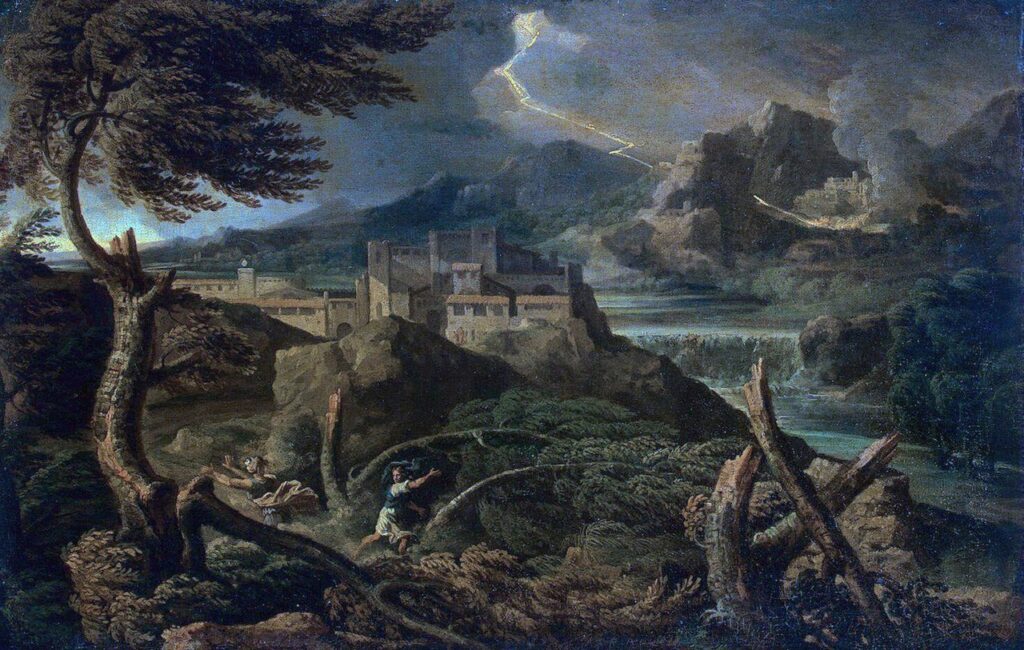
Baroque artists used strong contrasts between light and darkness to heighten emotional impact. Lightning flashes offered natural opportunities for dramatic illumination. Figures emerged from shadows, landscapes became charged with tension, and viewers felt the sudden violence of the scene.
Even when depicting mythological subjects, artists increasingly paid attention to atmospheric conditions. Clouds, rain, and stormy skies gained greater realism.
The Rise of Naturalistic Observation
Scientific developments also influenced artistic practice. The seventeenth century witnessed major advances in astronomy, physics, and natural philosophy. Artists and scientists alike sought a better understanding of the physical world.
Storms fascinated observers because they combined beauty and danger. Painters studied cloud formations and changing light conditions more carefully than ever before. While lightning remained difficult to capture accurately, depictions gradually became more naturalistic.
Landscape painters in the Dutch Republic were particularly influential. Artists such as Jacob van Ruisdael created dramatic skies that emphasized the power of nature. Although lightning was not always the focus, storm imagery became an important artistic subject.
By the end of the Baroque era, viewers expected greater realism. Nature itself had become worthy of careful observation.
Romanticism and the Sublime Power of Lightning
Nature as an Overwhelming Force
The Romantic movement emerged in the late eighteenth century and flourished during the first half of the nineteenth century. Romantic artists celebrated emotion, imagination, and the overwhelming power of nature.
Lightning became an ideal subject because it embodied what philosophers called the sublime. The sublime referred to experiences that inspired both awe and fear. A violent thunderstorm could make people feel small while also filling them with wonder.
Painters used lightning to emphasize humanity’s vulnerability. Tiny figures often appear beneath vast storm clouds, reminding viewers that nature operates according to forces beyond human control.
These works reflected broader cultural changes. Industrialization was transforming society, yet many artists looked to untamed landscapes for inspiration. Lightning symbolized the enduring power of the natural world.
Storm Landscapes and National Identity
Romantic painters across Europe and America created memorable storm scenes. Their works often linked dramatic weather to ideas of national character and wilderness.
In the United States, artists of the Hudson River School celebrated the grandeur of the American landscape. Massive skies, distant mountains, and powerful storms emphasized the scale of the continent. Lightning enhanced the sense of awe.
European artists pursued similar themes. Storms became symbols of emotional intensity and spiritual reflection. Rather than serving merely as background details, weather phenomena took center stage.
Common characteristics of Romantic lightning paintings included:
- Dramatic contrasts between light and darkness
- Vast landscapes dwarfed by storms
- Small human figures emphasizing vulnerability
- Emotional intensity and atmosphere
- A sense of mystery and wonder
These elements helped define the visual language of Romanticism.
Scientific Discovery Meets Artistic Emotion
The eighteenth and nineteenth centuries also witnessed major discoveries about electricity. Benjamin Franklin’s famous kite experiment in 1752 contributed to a growing understanding of lightning as an electrical phenomenon.
Scientists throughout Europe continued investigating atmospheric electricity. Public fascination with these discoveries increased. Lightning was no longer viewed solely as a divine force.
Artists responded in different ways. Some embraced scientific accuracy, while others continued emphasizing emotional impact. The result was a rich variety of interpretations.
Romantic painters often balanced observation and imagination. Their lightning strikes looked more realistic than medieval symbols, yet they still conveyed profound emotional and spiritual meanings.
Photography, Modern Art, and Contemporary Lightning Imagery
The First Lightning Photographs
A major breakthrough occurred in 1882 when photographer William Nicholson Jennings successfully captured one of the first known photographs of lightning. Photography transformed the study of storms.
For the first time, people could examine lightning in detail. Photographs revealed branching patterns that differed significantly from the simplified zigzags commonly used by artists. The actual structure of lightning proved far more complex and beautiful.
In 1886, Charles Moussette created Spiral of Lightning in a Thunderstorm, a photograph now preserved in the Metropolitan Museum of Art. Such images demonstrated the remarkable forms produced by electrical discharges in the atmosphere.
Scientific photography changed public expectations. Artists could no longer rely entirely on traditional conventions.
How Photography Changed Artistic Depictions
Photography influenced painters in subtle but important ways. Accurate visual records encouraged closer study of natural phenomena. Artists gained access to reference materials that previous generations could only imagine.
Lightning began appearing with more realistic branching structures. The stereotypical zigzag persisted in popular culture, but many serious artists sought greater accuracy.
At the same time, modern art movements increasingly emphasized interpretation rather than strict realism. Artists were free to use lightning symbolically while still benefiting from scientific knowledge.
The tension between observation and expression became a defining feature of modern artistic approaches.
Lightning in Modern and Contemporary Art
The twentieth century brought extraordinary experimentation. Artists explored abstraction, conceptual art, and new media. Lightning remained a compelling symbol because it could represent energy, transformation, danger, and inspiration.
One of the most significant modern works connected to lightning is The Lightning Field by Walter De Maria, completed in 1977. Located in New Mexico, the installation consists of 400 stainless-steel poles arranged across a remote landscape.
The work was designed to interact with changing weather and light conditions. Visitors experience the environment over extended periods, becoming aware of the relationship between nature, space, and perception. Actual lightning strikes occasionally occur, but the artwork remains powerful even when skies are clear.
Major developments that transformed lightning imagery include:
- Scientific understanding of electricity
- Meteorological research
- Photography
- Modern abstraction
- Environmental and land art
Today, lightning continues to inspire artists working in photography, digital media, painting, and installation art.
Lightning as an Enduring Artistic Subject
Despite centuries of scientific progress, lightning has never lost its mystery. Modern viewers understand electrical charges and atmospheric conditions, yet a lightning storm still inspires awe.
Artists continue exploring themes that fascinated their predecessors. Lightning remains a symbol of power, sudden change, and the forces that shape the natural world. Its visual drama makes it uniquely suited to artistic interpretation.
From ancient thunderbolts wielded by gods to contemporary environmental installations, lightning has illuminated the history of art in remarkable ways. The story of its depiction reveals how artists have continually adapted to new ideas while preserving a sense of wonder before nature’s most spectacular displays.
Key Takeaways
- Ancient artists primarily depicted lightning as a symbol of divine authority.
- Medieval religious art emphasized lightning as a sign of heavenly power and judgment.
- Renaissance and Baroque artists increasingly studied storms through direct observation.
- Romantic painters used lightning to express the sublime power of nature.
- Photography and modern science transformed artistic understanding of lightning’s appearance.
Frequently Asked Questions
Why was lightning important in ancient art?
Lightning symbolized the power of gods such as Zeus and Jupiter and served as a visual sign of divine authority.
When did artists begin depicting lightning more realistically?
The shift began during the Renaissance and accelerated during the seventeenth and eighteenth centuries as observation of nature became more important.
How did photography change lightning imagery?
Photography revealed the true branching structure of lightning and provided artists with accurate visual references.
What is The Lightning Field?
It is a large-scale land art installation created by Walter De Maria in 1977 in New Mexico using 400 stainless-steel poles.
Why does lightning remain popular in art?
Its dramatic appearance, symbolic meaning, and connection to powerful natural forces continue to inspire artists.