Tucked along the banks of the Scheldt River, just a stone’s throw from the North Sea, Antwerp’s rise to artistic prominence did not occur in isolation. Geography, commerce, and culture converged in this vibrant Flemish city to create a crucible of creativity. By the late 15th and early 16th centuries, Antwerp had become one of Europe’s most important cities—not only economically, but culturally—and this status laid the groundwork for an artistic golden age that would ripple through centuries.
At the heart of Antwerp’s transformation into an art capital was its role as a commercial hub. During the 16th century, it became the chief trade center in Western Europe, surpassing Bruges, its coastal cousin, in economic might. Merchants from Italy, Spain, Germany, and beyond converged on the city, bringing with them not only capital but cosmopolitan ideas and tastes. In the words of the Flemish humanist Lodovico Guicciardini, who wrote a detailed description of the Low Countries in 1567, Antwerp was “the meeting place of the whole world.”
This influx of wealth and diversity created an unparalleled demand for art. Local guilds and foreign patrons commissioned paintings, altarpieces, sculptures, and printed materials in unprecedented quantities. Art was no longer confined to ecclesiastical or aristocratic circles—it entered the bourgeois home, the merchant’s ledger, and the public square. Artists found in Antwerp not only clients, but also a dynamic network of workshops, publishers, and guilds that nurtured collaboration and innovation.
Crucial to this flourishing was the Guild of Saint Luke, the professional organization for painters, sculptors, and other visual artists. Membership in the guild was essential for artists to sell their work, but beyond its regulatory role, it also provided education, protection, and a space for artistic exchange. The guild became a powerful engine of creativity, ensuring that technical skills were passed down and artistic standards upheld.
Moreover, Antwerp’s position within the Spanish Netherlands placed it at the crossroads of North and South. This dual influence—Italian Renaissance elegance mingling with Northern realism—gave rise to a distinctive artistic identity. While Italian cities such as Florence or Rome are often celebrated for birthing the Renaissance, Antwerp’s version of it was no less significant. Its artists absorbed Italian techniques but adapted them to local themes, materials, and traditions, creating works of profound humanism and vivid detail.
The printing press also played a pivotal role in Antwerp’s cultural ascent. By the early 16th century, the city had become one of the great publishing centers of Europe. This meant that not only books, but also prints—engravings, woodcuts, and etchings—were produced and distributed widely. Art became reproducible, portable, and, crucially, affordable to a broader audience. This democratization of imagery helped seed visual literacy and expanded the market for both high art and popular culture.
In short, the conditions that made Antwerp a commercial powerhouse—its port, its internationalism, its wealth—also made it an incubator for artistic brilliance. But more than infrastructure or economics, it was the city’s spirit of openness, its embrace of innovation, and its vibrant civic life that fueled its artistic achievements. From the realism of Quinten Massys to the grandeur of Rubens, from the rustic humor of Bruegel to the elegance of van Dyck, Antwerp’s artists would shape the visual culture of Europe and leave an enduring mark on the history of art.
Medieval Foundations: Guilds, Religion, and Early Artistic Life
Before Antwerp dazzled the continent with the brilliance of Rubens or the biting wit of Bruegel, it was a quieter, devout, and artisan-driven town. The seeds of its later artistic grandeur were sown in the medieval centuries, when churches dominated the skyline, guilds organized labor, and art served primarily devotional and communal functions. This era may not shimmer with the stylistic breakthroughs of the Renaissance, but it is here, in the workshops of goldsmiths and stonemasons, in the chapels of parish churches, and in the quiet commission books of guilds, that Antwerp’s unique visual culture began to take shape.
By the 12th century, Antwerp had already established itself as an important trading post along the Scheldt River, though it would not reach the commercial heights of the 16th century until much later. Even so, its location made it a natural gathering place for traders, travelers, and clergy. Religion was the dominant force in daily life, and the Catholic Church was both the largest patron of the arts and the symbolic center of community identity. Art in this context was not meant to dazzle but to instruct and inspire. Altarpieces, illuminated manuscripts, devotional statues, and architectural adornments conveyed sacred narratives to largely illiterate audiences.
One of the most important engines of medieval artistic production was the church building itself. Structures like the Cathedral of Our Lady (Onze-Lieve-Vrouwekathedraal), whose construction began in 1352, were monumental not only in scale but also in their symbolic and economic significance. These edifices were collaborative efforts, involving architects, masons, sculptors, stained-glass artists, and painters. Art was integrated into every facet of the church, from its soaring vaults to the intricate carvings of its choir stalls.
The early art of Antwerp was inseparable from craftsmanship. There was little distinction between “artist” and “artisan.” Painters were considered tradesmen, much like bakers or blacksmiths, and they operated within a highly structured system of guilds. These professional associations regulated every aspect of artistic labor—from apprenticeship and workshop standards to pricing and production quotas.
The Guild of Saint Luke, named for the patron saint of artists and physicians, was officially recognized in Antwerp by the late 14th century. It became the central institution for painters and other visual craftsmen, overseeing the transmission of skills and ensuring the economic protection of its members. Entry into the guild was a rigorous process, requiring years of apprenticeship followed by a “masterpiece” submission that demonstrated the artist’s proficiency. This guild structure allowed for a remarkable continuity of knowledge and technique, even as styles and subjects evolved over time.
Much of the surviving art from this period consists of religious imagery, but within that constraint, there was room for individuality and local flavor. Sculpted altarpieces made of oak or walnut, often painted and gilded, became a regional specialty. These polyptychs told biblical stories across multiple panels and were frequently commissioned by guilds or wealthy patrons for churches and chapels. Antwerp’s artists developed a reputation for detail and narrative clarity—qualities that would later define the city’s Renaissance masters.
Another key aspect of Antwerp’s medieval art world was the presence of foreign influence. Situated within the Duchy of Brabant and later under Burgundian rule, the city was part of a broader network of cultural exchange. Artists traveled from city to city, techniques were shared, and styles evolved through this cross-pollination. In this way, early Antwerp absorbed elements from the Gothic traditions of northern France, the ornamental flourishes of German wood carving, and the emerging realism of early Netherlandish painting.
As the 15th century progressed, Antwerp began to attract more artists from surrounding regions, drawn by the city’s growing wealth and civic pride. Increasingly, artwork began to reflect not just religious themes but also secular and even civic concerns. Public art—such as tapestries, city seals, and paintings for guild halls—began to appear alongside strictly devotional commissions. The seeds of a more humanistic and worldly art had begun to sprout.
In sum, the medieval foundations of Antwerp’s art scene were rooted in a confluence of religion, community, and craft. Though the names of many early artists have been lost to history, their legacy lived on in the city’s aesthetic infrastructure, its organizational systems, and its cultural priorities. By the time the Renaissance arrived on Antwerp’s doorstep, the city already possessed the artistic muscle and institutional framework to support a creative explosion.
The Rise of the Antwerp School: 15th–16th Century Innovation
As the late medieval period gave way to the Renaissance, Antwerp stood on the cusp of a cultural revolution. By the mid-15th century, the city was undergoing dramatic changes. Its economy was booming, its population was swelling, and the visual arts were beginning to shift from sacred craftsmanship to a more expansive vision—one that fused tradition with innovation. This transformation laid the groundwork for the emergence of what would come to be known as the Antwerp School: a flourishing community of artists whose work bridged the Gothic and Renaissance styles and redefined the possibilities of painting in Northern Europe.
Central to this transformation was Antwerp’s economic ascendancy. The city became the most important port in the Low Countries, overtaking Bruges by the early 16th century as the commercial capital of the region. It was not only a center for shipping and finance but also a magnet for merchants, bankers, and artisans from across Europe. This cosmopolitan mix of people brought with it a confluence of artistic tastes, demands, and influences. For artists, it meant something profound: a consistent, diverse, and often wealthy clientele.
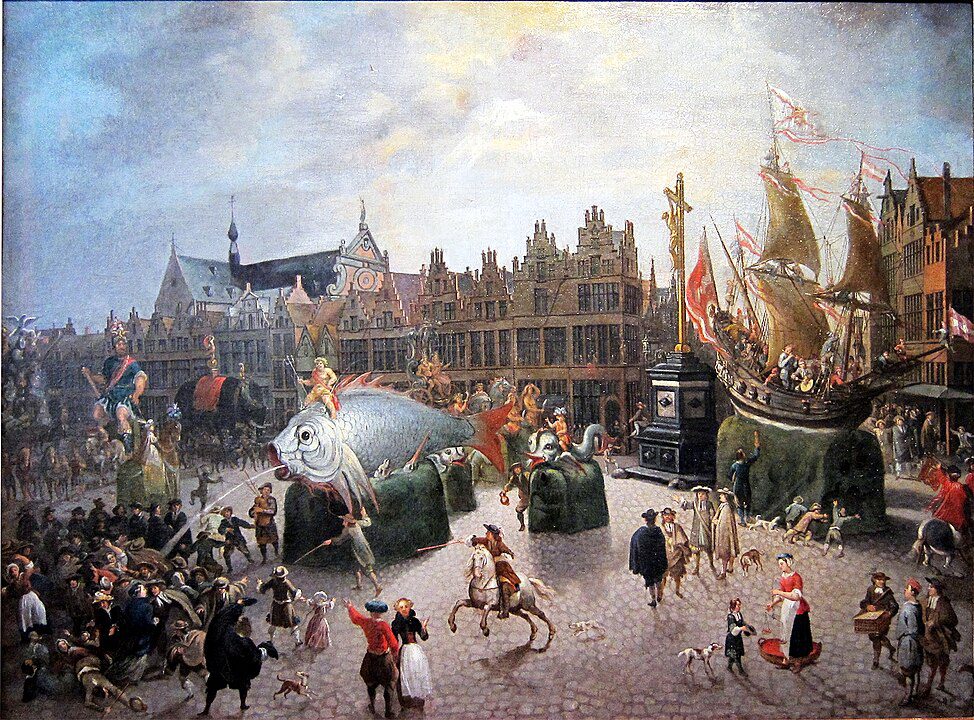
Antwerp’s boom created a hunger for art—not just for churches, but for private homes, civic buildings, and trade fairs. In the early 1500s, the city was home to one of the largest art markets in Europe. The Pand, a massive art and luxury goods fair held annually near the Cathedral of Our Lady, drew buyers and collectors from Italy, Spain, England, and beyond. Art became a commodity, and painters became both craftsmen and entrepreneurs. They produced not only major commissions but also smaller, more affordable works—genre scenes, portraits, and allegorical paintings—suited for a growing bourgeois audience.
It was in this climate that the Antwerp School emerged, marked by a group of artists whose work reflected both the Northern tradition of fine detail and an openness to Italian innovations. Quinten Massys is often cited as the foundational figure of this movement (and will be the focus of the next section), but he was far from alone. Artists like Joachim Patinir, Jan Gossaert, and Marinus van Reymerswaele helped to define a distinctly Antwerpian style characterized by complex compositions, an interest in classical themes, and a blend of realism with idealism.
One of the defining features of the Antwerp School was its embrace of narrative complexity. Rather than the static devotional images of earlier centuries, these new works often contained layered allegories, moral commentary, and scenes drawn from both biblical and secular sources. Joachim Patinir, for example, pioneered what became known as “world landscapes,” in which tiny figures play out religious or mythological dramas set against vast, meticulously rendered panoramic backdrops. These paintings were not just visual spectacles—they were intellectual puzzles that invited interpretation.
Another key innovation of the Antwerp School was the growing emphasis on the individual artist as a creative force. Painters began to sign their works more frequently, and the concept of artistic identity gained traction. The success of an artist was no longer solely determined by guild standing or workshop output, but increasingly by personal style and recognition. This shift helped pave the way for the celebrity of figures like Peter Paul Rubens in the following century.
The Antwerp School was also shaped by its close ties to the city’s robust printmaking and publishing industries. Artists collaborated with engravers and publishers to reproduce and distribute their works, reaching audiences far beyond the city. This dissemination helped spread Antwerp’s visual language throughout Europe and reinforced its reputation as a cultural capital. It also allowed for stylistic cross-pollination—artists could study prints from Italy, Germany, and France, and incorporate these elements into their own evolving vocabularies.
By the late 16th century, however, political and religious tensions began to destabilize the city. The Protestant Reformation, the Iconoclastic Fury of 1566, and the subsequent wars with Spain all had a devastating effect on Antwerp’s artistic community. Many artists fled to the Northern Netherlands, where cities like Amsterdam and Haarlem began to take the mantle. But even as Antwerp’s dominance waned, the innovations of its School endured.
The Antwerp School was more than a local phenomenon. It was a crucible of Northern Renaissance and early Mannerist experimentation—a movement that shaped European painting for generations. Its legacy can be traced not only in the brushstrokes of later Flemish artists but also in the evolution of genre, landscape, and allegorical painting throughout Western art.
Quinten Massys and the Birth of Northern Humanism in Art
In the tapestry of Antwerp’s art history, few figures are as foundational—or as emblematic of change—as Quinten Massys (c. 1466–1530). Often credited as the father of the Antwerp School, Massys was more than a painter of remarkable talent. He was a transitional figure, operating at a cultural crossroads, whose work captured the shifting intellectual and artistic climate of early 16th-century Europe. In his paintings, one can see the dying embers of medieval piety smoldering alongside the rising flames of Renaissance humanism. Massys didn’t just paint figures—he painted the human condition.
Born in Leuven, Massys moved to Antwerp around 1491, where he joined the Guild of Saint Luke. His early training may have included metalworking—a detail hinted at in his surname, which likely derives from “metze” or “metselaar,” meaning mason or smith—and some scholars believe this background shaped the meticulous precision evident in his later painting. His style was firmly rooted in the Flemish tradition established by Jan van Eyck and Rogier van der Weyden, with its emphasis on finely rendered detail, clarity of form, and luminous oil technique. But Massys also absorbed new influences, and in doing so, helped usher Antwerp into the Renaissance.
What makes Massys so important is the humanistic lens through which he approached traditional themes. In a time when many artists still adhered to rigid iconographic templates, Massys injected emotion, psychology, and even satire into his figures. One of his most famous paintings, The Moneylender and His Wife (1514), is a perfect example of this shift. The painting presents a bourgeois couple seated at a table: the man is absorbed in weighing coins, while his wife glances toward the scales with a conflicted expression. At first glance, it’s a moralistic critique of greed, echoing biblical warnings about avarice. But on closer inspection, the scene is rich with nuance—the glimmer of coins reflected in the mirror, the intimacy of the shared space, the softness of the woman’s gaze. It is at once a religious allegory and a deeply human moment.
Massys had a keen eye for social commentary, often drawing from popular themes and giving them new life through his technical skill and emotional sensitivity. In The Ugly Duchess (c. 1513), he paints a grotesquely caricatured older woman in extravagant clothing and a horned headdress—a visual satire of vanity and aging, likely inspired by Erasmus’ writings and Leonardo da Vinci’s drawings of physiognomy. While the painting is humorous, it also carries an undercurrent of sympathy, reminding the viewer of the frailties shared by all people.
This blend of moralism, realism, and empathy defines Massys’ contribution to art history. He was not merely painting pictures—he was participating in the intellectual discourse of his time. Antwerp was a hub of early humanist thought, with scholars, printers, and reformers like Erasmus frequenting the city. The philosophical environment prized the study of antiquity, the dignity of the individual, and the application of reason to matters of faith and society. Massys’ paintings reflect these ideas not only in content but in approach: they consider the complexity of human experience rather than presenting tidy religious absolutes.
Massys also excelled at religious compositions, and here, too, his humanist instincts are evident. In Pietà and Lamentation over the Dead Christ, he imbues familiar biblical scenes with raw, almost unbearable pathos. Mary’s anguish, Christ’s lifeless form, the mourners’ expressions—all are rendered with psychological depth and a kind of intimate realism that transcends the symbolic function of the image. These are not archetypes, but people in the throes of real grief.
His workshop was enormously influential. Massys trained a generation of painters who would carry forward his blend of emotional realism and technical finesse. His influence even reached across borders; some art historians argue that his works were studied in Italy and may have influenced early Mannerists. His reputation helped solidify Antwerp’s status as a major center for art production in the first half of the 16th century.
In a broader context, Massys represents the spirit of transition. He stands at the gateway between two worlds: one medieval, governed by theological certainties and hierarchical orders; the other Renaissance, shaped by humanist curiosity and a burgeoning secular sensibility. Through his work, viewers enter that liminal space—where saints have feelings, moneylenders have souls, and even satire can carry compassion.
Quinten Massys’ art challenges the binary of sacred and profane. He invites viewers to see not only divine stories, but human truths. And in doing so, he laid the philosophical and aesthetic groundwork for the Antwerp masters who would follow—artists who, like Massys, saw the world not only as it was, but as it might be understood.
Pieter Bruegel the Elder: Peasant Life and Visual Allegory
Pieter Bruegel the Elder (c. 1525–1569) was an enigma wrapped in a proverb, painted in oil, and set against the backdrop of a sprawling Flemish countryside. A towering figure in the history of art, Bruegel’s genius lay in his ability to elevate the seemingly mundane—plowmen, drunkards, peasants dancing in muddy fields—into complex visual narratives packed with moral reflection, social commentary, and piercing wit. His work helped define the identity of Northern European painting during the Renaissance, and nowhere did his singular vision find more fertile ground than in Antwerp.
By the time Bruegel arrived in the city around the 1550s, Antwerp was still a vibrant artistic hub, though already shadowed by religious upheaval and political instability. The Reformation was stirring, and tensions between Catholic Habsburg rule and emerging Protestant movements were nearing a breaking point. In this climate, Bruegel’s paintings operated on multiple levels—entertaining, instructing, and, at times, subtly subverting authority. He gave viewers the familiar peasant world but rendered it with enough ambiguity that it could be read as a celebration, a critique, or both.
One of the most striking aspects of Bruegel’s work is his focus on the common people. While Italian Renaissance artists were preoccupied with idealized beauty and divine subjects, Bruegel looked to the muddy earth and the people who worked it. His peasant scenes, such as The Peasant Wedding (c. 1567) and The Peasant Dance (c. 1569), are bustling with life—messy, joyful, corporeal. But these are not simple genre paintings. There is often an undercurrent of satire, or an allegorical warning about excess, lust, or folly. His peasants dance, but they also drink too much. They marry, but the ceremony is overshadowed by gluttony. In Bruegel’s world, human nature is on full display—flawed, absurd, and endlessly fascinating.
This fascination with human folly reached its most concentrated form in Netherlandish Proverbs (1559), a painting that crams over a hundred proverbs into a single, surreal landscape. Every corner teems with metaphor: a man bangs his head against a brick wall, another shears a sheep next to one shearing a pig, and two men try to pull the same rope in opposite directions. The painting is a visual encyclopedia of human irrationality, as relevant today as it was in the 16th century. Bruegel doesn’t lecture; he illuminates.
But Bruegel was more than just a chronicler of village life and idiom. He was also a master of landscape, and his “world landscapes”—inspired in part by Joachim Patinir—offered sweeping vistas populated with tiny figures enacting moral or biblical tales. In The Fall of Icarus (c. 1558), for example, the mythic tragedy is relegated to a barely visible splash in the sea, while the foreground is dominated by an oblivious farmer plowing his field. The message is subtle but profound: human ambition and hubris often go unnoticed by the world, which marches on regardless.
Religion, politics, and satire were embedded in Bruegel’s art, but always in a way that allowed for multiple readings. In The Triumph of Death (c. 1562), he depicts a hellish apocalypse where skeleton armies sweep across a barren landscape, killing indiscriminately. It’s a chilling meditation on mortality, but it also serves as a thinly veiled critique of war, greed, and the moral collapse of society—a mirror held up to a Europe tearing itself apart with religious conflict.
Bruegel was a student of humanity, but he was also a product of Antwerp’s intellectual and artistic environment. The city’s booming printmaking industry helped spread his imagery across Europe, with his collaborations with the publisher Hieronymus Cock ensuring that his engravings and designs reached a vast audience. Though he painted relatively few canvases—around 40 survive—his impact was magnified through these prints, many of which became part of a pan-European visual vocabulary.
Stylistically, Bruegel merged influences from Hieronymus Bosch’s surreal grotesqueries with the clear-eyed observation of daily life. He favored earthy colors, rhythmic compositions, and a painterly attention to detail. Yet his real innovation lay in how he used visual storytelling to fuse the sacred and the profane, the philosophical and the comic.
Bruegel died in 1569, likely in Brussels, but his legacy was deeply tied to Antwerp. His sons, Pieter Brueghel the Younger and Jan Brueghel the Elder, continued his style, helping to solidify the “Brueghelian” aesthetic in Northern painting for generations. And his moral, allegorical vision found echoes in the Baroque grandeur that would soon take hold in Flanders.
Ultimately, Bruegel’s genius lay not just in what he painted, but in how he made viewers think. His work turns the act of looking into an exercise in reflection. He invites us into a world that feels at once archaic and modern, distant yet uncomfortably close. In every muddied field and bustling tavern, Bruegel finds a mirror for humanity—and what he shows us is timeless.
The Printing Revolution and Graphic Arts
If oil painting was the jewel of Renaissance art, then printmaking was its engine. In 16th-century Antwerp, that engine roared to life. Long before mass media, before photography, before the internet, there was the printing press—and in Antwerp, it was as much a tool of art as it was of text. What emerged from this bustling Flemish city was a graphic revolution that not only changed how images were made and shared, but also who had access to them. Art was no longer confined to churches, palaces, or the hands of the elite. It could be printed, duplicated, sold at market, and hung in a merchant’s home or pasted in a scholar’s book. And at the center of this movement was Antwerp.
The city became a major publishing hub by the early 1500s, with its output rivaling that of Venice or Nuremberg. This was thanks in large part to the invention and expansion of copperplate engraving, a technique that allowed for intricate, durable, and reproducible images. While woodcuts had been in use since the 15th century, they lacked the subtlety and detail achievable with engraved copper plates. Antwerp artists and publishers quickly saw the potential. They transformed this new medium into a vibrant industry that combined artistry with entrepreneurial ambition.
Among the most important figures in this transformation was Hieronymus Cock, a printmaker and publisher who, in 1548, opened the house Aux Quatre Vents (At the Four Winds) with his wife, Volcxken Diericx. Cock was not only a skilled artist himself, but also a savvy businessman and a visionary. His publishing house became one of the most significant in Europe, producing thousands of prints that circulated widely, including engraved copies of works by Bruegel, Bosch, Raphael, and Titian.
Cock’s catalog was vast—landscapes, portraits, religious scenes, classical architecture, satirical imagery. But what made it revolutionary was its reach. His prints crossed borders, languages, and classes. They were studied by artists, used in textbooks, admired by collectors, and used as decorative art by the middle class. For the first time, an ordinary person could own an image by a great master—even if it was a copy. In this way, printmaking did for art what Gutenberg’s press had done for books: it democratized beauty.
This democratization, however, did not mean simplification. On the contrary, many prints from Antwerp were intellectually sophisticated, rich in allegory and classical reference. Artists like Cornelis Cort, Philip Galle, and Hendrick Goltzius elevated engraving to an art form in its own right. They created prints that were not merely reproductions of paintings, but original compositions crafted specifically for the printed page. Cort, for example, worked closely with artists like Titian, translating their painterly visions into tightly controlled lines and cross-hatching that retained the emotional depth of the originals.
Meanwhile, Bruegel’s own prints—many of them published by Cock—became cultural landmarks. His Big Fish Eat Little Fish, The Seven Deadly Sins, and The Virtues series are masterpieces of visual storytelling, packed with iconography, humor, and subtle social critique. These were not passive illustrations—they were meant to be studied, discussed, and interpreted. In them, Bruegel used the printed page as a space for moral and philosophical inquiry.
The rise of Antwerp as a printmaking capital also had profound implications for the education of artists. Prints served as references, study tools, and models. An aspiring painter in Utrecht, Bologna, or even Madrid could study Bruegel’s compositions, copy the poses of Raphael, or learn the rules of perspective from Italian treatises—all thanks to the print networks rooted in Antwerp. This flow of information helped standardize artistic training across Europe while also allowing for regional adaptation and experimentation.
Equally important was the synergy between image and text. Antwerp was not just printing images—it was printing ideas. Scientific diagrams, anatomical studies, architectural manuals, emblem books, and illustrated bibles all emerged from the city’s presses. The fusion of image and intellect helped shape the visual culture of the Renaissance, with artists and scholars working side by side to visualize knowledge. Publishers like Christophe Plantin (of the famous Plantin-Moretus Press) collaborated with engravers and typographers to produce works that were as visually refined as they were intellectually ambitious.
Yet, the golden age of print in Antwerp was not immune to disruption. Political instability, especially the Spanish repression of Protestantism and the Sack of Antwerp in 1576, drove many publishers and artists to the Northern Netherlands. Still, the influence of Antwerp’s printmaking legacy endured. Its methods, networks, and visual vocabularies were adopted in cities like Haarlem and Amsterdam, ensuring the survival of this graphic tradition well into the Dutch Golden Age.
In short, the printing revolution in Antwerp did more than expand the art market—it transformed what art was. It blurred the line between high and low culture, between painter and publisher, between the sacred and the secular. In doing so, it laid the groundwork for the visual literacy that modernity would require.
Baroque Splendor: Peter Paul Rubens and His Legacy
There are few names in the history of Western art that evoke grandeur quite like Peter Paul Rubens (1577–1640). To say Rubens dominated the Antwerp art scene in the 17th century would be an understatement. He didn’t merely succeed within it—he defined it. In Rubens, Antwerp found not only its greatest artistic voice, but also a powerful symbol of its resilience and cultural ambition following a period of war, repression, and decline.
Born in Siegen, Germany, to Flemish parents exiled for religious reasons, Rubens returned to Antwerp with his family after his father’s death. His early education in classical languages and humanist thought profoundly shaped his worldview. Rubens was not just an artist—he was a diplomat, scholar, linguist, and courtier. This polymathic identity would later distinguish his work from that of his contemporaries, and imbue it with an intellectual depth often overlooked beneath the visual bravado.
Rubens’ artistic training followed the conventional path: apprenticeships with local masters, culminating in membership with the Guild of Saint Luke in Antwerp. But it was his eight-year sojourn in Italy (1600–1608) that transformed him. There, he absorbed the grandeur of Renaissance and Baroque masters—Michelangelo’s muscular dynamism, Titian’s glowing color, Caravaggio’s chiaroscuro. He studied antiquities, copied frescoes, and refined his sense of scale and movement. When he returned to Antwerp in 1609, he brought Italy with him.
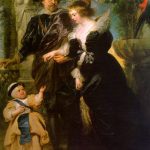
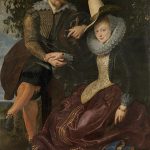
That year, he was appointed court painter to the Archdukes Albert and Isabella, rulers of the Spanish Netherlands. Rubens settled in Antwerp and built a house and studio that functioned as a combination palace, workshop, and intellectual salon. The Rubenshuis, still preserved today, became a magnet for artists, diplomats, collectors, and humanists. From this base, Rubens launched a career of astonishing productivity and influence. His studio operated with military precision, producing altarpieces, portraits, mythological cycles, political allegories, and private devotional works for clients across Europe.
What defined Rubens’ style—what made it unmistakably his—was its movement. Figures twist, leap, gesture, and emote in his compositions with a theatrical vitality that pulses with life. His use of color was lush and sensual; his brushwork fluid and assured. Rubens painted not only the divine, but the visceral: the sheen of flesh, the billow of fabric, the rush of wind through trees. Even in scenes of religious ecstasy or historical tragedy, the human body remained central—idealized, dynamic, and deeply expressive.
Take The Descent from the Cross (1612–1614), commissioned for the Cathedral of Our Lady in Antwerp. It is a masterwork of composition, weight, and emotional gravity. Christ’s limp body is carefully lowered by figures straining with effort and grief, their gestures forming a harmonious spiral that guides the viewer’s eye. Light and shadow heighten the drama; emotion is written in every face and hand. This is not just religious art—it is a meditation on sacrifice, duty, and humanity.
Rubens was also a gifted political operator. His commissions often had diplomatic dimensions, and he used his art as a form of soft power. One of his most significant projects was the Marie de’ Medici Cycle (1622–1625), a series of 24 monumental paintings for the Luxembourg Palace in Paris. Through allegory and classical symbolism, Rubens elevated the life of the French queen into a mythic narrative of divine providence and regal destiny. It was propaganda, yes—but executed with such brilliance that it transcended mere flattery.
Back in Antwerp, Rubens’ studio became a training ground for a generation of artists. His most famous pupil, Anthony van Dyck, would go on to become a major portraitist in England and help extend the Flemish Baroque style across Europe. But dozens of others passed through the studio, each absorbing the master’s lessons on anatomy, composition, and color. Rubens’ impact, therefore, was not only artistic but pedagogical. He helped codify a visual language that defined 17th-century painting.
Despite his international fame, Rubens remained deeply rooted in Antwerp. He advocated for the city’s artistic institutions, contributed to local churches, and supported the Jesuit order in their Counter-Reformation efforts. His art was a perfect instrument for that movement: emotional, persuasive, and rooted in the physical and spiritual drama of faith. Rubens’ religious works aimed not just to instruct or remind, but to move the viewer—literally and spiritually.
Rubens died in 1640, leaving behind an enormous body of work, much of it still housed in Antwerp’s museums and churches. But his true legacy lies in the vitality he brought to painting itself. He proved that art could be grand without being cold, intellectual without being distant, and beautiful without being idealized.
More than any other artist, Rubens embodied the spirit of the Baroque—its passion, its energy, its embrace of both the sacred and the sensual. In a city that had endured siege, iconoclasm, and decline, Rubens offered not just artistic splendor, but a vision of resilience, pride, and possibility. His brush brought light back to Antwerp, and that light has never fully dimmed.
Anthony van Dyck and the Internationalization of Flemish Art
If Peter Paul Rubens was the towering colossus of Flemish Baroque painting, Anthony van Dyck (1599–1641) was its cosmopolitan emissary. Trained in the high drama of Rubens’ studio, van Dyck emerged as a master in his own right, refining Flemish painting into something more intimate, elegant, and psychologically astute. He exported this new style to the courts of Europe—particularly England—where his portraits came to define royal image-making for generations. Through van Dyck, the grandeur of Antwerp’s art scene found a new stage, and Flemish aesthetics became a currency of international prestige.
Born in Antwerp to a well-to-do cloth merchant, van Dyck showed early artistic promise. By the age of 15, he was already registered as a master in the Guild of Saint Luke—a remarkable achievement that attests to both his precocity and the supportive infrastructure of Antwerp’s art world. But his real education began in Rubens’ workshop, where he worked as an assistant and collaborator during his late teens and early twenties. Rubens recognized his pupil’s talent, reportedly referring to him as “the best of my pupils.” Under Rubens, van Dyck absorbed the fundamentals of composition, anatomy, and theatricality, but he would soon soften and personalize those lessons into his own signature style.
Van Dyck’s early paintings bear the unmistakable imprint of Rubens’ dramatic energy—bold gestures, muscular forms, rich color palettes—but by the time he traveled to Italy in 1621, he began to pivot. In Genoa, he encountered a wealthy merchant class eager for portraits, and he rose to meet the demand. Italian influences, especially the grace and clarity of Titian, began to temper his style. His figures became more refined, his compositions more restrained, his use of color more subtle. This Italianate evolution proved critical to his later success.
Upon returning to Antwerp in 1627, van Dyck was already famous. He received numerous commissions for religious altarpieces and portraits of local elites, but his ambitions were increasingly international. Though he remained engaged with the Antwerp art scene, he had his eye on broader patronage networks. That opportunity came in 1632, when he was invited to the court of Charles I of England. There, van Dyck’s career reached its zenith.
Appointed “Principal Painter in Ordinary to Their Majesties,” van Dyck became the visual architect of the Stuart monarchy. His portraits of Charles I, Queen Henrietta Maria, and their children are iconic—not only for their beauty, but for their function. They did not simply represent their subjects; they elevated them. Charles appears noble, contemplative, almost divine—despite being, in reality, a deeply unpopular monarch whose reign would end in civil war and execution.
Take Charles I at the Hunt (c. 1635), for instance: the king is portrayed in civilian clothing, standing casually in a forest glade, gazing down at the viewer with an air of effortless superiority. His sword is relaxed at his side; his attendants linger in the background. Yet every detail—the tilt of his head, the gleam of his boot, the quiet dominance of his stance—reinforces his authority and nobility. This was not court propaganda in the grandiose style of Rubens, but something subtler, psychological. Van Dyck made monarchy look natural, inevitable, even poetic.
Van Dyck’s style was quickly imitated and widely admired. Across Europe, artists borrowed his soft modeling of flesh, his luminous fabrics, his elegant poses. His portraits emphasized character and charisma over heraldry and rank. In many ways, he created the prototype of the modern portrait—one that seeks the soul as much as the surface.
Back in Antwerp, van Dyck’s influence remained strong, even in his absence. He maintained connections with Flemish artists and dealers, and his fame added further luster to the city’s reputation. Antwerp became known not only as the home of great artists, but also as the training ground for painters who could thrive anywhere in Europe. His success proved that Flemish art could travel—adapt, evolve, and resonate across languages and courts.
Unfortunately, van Dyck’s life was short. He died in London in 1641 at the age of 42, just a year before the outbreak of the English Civil War. Yet in his brief career, he managed to redefine portraiture, bridge Northern and Southern European styles, and elevate the role of the court painter into that of a cultural force. His legacy endured not only in the countless artists he influenced—from Lely in England to Rigaud in France—but also in the broader transformation of what portraiture could be.
Through van Dyck, Antwerp’s artistic ideals—its blend of realism and refinement, intellectualism and accessibility—were transmitted to the broader European stage. He was a master of identity, not only in rendering others’ images, but in shaping his own. And in doing so, he helped shape the image of an age.
Artistic Decline and Political Turmoil: The Fall of Antwerp
The dazzling heights of Antwerp’s artistic golden age could not protect the city from the turbulent forces reshaping Europe in the 16th and 17th centuries. While painters like Rubens and van Dyck adorned palaces and cathedrals with Baroque splendor, the foundations beneath Antwerp’s cultural achievements were beginning to crack. The city’s decline was not the result of artistic failure, but of external pressures—wars, religious strife, and economic shifts—that dramatically altered its position in the European world. As a new century dawned, Antwerp would become less a capital of creation and more a symbol of what had been lost.
The trouble had been brewing for decades. The Protestant Reformation, ignited in 1517 by Martin Luther’s theses, had rippled through the Low Countries with particular intensity. Antwerp, with its international population, thriving printing industry, and intellectual circles, became a key site for religious debate. While the city was officially Catholic under Habsburg rule, Protestantism gained significant traction, especially among merchants and artisans. The resulting tension would boil over in the Beeldenstorm of 1566—a wave of iconoclasm in which Calvinist mobs destroyed religious images in churches across the Netherlands.
The iconoclasm was not merely a theological protest—it was a direct assault on the visual culture that had flourished in Antwerp’s churches and guild halls. Altarpieces were torn down, sculptures smashed, frescoes defaced. Artists, patrons, and clergy were traumatized. It was a devastating blow to Antwerp’s artistic infrastructure, and a foretaste of greater violence to come.
In 1576, the city suffered an even deeper wound during the infamous Sack of Antwerp. Spanish troops, unpaid and mutinous, looted the city in a horrific three-day rampage that left over 7,000 dead and much of the city in ruins. The event shocked Europe and marked the beginning of the end for Antwerp’s supremacy. Many artists and merchants fled north, to the more tolerant and increasingly prosperous Dutch cities of Amsterdam, Haarlem, and Leiden. The shift helped fuel the Dutch Golden Age, but it gutted Antwerp’s cultural economy.
The final blow came with the Fall of Antwerp in 1585, when Spanish forces under the Duke of Parma reconquered the city after a long siege. As part of the terms of surrender, Protestant citizens were given four years to leave. Tens of thousands departed, draining Antwerp of its commercial and intellectual lifeblood. The port was closed to foreign ships by the newly independent Dutch Republic, further crippling the city’s economy. Antwerp, once the beating heart of the European art market, was now isolated and subdued.
Yet even in this diminished state, Antwerp remained a city of art. The Counter-Reformation infused the Catholic Church with renewed energy and resources, and the Habsburg rulers turned to visual art as a means of reaffirming Catholic orthodoxy. This context provided opportunities for artists like Rubens, whose dynamic altarpieces were perfectly suited to the movement’s emotional and persuasive goals. But the art produced during this period, while often magnificent, was shaped by institutional mandates and religious conformity, rather than the open intellectual ferment of the earlier Renaissance.
The city’s once-vibrant printmaking industry also suffered under censorship and economic contraction. Many leading publishers had already relocated to the north, and though Antwerp continued to produce books and images, it no longer led the field. The center of gravity in European art had shifted.
Despite these losses, Antwerp did not vanish from the artistic map. It remained a regional center of training and production, with institutions like the Royal Academy of Fine Arts (founded in 1663) continuing to educate artists. Churches and civic buildings continued to commission works. But the character of Antwerp’s art had changed. It was no longer the experimental crucible of the Northern Renaissance, nor the bustling market of mass-produced images. It was a city turned inward, conservative in taste, reliant on memory and tradition.
Even so, the legacy of Antwerp’s earlier centuries never disappeared. The masterpieces that survived the iconoclasm and wars—Rubens’ altarpieces, Bruegel’s allegories, the engravings of Cock and Galle—remained as testaments to what had been. And in quieter ways, their influence continued to radiate. Artists in Spain, France, and England studied the Antwerp masters. Collectors sought out their works. The techniques and ideas developed in Antwerp—especially its synthesis of humanism, realism, and visual storytelling—remained foundational to European art.
In many ways, the story of Antwerp’s fall is also the story of how cultural power migrates. Political borders shift, economies rise and fall, but the achievements of an artistic center can echo long after its decline. For all its tragedy, the fall of Antwerp did not erase its brilliance. Instead, it gave the city’s artistic legacy a poignant afterlife—preserved in paint, ink, and memory.
19th-Century Revival: Romanticism, Historicism, and the Academy
The 19th century was an age of looking backward to move forward. Across Europe, cities dug into their histories, rediscovered forgotten artists, and celebrated national identities through cultural revival. In Antwerp, a city that had once dominated the artistic map but had long since faded from the forefront, this backward glance was also a reclamation—a bold effort to rekindle the artistic flame first lit by Rubens, Bruegel, and their Renaissance and Baroque peers. The revival that unfolded was fueled by Romanticism, institutional support, and a nationalistic pride eager to define what “Belgian” art could be in the modern era.
At the heart of this movement was the Royal Academy of Fine Arts, an institution that had been founded in 1663 but was reinvigorated in the 19th century with new purpose and prestige. The Academy became the engine of Antwerp’s cultural comeback. It trained artists not only in traditional techniques—drawing from live models, mastering anatomy, composition, and perspective—but also in the historicist styles that were in vogue. These included Romanticism, which emphasized emotion and individuality, and later, Academic Classicism, which looked to ancient Greece and Rome as models of beauty and idealism.
One of the most influential figures of this revival was Henri Leys (1815–1869), often regarded as the father of 19th-century Belgian historical painting. Leys helped bridge Romanticism and Historicism with his meticulously researched scenes of medieval and Renaissance life, many of them set in Antwerp itself. He aimed not just to evoke the past but to reconstruct it, drawing on archival sources and historical costumes to lend his work documentary weight. His paintings, such as The Mass of Berthal de Haze or Wedding in Flanders, celebrate the civic and artistic pride of Antwerp’s golden centuries. Through Leys, Antwerp’s past was made visible, tangible—and worthy of emulation.
Leys also mentored a generation of artists, among them Lawrence Alma-Tadema, who would go on to achieve international fame for his scenes of Roman antiquity. Though Alma-Tadema eventually settled in England, his training in Antwerp gave him the academic rigor and historical curiosity that would define his career. Similarly, Charles Verlat, another student of Leys, returned to the Academy as a director and helped modernize its curriculum while maintaining its dedication to technical excellence.
This period also saw a revival of Rubens’ reputation. Once dismissed by neoclassicists as overly florid and theatrical, Rubens was reappraised by Romantic and nationalist thinkers as a symbol of Flemish genius. Monuments were erected, exhibitions organized, and his house in Antwerp—the Rubenshuis—was restored and opened to the public in 1946 (after years of earlier conservation efforts). Rubens became not just an old master, but a civic icon, his legacy central to the city’s sense of cultural identity.
Museums played a critical role in this revivalist movement. The Royal Museum of Fine Arts Antwerp (KMSKA), founded in 1810 and housed in its grand neoclassical building from 1890, became both a temple of heritage and a training ground for the future. It collected and showcased the city’s artistic riches, placing the work of old masters alongside newer Belgian painters. The museum served as a cultural anchor—a space where Antwerp could reconnect with its past and define its future.
But the 19th-century revival wasn’t purely about nostalgia. It also intersected with broader European currents. Romanticism’s emphasis on nationalism gave new meaning to local history, and Historicism’s love of ornament and pastiche resonated in Antwerp’s architecture and civic art. Neo-Gothic churches and public buildings sprang up across the city, designed to recall its medieval grandeur. Artistic guilds and salons were reestablished, competitions held, and state patronage increased.
However, this revival had its contradictions. While it championed the past, it often shied away from the modern. As Impressionism, Symbolism, and later Expressionism emerged in France and Germany, Antwerp’s Academy and major institutions remained largely conservative. Innovation came slowly, and more avant-garde voices found themselves at odds with the academic orthodoxy. Yet even within these constraints, the 19th-century revival laid crucial groundwork for future movements.
It reasserted Antwerp’s role on the cultural stage. It gave new life to its institutions, elevated its historical heritage, and fostered a generation of artists whose work would resonate far beyond Belgium’s borders. Most importantly, it restored a sense of artistic continuity—a belief that the city’s story was not finished, but still unfolding.
In reclaiming its past, Antwerp also reimagined its future. The 19th century may have been a revivalist age, but it proved that the city’s artistic spirit could survive war, repression, and neglect. What had once been lost was, at least in part, found again—this time in oil, stone, and national pride.
Modernism in Antwerp: Expressionism, Abstraction, and Innovation
By the dawn of the 20th century, the world was changing at a dizzying pace, and Antwerp—so rooted in the glory of its past—had to choose whether to look backward or step into the modern age. The choice, in truth, was never that binary. While many of the city’s official institutions remained steeped in academic tradition, a wave of artists broke from the past, engaging with radical new forms of expression and global movements. From the emotional turbulence of Expressionism to the crisp geometry of Abstraction, Antwerp’s modernists helped reshape Flemish art for the contemporary age, often on their own terms and in conversation with broader European innovations.
The early modernist wave in Antwerp was shaped by the aftershocks of World War I. Belgium had suffered deeply during the war, and artists responded with works marked by anxiety, trauma, and a search for meaning. Flemish Expressionism, a movement with strong roots in both Antwerp and Ghent, emerged in this context. Inspired in part by German Expressionism but shaped by local conditions, it emphasized emotional intensity, distorted forms, and the inner life of subjects—whether rural workers, urban landscapes, or religious imagery.
One of the leading figures of this movement was Constant Permeke, whose dark, brooding figures of farmers and laborers became emblematic of postwar Flemish identity. Though Permeke was more closely associated with Ostend, his influence resonated throughout the region, and Antwerp’s younger painters absorbed his emotional directness and monumental style. Expressionism in Flanders, including in Antwerp, was less political than its German counterpart but more visceral—rooted in landscape, toil, and spirituality.
Alongside Expressionism, other modernist tendencies began to emerge in Antwerp, particularly in the 1920s and ’30s. The city became a meeting point for Constructivism, Cubism, and Abstraction, thanks in part to an influx of ideas from France, Russia, and the Netherlands. Artists like Jozef Peeters, based in Antwerp, became pivotal in this transition. A self-taught painter and fervent modernist, Peeters co-founded the Revues of Modern Art and launched Antwerp’s own take on international abstraction.
Peeters’ work moved from early Symbolist and Expressionist styles toward a crisp, geometric language influenced by Futurism and De Stijl. His dynamic compositions—filled with interlocking planes, mechanical motifs, and non-objective forms—embodied the spirit of the machine age and the search for a new visual order. More than an artist, he was a tireless organizer, writer, and advocate, helping to establish Antwerp as a node in the expanding network of European avant-garde circles.
This period also saw the rise of integrated arts movements, in which visual art, design, and architecture were linked. Antwerp artists and designers collaborated on posters, stage sets, typography, and furniture—seeking to reshape not just images, but environments. This Gesamtkunstwerk (total art) approach found fertile ground in Antwerp’s burgeoning design scene and eventually influenced the development of postwar Belgian graphic design.
However, modernism in Antwerp was not universally embraced. The Royal Academy of Fine Arts, while gradually evolving, remained conservative well into the mid-century. The academy’s continued emphasis on classical drawing and realist painting led to tensions between academic traditionalists and younger artists pushing boundaries. As a result, much of Antwerp’s modernist energy pulsed through independent galleries, artist collectives, and underground circles, rather than official institutions.
World War II further complicated the cultural landscape. The Nazi occupation disrupted artistic production, and the trauma of war left its mark on the city’s psyche. But in the postwar years, Antwerp experienced a creative resurgence. Abstract painters like Luc Peire and Paul Joostens expanded the vocabulary of Belgian modernism, embracing lyrical abstraction and experimental materials. Cobra, a pan-European movement founded in 1948, also had ripple effects in Antwerp, encouraging spontaneous, playful, and emotionally charged approaches to painting and sculpture.
In this moment, Antwerp became not only a site of artistic production, but of critical redefinition. What did it mean to be a Flemish artist in a globalizing, fragmented world? What role should heritage play in shaping the avant-garde? These questions reverberated through the city’s postwar cultural debates.
By the 1960s and ’70s, Antwerp’s modernist legacy fed into new movements: Pop Art, Conceptualism, and Minimalism began to appear in local galleries and artist-run spaces. The city’s art schools slowly adapted, bringing in new pedagogies and international faculty. What had once been a slow pivot away from tradition became an open embrace of plurality and innovation.
Antwerp’s entry into modernism wasn’t defined by one dominant school or movement—it was defined by collision: of history and invention, of Flemish earthiness and international abstraction, of emotional gravity and formal experimentation. The city’s artists forged their own paths through a century of upheaval, never abandoning the deep currents of narrative, symbolism, and materiality that defined Flemish art since the days of Bruegel.
Modernism in Antwerp, then, was not a clean break, but a layered evolution. It honored the past even as it disassembled it, pulled threads from Renaissance fabric and rewove them into something sharper, stranger, more electric.
Post-War to Contemporary: Avant-Garde, Fashion, and Global Influence
By the late 20th century, Antwerp had weathered centuries of transformation—triumph, decline, revival, and redefinition. What emerged after World War II was not a city looking back, but one increasingly defined by bold steps forward. In this final chapter of Antwerp’s artistic journey (for now), we see how the city embraced the avant-garde, launched a fashion revolution, and became a surprising but formidable force in the global contemporary art scene.
The Post-War Shift: Conceptualism and the Artist as Thinker
The 1960s and ’70s brought a major shift in how art was made, viewed, and valued. Across Europe, Conceptual Art rejected traditional media and materials in favor of ideas. Antwerp’s version of this movement was gritty, ironic, and often irreverent—infused with the city’s working-class sensibilities and deep artistic heritage.
Artists like Jef Geys played a central role. Geys combined photography, text, drawing, and everyday objects into works that questioned authorship, originality, and institutional power. His “Biografieën van de Arbeider” (Biographies of the Worker) and newspaper-style exhibition catalogues critiqued the structures of the art world itself. Other artists, such as Panamarenko, fused science fiction, engineering, and sculpture into wild, handmade flying machines that functioned more as poetic gestures than functional objects. His whimsical, impossible contraptions became metaphors for human aspiration and limitation—and cemented him as a cult figure in postmodern European art.
This generation of artists was nurtured not by the old Academy, but by independent spaces and a growing network of progressive institutions. In particular, the Museum of Contemporary Art Antwerp (M HKA), founded in 1985, helped consolidate the avant-garde’s presence in the city. With a mission to support both Belgian and international contemporary artists, M HKA became a hub for experimentation, critical theory, and cross-disciplinary collaboration.
The Antwerp Six: Fashion as a New Art Form
While visual artists continued to explore abstraction and conceptualism, the 1980s brought a surprising new creative export from Antwerp: fashion. A group of young designers—later dubbed the Antwerp Six—burst onto the international scene after a breakthrough show in London in 1986. They were: Ann Demeulemeester, Dries Van Noten, Walter Van Beirendonck, Dirk Bikkembergs, Dirk Van Saene, and Marina Yee.
All graduates of the Royal Academy of Fine Arts’ fashion department, the Antwerp Six blended conceptual rigor with striking silhouettes, theatrical presentations, and an often melancholic aesthetic that stood in stark contrast to the glossy consumerism of 1980s fashion. Their designs were wearable yet sculptural, cerebral yet emotive—more performance art than product. In a twist of art historical poetry, Antwerp’s Academy had once trained the likes of Rubens and van Dyck, and now it was producing global stars of the runway.
Of the six, Dries Van Noten became the most commercially successful, known for his layered textiles and cross-cultural references. Ann Demeulemeester, with her monochrome romanticism, earned a cult following. Meanwhile, Walter Van Beirendonck became famous for his flamboyant, gender-fluid designs infused with graphic art, pop culture, and activism.
Together, they redefined what it meant to be a fashion designer—not just a couturier, but a cultural commentator. They also put Antwerp on the global fashion map, and the city embraced them as both artists and ambassadors. The fashion district around Nationalestraat flourished, with concept stores, boutiques, and studios reinforcing the city’s creative ecosystem.
Contemporary Art and the Global Turn
Into the 21st century, Antwerp continued to thrive as a contemporary art center, thanks in part to its support for interdisciplinary practice. Luc Tuymans, arguably Belgium’s most influential contemporary painter, emerged from Antwerp’s scene in the 1990s. His muted, unsettling figurative paintings explore memory, trauma, and the banality of evil—especially in relation to World War II and colonial history. Tuymans’ work exemplifies Antwerp’s contemporary ethos: restrained, intellectual, and politically charged.
Artists like Jan Fabre, a choreographer, sculptor, and performance artist, pushed the boundaries of the body, ritual, and endurance. His installations and performances, often featuring insects, blood, or gold leaf, challenge the viewer to confront both beauty and discomfort. Fabre’s work, though controversial, is rooted in the deeply theatrical tradition of Flemish Baroque art—yet reimagined through a postmodern lens.
Art spaces like Extra City, deSingel, and Zeno X Gallery emerged as platforms for these voices, offering alternatives to the mainstream art market and nurturing experimentation. Simultaneously, institutions like the FOMU (Antwerp’s Museum of Photography) and the ModeMuseum (MoMu) expanded the city’s creative reach beyond painting and sculpture, cementing its role as a multidisciplinary cultural capital.
Antwerp Today: Art, Identity, and Global Dialogue
Today, Antwerp’s cultural scene is both fiercely local and deeply international. The city’s complex identity—Flemish but cosmopolitan, historical but future-facing—finds expression in its art, its fashion, and its urban development. Young artists trained at the Academy continue to blur boundaries between disciplines, embracing performance, digital media, activism, and critical theory.
At the same time, Antwerp’s artistic institutions have begun to reckon with the city’s colonial legacy, particularly through exhibitions, archival projects, and public debates. As Belgium confronts its role in the Congo and its place in global history, art in Antwerp becomes a site of reckoning as well as renewal.
In all of this, the spirit of Antwerp’s artistic history lives on—not as nostalgia, but as momentum. The experimentation of the printmakers, the humanism of Massys, the allegories of Bruegel, the theatricality of Rubens, and the elegance of van Dyck have all left their mark. But today’s Antwerp is no museum piece. It is alive, noisy, and wonderfully unfinished.
Institutions and Collections: The Role of Museums and Academies
Behind every great art city is an infrastructure that sustains it. While artists provide the vision, it is museums, academies, and cultural institutions that preserve memory, shape public taste, and pass on the tools of creation to new generations. In Antwerp—a city where art has been both a product and a symbol of civic pride—institutions have played an outsized role. From medieval guilds to 21st-century research centers, Antwerp’s cultural machinery has continually reinvented itself to protect the past and prepare for the future.
The Royal Academy of Fine Arts: From Guild to Global Studio
Founded in 1663, the Royal Academy of Fine Arts Antwerp is one of the oldest art schools in Europe and arguably the most influential in Belgium. Its early incarnation was part of a broader movement in Europe to formalize the training of artists, transitioning from guild-based apprenticeships to structured, hierarchical instruction. In Antwerp, this meant taking the legacy of the Guild of Saint Luke—once the domain of Massys and Bruegel—and adapting it to Enlightenment-era ideals of progress, discipline, and artistic hierarchy.
Through the 18th and 19th centuries, the Academy became synonymous with academic art, teaching rigorous drawing from life, classical composition, and technical precision. It produced painters, architects, and sculptors who would help define Belgium’s national identity in the 19th century. But it also became, at times, a symbol of conservatism, resistant to change and innovation.
That began to shift in the 20th century, particularly in the post-war years. The Academy expanded to include new disciplines such as photography, graphic design, and eventually fashion. Under the leadership of progressive directors, the curriculum opened to conceptual practices, multimedia work, and global influences. The fashion department, led for decades by Linda Loppa, became world-renowned—producing the Antwerp Six and turning what was once considered a “craft” into an art form on par with painting or sculpture.
Today, the Academy is part of the Artesis Plantijn University College, and its influence extends far beyond Belgium. Its graduates exhibit internationally, teach in major institutions, and shape the global creative landscape. What makes the Academy unique is its balancing act—honoring Antwerp’s artistic tradition while encouraging innovation, cross-disciplinarity, and critical engagement.
KMSKA – The Royal Museum of Fine Arts Antwerp
If the Academy trains the artists, the Royal Museum of Fine Arts Antwerp (KMSKA) houses their legacy. Founded in 1810 and moved to its neoclassical building in 1890, KMSKA is one of the premier art museums in Europe, with a collection that spans from the Early Netherlandish period to the modern era.
The museum is perhaps best known for its collection of Flemish Baroque masters—particularly Peter Paul Rubens, Anthony van Dyck, and Jacob Jordaens. But it also holds major works by Jean Fouquet, Hans Memling, and James Ensor. Its holdings reflect the full arc of Antwerp’s artistic history, from Gothic devotional objects to 20th-century abstraction.
The museum underwent a major renovation and re-opening in 2022, adding new wings and rethinking its presentation. The curators sought not only to restore masterpieces but to rethink their context—highlighting underrepresented artists, drawing connections between eras, and incorporating digital media. The result is a museum that serves both as a historical archive and a contemporary space for dialogue.
KMSKA’s mission isn’t just preservation—it’s interpretation. Through exhibitions, publications, and public programs, the museum fosters critical thinking about art’s place in society. It also functions as a research hub, collaborating with universities and scholars on topics ranging from conservation science to provenance research.
Rubenshuis and the Living Legacy
No tour of Antwerp’s institutions would be complete without the Rubenshuis—the former home and studio of Peter Paul Rubens. Acquired by the city in 1937 and opened as a museum in 1946, the Rubenshuis is more than a historic site. It’s a pilgrimage destination for art lovers, a working studio, and a time capsule of 17th-century artistic life.
The house contains not only Rubens’ own work but also pieces from his collection and by his contemporaries. It recreates the environment in which he worked, entertained diplomats, and trained the next generation of artists. The museum is currently undergoing extensive renovations, including plans to expand its gallery space and modernize its facilities while preserving its intimate, historic character.
More than just a tourist attraction, the Rubenshuis offers education programs, scholarly symposia, and outreach to new audiences. It keeps the Baroque tradition alive—not as nostalgia, but as a living, breathing influence on contemporary creativity.
M HKA and the Contemporary Turn
Antwerp’s institutions have not rested on their laurels. The Museum of Contemporary Art Antwerp (M HKA), founded in 1985, marked a new chapter in the city’s cultural evolution. Unlike the more traditional KMSKA, M HKA was designed to engage with the present—to showcase living artists, challenge conventions, and blur the boundaries between art, politics, and theory.
Its collection includes work by Panamarenko, Luc Tuymans, Jan Fabre, and international figures like Mike Kelley and Bruce Nauman. The museum frequently collaborates with artists on site-specific installations, performances, and cross-disciplinary experiments. It also acts as a think tank, publishing critical writing and hosting conversations on the future of art in a digital, globalized world.
M HKA has played a crucial role in expanding Antwerp’s identity from a city of old masters to a center of contemporary innovation.
Beyond the Big Names: Archives, Libraries, and Artist-Run Spaces
In addition to the major institutions, Antwerp supports a network of smaller spaces that are vital to its creative ecology. These include independent galleries like Zeno X, archives such as the FelixArchief, the Plantin-Moretus Museum (a UNESCO World Heritage Site dedicated to the history of printing), and artist-run spaces that provide platforms for emerging voices.
Together, these institutions form a constellation—a system of cultural support that bridges past and future, local and global, tradition and experiment.
Conclusion: Antwerp’s Enduring Legacy in Global Art History
To understand Antwerp’s place in art history is to understand the complex dance between place, people, and time. This is a city where canvases have served as battlegrounds for faith and politics, where printing presses spread images faster than sermons, and where a single brushstroke by Rubens could encapsulate an empire’s aspirations. Antwerp is not just a setting for art—it has been, time and again, a catalyst, a crucible, and a compass for how art is made, seen, and shared.
From the sacred oak altarpieces of the Gothic churches to the searing conceptualism of Jef Geys, Antwerp’s contribution has always been more than stylistic. It is philosophical. It is material. It is institutional. It is, above all, transformational.
In the 15th and 16th centuries, Antwerp stood as the commercial and visual heart of Europe. Artists like Quinten Massys and Pieter Bruegel the Elder did not simply depict life—they interrogated it. They asked how morality, humor, and humanity could coexist in oil and pigment. The Antwerp School set a precedent for hybrid, cosmopolitan art long before “globalism” became a buzzword. These were images rooted in local soil but tuned to the frequency of a continent in transition.
The printing revolution launched from Antwerp’s workshops changed the way people interacted with art. Through engraved lines and portable sheets, the city democratized beauty and knowledge. It forged an early version of a mass visual culture—one that continues in today’s hyper-mediated world.
With the rise of the Baroque, Antwerp gave the world Peter Paul Rubens, whose paintings fused classical idealism with sensual humanity, and whose diplomacy with the brush rivaled that of kings. Anthony van Dyck exported that vision, turning Flemish portraiture into a European lingua franca for aristocratic identity. Their legacy is visible in every modern portrait that seeks to capture not just a face, but a presence.
Even in decline, Antwerp never disappeared. The trauma of iconoclasm, the devastation of siege, the losses of empire—they marked the city, but did not erase it. Instead, these ruptures helped create a cultural identity rooted in endurance and reinvention. The 19th-century revival, led by historicist painters and fueled by Romantic nationalism, brought Rubens’ spirit back to the public eye. The Royal Academy grew into a modern institution, shaping generations of creators far beyond the Low Countries.
In the 20th and 21st centuries, Antwerp reasserted itself not through pastiche, but through innovation. From Flemish Expressionism to abstraction, from Panamarenko’s flying machines to Luc Tuymans’ ghosts of memory, the city became fertile ground for radical experimentation. And then came fashion—a medium once dismissed as decorative, reimagined by the Antwerp Six as a form of cultural critique and sculptural poetics.
Today, Antwerp’s institutions—KMSKA, M HKA, the Rubenshuis, and the Academy—form a matrix of memory and momentum. They curate the past not as a static treasure but as a living dialogue. They mentor, provoke, and adapt. They are not only guardians of heritage but engines of possibility.
The story of Antwerp is not linear. It loops, folds, and reemerges. Each chapter—be it Bruegel’s allegories, Rubens’ altarpieces, or Demeulemeester’s tailored shadows—builds on the one before. And in this layered palimpsest lies the city’s magic: its ability to be timeless by constantly becoming new.
Antwerp is, in a sense, a mirror held up to Europe’s soul. It reflects piety and pleasure, tragedy and triumph, intellect and instinct. Its streets have felt the weight of iconoclasts and the thrill of revolutionaries, the silence of occupation and the clamor of markets. Through it all, art has remained the throughline—the lens by which the city has seen itself and been seen by the world.
In a globalized age, when the concept of the “center” in art is constantly shifting, Antwerp offers something rare: continuity without complacency. It reminds us that artistic greatness is not always about relentless novelty. Sometimes, it’s about listening—to history, to place, to the materials in your hand. And in that listening, Antwerp has created some of the most resonant art the world has ever known.