A young woman sits at a small round table with a glass beneath her hand. She wears a dark dress, a pale bow at her throat, and a white apron across her lap. Her brown hair falls forward in short bangs, while her face turns toward the painter. Her expression is difficult to read. Is she amused, suspicious, tired, or simply watching the man who has been watching her? Henri de Toulouse-Lautrec leaves the question unanswered. The woman is Jeanne Wenz, and more than a century later, we know far more about the artist who painted her than the mysterious woman who repeatedly caught his attention.
Jeanne is usually described as a model for Toulouse-Lautrec, but “model” does not quite tell the whole story. She appeared in his work during the 1880s, when the young painter was still developing the bold approach to people that would later make him famous. This was before his celebrated Moulin Rouge posters, before Jane Avril and La Goulue became instantly recognizable figures in his art, and before Lautrec became the great visual chronicler of Montmartre nightlife. Jeanne belonged to the formative years. Looking at her portraits allows us to watch Lautrec learning how to transform a sitter into a personality.
That makes Jeanne particularly interesting as an early muse. There is no reliable evidence that she was Lautrec’s lover, and we should not manufacture a romance simply because art history likes romantic stories. A muse can matter in quieter ways. A familiar face can give an artist room to experiment with expression, posture, color, character, and mood. Jeanne appears to have provided exactly that opportunity.
There is also a mystery at the heart of her story. Even “Jeanne Wenz,” the name by which museums identify her, may not tell us precisely who she was. Her face survived. Much of her biography did not.
Who Was Jeanne Wenz?
Surprisingly little can be stated with certainty about Jeanne’s life. She belonged to the artistic circle surrounding the young Toulouse-Lautrec in Paris during the 1880s and was associated with Lautrec’s friend Frédéric Wenz, who studied in the artistic environment around Fernand Cormon. Lautrec painted Frédéric, and Jeanne also became one of his subjects.
For years, Jeanne was described as Frédéric Wenz’s sister. Later research has challenged that identification, suggesting that she may instead have been his companion. Even her surname is therefore less straightforward than it initially appears. “Jeanne Wenz” remains the established name used by major collections, including the Art Institute of Chicago and National Gallery of Art, but the basic facts of her family background remain surprisingly elusive.
This uncertainty tells us something important about the history of artists’ models. A famous painter could leave behind letters, exhibition records, family papers, sales records, photographs, and biographies. A woman who sat for him might survive only in a picture title or passing reference. Once the people who knew her were gone, even basic information could disappear.
Jeanne’s obscurity should therefore make us more careful, not more imaginative. Later stories have attempted to fill the gaps in her biography with dramatic claims, particularly about alcoholism and personal decline. The evidence is not strong enough to treat such stories as established fact. We know something far more valuable with certainty: Lautrec looked at Jeanne carefully, painted her more than once, and preserved an unmistakable sense of individuality in her portraits.
Jeanne Meets the Young Toulouse-Lautrec
When Jeanne entered Lautrec’s artistic world, he was not yet the famous painter of the Moulin Rouge. Born in Albi in 1864 into an aristocratic family, Henri de Toulouse-Lautrec suffered serious health problems while young. Fractures to both legs during adolescence were followed by impaired physical development. Art increasingly became the center of his life.
In Paris, Lautrec studied with Léon Bonnat and later Fernand Cormon. Cormon’s studio brought him into contact with ambitious young artists and gave him something beyond formal instruction: a social network. Friends and acquaintances became models, and Lautrec increasingly discovered that modern life offered subjects every bit as interesting as those sanctioned by academic tradition.
Frédéric Wenz belonged to this environment, and Jeanne seems to have entered Lautrec’s orbit through that connection. Whatever her precise relationship with Frédéric, she became sufficiently familiar to Lautrec for him to paint her. That familiarity mattered.
Sitting for a portrait involves more than remaining still. Artist and sitter occupy the same space for hours. Expressions change. Formal poses loosen. Small characteristics become noticeable. For an observant painter like Lautrec, a familiar sitter offered something an idealized studio model could not: personality. Jeanne could be studied rather than merely arranged.
Jeanne Wenz: From Model to Muse
The word “muse” often comes wrapped in romance. We imagine a beautiful woman inspiring a brilliant man, usually while conducting a passionate affair with him. Real artistic relationships were often much more complicated—and sometimes much less dramatic.
There is no sound evidence that Jeanne and Lautrec were lovers. Fortunately, she does not need to have been his lover to qualify as an important muse. Jeanne appeared during a crucial experimental period in Lautrec’s career. He was still deciding what sort of artist he would become.
His mature work would depend heavily on his ability to capture character through surprisingly economical means. A silhouette, crooked smile, gesture, hat, glove, or distinctive profile could identify a person immediately. Jane Avril did not look like La Goulue. Aristide Bruant could almost be reduced to his broad black coat, hat, and red scarf and remain unmistakable. Lautrec became a master at discovering what made an individual visually unique.
Jeanne’s portraits show that process developing. She offered him the same face under different circumstances. Instead of simply reproducing her appearance, Lautrec could experiment with what that appearance might communicate. That repeated artistic attention is what moves Jeanne beyond the role of an incidental model.
The 1886 Portrait of Jeanne Wenz
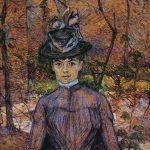
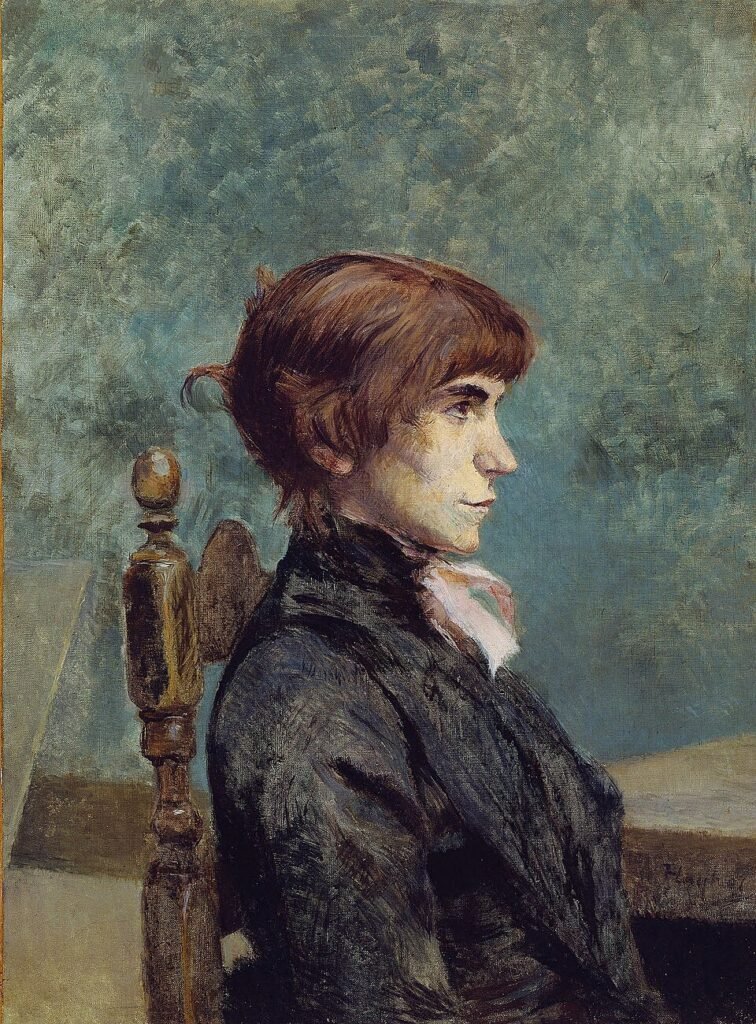
Lautrec’s 1886 Portrait of Jeanne Wenz, now in the Art Institute of Chicago, belongs to this early stage. Jeanne appears in profile rather than facing us directly. The composition is quieter and more restrained than the dazzling posters that would later define Lautrec’s public image.
The profile itself is important. It draws attention to contour—the forehead, nose, lips, chin, hair, and neck. Lautrec would eventually make expressive contour one of the foundations of his graphic style. Here we can already see his fascination with the distinctive outline of a person.
He also avoids turning Jeanne into a conventional ideal of feminine beauty. Nineteenth-century portraiture often flattered its female subjects. Lautrec increasingly resisted that impulse. He was interested in the features that made someone particular rather than those that made a woman conform to an accepted ideal.
Jeanne therefore becomes interesting because she looks like Jeanne. Her individuality, rather than generalized beauty, holds Lautrec’s attention. It is a seemingly simple idea, but it would become central to his mature art.
À la Bastille: Jeanne Looks Back
The transformation becomes clearer in À la Bastille (Jeanne Wenz), now in the National Gallery of Art in Washington. Dating from 1888, the oil painting measures 72.5 by 49.5 centimeters. Jeanne sits beside a small round table wearing a high-necked black dress. A pale bow appears at her throat, while a white apron spreads across her lap. Beneath one hand is a small glass.
This time Jeanne turns toward us.
Her eyebrows are pronounced. Her face has a strong structure, and one side of her mouth rises slightly. It is tempting to call the expression a smile, but it seems more complicated than that. There is humor perhaps, but also reserve. She appears aware of being watched without surrendering herself to the watcher.
That psychological ambiguity became one of Lautrec’s great strengths. Throughout his career, he painted people whom others were watching: dancers on stage, café customers, singers, prostitutes, and performers waiting backstage. Yet looking at someone did not necessarily mean knowing them. Jeanne already demonstrates this distinction.
The painting also moves her from the relatively private language of portraiture into the emerging world of modern Paris. Its title connects it with the popular culture surrounding Aristide Bruant, the singer and cabaret figure who became an important friend and subject for Lautrec. Bruant himself once owned À la Bastille.
Jeanne therefore stands at an important crossroads. She remains an individual portrait sitter, yet she is also becoming part of the social world that would dominate Lautrec’s mature art.
Was Jeanne Wenz Lautrec’s Tragic Muse?
A more dramatic version of Jeanne’s story has circulated over the years. It proposes that Lautrec painted her repeatedly while she descended into alcoholism and that certain pictures document stages of her deterioration.
It is an appealing narrative. It is also far less secure than it is sometimes presented.
The glass in À la Bastille should not be treated as a medical diagnosis. Lautrec painted the drinking culture of cafés and cabarets, while Bruant’s popular songs dealt with the rougher edges of Parisian life. A glass can therefore serve several artistic and social purposes. It does not prove that Jeanne herself suffered from alcoholism.
The distinction matters because women in bohemian artistic circles have often been reduced to stories about sex, drink, scandal, and tragedy. Male artists could drink heavily and have their behavior folded into the legend of creative genius. A female model’s drinking might become her entire identity.
Jeanne deserves better. Where evidence exists, we should follow it. Where the historical record becomes silent, we should allow it to remain silent rather than giving her an invented tragedy.
Jeanne and the Other Women of Lautrec’s Paris
Jeanne also looks different when placed beside Lautrec’s later female subjects. Women are everywhere in his art. They dance, drink, work, dress, wait, perform, rest, flirt, and sometimes simply stare back at the people staring at them.
Some became celebrities. Louise Weber, better known as La Goulue, became synonymous with the Moulin Rouge. Jane Avril developed a distinctive stage persona that Lautrec transformed into elegant, nervous lines. Yvette Guilbert could be recognized by her lanky silhouette and famous black gloves.
Jeanne was different. There is no secure evidence that she was a public celebrity. She belonged to an earlier and more intimate artistic environment.
Suzanne Valadon provides an especially interesting comparison. Valadon modeled for major artists, including Lautrec, but eventually became an important painter herself. History therefore remembers her from both sides of the easel.
Jeanne was not so fortunate. We know her largely because someone else painted her. The difference reminds us how easily the word “model” can conceal an entire person.
Did Lautrec Paint Jeanne More Than Twice?
Researchers have proposed that Jeanne appears in several additional Lautrec works. If those identifications eventually become widely accepted, her importance in his early career would grow considerably.
For now, caution is necessary. The two strongest museum identifications are the Portrait of Jeanne Wenz and À la Bastille (Jeanne Wenz). Additional identifications should be described as proposals rather than settled facts.
Identifying models in nineteenth-century paintings can be surprisingly difficult. Facial resemblance helps, but people can resemble one another. Hairstyles follow fashion. Clothes may be shared or reused. Paintings acquire inaccurate titles. Memories fade.
What matters for Jeanne’s story is that Lautrec certainly returned to her at least once. The difference between the two secure portraits is enough to show development. Jeanne gave him a familiar human subject through whom he could investigate different forms of portraiture.
That alone makes her significant.
What Jeanne Gave Toulouse-Lautrec
Jeanne gave Lautrec something every developing artist needs: a subject worth looking at more than once.
In the earlier portrait, he studies her profile. In À la Bastille, he studies expression, setting, and social character. The same woman becomes the foundation for two very different artistic problems.
That process points toward the Lautrec who would soon revolutionize the image of Parisian nightlife. His mature art depended upon observation. He noticed how someone held a shoulder, tilted a head, crossed a room, or occupied a chair. He could turn a gesture into a signature.
Jeanne belongs to the period when he was learning how to do that.
This is why “muse” seems more useful than simply “model.” Jeanne did not need to whisper artistic ideas into Lautrec’s ear. Her contribution was more fundamental. She gave him a real person against whom his developing powers of observation could work.
The Muse Who Disappeared
Then Jeanne fades from the documented story.
The paintings are easier to follow than the woman. À la Bastille belonged to Aristide Bruant and was sold in Paris in 1905, several years after Lautrec’s death. It later passed through other collections before Paul Mellon acquired it in 1963. Today it belongs to the National Gallery of Art.
We can trace the canvas across countries and decades. We know its dimensions. We know its owners. We know when it entered a museum collection.
We cannot reconstruct Jeanne’s life with anything like the same precision.
There is something poignant about that imbalance. Art preserved her face more successfully than history preserved her biography. Lautrec died in 1901 and became one of the defining artists of fin-de-siècle Paris. His posters became icons. His life generated biographies and exhibitions.
Jeanne remained inside the pictures.
Why Jeanne Wenz Deserves to Be Remembered as a Muse
Jeanne Wenz may never rank among Toulouse-Lautrec’s famous Montmartre personalities. She was not La Goulue kicking beneath the lights of the Moulin Rouge or Jane Avril twisting across one of his posters. Her importance is quieter.
She was there before all of that.
She sat for Lautrec while he was still developing the powers of observation that would make those later images possible. Her face gave him contour to study. Her posture gave him character to interpret. Her presence gave him an individual rather than an ideal.
Perhaps that is the fairest meaning of muse in Jeanne’s case. We do not need a love affair. We do not need scandal, addiction, or tragedy. We need only recognize that artistic development happens through encounters with real people.
Jeanne was one of those people.
More than a century later, she still sits at Lautrec’s little table in À la Bastille. Her hand remains beside the glass. Her eyebrows rise. The corner of her mouth turns upward. She seems on the verge of saying something, yet she never does.
Lautrec made her visible. History made her mysterious.
And perhaps that is why Jeanne Wenz remains such a compelling muse: the artist preserved her likeness, but he never exhausted her mystery.
Key Takeaways
- Jeanne Wenz was an early model and muse for Henri de Toulouse-Lautrec, appearing in securely identified portraits during the 1880s, before his famous Moulin Rouge period.
- There is no reliable evidence that Jeanne and Lautrec were lovers. Her importance lies instead in the recurring artistic attention he gave her during his formative years.
- Two major museum portraits securely identify Jeanne: the 1886 Portrait of Jeanne Wenz and the later À la Bastille (Jeanne Wenz).
- Claims that Jeanne suffered a documented decline into alcoholism should be treated cautiously. The surviving paintings cannot by themselves establish such a biography.
- Jeanne matters because her portraits reveal Lautrec developing his fascination with individuality, contour, gesture, expression, and the social world of modern Paris.
Frequently Asked Questions
- Who was Jeanne Wenz? Jeanne Wenz was a woman associated with the artistic circle surrounding Toulouse-Lautrec and Frédéric Wenz in Paris during the 1880s. Important details of her biography remain uncertain.
- Was Jeanne Wenz Toulouse-Lautrec’s lover? There is no reliable evidence establishing a romantic relationship between Jeanne and Lautrec. She is better understood as a recurring model and early artistic muse.
- How many times did Toulouse-Lautrec paint Jeanne Wenz? Two portraits are securely identified by major museums. Additional works have been proposed as depicting Jeanne, but those identifications should not be treated as universally established.
- What is the most famous painting of Jeanne Wenz? À la Bastille (Jeanne Wenz), dating from 1888 and now in the National Gallery of Art in Washington, is probably the best-known securely identified portrait.
- Why can Jeanne Wenz be called Toulouse-Lautrec’s muse? She repeatedly attracted Lautrec’s artistic attention during an important developmental period. Her portraits helped him explore individuality, expression, contour, and character before his mature Montmartre style emerged.