The story begins not with a kingdom, a language, or even a people who would have recognized the name Ukraine, but with a landscape—a vast sweep of grassland stretching from the forests of the north to the Black Sea. Long before cathedrals rose over Kyiv and centuries before artists painted Cossack heroes, the territory of present-day Ukraine served as one of Eurasia’s great crossroads. Armies crossed it, merchants traversed it, settlers cultivated it, and countless cultures left traces in its soil. The earliest foundations of Ukrainian art history are therefore not found in paintings or churches, but in pottery fragments, burial mounds, gold ornaments, and sacred objects fashioned by peoples whose names survive only in archaeology and ancient texts.
A Landscape That Encouraged Movement
Geography shaped everything. The fertile black-earth plains attracted farmers, while the open steppe invited mobility. Rivers such as the Dnipro connected northern forests with southern ports and eventually the Mediterranean world. Rather than forming an isolated cultural sphere, the region became a meeting ground where ideas traveled alongside goods and people.
This constant movement created a distinctive pattern that would reappear repeatedly in Ukrainian art history. Artistic traditions rarely developed in complete isolation. Instead, they absorbed influences from neighboring civilizations while preserving local characteristics. The same dynamic that later produced the Ukrainian Baroque or the avant-garde first appeared thousands of years earlier among prehistoric communities.
One of the earliest remarkable cultures was the Cucuteni–Trypillia civilization, known for its sophisticated settlements and striking ceramics. Between roughly 5000 and 3000 BC, Trypillian communities created pottery decorated with swirling geometric patterns, spirals, and rhythmic painted designs. Even today these vessels possess a startling visual confidence. Their makers had no written language, yet they communicated ideas about order, nature, and ritual through abstract ornament.
The Mystery of Trypillian Design
The painted ceramics associated with the Trypillia culture reveal an artistic sensibility that feels surprisingly modern. Red, black, and white motifs curve around vessel surfaces in carefully balanced compositions. Archaeologists continue to debate their meaning. Some interpret the patterns as symbolic representations of cosmological beliefs; others see them as decorative systems developed through generations of craft tradition.
What remains undeniable is their sophistication. These were not casual household objects. They embodied aesthetic decisions that required planning, skill, and shared cultural understanding.
A visitor examining surviving examples in the collections of the National Museum of the History of Ukraine encounters a world that predates classical Greece by millennia. The visual language differs entirely from later Christian icons or Renaissance portraits, yet the desire to transform ordinary materials into meaningful artistic objects is already fully present.
The surprise is how urban some of these supposedly prehistoric communities may have been. Certain Trypillian settlements reached extraordinary sizes, leading some scholars to describe them as proto-cities. Their inhabitants organized space, produced decorative arts, and maintained complex social structures at a scale once thought impossible for the period.
Gold Riders of the Steppe
By the first millennium BC, a different civilization dominated much of the region: the Scythians. Known primarily through ancient Greek accounts and spectacular archaeological discoveries, the Scythians were masters of horseback warfare who controlled enormous territories across the Eurasian steppe.
Yet their artistic legacy reveals a culture far more nuanced than the image of nomadic warriors might suggest.
The most famous surviving objects come from royal burial mounds known as kurgans. These earth-covered tombs preserved astonishing quantities of goldwork, weapons, jewelry, and ceremonial objects. Excavations transformed scholarly understanding of steppe cultures by revealing extraordinary craftsmanship.
Among the greatest discoveries is the Scythian Pectoral from Tovsta Mohyla, dating to approximately 350–300 BC. Fashioned from gold and elaborately decorated with scenes of animals, plants, and human figures, the object demonstrates technical mastery equal to that found anywhere in the ancient world.
Art as a Language of Power
The Scythians developed what scholars often call the “animal style,” characterized by dynamic representations of stags, predators, birds, and fantastical creatures. Animals twist, leap, and interlock in compositions filled with energy and tension.
These images were not merely decorative. They communicated status, identity, and spiritual beliefs. A gold ornament attached to clothing or weaponry announced both wealth and cultural affiliation.
Another celebrated example, the Gold Comb from the Solokha Kurgan, combines practical function with artistic ambition. The upper portion depicts armed warriors in dramatic interaction, creating a miniature sculptural narrative. Such objects challenge simplistic assumptions about steppe societies. They reveal patrons who valued storytelling, symbolism, and refined workmanship.
A brief inventory of recurring Scythian artistic themes illustrates their concerns:
- Powerful animals associated with strength and protection.
- Combat scenes emphasizing status and heroism.
- Precious materials used to express authority and prestige.
The result was an art form simultaneously mobile and monumental. Even when carried across the steppe, these objects projected political and spiritual significance.
When Greece Arrived on the Black Sea
While Scythian culture flourished inland, another artistic world emerged along the coast. Beginning in the sixth century BC, Greek settlers established colonies on the northern shores of the Black Sea. Among the most important were National Historical and Archaeological Reserve Olbia and Ancient City of Tauric Chersonese.
These settlements connected the region directly to the wider Mediterranean cultural sphere. Architecture, sculpture, pottery, coinage, and urban planning introduced artistic traditions developed hundreds of miles away in the Greek world.
The encounter between Greek colonists and local populations generated a fascinating exchange. Imported ceramics appeared alongside regional products. Greek artistic conventions influenced local elites, while trade relationships fostered hybrid forms that reflected multiple cultural identities.
A Marketplace of Ideas
Imagine standing in Olbia during its height. Ships arrive from distant ports carrying wine, olive oil, luxury goods, and artistic styles. Merchants negotiate in multiple languages. Craftsmen adapt foreign techniques for local markets. Religious traditions overlap and interact.
This environment produced something more significant than the transfer of objects. It encouraged the transfer of visual concepts.
The idea that art could represent idealized human bodies, commemorate civic achievements, or embody philosophical notions entered the region through these coastal centers. Although later historical developments would transform these influences, the Black Sea colonies established an enduring pattern: Ukraine’s territory repeatedly served as a bridge between larger cultural worlds.
This role as intermediary would become one of the defining characteristics of its artistic history.
Buried Treasures and Forgotten Worlds
Many of the most important works from this early period survived only because they were buried. Tombs, graves, and ritual deposits preserved artifacts that everyday life would otherwise have destroyed.
There is a certain irony in this. The artists who fashioned gold ornaments, painted pottery, or ceremonial objects could not have imagined that their work would remain hidden for centuries before re-emerging as evidence of vanished civilizations.
Archaeological excavations transformed these buried objects into historical witnesses. A gold plaque becomes testimony to trade networks. A painted vessel reveals symbolic systems. A burial mound exposes social hierarchies and religious beliefs.
Three kinds of discoveries have proven especially influential:
- Elite burials preserving luxury craftsmanship.
- Settlement sites revealing everyday artistic production.
- Coastal cities documenting interaction with the Mediterranean world.
Together they form the earliest visual archive of the lands that would eventually become Ukraine.
The First Pattern
What emerges from this distant past is not a single national tradition but a recurring historical pattern. The territory functioned as a place of encounter. Farmers met nomads. Steppe cultures interacted with urban civilizations. Local traditions absorbed foreign influences while preserving distinctive characteristics.
That pattern would endure through Byzantine Christianity, Polish-Lithuanian rule, Cossack patronage, imperial domination, modernism, and contemporary art. Again and again, artistic innovation emerged from contact, exchange, and adaptation.
The gold treasures of the Scythians, the painted ceramics of Trypillia, and the coastal cities of the Greeks belong to worlds separated by centuries. Yet together they established the foundations of a region whose visual culture would continually reinvent itself without ever losing its connection to the land that shaped it. The first chapter of Ukrainian art history is therefore not the story of a nation, but of a crossroads—and crossroads have a way of changing everyone who passes through them.
Kyiv and the Birth of a Visual Civilization
A traveler entering Kyiv in the eleventh century would have encountered something unprecedented in the lands of Eastern Europe: a city determined to express power, faith, and permanence through art on a monumental scale. Wooden settlements and earthworks had long existed across the region, but now stone walls rose toward the sky, church domes glittered above the hills, and interiors shimmered with mosaics fashioned from thousands of colored pieces of glass and stone. The visual world of the future had arrived.
The transformation was tied to one of the most consequential events in the region’s history: the adoption of Christianity by the rulers of Kyivan Rus at the end of the tenth century. Religion changed belief, politics, and international relations, but it also changed art. The conversion opened direct channels to one of the most sophisticated artistic traditions of the medieval world—the civilization of Constantinople.
A New Faith Demands New Images
Before Christianity, artistic production in the region consisted largely of portable objects, decorative crafts, and archaeological cultures whose visual languages survive only in fragments. Christianity brought something fundamentally different. It required architecture, liturgical objects, painted images, illuminated manuscripts, and ceremonial spaces capable of expressing sacred ideas.
The challenge was enormous. Christian worship relied upon visual forms that were largely unfamiliar to local populations. Churches required carefully organized interiors. Religious narratives had to be communicated through images. Saints, prophets, angels, and biblical scenes became central components of public life.
The arrival of these traditions did not erase local culture. Instead, foreign artistic models were adapted within a new environment. Craftsmen learned techniques from Byzantine masters while gradually developing regional approaches of their own.
This process would become one of the defining patterns of Ukrainian art history. Cultural influence rarely arrived as simple imitation. Imported ideas were absorbed, transformed, and eventually reimagined.
Constantinople on the Dnipro
The Byzantine Empire represented the greatest artistic power in the Christian East. Its capital, Constantinople, possessed architectural achievements, workshops, and artistic traditions unmatched across much of Europe.
When Kyivan rulers embraced Christianity, they also embraced the visual authority associated with Byzantine civilization. Architecture became a tool of statecraft. Monumental churches announced participation in a wider Christian world.
Yet the relationship was never merely one of dependence. The rulers of Kyivan Rus were ambitious patrons who sought not simply to borrow prestige but to create their own centers of power.
The result was one of the most remarkable artistic flowering periods in medieval Eastern Europe.
The Miracle of Saint Sophia
No building better represents this transformation than Saint Sophia Cathedral.
Constructed during the early eleventh century under the patronage of rulers associated with the reign of Yaroslav the Wise, the cathedral remains one of the great monuments of medieval Christianity. While wars, invasions, political upheavals, and centuries of change transformed the city around it, much of its original artistic program survived.
Walking into the cathedral today means entering a space where the eleventh century still speaks.
The building’s significance extends beyond architecture. Saint Sophia preserves one of the most important ensembles of medieval mosaics and frescoes anywhere in Europe. These works provide an extraordinarily rare glimpse into the visual ambitions of Kyivan Rus at its height.
Walls of Light
The Byzantine mosaic tradition sought to create environments that felt suspended between earth and heaven. Gold backgrounds reflected flickering candlelight. Colored tesserae captured shifting illumination throughout the day. Figures appeared less like physical bodies and more like sacred presences.
The effect was deliberate.
Rather than depicting ordinary reality, the mosaics invited worshippers into a spiritual realm governed by divine order. Every surface contributed to this experience. Architecture, decoration, ritual, and music formed a unified whole.
Among the cathedral’s greatest treasures is the eleventh-century Virgin Orans mosaic. Towering above the interior, the figure raises her arms in prayer. For centuries she has watched over generations of visitors, surviving invasions, revolutions, and wars.
The Woman Who Never Fell
An enduring legend emerged around the Virgin Orans. Kyiv residents sometimes referred to her as the “Indestructible Wall,” believing that as long as the image remained standing, the city itself would endure.
Whether one accepts the legend is beside the point. What matters is the extraordinary emotional relationship between artwork and community that it reveals. Few medieval images became so deeply woven into the identity of a city.
The mosaic’s visual power derives from remarkable restraint. The figure is monumental yet calm. Majestic yet approachable. The image avoids theatrical drama in favor of spiritual authority.
It demonstrates one of the great strengths of Byzantine art: the ability to communicate profound emotional weight through composure rather than movement.
Christ Above the City
Elsewhere within Saint Sophia, the Christ Pantocrator mosaic dominates the central dome. Christ appears as ruler of heaven and earth, gazing downward upon the congregation below.
The image reflects a central principle of Byzantine visual culture. Religious art was not intended merely to illustrate scripture. It established a sacred hierarchy that structured space itself.
Every figure occupied a meaningful position. Higher zones contained heavenly beings. Lower zones depicted saints and earthly participants in sacred history. Architecture became theology rendered in stone, glass, and paint.
Nearby, the Communion of the Apostles mosaic reinforces this vision. Christ appears distributing the Eucharist to his disciples, emphasizing the continuity between biblical events and contemporary worship.
The cathedral functioned not only as a place of prayer but also as a visual encyclopedia of Christian belief.
A Surprise Hidden in the Frescoes
One of the most fascinating aspects of Saint Sophia lies not in its religious imagery but in its secular details.
Among the surviving frescoes are depictions associated with the family of Yaroslav the Wise. These images offer rare glimpses into courtly life and political representation in medieval Eastern Europe.
Their survival is remarkable because medieval religious buildings often prioritized sacred subjects above all else. Yet here we find evidence that rulers understood art as a means of preserving dynastic memory.
This unexpected combination of spiritual and political imagery reveals something important about the ambitions of Kyivan Rus. The cathedral was not simply a church. It was also a statement about civilization itself.
Three interconnected messages emerge from the building’s artistic program:
- The state belonged to the Christian world.
- Its rulers possessed legitimacy and authority.
- Kyiv could rival other major centers of medieval culture.
The Rise of Artistic Workshops
Magnificent buildings do not appear spontaneously. Behind every mosaic and fresco stood teams of skilled artisans.
Some likely arrived from Byzantine territories. Others were trained locally. Together they established workshops capable of executing large-scale artistic projects.
These workshops became engines of cultural transmission. Techniques moved from master to apprentice. Materials were imported, adapted, and reproduced. Artistic knowledge became embedded within local institutions.
The importance of this development cannot be overstated. A sustainable artistic culture requires more than great patrons. It requires craftsmen, teachers, materials, and communities capable of preserving expertise across generations.
The eleventh century witnessed the formation of precisely such networks.
The Monastery Beneath the Earth
Another major center emerged at the Kyiv Pechersk Lavra, founded in the eleventh century.
Unlike Saint Sophia, which projected authority through monumental architecture, the Lavra began with caves inhabited by monks seeking spiritual discipline. Yet it would become one of the most influential religious and artistic centers in Eastern Christianity.
The contrast is striking. One institution expressed power through public grandeur. The other grew from ascetic devotion. Both, however, became crucial patrons of art.
Manuscript production, icon painting, architecture, and religious literature flourished within monastic communities. The Lavra helped preserve artistic traditions that would influence generations of painters and craftsmen.
Its importance extended far beyond Kyiv itself. Pilgrims carried ideas, stories, and visual models across vast territories.
The Birth of a Distinct Tradition
The art of Kyivan Rus was deeply indebted to Byzantium, yet it was never merely Byzantine art transplanted northward.
Climate, materials, political realities, and local patronage shaped new outcomes. Artists worked within inherited conventions while responding to regional circumstances. Over time, subtle differences accumulated.
The process resembles the growth of a language. A dialect initially echoes its parent tongue, but gradual adaptation produces something recognizable in its own right.
The same was true of visual culture.
By the end of the eleventh century, Kyiv had become more than a recipient of artistic influence. It had become a producer of artistic influence.
A City of Images
The achievement of this period cannot be measured solely through surviving buildings or individual masterpieces. Its deeper significance lies in the creation of an enduring visual civilization.
Art became woven into religious life, political authority, education, and collective memory. Images acquired public importance. Architecture became a language of power. Workshops transmitted skills across generations.
The foundations laid during this era would survive invasions, dynastic collapse, shifting borders, and profound cultural transformations. Later centuries would reinterpret these traditions in countless ways, but they would never entirely escape their influence.
Beneath every later chapter of Ukrainian art history—from icons and Baroque churches to modern experiments and contemporary debates—stands the world created in eleventh-century Kyiv, where stone, gold, and faith combined to give a young civilization its first monumental artistic voice.
Icons, Monasteries, and Medieval Imagination
When medieval travelers entered a church, they did not expect art to decorate the building. They expected art to inhabit it. Images were not regarded as illustrations, aesthetic luxuries, or historical artifacts. They were active presences within religious life—windows into sacred realities that existed beyond ordinary sight. To understand medieval Ukrainian art, one must begin with this different way of seeing.
The centuries following the great flowering of Kyivan Rus brought political upheaval, invasion, and fragmentation. Cities rose and fell. Trade routes shifted. Dynasties disappeared. Yet amid uncertainty, one artistic tradition not only survived but became increasingly central to cultural life: the icon.
For hundreds of years, icons served as the dominant artistic language of the region. They shaped visual culture more profoundly than any other medium, influencing architecture, literature, ritual, and even daily life. Through them, medieval artists developed a sophisticated and distinctive tradition that would endure long after kingdoms vanished.
Images Made for Eternity
Modern viewers often approach icons as paintings. Medieval believers approached them differently.
An icon was not intended to create an illusion of physical reality. Its purpose was spiritual rather than naturalistic. Perspective, anatomy, and spatial depth mattered less than symbolic truth. Figures appear frontal and calm. Faces possess a quiet intensity. Gold backgrounds dissolve ordinary settings into timeless space.
The goal was not to capture a fleeting moment.
The goal was to reveal eternal realities.
This explains why icons often seem strikingly different from later Renaissance painting. Renaissance artists increasingly emphasized observation, movement, and individual personality. Medieval icon painters pursued something else entirely. They sought visual stability in a world marked by uncertainty.
That search for permanence became especially important as political conditions grew more turbulent.
The Monastery as Workshop
The great monasteries of medieval Ukraine functioned not merely as religious institutions but also as cultural centers. Among the most influential was the Kyiv Pechersk Lavra, whose influence spread across Eastern Europe.
Within monastic walls, manuscripts were copied, religious texts were preserved, and artistic skills were transmitted from one generation to the next. The workshop became a place of both technical training and spiritual discipline.
An icon painter was expected to master more than craft. The work itself carried religious significance. Preparing pigments, drawing figures, and applying layers of paint were often understood as acts connected to prayer and devotion.
The relationship between art and faith was therefore unusually intimate. Painting was not separated from belief.
A Day in the Workshop
Imagine a monk entering a workshop before sunrise.
Light filters through narrow windows. Wooden panels lean against walls. Bowls contain pigments ground from minerals and earth. Apprentices prepare surfaces while experienced painters work carefully on faces and hands—the most expressive parts of an icon.
The atmosphere is quiet.
Every line follows established traditions refined across centuries. Every color carries symbolic meaning. Blue suggests heavenly reality. Gold evokes divine light. Red may signify sacrifice, kingship, or spiritual authority.
Innovation exists, but it unfolds gradually. A new gesture, a subtle change in expression, a regional preference for color—these developments accumulate over generations rather than appearing suddenly.
This slow evolution gives medieval icon painting its remarkable continuity.
Art After Catastrophe
The year AD 1240 marked one of the great turning points in Eastern European history. The Mongol sack of Kyiv devastated the city and shattered the political structures that had sustained the civilization of Kyivan Rus.
Many artistic centers suffered destruction. Churches were damaged. Workshops disappeared. Cultural networks fractured.
Yet one of the most surprising aspects of Ukrainian art history is how much survived.
Rather than ending artistic production, the catastrophe shifted its geography. New regional centers emerged. Monasteries preserved traditions. Local workshops adapted to changing circumstances.
The story of medieval Ukrainian art after 1240 is therefore not primarily a story of collapse.
It is a story of persistence.
The Rise of Regional Schools
As political power became more decentralized, artistic production increasingly developed through regional schools.
Among the most important was the Galician tradition centered in western territories. Here artists absorbed influences from multiple directions. Byzantine conventions remained foundational, but contact with Central European artistic currents introduced new possibilities.
The result was neither entirely Eastern nor entirely Western.
Instead, painters created hybrid visual languages capable of reflecting the complex cultural environment in which they lived.
This blending of influences would become a recurring feature of Ukrainian art. Geography once again encouraged exchange rather than isolation.
Faces That Remember
One of the most compelling surviving examples from this era is the Virgin of Volhynia, generally dated to the late thirteenth or early fourteenth century and preserved in the collections of the National Art Museum of Ukraine.
The image possesses a striking emotional gravity.
Unlike the idealized beauty associated with some Byzantine masterpieces, the Virgin’s face appears marked by experience. Her gaze feels contemplative, almost burdened by knowledge of suffering to come.
The painting demonstrates an important development within regional icon traditions. While artists continued to follow inherited religious conventions, they increasingly infused their work with psychological depth and local character.
A modern viewer may not immediately recognize the technical sophistication involved. Medieval icon painters worked within highly structured systems. Expressing individuality while remaining faithful to tradition required subtle mastery.
The Virgin of Volhynia achieves precisely that balance.
Saints for Everyday Life
Not all icons depicted grand theological themes. Many focused on saints whose lives intersected with ordinary concerns.
Among the most beloved figures was Saint Paraskeva, whose image appears frequently in surviving icon traditions of western Ukraine. Examples preserved in the Andrey Sheptytsky National Museum reveal how local communities developed deep attachments to particular holy figures.
Saints served multiple roles.
- Protectors of families and communities.
- Intercessors during illness or hardship.
- Models of faith and moral conduct.
Icons therefore operated at both public and personal levels. Monumental images filled churches, while smaller examples entered homes and accompanied daily life.
This intimate relationship between image and viewer helped ensure the survival of icon traditions across centuries of political instability.
The Unexpected Influence of Distance
One of the most fascinating aspects of medieval Ukrainian art is that its regional diversity often increased when political unity weakened.
At first glance, this seems contradictory.
Yet local workshops separated by distance developed distinctive habits. Painters favored certain colors, compositions, and facial types. Regional tastes shaped artistic production.
The Lutsk and Volyn traditions, for example, gradually acquired recognizable characteristics. Artists worked within the broader framework of Orthodox iconography while developing local identities.
The result resembles the evolution of regional dialects in language. Shared foundations remained intact, but subtle differences accumulated over time.
Far from weakening artistic culture, this diversity enriched it.
Imagining the Invisible
Medieval imagination operated differently from modern artistic expectations.
Contemporary viewers often celebrate originality and personal expression. Medieval icon painters pursued transcendence. Their challenge was not to invent new worlds but to visualize realities believed to exist beyond ordinary perception.
This required extraordinary discipline.
Every gesture mattered. Every color carried meaning. Every compositional decision contributed to a symbolic system understood by worshippers.
Three recurring characteristics define many medieval Ukrainian icons:
- Frontal figures that establish direct spiritual presence.
- Deliberate rejection of naturalistic perspective.
- Symbolic color systems rooted in religious tradition.
The effect can feel surprisingly powerful even today. Icons often appear still, yet that stillness creates a sense of concentration rarely found in more dramatic forms of art.
The Long Memory of Wood and Paint
Many medieval monuments disappeared through war, fire, and neglect. Wooden churches vanished. Frescoes deteriorated. Entire artistic centers were lost. Icons survived more successfully.
Protected within churches, monasteries, and private collections, they became repositories of cultural memory. Through them, later generations could maintain connections to a distant past even when political structures had vanished.
This continuity proved invaluable. The artistic traditions developed during the medieval period would eventually influence Baroque painters, nineteenth-century scholars, museum collectors, and modern artists seeking historical roots.
The icons became more than religious objects. They became historical witnesses.
A World Held Together by Images
By the close of the medieval era, the lands of present-day Ukraine no longer possessed the political unity that had characterized the height of Kyivan Rus. Power was dispersed. Borders shifted. Foreign rulers exercised influence over different regions.
Yet visual culture remained remarkably resilient.
Monasteries preserved knowledge. Workshops trained new generations. Regional schools enriched inherited traditions. Icons continued to define the spiritual and artistic imagination of society.
The achievement of this period lies not in monumental expansion or imperial grandeur. It lies in endurance. Through centuries of uncertainty, artists maintained a visual language capable of carrying faith, memory, and identity across generations.
In churches lit by candles and in workshops scented with wood and pigment, medieval painters created images intended for eternity. Many of them succeeded. Their faces still gaze outward across the centuries, calm and unwavering, as though the turmoil surrounding them had never truly ended and never truly mattered.
Between East and West
A merchant arriving in Lviv during the fifteenth century might hear half a dozen languages before reaching the market square. Church bells rang from different traditions. Merchants from Central Europe negotiated alongside Armenian traders. Orthodox nobles commissioned icons while Catholic patrons financed Gothic chapels. Few places in Europe offered such a dense concentration of cultural intersections.
The medieval world of Kyivan Rus had not disappeared entirely, but it no longer stood alone. The political landscape had changed. Much of the territory of present-day Ukraine became incorporated into the expanding spheres of the Grand Duchy of Lithuania and later the Polish-Lithuanian Commonwealth. These new realities introduced fresh artistic influences from Central Europe, Italy, Germany, Armenia, and beyond.
The result was not a simple replacement of one culture by another. Instead, a remarkable artistic dialogue emerged. Old Byzantine traditions continued to thrive even as Gothic architecture, Renaissance ideas, and Western forms of patronage entered the region. For artists and patrons alike, the challenge became learning how to inhabit multiple worlds at once.
A Borderland of Cultures
Modern discussions often portray Eastern and Western Europe as distinct cultural spheres. The reality was far more complicated.
The territories that now form Ukraine occupied one of the most important contact zones on the continent. Trade routes connected the Baltic and Black Seas. Religious traditions overlapped. Political authority shifted among competing powers.
This environment encouraged artistic flexibility.
Painters, architects, and craftsmen encountered a broader range of influences than many of their contemporaries elsewhere. Exposure to diversity did not necessarily produce harmony, but it generated creativity.
A church might display Byzantine-inspired icons while incorporating architectural elements derived from Gothic Europe. A noble patron could commission works influenced by Italian Renaissance ideas while maintaining deep connections to Orthodox religious traditions.
The boundaries between artistic categories became increasingly porous.
Lviv: A City Built from Encounters
No city better illustrates this transformation than Lviv.
Situated along major commercial routes, Lviv became one of the most cosmopolitan urban centers in Eastern Europe. Merchants, clergy, artisans, and travelers brought ideas from distant regions, turning the city into a laboratory of cultural exchange.
Walking through medieval Lviv would have been an education in architectural diversity.
Different communities often maintained their own religious institutions, each reflecting distinct artistic traditions. Rather than producing uniformity, urban growth generated visual complexity.
The city became a place where multiple histories unfolded simultaneously.
Stone Churches and New Horizons
One of the most fascinating monuments of this era is the Armenian Cathedral of Lviv, founded in 1363.
The cathedral embodies the interconnected nature of the region. Armenian merchants and settlers brought their own traditions, yet the building’s development reflects influences from Armenia, Byzantium, local Ruthenian culture, and Western Europe.
The structure defies simple classification.
It demonstrates how artistic traditions evolve when communities maintain connections to distant homelands while adapting to new environments. Every stone speaks of movement, migration, and cultural negotiation.
The building reminds us that Ukrainian art history has never belonged exclusively to a single ethnic or religious tradition. It developed through encounters among many communities that shared the same physical landscape.
The Gothic Arrival
Another major landmark, the Latin Cathedral, begun around 1360, introduced architectural forms associated with Western Christianity.
For visitors accustomed to Byzantine churches, Gothic architecture presented a dramatically different vision of sacred space.
Verticality became a central feature. Pointed arches directed the eye upward. Structural innovations allowed larger windows and greater interior height. Light itself acquired new importance.
The contrast between Gothic and Byzantine traditions was striking.
Byzantine churches often emphasized domes and inward spiritual focus. Gothic buildings pursued elevation and visual drama. Yet rather than choosing one tradition over another, many communities encountered both simultaneously.
This coexistence would profoundly influence later artistic developments.
The Renaissance Travels East
The Renaissance did not arrive all at once.
Unlike Florence or Venice, where Renaissance ideas emerged from local circumstances, Ukrainian territories experienced them through gradual transmission. Merchants, scholars, clergy, and architects carried new concepts across borders.
Humanism, classical forms, and changing ideas about representation slowly entered artistic life.
The process was selective. Local patrons adopted certain elements while rejecting others. Traditional religious imagery remained enormously important, but artists became increasingly aware of alternative approaches to space, proportion, and visual storytelling.
This period reveals a crucial truth about cultural exchange: influence rarely functions as simple imitation.
Ideas are translated before they are adopted.
A Castle Above the Frontier
The great Kamianets-Podilskyi Castle provides another window into this changing world.
Expanded and modified across the fourteenth through sixteenth centuries, the fortress stood at a strategic crossroads connecting multiple political and cultural spheres.
At first glance, castles seem far removed from art history. Yet medieval and Renaissance architecture served both practical and symbolic purposes.
Fortifications communicated power.
Their towers, gates, and walls projected authority while reflecting contemporary engineering and aesthetic preferences. Patrons invested considerable resources in ensuring that such structures impressed visitors as much as they defended territory.
The castle demonstrates how artistic ambitions extended beyond churches and paintings. Architecture shaped public perceptions of order, legitimacy, and civilization.
Noble Families as Cultural Architects
Art requires patrons.
During this era, influential noble families became increasingly important in shaping artistic production. Among the most significant were the Ostroh princes and later magnate networks such as the Potockis.
Their patronage transformed entire regions.
Churches received funding. Workshops gained commissions. Educational institutions emerged. Libraries expanded. The arts flourished not only because talented individuals existed but because powerful patrons believed cultural investment enhanced prestige.
The Ostroh court in particular became a major intellectual center.
Rather than viewing art as separate from learning, patrons often treated them as interconnected pursuits. Literature, theology, architecture, and visual culture developed together.
Three forms of patronage proved especially influential:
- Religious foundations and church construction.
- Support for educational institutions and scholarship.
- Commissioning artworks that reinforced dynastic memory.
These investments helped create durable cultural networks capable of surviving political change.
A New Sense of the Individual
One of the quieter transformations of the Renaissance era involved changing ideas about human identity.
Medieval art had focused primarily on sacred narratives and collective religious experience. Renaissance influence encouraged greater attention to individual patrons, historical figures, and worldly achievements.
The shift was gradual rather than revolutionary.
Portraiture remained relatively limited compared with Western Europe, yet interest in personal representation steadily increased. Noble families sought ways to preserve memory through visual means. Genealogy, lineage, and historical consciousness acquired new importance.
This emerging focus on individuality would later become a major force in Ukrainian art.
For now, however, it remained intertwined with older religious traditions rather than replacing them.
The City as a Work of Art
The growth of urban centers created opportunities unavailable in earlier centuries.
Markets, guilds, churches, schools, and civic institutions generated demand for artistic labor. Craftsmen organized themselves into professional communities. Architecture became increasingly sophisticated.
The historic center of Lviv offers perhaps the best surviving example of this transformation.
Its streets reveal layers of influence accumulated over centuries. Gothic forms stand beside Renaissance additions. Different religious communities left visible marks upon the urban fabric.
The city itself became a kind of collective artwork.
Each generation added new elements without entirely erasing what came before.
The Unexpected Strength of Diversity
Historians sometimes search for a single defining style to characterize a period. The fifteenth and sixteenth centuries resist such simplification.
Their greatest achievement may have been diversity itself.
Orthodox icons continued to flourish. Gothic architecture gained prominence. Renaissance ideas circulated among elites. Armenian, Ruthenian, Polish, and other traditions interacted in complex ways.
Rather than weakening cultural identity, this multiplicity often enriched artistic production.
Artists learned to navigate different visual languages. Patrons drew inspiration from multiple sources. Regional culture became increasingly sophisticated precisely because it remained open to exchange.
The period produced few dramatic manifestos or revolutionary breaks. Its significance lies elsewhere.
It created the conditions under which future artistic innovations could emerge.
Standing Between Worlds
By the sixteenth century, the lands of present-day Ukraine occupied a unique position within Europe. They were neither wholly Eastern nor wholly Western in artistic orientation. Instead, they participated in both worlds simultaneously.
This position sometimes brought tension. Religious conflicts and political rivalries were real. Yet it also generated extraordinary creative possibilities.
Architects borrowed across traditions. Painters adapted foreign influences. Patrons cultivated cultural networks stretching in multiple directions.
The result was an artistic landscape defined not by isolation but by conversation.
That conversation would become even more important in the next chapter, when a distinctly Ukrainian version of Baroque culture emerged—one capable of absorbing foreign influences while transforming them into something unmistakably its own. The centuries spent between East and West had prepared the ground for precisely that achievement.
The Cossack Baroque Revolution
Few periods transformed the visual landscape of Ukraine as dramatically as the age of the Cossack Hetmanate. Across the seventeenth and early eighteenth centuries, church domes multiplied on city skylines, monasteries expanded into architectural complexes of astonishing ambition, and decorative arts reached new levels of sophistication. Visitors traveling through Kyiv, Chernihiv, Pereiaslav, and other centers encountered a world that felt simultaneously familiar and new—a culture rooted in Orthodox tradition yet energized by a powerful creative confidence.
The style that emerged during this era is often called Ukrainian Baroque or Cossack Baroque. The name can be misleading. It suggests a provincial version of a broader European movement, as though local artists merely adapted ideas imported from Rome, Vienna, or Warsaw.
The reality was more interesting.
Ukrainian artists borrowed freely from the Baroque world, but they transformed those influences so thoroughly that a distinctive artistic language emerged. The result was not imitation but reinvention.
A New Political World
Art rarely flourishes in a vacuum.
The rise of Cossack political institutions created conditions that encouraged cultural patronage on a scale not seen for centuries. Following the upheavals of the seventeenth century, new elites emerged who sought legitimacy, prestige, and historical permanence.
Churches became central to this effort.
Unlike medieval princes who emphasized dynastic authority alone, Cossack leaders often presented themselves as defenders of faith, tradition, and community. Patronage therefore acquired both religious and political significance.
Building a church was not simply an act of devotion.
It was a statement about identity.
This connection between political ambition and artistic creation helps explain the extraordinary building campaigns that transformed the region during the Baroque era.
The Baroque Arrives—But Changes
Baroque art originated in the cultural and religious struggles of early modern Europe. In Italy and elsewhere, artists developed dramatic architectural forms, dynamic compositions, and emotionally powerful imagery intended to inspire viewers.
When these ideas reached Ukrainian lands, they encountered very different traditions.
Orthodox architecture possessed its own visual logic. Centuries of icon painting had established distinctive aesthetic preferences. Local craftsmen worked with regional materials and construction techniques.
Rather than abandoning these traditions, artists incorporated Baroque elements into them.
The resulting buildings often appear more restrained than their counterparts in Rome or southern Germany. Ornament flourishes, but it rarely overwhelms. Verticality is emphasized, yet harmony remains essential.
The style developed its own personality.
Domes Against the Sky
One of the defining features of Ukrainian Baroque architecture was its treatment of church silhouettes.
Instead of relying solely on the long façades and massive volumes favored elsewhere in Europe, architects frequently emphasized clusters of domes rising rhythmically above the landscape.
These structures possessed a striking relationship to their surroundings.
Viewed from a distance, they appeared almost sculptural. Multiple domes created movement without sacrificing balance. White walls and gilded surfaces caught changing light throughout the day.
The effect could be breathtaking.
Travelers approaching major cities often saw church complexes long before reaching their destinations. Architecture became a form of visual announcement, proclaiming both faith and civic pride.
Kyiv Reimagined
No city better illustrates this transformation than Kyiv.
The medieval capital had endured invasion, decline, and political change. Yet during the Baroque era, it experienced a remarkable cultural revival. Monasteries expanded. Existing churches were rebuilt. New architectural projects altered the city’s appearance.
The reconstruction of the Kyiv Pechersk Lavra played a particularly important role.
Originally founded in the eleventh century, the monastery underwent extensive rebuilding and expansion during the seventeenth and eighteenth centuries. Baroque architecture reshaped the complex while preserving its historical significance.
This combination of renewal and continuity became a hallmark of the era.
Patrons rarely sought to erase the past.
Instead, they attempted to glorify it.
Ivan Mazepa and the Architecture of Legacy
No individual is more closely associated with this artistic flowering than Ivan Mazepa.
Few political leaders in Ukrainian history invested more heavily in cultural patronage. Churches, monasteries, educational institutions, and artistic projects benefited from his support.
Mazepa understood something fundamental about architecture.
Buildings outlast political victories.
Military achievements can fade into memory. Institutions collapse. Borders shift. Yet churches and monuments continue shaping cultural identity long after their patrons disappear.
His patronage helped establish architectural standards that influenced generations of builders.
The scale of his ambition remains impressive. Numerous projects across the Hetmanate reflected a coordinated effort to strengthen both religious and cultural life.
The Gold Domes Return
Among the most symbolic projects associated with this period was the transformation of Saint Michael’s Golden-Domed Monastery.
Although its origins lay in the medieval era, Baroque reconstruction gave the complex a new visual identity. Ornate façades, elaborate decorative programs, and renewed architectural prominence reflected the changing artistic tastes of the age.
The monastery became a powerful symbol of continuity.
Ancient foundations remained visible beneath newer layers of artistic expression. The building embodied the idea that tradition could be preserved while still embracing innovation.
That tension between inheritance and reinvention lies at the heart of Ukrainian Baroque culture.
Ornament and Imagination
Architecture was only part of the story.
Interior decoration flourished as well. Carved iconostases became increasingly elaborate. Gold leaf, intricate woodwork, and decorative painting transformed church interiors into immersive environments.
The iconostasis—the screen separating the sanctuary from the nave—evolved into one of the era’s greatest artistic achievements.
Rather than serving as a simple partition, it became a monumental visual statement.
Rows of icons rose upward in carefully organized hierarchies. Carvers filled surrounding surfaces with vines, flowers, scrollwork, and symbolic motifs. Light reflected across gilded surfaces, creating an atmosphere of richness without abandoning religious purpose.
Three qualities define many surviving examples:
- Extraordinary craftsmanship in wood carving.
- Dense but carefully controlled ornament.
- Integration of painting, sculpture, and architecture into unified compositions.
The result was an artistic experience that engaged the eye at every level.
Chernihiv and the Regional Renaissance
Kyiv was not alone.
Cities across the Hetmanate participated in the artistic revival. One of the most important examples is the Trinity Cathedral, constructed between 1679 and 1695.
The cathedral illustrates how regional centers developed their own versions of Baroque expression.
Its architecture combines monumentality with balance. Decorative elements enrich the structure without obscuring its underlying clarity. The building feels both grand and disciplined.
This characteristic distinguishes much of Ukrainian Baroque architecture from more theatrical forms elsewhere in Europe.
The emphasis remains on harmony.
An Unexpected Difference
One of the most surprising aspects of Ukrainian Baroque art is what it often avoids.
Many European Baroque masterpieces seek emotional intensity through dramatic movement, illusionistic effects, and overwhelming spectacle. Ukrainian artists certainly appreciated grandeur, yet they frequently retained elements inherited from earlier Orthodox traditions.
As a result, the style possesses a distinctive calmness.
Even highly decorative churches often convey a sense of order rather than turbulence. Sacred images remain contemplative. Architectural compositions emphasize balance alongside magnificence.
This fusion produced something rare: a Baroque culture capable of expressing confidence without sacrificing spiritual introspection.
Saint Andrew’s Church and the Edge of an Era
The magnificent Saint Andrew’s Church, constructed between 1747 and 1754 and designed by Bartolomeo Rastrelli, stands near the end of the great Baroque age.
Perched dramatically above the city, the church demonstrates how international influences continued to shape local architecture. Yet even here, the building belongs naturally to Kyiv’s landscape.
Its silhouette interacts with hills, sky, and river in a way that feels unmistakably tied to place.
The church reminds us that Ukrainian art never developed through isolation. Its strength lay in adaptation—the ability to absorb external influences while preserving local character.
The Architecture of Confidence
By the middle of the eighteenth century, Ukrainian Baroque had achieved something remarkable.
It had transformed a period of political uncertainty into an era of artistic self-assurance. Churches, monasteries, iconostases, and civic buildings announced the presence of a mature cultural tradition capable of standing alongside the great artistic movements of Europe.
The achievement was not merely aesthetic. These buildings expressed a vision of society. They celebrated faith, education, memory, and public life. They connected medieval inheritance to early modern ambition.
Most importantly, they created some of the most recognizable images in Ukrainian cultural history—the shining domes, white walls, and elegant silhouettes that continue to define the visual identity of countless cities and towns.
The age of the Cossack Baroque proved that Ukraine was no longer simply absorbing artistic influences from neighboring civilizations. It had become a civilization capable of generating its own artistic language, one so distinctive that centuries later its buildings remain immediately recognizable against any horizon.
Portraits, Power, and Society in the Early Modern Era
For centuries, the most important faces in Ukrainian art belonged to saints.
They gazed from icons, church walls, and illuminated manuscripts. Their expressions were serene, timeless, and detached from ordinary life. Individual personality mattered less than spiritual significance. The purpose of art was to reveal holiness rather than character.
Then, gradually, new faces began to appear.
Hetmans, noblemen, bishops, military commanders, scholars, and wealthy patrons entered the picture. They stood before viewers not as sacred figures but as historical individuals. Their clothing, status, accomplishments, and identities became worthy subjects of artistic representation. This shift did not happen overnight, nor did it replace religious art. Yet by the seventeenth and eighteenth centuries, portraiture had become one of the most revealing forms of visual culture in Ukrainian society.
The rise of the portrait marked more than a change in subject matter. It reflected changing ideas about power, memory, and the place of the individual within history.
From Eternal Time to Historical Time
Medieval icons existed outside ordinary chronology.
A saint painted in the fourteenth century appeared much the same as one painted centuries earlier. The image represented a spiritual reality that transcended time. Portraits demanded something different.
A portrait referred to a specific person who had lived in a particular moment. This distinction seems obvious today, but it represented a profound cultural shift. Once artists began depicting identifiable individuals, art became more closely connected to biography, politics, and historical memory.
Patrons increasingly wished to preserve their presence for future generations. A church might commemorate divine truth, but a portrait could preserve a family’s legacy.
This new relationship between art and memory would reshape visual culture across the region.
The Birth of the Parsuna
One of the most fascinating developments of the seventeenth century was the emergence of the parsuna, an early form of secular portraiture found across parts of Eastern Europe.
The word itself derives from the Latin persona, meaning person. Parsunas occupy a curious position between medieval icon traditions and later portrait painting. At first glance, they often resemble icons.
Figures appear frontal. Backgrounds remain relatively simple. Expressions can seem restrained. Yet the subject is no saint. The figure is a military commander, nobleman, cleric, or political leader.
Artists were adapting inherited visual habits to entirely new purposes.
The result produced some of the most distinctive portraits of the early modern era.
Faces of Authority
Portraiture flourished because political authority increasingly required visual expression.
In earlier centuries, rulers relied heavily upon architecture, religious patronage, and ceremonial display. Portraits added a new dimension. They allowed leaders to project identity across distance and time.
The image became a political instrument. A painted likeness could communicate strength, wisdom, legitimacy, and cultural refinement. It could outlive its subject and continue shaping public perception long after death.
This was especially important in the world of the Cossack elite, where military achievement, lineage, and political reputation carried enormous significance.
Portraits became tools for constructing historical memory.
Bohdan Khmelnytsky and the Heroic Image
Among the most recognizable figures in Ukrainian historical portraiture is Bohdan Khmelnytsky.
Although many surviving representations were created after his lifetime or copied from earlier prototypes, they reveal how visual culture participated in the creation of historical legend. Khmelnytsky’s image became more than a likeness. It became a symbol.
Artists emphasized attributes associated with leadership and authority. Clothing, weapons, posture, and facial expression all contributed to a carefully constructed identity. Viewers were not merely seeing a man. They were encountering an interpretation of historical significance.
This distinction would become increasingly important in later centuries as national memory developed around iconic historical figures.
Ivan Mazepa and the Art of Reputation
If Khmelnytsky became a symbol of military leadership, Ivan Mazepa became one of the most visually represented political figures of the Baroque era.
His portraits reveal the sophistication of early modern patronage.
Mazepa understood that power required visibility. Churches, educational institutions, and artistic commissions all contributed to his public image. Portraiture formed part of a broader strategy of cultural self-presentation.
In many depictions, he appears richly dressed yet composed. The emphasis is not on theatrical display but on authority, education, and leadership.
These images performed a dual function.
They documented an individual while simultaneously shaping how future generations would remember him.
The Noble Gallery
Across Ukraine, aristocratic families increasingly assembled portrait collections.
These galleries functioned as visual genealogies. Ancestors appeared alongside descendants, creating narratives of continuity and prestige. Family history became something that could be displayed on walls.
Imagine entering a noble residence in the eighteenth century.
Portraits line hallways and reception rooms. Military uniforms indicate service and achievement. Heraldic symbols reinforce lineage. Faces from different generations observe visitors from every direction.
The collection serves multiple purposes.
- It preserves family memory.
- It demonstrates social status.
- It legitimizes claims to authority and inheritance.
Art became deeply intertwined with social identity.
The portrait gallery transformed private memory into public statement.
Scholars Enter the Picture
One of the most intriguing aspects of this period is the growing visibility of intellectual life.
The cultural world surrounding the Kyiv-Mohyla Academy produced scholars, theologians, writers, and educators whose influence extended far beyond Ukraine itself.
Portraiture increasingly reflected this reality. Not every important figure was a military leader or aristocrat. Clerics, teachers, and intellectuals also became worthy subjects of artistic representation.
This development signaled an expanding conception of prestige. Knowledge itself could now confer status.
Artists responded by depicting books, writing desks, and scholarly garments alongside more traditional symbols of authority.
Portraits of the Church
Religious art remained dominant throughout the early modern era, but even within ecclesiastical settings a new interest in individuality emerged.
Portraits of bishops, abbots, and influential clergy became increasingly common. These works occupied a fascinating middle ground.
Their subjects were religious figures, yet the images differed fundamentally from icons. The goal was not spiritual veneration but historical remembrance.
Viewers encountered real individuals whose contributions to church life merited preservation.
The distinction reveals how deeply portrait culture had penetrated society. Even institutions devoted primarily to sacred concerns recognized the value of recording personal identity.
The Surprise of Personality
Modern viewers often assume that early portraits lack psychological depth. Compared with later European masterpieces, many Ukrainian Baroque portraits appear formal and restrained.
Yet careful observation reveals something unexpected.
Personality frequently emerges through subtle means.
A slight tilt of the head. A direct gaze. A carefully chosen object. The arrangement of hands. These details communicate individuality without abandoning the dignity expected of official portraiture.
Artists worked within conventions, but they were not prisoners of them.
Some of the most compelling portraits of the period succeed precisely because they balance public authority with private humanity.
Clothing as a Language
Portraits served another important function: they recorded the visual culture of the age itself.
Fashion carried meaning.
Military attire signaled service and rank. Religious garments indicated ecclesiastical authority. Luxurious fabrics demonstrated wealth. Specific accessories communicated education, office, or family affiliation.
For historians, these details are invaluable.
Portraits preserve aspects of daily life that written records often overlook. Through them, viewers gain access to changing tastes, social aspirations, and cultural values.
Three recurring visual markers appear frequently in early modern Ukrainian portraiture:
- Ceremonial clothing emphasizing status.
- Insignia of office or military achievement.
- Books, crosses, or heraldic symbols indicating identity.
Together they form a visual vocabulary through which society represented itself.
The Human Face Becomes History
The emergence of portraiture transformed artistic culture in ways that extended far beyond individual paintings.
Once people began commissioning likenesses of themselves and their contemporaries, history acquired a face.
Political leaders became visible. Scholars entered collective memory. Families documented their lineage. Communities preserved images of figures they admired.
This process altered how society understood the relationship between past and present.
Icons connected worshippers to eternity.
Portraits connected them to history.
The distinction would prove enormously important in the centuries ahead, particularly as national consciousness, historical scholarship, and public museums developed.
Looking Back at Ourselves
By the end of the eighteenth century, portraiture had become an established part of artistic life. It did not replace religious art, nor did it sever connections to older traditions. Instead, it expanded the possibilities of visual culture.
Artists now moved between sacred and secular worlds with increasing confidence. Patrons recognized that images could preserve memory as effectively as architecture or written records. The individual emerged as a legitimate artistic subject.
In retrospect, this transformation seems inevitable. Yet it represented a profound reorientation of artistic attention.
For the first time on a large scale, Ukrainian art was not only asking how heaven should be pictured. It was also asking how human beings wished to be remembered. And once that question entered the studio, it would never entirely disappear.
Empire and the Search for a National Voice
The nineteenth century opened with a paradox. Never before had artists from the lands of present-day Ukraine enjoyed such broad access to professional training, prestigious institutions, and international artistic currents. Yet never before had so many of them faced pressure to define themselves within vast imperial systems that often left little room for regional identities.
The age of the Cossack Hetmanate had passed. Political autonomy had largely disappeared. Ukrainian territories were divided between empires, with most falling under the rule of the Russian Empire and western regions existing within the Habsburg realm. Administrative structures changed. Educational opportunities expanded. Cultural life became increasingly connected to imperial capitals.
For artists, these developments created both opportunity and uncertainty.
A young painter could now study at leading academies, encounter European artistic trends, and pursue professional recognition on a scale unimaginable to earlier generations. Yet success often required operating within institutions centered far from Kyiv, Poltava, or Chernihiv. The question became increasingly urgent: how could local identity survive inside larger political frameworks?
The search for an answer would shape the entire century.
The Empire as Classroom
For ambitious artists, formal education increasingly meant leaving home.
The most influential institution was the Imperial Academy of Arts in Saint Petersburg, which attracted talented students from across the empire. Its curriculum reflected European academic traditions emphasizing drawing, composition, anatomy, and classical ideals.
For many aspiring painters, admission represented a life-changing opportunity.
The academy offered access to collections, teachers, patrons, and professional networks unavailable elsewhere. It opened doors to careers in portraiture, historical painting, architecture, and illustration. Yet academic training carried its own assumptions.
Students learned universal artistic standards that often prioritized imperial narratives over regional subjects. The academy produced skilled professionals, but it also encouraged conformity to established cultural hierarchies.
Many artists benefited enormously from this education while simultaneously searching for ways to preserve their own cultural distinctiveness.
Learning to See the Land Again
One consequence of academic training was a renewed interest in observation.
Artists increasingly traveled, sketched landscapes, and studied ordinary life with greater attention. The countryside became an important subject.
This development reflected broader European trends. Across the continent, painters turned toward nature, rural communities, and local customs. Industrialization and political change encouraged many artists to seek authenticity in places that seemed untouched by modern upheaval.
In Ukrainian territories, the landscape itself became a powerful source of inspiration.
The wide steppes, river valleys, villages, and agricultural fields possessed a visual character unlike the urban environments of imperial capitals. Painters discovered that local scenery could serve not merely as background but as a meaningful subject in its own right.
The land began to acquire symbolic significance.
Folk Culture and the Memory of the Past
At the same time, intellectuals and artists became increasingly fascinated by folk traditions.
Embroidery, woodcarving, painted household objects, songs, legends, and customary dress attracted new attention. What earlier generations had regarded as ordinary aspects of rural life now appeared culturally significant.
This shift was part of a broader European phenomenon. Romantic thinkers often viewed folk culture as a repository of historical memory and national character. In Ukrainian regions, such ideas proved especially influential.
Artists collected motifs from village traditions. Scholars documented customs. Writers celebrated local folklore. Rural culture became a source of artistic inspiration and cultural preservation.
The movement was not simply nostalgic.
It reflected a growing conviction that the identity of a people could survive even when political power had been lost.
The Artist from the Village
No figure embodies this transformation more fully than Taras Shevchenko.
Today he is remembered primarily as a poet, but during his lifetime he was also a highly trained visual artist whose career reveals many of the tensions shaping nineteenth-century culture.
Born into serfdom, Shevchenko’s talent eventually brought him to the Imperial Academy of Arts. There he received rigorous academic training while developing as both painter and writer. His life reads almost like a novel.
A child born into poverty enters elite artistic circles. A student masters academic techniques while remaining deeply attached to the culture of his homeland. An artist achieves recognition yet becomes increasingly concerned with historical memory and social reality.
These experiences profoundly shaped his work.
“Kateryna” and a New Kind of Subject
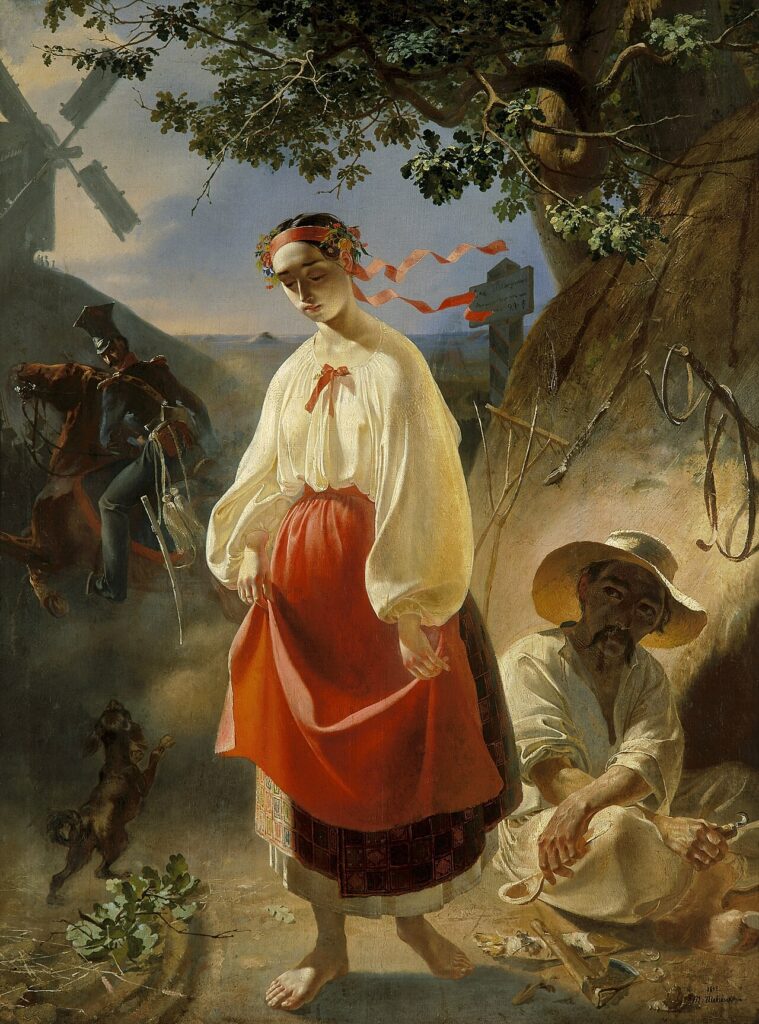
Among Shevchenko’s most important paintings is Kateryna, completed in 1842. The work reveals the emergence of themes that would become central to Ukrainian cultural life.
Rather than depicting a saint, emperor, or classical hero, the painting focuses on a young woman from a local narrative. Rural life, emotional experience, and social circumstances become worthy artistic subjects. This was a significant departure from many academic conventions.
The painting combines professional technique with deep engagement in local culture. It demonstrates that regional themes could possess the same artistic dignity traditionally reserved for more prestigious subjects.
The significance of such choices cannot be overstated. By elevating local stories, artists helped redefine what counted as history and culture.
Portraits Beyond the Capital
Portraiture remained an important genre throughout the nineteenth century, but its focus gradually broadened.
Artists such as Vasyl Tropinin produced works that captured individuals connected to Ukrainian society and culture. While trained within broader imperial traditions, painters increasingly paid attention to regional character and local identity.
Faces became historical documents.
Clothing, gestures, and settings preserved aspects of everyday life undergoing rapid change. Portraits recorded not only individuals but also entire social worlds. The best examples achieve something remarkable. They balance professional academic skill with a sense of lived reality.
Cities of Culture
Artistic life was not confined to imperial capitals.
Cities such as Kyiv and Kharkiv developed increasingly active cultural environments during the nineteenth century. Educational institutions expanded. Literary circles emerged. Exhibitions introduced audiences to contemporary artistic developments.
These urban centers became places where ideas circulated. Artists encountered scholars, writers, collectors, and patrons. Conversations about history, language, folklore, and culture increasingly influenced artistic production.
The relationship between visual art and literature became especially important.
Painters and writers often participated in the same intellectual networks, sharing concerns about memory, identity, and historical continuity.
The Surprise Hidden in Decorative Arts
Many nineteenth-century intellectuals expected artistic achievement to reside primarily in paintings, monuments, and elite collections.
What surprised them was the sophistication of village craftsmanship.
Embroidery patterns displayed remarkable complexity. Household decoration revealed strong compositional instincts. Woodcarving traditions preserved centuries of accumulated design knowledge.
Some artists began to study these forms seriously.
Three elements attracted particular attention:
- Geometric ornament preserved through generations of craft practice.
- Symbolic motifs associated with local traditions.
- Strong color relationships developed outside academic institutions.
These discoveries challenged assumptions about cultural hierarchy.
Beauty was not confined to academies.
It also existed in homes, workshops, and villages.
Between Admiration and Anxiety
The growing fascination with folk culture reflected both confidence and concern.
On one hand, artists celebrated local traditions as sources of vitality and originality. On the other, many feared that modernization might erase them.
Railways expanded. Cities grew. Economic relationships changed. New forms of communication connected distant regions.
These developments brought undeniable benefits, yet they also encouraged reflection on what might be lost.
Art increasingly became a means of preservation.
Painters documented landscapes, customs, and communities partly because they sensed those worlds were changing.
The nineteenth century was therefore not only an age of discovery. It was also an age of remembrance.
The Landscape Becomes a Symbol
Perhaps the most important artistic transformation of the era involved the land itself.
Earlier centuries had often treated landscape as secondary to religious or historical subjects. Nineteenth-century artists elevated it to new prominence.
The Ukrainian countryside became more than scenery.
It became a symbol of continuity.
Fields, rivers, villages, and horizons connected viewers to history in ways that monuments alone could not. The landscape appeared ancient, enduring, and deeply rooted in collective memory.
Artists found in it something increasingly valuable: a sense of permanence amid political uncertainty.
A Question Without an Answer
By the middle of the nineteenth century, artists from Ukrainian territories occupied a complex position.
They benefited from imperial institutions while seeking regional expression. They mastered academic techniques while drawing inspiration from folk traditions. They participated in broader European culture while exploring local themes.
No single solution resolved these tensions.
Instead, the century produced an ongoing conversation about identity, memory, and artistic purpose.
That conversation would soon intensify.
The next generation would move beyond preserving local culture and begin actively constructing a modern national artistic consciousness. Historical subjects, public memory, and cultural revival would take center stage. The search for a voice had begun; soon it would become impossible to ignore.
The Nineteenth-Century National Awakening
Every cultural revival begins with a question that seems simple until someone attempts to answer it.
Who are we?
In the nineteenth century, artists, writers, scholars, and collectors across the Ukrainian lands increasingly confronted that question. For generations, local traditions had survived within larger political frameworks. Folk songs were sung. Embroidery patterns passed from one generation to the next. Historical memories lingered in stories and family histories. Yet much of this culture existed as lived experience rather than as a consciously articulated identity.
That began to change.
By the middle decades of the nineteenth century, artists were no longer merely depicting local subjects because they happened to be nearby. They were choosing them because they believed those subjects expressed something essential about the people and history of the region. Village life, folk customs, landscapes, and the Cossack past acquired new significance.
Art became an act of cultural definition.
The Discovery of a Nation in Everyday Life
One of the striking features of the Ukrainian cultural revival is that it often began with ordinary things.
Artists did not initially search for identity in palaces or imperial monuments. They found it in villages, clothing, songs, and customs that many educated elites had previously overlooked.
The shift reflected broader Romantic currents sweeping across Europe. Intellectuals increasingly viewed traditional culture as a source of authenticity. Rural communities appeared to preserve historical memory more faithfully than rapidly changing cities.
For Ukrainian artists, this perspective proved especially powerful. The countryside became more than a place. It became a repository of cultural continuity.
Scenes that might once have been regarded as merely picturesque now appeared historically meaningful.
Taras Shevchenko and the Visual Imagination of Memory
No individual exerted greater influence on this transformation than Taras Shevchenko.
His literary achievements are immense, but his visual work also played a crucial role in shaping cultural consciousness. Shevchenko understood that images could communicate history and identity with extraordinary force.
His 1842 painting Kateryna remains one of the defining works of the period.
The painting presents a deeply human story rooted in local circumstances. Yet its significance extends beyond narrative. Shevchenko treated a subject drawn from Ukrainian life with the seriousness traditionally reserved for grand historical themes.
This was an artistic declaration. Local experience deserved attention. Local history deserved dignity. Local people deserved representation.
A Portfolio Called “Picturesque Ukraine”
In 1844, Shevchenko launched one of the most ambitious artistic projects of his career: Picturesque Ukraine. The title alone reveals much about the cultural moment.
The project sought to document landscapes, architecture, historical sites, and scenes of everyday life. Rather than focusing on imperial centers, it directed attention toward places and traditions that many audiences rarely encountered in visual form.
The undertaking reflected a growing conviction that art could preserve memory. Buildings might disappear. Customs might change. Historical knowledge might fade. Images could resist that process.
Although the project remained incomplete, its influence proved lasting. It demonstrated that the visual record of a people could itself become a cultural mission.
The Return of the Cossacks
Among the most powerful sources of inspiration was the memory of the Cossack era.
For nineteenth-century artists, the Cossacks represented more than historical figures. They embodied ideas of courage, independence, military achievement, and cultural distinctiveness. Their world provided a dramatic historical narrative around which broader cultural identity could be organized.
Painters, writers, and scholars revisited old chronicles, legends, and traditions. The result was not always historically precise. Romantic imagination frequently blended with historical fact.
Yet the revival’s significance lay elsewhere. It transformed the Cossack past into a shared cultural reference point. History became a source of artistic energy.
Heroes, Legends, and Reinvention
The nineteenth century did not simply recover the past.
It reinterpreted it. Historical figures acquired symbolic meanings that extended far beyond their actual biographies. Battles became legends. Leaders became cultural archetypes. Episodes from earlier centuries entered public imagination through literature, painting, and popular culture.
This process occurred across Europe, but it possessed particular importance in Ukrainian cultural life because historical memory often served as a substitute for political sovereignty.
When state institutions were absent, history itself became a form of cultural territory. Artists helped map that territory.
Painting the Village
While some artists looked toward heroic history, others focused on contemporary rural life.
Among the most important was Mykola Pymonenko, whose works depicted village customs, festivals, labor, and everyday social interactions. His paintings reveal a society undergoing gradual transformation.
The scenes often appear peaceful and familiar. Villagers gather, work, celebrate, and interact within recognizable settings. Yet beneath the apparent simplicity lies something more significant.
These works elevate ordinary experience into cultural narrative. The village becomes a stage upon which identity is performed and preserved. Viewers encounter not anonymous peasants but participants in a living tradition.
Konstantin Trutovsky and the Poetry of Daily Life
A similar impulse appears in the work of Konstantin Trutovsky.
His genre scenes captured moments that might otherwise have escaped historical attention. Weddings, gatherings, conversations, and domestic rituals became worthy artistic subjects.
The achievement of artists like Trutovsky was not merely documentary. They transformed observation into interpretation.
A wedding scene could express continuity between generations. Traditional clothing could symbolize cultural memory. A village gathering could suggest social cohesion and historical endurance.
Art was increasingly asked to communicate meanings beyond the visible surface.
The Collector as Cultural Guardian
The national awakening depended upon more than artists alone.
Collectors, museum founders, ethnographers, and scholars played essential roles. Throughout the second half of the nineteenth century, institutions devoted to preserving cultural heritage began to emerge.
Artifacts that earlier generations might have ignored suddenly acquired historical importance.
Embroidered textiles were collected. Folk art entered museum collections. Historical documents were preserved. Traditional objects became evidence of cultural continuity.
The rise of museums fundamentally changed the relationship between society and its past.
Objects once embedded in everyday life entered public memory.
The Surprise Hidden in Folk Ornament
One of the most influential discoveries of the period involved decorative art.
Researchers examining traditional embroidery, woodcarving, and household decoration found visual systems of remarkable sophistication. Patterns often varied from region to region, preserving local identities through color, geometry, and symbolic motifs.
Artists quickly recognized their potential. Three qualities proved especially attractive:
- Strong decorative rhythms and geometric structures.
- Distinctive regional variations.
- Deep historical continuity across generations.
What had once been considered craft increasingly influenced painting, design, and cultural symbolism.
The boundary between folk art and high art became less rigid.
A Public for National Art
An artistic movement requires an audience.
During the nineteenth century, newspapers, exhibitions, educational institutions, and cultural societies helped create a public interested in questions of identity and history.
Urban centers such as Kyiv, Kharkiv, and Lviv became increasingly important meeting places for artists and intellectuals. Ideas circulated more rapidly than ever before.
A painting could spark discussion. An exhibition could introduce unfamiliar subjects. A historical image could influence how viewers understood their place within a larger story. Art was becoming part of public life in new ways.
The Landscape Learns to Speak
Landscape painting also acquired deeper meaning during this era.
Artists continued to depict rivers, fields, forests, and villages, but viewers increasingly interpreted these scenes symbolically. The land itself became associated with continuity, memory, and belonging.
A field was no longer simply a field. A river was no longer merely a river. Natural features became participants in historical narrative.
This symbolic transformation helps explain why landscape would remain such a powerful theme in Ukrainian art well into the twentieth century. The physical environment served as a bridge between past and present.
A Culture Becomes Self-Aware
The national awakening was not a single event but a gradual process.
Artists painted local subjects. Scholars preserved traditions. Collectors assembled archives. Writers reimagined history. Together, they created a new cultural consciousness.
The significance of this transformation lies not merely in what was depicted but in why it was depicted.
Village life became important because it represented continuity. Historical memory became important because it offered identity. Folk traditions became important because they connected generations. Art was no longer only recording the world. It was helping define it.
By the end of the nineteenth century, the question that had launched the cultural revival—Who are we?—had not received a final answer. Yet artists had fundamentally altered the conversation. They had shown that local history, landscape, memory, and tradition could sustain a sophisticated cultural vision. That achievement would soon encounter an entirely different challenge, as a new generation of artists abandoned nostalgia and tradition in pursuit of radical modernity. The next chapter would bring an explosion of experimentation unlike anything Ukrainian art had ever seen.
The Ukrainian Avant-Garde Changes Modern Art
At the beginning of the twentieth century, the artistic map of Europe appeared relatively settled. Paris was the capital of modern painting. Vienna generated new ideas in architecture and design. Berlin, Munich, and Moscow fostered energetic artistic communities. Museums, critics, and collectors largely assumed that innovation would continue flowing from a handful of recognized centers.
Then something unexpected happened. A generation of artists connected to Kyiv, Kharkiv, Odesa, and other cities across the Ukrainian lands began producing some of the most radical work in modern art. They challenged assumptions about representation, color, movement, theatre, and even the purpose of art itself. Within a remarkably short period, they helped transform visual culture across Europe.
The significance of this achievement has often been obscured by the political history of the twentieth century. Many artists were later absorbed into broader narratives labeled “Russian avant-garde” or “Soviet modernism.” Yet recent scholarship has increasingly emphasized the importance of the Ukrainian artistic environment that shaped many of these developments.
The story is not one of isolated genius. It is the story of an entire creative ecosystem suddenly exploding with experimentation.
A World Moving Faster
The new century arrived with extraordinary energy.
Cities expanded rapidly. Railways compressed distances. Factories altered urban life. Electricity transformed public spaces. Newspapers, photography, and mass communication accelerated the circulation of ideas. Artists felt these changes intensely.
Traditional forms of painting seemed increasingly inadequate for expressing the experience of modern life. The world appeared faster, louder, and more fragmented than before. Many painters concluded that inherited artistic languages could no longer capture contemporary reality.
They began searching for alternatives. This search would lead them toward some of the most revolutionary ideas in art history.
Kyiv as a Laboratory
Modern audiences often associate avant-garde innovation primarily with Paris. Yet early twentieth-century Kyiv functioned as a remarkably dynamic artistic center.
Artists traveled frequently between cities, bringing ideas from across Europe. Exhibitions introduced new styles. Intellectual circles debated aesthetics, politics, science, and philosophy. The atmosphere encouraged experimentation.
Painters did not merely imitate Western European developments. They actively contributed to them. Influences moved in multiple directions, creating a complex network of artistic exchange.
What emerged from this environment was not a single movement but a constellation of overlapping experiments. The city became a laboratory for the future.
Alexandra Exter and the Art of Velocity
Among the most influential figures of the period was Alexandra Exter.
Her career embodied the international character of the avant-garde. She moved among artistic circles in Kyiv, Paris, and other European centers while maintaining deep connections to the cultural life of Ukraine. Exter’s work radiates energy.
Color fragments into dynamic planes. Forms intersect and collide. Composition becomes movement. Her paintings suggest a world in constant transformation, where stability gives way to rhythm and momentum.
Yet she was far more than a painter. Her Kyiv studio became an important gathering place for artists, designers, and intellectuals. Ideas circulated through conversations, collaborations, and shared experimentation.
Creative communities often matter as much as individual masterpieces. Exter helped create one.
Cubo-Futurism Arrives
One of the most influential artistic currents of the era combined elements of Cubism and Futurism.
Cubism challenged conventional representation by breaking objects into geometric structures. Futurism celebrated movement, technology, and modern speed. Together they produced a visual language capable of expressing a rapidly changing world.
Artists associated with Ukrainian centers adapted these ideas in distinctive ways. Rather than merely borrowing foreign styles, they infused them with local perspectives and concerns. Traditional subjects, urban scenes, and experimental compositions often coexisted within the same artistic environment.
The result was a modernism that felt simultaneously international and regional.
Oleksandr Bohomazov Sees the City Move
Few artists captured this transformation more vividly than Oleksandr Bohomazov.
His painting Tram (1914) remains one of the defining images of Ukrainian modernism. The work does not simply depict a vehicle moving through a city. It attempts to visualize movement itself.
Forms fracture and overlap. Perspective becomes unstable. The viewer experiences the sensation of speed rather than merely observing it. Urban life appears as a dynamic force reshaping perception.
The painting reveals a fundamental ambition of the avant-garde. Artists were no longer content to represent the world. They wanted to reinvent the way people saw it.
The Black Square Shock
Then came one of the most famous paintings in modern history.
In 1915, Kazimir Malevich exhibited Black Square.
At first glance, the work appears disarmingly simple: a black square placed against a white background. Yet its implications were revolutionary.
For centuries, Western painting had focused on depicting people, landscapes, stories, and objects. Malevich proposed something radically different. Art could exist independently of representation. Shapes and colors alone could constitute a complete visual language.
Many viewers were bewildered. Some regarded the work as absurd. Others recognized that a profound shift had occurred.
The Search for Pure Form
Malevich called his new movement Suprematism.
The name reflected his belief in the supremacy of pure artistic feeling over representation. Geometry became a vehicle for exploring visual experience free from narrative and imitation. The influence of these ideas extended far beyond a single painting.
Artists, designers, architects, and theorists across Europe engaged with questions raised by abstraction. What remains when recognizable subjects disappear? Can simple forms communicate meaning? How far can art move away from representation while remaining expressive?
These debates would shape modern art for generations.
A surprising detail often overlooked is Malevich’s deep connection to Ukraine. His later years included significant work and teaching in Kyiv, where he continued refining his ideas and influencing younger artists.
Art Escapes the Canvas
The avant-garde was never limited to painting.
Artists increasingly crossed boundaries between disciplines. Theatre, design, architecture, typography, and fashion became sites of experimentation. The traditional separation between fine art and applied art began to dissolve. Creative energy spilled into every available medium.
This expansion reflected a larger ambition. Many avant-garde artists hoped to transform everyday life itself. Art should not remain confined to museums. It should shape environments, objects, and public experience.
The dream was extraordinarily ambitious. For a brief period, it seemed achievable.
Vadym Meller Reinvents the Stage
One of the most remarkable examples emerged in theatre design.
Vadym Meller created stage environments that transformed theatrical space into a modernist experiment. Traditional scenery often sought illusion. Meller pursued something else.
Geometric structures, dynamic forms, and architectural elements reshaped how performers moved and how audiences perceived dramatic action. The stage became an active participant in performance.
The impact extended beyond theatre.
These designs demonstrated how avant-garde principles could reshape entire environments rather than isolated artworks.
The Unexpected Influence of Folk Art
One of the most fascinating aspects of Ukrainian modernism is its relationship to tradition. Avant-garde artists are often imagined as rejecting the past entirely. In reality, many remained deeply interested in folk culture.
Traditional embroidery, decorative patterns, icons, and village crafts provided unexpected inspiration.
Three qualities proved particularly attractive:
- Strong geometric organization.
- Bold color relationships.
- Simplified visual forms.
Artists transformed these influences rather than copying them directly. Yet traces of folk aesthetics often remained visible beneath even the most radical abstractions.
The future, paradoxically, sometimes emerged from the distant past.
Cities of Experiment
The movement extended beyond Kyiv. Kharkiv, Odesa, and other urban centers contributed to the vibrant artistic climate of the era. Exhibitions, schools, publications, and informal networks connected artists across regions.
What made the moment extraordinary was its density. Painters, designers, theorists, poets, architects, and theatre innovators often worked simultaneously, exchanging ideas at remarkable speed.
For a brief period, artistic possibility seemed limitless. The established rules had lost their authority. Everything could be reconsidered.
A Revolution Before the Revolution
Looking back, the avant-garde now appears almost prophetic.
Artists dismantled old forms before political revolutions dismantled old political structures. They questioned inherited assumptions before society itself entered a period of upheaval.
The timing was significant. The creative explosion occurred on the eve of some of the most dramatic events of the twentieth century. War, revolution, and political transformation would soon reshape every aspect of life.
Many avant-garde artists initially welcomed these changes, believing that social revolution might create opportunities for artistic revolution. The reality would prove far more complicated.
The Door to the Modern World
The achievement of the Ukrainian avant-garde remains astonishing.
Within a few decades, artists connected to the region helped redefine painting, theatre, design, and abstraction. Their influence reached far beyond national borders. Ideas developed in Kyiv studios and exhibited in regional centers entered global artistic conversations.
Perhaps the most remarkable aspect of the movement is its confidence. These artists did not ask permission to participate in modernism. They assumed they belonged at its forefront. And for a time, they did.
The door to the modern world had been thrown open. Geometry replaced tradition. Movement replaced stability. Experiment replaced convention. Yet just as the avant-garde reached its greatest creative heights, the political realities of the twentieth century began closing in. The next chapter would reveal how dreams of artistic freedom collided with revolution, ideology, and catastrophe.
Revolution, Utopia, and Catastrophe
For a brief moment, it seemed as though history had opened every door at once.
The old empires had collapsed. Political systems were being rebuilt. Social hierarchies appeared unstable. Across the former territories of the Russian Empire, artists imagined that a completely new world might be possible. In Ukraine, the 1920s became one of the most intellectually ambitious decades in the nation’s cultural history. Painters, designers, architects, theatre innovators, filmmakers, and educators believed they stood at the beginning of a new age.
The optimism was genuine. Many artists saw revolution not merely as a political event but as an opportunity to reinvent culture itself. Traditional boundaries between art and society appeared ready to disappear. Schools embraced experimentation. Public institutions commissioned ambitious projects. New theories emerged almost monthly.
Then the atmosphere changed. What began as a period of extraordinary creative freedom gradually hardened into one of the most destructive episodes in European cultural history. The same state that had initially encouraged innovation increasingly demanded conformity. By the late 1930s, many of the most talented figures of the Ukrainian cultural renaissance had been silenced, imprisoned, or executed.
The story of this era is therefore one of both possibility and loss.
The Dream of a New Beginning
The aftermath of revolution created conditions unlike anything artists had previously experienced.
Traditional patronage systems had weakened or disappeared. New institutions emerged. Government agencies sought cultural programs capable of shaping society. Education expanded. Public art projects multiplied.
Many artists welcomed these developments. They believed art should participate directly in social transformation. Museums, schools, factories, theatres, and public spaces all became potential sites of creative intervention.
The energy was remarkable. What had previously been avant-garde experimentation at the margins now appeared capable of influencing an entire society.
Kharkiv Becomes a Cultural Capital
One of the most important centers of this new world was Kharkiv, which served as the capital of Soviet Ukraine for much of the period between 1919 and 1934.
The city attracted writers, artists, educators, and administrators eager to shape cultural policy. Kharkiv became a place where ideas moved quickly.
New journals appeared. Debates flourished. Educational reforms encouraged innovation. Creative communities interacted across disciplines in ways that would have seemed impossible only a decade earlier.
The city radiated confidence. Many participants genuinely believed they were constructing the future.
The Laboratory of the Kyiv Art Institute
At the same time, the Kyiv Art Institute emerged as one of the most dynamic artistic schools in Europe.
Students encountered a remarkable range of approaches. Traditional academic methods coexisted with avant-garde experimentation. Teachers encouraged investigation rather than rigid adherence to established styles.
The institution functioned less like a conventional academy and more like a creative laboratory. Painters explored abstraction. Designers reconsidered the relationship between art and industry. Educators debated the social role of creativity.
For a brief period, it seemed possible that Ukraine might become one of the leading centers of modern artistic education. The optimism was intoxicating.
Mykhailo Boychuk and an Alternative Modernism
Among the most fascinating figures of the era was Mykhailo Boychuk.
Boychuk’s vision differed significantly from many of his avant-garde contemporaries. While some artists pursued abstraction and radical formal experimentation, he sought a synthesis of historical traditions and modern social concerns.
His inspirations were unexpectedly diverse. Byzantine mosaics, medieval frescoes, folk art, and early Renaissance painting all contributed to his thinking. Rather than rejecting the past, Boychuk attempted to transform it into a modern visual language.
The result became known as Boychukism. It was one of the most original artistic movements of the twentieth century.
Painting for the Public
Boychuk believed art should exist within public life rather than remain confined to private collections. Murals occupied a central place in his vision.
Large-scale public paintings could communicate shared values, historical memory, and social ideals. Walls became opportunities for artistic education. This ambition aligned well with the atmosphere of the 1920s.
Governments sought public cultural projects. Artists sought wider audiences. Monumental painting appeared capable of serving both goals simultaneously. Boychuk and his students received important commissions, producing murals that attracted attention across the region.
Many observers regarded the movement as one of the most promising developments in modern Ukrainian art.
The Unexpected Revival of History
One of the surprises of the decade was the continued importance of historical tradition. Revolutionary rhetoric often emphasized rupture with the past. Yet many Ukrainian artists remained deeply interested in older visual cultures.
Rather than abandoning medieval art, folk traditions, or religious imagery entirely, they reinterpreted them. Boychuk’s movement provides the clearest example, but similar tendencies appeared elsewhere.
Three historical sources proved especially influential:
- Byzantine and medieval artistic traditions.
- Ukrainian folk decorative culture.
- Monumental public art from earlier civilizations.
The result was a modernism unlike that found in many Western European centers.
Innovation emerged through transformation rather than rejection.
A Renaissance Takes Shape
The cultural flowering of the 1920s extended far beyond painting.
Writers, filmmakers, theatre directors, scholars, and composers participated in a broader renaissance of intellectual life. New ideas circulated across disciplines. Collaboration became increasingly common.
The atmosphere encouraged ambition. Artists did not merely want to create individual works. They hoped to reshape education, public space, and collective consciousness.
Looking back, the scale of their aspirations is astonishing. For perhaps the first time in modern history, an entire generation of Ukrainian cultural figures believed they could influence society at every level.
The Political Climate Shifts
Yet even as artistic experimentation expanded, political conditions were changing.
Centralized control increased. Official expectations became more rigid. Independent initiatives attracted greater scrutiny.
The transition was gradual. Many artists initially failed to recognize its significance. Cultural institutions continued functioning. Exhibitions still occurred. Schools remained active.
But the boundaries of acceptable expression were narrowing. The state increasingly viewed artistic autonomy with suspicion. What had once been encouraged as innovation now risked being interpreted as ideological deviation.
The Beginning of Fear
By the late 1920s and early 1930s, the atmosphere had altered dramatically.
Public criticism intensified. Administrative pressure increased. Careers became vulnerable to political accusations. The consequences were severe.
Movements once celebrated as progressive suddenly faced condemnation. Artistic theories that had seemed visionary became dangerous. Personal associations acquired political significance.
Creative life changed accordingly. Fear entered the studio. It entered classrooms.
It entered conversations among colleagues. The freedom that had defined the decade began to disappear.
The Destruction of a Generation
The tragedy that followed is remembered as part of the “Executed Renaissance.” The phrase captures both achievement and catastrophe.
An extraordinary generation of Ukrainian cultural figures had emerged during the 1920s. Many were now targeted during campaigns of repression. Writers, scholars, theatre directors, and artists faced arrest, imprisonment, exile, or execution.
Among the victims was Mykhailo Boychuk. In 1937, during the Great Purge, he was executed. Many of his students suffered similar fates. The movement he had created was effectively dismantled.
Murals Erased from the Walls
Perhaps the most heartbreaking aspect of the story is the destruction of the art itself.
Many of Boychuk’s monumental murals no longer exist. Works that once occupied public buildings were removed, painted over, or destroyed. Entire artistic programs vanished within a few years.
Modern historians often reconstruct these projects through photographs, sketches, and written descriptions. The loss is difficult to overstate. Art historians rarely encounter situations in which an entire movement is systematically erased. Yet that is precisely what occurred.
A culture that had hoped to reshape the future found its achievements deliberately dismantled.
The Silence After the Noise
By the end of the 1930s, the creative landscape looked very different from that of the previous decade.
The experimental energy of the avant-garde had largely disappeared from official institutions. Independent artistic movements had been suppressed. Public life increasingly demanded ideological conformity.
What remained was a profound absence. The generation that had imagined limitless possibilities was gone. Some had been executed. Others imprisoned. Many silenced.
The cultural renaissance that had seemed so promising only a few years earlier had been shattered.
The Lost Future
The tragedy of the Executed Renaissance lies partly in its unfinished nature. These artists were not preserving a fading tradition. They were building something new. Their projects remained incomplete. Their theories continued evolving. Their institutions were still developing.
One cannot help wondering what might have emerged had they been allowed to continue. The question has no answer.
What survives are fragments: photographs, surviving paintings, memoirs, archival records, and scattered works rescued from destruction. Yet even those fragments reveal the scale of the achievement.
For a brief period, Ukraine stood at the forefront of modern artistic experimentation. It produced thinkers, teachers, and creators of extraordinary ambition. Then political repression intervened with devastating force.
The catastrophe did not end Ukrainian art. Nothing so simple ever occurs in history. But it changed its course profoundly. The next chapter will explore the cultural system that emerged afterward—a world in which artistic life continued, yet under the watchful eye of a state determined to control not only politics but imagination itself.
Socialist Realism and the Soviet Cultural System
The destruction of the Ukrainian avant-garde in the 1930s did not produce an artistic vacuum. Studios remained open, academies continued training students, exhibitions were organized, and painters kept working. What changed was the framework within which art was expected to exist. The experimental culture of the 1920s, with its competing theories and formal innovations, gave way to a highly structured system that sought to direct artistic production toward specific ideological goals. For the next half century, most professional artists in Soviet Ukraine would operate within institutions designed to shape not only what art looked like, but also what subjects it treated and what social role it performed.
The standard Western narrative often reduces this period to a simple opposition between artistic freedom and political control. There is truth in that interpretation, but it is incomplete. Soviet cultural life was restrictive, sometimes brutally so, yet it also provided resources on a scale that many artists elsewhere could only imagine. The state funded academies, museums, publishing houses, exhibitions, commissions, and monumental projects. An artist who successfully navigated the system could receive studio space, materials, salaries, travel opportunities, and public visibility. The dilemma was obvious: patronage came attached to expectations. The same institutions that supported artistic careers also defined the boundaries within which those careers could develop.
The New Official Style
The doctrine that came to dominate Soviet artistic life is generally known as Socialist Realism. Consolidated during the 1930s and reinforced through cultural policy for decades afterward, it required art to be understandable, optimistic, and aligned with the state’s vision of historical progress. Abstraction, radical formal experimentation, and many avant-garde approaches were condemned as inaccessible or ideologically suspect. Artists were expected to depict workers, soldiers, engineers, collective farmers, scientists, and political leaders in ways that emphasized achievement, dignity, and social purpose.
At first glance, Socialist Realism appears surprisingly traditional. Many paintings employ techniques inherited from nineteenth-century academic art. Figures are recognizable. Perspective functions conventionally. Narrative scenes are carefully composed. The radical formal innovations of Malevich or Exter seem very far away. Yet this apparent traditionalism served a political purpose. Art was intended to communicate clearly to mass audiences. Ambiguity, irony, and formal experimentation often attracted suspicion because they could not be easily integrated into official narratives.
The consequences for Ukrainian art were profound. A generation that had once stood near the center of international modernism now found itself operating within one of the most tightly controlled cultural systems in Europe. Yet artists did not simply become passive instruments of policy. They adapted, negotiated, and occasionally found ways to pursue genuine artistic interests within officially acceptable frameworks.
Training the Soviet Artist
The Soviet system understood that controlling art required controlling education. Academies and institutes trained artists according to highly structured curricula that emphasized drawing, composition, anatomy, and technical mastery. Unlike the avant-garde schools of the 1920s, where competing theories often coexisted, postwar institutions generally promoted a more unified vision of artistic practice.
This emphasis on technical skill produced some unexpected results. Whatever one thinks of Socialist Realism as an ideology, many Soviet-trained artists possessed extraordinary command of their craft. Students spent years mastering figure drawing, painting techniques, and compositional organization. Academic standards could be rigorous. By the middle of the twentieth century, Ukraine had developed a large professional artistic community capable of producing work across a wide range of genres, from portraiture and landscape to monumental public art.
The system also fostered a highly organized exhibition culture. Regional and national exhibitions provided opportunities for recognition and advancement. Artists joined professional unions that functioned as both support networks and gatekeepers. Careers often depended upon participation in these institutions. Success required artistic ability, but it also required an understanding of the cultural expectations governing public life.
Art After War
The Second World War left much of Ukraine physically devastated. Cities suffered extensive destruction, millions of people died, and cultural institutions faced enormous challenges. In the aftermath, art became deeply involved in the work of reconstruction. Painters documented rebuilding efforts, architects redesigned urban centers, and monumental projects commemorated wartime sacrifice.
Few examples illustrate this transformation more clearly than the reconstruction of central Kyiv. The rebuilding of Khreshchatyk created not merely a commercial district but a symbolic landscape intended to embody resilience and renewal. Architecture became part of a broader narrative about survival and progress. Public space itself was treated as a cultural statement.
At the same time, war memory became one of the defining themes of Soviet-era art. Veterans, soldiers, resistance fighters, and grieving families appeared frequently in paintings and monuments. The scale of suffering ensured that these subjects possessed genuine emotional power. While official narratives often simplified complex historical realities, many artists approached wartime themes with sincere conviction. The result was a body of work that combined personal memory, public commemoration, and ideological messaging in ways that remain difficult to separate entirely.
Tatiana Yablonska and the Complexity of Soviet Art
One of the most important Ukrainian painters of the postwar period was Tatiana Yablonska. Her career demonstrates why simplistic judgments about Soviet-era art are often inadequate. Yablonska worked within official institutions and achieved considerable recognition, yet her best paintings reveal artistic ambitions extending beyond propaganda.
Her painting Bread (1949) became one of the iconic works of the era. On one level, the subject aligns comfortably with official expectations. Agricultural labor appears productive, organized, and socially meaningful. Yet the painting’s success derives from more than ideology. Yablonska demonstrates remarkable skill in handling space, color, and human movement. The figures possess vitality rather than merely symbolic function. The painting succeeds because it is carefully observed as well as politically acceptable.
A few years later, Morning (1954) revealed another dimension of her work. The painting depicts an intimate domestic scene rather than a grand collective narrative. Light fills the room. The composition feels relaxed and humane. Although created within the Soviet system, the work’s enduring appeal lies largely in qualities that transcend politics. It reminds viewers that artists operating under restrictive conditions often pursued goals more complex than simple ideological service.
Monumental Art and the Soviet Landscape
One of the most distinctive features of Soviet Ukraine was the integration of art into public space. Murals, mosaics, sculptures, and decorative programs appeared throughout cities, industrial complexes, schools, transportation hubs, and cultural centers. Unlike easel paintings confined to museums, these works formed part of everyday experience.
Monumental mosaics became especially significant from the 1950s onward. Their scale allowed artists to engage with architecture directly, while their durability made them suitable for public environments. Many combined modern design principles with officially approved themes. Workers, scientific achievement, technological progress, and historical memory appeared repeatedly, yet artists often introduced striking color schemes and inventive compositional solutions.
What makes these works particularly interesting today is their ambiguity. Some function clearly as ideological statements. Others possess visual qualities that exceed their political context. In many cases, the same artwork can be interpreted in both ways simultaneously. Recent efforts to document and preserve Soviet-era mosaics have encouraged scholars to reconsider a body of work that was long dismissed too easily.
Negotiation Rather Than Freedom
A useful way to understand Soviet artistic life is to think in terms of negotiation rather than absolute control or absolute freedom. Artists constantly evaluated what was possible. Some embraced official themes enthusiastically. Others sought greater autonomy within accepted genres such as landscape, still life, or portraiture. Many alternated between public commissions and more personal work.
Landscape painting, in particular, often provided opportunities for relatively independent artistic exploration. A painter depicting a river valley or a rural scene could focus on atmosphere, color, and composition without necessarily confronting ideological demands directly. This does not mean such works existed outside politics, but the relationship between artistic intention and official expectation was often less rigid than in explicitly political subjects.
The same dynamic appeared in portraiture. Official portraits of political leaders followed strict conventions, yet portraits of writers, musicians, scientists, or ordinary citizens sometimes allowed for greater psychological complexity. Skilled artists learned where flexibility existed and where it did not.
The Long Shadow of the Avant-Garde
Even though official culture rejected the radical modernism of the 1910s and 1920s, the memory of the avant-garde never disappeared completely. Reproductions circulated privately. Stories survived among artists and teachers. Certain formal concerns reemerged indirectly through design, illustration, and monumental art.
This persistence mattered because cultural traditions rarely vanish entirely. They may become hidden, fragmented, or transformed, but traces endure. Younger generations often encountered the avant-garde not through official institutions but through personal networks and informal conversations. The legacy of Malevich, Exter, Boychuk, and others remained dormant rather than extinct.
By the 1960s and 1970s, these submerged influences would begin resurfacing in unexpected ways. A new generation of artists started questioning the assumptions that had governed Soviet cultural life for decades. Their efforts remained cautious and often private, yet they signaled the emergence of an alternative artistic world operating beneath the surface of official culture.
The Soviet cultural system proved remarkably durable. It shaped careers, institutions, and public expectations across several generations. Yet no system remains completely closed forever. Beneath exhibitions, commissions, and state-approved narratives, artists continued searching for forms of expression that exceeded official limits. The next chapter follows those searches into studios, apartments, and informal artistic communities where another version of Ukrainian art was quietly taking shape.
Nonconformists, Underground Studios, and Late Soviet Dissent
By the 1960s, the Soviet cultural system appeared stable from the outside. Art academies continued to train students, state exhibitions filled official galleries, and Socialist Realism remained the dominant public language of visual culture. A visitor moving through museums and cultural institutions might easily have concluded that artistic life followed a predictable course. The avant-garde had been defeated, ideological boundaries were firmly established, and the state exercised effective control over cultural production.
Yet beneath that surface, another artistic world was emerging.
It did not possess large museums, generous public commissions, or official recognition. Its exhibitions were often temporary, improvised, and vulnerable to interference. Its audiences were comparatively small. Nevertheless, this unofficial sphere became one of the most important developments in late Soviet Ukrainian culture. Within private apartments, studios, workshops, and informal intellectual circles, artists explored possibilities largely excluded from official institutions. Some turned toward abstraction. Others experimented with symbolism, conceptual approaches, or highly personal forms of figurative art. What united them was not a single style but a shared determination to preserve artistic autonomy.
The existence of this underground culture reveals an important truth about Soviet artistic life. Control was extensive, but it was never absolute. Every system generates spaces at its margins, and it was within those spaces that many of the most interesting artistic conversations of the late Soviet period took place.
The Thaw and Its Limits
The death of Joseph Stalin in 1953 initiated a period often referred to as the Khrushchev Thaw. Political repression did not disappear, but certain aspects of public life became less rigid than they had been during the height of Stalinism. Writers, filmmakers, musicians, and artists discovered that some previously forbidden topics could now be approached with greater openness. New translations appeared. Foreign cultural influences became slightly more accessible. Historical subjects that had once been treated cautiously entered public discussion.
For younger artists, this atmosphere was transformative. Many had grown up knowing only the highly regulated cultural environment of the Stalin years. The possibility of experimentation—even limited experimentation—felt significant. They became curious about artistic developments that official education had largely ignored. Modernist movements once condemned as dangerous formalism attracted renewed interest. Information circulated through books, magazines, private conversations, and reproductions passed from hand to hand.
The thaw, however, had clear limits. Authorities remained suspicious of artistic independence, especially when it intersected with broader intellectual or political concerns. Artists quickly learned that greater flexibility did not mean complete freedom. The result was a culture characterized by cautious exploration. Boundaries had expanded, but no one was entirely certain where those boundaries lay.
The Sixtiers and Cultural Renewal
One of the most influential intellectual currents of the period was the movement known as the Sixtiers, or Shistdesiatnyky. This loose network of writers, artists, scholars, and cultural figures emerged during the late 1950s and 1960s. They were not a unified political organization, nor did they all share identical artistic goals. What connected them was a desire to revitalize cultural life and recover forms of intellectual independence that had been suppressed during previous decades.
The Sixtiers displayed a deep interest in history, language, literature, and artistic heritage. Many sought to reconnect with traditions that official culture had marginalized. The destroyed world of the 1920s avant-garde, the memory of the Executed Renaissance, and earlier currents of Ukrainian cultural life all attracted renewed attention. This process was not purely academic. Recovering forgotten artists and writers became a way of expanding the horizon of contemporary culture.
Visual artists participated actively in this broader movement. They explored alternative artistic languages while simultaneously reexamining historical traditions. The goal was not simply rebellion. It was recovery. Entire chapters of cultural history had been obscured, and many artists believed that understanding the past was essential for imagining the future.
Alla Horska and the Moral Dimension of Art
Few figures better embody the spirit of this era than Alla Horska. Trained within Soviet institutions, Horska developed into one of the most important artists associated with the cultural renewal of the 1960s. Her work ranged from painting and drawing to monumental projects, yet her significance extends beyond individual artworks.
Horska belonged to a generation that increasingly viewed artistic activity as inseparable from ethical responsibility. She participated in cultural initiatives, engaged with historical questions, and became associated with broader efforts to defend intellectual freedom. For many contemporaries, she represented the possibility that art could serve as a form of moral witness rather than merely an aesthetic practice.
Her death in 1970 under circumstances that remain deeply controversial transformed her into a powerful symbolic figure. Within cultural circles, she came to represent both the aspirations and the vulnerabilities of a generation seeking greater openness. The impact of her life cannot be measured solely through surviving works. It resides equally in the example she provided to younger artists who continued searching for independent forms of expression.
Odesa and the Geography of Nonconformity
If Kyiv served as an important intellectual center, Odesa became one of the most distinctive artistic laboratories of the late Soviet period. The city’s history had always encouraged a certain cosmopolitanism. Its port connected it to wider cultural currents, and its artistic community developed a reputation for experimentation, humor, and independence.
By the 1960s, Odesa had become home to a vibrant nonconformist scene. Artists explored styles and subjects that official exhibitions rarely welcomed. Some pursued abstraction, others developed highly personal figurative approaches, and still others experimented with conceptual ideas. What united them was a willingness to work outside established expectations.
Importantly, these artists did not necessarily view themselves as political dissidents in the conventional sense. Many were primarily concerned with artistic questions. They wanted freedom to explore color, form, symbolism, and personal experience without having every creative decision evaluated according to ideological criteria. In this respect, aesthetic independence itself became a form of quiet resistance.
The Fence Exhibition
One of the most famous episodes in the history of unofficial Soviet art occurred in Odesa in 1967. Frustrated by the limitations of official exhibition opportunities, artists including Valentyn Khrushch and Lyudmyla Yastreb organized an outdoor display that later became known as the Fence Exhibition.
The event lasted only a short time before authorities intervened. Yet its symbolic importance far exceeded its duration. By hanging artworks on a public fence, the participants transformed an ordinary urban structure into an improvised gallery. The gesture was simple but powerful. Art would be shown even if official institutions refused to accommodate it.
The Fence Exhibition has often been compared to later unofficial exhibitions elsewhere in the Soviet Union, but its significance within Ukrainian cultural history is distinctive. It demonstrated that alternative artistic communities were willing to create their own spaces rather than wait for official approval. The exhibition became part of the mythology of nonconformist art because it captured a larger reality: creativity persisted even when institutional support was absent.
Apartment Exhibitions and Informal Networks
Most underground artistic activity unfolded on a much smaller scale. Private apartments became crucial cultural venues. Paintings were displayed in living rooms. Discussions continued late into the night. Artists, writers, musicians, and scholars formed informal networks through which ideas circulated.
These gatherings performed functions normally associated with public institutions. They allowed artists to share new work, exchange criticism, and encounter unfamiliar influences. Because official channels often excluded experimental art, informal networks became essential mechanisms of cultural transmission.
The atmosphere could be remarkably intense. Participants understood that they were engaging with work unlikely to appear in major exhibitions. This awareness heightened the significance of the encounter. Art was not being consumed as part of a routine cultural program. It was being discovered through personal relationships and shared intellectual curiosity.
Such environments also fostered interdisciplinary exchange. Painters interacted with poets, filmmakers, architects, and historians. Conversations ranged far beyond visual art itself. The result was a cultural ecosystem that often proved more intellectually dynamic than many official institutions.
The Return of Modernism
One of the most important developments of the period was the gradual rediscovery of modernist traditions. Artists who had come of age after the destruction of the avant-garde began learning about figures such as Malevich, Exter, and Boychuk. Access to information remained limited, yet enough material circulated to inspire renewed interest.
This rediscovery was not an act of simple imitation. Few artists attempted to recreate the exact styles of the 1910s or 1920s. Instead, they absorbed lessons about artistic freedom, experimentation, and the legitimacy of formal innovation. The avant-garde became less a model than a precedent. It demonstrated that Ukrainian art possessed its own history of radical creativity.
The significance of this realization should not be underestimated. Official narratives often implied that artistic innovation originated elsewhere and that local culture should follow approved paths. The recovery of the avant-garde challenged that assumption. It revealed a historical tradition in which artists connected to Ukraine had helped shape international modernism itself.
Living in Two Worlds
Perhaps the defining characteristic of late Soviet artistic life was the coexistence of parallel realities. Official institutions continued functioning. Museums organized exhibitions. Professional unions managed careers. State commissions provided employment. At the same time, an unofficial sphere developed alongside these structures.
Many artists moved between both worlds. They accepted public commissions while pursuing private experiments. They participated in official exhibitions yet maintained connections to underground networks. The boundary between conformity and nonconformity was often less clear than later narratives suggest.
This dual existence required considerable adaptability. Artists learned to communicate differently depending on context. Certain works remained in studios or private collections, while others entered public circulation. Meaning itself sometimes became layered, with images capable of supporting multiple interpretations simultaneously.
The complexity of this environment helps explain why late Soviet art cannot be reduced to simple categories. Creativity persisted through negotiation, compromise, concealment, and occasional acts of open defiance.
Preparing for Another Transformation
By the 1980s, the Soviet cultural system still appeared formidable, but its authority was weakening. Informal artistic networks had become more extensive. Knowledge of international contemporary art was increasingly difficult to suppress. Younger artists entered the cultural scene with expectations very different from those of earlier generations.
Most participants could not yet foresee the dramatic political transformations that would soon occur. Yet the foundations of change were already visible. The unofficial culture of the preceding decades had preserved habits of independent thought, experimentation, and self-organization. When the Soviet system eventually began to unravel, artists would be ready to move quickly into newly available spaces.
The underground studios, apartment exhibitions, and informal conversations of the late Soviet era accomplished more than the survival of alternative art. They preserved the possibility of artistic plurality itself. That achievement would prove invaluable when Ukraine entered a new historical period—one defined not by operating beneath the system, but by confronting the opportunities and uncertainties of independence.
Independence and the Reinvention of Ukrainian Art
When Ukraine became independent in 1991, artists inherited a freedom that many of their predecessors had spent decades imagining but rarely experienced. Yet freedom arrived hand in hand with uncertainty. The Soviet Union had collapsed with astonishing speed, taking with it not only political structures but also the cultural system that had organized artistic life for generations. Academies remained, museums remained, and artists remained, but the framework connecting them had been fundamentally altered.
For much of the twentieth century, professional artists had operated within a state-managed environment. That environment imposed ideological limits, but it also provided exhibitions, commissions, salaries, studio spaces, and institutional support. Independence removed many of those constraints. At the same time, it removed many of those guarantees. The result was a period of remarkable instability. Some artists found themselves confronting opportunities that had never previously existed. Others struggled to adapt to a world in which state patronage could no longer be taken for granted.
The history of Ukrainian art after 1991 is therefore not a simple story of liberation. It is the story of a cultural ecosystem forced to reinvent itself almost overnight. The challenges were economic, institutional, historical, and aesthetic. Yet from this uncertainty emerged one of the most dynamic periods in modern Ukrainian cultural life.
The End of One World
The collapse of the Soviet Union produced a crisis of orientation. For decades, artists had worked within a system that defined professional success according to recognizable criteria. Official exhibitions, state commissions, and professional unions formed a relatively coherent structure. Suddenly, many of those structures either weakened dramatically or ceased functioning in their previous forms.
Economic hardship compounded the problem. The 1990s were difficult years throughout much of the former Soviet world, and artists felt these pressures acutely. Materials became more expensive. Institutional budgets shrank. Museums struggled. Collectors were relatively few. Markets that had scarcely existed under Soviet conditions were still in their infancy.
Yet the disappearance of established rules also created new possibilities. Subjects that had once been politically sensitive could now be addressed openly. Historical narratives previously marginalized or suppressed became available for reexamination. Artists could travel more freely, engage directly with international art worlds, and experiment without the same level of ideological scrutiny.
The old system had vanished. The new one had not yet fully emerged.
Rediscovering the Buried Past
One of the most important cultural developments of the 1990s was the recovery of historical memory. Entire chapters of artistic history that had been neglected, distorted, or suppressed during the Soviet period attracted renewed attention. Scholars revisited the Ukrainian avant-garde. Museums reassessed collections. Publications explored figures who had received little official recognition for decades.
The rediscovery of the Executed Renaissance proved particularly significant. Artists, writers, and intellectuals destroyed during the Stalinist period reentered public consciousness. Their work was no longer treated as an obscure footnote but as a central part of national cultural history.
This process transformed contemporary artistic thinking. Younger artists suddenly had access to a far richer historical inheritance than many had previously realized. The narrative of Ukrainian art expanded dramatically. It no longer began and ended with Soviet frameworks. Instead, artists could situate themselves within a much longer and more complex tradition that included medieval icon painting, Cossack Baroque culture, nineteenth-century national revival movements, avant-garde experimentation, and underground nonconformist networks.
Historical recovery became a creative resource.
The Ukrainian New Wave
Among the most influential artistic developments of the late 1980s and 1990s was the movement often referred to as the Ukrainian New Wave. Emerging during the final years of the Soviet Union and flourishing during the early independence period, it brought together artists who rejected many of the assumptions that had dominated official culture.
The New Wave was not a tightly organized school with a single manifesto. Its participants explored diverse styles and approaches. What united them was a willingness to embrace ambiguity, irony, quotation, and experimentation. The certainties of Socialist Realism no longer seemed convincing. Artists responded by creating works that often mixed historical references, popular culture, personal mythology, and contemporary politics in unexpected ways.
The atmosphere differed markedly from that of earlier generations. During the Soviet period, unofficial artists frequently defined themselves in opposition to official institutions. The New Wave entered a world in which those institutions were themselves undergoing transformation. Rather than fighting a clearly defined cultural orthodoxy, artists faced a more open and fluid environment.
This freedom encouraged extraordinary creativity, but it also raised difficult questions. What should Ukrainian art become now that it was no longer reacting against Soviet constraints?
Oleg Tistol and the Problem of Identity
Few artists explored these questions more persistently than Oleg Tistol. His work frequently engages with symbols, stereotypes, historical imagery, and cultural myths associated with Ukraine. Rather than presenting identity as something fixed and obvious, Tistol often treats it as a subject requiring investigation.
This approach reflected broader tendencies within post-Soviet culture. The newly independent state was itself engaged in a process of self-definition. Historical narratives were being reconsidered. Public symbols acquired renewed significance. Questions of memory, language, regional experience, and cultural continuity became increasingly prominent.
Artists did not simply illustrate these debates. They participated in them. Tistol’s work demonstrates how contemporary art could function as a space for examining national identity without reducing it to simple slogans or formulas.
The complexity of the subject became part of the artistic material.
Alexander Roitburd and Post-Soviet Imagination
Another key figure was Alexander Roitburd, whose work combined intellectual ambition with visual exuberance. Associated with the vibrant artistic culture of Odesa, Roitburd became one of the most internationally visible Ukrainian artists of his generation.
His paintings often draw upon art history itself. Classical references, historical imagery, and contemporary concerns intersect in layered compositions that resist straightforward interpretation. This engagement with the history of art was characteristic of a broader postmodern sensibility that emerged during the 1990s.
For artists who had inherited a fragmented cultural landscape, quotation and reinterpretation became powerful tools. Rather than seeking a single authoritative style, many embraced multiplicity. Different historical periods could coexist within the same work. High culture and popular culture could interact. National themes could be approached with seriousness, humor, skepticism, or all three simultaneously.
The result was an artistic environment far more diverse than anything possible under the Soviet system.
Building New Institutions
Creative energy alone could not sustain a cultural renaissance. Institutions were necessary as well. One of the most important developments of the 1990s was the emergence of organizations dedicated to supporting contemporary art.
The Soros Center for Contemporary Art, founded in 1993, played a particularly significant role. It provided funding, exhibition opportunities, and international connections at a moment when many traditional structures were struggling. For numerous artists, the center became an important gateway to broader global conversations.
The importance of such institutions is difficult to overstate. Contemporary art requires infrastructure. Artists need spaces to exhibit work, encounter new ideas, and connect with audiences. During a period of economic and institutional instability, organizations capable of providing these opportunities exerted enormous influence.
The development of new institutions also signaled a broader shift. Ukrainian art was becoming increasingly integrated into international networks rather than existing primarily within post-Soviet frameworks.
Entering the Global Conversation
Throughout the 1990s and early 2000s, Ukrainian artists became more visible abroad. Participation in international exhibitions increased. Curators from other countries began paying closer attention to artistic developments in Kyiv, Odesa, Lviv, Kharkiv, and elsewhere.
This integration into global contemporary art produced both opportunities and challenges. On one hand, artists gained access to larger audiences and broader intellectual exchanges. On the other hand, they faced pressure to explain their work within international contexts that often possessed limited knowledge of Ukrainian history.
The question of representation became increasingly important. How should Ukrainian art be presented to audiences accustomed to viewing the region through Soviet or Russian frameworks? How could artists communicate local experiences without reducing them to exotic cultural markers?
These questions would remain central throughout the following decades.
The Rise of Contemporary Art Centers
The maturation of the contemporary art scene became particularly visible in the early twenty-first century. New galleries, festivals, and exhibition programs expanded the cultural landscape. Perhaps the most internationally recognized example is the PinchukArtCentre, which opened in 2006.
The center quickly became a major venue for contemporary art in Eastern Europe. International exhibitions introduced Ukrainian audiences to global developments while also providing local artists with valuable visibility. The institution symbolized the growing confidence of a cultural scene that had spent the previous decade building itself under difficult circumstances.
Such developments reflected a broader transformation. Contemporary art was no longer a marginal activity sustained primarily by informal networks. It had become an increasingly visible component of public cultural life.
A New Relationship with History
One of the most distinctive features of post-independence Ukrainian art is its relationship to the past. Earlier generations often experienced history as something imposed from above through official narratives. Contemporary artists increasingly treated history as material for investigation.
The medieval world, the Cossack era, the nineteenth-century national revival, the avant-garde, the Soviet period, and the underground culture of the late twentieth century all became available for reinterpretation. Artists moved freely among these layers of memory, creating works that questioned inherited assumptions and explored overlooked connections.
Three recurring themes emerged repeatedly:
- The recovery of suppressed historical narratives.
- The examination of collective memory.
- The relationship between local experience and broader global histories.
These concerns would become even more prominent as political events accelerated during the twenty-first century.
Reinvention Rather Than Arrival
By the early 2000s, Ukrainian art had accomplished something remarkable. It had survived the collapse of one political system, the uncertainty of economic transition, and the challenge of rebuilding cultural institutions. Yet the period should not be understood as the conclusion of a journey. It was a beginning.
The artists of independence inherited a fragmented but extraordinarily rich cultural legacy. They rediscovered forgotten histories, created new institutions, and established connections reaching far beyond national borders. Most importantly, they demonstrated that Ukrainian art no longer needed to define itself primarily in relation to Soviet structures.
It could speak in its own voice.
That voice, however, would soon confront new historical pressures. Political upheaval, debates over memory, and the realities of war would reshape cultural life once again. The next chapter examines how artists responded when history stopped feeling distant and began unfolding directly around them.
Art, Memory, and Conflict in the Twenty-First Century
The relationship between art and politics is often discussed as though it were a matter of choice. Artists, according to this view, decide whether or not to engage with public events. In twenty-first-century Ukraine, that distinction became increasingly difficult to maintain. Political transformation, questions of historical memory, and eventually war entered daily life with such force that they reshaped the conditions under which culture itself operated. Artists did not suddenly abandon aesthetic concerns in favor of political ones. Rather, they found that aesthetics, memory, identity, and public life were becoming inseparable.
This process did not begin with the full-scale Russian invasion of 2022. Its roots stretch back through a series of events that gradually altered how Ukrainians thought about citizenship, history, and public space. By the early twenty-first century, contemporary art in Ukraine had already become deeply engaged with questions of collective memory and social change. What followed was an acceleration of tendencies that had been developing for years.
The result was one of the most striking transformations in recent European cultural history. Ukrainian art moved from relative marginality within global conversations to a position of unprecedented international visibility. This attention emerged under tragic circumstances, but it also revealed the depth and sophistication of a cultural tradition that many international audiences had long underestimated.
Public Squares as Cultural Spaces
The Orange Revolution of 2004–2005 demonstrated that public space could function as more than a political arena. It could also become a cultural one. Protest movements generated visual languages of their own: banners, posters, symbols, performances, songs, and improvised installations. These forms rarely fit neatly within conventional categories of fine art, yet they played an important role in shaping collective experience.
For many artists, the events revealed new possibilities for participation in civic life. Public squares became places where visual culture circulated rapidly and where creative expression could contribute directly to broader social conversations. The distinction between artist and audience sometimes blurred. Citizens created images, modified symbols, and participated in shared acts of visual communication.
The significance of these developments would become even clearer during the following decade. Artists increasingly understood that cultural production could occur outside traditional institutional settings. Museums and galleries remained important, but streets, squares, and temporary public interventions acquired new relevance.
Euromaidan and the Transformation of Visual Culture
The Revolution of Dignity, often known internationally as Euromaidan, marked a decisive turning point. Beginning in late 2013 and continuing into 2014, the protests transformed central Kyiv into a vast and evolving environment of political action, memorial practice, and artistic expression.
Observers frequently remarked upon the extraordinary density of visual material that appeared during the protests. Posters covered walls. Barricades acquired symbolic meaning. Memorials emerged spontaneously. Religious imagery, historical references, contemporary graphic design, and handmade signs existed side by side. The movement generated not a single aesthetic but a constantly shifting visual ecosystem.
What distinguished this environment was its participatory character. Much of the imagery was not produced by established artists working in isolation. It emerged through collective activity. Professional designers, students, activists, painters, photographers, and ordinary citizens all contributed to the visual culture of the protests. The result was a public archive created in real time.
Art historians will likely continue studying these materials for decades because they reveal how visual culture functions during moments of profound social transformation. The images were not merely documenting events. They were helping participants understand what those events meant.
Memory in the Immediate Present
One of the most striking aspects of the Maidan period was the speed with which memorial practices developed. Commemoration is often associated with historical distance, yet during the protests memorialization began almost immediately. Photographs, candles, flowers, portraits, and temporary installations appeared in response to unfolding events.
This phenomenon illustrates an important characteristic of contemporary Ukrainian culture: memory is frequently treated not as a passive record of the past but as an active social process. The creation of memorial spaces became part of the struggle to define the meaning of events while those events were still occurring.
Artists played a crucial role in this process. Some created formal works. Others contributed to collective memorial projects. Many documented transformations occurring in public space. The boundary between art, documentation, and commemoration often became difficult to define.
The result was a visual culture deeply concerned with remembrance, yet focused intensely on the present.
The Shock of 2014
The events of 2014 altered the trajectory of Ukrainian art in ways that are still unfolding. The annexation of Crimea and the outbreak of conflict in eastern Ukraine confronted artists with realities that many had not expected to address directly. Questions of territory, displacement, historical narrative, and political violence moved from the background to the center of cultural life.
Institutions felt these pressures as well. The experience of the Izolyatsia Foundation became emblematic of the broader disruption. Established in Donetsk in 2010, the foundation was forced to relocate after armed groups seized its original premises in 2014. Its displacement transformed the institution into a symbol of both cultural vulnerability and resilience.
The story illustrates how conflict reshaped not only artistic themes but also the physical infrastructure of culture. Museums, galleries, archives, and educational institutions all confronted new uncertainties. Art was no longer responding merely to abstract political questions. It was responding to events that directly affected artists’ lives and workplaces.
Artists as Witnesses
The years following 2014 witnessed a growing emphasis on documentation and testimony. Photographers, filmmakers, painters, and installation artists increasingly explored themes of displacement, memory, trauma, and social transformation. Their approaches varied enormously. Some pursued documentary strategies. Others relied upon metaphor, symbolism, or conceptual frameworks.
What united many of these projects was a concern with witnessing.
Artists sought to record experiences that might otherwise disappear into statistics or political rhetoric. The focus often shifted from grand narratives to individual stories. Families displaced by conflict, altered urban landscapes, abandoned industrial sites, and transformed communities became recurring subjects.
This attention to lived experience reflected a broader trend within contemporary art. Rather than presenting fixed ideological conclusions, many artists explored ambiguity and complexity. The goal was not simply to explain events but to create spaces in which viewers could confront their human dimensions.
Institutions and International Visibility
During the 2010s, institutions such as Mystetskyi Arsenal played an increasingly important role in presenting contemporary Ukrainian art. Large-scale exhibitions brought together historical and contemporary material, encouraging audiences to view current developments within broader cultural contexts.
At the same time, Ukrainian artists gained greater visibility abroad. Curators and museums outside the country began paying closer attention to a cultural scene that had often been overlooked. This process accelerated after 2014 and expanded dramatically after 2022.
The growing international presence of Ukrainian art produced important opportunities, but it also created challenges. Artists frequently found themselves asked to represent not only individual practices but an entire nation. Many resisted simplistic expectations. They wanted international audiences to understand Ukraine as a complex cultural landscape rather than merely a geopolitical subject.
The tension remains significant today.
Pavlo Makov and the Language of Exhaustion
Few works capture the mood of recent decades more effectively than the projects of Pavlo Makov. His long-developing Fountain of Exhaustion, later reimagined as Fountain of Acqua Alta for Ukraine’s presentation at the 2022 Venice Biennale, occupies a fascinating position within contemporary art.
The work predates the events that eventually brought it global attention. Developed over many years, it explores systems under pressure, the distribution of resources, and the gradual depletion of energy. Yet when presented internationally in 2022, audiences inevitably viewed it through the lens of contemporary events.
This shift demonstrates how artworks acquire new meanings over time. Makov’s project was not originally conceived as a response to a specific military conflict. Nevertheless, its themes resonated powerfully with a world suddenly paying close attention to Ukraine.
The work’s international reception illustrated the growing visibility of Ukrainian contemporary art and its capacity to speak beyond immediate political circumstances.
The Full-Scale Invasion and Cultural Survival
The Russian invasion of 2022 transformed cultural life on a scale difficult to overstate. Artists became soldiers, volunteers, refugees, documentarians, and witnesses. Museums confronted questions of preservation and evacuation. Curators reorganized exhibitions under emergency conditions. Entire communities faced displacement.
Yet cultural activity did not cease.
On the contrary, many artists responded with extraordinary intensity. New works emerged addressing loss, destruction, resilience, and historical memory. Documentation projects expanded rapidly. International collaborations multiplied. Exhibitions devoted to Ukrainian art appeared across Europe and North America.
One of the most remarkable aspects of this period has been the determination to preserve cultural heritage while simultaneously producing new work. The effort reflects a recognition that culture itself forms part of what is being defended. Art is not separate from national life. It is one of the ways a society understands itself.
Beyond the Headlines
The international attention received by Ukrainian art since 2022 has generated both opportunities and concerns. Greater visibility has allowed many artists to reach audiences that previously knew little about Ukrainian culture. At the same time, there is a risk that art becomes interpreted exclusively through the lens of war.
Many Ukrainian artists have emphasized that their work belongs to a much longer history. Contemporary events are enormously important, but they exist within a cultural tradition extending from medieval icon painters and Cossack patrons to avant-garde innovators and underground nonconformists.
Understanding that continuity matters. Without it, viewers may mistake visibility for origin and assume that Ukrainian culture emerged only when global attention arrived.
The reality is quite different.
Art in a Time of History
The twenty-first century has forced Ukrainian artists to engage repeatedly with events of extraordinary consequence. Revolutions, political transformation, territorial conflict, and full-scale war have all shaped the cultural landscape. Yet the most significant achievement of contemporary Ukrainian art may be its refusal to reduce itself to any single event, however dramatic.
Artists have documented conflict, preserved memory, challenged historical narratives, and participated in public life. They have also continued exploring formal questions, personal experiences, and broader human concerns. The best contemporary work operates simultaneously on multiple levels. It responds to immediate realities while remaining connected to deeper cultural traditions.
In this sense, the story of Ukrainian art in the twenty-first century is not merely a story of crisis. It is a story of continuity under pressure. The centuries-long conversation between memory and innovation, local experience and international influence, survival and reinvention continues. The final chapter will step back from individual periods and movements to consider a larger question: after more than a thousand years of artistic development, what characteristics truly distinguish Ukrainian art, and what place does it occupy within the wider history of world culture?
What Makes Ukrainian Art Distinct?
The temptation at the end of a long history is to search for a single answer. After tracing more than a thousand years of artistic development—from Trypillian ceramics and Scythian gold to medieval mosaics, Cossack cathedrals, avant-garde abstraction, and contemporary installations—it is natural to ask whether some essential quality unites all of these works. Is there a distinctly Ukrainian artistic sensibility? Can one identify a continuous thread running through such diverse periods, religions, political systems, and aesthetic movements?
The answer is both yes and no. No single style defines Ukrainian art. The mosaics of eleventh-century Kyiv bear little visual resemblance to the geometric abstractions of Malevich. A Baroque church in Chernihiv does not look like a conceptual installation created in Kyiv a century ago, nor does either resemble the painted pottery of prehistoric settlements. Attempts to reduce Ukrainian art to a single aesthetic formula inevitably fail because its history is too varied, too complex, and too shaped by changing circumstances.
Yet certain patterns recur with remarkable persistence. They appear in different forms across centuries, surviving political collapse, foreign rule, religious transformation, and cultural upheaval. These patterns do not constitute an essence in the mystical sense. Rather, they reveal recurring historical conditions that have shaped artistic development again and again.
The story of Ukrainian art is not the story of a single style. It is the story of a particular cultural experience.
A Civilization of Crossroads
Perhaps the most important characteristic of Ukrainian art is its repeated emergence at points of cultural encounter.
From the beginning, the territory that now forms Ukraine occupied a position between larger worlds. Ancient Greek colonies interacted with steppe cultures along the Black Sea coast. Byzantine Christianity transformed the artistic life of Kyivan Rus. Medieval cities absorbed influences from Central Europe, Armenia, and the Orthodox East. The Baroque era drew upon local traditions while engaging with broader European currents. Modernist artists participated in international avant-garde movements while developing ideas rooted in local experiences.
This pattern appears so consistently that it can hardly be dismissed as coincidence.
Geography encouraged exchange. Rivers connected distant regions. Trade routes carried objects and ideas. Political borders shifted repeatedly. Communities speaking different languages and practicing different religions often inhabited the same cities. The result was a culture that developed through interaction rather than isolation.
This helps explain why Ukrainian art repeatedly resists simple categorization. It has never belonged exclusively to East or West, to one empire or another, or to a single artistic lineage. Its history is marked by adaptation, synthesis, and transformation.
The most creative periods often emerged precisely when artists encountered multiple traditions simultaneously.
The Persistence of Memory
A second recurring theme involves memory.
Many artistic traditions develop within relatively stable political environments. Ukrainian art more often developed amid disruption. Kingdoms disappeared. Borders changed. Empires rose and fell. Institutions were destroyed and rebuilt. Entire generations of artists were lost to war, repression, or exile.
Under such conditions, art frequently assumed the role of cultural memory.
Icons preserved religious traditions through centuries of political fragmentation. Baroque churches connected communities to earlier spiritual and historical narratives. Nineteenth-century artists collected folk traditions because they feared they might vanish. Modern scholars reconstructed the history of the avant-garde because political repression had obscured it. Contemporary artists continue grappling with questions of remembrance and historical continuity.
This concern with memory is not simply nostalgic. It reflects a practical cultural reality. When institutions prove fragile, memory becomes a form of preservation. The result is an artistic culture unusually attentive to historical inheritance.
The Dialogue Between Local and Universal
One of the most striking features of Ukrainian art is its ability to move between local specificity and broader human concerns.
Consider Taras Shevchenko. His paintings and writings emerged from particular historical circumstances, yet their themes of dignity, loss, injustice, and memory resonate far beyond nineteenth-century Ukraine. The same dynamic appears in the work of avant-garde artists such as Kazimir Malevich. Although shaped by specific cultural environments, his ideas transformed global art history.
This ability to connect local experience with universal questions recurs across centuries.
Artists repeatedly begin with particular places, histories, and traditions. Yet their work often reaches beyond those origins. The mosaics of Saint Sophia Cathedral belong to the history of Kyivan Rus, but they also belong to the wider history of medieval Christianity. The icons of Volhynia emerged from regional workshops, yet they participate in broader conversations about spirituality and representation. Contemporary artists responding to war address specifically Ukrainian experiences while also exploring questions relevant to audiences everywhere.
The local and the universal rarely appear as opposites. Instead, they reinforce one another.
Reinvention Rather Than Continuity
Many national art histories emphasize continuity. They describe artistic traditions unfolding gradually across centuries with relatively clear lines of development.
The Ukrainian case is different. Again and again, artists found themselves rebuilding after interruption. The Mongol destruction of Kyiv altered medieval cultural life. The decline of the Hetmanate transformed patronage systems. The suppression of the avant-garde shattered one of the most innovative artistic movements of the twentieth century. Political upheavals repeatedly forced artists to reconsider inherited assumptions.
Yet these disruptions did not produce cultural emptiness. They produced reinvention.
The ability to recover fragments of the past and adapt them to new circumstances became one of the defining strengths of Ukrainian art. The Cossack Baroque transformed Byzantine and European influences into a distinctive regional style. Boychuk sought to combine medieval traditions with modern social concerns. Contemporary artists continue revisiting historical material in search of new meanings.
The pattern resembles archaeology as much as genealogy. Each generation excavates, reinterprets, and rebuilds.
The Importance of Place
Landscape occupies a unique position within Ukrainian artistic culture.
This observation extends beyond conventional landscape painting. The physical environment shapes artistic imagination at multiple levels. The broad steppe, river systems, fertile agricultural regions, forest zones, and urban centers all appear repeatedly across different periods.
The significance of place becomes especially visible during moments of political uncertainty. When institutions change, the landscape remains. Nineteenth-century painters treated rivers and fields as symbols of continuity. Twentieth-century artists frequently returned to local environments even while embracing modernist experimentation. Contemporary artists continue exploring relationships between geography, memory, and identity.
The land functions as more than scenery. It serves as a repository of historical experience.
This may help explain why questions of territory, displacement, and belonging have become so important in recent decades. The connection between cultural memory and physical place has deep roots within the artistic tradition.
Art Beyond the Capital
Another notable characteristic is the importance of regional diversity. Many countries possess a single dominant artistic center that largely defines national culture. Ukraine has certainly had important capitals, especially Kyiv, but its artistic history cannot be reduced to one city.
Lviv, Odesa, Kharkiv, Chernihiv, Kamianets-Podilskyi, and numerous other centers played crucial roles at different times. Medieval icon workshops flourished in multiple regions. Baroque culture developed through networks of monasteries and patrons. The avant-garde emerged from several urban centers simultaneously. Nonconformist art thrived in Odesa as much as Kyiv.
This decentralization contributed to artistic richness. Different regions absorbed different influences and developed distinct traditions. The resulting diversity complicated efforts to define a single national style, but it also prevented cultural life from becoming overly uniform.
Plurality became a strength.
The World Rediscovers Ukrainian Art
For much of the twentieth century, international understanding of Ukrainian art remained incomplete. Political circumstances often encouraged scholars and institutions to place artists within broader imperial or Soviet frameworks. As a result, many contributions originating in Ukraine became disconnected from their cultural contexts.
Recent decades have witnessed significant change. Researchers have revisited archives. Museums have reexamined collections. International exhibitions have highlighted previously neglected histories. Figures once discussed primarily within larger narratives increasingly appear within more accurate cultural contexts. This process remains ongoing.
Its importance extends beyond questions of national attribution. A fuller understanding of Ukrainian art also improves our understanding of European and global art history. The story of modernism, for example, becomes richer and more accurate when the roles of Kyiv, Kharkiv, Odesa, and other centers are properly recognized.
Recovering these histories is not merely an act of correction. It is an expansion of historical knowledge.
What the Thousand-Year Story Reveals
Looking across the entire sweep of Ukrainian art history, one lesson emerges repeatedly: cultural creativity does not depend upon political stability alone. Some of the most remarkable achievements occurred during periods of uncertainty, transition, or external pressure.
The mosaics of medieval Kyiv emerged from the encounter between local ambition and Byzantine influence. The Cossack Baroque flourished amid political transformation. The avant-garde developed during years of extraordinary upheaval. The underground culture of the late Soviet period survived without official recognition. Contemporary artists continue working under conditions that many would find unimaginably difficult.
This does not mean adversity is desirable. Many cultural losses were tragic and irreversible. Entire movements were destroyed. Artists were silenced. Works disappeared.
Yet the broader history demonstrates a remarkable capacity for renewal. Again and again, artistic life found ways to continue.
A Place in World Art History
The history of Ukrainian art ultimately challenges a common assumption about cultural development. It suggests that major artistic innovation does not emerge only from dominant political powers or famous capitals. Important ideas can arise from places often treated as peripheral by conventional narratives.
Ukraine’s contribution to world art is not limited to a few celebrated names or isolated masterpieces. It consists of a long tradition of cultural mediation, adaptation, experimentation, and reinvention. From medieval mosaics to contemporary installations, artists connected to these lands repeatedly transformed influences from multiple directions into something distinctive.
That achievement remains unfinished.
Art history does not end with the present generation. New works continue to appear. New interpretations continue to emerge. Future artists will undoubtedly revisit the same questions that have shaped the past thousand years: questions of memory, identity, place, continuity, and change.
What distinguishes Ukrainian art is not a single style, technique, or ideology. It is a recurring ability to create meaning at the intersection of different worlds. That capacity has shaped its past, and it may prove equally important to its future.