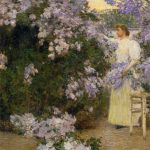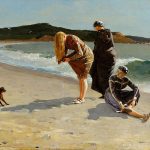
Childe Hassam was born on October 17, 1859, in Dorchester, Massachusetts, a neighborhood of Boston that was then still semi-rural. He came from an old New England family, descended from early colonial settlers. His father, Frederick Fitch Hassam, was a businessman involved in cutlery importing, while his mother, Rosa Delia Hawthorne Hassam, had a deep interest in literature and the arts. This combination of practical trade and refined culture would later mirror Hassam’s own dual commitment to realism and artistic elegance.
The young Hassam was surrounded by the harsh but poetic landscape of New England. The changing seasons, maritime atmosphere, and close-knit Protestant environment made a deep impression on him. He grew up among white-steepled churches, elm-lined roads, and Boston’s mix of industrial growth and Yankee tradition. These scenes would stay with him for life, influencing his lifelong attachment to order, harmony, and American subject matter grounded in his early environment.
Early Artistic Talent and Boston Beginnings
Hassam showed a knack for drawing early in life, but he was not formally trained in his youth. At age 17, he began working as an apprentice to a Boston wood engraver, George Johnson, where he developed strong technical skills and a sense for line and precision. The job taught him discipline and accuracy, both of which remained present even in his later, more fluid Impressionist style. It also gave him access to Boston’s publishing world, where he began illustrating for magazines such as Harper’s Weekly and Scribner’s Monthly.
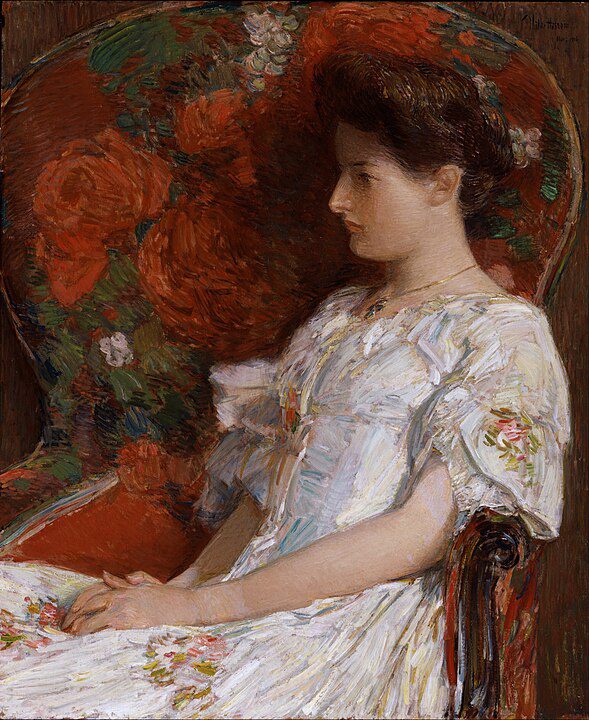
By the early 1880s, Hassam had begun painting seriously, initially in watercolor. His early works captured Boston’s streets, neighborhoods, and countryside in a style rooted in realism but increasingly sensitive to light and atmosphere. Though mostly self-taught, he took a few courses at the Lowell Institute and briefly studied at the Boston Art Club. In 1882, he had his first solo show in Boston, marking the beginning of a professional painting career that would span over five decades and produce more than 3,000 works.
Paris Studies and European Exposure
In 1886, newly married to Kathleen Maude Doan, Hassam left Boston for Paris to refine his art in Europe. He enrolled at the Académie Julian, a private art school that attracted many Americans, where he studied under Jules Joseph Lefebvre and Gustave Boulanger. While his teachers emphasized the traditional academic style, Hassam quickly became more interested in the progressive techniques of the French Impressionists. He spent much of his time in Paris painting outdoors, exploring the city’s boulevards, parks, and cafés with a focus on light, atmosphere, and everyday life.
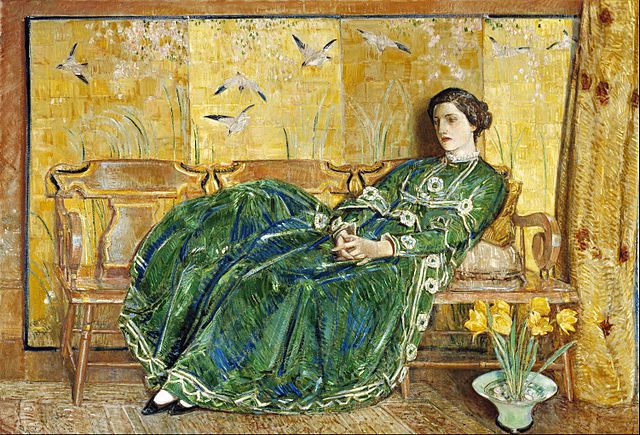
During his three years in France, Hassam produced over 60 oil paintings and countless sketches and watercolors. He admired Monet, Pissarro, and Degas, not just for their color and brushwork, but for their interest in modern life and spontaneous composition. Yet Hassam never fully embraced the looser extremes of French Impressionism. Instead, he absorbed its principles and applied them to American themes in a way that remained structured and distinctly his own. He returned to the United States in 1889 with a personal version of Impressionism ready to be expressed through the lens of American cities and landscapes.
Defining the American Impressionist
Founding Member of “The Ten”
In 1898, Hassam became one of the founding members of “The Ten American Painters,” a group that split from the conservative Society of American Artists. Dissatisfied with the academic juries and conservative tastes that dominated the American art scene, these ten artists wanted to exhibit their work independently. The group included other well-known painters such as J. Alden Weir, William Merritt Chase, and Thomas Wilmer Dewing. Their goal was to champion individuality, experimentation, and aesthetic quality over conformity to rigid standards.
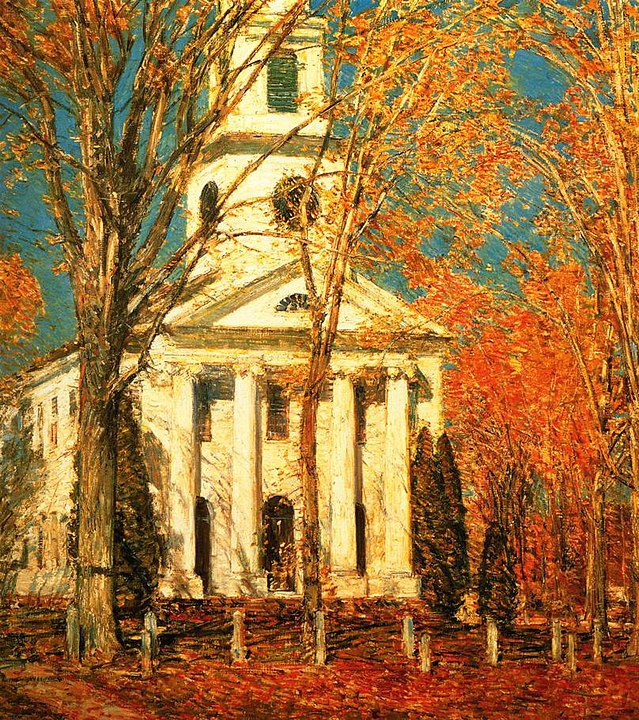
“The Ten” helped shape a distinctly American interpretation of Impressionism. They organized independent exhibitions across major cities, presenting work that combined European techniques with American subjects and ideals. For Hassam, the group provided a platform to showcase his urban views, seascapes, and patriotic compositions without compromise. Though the group eventually dissolved in 1919, its impact on the direction of American art was lasting, with Hassam among its most prominent voices.
Urban Scenes and Patriotic Imagery
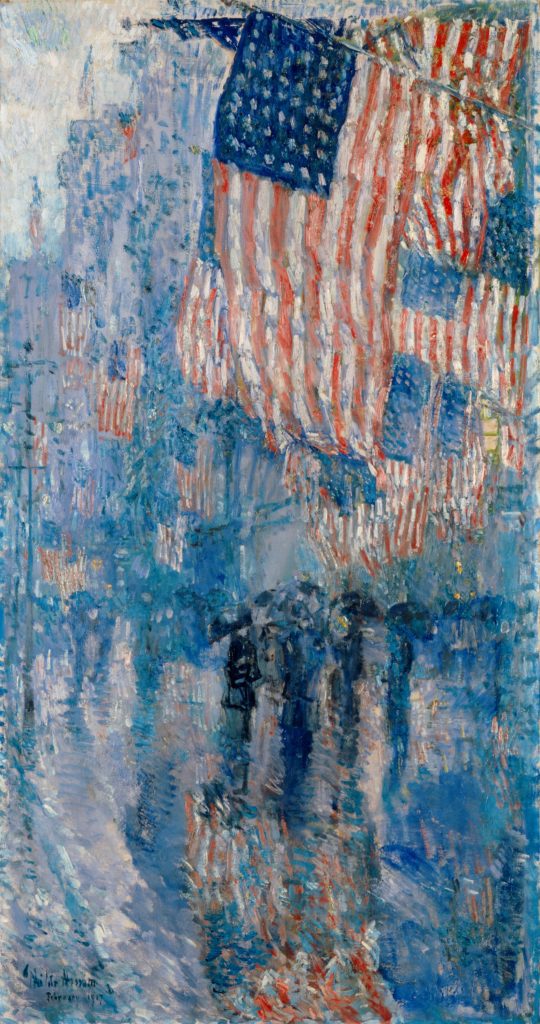
Hassam’s city scenes are some of his best-known works. After returning from Paris, he settled in New York City and began painting modern urban life with a fresh eye. He captured rainy sidewalks, bustling crowds, American flags, and horse-drawn carriages with shimmering brushstrokes and carefully orchestrated compositions. His Fifth Avenue series, in particular, displayed his ability to merge Impressionist technique with patriotic subject matter, especially during World War I.
One of his most iconic paintings, The Avenue in the Rain (1917), shows American flags lining a rain-slicked Fifth Avenue. The work, part of his Flag Series, was both a celebration of national unity and a subtle call to arms during a time of global conflict. These flag paintings were widely praised and remain among his most reproduced works. Today, The Avenue in the Rain hangs in the White House, part of the permanent collection, and has been displayed by multiple presidents as a symbol of American resilience.
Notable Works from This Period:
- The Avenue in the Rain (1917)
- Allies Day, May 1917
- Boston Common at Twilight
- Rainy Day, Fifth Avenue
- Flags on the Waldorf
Isles of Shoals and Coastal Works
While Hassam’s city scenes received much attention, he also had a deep connection to nature and the sea, particularly in the Isles of Shoals off the coast of New Hampshire and Maine. From the mid-1880s onward, he spent many summers on Appledore Island, painting seascapes, wildflowers, and the rocky coastline. These works represent a more meditative side of Hassam, showing his skill in capturing the shifting light and rugged beauty of the Atlantic coast.
His time on Appledore was closely linked to poet Celia Thaxter, whose summer salon attracted artists, writers, and musicians. Hassam formed a strong friendship with her, and she became both muse and hostess to many of his coastal works. One of his standout paintings from this period, Poppies, Isles of Shoals (1891), showcases a vibrant field of flowers swaying under a pale sky, rendered with thick, broken brushstrokes. These coastal paintings offered a counterpoint to his urban work and highlighted the breadth of his Impressionist vocabulary.
Hassam’s Career, Recognition, and Philosophy
Exhibitions and Critical Acclaim
Hassam’s work found a strong audience during his lifetime. He exhibited regularly at major institutions, including the National Academy of Design, the Corcoran Gallery of Art, and the Carnegie Institute. His solo exhibitions in New York, especially those at the Knoedler Gallery, drew serious collectors and prominent patrons. By the 1910s, he had achieved a level of commercial success that allowed him to live comfortably and continue painting without reliance on commissions.
His paintings were acquired by major American museums during his lifetime, including the Metropolitan Museum of Art, the Museum of Fine Arts in Boston, and the Art Institute of Chicago. These acquisitions cemented his reputation as one of the most important American artists of his generation. Though he never received the same level of critical study as John Singer Sargent or Mary Cassatt during the early 20th century, Hassam remained a well-regarded and influential figure in both private and institutional circles.
Artistic Beliefs and Conservative Leanings
Hassam held firm beliefs about the role of art in society. He rejected the rise of modernist abstraction and the chaotic experimentation that came with it. He viewed much of European modernism after 1910 as frivolous and degenerate, favoring instead a disciplined, moral, and aesthetically grounded approach to painting. His views were shaped by his New England upbringing and a deep-seated patriotism that surfaced frequently in his subject matter.
He was a vocal supporter of America’s entry into World War I and used his art to bolster public morale and national pride. His flag series was not just decorative; it was intended to inspire civic virtue and collective purpose. Hassam believed that American artists should express the spirit of their own land, rather than chase foreign avant-garde trends. This conservative philosophy set him apart from younger artists and critics who were increasingly drawn to modernist movements.
Late Career and Continued Output
Even into his 70s, Hassam continued to paint with energy and focus. His later years saw a return to more traditional themes, including landscapes, interiors, and etchings. While he did experiment with lithography and printmaking, he remained loyal to Impressionism in both technique and subject matter. His color palette softened slightly, but the underlying structure of his compositions remained firm and clear.
In 1935, Hassam died at the age of 75 in East Hampton, New York. He had spent the last years of his life painting and exhibiting without interruption. By the time of his death, he had created over 3,000 pieces of art — a massive and diverse body of work. Though tastes in the art world had shifted toward abstraction, his commitment to visual clarity and national identity had already left a deep and permanent mark on American painting.
Legacy, Collections, and Influence
Institutional Collections and Market Value
Today, Childe Hassam’s work is represented in nearly every major American art museum. His paintings are held in the permanent collections of the Metropolitan Museum of Art, the Museum of Fine Arts Boston, the Art Institute of Chicago, the National Gallery of Art, and the White House. The Avenue in the Rain, one of his most well-known patriotic works, has been displayed in the Oval Office under multiple presidents. These institutional holdings have solidified Hassam’s place among the great American artists of the late 19th and early 20th centuries.
His work remains highly sought after in the art market as well. Several of his paintings have sold for millions of dollars at auction, reflecting both artistic merit and strong collector interest. In 2004, Coast Scene, Isles of Shoals sold at Sotheby’s for over $3 million. The continued value of his work lies in his unique ability to blend beauty with a clear national identity — something few artists have accomplished with such consistency. Museum acquisitions, academic reappraisals, and private collectors have all played a role in preserving and elevating Hassam’s legacy.
Influence on American Landscape and Urban Painters
Hassam’s approach to American Impressionism influenced a generation of painters who sought to express their surroundings in a fresh and personal way. Artists such as Edward Redfield, Ernest Lawson, and Willard Metcalf absorbed Hassam’s treatment of light and atmosphere while adapting it to their own regional scenes. His work helped pave the way for American artists to see their cities, coastlines, and countrysides as worthy subjects of beauty and significance.
Unlike the more European-leaning artists of his era, Hassam focused on specifically American scenes — New York’s bustling avenues, Boston’s public gardens, and New Hampshire’s rocky coasts. He avoided exoticism and mythology, choosing instead to elevate everyday life. His style, while rooted in French Impressionism, maintained a clarity and structure that made it more palatable to American audiences. Through both his urban and rural works, he built a bridge between European technique and American content, shaping a national style that was uniquely his own.
Reappraisal in Modern Art History
In recent decades, Childe Hassam’s work has received renewed scholarly attention. While he was often seen during the mid-20th century as a lesser figure compared to Cassatt or Sargent, modern art historians have come to appreciate his role in shaping a distinctly American version of Impressionism. His WWI flag series, in particular, is now seen as one of the most visually compelling and historically important responses to wartime patriotism in American art.
Hassam’s work is also appreciated for its balance between realism and abstraction — between the observed world and the shimmering techniques of Impressionism. Scholars continue to analyze how his compositions use color and structure to convey national identity, restraint, and a deep love of place. While debates persist over where he ranks in the hierarchy of American painters, his influence is now viewed as both foundational and enduring. He was not simply an imitator of the French; he was a builder of something new, American, and lasting.
Key Takeaways
- Childe Hassam was a leading figure in the development of American Impressionism, combining French technique with American themes.
- His urban and coastal scenes are celebrated for their clarity, color, and strong national character.
- Hassam played a major role in “The Ten,” a group of American painters who sought independence from academic restrictions.
- His WWI-era flag paintings remain iconic symbols of American patriotism and unity.
- Museums, scholars, and collectors continue to affirm his legacy through exhibitions and high-profile acquisitions.
Frequently Asked Questions
Where was Childe Hassam born?
He was born in Dorchester, Massachusetts, on October 17, 1859.
What is Childe Hassam best known for?
He is best known for his American Impressionist paintings, especially his Fifth Avenue flag series during World War I.
Did Childe Hassam study in Europe?
Yes, he studied at the Académie Julian in Paris from 1886 to 1889, where he was influenced by the French Impressionists.
Is Childe Hassam’s work in major museums?
Yes, his works are held in the Metropolitan Museum of Art, MFA Boston, Art Institute of Chicago, and many others.
What style of painting did Hassam use?
He practiced American Impressionism, which adapted French Impressionist techniques to American subjects and values.