Long before Wyoming bore its name—before the railroads, before the trappers, before even the treaties—its canyons, cliffs, and sandstone outcroppings bore witness to a form of image-making that carried both sacred function and aesthetic force. These markings, known today as petroglyphs (carvings) and pictographs (painted images), appear throughout the state but are especially dense in the Wind River Basin, the Bighorn Basin, and the Red Desert. Dating the oldest of them remains difficult, though archaeologists estimate some may be over 1,000 years old, while others are as recent as the 19th century.
Among the most studied sites is Legend Rock, near Thermopolis, which contains more than 300 individual petroglyph figures across a 1,000-foot cliff face. The designs range from recognizable animals and human forms to abstract patterns and enigmatic anthropomorphic figures with exaggerated hands, feet, or internal body lines. Many of these belong to what scholars term the Dinwoody tradition, a style characterized by finely pecked, often spiritually charged forms that suggest interiority, transformation, or otherworldly states.
These aren’t decorative flourishes, nor were they idle musings. They were—and in many cases still are—part of a symbolic system tied to vision quests, ceremonial sites, and oral histories. The repetition of particular forms across wide regions, often near water sources or migration routes, indicates that the rock surfaces served not only as mnemonic anchors but also as meeting grounds for overlapping peoples—Shoshone, Crow, and earlier, now-lost cultures. The figures were not intended to be seen by all; many were embedded in high or difficult-to-access places, suggesting selectivity in audience and ritual exclusivity in creation.
Three especially striking motifs recur throughout the Wind River petroglyphs:
- Shield-bearing warriors: circular-bodied figures holding geometric “shields,” interpreted as status emblems, clan signs, or spiritual talismans.
- Patterned anthropomorphs: human-like figures with internal decoration, potentially indicating trance visions or mythic beings.
- Bighorn sheep and elk: not just fauna but also spiritual mediators, appearing in hunting rituals and dream imagery.
ancestors of the Crow people sometime between 1200 and 1700 AD. With its central cairn and radial stone spokes, the wheel tracks solstices and alignments with key stars, functioning both as an astronomical instrument and a spiritual site.
This interweaving of land, ritual, and visual order suggests a different conception of “art” from modern understandings. What survives on the rock face or across the archaeological efforts in the early 20th century often treated these works as artifacts to be catalogued or photographed, more recent scholarship—especially in collaboration with tribal elders—has emphasized their continuing cultural importance. Access to some sites is restricted today not for reasons of preservation alone, but out of respect for the spiritual frameworks in which they still operate.
Indigenous Mark-making and Memory Across Centuries
As new technologies and materials entered the region—metal tools, horses, firearms—the visual traditions of Wyoming’s Native peoples also shifted. But the urge to encode memory and meaning through mark-making endured. By the mid-19th century, ledger art began to flourish among Plains peoples, including the Cheyenne, Lakota, Arapaho, and Shoshone. Created on reused pages of account books, often sourced from U.S. Army forts or trading posts, these drawings adapted earlier pictographic traditions to portable media, chronicling battles, ceremonies, and personal exploits in a stylized, linear form.
Wyoming was a key site in this transition. Fort Washakie, established in 1869 within the Wind River Reservation, became not only a military outpost but also a cultural point of tension and exchange. Soldiers, missionaries, and anthropologists began collecting Native drawings as curiosities or “ethnographic evidence,” while the artists themselves—often men who had earned prestige as warriors—used the medium to assert identity in a world of encroaching confinement.
One remarkable example is the work of Bear’s Heart, a Cheyenne artist who, though imprisoned in Florida in the 1870s, produced ledger drawings reflecting battles in Wyoming and the Dakotas. His figures are elegant yet restrained, balancing abstraction and realism in a style that has become iconic in Native American art history. While he never returned to Wyoming, his work preserves a vision of it—alive with movement, conflict, and symbolic density.
The shift from rock to paper, from pecked sandstone to colored pencil, marked a transformation, not an ending. Across centuries, the aesthetic traditions of Indigenous Wyoming reveal a continuity of presence through adaptation, a visual persistence under pressure. These images—etched into cliffs or penciled onto ledgers—are not just records of what was seen but assertions of how to see.
And they remain, in quiet cliffs and dusty archives, as the first visual chapter in Wyoming’s art history—still resonant, still watching.
Fur, Trade, and Drawing the Frontier: Early Images by Explorers and Trappers
A century before Wyoming entered the Union, it had already been pictured, imagined, and mythologized by outsiders whose sketches, paintings, and visual records turned the land into a stage for profit, empire, and spectacle.
Alfred Jacob Miller and the Aesthetics of Encounter
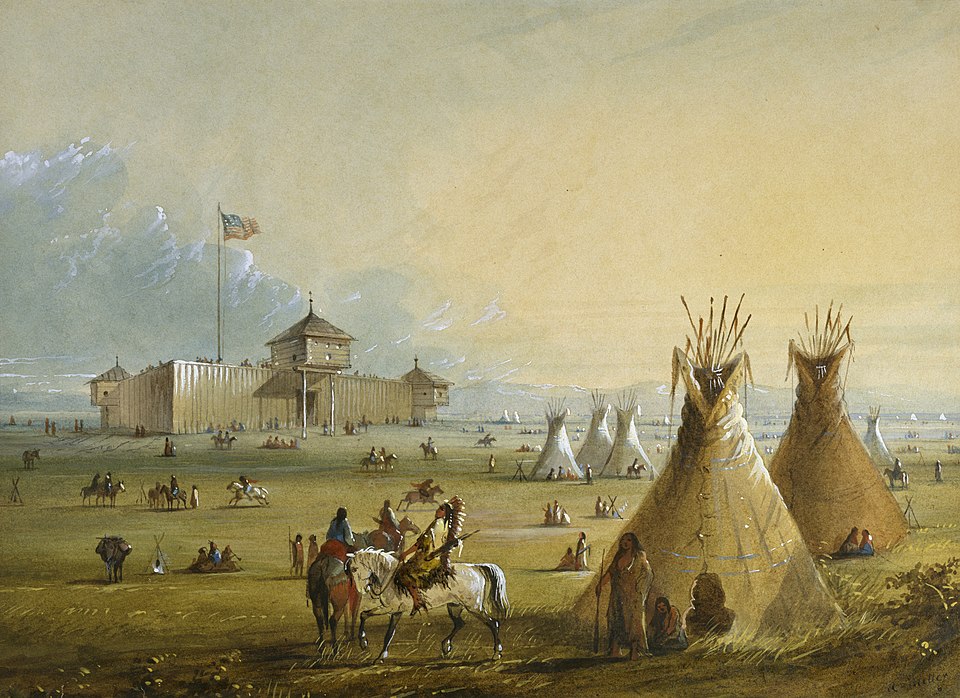
One of the earliest and most prolific visual chroniclers of Wyoming was Alfred Jacob Miller, a Baltimore-born painter who joined a fur-trading expedition to the Rocky Mountains in 1837. Invited by the Scottish aristocrat William Drummond Stewart, Miller traveled with a caravan organized by the American Fur Company, journeying along the Platte River and deep into what is now western Wyoming.
What Miller produced from this expedition would shape the visual imagination of the American West for decades. His sketches, later transformed into large studio paintings, depict dramatic mountain passes, hunting scenes, and so-called “rendezvous” camps—temporary trading villages where trappers, Native tribes, and merchants exchanged goods and stories. These annual rendezvous, often held near the Green River or Wind River Range, became mythic in both economic and cultural memory, and Miller’s images helped solidify that myth.
His style blended Romanticism with ethnographic detail. In paintings such as Rendezvous—Green River Valley, he composed scenes with sweeping horizons and staged interactions between Native figures and white trappers, creating a visual harmony that elided the deep frictions and exploitations embedded in the fur trade. What appears idyllic on canvas was, in reality, a convergence of desperation, risk, and commercial ambition. Beavers, whose pelts underwrote much of the early regional economy, were being trapped to ecological collapse. Native nations were being drawn into volatile systems of dependence and resistance.
Yet Miller’s art rarely hinted at this instability. His Native subjects are often depicted with dignity but stripped of agency—costumed participants in a Euro-American drama of exploration and masculinity. Still, his work remains invaluable, both as aesthetic record and historical artifact, revealing how eastern audiences first came to visualize the land and its inhabitants.
Sketchbooks on the Move: Mobility as Medium
Miller was not alone. From the 1820s through the 1850s, a wide range of itinerant artists, surveyors, and military draftsmen moved through Wyoming’s mountains and plains, carrying sketchbooks instead of rifles. Their goal was not only to document the landscape, but to make it legible to institutions of power—fur companies, governments, investors, and mapmakers.
One significant example is Rufus B. Sage, a journalist and adventurer who traveled through the region in the early 1840s. Though better known for his written narratives, his expedition included illustrative renderings of topography and settlement, meant to orient future travelers. Similarly, John C. Frémont’s mapping expeditions—often accompanied by artists like Charles Preuss—produced some of the earliest detailed images of Wyoming’s mountain corridors and river valleys, combining artistic intuition with proto-scientific precision.
These images had a dual purpose:
- Navigation: helping others find passable routes through the Rockies, especially as overland migration accelerated.
- Claim-making: transforming wild terrain into gridded space, ripe for control and resource extraction.
For these artists, mobility wasn’t just a circumstance—it was a defining feature of their method. Sketches were made rapidly, often under duress, with minimal tools. The results carry the marks of haste: unshaded pencil lines, rough outlines, sometimes overwritten with notations like “snow line here” or “elk herds observed.” But what they lack in polish, they gain in immediacy. These were working documents, intended for future development in map rooms or artist studios back east.
One such sketch, housed today at the Beinecke Rare Book Library, shows a fragmentary drawing of the South Pass, the wide corridor through the Continental Divide in central Wyoming. Barely detailed, it nonetheless captures the vastness and significance of the gap—through which thousands of emigrants, missionaries, and military detachments would soon pass on their way west.
The sketchbook, then, was not just a container of images. It was a mobile tool of imperial foresight—a site where the imagined and the actual merged into strategic visibility.
Romanticism, Commerce, and the Myth of the Mountain Man
If the early fur trade artists documented a world of rugged exchange and fleeting camps, they also helped manufacture one of the most enduring visual archetypes of the American West: the mountain man. Clad in buckskin, rifle in hand, solitary and morally ambiguous, this figure emerged from a mixture of lived experience and artistic invention.
While based in reality—men like Jim Bridger, Jedediah Smith, and Kit Carson traversed what became Wyoming in brutal, often violent conditions—the image that took hold in art was far more stylized. In postbellum paintings and popular illustrations, the mountain man became a romantic emblem of freedom, self-reliance, and primal masculinity. He stood apart from both settler society and Native culture, framed as a liminal go-between, somehow above politics yet fully complicit in the extractive economy of the fur trade.
Artists such as William Ranney and George Catlin contributed to this mythology, though Catlin, in particular, complicated the genre by portraying Native life with documentary ambition. Still, the dominant strain was theatrical. In one illustration published in Harper’s Weekly in the 1870s, a bearded trapper stands atop a cliff—muscles taut, gaze fixed on the valley below—while a bear skin flutters dramatically at his feet. This was Wyoming reimagined as epic stagecraft.
The mountain man image was further canonized by later sculptors and painters working well after the era had passed. But the seeds were sown early, in the sketchbooks and canvases of those who encountered the Wyoming Territory not as home, but as theater.
Three ingredients shaped this early visual myth:
- Isolation: figures placed alone or with a single companion, framed against massive natural backdrops.
- Weaponry and gear: emphasized as both survival tools and masculine ornaments.
- Dramatic lighting: borrowed from European Romanticism to heighten drama and moral ambiguity.
Yet behind the myth stood a more complex visual record—drawings of trading posts, crude depictions of Native encampments, and tired men clustered around fires, boots off, coats patched. These quieter images, often buried in archives, speak to another reality of frontier art: one not of heroism, but of fatigue, improvisation, and cultural entanglement.
Miller’s romantic rendezvous scenes, the map-sketches of army draftsmen, and the evolving icon of the lone trapper all contributed to the first formal visualizations of Wyoming. Long before its borders were drawn, its image was already taking shape—in eastern salons, newspaper engravings, and government reports—as a land of sublime danger and lucrative promise.
That image would persist. But soon, it would be reframed—literally and politically—by artists tied to empire and expansion, hired to render Wyoming’s wildness not merely as myth but as destiny.
Territorial Visions: Surveyors, Soldiers, and the Invention of the Sublime
In the decades between exploration and statehood, Wyoming became a canvas for competing visions—scientific, imperial, and aesthetic. Artists embedded in military and geological surveys helped redefine the landscape not merely as wilderness, but as a spectacular asset of national significance.
Railroad Surveys and the Politics of Landscape
The transformation of Wyoming from remote terrain into visual property accelerated dramatically with the westward expansion of railroads. In the 1850s and especially after the Civil War, government-backed survey expeditions swept through the region, tasked with mapping routes, cataloguing resources, and assessing military feasibility. Art played a central role in these missions—not for sentiment, but for persuasion.
Among the most consequential of these expeditions was the Union Pacific Railroad Survey, part of the broader Pacific Railroad Surveys initiated in the 1850s and revitalized in the 1860s. Surveyors such as Captain Howard Stansbury and later Ferdinand V. Hayden brought with them not only engineers and geologists but also artists—trained professionals whose job was to make the West legible and alluring.
These artists, including Henry W. Elliott and William Henry Holmes, created topographic drawings, watercolors, and lithographs designed to impress Congress, investors, and the American public. Their landscapes were not neutral. They emphasized vastness, mineral richness, and accessibility. Wyoming’s plains were rendered as smooth corridors for rail lines; its mountains appeared as noble barriers to be mastered. The pictorial frame aligned with the economic frame: this was land to be known, valued, and ultimately taken.
The 1869 Hayden Geological Survey, which passed through parts of southern and western Wyoming, marked a turning point. Sponsored by the Department of the Interior and supported by the military, it included the now-famous painter Thomas Moran and the photographer William Henry Jackson. Together, they would reimagine the land not just as property, but as sublime spectacle—national inheritance disguised as natural wonder.
Three elements dominated the visual rhetoric of these surveys:
- Elevation and distance: scenes composed from high vantage points, showcasing vertical drops and endless horizons.
- Scale contrasts: tiny human figures or survey camps dwarfed by geological formations, emphasizing grandeur and awe.
- Atmospheric drama: swirling clouds, twilight tones, and golden illumination, echoing European Romanticism but applied to American terrain.
These images traveled east swiftly—reproduced in engravings, exhibited in salons, and circulated in political documents. Their function was not decorative. They were instruments of federal ambition.
Thomas Moran’s Yellowstone and the Birth of National Parks
No single artist did more to shape the aesthetic legacy of Wyoming in the 19th century than Thomas Moran, whose 1871 expedition with the Hayden Survey culminated in a series of paintings that transformed public perception of the region. Moran, trained in the Hudson River School tradition and steeped in European Romanticism, brought a theatrical sensibility to Wyoming’s geothermal chaos.
His masterpiece, The Grand Canyon of the Yellowstone (1872), was based on sketches made in the field, reworked in his studio into a vast, light-soaked canvas nearly seven feet across. The image is hallucinatory in its intensity—steam plumes rise from sulphur pools, golden cliffs plunge into mist, and a thin river curls at the bottom like a silver thread. It was less a record than an invocation. Viewers gasped when it was exhibited in Washington, DC. Congress, swayed in part by these visuals, designated Yellowstone as the first national park in 1872—an unprecedented act of preservation framed by artistic vision.
Moran’s partnership with Jackson, whose photographs provided a parallel (and sometimes more grounded) documentary record, made the duo instrumental in the federal myth-making project. Jackson’s images, while technically precise, also trafficked in scale and drama. His glass-plate photograph of the Castle Geyser, shot against a low horizon with rising steam backlit by late sun, resembles a vision from another world. Together, the painter and the photographer created a composite image of Wyoming as both laboratory and cathedral.
Moran’s influence extended beyond Yellowstone. In later trips, he painted the Tetons, the Wind River Range, and the Green River Cliffs, each time with an eye toward elevating the terrain to national symbol. His work anchored Wyoming in the American imagination not as a corridor to somewhere else, but as a destination in itself—remote, extreme, and spiritually potent.
Sublimity, Science, and Strategic Representation
What the survey artists achieved was not just beauty. It was control. Through images, they performed an act of visual conquest, turning unbounded landscapes into charted, named, and aestheticized zones of interest. The sublime—a European concept rooted in awe, terror, and divine immensity—was repurposed into a tool of empire.
Wyoming, with its geysers, buttes, and snow-capped peaks, proved especially fertile for this technique. In a single watercolor, a ridge could appear both threatening and beckoning, untamable yet destined to be claimed. These contradictions were useful. They permitted Americans to imagine the West as both wild and already theirs.
Yet this process was not without tension. The surveys often moved through lands still inhabited or claimed by Native peoples, whose own spatial understandings were erased or displaced by the new visual order. Rock art was ignored, treaty lines were redrawn, and sacred mountains were reduced to geological cross-sections. The survey images, however majestic, were complicit in these erasures.
Still, their legacy is hard to overstate. Wyoming’s modern identity—as a place of natural wonder, protected wilderness, and rugged scenic value—owes much to the 19th-century project of territorial visualization. The national park system, tourism industry, and even the state’s license plates trace their origins to this moment of representational invention.
In Moran’s glowing cliffs and Jackson’s spectral geysers, the land became more than itself. It became emblem, resource, and spectacle—an aesthetic frontier curated for the eye and claimed for the nation.
Native Continuities and Cultural Resistance: Art Under Pressure
Against the expanding visual empire of surveyors and romantic painters, a quieter, more resilient current of image-making endured across Wyoming: the adaptive, often covert visual practices of Native peoples navigating loss, confinement, and the transformation of their homelands.
Ledger Art and the Shift from Hide to Paper
By the 1870s, the Indigenous nations of Wyoming—particularly the Eastern Shoshone and Northern Arapaho, but also the Cheyenne and Lakota—faced devastating upheaval. Their territories were steadily absorbed into reservation systems, their economies disrupted, and their ceremonial lifeways targeted for suppression. Yet in this environment of control, new forms of visual expression emerged—especially the tradition known as ledger art.
This term refers to a style of drawing that developed from earlier pictographic traditions once rendered on animal hides. When access to hides declined—due to overhunting, enforced settlement, and economic collapse—artists turned to new surfaces: pages of discarded ledger books, accounting paper, and military records, often acquired at trading posts or through military intermediaries. The transition was practical, but also symbolic. What had once been private or ceremonial art now became portable, often traded or gifted, and increasingly visible to outsiders.
Ledger drawings typically featured scenes of war exploits, horse raids, dances, and acts of personal bravery. But they were more than chronicles of conflict. They were acts of visual memory, preserving autonomy in the face of bureaucratic erasure. Figures were stylized but legible: horses in motion, warriors with flowing feather headdresses, geometric tipis in the background. Motion was implied through diagonal lines and overlapping limbs; color—often made from commercial pencils or inks—was applied in bold, assertive planes.
Artists like Howling Wolf (Southern Cheyenne) and Bear’s Heart (Cheyenne), though not from Wyoming specifically, produced works during periods of imprisonment that depicted events in the Powder River Basin and near Fort Washakie. Their drawings offer crucial insights into Native experiences of war, exile, and adaptation—crafted with extraordinary clarity despite being made under duress.
The ledger style became a mobile form of resistance. In its portability, it defied spatial confinement; in its content, it defied narrative control. At a time when federal policy sought to erase Indigenous sovereignty through boarding schools, allotment, and forced labor, these drawings reasserted identity with vivid, uncompromising presence.
Three typical subjects in Wyoming-associated ledger art demonstrate its expressive range:
- Horse raiding scenes: valorized both for their martial skill and their symbolism of mobility and independence.
- Ceremonial gatherings: dances, drumming, and kinship events rendered in communal layouts, preserving ritual memory.
- Encounters with soldiers: sometimes combative, sometimes observational, showing blue-coated figures with rifles or flags.
In many cases, the paper’s original use—ledgers, receipts, forms—remains visible beneath the drawings, creating an accidental palimpsest of colonial administration and Native assertion. What the bureaucrats tried to control with ink and number, the artists reclaimed with color and form.
Art as Archive in Times of Displacement
Beyond ledger art, other forms of Native visual culture persisted across Wyoming in modified or disguised forms. Beadwork, for instance—once used to adorn robes and ceremonial objects—shifted onto commercially available textiles and clothing. Eastern Shoshone bead artists developed distinctive floral and geometric styles, often integrating Catholic or Christian motifs as camouflage against religious suppression. Arapaho artisans continued to produce intricately decorated bags, cradleboards, and ceremonial staffs, even as federal agents discouraged or banned their use.
The reservation era also saw the rise of painting as archive—works that recorded tribal histories, migration narratives, and cosmological maps in newly permitted media. In the 20th century, artists such as Carl Sweezy (Arapaho) adapted earlier visual motifs into narrative painting, using watercolor and ink to tell stories that federal histories ignored.
At Fort Washakie and on the Wind River Reservation, informal art schools emerged in church basements and community centers. Though often led by missionaries or white teachers, these spaces became venues for innovation. Native artists absorbed new materials—tempera, oil pastel, commercial brushes—while maintaining distinct subject matter rooted in cultural continuity. The result was a hybrid aesthetic: neither fully traditional nor assimilated, but reflective of a people adapting under constraint.
Even ceremonial art forms, like the painting of drums or the construction of dance regalia, took on new dimensions during periods of enforced invisibility. In the early 20th century, Ghost Dance imagery, banned by the U.S. government, survived in hidden motifs—circles, stars, handprints—woven into otherwise permissible art forms. The visual field became a zone of coded persistence.
Three recurring materials in reservation-era art highlight this improvisation:
- Flour sacks: repurposed as canvases for painting or beadwork, often bleached and softened for reuse.
- Tin and metal scraps: hammered into ornaments, jewelry, or tools with engraved designs.
- Salvaged paper: from Bibles, newspapers, or army documents, serving as drawing surfaces or collage material.
In this context, art was not only expression—it was protection, strategy, and remembrance. Each design held layers of encoded meaning, legible to those who knew, invisible to those who didn’t.
The Shoshone, Arapaho, and the Visual Language of Survival
By the early 20th century, the Native art of Wyoming had entered a third phase—not pre-contact, not early resistance, but survival under long-term occupation. Within the Wind River Reservation, established in 1868 and shared by the Eastern Shoshone and Northern Arapaho, art became a vessel for transmitting cultural knowledge amid institutional suppression.
Artistic mentorship often passed through families: grandmothers teaching granddaughters bead techniques; fathers demonstrating painting styles or carving methods. While federal education policies discouraged Native languages and ceremonial practice, visual art remained a space where cultural identity could persist—sometimes quietly, sometimes defiantly.
One compelling micro-narrative comes from a bead artist named Minnie White, Eastern Shoshone, who in the 1930s began crafting elaborate dance aprons and moccasins not for trade but for community use. Her designs—dense fields of color interlaced with crosses, buffalo tracks, and crescent moons—spoke not just to beauty but to cosmology. When asked why she included certain motifs, she is said to have replied: “Because they come from my dreams.”
Dreams, visions, and ancestral communication remained vital parts of artistic practice. Art was not merely skill, but connection—a way to navigate the trauma of dislocation through memory and imagination. In many cases, art outlasted language. Designs survived long after stories were forgotten. A bead pattern preserved a song. A drawing revived a ceremony.
Meanwhile, outsiders continued to collect and classify these works, often stripping them from their original contexts. Museums in Denver, Chicago, and Washington acquired Wyoming Native art with little regard for its ceremonial or communal meaning. Catalogued as “ethnographic” or “primitive,” it was divorced from the living cultures that produced it.
Yet the art itself resisted such flattening. In its precision, elegance, and layered content, it continued to tell stories—of survival, refusal, and self-determination. Wyoming’s visual history is incomplete without this parallel canon: not seen in grand galleries, but kept in family trunks, worn at powwows, and drawn in secret when such acts were forbidden.
Under pressure, the art of the Shoshone, Arapaho, and other Indigenous peoples did not vanish. It transformed. It adapted. And it endured—quietly defiant, vividly present, written not only on paper, but into the body of the land itself.
Ranch Aesthetics: Cowboy Artists, Rodeo Posters, and the Rise of a Western Genre
As Wyoming transitioned from a site of territorial conquest to a settled state, its visual culture shifted as well—from the sublime to the familiar, from the ceremonial to the commercial. The cowboy emerged not only as a labor figure but as an icon, and with him came an entire visual language that redefined how Wyoming was seen, sold, and remembered.
Charles Belden’s Photography of the Pitchfork Ranch
In the early 20th century, one of the most enduring visual records of Wyoming ranch life was created not with a paintbrush but with a camera. Charles J. Belden, heir to a wealthy San Francisco family, settled at the Pitchfork Ranch near Meeteetse in the 1910s and began photographing daily life on the range. His black-and-white images—now held in archives such as the American Heritage Center—are among the most iconic depictions of Wyoming’s working landscape.
Belden’s photographs struck a careful balance between documentation and mythmaking. On one hand, they captured ranch hands mid-task: herding cattle, repairing fences, branding steers. On the other, they framed these scenes with an almost cinematic eye. Snowstorms blurred the edges of riders. High-angle shots dwarfed men against rolling sagebrush. Horses kicked up clouds of dust that doubled as atmospheric texture.
His subjects were often unposed, but his compositions were meticulous. A photograph of a cowboy leading a packhorse over a ridge is as much about negative space as it is about realism. Belden used the sky as a narrative element—vast, weightless, framing the solitary figure below.
Belden’s work was distributed widely through national magazines like National Geographic and The Saturday Evening Post, shaping how distant audiences imagined the American West. His photos transformed Wyoming from frontier to lifestyle, offering a vision of rugged independence, masculine virtue, and natural order—idealized, but grounded in daily labor.
Three visual motifs recur across Belden’s body of work:
- Silhouetted riders: figures on horseback positioned against sunset or snow, heightening drama and isolation.
- Working hands: close views of calloused fingers tying rope, repairing tack, or gripping saddles.
- Animal intimacy: calves in winter coats, dogs resting in barns, horses mid-gallop—emphasizing partnership over domination.
Belden’s ranch imagery became emblematic of a new genre: one that blended realism with reverence, offering both ethnographic record and poetic ideal. His eye transformed the ranch from a site of toil into a source of aesthetic identity.
The Emergence of Western Illustration and Branding
Parallel to documentary photography, a different kind of cowboy image emerged—louder, bolder, and unabashedly commercial. This was the realm of Western illustration, a genre that exploded in popularity through dime novels, advertising, and eventually, mass-produced rodeo posters.
In Wyoming, especially around Cheyenne, this new visual culture found fertile ground. The Cheyenne Frontier Days, first held in 1897, quickly became the largest rodeo in the world, and with it came the need for publicity—bold, eye-catching posters that could draw crowds from across the state and beyond.
Early posters were hand-drawn, often by local artists or lithographers commissioned by print houses in Denver or Chicago. The imagery was formulaic but effective: bronc riders mid-buck, bulls charging across dust clouds, cowgirls with rifles and ribboned hats. Color was used for impact—deep reds, electric blues, and stark yellows—and perspective was often exaggerated for theatrical effect.
By the 1920s, rodeo posters had become their own subgenre of Americana, blending Art Deco influences with folk motifs. Wyoming’s events, especially those in Casper, Laramie, and Douglas, developed their own aesthetic signatures. In many cases, the posters featured local champions or animals by name—“Smoky Joe,” “Wild Nell,” “Tex Irwin”—turning regional performers into visual folklore.
These posters weren’t just advertisements. They helped consolidate the cowboy as a cultural archetype, shifting from local laborer to national icon. The visual vocabulary—lariat arcs, rearing horses, desert backdrops—became shorthand for “authentic” Western identity.
One especially influential figure in this development was Will James, a cowboy-turned-artist whose ink drawings and watercolors, published in bestsellers like Smoky the Cowhorse (1926), shaped generations of Western illustrators. Though James was more closely associated with Montana, his depictions of Wyoming landscapes and characters helped cement the myth of the honest, stoic cowboy—often alone, sometimes wounded, always principled.
By the mid-20th century, Wyoming’s Western aesthetic had become formulaic but powerful. Even as the real labor of ranching grew more mechanized and less romantic, the image endured, stylized and commodified. The cowboy now lived in posters, belt buckles, and cigarette ads—an aesthetic currency exported far beyond the state lines.
Romanticization vs. Real Labor in Cowboy Art
The central paradox of cowboy art in Wyoming is that it often elevates a form of work that, in its lived experience, is harsh, repetitive, and economically precarious. While artists and photographers turned cowboys into symbols of freedom and grit, real cowboys—many of them Indigenous, Mexican-American, or itinerant—worked long hours for low pay, with little public recognition.
In traditional cowboy art, these complexities are often glossed over. Paintings by later artists such as James Bama, who moved to Cody in the 1960s, carry forward the visual tropes of the genre with hyperreal precision: creased hats, dust-choked boots, sun-creased brows. Bama’s portraits are undeniably skillful, but they continue the mythic framing—where even poverty becomes picturesque.
Yet some Wyoming-based artists have pushed against this grain. In the 1980s and ’90s, Terry Gardner, a lesser-known Laramie painter, began depicting ranch life in winter: busted fences, cattle skulls, empty trailers. His muted palette and sparse compositions challenged the rodeo-hero narrative, suggesting a different kind of Western story—one of fatigue, survival, and solitude. These works never circulated as widely as the golden-lit bronc riders, but they tell another truth.
Likewise, recent Native artists from Wyoming have reentered the cowboy genre with subversive intent. One Northern Arapaho painter, Robert Martinez, often depicts contemporary Native cowboys in high-contrast compositions—some armed with cellphones, others with tribal flags in rodeo arenas. His works reclaim the cowboy image from a long history of erasure, inserting Native presence back into a landscape it never left.
The cowboy remains the most visible figure in Wyoming’s visual culture—but also its most contested. Beneath the posters and portraits lies a deeper reality: a working tradition built on endurance, shaped by landscape, and increasingly aware of its own image.
The aesthetic of the ranch is no longer just a byproduct of lifestyle; it is a language of its own—flexible, stylized, commercialized, but still tethered, however loosely, to the dust and sweat of the land.
Women, Craft, and Domestic Modernism on the High Plains
While cowboy imagery and wilderness paintings dominated the public face of Wyoming’s art, a quieter revolution unfolded in kitchens, barns, and backrooms: women shaping the state’s visual culture through craft, experimentation, and modernist forms born not in the metropolis, but in isolation.
Quilting, Beading, and the Aesthetics of Use
Throughout the late 19th and early 20th centuries, women across Wyoming—homesteaders, ranch wives, Native artisans, missionaries, and boarding school teachers—developed intricate forms of craft that served both function and expression. Quilting, in particular, emerged as a vital medium, bridging aesthetic experimentation with the material demands of frontier life.
Unlike the masculine heroism depicted in rodeo posters or landscape paintings, these works grew from necessity. Quilts had to keep a child warm during a blizzard, to cover cracked plaster walls, or to soften the hard edges of a drafty sod house. Yet within those constraints, creativity flourished. Patterns varied from inherited East Coast designs to improvised geometries that responded to the fabric at hand—tobacco sacks, worn dresses, or surplus cloth from army depots.
In rural Wyoming, quilting bees were often among the few communal artistic gatherings available to women. These events, while practical, allowed for visual exchange and aesthetic commentary. Designs like the Lone Star, Log Cabin, and Bear Paw carried regional significance. Color choices, border treatments, and stitching motifs became coded ways to express taste, status, even local identity. Some women signed their work in thread; others embedded stories in color progressions or symbolic placement.
Beadwork followed a similar arc. Among the Eastern Shoshone and Northern Arapaho, women maintained traditional patterns while experimenting with new materials—glass seed beads from Europe, velvet from discarded coats, synthetic threads. Floral motifs remained popular, but by the 1930s, some artists began integrating pictorial scenes and stylized wildlife, reflecting a subtle convergence with Western art forms.
Three forms of domestic art sustained across generations of Wyoming women:
- Crazy quilts: abstract, often unplanned compositions made from irregular scraps, incorporating embroidery and found objects.
- Painted flour-sack curtains: functional textiles transformed with hand-painted designs, often floral or geometric, used in isolated ranch houses.
- Cradleboards and dance regalia: constructed by Native women using a blend of traditional and adapted materials, reflecting both heritage and survival.
These works were rarely exhibited and even more rarely preserved. Many have been lost to time, decay, or disinterest. But they constituted a shadow archive—works of aesthetic clarity shaped by wind, cold, silence, and endurance. Their legacy has begun to resurface only recently, through textile history research and tribal art initiatives.
Mabel Dodge Luhan’s Circle and Peripheral Modernisms
While domestic crafts shaped one stratum of Wyoming’s visual history, another—more overtly avant-garde—briefly brushed against the state in the early 20th century through the influence of Mabel Dodge Luhan, a patron and writer associated with the modernist movement in the Southwest.
Though Luhan is best known for her salon in Taos, New Mexico, her circle included figures who traveled extensively through the American West, including parts of Wyoming. Artists like Marsden Hartley, John Marin, and Georgia O’Keeffe explored western landscapes not merely as subjects, but as conceptual material—testing abstraction, silence, and scale in response to the American interior.
O’Keeffe’s visits to Wyoming—particularly the Tetons in the 1940s—yielded a handful of hauntingly sparse works: bone-white peaks rendered against flat skies, horizon lines stripped of narrative or human presence. Though she never stayed long, her aesthetic mapped something vital about Wyoming’s emotional topography: its sense of vast containment, of interior vastness unbroken by civilization.
What connected these artists wasn’t just geography—it was an orientation toward peripheral modernism, a sensibility that sought clarity and shape in non-urban spaces. Their interest in “the West” was not folkloric but formal. In the silence of plains and plateaus, they found alternatives to the frenetic visual overload of industrial cities.
Wyoming, with its emptiness, became a foil. A place to strip down, pare back, and listen. The women who created in this mode—whether guests like O’Keeffe or locals whose names went unrecorded—offered a modernism rooted not in manifestos, but in endurance.
A particularly powerful micro-narrative involves Olive Fell, a Cody-born artist active in the 1930s–50s, who blended modernist linework with Western subjects. Her stylized animal prints, sold to tourists in Yellowstone gift shops, veered between illustration and abstraction. Though dismissed by some as kitsch, her work quietly married Art Deco aesthetics with regional wildlife—bears, moose, coyotes—offering a sly challenge to the hierarchy of “serious” art.
Fell’s studio, carved into the side of a hill and powered by hand-rigged generators, became a local landmark. She worked alone, mostly in silence, producing hundreds of prints, each one slightly different. Her legacy complicates any neat division between modernism and vernacular, center and margin.
Home Studios, Isolation, and the Gendered Practice of Art
One of the defining features of women’s artistic practice in Wyoming was the home studio—not as a luxury atelier, but as a repurposed corner of domestic space. A kitchen table became a drawing board. A root cellar doubled as a darkroom. Children napped in the same room where weaving or painting was done. The constraints were real, but so was the innovation.
For many women artists, isolation shaped both subject and method. Without access to exhibitions, collectors, or formal training, their work evolved in idiosyncratic directions. Local landscapes, family portraits, and dream motifs recurred, often filtered through practical materials—pencil, charcoal, mud-based pigments, or sewing thread.
In the 1940s, a little-known artist named Clara Rust, living on a remote homestead near Lusk, kept a painted diary on feed sack canvas. Her images—cows in snow, birds near fence posts, her children’s silhouettes—were captioned in careful cursive. Though technically unsophisticated, they reveal a sensibility sharpened by quiet: the capacity to notice small shifts in light, to translate repetition into composition.
Rust’s work, rediscovered by a local museum in the 1990s, challenges assumptions about amateurism. Her eye was steady. Her colors—limited by budget—were deliberate. She worked not for acclaim, but to bear witness. “I didn’t think it was art,” she once wrote in a letter. “I just didn’t want to forget.”
Across Wyoming, hundreds of such artists worked in partial obscurity—some known only by initials stitched into quilts or names scrawled on the backs of fading photographs. Their contributions don’t fit neatly into the established categories of art history, but they shaped the visual memory of place. They recorded weather, grief, childhood, animal life. They crafted beauty under pressure.
In doing so, they gave Wyoming another kind of aesthetic—domestic, intimate, and rigorous. One where silence was not absence, but form.
The New Deal Comes West: Murals, Mining, and Monumentality
During the economic devastation of the Great Depression, Wyoming’s visual culture entered a new phase—public, monumental, and federally funded. Through the programs of the New Deal, art came down from museum walls and into post offices, schools, and community halls, transforming small towns into stages for an ambitious national aesthetic experiment.
WPA Projects and the Visual Politics of the 1930s
The New Deal’s approach to art was as ideological as it was practical. Under the Works Progress Administration (WPA) and its Federal Art Project (FAP), artists were hired not only to create, but to serve—bringing art to the people, and in turn shaping how “the people” saw themselves. In Wyoming, where economic hardship was acute and rural isolation profound, these programs planted visual seeds in places that had never hosted art before.
Painters and sculptors were commissioned to depict scenes of regional labor, history, and community. The results were often didactic but occasionally profound—murals that blended social realism with mythic narrative, elevating miners, ranchers, and railroad workers to the level of allegory. For towns that had lost banks, businesses, and entire populations during the Dust Bowl years, these works served as visual anchors of pride and perseverance.
In Casper, the state’s oil hub, a series of murals funded by the WPA depicted the growth of the petroleum industry—not as environmental extraction, but as noble progress. In one panel, oil derricks rise against a pinkening sky while workers, clean and determined, gaze westward. The effect is less a snapshot than a benediction: industry rendered as salvation.
These images were not neutral. They advanced a moral narrative of resilience, productivity, and social cohesion. But they also offered a rare platform for visual experimentation. Artists were encouraged to blend styles—classicism, regionalism, even mild abstraction—so long as the final work could be “read” by its audience.
Three thematic pillars structured most New Deal art in Wyoming:
- Labor as heroism: workers shown in dynamic poses, often foregrounded against vast, tamed landscapes.
- Settlement as destiny: homesteaders and pioneers framed as moral vanguards, often with religious or classical overtones.
- Resource as identity: coal, oil, agriculture, and livestock rendered not as commodities but as civic virtues.
In many cases, the artists were not from Wyoming at all. Federal administrators assigned them to towns based on need, skill, or availability. Yet some stayed on, drawn by the land’s austerity and the freedom to work outside the glare of major art centers. Their legacy is scattered, uneven, and often weather-worn—but still visible.
Post Office Murals in Casper, Powell, and Rock Springs
Among the most enduring artifacts of this period are the post office murals, funded by the Section of Fine Arts, a New Deal program distinct from the WPA but with similar goals. These murals were competitively awarded, and their content carefully curated to reflect local themes. In Wyoming, at least ten such works were completed between 1937 and 1942, each offering a glimpse into the state’s evolving self-image.
In Powell, artist M. S. (Mike) Macrum painted Powell’s Agriculture Resulting from the Shoshone Irrigation Project—a panoramic scene that frames a sugar beet harvest as the result of federal irrigation, linking labor to infrastructure and landscape. The figures are idealized but not abstract; their posture conveys effort, while the background shows orderly fields reaching toward the horizon.
In Rock Springs, a coal mining town with a history of ethnic conflict and labor unrest, the mural Mine Rescue by Louise Emerson Ronnebeck offers a more dramatic tone. A team of men—white, helmeted, tense—emerges from a shaft carrying an injured comrade. The composition is stark and symmetrical, suggesting ritual as much as realism. The use of light and shadow, reminiscent of Renaissance chiaroscuro, elevates the scene to sacrificial proportions.
Ronnebeck, one of the few women awarded major New Deal commissions in the West, brought both skill and seriousness to her Wyoming projects. Her backgrounds are detailed but restrained; her figures convey strength without sentimentality. In Rock Springs, her work stands as both civic tribute and subtle critique: mining is portrayed not only as industry, but as burden.
Other murals followed similar formulas, with variations in tone. In Casper, Eugenie Shonnard’s mural Logging in the Big Horn Mountains emphasizes harmony between man and nature, while in Thermopolis, George Vander Sluis paints a vision of hot springs leisure that borders on utopian. Each mural, though stylistically distinct, reinforces a central message: Wyoming matters, and its people are noble.
The irony, of course, is that many of these towns were struggling to survive. The murals projected a vision of stability and productivity that often masked local anxiety and precarity. But they also gave form to aspirations—something to look at, and to live up to.
Mining Towns and Labor Imagery in Public Art
Wyoming’s mining towns—Kemmerer, Hanna, Superior—provided especially rich material for New Deal artists seeking subjects of labor and resilience. The coal industry had long been central to the state’s economy, but by the 1930s, it was in decline. Dangerous working conditions, unstable markets, and waves of strikes had eroded both morale and livelihood.
Artistic depictions of this world had to walk a careful line. Federal overseers discouraged overtly political content—no depictions of strikes, injuries, or squalor. But some artists managed to encode complexity within the frame.
In Hanna, an unsigned WPA-era bas-relief above a school entrance shows a miner handing a tool to his son, while behind them a rising sun illuminates a factory skyline. On one level, it’s a simple intergenerational gesture. On another, it reflects the uneasy handoff between a collapsing industrial past and an uncertain future.
Photographers working under the New Deal also captured these towns with a different kind of clarity. Arthur Rothstein, visiting Wyoming in 1936, produced a series of stark images: black smoke coiling from chimneys, miners’ families in front of clapboard houses, piles of coal against snow-dusted fields. His lens offered what the murals could not—an unembellished record of subsistence and survival.
Yet even within these constraints, Wyoming’s New Deal art achieved something lasting. It didn’t just depict the state—it gave it scale, narrative, and cohesion. Small towns became part of a national story. Miners, ranchers, and schoolteachers were reimagined as protagonists in a shared civic epic.
Many of these works still survive. Some have been restored; others lie beneath layers of institutional neglect. But they remain embedded in the architecture of daily life—above post office counters, in courthouse foyers, along school hallways—quiet reminders that art once mattered enough to be public.
The New Deal’s visual legacy in Wyoming is not only a story of style or subject. It is a story of belief—that art could be civic, that labor could be noble, and that even the smallest towns could carry monumental vision.
Abstract Frontiers: Jackson Hole and the Arrival of the Moderns
In the postwar decades, Wyoming underwent a subtle but striking shift: from regional stronghold of realist and frontier art to a site of abstract experimentation and modernist retreat. Nowhere did this transition crystallize more vividly than in Jackson Hole, where rugged isolation collided with high aesthetics, and where a new generation of artists sought to redraw the boundaries of what Western art could be.
The Founding of the Jackson Hole Art Association
Jackson Hole in the 1950s was still remote, seasonal, and economically dependent on ranching and tourism. But it also possessed a strange gravitational pull—its mountains, light, and scale drew artists looking to escape the constraints of coastal art markets. In 1963, a small group of painters and patrons founded the Jackson Hole Art Association, an initiative that began modestly—with classes, exhibitions, and visiting lecturers—but soon catalyzed a much broader artistic presence in the valley.
This was not a Western art club in the old sense—its vision was cosmopolitan. While cowboy painters remained active, the JHAA also welcomed abstract painters, experimental sculptors, and photographers steeped in East Coast minimalism. The founding members saw no contradiction in hosting rodeo-themed painting workshops one week and showing large-format gestural abstractions the next.
The Jackson Hole Art Fair, established soon after, expanded this eclecticism. By the 1970s, it was drawing artists from New York, Chicago, and the Bay Area—many of whom came not to teach the West, but to listen to it. The valley’s scale, light, and silence made it a laboratory for formal exploration. Artists spoke of “clearing the noise,” of stripping the visual world down to essentials.
The Association built out studio space, mounted juried exhibitions, and developed a year-round residency program. But its deeper significance lay in tone: Jackson Hole became a place where abstraction, previously seen as alien to the region, was not only allowed but expected. This was the emergence of a modernist frontier, where artistic freedom echoed the mythic independence of the landscape.
Three characteristics defined this early Jackson Hole modernist scene:
- Large scale: canvases and sculptures often matched the surrounding geography, embracing monumentality over intricacy.
- Neutral palette: color choices reflected the natural environment—stone grays, sage greens, snow whites—eschewing the artificial.
- Spatial openness: compositions avoided density, allowing negative space to dominate and breathe.
This wasn’t an imitation of New York abstraction—it was a recalibration, grounded in a different physical and emotional climate.
Margaret and Joffa Kerr: Expressionism at Elevation
Among the most influential figures in Jackson Hole’s early modernist turn were Margaret and Joffa Kerr, a married couple who arrived in Wyoming in the late 1950s after time in the Pacific Northwest and Europe. Both were painters, but their styles diverged: Margaret favored gestural, emotionally charged works influenced by the Abstract Expressionists, while Joffa worked in more minimal, meditative idioms, echoing Japanese aesthetics and the desert painters of New Mexico.
Margaret Kerr’s canvases—many of which are now housed in the permanent collection of the National Museum of Wildlife Art—are not “Western” in subject, but deeply responsive to the West in mood. In one untitled work from 1968, slate-colored brushstrokes sweep across the canvas like mountain winds, anchored by vertical bands that suggest aspen trunks or canyon walls. The painting contains no literal imagery, yet it evokes the experience of being among peaks—buffeted, dwarfed, and exalted.
Joffa Kerr’s work moved in the opposite direction: spare, disciplined, often monochromatic. His series of ink-on-paper pieces titled Winter Lines (1973) are no more than a few marks each—just enough to register snowdrift, hillside, shadow. Yet in their restraint lies power. These works reflect a modernist ethos deeply informed by landscape but unwilling to romanticize it.
The Kerrs also taught, mentored, and exhibited widely in the region, bridging the gap between local craft traditions and high art discourse. They resisted categorization, refusing to choose between regional loyalty and cosmopolitan ambition. Their work—and their life in the Tetons—demonstrated that Wyoming could be not just a backdrop for abstraction, but a generator of it.
Their home studio, perched on the edge of the Snake River Valley, became a magnet for visiting artists. Painters from Europe and California would come for residencies, leaving behind canvases and journals now held in regional archives. These informal exchanges shaped a generation of Wyoming artists who saw in abstraction not a rejection of place, but a deep engagement with it.
Modernism, Mountains, and the New Western Landscape
The relationship between modernist form and mountain landscape in Wyoming is not one of opposition. Rather, the very extremity of the terrain—its verticality, emptiness, and meteorological drama—lends itself to formal experimentation. The Tetons, for example, resist easy depiction. Their contours are jagged, their light changes by the minute, and their scale dwarfs any attempt at pastoral prettiness. As such, artists turned to abstraction as a way of approximating feeling over form.
One artist who captured this turn was Neltje Doubleday, the heiress-turned-artist who settled near Sheridan in the 1980s. Though not based in Jackson Hole, her large abstract canvases, inspired by Wyoming’s storms, plains, and rivers, echoed the same ethos: scale, gesture, and elemental confrontation. Her work—sometimes likened to Joan Mitchell or Helen Frankenthaler—offered an alternative to both cowboy art and minimalist restraint: abstraction as weather.
Neltje’s legacy culminated in the founding of Ucross, the artist residency she helped develop on a 20,000-acre working cattle ranch. Ucross became, and remains, one of the most respected artist residencies in the country, drawing writers, composers, and visual artists to rural Wyoming. While not explicitly modernist, the residency has deepened the state’s connection to national art dialogues—offering quiet, space, and time for rigorous work outside the market’s glare.
By the 1990s, abstraction in Wyoming was no longer novel. It was an accepted thread in the state’s artistic weave. Artists like Diana Miller, Bill Sawczuk, and David Klaren produced works that blended modernist techniques with Western subjects—flattened perspectives of barns, chromatic studies of grasslands, minimalist renderings of cattle silhouettes.
This new Western abstraction wasn’t evasive or aestheticist—it was elemental. It sought to match the land’s silence, to engage its forms without dominating them. And in that respect, it paralleled the older traditions of Indigenous mark-making and visual economy. The land demanded not clutter, but clarity.
If the early 20th century had painted Wyoming as mythic, and the Depression had rendered it heroic, the late 20th century saw a subtler vision emerge: art that respected emptiness, that let space speak, that saw mountains not as backdrops but as provocations.
In Jackson Hole and beyond, abstraction was not a rejection of the West—it was, finally, a way to see it clearly.
The Wildlife Turn: Bronze, Realism, and the Economics of Elk
As abstraction quietly reshaped parts of Wyoming’s artistic scene, another movement surged forward with unshakable popularity and economic force: wildlife art. Rooted in realist technique, commercial savvy, and cultural nostalgia, it became a dominant aesthetic mode across the state by the late 20th century—especially in and around Jackson Hole. What began as niche sporting illustration soon matured into a multimillion-dollar market, anchored by bronze sculpture, detailed painting, and the potent charisma of wild animals rendered lifelike, massive, and immobile.
National Museum of Wildlife Art and Its Market Impact
The most visible symbol of this aesthetic consolidation is the National Museum of Wildlife Art, founded in 1987 just north of Jackson. Perched on a butte overlooking the National Elk Refuge, the museum’s fortress-like structure—built from Idaho quartzite to blend with the terrain—houses one of the world’s largest collections of wildlife-themed visual art. With works ranging from John James Audubon to Robert Bateman, the institution has legitimized a genre long dismissed by critics as sentimental or commercial.
But sentiment sells, and wildlife art, particularly in Wyoming, has benefited from a rare confluence of cultural forces: affluence, tourism, nostalgia, and a conservationist ethos tied to visual possession. Visitors to the Jackson area—many of them from urban centers—come seeking proximity to nature. Wildlife art offers a safe, polished version of that encounter: a grizzly caught mid-snarl, an elk bugling against the snow, a bald eagle launching into flight. Real animals are elusive; the bronze or oil-painted version waits indefinitely.
The museum also serves as an economic engine. Its annual Western Visions exhibition and sale draws collectors, patrons, and artists from across the country. Prices routinely reach into six figures. Proceeds support not only the institution but also a broader market ecosystem: galleries, foundries, framers, and art schools, all tied to the wildlife economy.
Three qualities distinguish the dominant wildlife art aesthetic in Wyoming:
- Hyperrealism: anatomical precision, fur texture, and environmental detail pushed to photographic intensity.
- Heroic framing: animals often shown alone, centered, and elevated—analogous to portraiture, not ecology.
- Stillness as reverence: action is frozen at its peak moment, creating a visual shrine rather than a narrative scene.
These works are not only representations—they are commodities and trophies. They align with hunting culture but also with a preservationist impulse, offering symbolic stewardship through ownership. They invite admiration, not challenge.
Yet the genre is not monolithic. Within the wildlife art scene, there exists a subtle spectrum—from field-study naturalism to near-mystical idealization. The best works avoid kitsch not by rejecting realism, but by infusing it with atmosphere, abstraction, or philosophical depth.
Casting the Wild: Foundries, Figurines, and Fidelity
Much of Wyoming’s wildlife art circulates in bronze sculpture, a medium that confers weight, durability, and the illusion of permanence. The state is home to several respected foundries, including Mountain Trails Gallery Foundry in Jackson and regional casting facilities in Idaho and Montana. Artists often work collaboratively with foundry specialists, overseeing the translation from clay or wax maquettes to full-scale bronzes via the lost-wax method.
This process is both technical and interpretive. Details are negotiated: how much musculature to emphasize, how to balance anatomical truth with symbolic posture, where to place the animal in relation to base and horizon. The goal is fidelity, but also drama.
Bronze has become the dominant material not just for wildlife sculpture but for Wyoming’s entire civic aesthetic. In town squares, outside lodges, and along highway pullouts, life-size elk, bison, and bears stand frozen—stoic witnesses to a curated wildness. The medium signals seriousness and cost. It turns natural subjects into monuments.
Yet bronze also lends itself to replication. Many artists produce limited edition casts—25, 50, sometimes 100 copies—each sold as an original within its series. This practice blurs the line between art and product, and it raises uncomfortable questions about authenticity and saturation. If a bison sculpture exists in five dozen driveways from Cody to Connecticut, does it still carry the force of Wyoming’s landscape?
Some artists have tried to subvert this economy. Joe Halko, a sculptor active in the 1990s and early 2000s, produced a series of fragmented animal busts—heads without bodies, hooves emerging from minimalist plinths—that gesture toward absence rather than spectacle. His work, though less commercially successful, challenged the genre’s conventional desire for completion and polish.
More often, though, artists work within the established codes. Sculptors like Sandy Scott, Rosetta, and Steve Kestrel have achieved national recognition through works that blend biological precision with compositional elegance. Scott’s Buffalo Trail—a dynamic series of bison in motion—was installed outside the National Museum of Wildlife Art in 1997, becoming an emblem of the institution’s identity.
Collectors prize these works for their solidity, their aura of the untamed, and their compatibility with Western architecture. A bronze elk by the fire pit. A crouched cougar beneath the staircase. The animal becomes decor—but serious decor, imbued with primal gravitas.
The Art of Taxidermy and the Edge of Sculpture
At the margins of wildlife art lies a more complicated medium: taxidermy. While not traditionally classified as fine art, its visual impact—and its long history in Wyoming—demands attention. In hunting lodges, ranger stations, and even some galleries, taxidermied animals serve both as trophies and as installations: three-dimensional representations of conquest, preservation, and spectacle.
Wyoming, with its robust hunting culture and proximity to big game populations, has produced generations of skilled taxidermists. The practice requires anatomical knowledge, craftsmanship, and aesthetic judgment: how to pose the animal, how to set its eyes, how to treat the hide. In recent decades, some artists have blurred the boundary between taxidermy and sculpture, using mounted animals to explore themes of mortality, artifice, and ecological tension.
One provocative example is Roe Ethridge’s 2014 photo series shot at a Jackson taxidermy studio, where half-finished mounts—elk heads without eyes, foxes with exposed seams—appear as uncanny hybrids: not quite alive, not quite dead, but aesthetically potent. These images strip away the illusion of realism, revealing the labor and artifice behind the display.
A handful of contemporary Wyoming-based artists have engaged with taxidermy directly. Matt Flint, a painter and mixed-media artist, incorporates animal forms—often derived from mounted specimens—into layered, semi-abstract canvases that evoke presence without relying on exact depiction. His work gestures toward the animal as spirit form, a shadow in the psyche rather than a specimen in the room.
Yet for the broader public, taxidermy remains part of the expected Wyoming aesthetic. It reinforces a version of the natural world where danger is conquered, beauty is preserved, and the wild becomes knowable through aesthetic control.
Whether in bronze, paint, or fur, the wildlife turn in Wyoming art reflects a deep cultural tension: the desire to revere what has been subdued, to aestheticize what has been managed. It offers beauty, grandeur, and reassurance—but rarely surprise.
As the state’s most commercially successful visual genre, wildlife art commands markets, defines institutions, and dominates tourist imagination. But in doing so, it also frames nature as something still, observable, and safe—when the real West, in its weather, politics, and animal life, is anything but.
Native Renaissance and Cultural Assertion in Contemporary Wyoming
In recent decades, Indigenous artists in Wyoming have moved from the margins of the state’s art history into newly assertive, evolving positions—reclaiming image, territory, and narrative from centuries of distortion. This renaissance is not a return to past forms but an ongoing act of presence, as Shoshone, Arapaho, and affiliated artists continue to make visual culture rooted in sovereignty, transformation, and refusal.
Eastern Shoshone and Northern Arapaho Artists Today
The Wind River Reservation, home to both the Eastern Shoshone and Northern Arapaho, remains a central node of Native cultural life in Wyoming. It is also a generative site for contemporary art—art that addresses not only historical survival, but also urban migration, tribal governance, and generational healing. Many of the most influential artists working today draw on traditional techniques and iconography while confronting contemporary realities.
One of the most prominent figures in this field is Robert Martinez (Northern Arapaho), whose bold, high-contrast portraits blend historical reference with graphic immediacy. Working in colored pencil, airbrush, and digital media, Martinez produces images that confront the viewer head-on: warriors in sunglasses, tribal youth with painted faces, elders in regalia lit like cinematic heroes. His style—tight, intense, and deeply intentional—refuses ethnographic detachment. These are not “Native types.” These are people: named, known, present.
Martinez also revisits historical trauma through vivid color. His Boarding School series depicts students with shaved heads, stiff collars, and wary expressions, the background fields drenched in acid hues—pink, lime, cyan—as if to defamiliarize the horror, make it visible again in a culture quick to sanitize it. These works are not just historical commentary; they are assertions of unbroken identity.
Other artists from Wind River pursue different formal languages. Diane Black, a Shoshone bead artist, fuses traditional floral designs with asymmetrical modern patterns, producing wearable works that cross aesthetic boundaries. Her pieces—bracelets, medallions, belt buckles—are increasingly displayed not just in powwow arenas, but in museum vitrines and curated fashion showcases. They reflect a living continuum, not a preserved heritage.
Three current directions in Wind River art highlight the diversity of this renaissance:
- Narrative digital painting: often incorporating family photographs, tribal history, and color symbolism to create layered compositions.
- Mixed media regalia: combining beads, mirror, LED lighting, and printed fabrics in performance garments for contemporary powwows.
- Collaborative murals: painted on school walls or community centers, telling intergenerational stories through local symbols and stylized iconography.
This new generation of artists does not draw lines between fine art, craft, and community practice. Art is lived—taught in schools, worn in public, performed at ceremonies, and uploaded to Instagram. The medium changes, but the purpose holds: cultural continuity through visual assertion.
Revival, Reinvention, and the Politics of Representation
While much of 20th-century Native art in Wyoming focused on preservation, today’s artists are often engaged in revival and reinvention—a politics of self-representation aimed not at outsiders but at the community itself. In a state where Native populations remain politically underrepresented and socially stereotyped, visual art becomes both weapon and salve.
The Wind River Unity mural project, launched in the late 2010s, brought together young artists from both the Shoshone and Arapaho nations to design and paint large-scale public artworks across the reservation. One mural near Fort Washakie depicts a composite figure—a dancer in regalia with a hand raised toward the sky, surrounded by clouds, buffalo, and digital circuit motifs. The image speaks to the hybridity of modern Native identity: rooted in place, shaped by history, but connected to technology, memory, and forward movement.
These murals are not just decoration. They are public affirmations of survival in a region where Native people remain highly visible yet structurally marginalized. They stand as visual declarations that the reservation is not a relic, but a sovereign cultural zone still creating its own future.
This shift also plays out in the annual Northern Arapaho Experience Art Show, held in Riverton and curated by tribal members. Here, beaded basketball shoes sit next to ledger-style digital prints; ceramic bowls feature hand-painted QR codes linking to songs in Arapaho; elders present with grandchildren, each showcasing their work on equal footing. The show deliberately avoids Western gallery hierarchies. It’s not about canon. It’s about continuity.
And in all of this, artists navigate the politics of being seen. Representation—always a fraught category for Native people in American visual culture—becomes a strategy of refusal: refusing stereotype, refusing assimilation, refusing invisibility.
Powwow Posters, Painted Drums, and New Media
One of the most distinctive and under-examined genres of Native contemporary art in Wyoming is the powwow poster—a mix of graphic design, tribal heraldry, and event promotion that has become a vernacular visual language of Indigenous assertion. These posters, often circulated via flyers, Facebook, and text chains, use bold imagery to invite participation and proclaim presence.
The designs vary: some feature historic photos of dancers layered over electric backdrops; others incorporate sponsor logos, prize lists, and starburst typography. But they share a tone of pride and autonomy—visual declarations that powwows are not just performances, but sacred civic rituals. In an art-historical context, these posters function as both ephemeral artifacts and living documents, composed for use but rich with design language, symbolism, and cultural texture.
Another increasingly important medium is the painted drum, a hybrid of instrument and canvas. Contemporary artists often use commercial drum frames but apply intricate, hand-painted designs that blend Plains iconography with pop-cultural references—lightning bolts, animal totems, superhero emblems. These drums are sometimes played, sometimes displayed, sometimes both. They blur the line between ritual object and aesthetic statement.
Digital platforms, too, have expanded the field. Artists use Instagram to circulate short animations featuring tribal stories; TikTok to perform masked dances spliced with neon filters; and websites to archive family beadwork across generations. Far from being passive consumers of digital culture, Wind River artists are reshaping it to their own needs—embedding tribal language, land-based knowledge, and ceremonial aesthetics into formats built for velocity and virality.
One particularly striking micro-narrative comes from Trevino Brings Plenty, a Northern Arapaho poet and visual artist whose recent collaboration with a coder resulted in an interactive map of historical tribal movements layered with sound recordings, hand-drawn icons, and archival text. The project is less “art” in the traditional sense than a cultural tool—but its impact is aesthetic, immersive, and emotionally resonant.
Such works expand the category of Native art beyond beads and feathers. They acknowledge tradition but resist containment. They make room for anger, joy, memory, and technology—all in the same visual field.
In the face of a state art scene still dominated by cowboys and bronze elk, these Native artists are not asking for inclusion. They are building parallel systems—local, experimental, and deeply rooted—where visibility is not granted, but claimed.
Art in Isolation: Wyoming’s Role in Digital and Remote Practice
For over a century, Wyoming has been defined as much by its sparseness as its scale. With fewer people than nearly any other U.S. state and vast distances between towns, its cultural life has often operated at the edge of national visibility. Yet in the 21st century, this very isolation—long considered a barrier to artistic production—has become a catalyst for new modes of making. As digital tools expand and remote networks tighten, Wyoming’s geographic remoteness no longer precludes participation in contemporary art. It reshapes it.
Distance as Constraint and Catalyst
Artists in Wyoming have long contended with the logistical realities of working far from major art markets. The nearest large-scale contemporary galleries are hundreds of miles away. Freight costs are steep. Studio visits are rare. For many artists, the dream of “discovery” by a curator or collector was, for most of the 20th century, implausible without leaving the state.
But isolation also brings freedom. Without the pressure of market trends or institutional expectations, Wyoming-based artists have developed practices that are unusually self-directed. They have time to fail, to reflect, to build slowly. Many have turned to environmental installation, time-based performance, or long-form process works that would struggle to find commercial outlets elsewhere but thrive in solitude.
This freedom is not romantic—it is functional. When a Laramie painter has to wait three weeks for a shipment of pigment or stretchers, she may turn to local clay or found materials. When a sculptor outside Pinedale can’t rent gallery space, he might build an outdoor installation in a cow pasture, photograph it, and share it online. The absence of infrastructure becomes a framework for invention.
One such artist is Kate Jensen, a mixed-media practitioner living near Saratoga, whose seasonal works—textiles frozen into rivers, pigment trails across snow—are deliberately ephemeral. They exist for a few hours, then melt. She documents them via drone and handheld camera, distributing them as short digital essays. Her practice is shaped by landscape, weather, and time—parameters imposed by isolation, but turned into form.
Three recurring strategies among Wyoming’s isolated artists stand out:
- Ephemeral site work: installations using snow, ice, wind, or shadow that vanish after documentation.
- Portable media: drawings, zines, and digital files designed to be shared rather than exhibited.
- Process visibility: open studios, livestreamed work sessions, and process journals that foreground making over product.
Distance, then, doesn’t simply define Wyoming—it informs the very logic of its art.
Online Exhibitions from Lander to Laramie
With the rise of digital tools and virtual curation, Wyoming artists have found new ways to reach audiences without abandoning their geographic specificity. What began as necessity—exacerbated during the COVID-19 pandemic—has grown into a legitimate mode of exhibition.
Institutions like the Lander Art Center, the University of Wyoming Art Museum, and the Art 321 Center in Casper have developed increasingly sophisticated online programming. Artists upload high-resolution images, video walkthroughs, and audio commentary. Curators build virtual rooms that approximate the gallery experience—or, in some cases, intentionally depart from it.
In 2021, the Wyoming Arts Council launched an interactive map-based exhibit titled Uncommon Ground, allowing users to explore works by artists across the state based on their geography. Clicking on Sweetwater County might yield a ceramicist working in functional forms; Carbon County might feature a sound artist recording wind harmonics in abandoned mines. The site fused cartography and curation, suggesting that Wyoming’s artistic identity is not centralized, but scattered—like seeds in wind.
A more experimental effort came from the Laramie-based collective High Plains Interference, which hosts “slow uploads”—virtual exhibitions that appear over time, piece by piece, often accompanied by commentary or poetic text. One show, No Signal, consisted of eight short video pieces uploaded over eight weeks, each recorded during winter storms across the state. The constraint of time, place, and bandwidth became the show’s theme.
In these digital spaces, Wyoming artists do not apologize for their remoteness. They highlight it, manipulate it, and even aestheticize it. Grainy footage, dropped frames, long silences—these become part of the work. The digital becomes not a substitute for presence, but an extension of isolation’s texture.
Importantly, these platforms have also made possible new forms of collaboration. A sculptor in Jackson can now co-create a video piece with a poet in Gillette and a composer in Cheyenne—without meeting in person. What once felt like solitary practice is becoming interwoven through screens, text threads, and shared files.
Infrastructure, Access, and the Changing Studio
Yet the digital turn is not without limits. Infrastructure across Wyoming remains uneven. Many rural areas lack reliable high-speed internet, and shipping costs for materials can be prohibitive. Digital literacy varies. For every artist livestreaming a virtual critique, there is another hand-lettering a show card to tack onto a café bulletin board.
This friction—between ambition and access—is now part of Wyoming’s artistic landscape. Some artists embrace analog resistance, doubling down on tactile media, mail art, and local display. Others engage in what might be called patchwork connectivity: mixing offline making with online distribution, adapting old tools to new purposes.
A compelling micro-narrative comes from Joel Ruiz, a self-taught photographer in Thermopolis who began using borrowed WiFi from a public library parking lot to upload daily photo essays during the pandemic. His subjects: empty fairgrounds, hand-painted yard signs, cattle auctions, and the changing river light. Over time, his posts gained a following—not for their technical finesse, but for their quiet attention to place. In 2022, a selection of his images was acquired by the Wyoming State Archives.
The changing studio, in Wyoming, is often non-studio: a truck bed, a kitchen table, a tent, a van parked in a canyon. The myth of the isolated artist persists, but now with devices, apps, solar chargers, and cloud storage. Art is still made in solitude—but shared in company.
Some artists have formalized this hybridity. The Ucross Foundation, already noted for its major residency program, now supports digital residencies: artists engage from afar, share works-in-progress virtually, and exhibit online. This allows participation by those who cannot leave family, health obligations, or jobs—but who still want to be part of Wyoming’s expanding art dialogue.
What emerges from all this is a new artistic model—not dependent on New York or Los Angeles, but also not provincial. Wyoming’s isolation is no longer just a condition. It’s an aesthetic, a method, a point of view.
The wind, the distance, the time between uploads—these shape the work as surely as color and form. And in that delay, in that space, something singular continues to take shape.
Institutions, Identity, and the Question of a Wyoming Aesthetic
After more than a century of diverse, conflicting, and often overlapping visual practices—from ancient petroglyphs to digital media installations—the question remains: Is there a Wyoming aesthetic? Is there something, in the midst of so much variety, that coheres into a visual identity, however porous? Or is Wyoming, like its landscape, defined more by distance and contrast than by unity?
University of Wyoming Art Museum and Regional Authority
If any institution has tried to answer this question publicly and programmatically, it is the University of Wyoming Art Museum (UWAM) in Laramie. Founded in 1972 and housed in a striking contemporary building by architect Antoine Predock, the museum has gradually emerged as a cultural anchor for the state—curating not just exhibitions, but also identity.
UWAM’s collection is eclectic. It includes Western landscapes, Abstract Expressionism, Native ledger art, international contemporary works, and photography. But the curatorial focus often returns to place—not in a nostalgic or folkloric sense, but as a source of inquiry. Exhibits like Western Explorations, Shifting Ground, and Laramie Inside Out have foregrounded local artists while situating their work within broader conversations on ecology, sovereignty, gender, and time.
The museum also runs the Visual Arts Fellowship, an annual award that brings together emerging and mid-career artists across Wyoming. Past fellows have included beadworkers, conceptual sculptors, landscape painters, and social-practice artists. The diversity of their work challenges any narrow definition of Wyoming art—but also suggests a certain shared ethos: attentiveness to land, tension with history, and a complex relationship to isolation.
Educational outreach is another cornerstone of UWAM’s influence. Its Traveling Exhibits Program brings curated shows to schools and libraries in remote parts of the state. These exhibits often juxtapose historical and contemporary work—an Arapaho painter next to a WPA muralist, a cowboy sculptor beside a digital media artist—encouraging viewers to see not opposition, but a spectrum.
The museum doesn’t dictate a Wyoming aesthetic. But it shapes the questions around it. In doing so, it has become not just a repository of objects, but a space for cultural negotiation.
Local Collectors, Regionalism, and Self-Perception
If museums formalize culture, collectors often personalize it. Across Wyoming, a loose network of private collectors—ranch owners, businesspeople, transplanted urbanites—have helped define what “counts” as regional art by what they choose to acquire and display. In Jackson, for example, high-end galleries serve a clientele that favors wildlife bronzes, mountain landscapes, and realist portraiture. In Casper and Sheridan, preferences tend to lean toward Western heritage painting and functional ceramics. Meanwhile, in towns like Laramie or Rock Springs, collectors are more likely to seek out experimental or hybrid work.
This patchwork market creates friction. Artists who veer too far from representational norms—particularly those whose work is conceptual, minimalist, or politically explicit—often find few local buyers. As a result, some split their practice: making commercial work for income and personal work for exhibition elsewhere. Others relocate altogether, unable to sustain careers within a system that prizes clarity over critique.
But regionalism has its subtleties. Not all Western art is reactionary or nostalgic. Many artists working within the “Western” idiom push its boundaries from within. Consider Bill Gollings, an early 20th-century painter whose heroic ranch scenes are suffused with melancholy and ambiguity. Or Travis Walker, a Jackson-based painter whose vivid, contemporary renderings of Teton landscapes flatten depth, exaggerate color, and verge on parody. These artists use the language of Western art—but speak it with irony, affection, and complication.
Meanwhile, collectors shape self-perception. When a business lobby in Cheyenne commissions a monumental oil of a cattle roundup, it signals a vision of identity: industrious, pastoral, Anglo-centric. When a public library in Riverton hangs a contemporary Native ledger drawing, it signals something else entirely. Each act of acquisition is also an act of definition.
Three forces shape this regional aesthetic economy:
- Visibility: which works are physically present in public and private spaces across the state.
- Narrative coherence: which works tell stories that align with or challenge dominant Wyoming myths.
- Circulation: which works are able to travel—digitally or physically—beyond the state to shape outside perceptions.
In the end, regionalism in Wyoming is less about conformity than about negotiation—between the old and the new, the market and the message, the land and its stories.
Is There a Wyoming School—or Just a Place Artists Go?
So: is there a Wyoming school of art?
There are schools in the literal sense: the University of Wyoming’s MFA program, community college studios in Casper and Sheridan, tribal programs on Wind River. There are schools in the figurative sense: loose movements, local collectives, informal mentorships. But there is no unified “Wyoming School” in the sense of a coherent style or doctrine. The term resists application here—and perhaps that resistance is instructive.
What Wyoming offers is not a school, but a condition: of space, of distance, of elemental intensity. Artists who live and work here must contend with weather, scale, and solitude. They must make choices about visibility and audience. They must decide whether to engage the iconography of the West or to subvert it—or to ignore it entirely.
Some artists arrive to escape the cities. Others are born here and choose to stay. Still others return after years away, bringing with them new techniques and unresolved questions. They find studios in barns, in shipping containers, in abandoned motels. They show their work in galleries, on Instagram, in pop-up sheds beside the highway.
They do not form a school. But they form something else: a dispersed conversation, rooted in place, sustained by grit, driven by contradiction. Some make elk sculptures; others paint ghost towns in pastel smears; others digitize bead patterns into pixelated prayer rugs.
Together, their work refuses coherence. It offers instead a living field—sprawling, uneven, wind-scoured, and luminous.
Just like Wyoming itself.