The first known artists in the region that would one day become Romania did not speak Romanian, or Dacian, or any recorded language. They carved, painted, and shaped the world in silence, leaving behind objects that resist translation but insist on meaning. Long before Dacia rose as a political entity, this land saw the birth of form, of gesture, of abstraction, and of the earliest human attempts to give shape to spirit and memory.
Paleolithic Carvings and the Dawn of Imagination
At the western edge of the Carpathians, near the village of Românești in Timiș County, archaeologists have uncovered fragments of carved stone tools and engraved animal bones dating back over 30,000 years. These early Paleolithic sites—small, scattered, and enigmatic—suggest the presence of mobile bands of hunter-gatherers whose creative instincts already extended beyond utility. A curved incised pattern on a mammoth tusk, or a carefully retouched flint scraper, might not qualify as “art” by the standards of the Louvre, but these gestures signal the emergence of symbolic thinking.
More dramatically, the Venus figurines—small sculptures of exaggerated female forms—began to appear in Central and Eastern Europe during the Gravettian period. While none have been definitively found within modern Romanian borders, similar stylized human figures have emerged from later Mesolithic and Neolithic strata in Romania, echoing this same preoccupation with the human body as a source of fertility, mystery, and meaning. These early forms may not yet represent individual portraiture or storytelling, but they clearly carried ritual weight. The region’s caves and river valleys—especially in the Apuseni Mountains and the Iron Gates area—would have served as natural gathering points, where these figures might have been made, exchanged, or revered.
The earliest art of the Romanian lands thus arrives not as narrative, but as presence: portable objects of unknown function that radiate symbolic charge. Whether these carvings were carried as amulets, buried as offerings, or simply admired is unknown. But the act of their making suggests something profoundly human—a need to represent, to invest matter with significance.
The Neolithic Ceramic Cultures: Cucuteni–Trypillia Splendor
The most visually spectacular prehistoric culture in Romanian territory emerged during the Neolithic, around 5200 BC, in the form of the Cucuteni–Trypillia civilization. Spanning parts of modern-day Romania, Moldova, and Ukraine, this culture produced what is arguably the most technically and aesthetically advanced Neolithic pottery in all of Europe.
Excavations at sites such as Cucuteni, Târgu Frumos, and Poduri–Dealul Ghindaru have revealed a ceramic world of astonishing complexity. Bowls, jars, and figurines were painted in swirling black, red, and white pigments—spirals, zigzags, and concentric circles enveloping each surface with rhythmic, hypnotic precision. Many vessels seem to abandon function entirely in favor of expressive form, with wide, flared rims and asymmetrical bodies that suggest a concern not just with utility, but with spectacle and symbol.
The anthropomorphic and zoomorphic figurines of the Cucuteni–Trypillia people are particularly striking. Many are abstract to the point of near-modernist minimalism: headless torsos with incised hips and swollen breasts, or stylized cattle and birds with simplified limbs. Some sit cross-legged in poses that seem meditative, others stand rigid and upright like guardians of some vanished temple. These figurines were often found in domestic settings, buried under floors or near hearths, suggesting a ritual or protective role in the household.
Three curious features distinguish this Neolithic culture:
- The absence of fortifications: Settlements were often vast (some over 300 hectares) but unfortified, indicating either a period of unusual peace or a belief system that did not prioritize militarized space.
- The periodic burning of entire villages: Some scholars believe these settlements were intentionally destroyed and rebuilt in cycles, possibly as part of a spiritual renewal process.
- The integration of design and dwelling: Clay figurines and pottery fragments are often found alongside sophisticated loom weights and house models, suggesting a culture in which aesthetics were embedded in daily life.
This was not merely a utilitarian society. Its people poured tremendous energy into making beautiful things—things that may have narrated the cosmos, marked time, or mediated between the living and the dead. The Cucuteni aesthetic was not decorative; it was cosmological.
Ritual, Abstract Form, and the Rise of Symbolic Objects
As the Neolithic era gave way to the Copper and early Bronze Ages (roughly 3500–2000 BC), Romanian territory began to show increasing signs of stratified societies, long-distance trade, and technological advancement—particularly in metallurgy. New burial practices emerged, along with more elaborate weapons, ornaments, and tools, many of which were decorated with geometric motifs or inlaid with precious materials.
The Coțofeni culture and later the Gârla Mare culture along the Danube produced bronze axes, gold bracelets, and ceremonial vessels that blur the line between adornment and icon. A particularly haunting find from the Gârla Mare region includes clay female figurines with pierced torsos and mask-like faces—objects believed to have been used in fertility rituals or mourning ceremonies. These figures, eerily stylized and compact, foreshadow the schematic abstraction that would re-emerge in Romanian sculpture millennia later.
The early metal age also introduced new mediums of art:
- Gold and copper jewelry: Simple spiral bracelets, hammered plaques, and torque-like neck rings begin to appear across burial sites in Transylvania and Oltenia.
- Stone stelae and grave markers: Some show early attempts at human depiction or animal motifs.
- Carved bone and antler implements: Often functional, but increasingly adorned with symmetrical incisions or stylized animal heads.
These changes reflect a broader transition: art was no longer confined to the domestic or sacred interior. It began to participate in social hierarchy, burial ritual, and territorial marking. As trade networks expanded, objects became both more mobile and more communicative—tokens of status, conduits of belief, and possibly even early scripts of identity.
By the time Dacia emerged as a political entity in the late first millennium BC, the Romanian lands already bore the traces of an artistic tradition both ancient and distinctive. From the spirals of Cucuteni to the grimacing mask-figures of Gârla Mare, the pre-Dacian world was one in which form was saturated with ritual and meaning. These objects do not narrate history in the modern sense, but they convey something older and perhaps deeper: the desire to impress memory into matter.
Dacian Echoes: The Pre-Roman and Roman Foundations of Artistic Identity
In the shadowed mountains of Transylvania, amid the ruins of stone fortresses and the buried remnants of a once-formidable kingdom, the art of the Dacians speaks in fragments. It is not a coherent corpus in the classical sense—no great frescoes, no grand sculptures in the Greco-Roman mode—but a scattered set of clues: engraved weapons, ceremonial vessels, architectural ruins, and a mysterious standard shaped like a dragon’s head. These artifacts mark a turning point between prehistoric abstraction and the political language of empire. They carry a tone of resistance, sovereignty, and sacred order.
Mountain Fortresses and Ritual Objects
The core of Dacian material culture flourished between the 1st century BC and the Roman conquest in AD 106, under a series of powerful kings who ruled from fortified complexes in the Orăștie Mountains. These hilltop citadels—Sarmizegetusa Regia, Costești, and Blidaru, among others—combined military strength with spiritual function. Built from massive limestone blocks fitted without mortar, their walls form broad terraces and sanctuaries whose circular stone altars may have echoed ancient solar rites.
Among the most enigmatic Dacian relics are these sanctuary complexes—stone arrangements often aligned to cardinal points, consisting of concentric rings and radial columns. Scholars have debated their function for over a century: were they astronomical observatories, ritual platforms, or public stages for communal ceremonies? No definitive answer has emerged, but their scale and placement suggest both sacred and administrative purposes.
Burial sites and hoards have yielded a rich trove of ritual and prestige objects:
- Curved silver fibulae (clothing clasps) in animal shapes, often with stylized spiral patterns.
- Decorated ceramic ware, sometimes incised with geometric motifs or burnished to a mirror finish.
- Gold helmets and bracelets, often richly embossed, blending steppe, Celtic, and local influences.
One of the most famous Dacian gold pieces—found at Pietroasa in the 19th century, though its precise cultural attribution is debated—is a massive eagle-headed fibula set with gemstones. Regardless of its precise date, it illustrates the region’s long history of using art as a vehicle of elite identity.
The Dacians seemed particularly drawn to metalwork, not only for adornment but for ritual—a pattern suggesting a class of artisan-priests or metal-specialist elites. In Dacian society, form was rarely neutral; it was charged with symbolic intent.
Roman Conquest and Urban Craftsmanship
In AD 106, the Roman Emperor Trajan launched a decisive campaign into Dacia, defeating King Decebalus and transforming the region into a Roman province. What followed was not merely political incorporation, but cultural rupture and transformation. The Romans founded a new capital, Ulpia Traiana Sarmizegetusa, replete with baths, forums, amphitheaters, and stone inscriptions. Latin supplanted the Dacian language. Sculpture, mosaic, and architectural decoration flourished under Roman patronage, and a new class of local elites emerged—hybrids of Roman and Dacian ancestry—who commissioned statues, sarcophagi, and temples in the imperial idiom.
Yet the Dacians were not erased. They appear vividly on Trajan’s Column in Rome, depicted with long hair, curved swords (falx), and fierce dignity. In over 150 narrative scenes, Roman sculptors chronicled the campaign in a frieze over 600 feet long, showing not only battles but diplomacy, construction, and religious rites. This monumental artwork remains one of the richest surviving sources of Dacian material culture, however filtered through Roman eyes.
Back in Dacia, the fusion of styles began to reshape visual language:
- Gravestones and altars in Roman Dacia show a mixture of Latin inscriptions and local motifs—birds, vines, rosettes, and stylized suns.
- Wall paintings and mosaics, though modest compared to Italy or North Africa, show the spread of Roman decorative idioms.
- Small figurines and votive objects continue to show a dual lineage: Roman gods rendered with provincial touches, or local deities Romanized in form but not in spirit.
Craftsmanship shifted from tribal artisanry to urban workshops. New professions emerged: mosaicist, stonecutter, fresco painter. Tools and techniques standardized. Yet under the surface, older habits endured.
The Symbolism of the Dacian Draco
One of the most enduring and mysterious symbols of Dacian identity is the draco—a standard carried into battle, consisting of a dragon’s head (often wolf-shaped) mounted on a wind-sock body that would hiss and ripple as the warrior charged. Though similar standards existed among steppe peoples, the Dacian version was distinctive enough that Roman soldiers in the later empire adopted it for their own cavalry, calling it the draconarius.
What exactly did the Dacian draco mean? Scholars have posited several layers of interpretation:
- Totemic power: The dragon-wolf may have served as a tribal totem, invoking martial prowess or divine protection.
- Sound and motion: As a kinetic, noise-making object, it likely terrified enemies and inspired comrades—an early fusion of sound sculpture and battlefield theater.
- Ancestral symbolism: The wolf was sacred in many ancient cultures, often associated with initiation, war, and the boundary between worlds. The Dacians may have seen themselves as inheritors of a mythic lineage tied to this animal.
No intact original survives, but the image of the draco recurs on Roman coins minted for the province, on sculpture, and in later folklore. It is perhaps the oldest distinct artistic symbol tied to Romanian lands that has carried forward into the national imaginary—resurfacing in medieval heraldry, Renaissance chronicles, and even 20th-century nationalist art.
What makes the Dacian artistic legacy compelling is not its monumentality or technical refinement—those belong more properly to Rome—but its symbolic compression. Dacian art is spare, forceful, ceremonial. It seems to grasp intuitively that form carries power when it is not overdetermined, when it holds something back.
The Dacian world, in its final years, was one of convergence and transformation. Local motifs mingled with imperial orders. Old sanctuaries fell into ruin as Roman temples rose. But under the Roman surface, something remained—a visual memory encoded in objects, gestures, and patterns. In the centuries that followed, as Rome receded and new powers arrived, the echoes of Dacia would not vanish. They would become subterranean: preserved in rural motifs, revived in nationalist art, and mythologized into the roots of Romanian identity.
Byzantine Currents and the Making of Christian Visual Language
There is a moment in the history of Romanian lands when silence becomes gold-leafed, when the carved gods of wood and stone yield to the painted icons of saints and martyrs, and the visual language of the divine becomes flat, glowing, and formal. Christianity did not arrive all at once in this region. It seeped in—through soldiers, merchants, captives, and missionaries—before it ever commanded temples or laws. But once it took hold, it brought with it the full visual repertoire of Byzantium: the icon, the fresco, the illuminated manuscript, and the architectural grammar of domes and crosses. In the centuries following the fall of Roman Dacia, Byzantine art became not simply influential, but foundational—shaping the way divinity, authority, and even the human face would be pictured for more than a millennium.
The Spread of Orthodoxy Through Iconography
The earliest Christian artifacts from what is now Romania are modest: ceramic oil lamps with crosses, signet rings with Christograms, and humble graffiti scratched into tomb walls. But by the 4th and 5th centuries, Christianity had gained institutional form in Roman cities like Tomis (modern Constanța) and Durostorum (Silistra), which housed bishops, basilicas, and episcopal councils.
As the Western Roman Empire crumbled, the Eastern Roman—or Byzantine—Empire grew in cultural and religious authority. With it came a distinct aesthetic logic: the sacred image was no longer representational but participatory—a window, not a likeness. The icon did not portray a saint the way a Roman bust portrayed a general. It made that saint present, through geometry, color, and fixed form. This belief infused every surface the Orthodox Church touched.
By the 8th century, despite intermittent invasions by Goths, Avars, and Slavs, iconography had become the dominant visual language in the Christian enclaves of the lower Danube. It reached deep into rural monasteries and hilltop chapels, carried by traveling monks, imperial patrons, and increasingly localized artistic schools. Frescoes covered entire apses and naves, showing the hierarchy of heaven in vertically structured compositions: Christ Pantocrator above, saints below, sinners cast to the margins. These were not mere decorations. They were didactic systems, teaching theology through form and awe.
The iconostasis—the wall of icons that separates the sanctuary from the nave—became central to Orthodox architecture. While the full iconostasis would not develop in its elaborate form until later centuries, its visual and theological logic took root early: a structured view of the cosmos, ordered in color, posture, and gaze.
In Romanian territory, this Byzantine visual grammar did not arrive uniformly. In Transylvania, Latin-rite Christianity competed with Orthodoxy, creating complex local hybridity. In the south and east—Wallachia and Moldavia—the Orthodox model dominated, establishing artistic conventions that would persist, with variation, until the 19th century.
Frescoes in Monasteries and Hidden Churches
By the 12th and 13th centuries, the painted church interior had become a fully realized art form in the Romanian principalities. Modeled on Byzantine prototypes but increasingly local in style and palette, these frescoes covered every inch of surface—from dome to doorway—with densely packed scenes from Scripture, hagiography, and apocrypha.
In lesser-known rural churches, often built partly underground or shielded by forests, artists adapted monumental themes to intimate spaces. One can still find surviving fragments of 13th-century wall paintings in places like Strei-Sângeorgiu, Densuș, and Sântamaria-Orlea, where Christ appears as a warrior-king, flanked by Apostles in flowing robes. The color schemes—ochres, reds, and mineral blues—are not merely inherited from Byzantium but adjusted for the changing light of the Carpathians, where sun slants differently, and stone absorbs pigment with a more porous touch.
The monasteries of Neamț and Cozia, founded in the 14th century, mark the maturation of these visual traditions. Their frescoes show a move toward local stylization: rounder faces, earthier palettes, and a greater emphasis on spatial depth. While still hierarchical and symbolic, the figures begin to hint at emotion. A grieving Mary clasps her dead son with genuine pathos. A saint’s raised hand bends with real weight. The art remains liturgical, but its affect becomes more human.
These changes coincided with a broader phenomenon: the increasing autonomy of the Romanian principalities, and their ambivalent relationship with the Eastern Roman center. Artists began to work not only from imported models but from local sketchbooks, oral stories, and ecclesiastical commissions tied to regional saints. In some cases, local rulers—like Radu I of Wallachia or Petru I of Moldavia—patronized artists to reinforce political authority, commissioning vast fresco cycles that narrated not only biblical events but the sacred legitimacy of their own reigns.
Artistic Syncretism in Moldavia and Wallachia
From the 14th century onward, Romanian religious art shows signs of bold synthesis. It draws on Byzantine form, yes—but also on Slavic, Armenian, Latin, and even Persian motifs, depending on trade routes, ecclesiastical links, and political alliances.
A clear example appears in the church at Curtea de Argeș, a jewel of early 16th-century architecture whose twisted columns and arabesque stone carvings evoke both Eastern Christian and Islamic design. While its frescoes follow the traditional Orthodox structure, they exhibit highly individual faces, narrative invention, and even touches of humor—an old man tripping over his robe, a child peeking from behind a saint.
Even more vivid are the illuminated manuscripts of this period. Produced in monastic scriptoria and princely courts, they blend Byzantine calligraphy with distinctly local marginalia—vines turning into dragons, saints holding regional banners, halos drawn with compass-precise lines that suggest a fusion of spiritual and geometric preoccupations.
By the 15th century, Moldavia in particular became a center of artistic innovation, catalyzed by the reign of Stephen the Great (Ștefan cel Mare), a warrior-prince who commissioned dozens of churches and monasteries as acts of piety and statecraft. Under his rule, art became a mode of resistance as well as reverence—a way to assert identity against Ottoman pressure, Hungarian influence, and Byzantine collapse.
The result is a unique kind of Orthodox visual culture: traditional in structure, but flexible in detail; reverent, but not rigid. Saints look out not only with divine authority, but with faces that sometimes echo the local peasantry. Christ still reigns in majesty, but his cloak is dyed in the hues of the forest, not the court.
By the end of the medieval period, Romanian lands had absorbed, adapted, and extended the Byzantine artistic tradition into something their own: not a copy, but a current—one that would carry forward into the painted monasteries of Bucovina, the Brâncovenesc architectural experiments, and even the 20th-century revivalist movements. It is a current still visible today, in the glow of iconostases, in village churches, in the way light bends across gold leaf.
The Painted Monasteries of Bucovina: Walls That Speak
High in the northern hills of Moldavia, where fir forests break into pastureland and the wind seems to pause before it rounds the monastery walls, there stands a constellation of buildings unlike any in Europe. Their names—Voroneț, Humor, Sucevița, Moldovița—ring with a quiet authority, and their walls are not blank. They are blue, red, gold, and green, covered entirely in frescoes: saints, prophets, angels, tyrants, devils, horsemen, and martyrs, rendered with such density and intensity that the eye has no choice but to follow. These are the painted monasteries of Bucovina, and they constitute one of the most ambitious and enduring experiments in sacred art ever undertaken in the Orthodox world.
Humor, Voroneț, and the Theological Imagination
The flowering of Moldavian mural painting began in earnest during the late 15th and early 16th centuries, under the patronage of Stephen the Great and his successors. It continued for more than a century, forming a school of religious art so coherent and yet so inventive that it stands as a cultural phenomenon in its own right.
The earliest and most famous of these is the Voroneț Monastery, completed in 1488. Its west wall, facing the setting sun, bears a monumental Last Judgment—an eschatological drama of such scale and narrative complexity that it draws comparison not to icons or illuminated manuscripts, but to Gothic cathedrals and Persian miniatures. Christ sits enthroned at the top center, flanked by Mary and John the Baptist, while rivers of fire and lines of the damned descend toward the bottom margin. But this is no chaotic medieval hellscape. Every element is ordered, deliberate, composed within the architectural logic of Orthodox theology.
The distinctive “Voroneț blue”—a deep ultramarine made from lapis lazuli and local minerals—gives the entire wall a visual coherence that is both calming and electrifying. It is not merely a background. It is a cosmic field, a visual theophany that swallows the gaze. Against it, the figures seem to float in sanctified air.
Other monasteries followed this model but varied its execution. Humor Monastery (1530), for instance, includes narrative cycles of the Siege of Constantinople, complete with minutely detailed warships and crumbling ramparts. Sucevița (late 16th century) adds architectural grandeur and complex allegorical schemes, including the Ladder of Virtues, a terrifying depiction of human souls struggling upward toward salvation, while demons claw them down from the rungs.
What sets these frescoes apart is their extroversion. Unlike most Orthodox murals, which concentrate on interior walls and domes, the Bucovina monasteries turn outward. Their external walls become theological encyclopedias visible to passerby, pilgrims, and perhaps even the indifferent. They do not hide revelation behind iconostases—they declare it in open air.
The External Fresco as Visual Catechism
There was a practical dimension to this boldness. In a region of shifting political control—between the Ottoman Empire, the Kingdom of Poland, and the Holy Roman Empire—the monasteries served both religious and diplomatic functions. They were places of worship, but also statements of continuity, authority, and cultural defiance.
The murals were legible not just to theologians, but to illiterate villagers. They formed what some scholars have called a “painted Bible”—a full visual catechism designed to teach doctrine through image. Each wall was carefully composed:
- The south wall often showed the Tree of Jesse, a genealogical rendering of Christ’s human ancestry, filled with kings, prophets, and stylized trees that bloom into halos.
- The west wall bore the Last Judgment, reminding viewers of their final fate in dramatic, unmistakable terms.
- The north wall, more protected from sun and rain, often included historical or polemical cycles, such as the Fall of Constantinople or the persecution of Christians under the Persians.
These cycles were not copied wholesale from Byzantine models. They were adapted and expanded, incorporating local motifs, regional costume, and contemporary references. A condemned soul might wear a Polish-style hat. A blessed saint might ride a Moldavian horse. Even the architecture in miniature cityscapes echoes the hilltop forts and wooden towers of 16th-century Moldavia.
Each element carried layers of meaning. The angels were not mere messengers—they were celestial hierarchs with coded wings and garments. The devils were not abstractions but visualized sin: greed, sloth, lust, arrogance. Even the margins of the frescoes were filled with ornamental bands, often floral or geometric, providing rhythm and closure, like illuminated frames.
What emerged was not simply an aesthetic achievement, but a moral architecture: an entire worldview, wrapped around the body of a building, meant to be seen, contemplated, and internalized over years, perhaps over lifetimes.
Color, Pigment, and Regional Stylistics
The success of the Bucovina frescoes depended not only on theological clarity, but on technical mastery. These were not naïve village paintings. The artists—often trained in monastic workshops, though some may have traveled from Constantinople or Thessaloniki—understood pigment chemistry, fresco timing, and visual composition at a high level.
The most iconic colors included:
- Voroneț blue, derived from lapis or azurite, bound with lime and egg.
- Sucevița green, a deep copper-based verdigris used for garments and backgrounds.
- Cinnabar red, often used for martyrdom scenes, blood, and divine flame.
Because these murals were painted on wet lime plaster, the color became embedded into the wall itself—a technique known as buon fresco. This method made the paintings durable but demanded speed and precision. Each day’s section, called a giornata, had to be completed before the plaster dried. This constraint meant that large scenes were divided into coherent daily units, creating a subtle rhythm across the wall.
Even now, after centuries of wind, rain, snow, and neglect, the frescoes remain legible—faded, yes, but not erased. Their survival is not accidental. The architecture protected them: steep eaves, elevated foundations, and curved apses helped shed water and reduce cracking. The cold Moldavian winters may even have helped preserve pigment by slowing microbial decay.
These buildings were not painted for glory. They were painted for endurance—for a world in which kingdoms fall but the Word, pictured faithfully, remains. In this way, the Bucovina monasteries belong to the same artistic impulse as the prehistoric figurines and Dacian sanctuaries: the desire to bind meaning to matter, to store the invisible inside the visible.
They still stand, not just as tourist attractions or national heritage, but as living monuments in the theological sense. Their walls still speak.
Ottoman Shadow, Orthodox Light: Art Under Political Pressure
In the centuries following the fall of Constantinople in 1453, the Romanian principalities—Wallachia, Moldavia, and later Transylvania—were drawn ever deeper into the orbit of the Ottoman Empire. This political subordination did not take the form of outright annexation but of vassalage, tribute, and strategic containment. The sultans rarely demanded conversion or cultural uniformity. Instead, they imposed influence through diplomacy, economics, and architecture. Yet the impact on Romanian visual culture was profound—not because of overt suppression, but because of the paradoxes and constraints it introduced. Art survived, even flourished in places, but it did so under pressure: confined, cautious, intensely localized. In that pressure, something distinct emerged—a visual tradition that turned inward, adapting Orthodox forms to survive the weight of foreign sovereignty.
Stylization and Constraint Under Vassalage
Ottoman suzerainty over Moldavia and Wallachia meant that native princes held power only at the sultan’s pleasure. These rulers paid tribute and were often replaced or exiled at imperial whim. Under such conditions, public monuments became both more cautious and more symbolic. Gone were the sweeping fresco programs on the exterior of monasteries, as seen in Bucovina. Instead, churches grew smaller, more defensive, often hidden by forests or folded into private estates. The grand theological proclamations of the 16th century gave way to a coded, internalized aesthetic.
Artistic stylization became a form of compression. Faces grew more schematic. Backgrounds flattened. Color remained vivid, but was applied in stricter zones, creating a rhythm more akin to weaving or manuscript illumination than to Renaissance perspective. The icon did not disappear—it became denser, more metaphysical.
The 17th century saw the emergence of icon painters who worked anonymously or under monastic patronage. Their work, such as that preserved in the Dragomirna and Hurezi monasteries, shows a narrowing of style but a deepening of symbolic focus. The figures they painted do not move, gesture, or interact. They stand, frontal, surrounded by golden silence. What changes is not form but gaze: eyes grow larger, more meditative, more absolute. The icon in this period becomes less about theological instruction and more about devotional stillness, a spiritual anchor amid political instability.
This was also the era when iconostasis walls became more elaborate, serving as both spiritual portals and visual barricades. Woodcarving reached new heights—dense, rhythmic lattices of vines, animals, and acanthus leaves wrapping around saints and scenes like protective armor. These carvings, while rooted in Byzantine vocabulary, began to integrate Baroque asymmetry and Ottoman floral motifs, signaling a hybrid aesthetic emerging at the margins of empire.
The pressure of vassalage produced not decline but transmutation. The sacred image became a site not of power but of continuity—a thread of visual order in a fragmented political world.
Miniatures, Manuscripts, and Private Devotion
Large-scale fresco cycles became rarer in this era, not only due to financial constraints but also because of shifting patronage patterns. Religious art moved indoors, into books, diptychs, and private chapels. The manuscript tradition, long overshadowed by mural painting, experienced a quiet renaissance in monastic centers like Putna, Neamț, and Snagov.
The illuminated manuscripts of the 17th century are modest in scale but rich in symbolism. They show a growing interplay between text and image: calligraphy bends to accommodate saints’ halos, marginalia curls into vegetal arabesques, and initials bloom into miniatures. The Gospels, Psalters, and hagiographies copied during this period were intended not for grand ceremonies but for contemplative reading—objects meant to be held, whispered over, and passed between hands in secret.
Three particularly distinctive forms of this private devotional art include:
- Travel icons, painted on small wooden panels, sometimes fitted with hinges to fold like a book. These were carried by pilgrims, soldiers, and clergy across mountains and borders.
- Manuscript miniatures showing local saints or miracles, often accompanied by rhymed prayers in Slavonic or Romanian.
- Personal relic boxes, adorned with miniature crucifixions or portraits of the Virgin, often encrusted with beads, cloth, or silver leaf—objects that blur the line between art, relic, and amulet.
These forms allowed sacred imagery to circulate under the radar of Ottoman oversight. They also created a more intimate relationship with art: no longer a spectacle on the wall, but a presence in the pocket or drawer.
The image became personal, portable, and increasingly syncretic. Turkish floral motifs appeared alongside Christian martyrs. Armenian-style frames bordered Slavic saints. The fragmentation of the political world led to a cosmopolitanism of necessity, and Romanian religious art absorbed it all.
Domestic Architecture and Religious Spaces
If painting turned inward in the Ottoman era, architecture followed suit. Church buildings shrank in size but grew in detail, especially in their decorative elements. From the 17th through the early 18th century, a new type of compact, walled monastic complex emerged, particularly in Wallachia. These complexes typically included a central church, bell tower, refectory, and high walls—simultaneously places of worship and fortified refuges.
This was the prelude to the Brâncovenesc style, which would soon redefine religious architecture in Romania. But even before that formal articulation, signs of transformation were present. Moldavian churches retained their flared roofs and semi-rounded apses but began to feature Oriental-influenced porticos, often with pointed arches and floral stone reliefs. Wallachian churches showed a similar fusion: Byzantine plans beneath Ottoman domes, all fronted by porches supported with twisted columns—a motif borrowed from Renaissance Italy and filtered through Balkan intermediaries.
In domestic buildings, too, the sacred and secular blended. Nobles commissioned small chapels within manor houses, decorated with icons and embroidered cloths. Painted ceilings with star patterns or zodiac signs—not heretical in an Orthodox context, but symbolically complex—suggested a cosmic worldview shaped by both astrology and faith.
Perhaps the most telling feature of religious art under Ottoman suzerainty is its tenacity. Even in constrained form, the Orthodox image did not vanish. It adapted, hid, transformed, and re-emerged. In so doing, it laid the groundwork for later outbursts of artistic confidence—once external pressures eased, and Romanian patronage could turn again toward public beauty without fear.
These centuries of restraint produced something paradoxically fertile: an art of economy, quiet power, and sacred patience. It is the art of a people who could not command empires, but could still mark walls, carve wood, and carry the divine in the fold of a sleeve.
The Brâncovenesc Style: A Romanian Renaissance
There are moments in art history when pressure produces not only resistance, but refinement—when cultural constraints yield a kind of golden synthesis. Such a moment occurred at the turn of the 18th century in Wallachia under the reign of Prince Constantin Brâncoveanu (ruled 1688–1714). Amid Ottoman vassalage, rising Habsburg influence, and an increasingly complex Orthodox world, a unique architectural and artistic style emerged: neither entirely Byzantine, nor Ottoman, nor Western—but something distinct, elegant, and locally rooted. Today known as the Brâncovenesc style, it marks one of the clearest articulations of Romanian aesthetic identity before the modern age.
Brâncoveanu was no ordinary prince. A devout Orthodox Christian, a shrewd diplomat, and an ambitious patron, he saw in art not merely devotion or display, but continuity and self-definition. Under his rule, Wallachia became a cultural laboratory, where stonemasons, iconographers, calligraphers, and architects worked side by side in princely courts, monasteries, and urban villas. The result was a style that fused sacred and secular, Eastern and Western, into a visual language of precision, grace, and layered symbolism.
Columns, Arches, and the Rebirth of Form
The most striking visual hallmark of the Brâncovenesc style is its architectural vocabulary. Buildings from this period—especially churches, monasteries, and princely residences—share a common lexicon of forms that suggests a Renaissance-level synthesis of structural elegance and decorative intricacy.
At its core is the porch, or pridvor, supported by slender, carved columns with helical shafts, often arranged in triads or pairs. These columns, sometimes fluted, sometimes twisted, evoke both Byzantine capitals and Italianate loggias, suggesting a deep engagement with trans-Mediterranean classicism. Their capitals often combine acanthus leaves, volutes, and grape clusters, merging Orthodox symbolism with Renaissance naturalism.
The arches they support are typically cusped or ogee-shaped, a form found in Islamic and Venetian architecture. Yet here they take on a liturgical clarity, framing the church entrance with rhythm and shadow, inviting not only entry but contemplation.
Walls are often divided into horizontal registers by stone bands, with alternating surfaces of bare plaster and carved friezes. Window frames are scalloped, ornamented, or encased in floral scrollwork. Roofs are high, usually hipped or pyramidal, with wide eaves that echo traditional Romanian peasant houses. This continuity between vernacular and princely architecture is key to the style’s appeal: it elevates without severing roots.
Examples of this architecture include:
- The monastery of Hurezi (1690–1695), Brâncoveanu’s masterpiece and the clearest canonical expression of the style, now a UNESCO World Heritage site.
- The churches of Mogoșoaia and Potlogi, where princely residences blend seamlessly with places of worship.
- Urban buildings in Bucharest and Târgoviște, some of which still survive as foundations or fragments, especially in monasteries and former curți domnești (royal courts).
This fusion of elegance and economy—the carved porch, the layered façade, the measured palette—did not aim for grandeur. It aimed for order, light, and harmony, a kind of Orthodox classicism born of political ambiguity and spiritual conviction.
Aesthetic Patronage at the Court of Constantin Brâncoveanu
Brâncoveanu’s court was not merely an administrative center but a multi-ethnic, multi-lingual hub of artistic production. His scribes translated Greek theological texts into Romanian. His architects studied both local monasteries and Venetian blueprints. His icon painters absorbed the Cretan style and introduced subtler shading, finer brushwork, and increased naturalism—without abandoning theological rigour.
Within the walls of his residences at Mogoșoaia and Bucharest, Brâncoveanu hosted Greek scholars, Ottoman diplomats, and Western emissaries. He sponsored the printing of Gospels, Psalters, and theological commentaries in Romanian, Slavonic, and Greek, often richly illustrated with woodcuts or gilded initials. These texts, produced at printing presses in Bucharest, Snagov, and Târgoviște, show a calligraphic style that is simultaneously modernizing and ornamental—transitional objects bridging the illuminated manuscript and the printed book.
His patronage extended to textiles and decorative arts as well. Embroidered altar cloths from this period—often made by monastic women—combine stylized vegetal motifs with metallic threads and personalized inscriptions. Brass candlesticks, candelabra, and incense burners bear both Arabic script (a nod to Ottoman craftsmanship) and Christian symbols, creating a visual palimpsest of imperial cohabitation.
But perhaps most poignant are the painted portraits of Brâncoveanu and his family. Depicted in rich robes, standing beside patron saints or beneath celestial mandorlas, these images project authority and piety in equal measure. They were not intended as realistic likenesses, but as liturgical presences, a visual claim to both temporal rule and spiritual grace. Many were placed in church narthexes or princely foundations, transforming the architectural space into a dynastic reliquary.
That Brâncoveanu was eventually executed in Istanbul in 1714—beheaded along with his sons for refusing to convert to Islam—only deepens the aura around his artistic legacy. His martyrdom became a sanctified moment, cementing the Brâncovenesc aesthetic as both a political testament and a spiritual offering.
Hybridization of Byzantine, Baroque, and Local Elements
The Brâncovenesc style did not emerge in a vacuum. It absorbed, recombined, and reimagined existing traditions in a way that speaks to the porosity of Romanian culture in the early modern period. Three influences in particular shaped its final form:
- Byzantine tradition, evident in the iconography, liturgical space, and theological framing. Saints still floated on gold fields, and the structure of churches still echoed the cross-in-square model.
- Balkan Ottoman craftsmanship, visible in stone carving, tilework, and wood inlay. Many artisans were brought from Sofia, Istanbul, and Thessaloniki.
- Central European and Italian Baroque, which introduced illusionistic painting, axial symmetry, and ornamental exuberance—filtered through Polish, Hungarian, or Viennese intermediaries.
In Romanian hands, these elements did not clash. They interlaced, forming an idiom that could adapt to princely chapels, monastic enclosures, and town villas alike. Even rural churches began to incorporate Brâncovenesc flourishes: a carved window here, a twisted column there, a stone cross that echoed courtly motifs in simplified form.
What emerges from this period is not just a style, but a philosophy of form—one that values balance, embeddedness, and the sanctification of craft. It is not triumphant. It is not imperial. It is resolute, serene, and unmistakably Romanian.
The Brâncovenesc moment was brief. Within a generation of Brâncoveanu’s death, Phanariot rulers from Istanbul began to take over Wallachia and Moldavia, shifting patronage patterns and introducing a more cosmopolitan, often more Westernized aesthetic. But the memory of this era—its clarity, its calm, its fusion—remained powerful. In the 19th and even 20th centuries, architects, painters, and national ideologues would return to the Brâncovenesc style as a model of cultural equilibrium, an emblem of Romanian sophistication that neither isolated itself nor surrendered to the currents of empire.
Neoclassicism and Nationalism in the 19th Century
The 19th century was a time of dramatic political reorientation for the Romanian principalities. The long twilight of Ottoman suzerainty gave way to new currents: Russian influence to the east, Habsburg administration in Transylvania, and the rising tide of nationalism sweeping across Europe. In 1859, Moldavia and Wallachia united under Alexandru Ioan Cuza, and by 1881 Romania had become a kingdom. This was not merely a change of sovereignty—it was a redefinition of identity. And in the arts, it brought a decisive turn: away from sacred traditions and toward a new visual vocabulary rooted in history, secularism, and classical form. Neoclassicism, long dominant in Western Europe, arrived in Romania not as a spent force but as a modernizing ideal, closely linked to the building of national consciousness.
This period witnessed the birth of secular painting, public sculpture, formal art academies, and architectural monuments designed to embody a newly imagined Romanian nation. Artists now worked not for monasteries or princely courts but for cities, state institutions, and a public audience. Art became a means of narrating history, legitimizing politics, and constructing a visual identity that could hold its own in the company of France, Austria, or Italy.
The Rise of Secular Painting and Portraiture
In earlier centuries, Romanian painting was almost entirely liturgical. But by the early 1800s, the emphasis shifted toward portraiture, genre scenes, and historical allegory—genres that allowed for individual expression, social commentary, and nationalist mythmaking. At the forefront of this transformation was Theodor Aman (1831–1891), often credited as the founder of modern Romanian painting.
Educated in Paris under the influence of Delaroche and Ingres, Aman returned to Romania with a refined academic technique and a deep sense of national mission. His canvases—meticulously composed, richly colored, often narrative in structure—helped define a new visual lexicon for a modernizing nation. He painted the Boyar aristocracy, the rising bourgeoisie, and pivotal historical moments with equal flair. His “Mihai Viteazul’s First Night at Alba Iulia” (1859) combines historical drama with theatrical composition, evoking both national pride and classical gravitas.
Aman was also a tireless institution-builder. In 1864, he co-founded the Bucharest School of Fine Arts, serving as its first director and establishing a curriculum based on French academic principles. The very act of founding an art school was radical in a context where visual training had long been ecclesiastical. It signaled a new kind of artist: one who worked in oil on canvas, exhibited in salons, and addressed a lay audience.
Portraiture in this period was more than likeness—it was political semiotics. Sitters were depicted with emblems of class, profession, and cultural aspiration: books, medals, military uniforms, or folkloric costume. Women were increasingly shown not as saints or Madonnas, but as educated companions, allegories of the nation, or patrons of culture.
The painted face became a new kind of icon—not sacred, but civic.
Theodor Aman and the Modern Romanian Academy
Aman was not alone in shaping 19th-century Romanian art, but his institutional legacy was unmatched. Through his leadership at the School of Fine Arts, he helped form a generation of painters who would carry Romanian visual culture into the secular, nationalist frame. Among his peers and students were:
- Gheorghe Tattarescu (1820–1894), whose religious murals modernized Orthodox visual language by incorporating neoclassical anatomy and perspective, while his historical and patriotic works contributed to national myth-making.
- Nicolae Grigorescu (1838–1907), whose work would eventually shift Romanian painting toward Impressionism but who began his career painting icons and religious murals, blending Orthodox training with French plein-air methods.
- Ion Andreescu (1850–1882), whose quiet landscapes introduced a lyrical realism and a more introspective visual tone, setting the stage for a poetic nationalism.
What unified these figures was a belief in art as a public good, a contributor to national cohesion, and a vehicle for elevating civic life. They exhibited at national salons, contributed to illustrated journals, and participated in state commissions for public buildings and monuments.
One of Aman’s most enduring contributions was his emphasis on historical painting—a genre that allowed Romanians to visualize their past in monumental terms. Whether depicting battles against the Ottomans, the unification of principalities, or heroic deaths, these canvases offered visual fables of national endurance, drawing on classical composition but infused with local specificity.
This was history not merely remembered, but constructed, and painting became a central tool in that act of cultural creation.
History Painting as Nation-Building
As Romanian elites worked to consolidate national institutions—parliament, universities, the Orthodox Patriarchate—they also turned to artists to construct the past. Historical painting became a didactic art, rooted in academic technique but driven by patriotic urgency.
The canvas became a stage on which foundational myths could be re-enacted: the bravery of Michael the Brave, the resistance of the boyars, the sufferings of the peasants. These images were not neutral. They selected, dramatized, and often invented continuity, linking medieval sovereignty to modern statehood in one visual arc.
In Bucharest and Iași, newly built palaces and administrative buildings commissioned vast murals and painted cycles. The rise of public monuments—equestrian statues, allegorical friezes, and sculptural ensembles—transferred these historical narratives into the urban landscape. By the 1880s and 1890s, almost every significant square in Bucharest had acquired a national allegory in stone or bronze, often surrounded by ornamental gardens and axial boulevards modeled on Parisian design.
This aesthetic strategy was not unique to Romania. Across Europe, newly emerging or reasserting nation-states—Italy, Germany, Greece—used neoclassical form to project historical legitimacy. But in Romania, the project was especially charged. The memory of Ottoman domination, the fragmentation of territories, and the linguistic and religious diversity of the population made art an essential tool of cultural unification.
Three themes dominated this visual nationalism:
- Heroic sacrifice, exemplified in martyrdom scenes, battlefield deaths, and Christian resistance.
- Ancestral continuity, rendered through genealogies, dynastic portraits, and costume studies.
- Territorial unity, often symbolized by feminine allegories of “Mother Romania” embracing her scattered provinces.
These themes created a shared imaginary that would outlast the styles themselves. Even when Romanian painting moved on to Symbolism and modernism, the iconography of the nation, forged in this neoclassical era, remained a durable reservoir.
What makes this period especially compelling is not just its politics, but its transitional character. It stood at the crossroads of faith and reason, empire and nation, sacred art and secular culture. Artists no longer worked in anonymity or monastic obedience. They signed their names, debated technique, exhibited in public, and considered their work part of a larger civic project.
In this sense, the neoclassical painters of 19th-century Romania were not merely imitators of the West. They were translators and architects, forging a national visual identity at the threshold of modernity.
Symbolism, Folklore, and the Roots of a Modern Romanian Vision
As the 19th century drew to a close, Romanian art began to pivot away from the clarity and didacticism of neoclassicism. The heroic tableaux, with their sculptural figures and monumental backdrops, gave way to something more inward, more poetic, more psychologically charged. Symbolism arrived not as a rupture, but as a deepening—of mood, myth, and metaphysics. In the hands of Romanian artists, Symbolism fused with folklore, Orthodox mysticism, and the rhythms of rural life to form a visual culture both modern and ancestral. It was not a rejection of nationalism, but a reframing: the nation no longer as battlefield or dynasty, but as soil, dream, and archetype.
This turn was marked by a shift in subject matter and sensibility. Painters no longer sought only to narrate history or portray the civic elite. They turned instead to peasant rituals, forested landscapes, archaic costumes, and visionary tableaux. In doing so, they laid the conceptual foundation for Romanian modernism—one rooted not in Paris or Vienna, but in the Carpathians, the Orthodox calendar, and the untamed margins of memory.
Nicolae Grigorescu and the Rustic Sublime
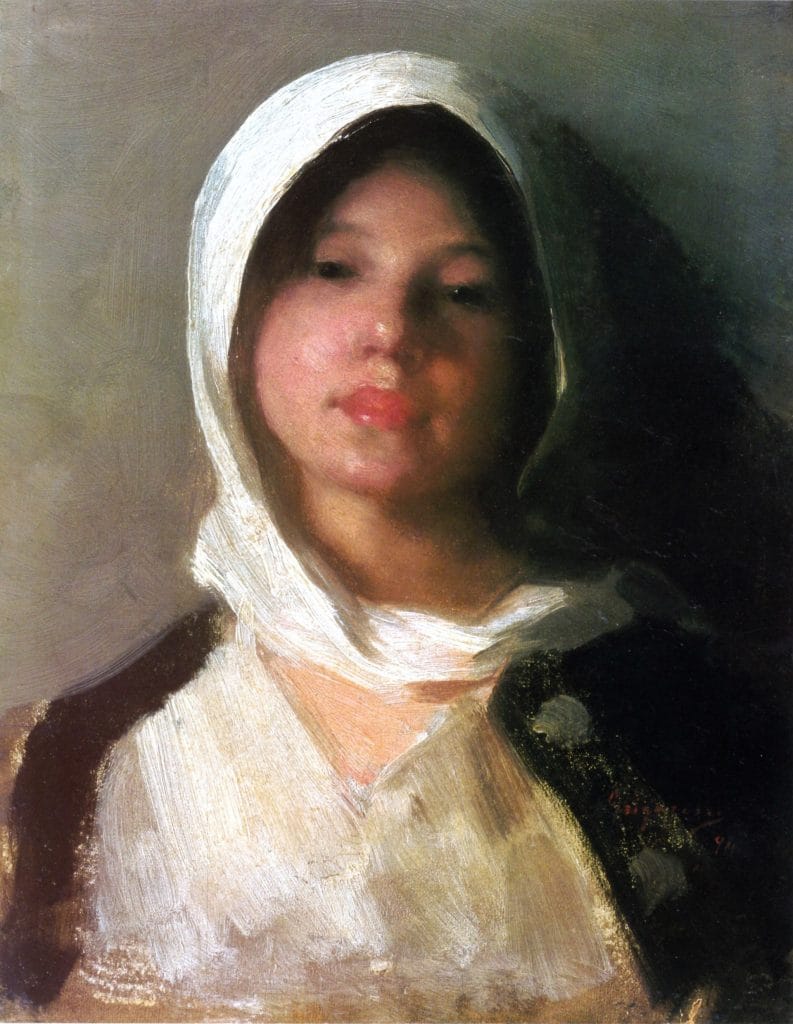
At the center of this transition stood Nicolae Grigorescu (1838–1907), the first Romanian painter to successfully integrate French plein-air techniques with native themes. Trained in Paris and influenced by the Barbizon School, Grigorescu returned home in the 1870s and began painting Romanian peasants, shepherds, and rural vistas with a tenderness and immediacy that were new to Romanian art.
His brushwork was loose, atmospheric, often spontaneous. But his subjects—barefoot girls leading cattle, monks on winding roads, cottages bathed in twilight—carried deep symbolic weight. In “Peasant Girl Resting” or “Oxen at the Watering Hole,” the figures are not portraits of specific people, but emblems of timeless labor, endurance, and humility. These are not scenes observed; they are rhythms lived, rendered in color.
Grigorescu also painted war scenes—he served as an official artist during the Romanian War of Independence (1877–1878)—but even these are subdued, focusing on the aftermath, the soldier’s fatigue, the solemnity of survival rather than the spectacle of battle. His eye was always drawn to the ordinary, the intimate, the real imbued with a certain soft luminosity, as if filtered through memory.
Unlike Aman or Tattarescu, Grigorescu avoided moral allegory or political grandstanding. His nationalism was quieter, grounded in the visual dignity of the rural world. He painted not an idea of Romania, but its texture: rough bark, wool shawls, mud paths, fading light.
Sămănătorism and the Cult of the Peasant
By the 1890s, this rural focus became not just an aesthetic choice but a cultural movement. Known as Sămănătorism, after the influential literary journal Sămănătorul (“The Sower”), this movement sought to root Romanian national identity in the traditions, speech, clothing, and worldview of the peasant class. It was a reaction to urban cosmopolitanism, industrialization, and perceived moral decay. And while its literary dimensions are well studied, its impact on visual art was equally profound.
Painters, illustrators, and even architects began to idealize the village—not just as a repository of folklore, but as a moral center, a place where uncorrupted Romanian essence endured. Costumes were studied and classified. Wooden churches were measured and drawn. Folk embroidery was analyzed like ancient script.
This interest extended to iconography and craft. Artists collected or copied peasant icons, drawn not by academy-trained painters but by itinerant iconographers working with homemade pigments and rough boards. These naive images—flat, awkward, saturated with gold and red—began to be appreciated not as primitive, but as authentic. They inspired a new kind of modernist aesthetic: flat planes, expressive distortions, symbolic compression.
Among the artists influenced by this rural turn were:
- Ștefan Luchian (1868–1916), whose portraits of peasant women and still lifes of sunflowers and wildflowers pushed the boundaries of color and gesture.
- Ion Theodorescu-Sion (1882–1939), whose later work synthesized folk motifs, Christian symbolism, and cubist geometry into a kind of rural modernism.
- Camil Ressu (1880–1962), who combined academic technique with a deep empathy for peasant labor and landscape.
For these painters, the village was not a nostalgic backdrop. It was a living mythology, a world governed by cyclical time, ancestral memory, and tactile devotion.
Three recurrent motifs dominated this period:
- The spinning woman, often shown seated by a fire, symbolizing both domestic continuity and mythic thread.
- The crossroad shrine, a small painted iconostasis on a wooden post, marking both literal and spiritual thresholds.
- The forest clearing, a space of both revelation and concealment, where folklore, Orthodoxy, and pagan echoes coexisted.
These were not quaint genre scenes. They were ritual images, distillations of a worldview where time moved in liturgical cycles, where nature and the sacred interwove, and where the peasant body was both laboring and symbolic.
Myths, Forests, and a Visual Poetics of Soil
As Symbolism matured in Romania, it absorbed not only folklore but also myth and esoteric philosophy. The forest ceased to be merely a backdrop; it became a psychological space, a realm of transformation. The peasant costume became a kind of national mask. The house, the field, the river—they took on archetypal significance.
In painting, this was matched by a shift in technique: deeper palettes, more stylized forms, and an increasing use of ornamental motifs drawn from textiles, woodcarving, and icon borders. Orthodox symbols—angels, halos, sacred trees—were reimagined not as dogma, but as poetic glyphs.
Artists like Octav Băncilă, Arthur Verona, and later Nicolae Tonitza began to explore this layered symbolic language. Băncilă’s peasant faces are often weary but luminous, as if bearing ancestral knowledge. Verona painted forest nymphs, mythic weddings, and sacred groves. Tonitza—though more associated with interwar expressionism—emerged from this Symbolist climate, his children’s faces haloed not with gold but with melancholy.
The literary world, too, fed this visual turn. The poems of Mihai Eminescu—filled with spectral woods, celestial maidens, and cosmic longing—inspired countless illustrations and paintings. The ballads and folk tales collected by Petre Ispirescu and George Coșbuc became visual subjects in their own right, spawning narrative cycles that blurred the line between folklore and fantasy.
In this period, the idea of Romania as an artistic subject expanded. It was no longer just a geopolitical project. It became a metaphysical terrain, a place where form and spirit met in ritual, pattern, and dream.
This Symbolist phase prepared the ground for the Romanian avant-garde. By reconnecting art with myth, memory, and ancestral form, it allowed later movements—Dada, Surrealism, Constructivism—to break radically from realism without severing their roots. The symbolic imagination had been reawakened.
Avant-Garde Disruptions: Dada, Constructivism, and Surrealism
If Symbolism offered the Romanian imagination a dreamlike space of ritual and myth, the avant-garde of the early 20th century took a hammer to the frame. In the wake of World War I, Romanian artists ceased to look for a visual language that could reconcile past and present. Instead, they declared war on coherence itself. Dada, Constructivism, and Surrealism—movements that sought not to illustrate the world but to dismantle and reassemble it—found eager Romanian participants, many of whom were instrumental in their creation. What emerged was a brief but seismic period in which Romanian artists were not followers of international trends, but architects of cultural revolution, provocateurs who dissolved aesthetic rules with a mix of violence, irony, and metaphysical hunger.
Though some of these figures worked abroad—in Zurich, Paris, Berlin—their sensibility was steeped in the hybrid, contradictory, and often mystical terrain of Romanian cultural life. They carried the village and the icon, the Orthodox chant and the folk spell, into the crucible of modernist experimentation. What came out the other side was something entirely new: a modernism both radical and haunted, machine-age in its technique, but ancestral in its obsession with memory, ritual, and trauma.
Tristan Tzara and the Birth of Dada in Zürich
At the center of this explosion stood Tristan Tzara (born Samuel Rosenstock in Moinești, Romania, 1896), the man who did not merely participate in Dada—he named it. In 1916, amid the chaos of World War I, Tzara and a band of artists, poets, and musicians founded the Cabaret Voltaire in Zurich. Their aim was not to create art but to annihilate it. They recited gibberish, destroyed syntax, and denounced logic itself. For them, the war was not an accident of history but the consequence of a culture rooted in reason, hierarchy, and order. Dada was their rejection, their revolt, their purge.
Tzara, who had studied Symbolist poetry in Bucharest and contributed to local journals, brought to Dada a lyrical nihilism that set it apart. His manifestos—written in an incendiary, self-destructing prose—redefined the artistic role: not to produce beauty, but to expose absurdity. In his words:
“Thought is made in the mouth.”
“Art is a private affair, the artist produces it for himself.”
“Dada is nothing.”
And yet, Dada was not nothing. It was a method, a stance, an engine of negative creation. Through collage, performance, and typographic violence, it sought to explode the assumptions of bourgeois taste. Tzara’s own work—particularly his sound poems, random word assemblages, and theatrical provocations—paved the way for performance art, conceptualism, and postmodern irony.
His Romanian origins were not incidental. They lent him an outsider’s fury, a taste for mythic inversion, and a familiarity with cultural fragmentation. In the swirling eddies of Zurich, Tzara wielded that marginality as a weapon, turning the dialects of empire into the linguistic shrapnel of modernism.
Victor Brauner and the Surrealist Allegory
If Tzara burned down language, Victor Brauner (1903–1966) conjured its ghosts. Born in Piatra Neamț and educated in Bucharest, Brauner moved to Paris in the 1930s and soon joined the circle of André Breton, the high priest of Surrealism. But unlike Breton’s more cerebral vision, Brauner’s art remained deeply embodied, intensely personal, and often terrifying. He painted philosophical wounds: headless torsos, wounded eyes, spectral limbs, and alchemical creatures that seemed torn from both a child’s nightmare and an apocryphal gospel.
One of Brauner’s most prophetic works is Self-Portrait with Enucleated Eye (1931), in which he depicts himself with one eye gouged out—a surreal allegory that became grimly real in 1938, when he lost his left eye during a fight at a gallery. His work is full of such eerie convergences: dream and injury, myth and biology, trauma and design.
Brauner’s iconography is dense with Romanian echoes. He drew on Kabbalah, Gnosticism, peasant magic, and Byzantine motifs, translating them into a visual language of symbolic dread. Eyes float like planets. Hands become sigils. His figures are often suspended, crucified, or flayed—half-saint, half-specimen. They seem to exist in a dimension where Orthodox mysticism and modern horror meet.
Unlike Tzara’s Dada, which exploded meaning, Brauner’s Surrealism sought occult coherence—a secret logic beneath catastrophe. His paintings are not nonsense. They are encrypted fables, paintings as ritual diagrams, as wounds turned into oracles.
His influence extended beyond Paris. Romanian contemporaries and younger painters such as Jacques Hérold and Gellu Naum would carry the Surrealist flame into poetry, drawing, and later Romanian modernist literature. For them, the unconscious was not merely a Freudian territory—it was a folk cosmos, an ancestral dreamscape distorted by modern violence.
Romanian Cubism and the Parisian Connection
Though Dada and Surrealism carried the most notoriety, Romanian artists were also active in other avant-garde forms, especially Cubism, Constructivism, and abstract design. Artists like Marcel Janco, M.H. Maxy, and Mattis-Teutsch developed their own variants of modernist geometry, merging abstraction with folk motifs, utopian politics, and industrial aesthetics.
Marcel Janco, a key figure in Zurich Dada, later returned to Bucharest and became one of the driving forces behind the journal Contimporanul (1922–1932), a central node of Romanian avant-garde activity. He created architectural collages, designed costumes for experimental theater, and developed a style that blended Cubist fragmentation with Constructivist optimism. His work suggested that modernity was not just critique but construction—a new visual grammar for a new society.
M.H. Maxy, a Bauhaus-trained painter and stage designer, fused abstraction with political commitment. His work for Yiddish theater in Bucharest and visual contributions to avant-garde journals embodied a leftist cosmopolitanism, rooted in Romanian Jewish experience and European modernist networks.
János Mattis-Teutsch, based in Brașov, produced some of the most lyrical abstract works of the Romanian interwar period. Influenced by Kandinsky and German Expressionism, he created color harmonies and biomorphic forms that suggested a spiritualized version of Constructivism. His vision was utopian, rooted in a belief that abstraction could heal division, that color and form could produce an ethical harmony.
These artists maintained strong ties to Parisian modernism, but their work retained a distinct regional vocabulary—a palette shaped by Carpathian light, Orthodox ritual, and the fractured politics of a country caught between empires. In their hands, the avant-garde became not a rupture with Romanian culture, but a recasting of its archetypes.
What unites the Romanian avant-garde—across its wildly divergent modes—is a sense of the uncanny, a knowledge that language, image, and myth are never fixed. They dissolve, re-form, mutate. This was not art for the academy or the church. It was art for thresholds, masks, and metamorphoses.
By the end of the 1930s, many of these artists had scattered: Tzara became a French citizen, Janco emigrated to Palestine, Maxy remained in Romania under increasing pressure. The war would silence many voices. The coming of communism would redirect others. But the brief, brilliant combustion of Romanian avant-gardism left a mark—less in monuments than in methods: irony, rupture, layering, transformation.
The village had given way to the vortex. The icon to the collage. But beneath the chaos, something old still flickered: the faith that image is power, even when fractured.
State, Form, and Function: The Visual Language of Socialist Realism
After the wars and ruptures of the early 20th century, Romania entered a new era not of fragmentation, but of command. The 1947 abolition of the monarchy and the establishment of the People’s Republic of Romania marked the beginning of a period when visual culture was no longer plural or experimental but centrally managed and ideologically defined. Under the supervision of the Romanian Workers’ Party—and later Nicolae Ceaușescu’s totalitarian regime—art became a tool of statecraft. It was expected to uplift the working class, glorify industrial progress, and narrate the inevitability of socialism. The result was a visually coherent but creatively restricted system known as Socialist Realism.
This was not an aesthetic in the traditional sense. It was an official mandate, modeled on Soviet precedents and enforced through unions, commissions, censorship, and state funding. Artists could still paint, sculpt, and design—but within strict parameters. They had to depict heroic labor, collective identity, and loyalty to the Party. Abstraction was suspect; irony was forbidden. The result was a peculiar visual world: rich in technique, often monumental in scale, but strangely flattened in meaning—an art of utility, spectacle, and compliance.
Ceaușescu’s Cultural Machine
Socialist Realism in Romania unfolded in phases, shaped by changing political leadership and international alignments. In the early years (late 1940s through 1950s), Romanian art closely followed the Soviet model. Painters were instructed to emulate figures like Aleksandr Gerasimov and Isaak Brodsky—artists who depicted Stalin, Lenin, and heroic workers with photographic precision and theatrical lighting. The Romanian equivalents portrayed Gheorghe Gheorghiu-Dej, factory collectives, and peasant brigades in similar fashion.
By the time Ceaușescu rose to power in 1965, Socialist Realism had softened slightly, adopting a more “national” tone. Ceaușescu positioned himself as a defender of Romanian sovereignty against Moscow’s domination, and this shift filtered into the arts. Painters and sculptors were encouraged to draw on folk motifs, historical heroes, and rural themes—as long as these supported the official ideology. Under Ceaușescu, the aesthetic remained realist, but the content was nationalist-socialist, a peculiar blend of Lenin and Dacia, Marx and Mihai Viteazul.
This hybridization was institutionalized in museums, textbooks, and public commissions. The state constructed new art academies, galleries, and “Houses of Culture” in cities and villages, where officially sanctioned artists exhibited massive canvases of combine harvesters, steelworkers, and folklore festivals. These were not simply decorations—they were ritual affirmations of the state’s narrative.
Key features of the Socialist Realist visual program included:
- Strict narrative clarity: Paintings had to be immediately legible, with identifiable subjects and ideological messages.
- Heroic scale: Figures were often larger than life, especially in public murals and sculptures.
- Idealized settings: Factories gleamed, crops were abundant, and peasants smiled beneath red banners.
This was not satire. It was utopian realism, enforced by decree. Artists who failed to comply were denied exhibitions, jobs, and travel visas. Some were arrested. Others retreated into private practice or abandoned visual art altogether.
Yet within these constraints, some artists developed a highly skilled, if ideologically compromised, visual idiom. Painters like Ion Sălișteanu and Corneliu Baba managed to infuse their state-commissioned portraits with nuance and subtlety. Sculptors like Boris Caragea created technically masterful statues of Lenin and Ceaușescu, even as their private work suggested deeper ambivalence.
The National Museum of Art in Bucharest, though purged and reorganized under socialist directives, continued to house pre-communist masterpieces. Visitors could view medieval icons and Brâncovenesc carvings in one wing, and Socialist Realist tableaux in another—a stark visual contrast between spiritual symbolism and ideological utility.
Monumentality, Murals, and the Worker’s Image
Public space was the primary canvas of Socialist Realism. The Party recognized that urban landscapes offered the most visible and controllable stage for shaping collective consciousness. Cities were remade to reflect ideological order, and art followed.
Murals adorned factory walls, subway stations, schools, and apartment blocks. Many were mosaics, composed of thousands of ceramic tiles, and designed by collectives rather than individuals. These murals were not intended to delight or provoke—they were meant to instruct and normalize. A good mural showed cooperation, progress, the harmony of man and machine. A better one added historical continuity: Dacians, 1848 revolutionaries, and partisans of World War II aligned in a single pictorial arc leading to socialist utopia.
Sculpture, too, was transformed. Bronze workers stood at attention in public squares, holding tools like torches. Peasant women held loaves of bread in poses that echoed Soviet archetypes. Even when executed with classical skill, these works exuded a staged optimism, a vision of society that was not experienced so much as asserted.
Perhaps the most notorious architectural expression of this monumentalism was the Palace of the People (now the Palace of the Parliament), initiated by Ceaușescu in 1984. Designed by architect Anca Petrescu and built with a massive conscripted workforce, the building is one of the largest in the world. Its construction demolished swaths of Bucharest’s historic center, including churches, monasteries, and residential neighborhoods. The palace’s interior is adorned with socialist-themed bas-reliefs, allegorical frescoes, and carpets the size of gymnasiums. It stands today not as a symbol of triumph, but as a mausoleum of megalomania—the ultimate monument to a visual culture of scale without soul.
Architecture as Propaganda
Architecture under socialism was not just functional; it was pedagogical. Apartment blocks, ministries, stadiums, and cultural centers were designed to express ideological principles: uniformity, efficiency, and state control. The transition from eclectic interwar styles to standardized concrete brutalism was swift and nearly total.
The housing blocks of the 1960s through 1980s—often gray, repetitive, and overbearing—were designed for mass occupancy, but also for visual coherence. Viewed from above, these buildings formed grids, axes, and centralized plazas that mirrored Party hierarchies. Inside, they offered little ornamentation or individuality.
Yet even here, state art intervened. Lobbies often contained wall reliefs, portraits of Ceaușescu, or ceramic panels depicting stylized wheat fields and rising suns. Public schools displayed didactic diagrams of history and science, all imbued with socialist optimism.
A few architectural experiments attempted to blend vernacular and modernist elements. Some town halls and cultural centers incorporated Brâncovenesc motifs—twisted columns, floral reliefs—rendered in concrete or ceramic. These hybrids were encouraged under Ceaușescu’s national-communism, which sought to root socialist aesthetics in Romanian tradition. But they were rare and always tightly supervised.
The ultimate function of architecture during this period was to create legibility. Citizens were to move through orderly, predictable spaces. Nothing was left to chance. Art and design served not beauty, but behavior.
And yet, amid the concrete and choreographed cheer, a silent resistance grew. Some artists withdrew into private studios, where they created works that would never be shown. Others experimented in code—abstract forms, allegorical metaphors, and double meanings that evaded censors but spoke volumes to those who knew how to read them.
That resistance would come to full expression in the 1980s, and especially after the 1989 Revolution. But even within the visual language of Socialist Realism, one can detect signs of strain—figures too rigid, smiles too forced, buildings too large to be human. The art of the state told a story of progress. The texture of the work often betrayed fatigue.
It was an art of function and form, but not of freedom. The rupture would come soon.
Resistance and Irony: Subversive Art Behind the Iron Curtain
In the official narrative of Communist Romania, art was clear, instructive, and optimistic—a visual echo chamber for the Party line. But beneath that surface, in garages, private homes, and improvised studios, a different art persisted: fragmented, coded, ironic, and often invisible. It did not speak in slogans but in whispers, using metaphor, performance, and formal obliqueness to evade the ever-watching eye of the state. If Socialist Realism claimed to portray reality, subversive artists redefined reality as something inward, unstable, and impossible to regulate.
This art did not erupt all at once. It evolved slowly, through what could be called micro-acts of aesthetic defection. Artists did not always declare their rebellion—they embedded it. A landscape that was just a little too empty. A portrait whose eyes refused to meet the viewer’s. A performance attended by no audience but carefully documented. These were not overt political statements; they were gestures of refusal: against clarity, against conformity, against the idea that reality could be flattened into ideology.
Clandestine Installations and Performance
The restrictions of the socialist system made traditional exhibition impossible for many avant-garde or critical artists. Galleries were closely monitored. Public commissions were ideologically vetted. So artists turned inward—into domestic spaces, which became both studios and venues.
The home exhibition became a distinct Romanian form of subversion. Artists would invite trusted friends to view works hung in kitchens, bedrooms, or stairwells. Performances were staged in courtyards, documented in photographs, then hidden or smuggled out. The risk was not abstract: many artists were monitored by the Securitate, the state security apparatus. Informants lurked in artistic circles. One wrong word could cost a job, a visa, or more.
Amid this climate, some of the most daring and original Romanian art was produced—not on canvas, but in gesture, body, and space.
A leading figure in this world was Ana Lupaș, whose early work in the 1960s and ’70s explored textiles, ritual, and rural labor. Her ongoing project, The Solemn Process, began as a series of collaborative sculptures made with villagers using straw and fabric—ritual forms suggestive of funerary objects or harvest offerings. Later, she preserved and reinterpreted these works in metal, transforming ephemeral folk gestures into permanent, sacred forms. The work was neither pro-regime nor overtly dissident. It was something rarer: a transhistorical vocabulary, a way of marking time that the state could neither control nor interpret.
Others embraced ephemerality even more radically. Artists like Geta Brătescu turned everyday gestures—cutting paper, drawing a circle, arranging a desk—into ritualized acts of attention. In her iconic The Studio, she documented herself in a small Bucharest workspace, performing repetitive actions that blurred the line between art and life, visibility and concealment. Her art was an exercise in survival, an ethics of making under conditions where nothing could be shown and everything had to be meant.
These practices were sometimes documented in samizdat publications, mailed abroad to sympathetic curators, or quietly shared between friends. Their very marginality became their strength. They formed an art that could not be co-opted—not because it was overtly political, but because it refused the logic of spectacle.
Ion Grigorescu and the Documented Body
Among the most radical and influential of Romania’s subversive artists was Ion Grigorescu (b. 1945), whose work in photography, film, and performance broke nearly every rule of Socialist Realism. Where official art exalted the collective worker, Grigorescu turned the camera on himself—naked, wounded, aging, alone.
His performances, often staged in private apartments or derelict sites, used his own body as a site of critique. In Dialogue with Ceaușescu (1978), he filmed himself enacting a silent argument with an imaginary dictator—both roles played by Grigorescu, masked, contorted, and mute. In Birth (1978), he lay curled on a kitchen table in fetal position, surrounded by domestic detritus. These works were not shown in galleries; they circulated as photographic documentation, sometimes not even developed until years later.
Grigorescu’s body was his canvas, but also his prison. He filmed himself sleeping, masturbating, praying, aging, mapping the boundary between public and private, material and metaphysical. His work drew on Orthodox mysticism, Christian martyrdom, and avant-garde strategies, yet it conformed to no single movement.
His diary-like photo series, such as Self-Portrait in the Mirror or Daily Activities, recorded banal acts with obsessive precision. These were not images of dissent in the traditional sense. They were icons of existence, asserting that the inner life still mattered, even under total surveillance.
Grigorescu’s practice was not heroic. It was ascetic—a private form of resistance grounded in the act of attention itself. Where Socialist Realism shouted, he whispered. Where it declared, he reflected. His work stands today as one of the most sustained and fearless explorations of subjectivity under dictatorship in all of Eastern Europe.
The Atelier as a Site of Dissent
For artists excluded from official exhibition spaces, the studio—or atelier—became both sanctuary and stage. These were not just places of production. They were zones of exception, where one could read banned books, play censored music, and create without immediate oversight. The studio was a site of imagined freedom, even as its walls bore the anxiety of being overheard.
Some studios doubled as archives, preserving unofficial histories. Others became sites of collaborative making, where artists shared materials, techniques, and strategies for evasion. Because access to supplies was limited, artists often reused canvases, built their own tools, or invented mediums. This material scarcity bred formal ingenuity. Collage, assemblage, and found-object art flourished—not from conceptual intent, but from necessity.
This period also saw the emergence of a small but vital group of theorists and curators who quietly supported subversive artists. Figures like Andrei Pleșu, Ion Bitzan, and Ruxandra Balaci maintained networks of critical dialogue, helping to smuggle works abroad, organize semi-private exhibitions, and build what would later become the foundations of post-communist contemporary art infrastructure.
Artists often lived in cognitive dissonance: producing official commissions by day and forbidden work by night. Some navigated this split with ironic aplomb, embedding hidden critiques into seemingly harmless scenes. A painting of a village might contain impossible shadows. A factory mural might show identical workers with blank eyes. A bust of a political figure might be executed with such technical perfection that it crossed into satire.
What unites this generation of subversive artists is not a shared style, but a shared refusal to surrender the imagination. They worked in corners, margins, and silences. They documented not just injustice but the absurdities of daily life under ideological totality.
And they endured.
When the regime collapsed in 1989, their work did not emerge as a triumphant banner. It emerged as a map of hidden continuity, a record of inner life, private meaning, and formal resilience that had survived, unbroken, in the dark.
After 1989: Rupture, Reckoning, and Radical Expression
The fall of Nicolae Ceaușescu’s regime in December 1989 was televised, fragmented, and violently theatrical—a fitting punctuation to decades of tightly scripted visual control. What followed was not the clean dawn of artistic freedom, but a complicated, destabilizing void. Overnight, the ideological framework that had governed public art vanished, leaving behind not only physical ruins—murals, monuments, and Party architecture—but a collapsed cultural language. Artists were no longer told what to make. But they were also no longer told how to live. In that vacuum, Romanian art entered a phase of reckoning, rupture, and experimentation—at once cathartic and disorienting.
The early 1990s did not produce a singular aesthetic. Instead, they gave rise to an unruly field of voices grappling with trauma, memory, history, and the uncertain promises of liberal capitalism. Installation, performance, photography, and conceptual practice came to the fore, often executed with minimal means but maximal urgency. Museums and academies struggled to redefine their roles. Censorship lifted, but support structures were fragile. Artists were free, but the audience was elusive, and the market chaotic.
Out of this flux emerged some of the most provocative and internationally visible work in Romanian art history—work that did not abandon the past, but turned to face it directly, often with irony, violence, or quiet fury.
The Void of Ideology and Explosion of Medium
The collapse of communism did not simply remove an aesthetic doctrine. It created a condition of derealization, in which public imagery—once so loaded with official meaning—suddenly appeared hollow, absurd, or ghostlike. Former monuments stood in traffic islands, unacknowledged. Ceaușescu’s palace loomed over Bucharest, too big to destroy, too compromised to fully inhabit.
Artists responded by turning to new media and ephemeral forms: video art, conceptual installations, performance documentation, and architectural interventions. These practices allowed for critical distance and formal experimentation at a time when traditional painting and sculpture seemed unable to articulate the new condition of post-totalitarian disbelief.
One of the earliest and most influential collectives was SubREAL, formed by Călin Dan and Josif Király in 1990. Their work dissected the residues of Socialist Realism and art bureaucracy. In their Serving Art series, they used photographs of former regime-sanctioned artworks—trophies of official culture—and recontextualized them as relics, arranged in grid systems or ritual configurations. The effect was archaeological: exposing not only what was shown, but what had been fetishized, concealed, and discarded.
Artists also began to interrogate the status of the artist itself. What does it mean to create after the fall of ideology? Who is the audience? What is the function of beauty in a disenchanted world? These were not rhetorical questions—they were existential dilemmas. With state patronage gone and private galleries still embryonic, many artists turned inward, embracing a deliberately provisional, anti-monumental aesthetic.
The material vocabulary of the 1990s was often bare: photocopies, found objects, television monitors, chalk, dust. The formal grammar was one of negation: absence, repetition, parody, delay. And yet, in this aesthetic of uncertainty, something urgent persisted—the need to account for a past that had not been reckoned with.
Dan Perjovschi’s Drawing as News Commentary
Among the most iconic post-1989 artists is Dan Perjovschi (b. 1961), whose work combines drawing, journalism, performance, and social critique. Perjovschi’s medium is deceptively simple: black marker on white wall. But his execution—spontaneous, rapid, razor-sharp—transforms the gallery wall into a site of live commentary.
His drawings are cartoons, yes, but also diagrams of crisis. They address politics, religion, media, and global capitalism with wry detachment and furious clarity. Stick figures, speech bubbles, and slogans are arranged across institutional spaces like graffiti from a hyper-literate citizen. They are at once urgent and temporary: drawn directly onto walls, then painted over when the exhibition ends.
Perjovschi’s practice emerged in the 1990s but matured in the early 2000s, when he began to exhibit widely across Europe and the U.S. He often uses the wall space of prestigious museums—Tate Modern, MoMA, Centre Pompidou—not to celebrate art, but to mock its pretensions. His aphorisms strike hard:
“East is the new West.”
“Local culture is a global export.”
“Revolution is not for sale.”
Though his reach is international, Perjovschi’s sensibility is viscerally Romanian: ironic, skeptical, shaped by decades of propaganda and surveillance. He lived through Ceaușescu. His stick figures carry that memory in their thin arms and heavy captions.
Unlike the monumental works of Socialist Realism, Perjovschi’s art is fast, volatile, and disposable. It belongs to the moment, to the wall it marks and then abandons. But it leaves a trace—a critical energy, a reminder that art can still disrupt, even with nothing but ink.
Galleries, Collectives, and the Search for Audience
In the absence of a coherent art market or strong public institutions, post-1989 Romanian artists often built their own infrastructures: independent galleries, temporary collectives, artist-run spaces. These were not just exhibition venues. They were laboratories, classrooms, survival networks.
In Bucharest, spaces like Plan B, Tranzit.ro, and Salonul de Proiecte became vital nodes for emerging contemporary art. They exhibited both local and international work, hosted debates, and produced publications. They provided a counterpoint to the state-run museums, which were often slow to adapt or dominated by conservative tastes.
One of the defining features of post-communist art in Romania was its collective energy. Unlike the isolated studio genius of modernism, many artists worked in groups, sharing authorship and space. The Romanian Pavilion at the Venice Biennale—previously a neglected backwater—began to gain attention in the 2000s, showcasing artists who combined formal innovation with historical and political engagement.
Notable examples include:
- Miklós Onucsán, who explored objecthood, fragility, and institutional critique.
- Șerban Savu, whose melancholic paintings of Romanian post-industrial landscapes combine technical precision with social ambiguity.
- Anca Benera & Arnold Estefan, whose collaborative practice investigates geopolitics, cartography, and state violence through conceptual installations.
These artists do not illustrate Romanian identity. They interrogate it, often using the very tools—statistical charts, national anthems, historical maps—that once structured state ideology.
What unites this generation is a refusal of nostalgia. They do not long for the past, nor do they celebrate the market-driven present. Their work is critical, exploratory, and haunted—not by longing, but by unresolved memory.
If there is a common theme in post-1989 Romanian art, it is reckoning: with dictatorship, with memory, with the promises of democracy and the failures of transition. The materials may be humble, the spaces provisional, but the ambition is vast: to rebuild a visual language in the wake of historical collapse.
Contemporary Romanian Art on the Global Stage
In the decades since the fall of communism, Romanian art has undergone a transformation from margin to presence, from internal reckoning to external recognition. What began in the 1990s as a search for language—fragmented, improvised, and local—has evolved into a mature, internationally engaged ecosystem. Romanian artists now exhibit at biennials, win major residencies, and are represented in museum collections around the world. Yet this global visibility has not erased the tension that gives Romanian art its distinctive charge: the consciousness of history, the unease of identity, and the memory of control.
Unlike earlier periods defined by stylistic movements or ideological programs, contemporary Romanian art is marked by pluralism—not just in form or medium, but in modes of inquiry. Some artists mine the archive. Others explore social trauma, architecture, migration, or ecological anxiety. What unites them is not a national style but a shared capacity for ambivalence, irony, and structural critique—a sensibility forged in a country where the past is always in the room, never quite at rest.
The Cluj School and New Figuration
Perhaps the most visible cluster of post-2000 Romanian artists is the so-called Cluj School—a group of painters centered around the city of Cluj-Napoca and its Faculty of Fine Arts. Though the label is not formally claimed by its members, it has come to denote a loose but identifiable tendency: figurative painting with realist precision, psychological tension, and a muted, cinematic palette.
The most prominent figure to emerge from this milieu is Adrian Ghenie (b. 1977), whose rise to international prominence has been meteoric. Ghenie’s large canvases, often thickly layered and violently scraped, depict historical and psychological subjects: portraits of Hitler, Freud, and Darwin dissolved into streaks of flesh and shadow. His work draws on art history (especially Bacon and Richter), but is haunted by the specter of European catastrophe. These are not historical paintings in the traditional sense; they are excavations—paintings as eroded evidence, or forensic dreams.
Other painters associated with the Cluj scene include:
- Victor Man, whose dark, introspective works often combine medieval iconography with postmodern ambiguity.
- Marius Bercea, whose canvases layer Romanian post-communist architecture with nostalgic color and surreal detail.
- Serban Savu, who depicts everyday life in post-industrial Romania with a restraint that borders on the metaphysical—cafeteria workers, retirees, housing blocks, all painted with eerie calm.
Though stylistically varied, these artists share a fascination with temporality and residue—painting not what is seen, but what is left behind, refracted through the ghost light of memory.
What distinguishes the Cluj School is not only its formal coherence but its infrastructure. The city is home to Fabrica de Pensule (The Paintbrush Factory), a former industrial site transformed into a hub for studios, galleries, and cultural organizations. Though recently displaced from its original space, its spirit endures—a rare example of artist-led institutional building in post-socialist Europe.
Biennials, Residencies, and Curatorial Interest
Romanian art’s global rise has been shaped not only by its artists but by its curators, theorists, and institutions. Since the early 2000s, Romania’s participation in major biennials—Venice, São Paulo, Istanbul—has consistently drawn attention for its conceptual rigor and political acuity.
The Romanian Pavilion at the Venice Biennale, long marginalized, has become a platform for bold, often understated interventions. Highlights include:
- Ion Grigorescu’s retrospective presentation in 2007, which introduced global audiences to his decades of subversive, body-based work.
- The 2011 pavilion by Alexandra Pirici and Manuel Pelmuș, which replaced physical artworks with “immaterial retrospectives”—live reenactments of key moments in Romanian art and politics, performed by dancers.
- Andra Ursuța’s inclusion in the 2022 Biennale, whose visceral sculptures explore violence, vulnerability, and social decay using cement, silicone, and found materials.
These appearances have helped shift the perception of Romanian art from regional curiosity to critical interlocutor—a voice shaped by the traumas of 20th-century totalitarianism, but fully engaged with the dilemmas of the 21st: surveillance, migration, global inequality.
Institutions such as tranzit.ro, Salonul de Proiecte, and the National Museum of Contemporary Art in Bucharest have also played key roles in curating, documenting, and theorizing this transition. They have facilitated collaborations across borders, supported emerging artists, and created platforms for dialogue within and beyond Romania.
The residency circuit—from Akademie Schloss Solitude to the Rijksakademie—has further globalized Romanian practice. Artists such as Delia Popa, Apparatus 22, and Anca Benera & Arnold Estefan have used these opportunities to develop socially engaged, research-driven work that transcends national boundaries while remaining rooted in local tension.
Romanian art, in other words, has not become international by shedding its specificity. It has become legible by framing its specificity as critique.
National Identity in a Post-National Context
One of the defining tensions in contemporary Romanian art is the problem of national identity. After decades of nationalist propaganda under Ceaușescu—and centuries of myth-making before that—many artists approach “Romania” not as a subject to be celebrated, but as a site of suspicion.
This ambivalence has produced rich, layered work. Artists explore:
- Historical erasure, particularly around Romania’s Jewish, Roma, and minority populations.
- Architectural violence, examining how state power reshaped cities and erased memory.
- Migration and diaspora, documenting the lives of Romanians abroad and the cultural feedback loops that result.
Artists like Cristina David, Ioana Nemeș, and Dana Bucătaru have turned daily life into poetic systems—charts, routines, objects—that trace the intersection of personal narrative and state history. Others, like Nicolae Comănescu, engage in visual archaeology, painting over urban detritus or mixing pigment with local dust.
Some address the new mythology of Europeanness itself. The promise of post-1989 accession to the European Union brought both opportunity and illusion. For many artists, the EU is not a utopia, but another system of discipline—one that replaces ideological censorship with economic abstraction. In this sense, contemporary Romanian art is deeply European, but not comfortably so. It belongs to a continent of suspended ideals, where freedom is real but uneven, and memory is too heavy to forget.
In this uncertain terrain, the most powerful Romanian art of today does not offer answers. It offers structures for reflection: installations, performances, drawings, and videos that help audiences feel the weight of time, the distortion of language, the residue of systems.
It is not nationalist. But it knows its soil.
It is not utopian. But it refuses despair.
It is art made in the wake of collapse, in the search for form—not to restore what was, but to glimpse what might still be made from its ruins.