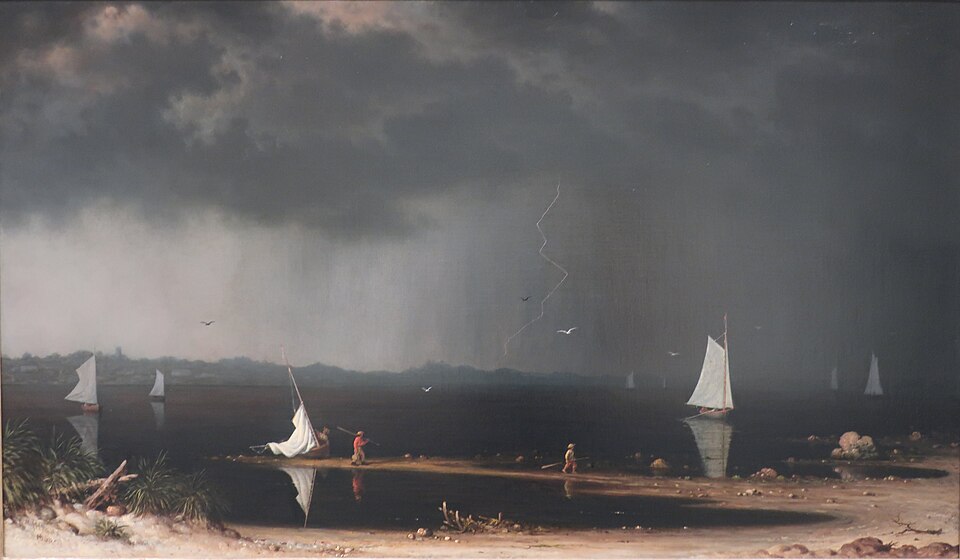
Rhode Island’s earliest works of art were made not in studios but in workshops, meetinghouses, and private parlors—quietly woven into the daily life of a colony built on religious dissent, maritime enterprise, and civic independence. Art, in this context, was rarely elevated above function. And yet, from carved headstones and painted signs to fine furniture and commissioned portraits, the colony’s material culture reveals a visual language shaped by order, restraint, and a persistent attention to craftsmanship.
Newport and Providence as Artistic Hubs
By the early 18th century, Newport and Providence had emerged as distinct artistic centers, each reflecting the commercial and cultural strengths of its region. Newport, a prosperous seaport with connections to the Caribbean and Europe, developed a refined urban culture earlier than most of its New England neighbors. Its merchants and clergy commissioned portraits, imported silver, and supported furniture makers whose work now defines the so-called “Newport school.” Providence, more provincial in its early years, developed a quieter but no less capable culture of craftsmanship centered around practicality and local needs.
Unlike Boston or Philadelphia, Rhode Island’s cities were not known for elite institutions or large-scale art commissions. Instead, what flourished were networks of artisan families—cabinetmakers, silversmiths, and housepainters—who passed skills down through generations. Their works were rarely signed, but their names survive in probate records, apprenticeships, and scattered attributions.
Among these, the Goddard and Townsend families of Newport gained lasting renown for their high chests, block-front desks, and claw-and-ball feet—forms that now dominate American decorative arts collections. Their pieces, crafted from native woods like cherry and maple, combined ornament with discipline. Though influenced by British rococo styles, they remained grounded in proportion and restraint, qualities long associated with Rhode Island design.
Three forms of early artmaking dominated Rhode Island before the Revolution:
- Furniture making, especially in Newport, where local joiners produced some of the most elegant case pieces in colonial America.
- Portraiture, often by itinerant painters who passed through town, leaving behind likenesses of ministers, merchants, and their wives.
- Decorative arts, including signs, gravestones, and embroidery—functional objects elevated by careful design.
Limners, Carvers, and Cabinetmakers
Before formal academies or imported oils, the colony’s visual identity was shaped by local artisans. Limners—self-taught portrait painters—traveled from town to town, painting stiff, frontal likenesses against dark backgrounds. These early portraits were rarely nuanced, but they served a vital purpose: documenting family lineage and establishing social status. One such example is the work of Samuel King (1749–1819), a Newport artist whose painting career began with house- and sign-painting before evolving into respectable portraiture. His sitters—often shown in powdered wigs and modest clothing—speak to a culture that valued dignity over flair.
Carvers, meanwhile, adorned pulpits, fireplace mantels, and ship figureheads with baroque flourishes drawn from pattern books and memory. Though their names are mostly lost, their skill remains evident in surviving architectural details and furniture ornament.
Cabinetmakers, the most visible class of early Rhode Island artisans, operated workshops that employed both enslaved and free laborers. Their work married English design with local timber and American invention. The Newport shell-carved block-front chest became an icon of colonial elegance, and its construction required precise joinery, sharp tools, and years of practice. Such pieces were not cheap, and their presence in a household marked economic and social achievement.
One mid-18th-century inventory from a Newport estate lists:
- “1 Looking Glass framed in Carv’d Maple”
- “A Mahogany Tea Table with Claw Feet”
- “Two Portraits of ye Deceased & Wife in Gilt Frames”
These were not mere furnishings; they were expressions of order, prosperity, and refinement.
The Influence of Puritan Taste and English Models
Although Rhode Island was founded by religious dissenters, it did not adopt the same visual austerity as its Puritan neighbors in Massachusetts Bay. Roger Williams’ commitment to liberty of conscience fostered a degree of tolerance that extended to the visual realm. Newport, with its Quakers, Baptists, Anglicans, and Jews, permitted a broader range of artistic expression than might be expected for a colony of its size.
Still, the colony’s visual culture remained closely tied to English models. Imported prints, engravings, and pattern books helped set the tone. Many early limners copied their compositions directly from mezzotints sent across the Atlantic, especially portraits of nobility or clergy. Faces were often formulaic—only the details of dress or background changing to suit the sitter. The goal was not to innovate, but to emulate—maintaining a visual continuity with the mother country, even as political ties began to fray.
Furniture followed a similar logic. Design books by Thomas Chippendale and William Salmon circulated among craftsmen, whose adaptations reflected both available materials and local preferences. While Massachusetts favored heavier, more angular styles, Rhode Island furniture tended to be lighter in ornament but richer in curve—a subtle but consistent aesthetic distinction.
There was little “folk art” in the romanticized sense. What existed instead was a high level of technical skill applied to useful objects, often with careful embellishment and classical reference. Whether a silver tankard or a wall sconce, the object was expected to endure—and to speak, quietly, of order and civility.
Rhode Island’s colonial art history is not one of grand statements or avant-garde flourish. It is, rather, a record of subtle discipline—of craftsmanship honed within tight-knit communities, and of visual traditions shaped more by practicality and precision than by ideology or display. From the carved leg of a desk to the brushstroke on a merchant’s brow, the colony’s art reveals a culture that prized skill over spectacle.
Painted Authority: Federal Portraiture in Post-Revolutionary Rhode Island
In the years following American independence, portraiture in Rhode Island reached a level of ambition and polish previously unseen in the colony’s visual history. Art was no longer merely an emblem of private dignity or mercantile success—it became a visual declaration of civic identity, national allegiance, and refined taste. The period between the 1780s and 1820s saw the rise of a more professional class of painters, most famously Gilbert Stuart, who transformed the portrait from a colonial likeness into a symbol of American authority.
Gilbert Stuart’s Birthplace and His National Fame
Gilbert Stuart (1755–1828), born in Saunderstown, Rhode Island, remains the most significant painter the state has ever produced. Though he spent much of his working life elsewhere—London, Dublin, New York, Philadelphia, and Boston—Stuart’s roots in Rhode Island were formative. He received his earliest training under Scottish artist Cosmo Alexander in Newport and painted his first known work at age 14. The artistic ambitions he developed there, however, could not be fulfilled in the narrow confines of colonial America. Like many serious painters of his generation, Stuart sought success in Europe, and it was in London that he came under the tutelage of Benjamin West, the American-born president of the Royal Academy.
By the time Stuart returned to the United States in the 1790s, he had become a polished and confident painter of aristocratic portraits, blending English sophistication with an increasingly American sense of directness. His most famous works—the unfinished “Athenaeum” portrait of George Washington, as well as likenesses of Adams, Jefferson, and Madison—helped to define the visual language of the early Republic. These were not decorative portraits for domestic interiors. They were designed to endure, to command, and to shape how future generations would imagine the founders.
Though Stuart never again lived permanently in Rhode Island, his presence there was continuous through commissions, family ties, and the lasting influence of his work. Several of his portraits remain in Rhode Island institutions, including:
- A 1773 portrait of Dr. Hunter, held by the Redwood Library in Newport.
- Early likenesses of local gentry painted before his departure for Europe.
- Later works acquired by the Rhode Island Historical Society and the RISD Museum.
His technique—subtle modeling, fluid brushwork, and an unmatched ability to capture facial character—marked a dramatic leap forward from the flat, formulaic limner tradition of the colonial period. In Stuart’s hands, the American portrait became not only technically excellent but psychologically acute.
Portraits of Merchants, Ministers, and Patriots
While Stuart towered above his peers, he did not operate in isolation. A growing appetite for portraiture in the post-Revolutionary years created a market for painters of various skill levels, particularly among the merchant class of Providence and Newport. As Rhode Island’s economy shifted from seaborne trade to early industrialization, leading families sought to anchor their status through visual legacy. Ministers, military officers, shipowners, and judges all sat for portraits—often in profile, set against draped curtains or fluted columns, dressed in sober black or modest finery.
These portraits served several functions:
- Documentation: In a period when photography did not exist, a portrait was a means of preserving a likeness for descendants.
- Assertion: Painted portraits conveyed authority and refinement, signaling a family’s education, piety, or political alignment.
- Memorialization: Many works were commissioned after death, sometimes based on earlier sketches or written descriptions.
Rhode Island artists such as James Sullivan Lincoln, a key figure in Providence portraiture in the early 19th century, continued this tradition well into the 1800s. Lincoln’s portraits of governors and judges are stiff by modern standards but deeply rooted in a tradition that emphasized dignity, not expression.
A particularly striking example can be found in the portrait of William Ellery, signer of the Declaration of Independence, whose sober expression and plain dress emphasize the austere moral character associated with the early Republic. Unlike their European counterparts, Rhode Island’s patrons often rejected ostentation, preferring a visual style that stressed moral uprightness and civic virtue over flair.
Classical Backdrops and Republican Symbolism
By the early 19th century, the influence of neoclassicism began to reshape the American portrait. Inspired by ancient Rome and Enlightenment ideals, artists integrated symbolic motifs that conveyed more than the subject’s appearance—they conveyed an ideology. Rhode Island portraiture reflected this shift in subtle but deliberate ways.
Subjects were posed beside classical columns, wearing togas or sashes, holding scrolls or books. These elements signaled education, authority, and republican virtue. In some cases, American flags were draped in the background, or eagles were subtly worked into the frame. Even when the sitter wore contemporary dress, the setting suggested continuity with ancient ideals—of duty, justice, and civic responsibility.
Stuart himself was highly skilled at balancing realism with symbolism. In his portrait of George Washington, for example, the general is presented not as a military hero, but as a statesman: calm, composed, and entirely in control. The background is dark and spare, emphasizing the power of the sitter’s gaze and presence. This manner of presentation influenced generations of American artists.
In Rhode Island, these classical conventions were often deployed without excess. The local taste remained cautious, reflective of the state’s broader cultural character: practical, restrained, and skeptical of grandiosity. Yet the influence of republican symbolism was impossible to miss. It marked a clear evolution from the purely devotional or domestic portraiture of the colonial period toward a more public, politicized art form.
The Federal period in Rhode Island’s art history was defined by the rise of professionalism, the assertion of national identity through painted likenesses, and the enduring ideal of visual clarity as a marker of truth and virtue. Whether in the fluent brushwork of Gilbert Stuart or the modest compositions of local painters, portraiture became a civic act—one that fused private memory with public meaning.
Stone, Iron, and Elegance: Architecture and Ornament in the 19th Century
The visual character of 19th-century Rhode Island was as much built as it was painted. Architecture became a dominant art form during this period, shaping not only the skyline of cities like Providence and Newport but also the taste and aspirations of the region’s growing middle and upper classes. Stone churches, cast-iron railings, and ornamental woodwork told the story of industrial ambition and civic refinement. As Rhode Island moved into the industrial age, its buildings began to carry the full weight of its cultural identity.
Granite Churches and Greek Revival Facades
By the 1820s, the austere meetinghouses of the colonial era were giving way to more assertive structures. The Greek Revival style, which swept across the United States in the early 19th century, found fertile ground in Rhode Island. White columns, pedimented gables, and symmetrical façades symbolized both civic order and the democratic ideals of the young Republic. In Providence, public buildings and private homes alike adopted these classical features, blending elegance with restraint.
Churches were often the most prominent structures in town, both in size and in ornamentation. The First Baptist Church in America, while built earlier (1775), set a precedent for combining classical proportion with New England simplicity. Later 19th-century churches followed suit but expanded in material and scale. Granite from Rhode Island quarries began to appear in foundations and walls, its durability matched by a symbolic permanence.
Trinity Church in Newport, for example, began to take on a more monumental presence through renovations and additions. In Providence, new church buildings adopted a variety of styles—Romanesque, Gothic Revival, and Second Empire—each marking a different phase in the city’s growth.
Residential architecture mirrored these trends. The 1840s and 1850s saw a proliferation of Greek Revival homes across Rhode Island towns—low-pitched roofs, pilasters, and heavy cornices giving even modest houses a sense of dignity and order. Many of these were built by skilled craftsmen who had previously worked on mills or public buildings, bringing a high level of precision to domestic construction.
Throughout this period, three materials increasingly defined Rhode Island’s architectural palette:
- Granite, quarried locally, used in churches, banks, and public monuments for its strength and visual authority.
- Brick, especially in industrial buildings and schools, prized for its fire resistance and regularity.
- Painted wood, in clapboard houses and decorative trim, adaptable to both classical and romantic styles.
Foundries, Railings, and Decorative Ironwork
While stone and wood defined the bones of 19th-century Rhode Island buildings, it was iron that gave them their flourish. As Providence became a center of industrial production, local foundries began to produce cast-iron elements that adorned homes, businesses, and public spaces. Decorative fencing, balcony railings, window grilles, and lampposts—many made in Providence or Pawtucket—transformed the urban environment with a sense of mechanical elegance.
The foundry of J.N. Arnold & Company, operating in Providence by the 1850s, was one of several local manufacturers producing finely detailed architectural ironwork. These pieces were not merely utilitarian; they were crafted to resemble vines, scrolls, and geometric motifs, often based on pattern books circulating from Europe. The use of cast iron allowed for a high level of detail at relatively low cost, making ornamentation more accessible to middle-class homeowners.
A walk through Providence’s College Hill neighborhood today still reveals:
- Iron fences with spear-shaped finials lining 19th-century townhouses.
- Stair railings with curved volutes and rosettes.
- Balcony supports in acanthus or anthemion motifs, echoing ancient Greek design.
These details, once considered minor, came to define the aesthetic of Rhode Island’s urban centers. They offered a visible record of industrial skill married to artistic intention.
Public buildings embraced iron in more conspicuous ways. The Arcade in Providence (built 1828), one of the earliest enclosed shopping malls in the United States, features granite columns paired with a delicately proportioned iron and glass roof—demonstrating a synthesis of classical form and industrial material. This architectural hybrid—solid yet transparent, heavy yet airy—signaled the beginning of a new kind of urban experience.
Builders, Masons, and the Rise of the Skilled Trades
Behind every column, cornice, and iron gate stood a growing class of skilled tradesmen whose work shaped the physical identity of Rhode Island. The 19th century saw the formation of trade guilds, apprenticeship systems, and builder’s manuals that elevated construction from labor to craft. Masons, carpenters, plasterers, and ironworkers became not only artisans but participants in a shared visual language rooted in proportion, ornament, and permanence.
These workers rarely signed their names to their creations, but their skill defined the state’s built environment. Mill buildings in Pawtucket and Woonsocket featured arched windows, brick corbelling, and ornamental venting—elements that served no mechanical function but indicated pride in workmanship. Schools, courthouses, and armories were built with a seriousness that reflected both civic purpose and architectural literacy.
Some Rhode Island builders became locally famous. Russell Warren, an architect and builder active in the 1820s–50s, designed a number of prominent Greek Revival structures, including the Providence Arcade and multiple churches. His work demonstrated that Rhode Island was not merely importing style from Boston or New York but developing its own architectural voice.
That voice was marked by:
- Clarity of form, avoiding unnecessary flourish.
- Balance, especially in domestic architecture where symmetry was highly valued.
- Endurance, as evidenced by the many 19th-century buildings still standing today with minimal alteration.
Even in factory towns, attention was paid to visual harmony. A textile mill might feature a projecting central tower with a clock face—not for function alone, but as a civic anchor. Train stations, too, were designed to impress, often in Romanesque or Second Empire style, complete with bracketed eaves and cupolas.
By the end of the 19th century, Rhode Island had quietly built one of the most architecturally cohesive environments in New England. Its buildings spoke not of flamboyant wealth or theoretical modernism, but of order, function, and aesthetic discipline. Whether in a granite lintel or a hand-turned baluster, beauty was found in structural integrity and measured detail.
The Aesthetic Movement and Newport’s Gilded Mansions
In the final decades of the 19th century, Rhode Island—particularly the city of Newport—became a proving ground for a new kind of art patronage: extravagant, international, and intensely focused on the unity of the arts. The Gilded Age arrived not just with capital but with taste, and with it came the Aesthetic Movement—a philosophy that elevated beauty, craftsmanship, and artistic harmony over utility or moral didacticism. Newport, long a seaport and religious refuge, was transformed into a seasonal colony for America’s wealthiest families. Their summer “cottages,” built by the likes of Richard Morris Hunt and Stanford White, became theaters of visual ambition. These were not homes in the ordinary sense. They were complete works of art, decorated by European painters, American artisans, and imported furnishings chosen to impress and endure.
Murals, Frescoes, and European Influence
The interiors of Newport’s Gilded Age mansions were not conceived as empty shells to be filled later—they were fully designed environments, down to the last hinge, vase, and cornice. The Aesthetic Movement emphasized not only the beauty of individual artworks but the orchestration of the whole. Ceilings were painted in allegorical scenes; walls were upholstered in silk or leather; floors bore inlaid woods in exotic patterns. European artists, especially from France and Italy, were brought in to execute frescoes in the Beaux-Arts style, while American artists trained at the École des Beaux-Arts or the Académie Julian returned with new techniques and a taste for Renaissance grandeur.
In The Breakers, commissioned by Cornelius Vanderbilt II and completed in 1895, the ceiling of the Morning Room glows with painted cherubs and gilded plaster—an echo of Louis XIV’s Versailles but executed by a multinational team of craftsmen. Meanwhile, the Elms and Marble House both contain rooms copied nearly wholesale from French palaces, complete with imported paneling and antique fireplaces. These were not pastiches; they were strategic quotations, meant to elevate the cultural stature of their owners through architectural continuity with European high tradition.
The Aesthetic Movement in Newport bore three consistent features:
- Integration: Walls, furniture, paintings, and decorative objects were designed as a single artistic composition.
- Craftsmanship: Artisanship was not secondary; woodcarvers, metalworkers, and muralists were given equal status to architects.
- Cosmopolitanism: These interiors drew on European traditions without apology, asserting that American wealth could equal, or even surpass, Old World refinement.
This influence extended beyond mere decoration. The inclusion of artists in architectural planning encouraged collaboration and raised the prestige of American decorative arts. Tiffany Studios, for example, provided stained glass and lighting fixtures for several Newport mansions, introducing iridescent surfaces and complex color harmonies previously unknown in American interiors.
The Role of Private Wealth in Patronage
What made Newport exceptional was not just the art itself, but who paid for it and why. In contrast to earlier periods, where portraiture or furniture might signal a modest assertion of respectability, the patrons of the Gilded Age saw art as a declaration of social position. The mansions they commissioned functioned as cultural arsenals, stocked with rare books, Old Master paintings, and decorative objects meant to legitimize their position among the world’s elite.
Unlike public museums or civic commissions, these collections remained private—sometimes even hidden from visitors. Alva Vanderbilt, who built Marble House, insisted that art could serve the cause of women’s influence and national prestige, while others saw their role as stewards of taste. These patrons were not dilettantes; they employed agents, traveled abroad to purchase directly from dealers and galleries, and read the leading European journals of aesthetics and design. They sought not novelty but permanence—art that would last, and that would place their names alongside established cultural dynasties.
The architecture of patronage in Newport was more than economic. It was deeply hierarchical. Architects like Richard Morris Hunt were given nearly absolute authority over form and detail, while imported artists were treated as necessary, even noble, collaborators. What emerged was not eclecticism for its own sake but a belief that civilization itself could be condensed into stone, velvet, and gold leaf.
Behind the surface luxury, there was also discipline. These houses were governed by rules—symmetry, historical reference, craftsmanship. In this way, the Gilded Age aesthetic in Rhode Island retained something of the colonial ethos: a respect for order, permanence, and structural integrity, now amplified on a monumental scale.
Marble, Mosaic, and the Importation of Taste
Rhode Island’s Gilded Age art did not develop organically from local traditions; it was imported, commissioned, and staged. Materials arrived from abroad—Italian marble, French brocade, English ceramics—not as tokens of travel but as raw materials in the construction of prestige. Marble was particularly favored for its connotations of classical civilization. In the dining room of Marble House, every surface gleams with imported stone, from the Ionic columns to the intricately veined panels, each piece matched and cut to echo a Roman temple.
Mosaic floors, made in Venice and shipped across the Atlantic, lent Byzantine richness to spaces meant for leisure. Fireplaces were often constructed from salvaged European mantels, complete with carved coats of arms or biblical scenes. Even the smallest decorative elements—doorknobs, curtain rings, lamp pulls—were sourced from ateliers in Paris and Milan.
This pursuit of European taste was not merely mimetic. It was strategic. The American elite, insecure about their cultural position, used architecture and art to naturalize their authority. By surrounding themselves with symbols of antiquity, aristocracy, and artistic achievement, they asserted that their wealth was more than material—it was historical.
Yet even within this environment of imported luxury, local artistry persisted. Rhode Island artisans—stonecutters, plasterers, gilders—executed the plans of foreign-trained designers with precision. Their work, though often anonymous, remains embedded in the walls and ceilings of Newport’s mansions. The Aesthetic Movement’s emphasis on craftsmanship gave these skilled workers unprecedented importance, and their contributions helped establish Rhode Island as one of the finest sites of Gilded Age artistry in the United States.
The Newport mansions are not merely relics of excess. They are statements of cultural ambition, made concrete through imported materials and native skill. In them, the Aesthetic Movement found its American stronghold, and in Rhode Island it achieved a kind of controlled splendor—ornate, yes, but always architecturally coherent, intellectually serious, and technically superb.
Art Education in the Industrial Age: Founding RISD
The founding of the Rhode Island School of Design in 1877 was not the result of bohemian dreaming or philosophical debate. It was a deliberate act by industrialists, reformers, and civic leaders who believed that art and industry should be taught together—with discipline, purpose, and immediate utility. RISD emerged in a time when American cities were grappling with the tension between mechanized production and artistic quality. In Providence, this tension was answered not by rejecting industry, but by elevating the crafts and visual disciplines that industry had begun to erode.
The Industrialists Behind the School
The origins of RISD are inseparable from the wealth generated by Rhode Island’s textile mills, machine shops, and metal foundries. Providence in the late 19th century was a thriving industrial city, and its elite saw cultural institutions as essential to their civic identity. Unlike their counterparts in Boston or New York, the founders of RISD were not primarily interested in classical education or elite refinement—they wanted trained workers, skilled designers, and artists capable of contributing to the local economy.
The school was founded under the charter of the Rhode Island Women’s Centennial Commission, which had raised surplus funds from the 1876 U.S. Centennial Exposition in Philadelphia. Rather than donate the funds to an existing charity, the commission—led by Helen Adelia Rowe Metcalf—proposed a school of design to serve the “industrial classes.” Her vision, shared by manufacturers and reformers alike, was to teach drawing, ornament, and mechanical design in ways that could be applied to textiles, furniture, metalwork, and printing.
Metcalf’s role was pivotal. Far from a symbolic figure, she oversaw the early development of the school with discipline and foresight, insisting that art should never drift into abstraction or pretension. She understood that in an industrial city, design had to justify itself in the marketplace. The first classes were held in a rented building on Benefit Street. The curriculum was straightforward: mechanical drawing, freehand sketching, geometry, and decorative composition.
Three principles governed RISD’s early years:
- Utility: Students were trained to enter the workforce, not simply to cultivate taste.
- Skill: Draftsmanship and manual dexterity were taught with rigor.
- Integration: Art was linked to manufacturing, from textile patterns to architectural ornament.
This was not fine art in the European sense. It was applied art, rooted in the belief that beauty and function could—and should—coexist in everyday objects.
Women, Drawing, and Applied Design
One of the defining features of RISD’s early decades was its enrollment of women. At a time when most art academies excluded female students from serious instruction, RISD admitted them from the beginning—not as a progressive gesture, but because they were seen as essential to the applied arts economy.
Women were trained to design wallpaper, weave textiles, illustrate books, and decorate ceramics. These were not considered hobbies; they were professional skills. In some ways, RISD offered more opportunity to women than the male-dominated ateliers of Paris or New York. By 1895, women made up the majority of the student body. Many went on to teach, to found their own studios, or to work for industrial firms that valued their training in pattern design and visual organization.
This emphasis on applied design also shaped the school’s aesthetics. The influence of the English Arts and Crafts movement, particularly the ideas of William Morris and Charles Robert Ashbee, filtered into the curriculum through pattern books and visiting lecturers. RISD students were taught to see design not as embellishment, but as structure—something inherent to the form and function of an object. Whether drafting a cornice, carving a panel, or stitching a curtain, they learned to think like builders.
The school’s pedagogy emphasized discipline over inspiration. Students drew from plaster casts, copied engravings, and learned proportion through repetition. They were not encouraged to “express themselves” in the modern sense, but to master techniques that could be adapted to many fields. This made RISD unusually practical among American art schools—less romantic than the Art Students League, less academic than the Pennsylvania Academy—but no less rigorous.
The European Cast Tradition and Early Curriculum
RISD’s early curriculum reflected the dominant teaching method of the time: the cast tradition. Students began with copies of geometric forms, moved on to drawing from plaster casts of antique sculpture, and finally progressed to live models. This system—borrowed from European academies—was intended to train the eye and hand through precise observation. It was not about personal expression but about fidelity to form.
The school acquired a large collection of casts from classical antiquity, Renaissance sculpture, and architectural detail. These casts lined the corridors of the early RISD building and served as the basis for hundreds of drawing exercises. Students rendered the folds of drapery, the muscles of a Roman torso, or the profile of a Greek coin until their marks became second nature.
This approach, though later dismissed by modernists as rigid, produced students with technical command. Many went on to work in architecture, engraving, furniture design, and stained glass—fields that demanded not creativity in the abstract, but competence in execution.
By the 1890s, RISD had begun to expand its offerings. Architecture, metalwork, and textile arts were added to the curriculum. The faculty included practicing designers and craftsmen rather than theorists. The goal remained clear: to train professionals who could contribute to both industry and the civic landscape.
Notably, RISD resisted the more flamboyant trends of art education that emerged in the early 20th century. While schools elsewhere embraced modernism, abstraction, and personal symbolism, RISD continued to emphasize form, proportion, and technical mastery. It was a conservative school in the best sense: protective of standards, skeptical of novelty, and committed to the integrity of the visual object.
RISD’s founding was not an act of rebellion, but of purpose. It emerged from the industrial fabric of Providence and remained rooted in the belief that art should serve, clarify, and endure. Its early graduates did not seek fame in salons or galleries. They designed buildings, illustrated books, embroidered panels, and built the visual infrastructure of New England. In doing so, they laid the groundwork for a tradition of art that is neither elitist nor populist—but precise, material, and rooted in work.
Painted Landscapes and Industrial Scenes: 19th-Century Rhode Island Painters
While the mills roared and foundries flared across Rhode Island’s rapidly expanding towns, another kind of work was unfolding in quieter rooms: the painter’s observation of a landscape in transition. The 19th century was the first full century in which Rhode Island painters worked not only as craftsmen or decorators but as self-aware artists—interpreting the world before them through studied composition and deliberate technique. Their subjects ranged from wooded shorelines and calm harbors to railroads, factories, and brick smokestacks. These artists were not merely recording change—they were navigating it, carefully choosing when to celebrate beauty, when to confront harshness, and when to blend the two.
The American Pre-Raphaelites and Tonalist Schools
The first half of the 19th century saw Rhode Island painters working largely within the traditions of academic realism and the Hudson River School. But by the 1860s and 1870s, the state became a minor center of two overlapping movements: the American Pre-Raphaelites and the tonalists. Though less celebrated than their New York or Boston peers, Rhode Island artists adopted these styles with a distinctive clarity and restraint.
The American Pre-Raphaelites, inspired by the English group of the same name and by the writings of John Ruskin, emphasized precise naturalism. Their paintings—often small, detailed, and carefully observed—sought moral and aesthetic truth in the landscape. Some RISD-trained or Providence-based artists adopted this approach for studies of local flora, geological formations, or rural architecture. These works were not dramatic vistas but quiet, almost devotional renderings of Rhode Island’s natural features: a weathered stone wall, a glacial boulder, the edge of a hayfield.
In the same period, tonalism emerged as a softer, moodier alternative. Using a restricted color palette—grays, browns, and muted greens—tonalist painters created atmospheric landscapes that emphasized harmony and introspection. In Rhode Island, this translated into scenes of evening rivers, misty harbors, and low hills under overcast skies. The goal was not grandeur, but serenity. Where Hudson River School painters often aimed to impress, tonalists sought to calm.
Three key features defined Rhode Island painting in this period:
- Local specificity: Even in more generalized scenes, the forms and vegetation of Rhode Island are unmistakable—quahog boats, salt marshes, granite outcrops.
- Measured scale: Works were rarely monumental. The modest size of many canvases suggests both economic restraint and a more intimate relationship with place.
- Balanced composition: Influenced by classical design principles, Rhode Island painters often constructed their landscapes with careful symmetry and visual equilibrium.
Local Rivers, Mills, and Urban Motifs
By the late 19th century, artists began to confront the reality that much of Rhode Island’s most characteristic scenery was no longer pastoral. The rivers that once powered small gristmills were now lined with vast brick complexes producing cotton and metal goods. Rail lines cut through wooded areas, and city centers expanded in every direction. Rather than turn away, some painters began to include these industrial features in their work—often with a sense of ambivalence, but without disdain.
One example is Edward Mitchell Bannister (1828–1901), a Providence painter known for his poetic landscapes. Though best known for rural scenes, Bannister occasionally included subtle traces of industry—smoke rising in the distance, mill buildings softened by haze. His style, influenced by Barbizon painters and American tonalists, offered a middle ground between natural beauty and man-made transformation. His work did not moralize; it observed.
Other lesser-known Rhode Island painters of the period documented the encroachment of urban forms with greater clarity. Factory chimneys, horse-drawn trolleys, and stone bridges appear not as intrusions but as subjects worthy of compositional attention. Some even adopted elements of architectural drawing, highlighting the geometry of the built environment with fine linework and crisp shadows.
This balance of nature and industry was particularly evident in paintings of the Blackstone River Valley—a region whose waterfalls and mills offered both aesthetic variety and economic significance. Artists working in this region often depicted:
- Mill ponds reflecting evening light, with buildings half-submerged in the glassy surface.
- Rough stone retaining walls, built to control the river’s flow but adding compositional strength to the image.
- Workers’ housing, lined in neat rows, their repetition offering rhythmic structure to the background.
These scenes were not romanticized. Nor were they critical. They were factual, carefully composed, and often quietly beautiful—proof that even industrial sprawl could yield artistic coherence when approached with discipline.
The Shift from Idealized Nature to Realism
Perhaps the most important development in 19th-century Rhode Island painting was the shift from idealized to observed nature. Earlier artists often borrowed compositions from European prints or invented vistas that conformed to classical ideals. But by the second half of the century, there was a growing insistence on accuracy—not photographic detail, but fidelity to what the eye actually saw.
This movement toward realism did not reject beauty. It simply found it in different places: the curve of a shoreline, the color of wet granite, the geometry of a mill roof under winter light. Painters studied meteorology, geology, and botany—not for abstraction, but to inform their depiction of local scenes.
Realism in Rhode Island never became harsh or political. It remained committed to structure, order, and a kind of visual sincerity. Even when depicting laborers or tenements, artists maintained compositional clarity and technical restraint. This artistic temperament mirrored broader cultural values: modesty, precision, and endurance.
By 1900, Rhode Island had produced a generation of painters who may not have made national headlines, but who created a coherent visual record of a state in transition. Their work survives in town libraries, small museums, private collections, and historical societies—not as forgotten relics, but as deliberate, crafted interpretations of place.
Rhode Island’s 19th-century painters were not part of a grand movement or national school. They were, instead, steady observers of their own environment—working with technical control, quiet confidence, and a deep understanding of the forms around them. Their art reveals not only what Rhode Island looked like, but how it thought and felt: industrious, orderly, and always grounded in the real.
The Mathewsons, the Chapins, and the Rise of Regional Style
As the 19th century turned into the 20th, Rhode Island art began to develop a more localized voice—not just in subject matter, but in attitude. This wasn’t a rejection of national or European trends, nor a manifesto of independence. It was subtler: a quiet insistence that Rhode Island life, rendered with fidelity and restraint, deserved its own visual vocabulary. This regional style—rooted in realism but distinct from academic formalism—found some of its strongest expression in the domestic and portrait paintings of families like the Mathewsons and Chapins, whose works remained close to home in every sense.
Portraiture and Genre Painting in Providence
In an age when American artists were increasingly drawn to Paris or Munich for training, a number of Rhode Island painters remained content to work within the visual language they had inherited. They portrayed the faces and rooms they knew: family members, local ministers, students, neighbors, interiors warmed by oil lamps and framed by patterned wallpaper. Their works lacked theatricality, but they were not naïve. They were composed with a studied balance and technical control that spoke to both education and artistic conviction.
One family whose work embodied this sensibility was the Mathewsons of Providence. William Mathewson (1822–1896), a painter and teacher, produced a body of portraits and domestic scenes that combine careful draftsmanship with an unembellished directness. His sitters often appear formally dressed, seated in parlor chairs or against plain curtains, their features rendered with subdued lighting and minimal idealization. There is a kind of moral steadiness in these images: a belief that dignity need not be dramatized.
Equally notable were his genre scenes—tableaus of everyday life, such as children at study, women sewing, or families gathered for meals. These works did not chase sentimentality, nor did they mimic the elaborate narratives favored by popular illustrators. Instead, they presented local life in a visual language that was accessible, precise, and calm.
Similarly, the Chapin family produced artists who remained committed to representational painting even as modernist styles began to attract wider attention. Though their output was modest in volume, it reflected the same values: clarity, realism, and a close attention to the visual structure of daily life. The best of these paintings—many of which remain in private collections or Rhode Island museums—possess a quiet authority that resists both nostalgia and innovation.
In both families, three qualities defined the regional style that emerged:
- Familiarity: Their subjects were drawn from their own social circles, neighborhoods, and homes—not as ethnographic curiosities, but as natural subjects for careful study.
- Composure: Poses, compositions, and color palettes remained balanced and restrained, avoiding flamboyance or excessive expression.
- Continuity: These works built on earlier traditions of colonial and Federal portraiture, updating them without discarding their core structure.
A Visual Record of Domestic Life
Where earlier Rhode Island artists had focused on landscape or civic portraiture, painters of this regional style turned increasingly inward. Their attention to domestic interiors was not decorative—it was documentary. They painted the rooms people actually lived in: with rugs, coal stoves, modest drapery, worn armchairs, and schoolbooks scattered on tables. Light fell through actual windows, not imaginary ones. Wallpaper patterns were recorded faithfully, not idealized.
In a painting such as Woman Reading by Lamplight, attributed to a member of the Mathewson circle, the viewer encounters not a symbolic figure but a real moment: a middle-aged woman, her posture slightly slouched, one hand resting on the edge of a worn book. The lamp glows amber; the wallpaper is printed with small blue flowers; a mirror reflects the back of her head. There is no narrative, no allegory—only quiet observation and compositional control.
This style of work—often dismissed as provincial in its own time—has gained new respect as scholars and curators reconsider the value of regional realism. These paintings provide a record not only of what Rhode Island interiors looked like, but how its people understood space, family, and time. They remind us that art need not be monumental to be meaningful.
Even when these artists depicted outdoor scenes, the domestic impulse remained. Backyards, garden fences, porches, and street corners appear again and again—not as backdrops, but as subjects in their own right. The goal was not to escape the familiar but to see it clearly, and to fix it on canvas with care.
Realism Without Sentimentality
What distinguishes Rhode Island’s regional painters from their better-known counterparts elsewhere in New England—such as Winslow Homer in Maine or Eastman Johnson in Massachusetts—is their avoidance of theatrical emotion. There is little pathos in their scenes, even when depicting age, poverty, or solitude. Their realism is restrained, cool, and observational. This quality, often misread as detachment, is better understood as discipline: a refusal to manipulate, dramatize, or condescend.
This tonal clarity extended to their use of color. Palettes tended toward earth tones, natural light, and subtle variation rather than bold contrast. Brushes were used to render texture and form, not gesture or emotion. Skin tones were mixed with muted reds and browns; fabrics were painted with precise folds but no unnecessary highlights. In this sense, their realism was closer to the Dutch tradition than to contemporary American romanticism.
One particularly fine example can be found in the portrait of an elderly Providence judge, seated in profile with a law book in hand. His face is lined, his expression composed but not stern. The background is a dark interior wall with minimal decoration. The portrait communicates intelligence, gravity, and restraint—without theatrical light, heroic posture, or elaborate costume. It is a study in presence, not performance.
These artists, whether trained locally or in Boston and New York, consistently returned to the same principles:
- Draw clearly and precisely.
- Represent what you know.
- Let form and proportion carry the weight of meaning.
Their works never dominated national exhibitions. They rarely traveled far from Rhode Island. But they offer something few louder voices of the period could: an honest, consistent, and technically grounded vision of a place and its people.
In the hands of the Mathewsons, the Chapins, and their contemporaries, Rhode Island painting became a visual language of quiet fidelity. This regional style did not shout or shock—it endured, carried forward by craft, coherence, and an unbroken line of observation from the colonial parlor to the modern studio.
Printmakers and Precision: The Etching Revival in Rhode Island
While painters in Rhode Island were quietly refining a regional realism grounded in domestic life and familiar landscapes, another visual tradition was developing in parallel: the disciplined, detail-driven world of printmaking. In the second half of the 19th century, Rhode Island played a notable role in the American etching revival—a movement that prized technical skill, architectural subject matter, and compositional restraint. Though modest in scale, this movement left a lasting imprint on the state’s artistic identity, reflecting both its industrial character and its enduring respect for structure, order, and the graphic arts.
Industrial Lines and Architectural Detail
The appeal of etching in Rhode Island was not abstract. It matched the character of its cities. Providence and its surrounding towns were filled with structures that lent themselves to the printmaker’s eye: brick mills, iron bridges, granite churches, narrow alleys, and shipyards bristling with masts and rigging. These forms, composed of sharp angles and textured surfaces, demanded a medium capable of capturing their intricacy. Etching provided just that—a means of rendering fine detail, tonal contrast, and architectural precision on a modest scale.
Etchers in Rhode Island often focused on:
- Urban scenes: narrow streets, factory facades, public buildings.
- Marine subjects: docks, ship hulls, rigging lines.
- Historic architecture: churches, colonial houses, and mill complexes.
Unlike romantic landscape painters who sought mood and atmosphere, these artists sought clarity. Their tools—fine-pointed needles, copper plates, acid baths—were better suited to crisp edges than to broad, expressive strokes. The results were images that could be both intricate and austere, filled with subtle gradations of tone and sharply defined contours.
Many of these prints were not large. Printed in editions of 25 or 50, they were collected by connoisseurs and often mounted in portfolios alongside prints from New York, Philadelphia, and London. Yet their small size belied their ambition. They required a level of concentration and patience that rivaled any oil painting.
The New England Gravure
The etching revival in Rhode Island was part of a broader resurgence of interest in engraving and printmaking across New England. Fueled in part by the formation of etching societies and the rise of technical schools, the movement drew together artists, illustrators, and draftsmen who saw in the medium a way to unite tradition with modern craftsmanship.
One such group was the Providence Art Club, founded in 1880. While best known for its painting exhibitions, the club also included skilled printmakers among its members. Some were trained architects or engineers who turned to etching as a form of disciplined expression. Their backgrounds often informed their choice of subject: arches, pilasters, cornices, and city skylines, rendered with mathematical accuracy and compositional balance.
Rhode Island’s proximity to Boston and New York allowed its artists to participate in regional exhibitions, share plates with printers in larger cities, and study the great European etchings then being collected by American museums. The RISD Museum, founded in the same period, began acquiring old master prints—Dürer, Rembrandt, Piranesi—providing students and local artists with firsthand models of technical excellence.
Printmakers in this tradition tended to value:
- Draftsmanship: Every mark had to carry visual weight; sloppiness had no place in etching.
- Monochrome discipline: Working in black and white forced an attention to line, shadow, and proportion.
- Control: The entire process, from the first drypoint scratch to the final press run, rewarded careful planning and methodical execution.
There was also a shared understanding that etching, unlike painting, was democratic in its reach. Prints could be sold more affordably, disseminated widely, and appreciated by a broader audience. This appealed to Rhode Island’s culture of modesty and work ethic. Printmakers weren’t chasing stardom—they were mastering a craft.
Academic Training Meets Mechanical Draftsmanship
By the late 19th century, RISD had begun to formalize its printmaking curriculum, folding it into courses on drawing, mechanical drafting, and design. This blending of academic art and industrial skill reflected the school’s founding principles: that art and industry were not separate realms, but two sides of the same discipline.
Students learned to draw from plaster casts and blueprints in the same semester. They studied ornament and geometry side by side. The print shop, equipped with metal plates, acid baths, and rolling presses, became a place where future architects, illustrators, and decorative designers could refine their visual control.
Some students went on to become fine-art etchers; others became engravers for books, labels, banknotes, or architectural renderings. What mattered was the precision of the eye and the hand. One RISD instructor in the 1890s was known to flunk students not for lack of talent, but for uneven pressure on a line. Printmaking at RISD was a discipline, not a pastime.
This attitude extended beyond the school. Many of Rhode Island’s leading printers and publishers employed etchers and engravers for their advertisements, illustrations, and letterpress layouts. Newspapers, catalogs, and illustrated journals all relied on the skills of artists trained in fine lines and spatial control. In this way, the etching revival did not remain confined to galleries or art clubs—it entered daily life.
Even today, surviving Rhode Island prints from the period reveal a remarkable consistency: clean lines, accurate perspectives, and a focus on built form. Unlike the woodcut revivalists or poster designers who emerged later, these etchers did not seek novelty. They sought permanence.
The etching revival in Rhode Island was not flamboyant, nor was it ideological. It was grounded in skill, discipline, and the visual logic of an industrial landscape. Its best practitioners left behind images that continue to instruct: not just in how things looked, but in how art could clarify, order, and dignify the manmade world.
Modernism Arrives: Cubism, Abstraction, and the RISD Circle
Modern art came to Rhode Island not in a riot of manifestos or radical experiments, but through the steady hands and trained eyes of artists who had already mastered the old forms. At the turn of the 20th century, as Cubism, abstraction, and non-representational art began to reshape Europe and American cities, Rhode Island’s artists and instructors—especially those affiliated with the Rhode Island School of Design—grappled with these new styles through a lens of formal discipline, compositional clarity, and a continuing respect for structure. Modernism in Rhode Island did not explode; it unfolded, carefully and deliberately, among artists trained to draw before they theorized.
Faculty and Students of the 1920s–40s
By the 1920s, RISD had become a serious academic institution with a faculty that combined traditional skill with intellectual breadth. Some of its teachers had studied abroad in Paris, Berlin, or Vienna. Others were veterans of New York’s evolving art world, exposed to movements like Precisionism, Synchromism, and American Cubism. Though RISD did not embrace ideological modernism, it began to incorporate modernist principles into its curriculum and practice—not as a rupture, but as an extension of earlier values.
Several faculty members began experimenting with flattened space, geometric composition, and abstracted forms. Rather than abandon drawing or naturalistic proportion, they used these modernist tools to explore visual order at a deeper level. Students followed suit, producing still lifes, cityscapes, and figure studies that bore the influence of European modernism but retained a distinctly Rhode Island sensibility: modest scale, careful construction, and formal restraint.
This RISD circle of modernist-inclined artists shared a few key characteristics:
- Architectonic thinking: Their compositions often had the clarity of architectural plans—grids, overlapping planes, and rational perspective.
- Muted palettes: Rather than the bold colors of the Fauves or German Expressionists, Rhode Island modernists tended to work in grays, ochres, and subdued blues.
- Studio discipline: Abstraction was approached as a problem of form, not a vehicle for personal revelation or ideological commentary.
These artists did not seek to shock. They sought to refine.
One early RISD graduate, William H. Gordon, produced a series of cubist-inspired still lifes in the 1930s that show this approach in action. Glass bottles, table edges, and book spines dissolve into planes and facets—but the composition remains stable, almost classical. There is no chaos here. Only analysis.
Urban Subjects, Hard Geometry
As Providence expanded in the early 20th century, its artists found new inspiration in the industrial landscape. Bridges, smokestacks, stairwells, and water towers became common subjects—often rendered not with realist detail, but with abstracted geometry. This was not propaganda or critique. It was a way of bringing order to complexity.
Modernist artists in Rhode Island were particularly drawn to:
- Fire escapes: The regularity of their lines and shadows offered natural grids for composition.
- Mill complexes: Seen from above or obliquely, these became exercises in volume and void, light and shadow.
- Street intersections: Wires, signage, and trolley lines lent themselves to the cubist habit of fracture and overlay.
This visual language, though modern, remained grounded in physical reality. It avoided surrealism, romanticism, and the biomorphic tendencies of later abstraction. Instead, it cultivated a quiet rigor—taking the built environment as a source of compositional intelligence.
An outstanding example is the Providence painter Charles L. Petersen, whose works from the late 1940s reduced city blocks to interlocking rectangles of color and shade. His canvases, typically no larger than two feet across, depict nothing recognizable at first glance. Yet with closer inspection, one can read the streets, rooftops, and shadows of an actual place—flattened, distilled, and clarified.
This was modernism not as rebellion, but as refinement.
The Balance of Technique and Theory
RISD’s embrace of modernism remained cautious through midcentury. The school never threw out its cast collection or drawing curriculum. Students still sketched from life, studied anatomy, and learned perspective. What changed was the interpretation of form. Cubism and abstraction were not taught as replacements for realism, but as complementary tools—ways of thinking about space, proportion, and surface.
This pedagogical stance produced a generation of artists fluent in both the traditional and the modern. They could draw a figure with anatomical accuracy or reduce it to angular segments; they could render a city street in linear perspective or break it into rhythmic shapes. This dual fluency made Rhode Island’s modernists unusually versatile—and unusually mature.
Several RISD-trained artists went on to influence the national scene. Though few remained in Rhode Island permanently, their education reflected the values of the state:
- Discipline before expression
- Order before ideology
- Craft before concept
Even those who embraced full abstraction—such as painter Beatrice Hasell, whose later canvases approached pure color-field composition—carried with them the imprint of a disciplined, structured education. Their canvases were not improvised. They were planned, measured, and executed with a seriousness that reflected their training.
Modernism in Rhode Island did not tear down the past. It built upon it—quietly, carefully, and with respect for the forms that had come before. In the hands of RISD faculty and graduates, cubism and abstraction became not acts of rupture, but exercises in order and design. They made modern art not only intelligible, but durable—rooted in structure, not spectacle.
Marine Artists and Coastal Realism in the Mid-20th Century
By the middle of the 20th century, while abstraction was gaining ground in galleries and art schools across America, a quiet tradition persisted along Rhode Island’s coastlines. Marine painting—once a dominant genre in the 19th century—remained alive and well in the state, practiced by artists who rejected novelty in favor of visual truth, discipline, and direct engagement with their surroundings. These painters were not provincial holdouts. They were heirs to a maritime culture that had shaped Rhode Island’s identity since the 17th century. For them, the harbors, ships, and skies were not metaphors—they were subjects, enduring and elemental.
Fishing Boats, Harbors, and Weathered Shores
The subjects of Rhode Island’s mid-century marine artists were never abstracted or exaggerated. They were drawn from life: the curve of a hull pulled onto a winter dock, the shine of a wet deck under a gray sky, the geometry of ropes and sails laid out for repairs. These were working harbors—Narragansett Bay, Galilee, Wickford—not romantic seascapes.
Painters like Earl Carpenter, based in Westerly, produced meticulous harbor scenes that reflected both artistic care and maritime knowledge. His boats were not generic—they were identifiable models, painted with attention to their rigging, lines, and seasonal wear. He understood the balance of a vessel, the color of old wood in salt air, and the way fog flattens sound and color at sea.
Marine painting in this period avoided sentimentality. It recorded, but did not mythologize. Artists returned to the same locations throughout the year, noting changes in weather, light, and human activity. These were not staged compositions—they were field studies, refined into complete works through repetition and draftsmanship.
Typical subjects included:
- Trawlers and draggers, depicted docked or under tow, with nets and gear visible in fine detail.
- Lobster shacks and fish houses, shown in low light or at dawn, weather-beaten but still in use.
- Coastal topography, rendered with geologic accuracy—crags, bluffs, and tidal pools shown as they were, not idealized.
The visual honesty of these works reflects the practical ethos of coastal Rhode Island. There was no need for fantasy. The landscape itself, and the life it supported, provided endless material.
The Continuity of Representational Marine Painting
Rhode Island’s marine painters maintained a continuity with earlier maritime artists—figures like Fitz Henry Lane and James Buttersworth—while stripping away the theatrical elements that once dominated 19th-century ship portraiture. The emphasis shifted from heroic naval battles and storm-tossed clippers to the quieter labor of everyday seafaring life.
This style, often called coastal realism, emphasized:
- Accurate line: Ships and harbors were drawn with the precision of a draftsman.
- Controlled light: Skies and water were painted with close attention to atmospheric conditions—subtle shifts of tone, no dramatics.
- Quiet color: Browns, grays, ochres, and sea greens dominated; vibrant pigments were used sparingly, and only where natural.
Artists like Thomas Deininger, though later associated with assemblage and found-object work, began his career studying and replicating traditional marine subjects, grounding his later experimentation in a firm knowledge of visual order. Others, such as Ruth Mayer, painted coastal scenes and ships with a romantic flair, but still rooted in observation and careful proportion.
What unified these artists was not style alone, but a shared fidelity to place. They were not tourists; they were part of the coast’s daily rhythm. Many had family connections to fishing, boat building, or naval service. Their art grew not from theory, but from habit—watching tides, tracking weather, returning to the same cove or pier with a sketchbook and camera.
This grounded approach yielded art that, while rarely fashionable, remained sought after by collectors and institutions that valued skill over trend.
Painting Wind and Salt with Precision
There is a particular challenge in painting the sea: to depict movement without melodrama, and atmosphere without blur. Rhode Island’s mid-century marine artists met this challenge with patience. Their waves were not explosive—they were rhythmic. Their skies were not apocalyptic—they were seasonal. Wind was shown by the angle of a line, the lean of a mast, the shift of a sail—not by brushy chaos.
A fine example can be found in a 1957 oil painting by William E. Norton titled Incoming Fog, Watch Hill, where a fleet of fishing boats is shown returning to harbor in the early evening. The sea is calm but dappled, the air thickening with mist, the sky receding in carefully layered grays. The composition is built not around action, but balance. Each line is considered; every object has visual weight.
This kind of painting—meticulous, slow, observational—is often overlooked in modern surveys, but it reflects a sustained tradition of serious, disciplined work. It also documents the vanishing forms of New England’s working waterfronts: the wooden-hulled boats, the iron davits, the coal sheds and fish piers, many of which have now disappeared.
By the late 20th century, this tradition would begin to fade, as harbors were redeveloped and fishing industries shrank. But the paintings remain, not as nostalgia, but as testimony: that there was once a time when artists in Rhode Island painted what they saw, with technical precision and quiet reverence.
Rhode Island’s marine painters held the line against abstraction not out of stubbornness, but out of fidelity—to place, to craft, and to truth. Their work, often overlooked in modern art histories, reminds us that clarity, patience, and observation still matter. In the shifting tides and weathered piers of coastal realism, they found a subject worthy of their attention—and ours.
Ceramics, Textiles, and Wood: Studio Craft in the Postwar Period
In the decades following World War II, as American painting veered toward abstraction, and as the art world’s focus shifted toward cities like New York and Los Angeles, Rhode Island quietly nurtured another tradition—one rooted not in theory or spectacle, but in material, form, and mastery of handwork. The studio craft movement, long overshadowed by the prestige of painting and sculpture, found fertile ground in Rhode Island’s work ethic, industrial history, and enduring respect for utility. Ceramics, textiles, woodworking, and metalsmithing became more than trades—they became a form of modern art grounded in tradition.
RISD, once again, was central to this development. Its postwar curriculum expanded to support not only fine arts and design, but also the applied arts, now elevated to studio disciplines in their own right. These programs fostered a generation of artisans who approached their work with the seriousness of sculptors and the exacting discipline of engineers.
Hand-Made in a Machine Age
By 1950, the American household was dominated by machine-made goods—plastics, pressed metals, synthetic fabrics. In this environment, hand-crafted objects became not merely nostalgic, but countercultural. Rhode Island studio artisans responded not by rejecting modernity, but by restoring dignity to material. They worked in clay, fiber, and wood with a level of intentionality that stood against the throwaway culture beginning to define postwar consumerism.
In ceramics, artists like Wayne Higby—who studied at RISD and taught briefly there—approached pottery as architectural sculpture. His vessels were not just containers; they were landscapes in form, referencing geological striations, earth tones, and structural balance. Others, such as Makoto Yabe, brought Japanese ceramic traditions to Rhode Island, fusing Eastern glaze techniques with Western kiln technologies. The pottery wheel became a site of cultural dialogue and formal innovation.
Woodworking flourished in similar ways. The Furniture Department at RISD, which came into its own in the 1950s and 60s, trained students to think about joinery, grain, proportion, and ergonomics with near-architectural precision. Their pieces were not rustic or decorative—they were modernist, functional, and elegant. A simple side table or ladder-back chair could take months to execute, not from indecision, but from fidelity to the wood itself.
In textiles, fiber artists reclaimed weaving, dyeing, and surface design from the realm of hobbyists and returned them to serious craft. One could learn to weave on a 16-harness loom, mix natural dyes, and produce fabric not as yardage but as artwork—intended for wall display, not upholstery.
Across all of these fields, three principles governed the studio craft ethos in Rhode Island:
- Truth to material: Clay, wood, and fiber were respected, not disguised. Their textures and weaknesses were part of the design.
- Mastery of technique: Handwork was taught as discipline, with years of practice required before originality was encouraged.
- Function with grace: Most objects served a use—bowls, chairs, jackets—but they were made with a beauty that transcended necessity.
Studio craft was not anti-modern. It was post-industrial—serious, grounded, and rooted in a respect for making.
RISD’s Influence on National Studio Movements
By the 1960s, RISD’s craft departments were among the most respected in the country. Visiting artists, critics, and curators came not only to evaluate student work, but to study a model of education that treated the applied arts as equal partners in the broader field of visual culture. Where many art schools divided “fine” from “craft,” RISD deliberately blurred the line.
In the Ceramics Department, students studied kiln chemistry, glaze formulation, and wheel technique alongside formal design and art history. In Furniture Design, they worked with walnut, cherry, and ash—often from local mills—learning mortise-and-tenon joints before ever attempting a personal design. Textile majors wove on Swedish looms, studied Jacquard mechanisms, and learned to dye using both synthetic and plant-based formulas.
The result was a generation of makers who emerged not only with skill, but with a sense of cultural continuity. They saw themselves not as rebels or decorators, but as stewards of form. Their works began to appear in national exhibitions and museums—not just in craft shows, but in serious galleries and curated spaces.
RISD’s alumni went on to lead craft programs across the country, start their own studios, and influence the rising tide of American studio craft in the 1970s and 80s. They brought with them a philosophy of making that was at once humble and exacting.
Three departments in particular became nationally recognized:
- Ceramics: For its emphasis on both wheel-thrown and sculptural forms, blending East and West.
- Furniture Design: For its Bauhaus-informed commitment to utility, proportion, and elegant simplicity.
- Textiles: For maintaining hand processes even as the fashion industry moved toward synthetic automation.
These were not departments of ornament. They were departments of design, rooted in material intelligence.
Traditions of Utility and Discipline
One of the quiet triumphs of Rhode Island’s studio craft tradition was its refusal to sever art from life. A well-thrown bowl, a well-fitted chair, a carefully woven textile—these were not lesser forms because they were used. On the contrary, their usefulness made them more honorable, more demanding. They had to endure.
This moral dimension—never stated outright—underpinned the best craft work of the period. Students were taught to plan carefully, to waste nothing, to respect the resistance of their materials. Glazes were tested in dozens of variations. Wood was dried, matched, and fitted by hand. Textiles were woven to the thread count, not “eyeballed.” The result was work that felt honest, not decorative—firm in purpose, subtle in expression.
Even as postmodernism and conceptual art swept into academic programs elsewhere, Rhode Island’s studio artists held fast to their practices. They did not theorize about chairs—they built them. They did not question the bowl—they perfected its curve. There was no irony, no parody. Only care.
This is not to say the work was conservative in style. Many of the pieces—especially in ceramics—pushed formal boundaries. There were asymmetrical vessels, flame-scarred platters, chairs with sculptural backs and textile inlays. But the innovation always emerged from discipline, not ego. There were rules, and students learned to break them only after they had been obeyed.
In the hands of Rhode Island’s postwar studio artists, craft became a serious, noble pursuit—free from academic jargon, rooted in labor, and elevated by the dignity of material truth. These makers did not seek fame or theory. They sought excellence. And in their bowls, chairs, and woven cloths, they left behind a visual legacy as enduring as any canvas.
The Art of Providence’s Streets: Murals, Sign Painters, and Typography
While the galleries and classrooms of Providence nurtured painting, sculpture, and design, another tradition of art unfolded outdoors, along its brick walls, storefronts, and street corners. This was not museum art. It was public, purposeful, and often anonymous—produced by sign painters, muralists, and letterers whose work defined the city’s visual rhythm for more than a century. Their art was rooted not in individual expression but in clarity, craft, and the communicative power of the hand.
Before graffiti, before “street art” became a genre, Rhode Island’s urban aesthetic was shaped by men with brushes and stencils, trained in shops and trade schools, whose letters and images gave structure and identity to the public square. Their legacy survives in faded advertisements, carved inscriptions, and painted shopfronts—reminders of a time when the street itself was a canvas for order and skill.
Painted Advertisements and Urban Graphics
Beginning in the late 19th century and continuing well into the 1950s, Providence’s commercial buildings served as display space for large-scale hand-painted advertisements—known as “ghost signs” today. These were not random scrawls or casual decorations. They were precisely rendered graphics, often several stories high, executed by trained hands working from detailed sketches.
Companies like Sherwin-Williams, Coca-Cola, and local merchants commissioned these signs not only for their promotional value, but because they established a brand presence with authority and style. Lettering was laid out according to strict proportional guidelines, with careful attention to kerning, balance, and line weight. Colors were limited by available pigments and urban grime, but designs made the most of contrast: white block letters against dark brick, yellow borders around bold red script.
Rhode Island’s brick industrial buildings—flat, tall, and centrally located—were ideal canvases. The walls of mill buildings, warehouses, and corner shops became the city’s unofficial billboards. Some painters worked from scaffolding; others dangled from ropes, using charcoal outlines and guide rails to keep letters straight across forty-foot spans.
Three qualities defined the best of these urban graphics:
- Precision: The lettering had to read cleanly at distance, with proper spacing and optical correction.
- Durability: Paints were chosen for longevity—often mixed with linseed oil and lead for adhesion and weather resistance.
- Consistency: The house styles of major firms were replicated across cities, but local painters adapted them with flair.
These signs were not only advertising; they became part of the architectural language of the city. Their placement, scale, and rhythm helped organize the visual field of Providence’s streetscape.
Many of these signs, now faded but still visible, serve as historical palimpsests—layered with overpainting, partial erasure, or the ghostly outlines of businesses long gone. They are not relics of nostalgia. They are documents of a culture that valued legibility, placement, and design integrity.
Hand-lettering and the Persistence of Craft
Beneath the large wall signs and billboards, a smaller, no less important tradition flourished: the hand-painted signboard. These were the bread and butter of Rhode Island’s commercial streets—displayed on grocery storefronts, barbershops, churches, fraternal lodges, ice delivery wagons, and civic buildings.
Local sign painters, often trained in trade schools or apprenticeships, maintained a disciplined repertoire of styles: Roman, Gothic, script, block, and slab serif. They carried layout kits, mahlsticks, quills, and enamel paints. Their work was exacting and time-sensitive, requiring both speed and control.
Unlike print design, which could be tested and proofed, hand-painted signs required confidence. One wrong stroke could ruin a letter. Painters worked freehand, often without stencils, guided by chalk outlines and decades of muscle memory.
This tradition extended into the 20th century, overlapping with the rise of graphic design. Even as vinyl lettering and neon signs entered the scene, hand-painted signage retained a special place in Rhode Island’s visual life. It conveyed personality, care, and local identity.
Among the most visible sites for this craft were:
- Church boards, updated weekly with hand-lettered sermons and event details.
- Café windows, with white enamel script advertising “Hot Sandwiches” or “Breakfast Served All Day.”
- Market awnings, where painted letters stretched across canvas with rhythmic spacing and a confident curve.
In the late 20th century, some of these painters began to be recognized not only as tradesmen, but as artists. Their signs were preserved, photographed, and occasionally restored—not for nostalgia, but for their clarity, elegance, and visual discipline.
Even today, a handful of Providence shops still commission hand-lettered signage. Not because it’s fashionable, but because it lasts.
Murals as Civic Beautification, Not Protest
Though Rhode Island never became a center for politicized muralism in the mold of 1930s Mexico or post-1960s New York, it did embrace public painting as a form of civic pride and beautification. From the 1930s Works Progress Administration projects to late-20th-century community efforts, murals were used to enhance public buildings, schools, and parks—not to make ideological statements, but to honor local history and uplift the environment.
One of the earliest coordinated mural efforts came under the WPA, when artists were hired to paint scenes in schools and post offices. These works, often allegorical or historical, were designed with clarity and moral purpose: to celebrate labor, community, and order. Unlike abstract murals of later decades, these compositions were readable and often narrative.
A fine example can be seen in the Rhode Island Industry mural series painted in the 1930s in a Providence post office. The panels depict textile workers, engineers, and harbor scenes—not as political symbols, but as dignified subjects rendered with classical proportion and compositional balance. The emphasis is not on struggle or rebellion, but on competence and cooperation.
Later, in the 1970s and 80s, mural painting in Rhode Island took on a more decorative and commemorative tone. Artists collaborated with neighborhoods to produce works that reflected local identity: ethnic heritage, historical landmarks, and seasonal festivals. These murals were often painted on community centers, underpasses, and library walls. They were intended not to provoke, but to affirm.
Throughout these projects, several values remained consistent:
- Legibility: Figures and scenes were recognizable, proportions correct, and settings identifiable.
- Structure: Murals were planned with full-scale sketches, gridded transfers, and color studies—not improvised on the wall.
- Respect: Subject matter was chosen to reflect local values—hard work, family, memory—not to push national agendas.
Unlike the street art movements of larger cities, Rhode Island’s public art remained rooted in place, modest in scale, and conservative in composition. It was art made with permission, not defiance.
The streets of Providence, marked by fading signs, crisp lettering, and quiet murals, form a gallery of civic order and vernacular skill. In an age increasingly defined by digital saturation and visual chaos, these hand-made works remind us that the city can still speak with clarity—when it is painted with discipline, shaped by tradition, and made to last.
Museums and Patrons: Preserving and Displaying Rhode Island’s Art
The art of a place survives not only through the hands of its makers, but through the discernment of its keepers. In Rhode Island, the task of preservation has largely fallen to its museums, historical societies, and private patrons—individuals and institutions that, often quietly, ensured that the state’s artistic heritage would not be forgotten, dispersed, or misunderstood. The work of collecting, cataloguing, and displaying Rhode Island’s art has been guided not by trends or ideology, but by a long-standing commitment to skill, history, and public dignity.
Two institutions in particular have shaped the preservation and presentation of Rhode Island’s visual culture: the RISD Museum and the Rhode Island Historical Society. Alongside them stand a constellation of smaller organizations, house museums, and private collectors whose efforts have enriched the state’s cultural memory and broadened access to its artistic past.
The RISD Museum’s Role in Collection and Education
Founded in 1877, the RISD Museum is among the oldest and most respected college art museums in the country. From its earliest days, the museum was envisioned not as a vanity project or a civic ornament, but as a teaching collection—an active laboratory for the education of artists and designers. This purpose shaped its collecting practices, its display philosophy, and its sense of public obligation.
The RISD Museum’s holdings reflect a deep respect for both fine and applied arts. Its galleries include:
- American painting and decorative arts, with particular strength in colonial and Federal portraiture, 18th-century furniture, and Rhode Island silver.
- European painting, collected for instructional purposes as well as connoisseurship, including works by Tiepolo, Turner, and Degas.
- Textiles, ceramics, and design, displayed not as decorative afterthoughts but as primary works of artistic expression.
Among the most significant aspects of the RISD Museum is its devotion to Rhode Island’s own traditions. Works by Gilbert Stuart, the Goddard and Townsend cabinetmakers, and 19th-century marine painters are not sidelined as regional curiosities. They are presented as part of a coherent, serious art historical narrative.
Furthermore, the museum has maintained its original mission of instruction. RISD students still draw from the museum’s cast collection, study object design firsthand, and explore techniques through curated exhibitions. This continuity of use—as much as the objects themselves—preserves Rhode Island’s artistic heritage in a living, functional way.
The museum’s display philosophy has long emphasized:
- Clarity: Objects are presented with minimal interpretive clutter, allowing form and craftsmanship to speak directly.
- Chronology: Artworks are grouped historically, revealing developments in style, material, and technique.
- Respect for medium: Decorative objects are given the same curatorial care as paintings and sculptures.
In this, the RISD Museum maintains an unusually serious tone—free of sensationalism, market-driven fads, or ideological distortions.
Private Collectors and Historical Societies
While the RISD Museum serves as the flagship, much of Rhode Island’s art has been preserved through the quieter work of private collectors and local institutions. The Rhode Island Historical Society, founded in 1822, has played a central role in gathering portraits, manuscripts, textiles, and objects related to the state’s civic and domestic life. Its holdings include works by early limners, 18th-century portraitists, and hundreds of pieces of vernacular art—samplers, fraktur, mourning pictures, and carved furniture.
Historical societies in smaller towns—Newport, Bristol, East Greenwich—also maintain substantial collections. These often include:
- Portraits of local figures, painted by itinerant or regional artists.
- Domestic artifacts, such as painted chests, needlework, and hand-woven coverlets.
- Prints and maps, detailing the visual development of cities, harbors, and estates.
Private collectors have also preserved key works—especially in the fields of marine art, silver, and early American furniture. These individuals, often guided by a sense of stewardship rather than self-promotion, have ensured that objects of local significance remain in or return to Rhode Island.
In the 20th century, as corporate collections and institutional acquisitions gained prominence, some Rhode Island companies—banks, insurance firms, and law offices—began collecting local art as part of their civic identity. These corporate collections, often modest, nonetheless reflect a serious respect for regional culture and visual tradition.
The preservation effort has often required private initiative to supplement institutional gaps. Collectors have funded research, published catalogues, and even repatriated Rhode Island works from out-of-state auction houses and dealers. This kind of quiet patronage has done more to preserve Rhode Island’s artistic coherence than any single cultural policy.
Displaying Local Work Without Sentimentality
One of the strengths of Rhode Island’s art institutions has been their refusal to indulge in regional boosterism. Unlike some areas that overinflate the importance of local artists or attach modern ideological frameworks to historical material, Rhode Island’s museums and patrons have generally taken a more sober, factual approach.
A Gilbert Stuart portrait is displayed not because he was “from here,” but because it is well painted and historically significant. A block-front chest is preserved not as a symbol of identity, but as an example of unmatched craftsmanship. The emphasis remains on quality, continuity, and form—not personal narrative, grievance, or novelty.
When local artists are included in major exhibitions, they are judged by the same standards as their national peers. This disciplined approach has preserved the integrity of Rhode Island’s art history. It has also prevented the distortion or politicization of its visual culture—a risk that many other regions have not managed to avoid.
That said, Rhode Island has not ignored the value of accessibility. Institutions have mounted exhibitions focused on labor, immigration, domestic life, and faith—always through the lens of material culture and formal analysis, never through the filter of contemporary jargon or ideological reinterpretation.
The preservation of Rhode Island’s art has succeeded because it has remained rooted in care, competence, and continuity. Through its museums, patrons, and historical societies, the state has honored not only its artists, but its builders, craftsmen, and designers—without affectation, without revisionism, and without forgetting the hard virtues that made the work worth keeping in the first place.
Stone in the Sea: Enduring Themes in Rhode Island’s Artistic Legacy
Rhode Island’s art history, like the state itself, is compact, deliberate, and built to endure. Though it never claimed the attention of New York’s art market or Boston’s cultural prestige, Rhode Island cultivated something far more valuable: a tradition rooted in discipline, material intelligence, and the quiet virtues of fidelity to place. Its artists—cabinetmakers, portraitists, printmakers, craftworkers, and modernists—shared a common impulse: not to astonish, but to clarify; not to invent for invention’s sake, but to shape beauty out of order.
The legacy they left is not one of spectacle. It is one of structure, restraint, and realism. Whether carved in wood, painted in oil, woven in wool, or drawn in graphite, the best of Rhode Island’s art reflects the durable character of the state itself.
Maritime Memory and Monumentality
The sea shaped Rhode Island’s artistic sensibility as surely as it shaped its commerce. From early harbor scenes to mid-20th-century marine painting, the coastal environment provided both subject and metaphor—stable, ever-present, and morally legible. Unlike romantic seascapes filled with ruin and tempest, Rhode Island’s depictions of the sea emphasized:
- Navigation: Ships at work, not in distress.
- Labor: Dockworkers, net menders, and shipwrights, shown with dignity and realism.
- Structure: Lighthouses, piers, and breakwaters rendered with architectural clarity.
Even in abstraction, the forms of the coast remained. The horizontal bands of a tide line, the upright logic of a mast, the radial pattern of a compass rose—all made their way into paintings, prints, and weavings. The sea in Rhode Island art was not wild. It was known, measured, and respected.
Public monuments, too, adopted a maritime stance. Sculptures of naval officers, granite war memorials near the harbor, and cast-iron plaques marked the sea’s importance not only in economic terms, but in the state’s sense of itself. This use of stone and metal—enduring materials in a weathered landscape—reinforced the virtues of permanence, memory, and physical presence.
The Human Form in Rhodian Art
From colonial portraiture to modern figure studies, Rhode Island artists treated the human body with seriousness and clarity. They avoided distortion, sentimentality, and theatricality. Even in periods of artistic change, the figure remained proportioned, grounded, and psychologically restrained.
This tradition can be traced from early limner portraits, through the mature elegance of Gilbert Stuart, into 20th-century realism, and even into the structured abstraction of RISD-trained modernists. Across generations, certain qualities recur:
- Stillness: Subjects are seated, standing, or engaged in quiet labor—not gesturing wildly or caught in dramatized poses.
- Structure: Bones, muscles, and posture are accurately rendered, with anatomical correctness taking precedence over expressive distortion.
- Restraint: Facial expressions are composed. Emotions are suggested through form and composition, not exaggeration.
In textiles and craft, the human form appears less frequently, but always with balance and dignity. Quilts incorporate stylized figures within symmetrical patterns. Carved furniture often includes classical motifs—acanthus leaves, lion’s feet, or volutes—that hint at human motion or gesture without becoming narrative.
Even in the modern era, when much of American figure painting grew either abstract or theatrical, Rhode Island’s artists maintained a preference for still, grounded forms. The figure was treated as a vessel of presence, not a symbol of crisis or rebellion.
What Survives, and Why
A final measure of an artistic tradition lies in what remains. In Rhode Island, much has survived—not just because of luck or climate, but because of the nature of the work itself. Art that is made with care, with sound materials, and for clear purposes tends to endure. So does art that is valued, not for novelty, but for order and beauty.
Thousands of objects in Rhode Island—paintings, signs, cabinets, quilts, engravings—are still in use, still displayed, still studied. Their makers may be forgotten, but their craftsmanship remains legible. Their purpose remains clear.
There are several reasons for this survival:
- Civic memory: Historical societies, museums, and families have preserved local art not as relics but as part of civic identity.
- Material quality: From old-growth cherry wood to lead-based oil paints, the materials used by Rhode Island artists were chosen for endurance.
- Cultural character: A regional respect for preservation, tradition, and clarity has protected these works from fads and destructive reinterpretation.
This survival has a moral dimension. It suggests that what was made in Rhode Island was meant to last—not just physically, but intellectually. Its art was not an act of rebellion, but of participation: in faith, in community, in the built environment.
Rhode Island’s art does not call attention to itself. It doesn’t shout, posture, or clamor for novelty. It stands firm—like a stone in the sea—built by hands trained in skill, guided by proportion, and informed by the belief that beauty is found not in invention, but in truth. Its legacy endures not in movements or slogans, but in the patient disciplines of its makers—and in the structures, images, and objects that still surround us today.