Art history, as commonly taught and displayed, has long celebrated the genius of men—while the contributions of women artists have been quietly set aside, minimized, or erased altogether. The 18th century, a time of Enlightenment thinking and sweeping cultural shifts, was paradoxically a period where women were still expected to retreat from the public stage. Artistic ambition was deemed inappropriate for respectable women, and those who persisted often did so under social scrutiny or institutional exclusion. Many women worked in the shadows, accepted for their talent in limited genres like still life or portraiture but denied access to full artistic recognition.
Even those who achieved fame during their lifetimes saw their names vanish from historical records, their works misattributed to male peers, or simply disregarded by curators and critics of the 19th and 20th centuries. Today, thanks to dedicated scholars, curators, and cultural institutions, a long-overdue reawakening has begun. Museums and researchers are finally acknowledging the talent and influence of these women. The restoration of their legacies doesn’t merely correct the record—it broadens our understanding of the 18th-century art world.
In this article, we’ll explore the lives and careers of seven remarkable women who defied the limitations of their era. Each of them overcame societal constraints and carved a space for themselves in a world that was largely closed to women. Some were trailblazers, entering institutions that barely tolerated their presence. Others found success only to be forgotten, lost to time until modern researchers pieced their stories back together.
Art in the 1700s – A Man’s World?
The art world of the 1700s was structured to elevate male artists and exclude women from serious participation. Institutions such as the Académie Royale in Paris and the Royal Academy in London held the power to make or break a career, and they almost never opened their doors to female artists. Patrons, especially those in government or religious offices, overwhelmingly supported male painters. Even women born into artistic families found it nearly impossible to receive formal training or public commissions.
Angelica Kauffman – The Cosmopolitan Classicist
Maria Anna Angelica Kauffman was born on October 30, 1741, in Chur, Switzerland, to Austrian parents. Her father, Johann Joseph Kauffman, was a painter and her first teacher, encouraging her talent from an early age. By age 12, Angelica was recognized as a prodigy and had already begun receiving commissions for portraits and religious works. Her linguistic skills and musical talent gave her access to elite circles across Europe, where her refined manners and intellect impressed noble patrons.
Kauffman’s career took her across the continent—from Switzerland and Italy to England and eventually Rome. She achieved a historic milestone in 1768 when she became one of only two female founding members of the Royal Academy of Arts in London, an extraordinary accomplishment in a rigidly male institution. Her paintings combined Neoclassical themes with emotional depth, focusing on historical and mythological subjects often ignored by other female artists. Her 1775 work Cornelia, Mother of the Gracchi, exemplifies this approach, portraying maternal virtue with classical gravitas.
Rivalry and Recognition
Kauffman’s contemporary, Mary Moser, was the other woman admitted to the Royal Academy in 1768, and the two often found themselves compared—sometimes unfairly. While Moser specialized in botanical subjects, Kauffman was determined to succeed in the “grand manner,” painting large-scale historical scenes dominated by male artists. Her friendship with Sir Joshua Reynolds, the Academy’s first president, drew whispers and fueled jealous speculation, but also opened doors to high-profile commissions. Despite her prominence, she still faced discrimination: women members were excluded from meetings and life-drawing classes.
Angelica returned to Italy in the 1780s, where she married Venetian artist Antonio Zucchi in 1781 and settled in Rome. There she continued to paint and received commissions from European aristocrats and royalty. After her death on November 5, 1807, in Rome, she was buried in the Pantheon beside her artistic hero, Raphael. Although she was one of the most celebrated women artists of her time, her legacy faded in the 19th century, as history textbooks and galleries narrowed their focus to men alone.
Élisabeth Vigée Le Brun – Portraitist to Power
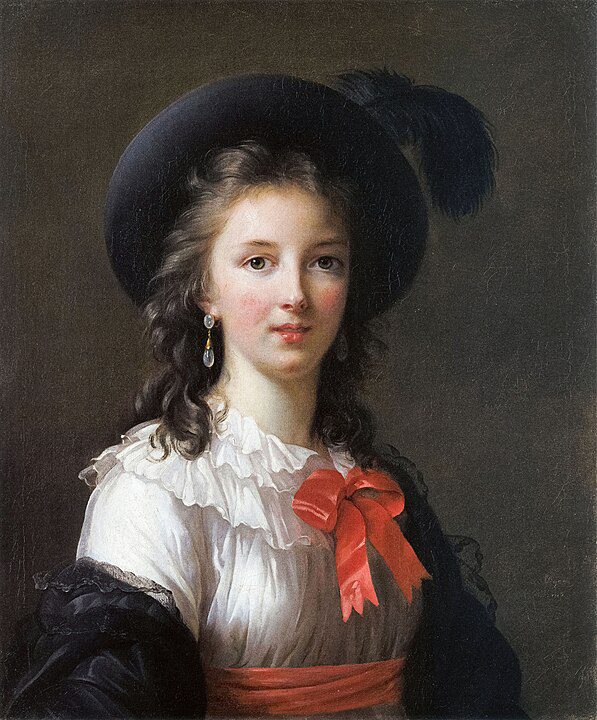
Élisabeth Louise Vigée Le Brun was born on April 16, 1755, in Paris, into an artistic family—her father, Louis Vigée, was a portraitist who recognized his daughter’s gift early. After his death in 1767, she supported her mother and brother through painting. She married art dealer Jean-Baptiste Le Brun in 1776, a union that offered both opportunity and constraint. His connections helped launch her career, but their relationship eventually soured due to financial disagreements and infidelity.
Élisabeth’s breakthrough came when she became the favorite portraitist of Queen Marie Antoinette in the early 1780s. Her ability to capture the queen’s charm and personality in a refined, graceful style earned her royal favor and countless commissions. In 1783, she was admitted to the Académie Royale de Peinture et de Sculpture—one of only a handful of women ever granted this honor, and largely thanks to the Queen’s intervention. Her 1783 portrait Marie Antoinette in a Muslin Dress was both praised and criticized for its intimacy, signaling a shift in public portraiture.
Exile and Endurance
The French Revolution forced Vigée Le Brun into exile in 1789. Despite the fall of the monarchy and the dangers it posed to royal affiliates like herself, she managed to thrive abroad. Over the next decade, she traveled to Italy, Austria, Germany, and Russia, where she painted members of the European elite, including Empress Catherine the Great’s granddaughters. Her work retained a delicate elegance that appealed to the aristocracy of multiple nations.
Though she returned to France in 1802 after the rise of Napoleon, her artistic style was considered outdated in the new political climate. She continued to paint but was never again as prominent as during her pre-revolutionary years. Élisabeth published her memoirs in 1835, offering invaluable insight into her career and society. She died on March 30, 1842, at the age of 86, in Paris, leaving behind over 660 portraits and 200 landscapes.
Anne Vallayer-Coster – Still Life with Status
Anne Vallayer-Coster was born on December 21, 1744, in Paris into a family of artisans, which provided her early exposure to the decorative arts. She gravitated toward still life, a genre often regarded as lower in prestige, but one in which she demonstrated unmatched technical mastery. Her skill was evident in her meticulous renderings of fruit, flowers, and luxurious objects, all painted with dazzling clarity. She was influenced by the Dutch still life tradition but elevated the genre with French refinement.
Her talents did not go unnoticed. In 1770, at just 26 years old, Vallayer-Coster was accepted into the Académie Royale de Peinture et de Sculpture—an extraordinary feat for a woman at the time. Her reception piece, Attributes of Music (1770), showcased her command of texture and symbolism. Despite working in a genre considered decorative, she gained the patronage of Queen Marie Antoinette and exhibited regularly at the prestigious Paris Salon. Her still lifes often included musical instruments, books, and fine fabrics, offering symbolic commentary on wealth and mortality.
Patronage and Prestige
Although her royal connections brought her prominence during the 1770s and 1780s, the outbreak of the French Revolution in 1789 dramatically shifted her fortunes. Like many artists linked to the court, Vallayer-Coster found herself on the periphery of the new political order. She continued to work but without the lavish commissions and prestige she once enjoyed. After 1795, her public presence diminished, and her name faded from art historical discourse.
She married Jean-Pierre Silvestre Coster in 1781 and largely retreated into private life during her later years. Her technical accomplishments remained respected by those who knew her work, but without champions in the new regime, her legacy languished. She died in 1818 in Paris, having lived through the rise and fall of empires, revolutions, and a dramatic reshaping of French society. Only in recent decades have her paintings been revisited as masterpieces in their own right.
Rosalba Carriera – The Venetian Pastellist
Rosalba Carriera was born on October 7, 1673, in Venice. Though technically born in the 17th century, her major influence flourished in the 18th. She began her career painting miniature portraits on snuffboxes before moving on to full-scale portraiture. Carriera is widely credited with elevating pastel painting to a respected art form across Europe.
Her delicate, soft-focus portraits captured the faces of nobles, musicians, and intellectuals with a unique intimacy. In 1720, she was invited to France and became a member of the Académie Royale—a rare honor for a woman and a foreigner. There, she painted Louis XV as a child and many members of the French court. Her pastel technique brought a new sense of vitality and freshness to portraiture, offering a subtle alternative to the heavier oil portraits common in that era.
Innovation in Medium
Carriera’s pastels allowed her to convey textures and skin tones with a tenderness few oil painters could match. This innovation made her immensely popular, especially among the more refined circles of Paris and Vienna. She traveled extensively, including to Germany and Austria, and her reputation spread throughout the courts of Europe. Her influence reached artists such as Maurice Quentin de La Tour and Jean-Étienne Liotard.
Later in life, Carriera suffered from failing eyesight and eventually went blind. She died on April 15, 1757, in Venice, after a long and prolific career. Though celebrated in her lifetime, her association with pastel—long considered inferior to oil—contributed to her marginalization in later histories. Today, scholars and collectors are revisiting her legacy, recognizing her as one of the most technically gifted and innovative portraitists of her century.
Mary Moser – The English Botanical Virtuoso
Mary Moser was born in London on October 27, 1744, the daughter of Swiss-born painter George Michael Moser. Her father was a founding member of the Royal Academy and taught her both painting and engraving from a young age. Moser exhibited her first works at the Society of Artists when she was just 14, showing remarkable skill in floral composition. Her paintings combined botanical precision with a lush, almost theatrical beauty.
In 1768, at age 24, Moser was chosen alongside Angelica Kauffman as one of the two female founding members of the Royal Academy of Arts in London. Her floral still lifes were both scientifically accurate and artistically captivating, earning the admiration of elite patrons. Her most significant commission came in 1790 when Queen Charlotte asked her to decorate a room at Frogmore House. The resulting floral compositions were grand in scale and executed with meticulous detail.
Institutional Ironies
Despite her foundational role in the Royal Academy, Moser was effectively excluded from many of its activities. Women were barred from attending nude life-drawing classes—an essential aspect of academic training—restricting their ability to master historical painting. Though Moser’s talents were undeniable, the very institution she helped found maintained barriers against her full participation. Her success, in some ways, highlighted the paradox of progress without equality.
In 1793, Moser married Captain Hugh Lloyd and gradually retired from public artistic life. She died in 1819 in London, at age 75, largely forgotten by the institution she had helped build. For decades, she was remembered only as a novelty—a female exception to the male rule. But modern reevaluations recognize her as a skilled artist in her own right, deserving of more than a historical footnote.
Margareta Haverman – The Mystery of the Dutch Flower Painter
Margareta Haverman was born around 1693 in Breda, in the Dutch Republic. Little is known about her early life, but she studied under the celebrated flower painter Jan van Huysum, possibly without formal apprenticeship. Her style bears striking similarities to his, leading to questions of authorship in later years. What is clear is that Haverman had exceptional skill and ambition, seeking recognition at the highest levels.
In 1722, she was admitted to the prestigious Académie Royale in Paris—a rare accomplishment for a foreign-born woman. However, her acceptance was soon mired in scandal when it was alleged that one of her works had been completed by her teacher, van Huysum. The accusation led to her expulsion from the Academy, and her name was scrubbed from the records. Only two of her paintings are definitively known today, both exquisite floral compositions.
The Signature Scandal
The controversy over her admission may have been influenced as much by institutional jealousy as by any real deception. The fact that she, a woman, had entered a respected academy with such technical mastery may have provoked backlash. After her expulsion, she faded into obscurity, and no confirmed records of her life after 1723 exist. She may have returned to the Netherlands, or perhaps she gave up painting entirely.
Haverman’s legacy remains largely speculative, but her work demonstrates undeniable talent. The few surviving paintings show a deep understanding of light, composition, and botanical form. Her story serves as a powerful symbol of how fragile a woman’s career could be in the art world of the 18th century. Today, art historians are re-examining her case, offering a more sympathetic and balanced interpretation.
Why These Artists Were Forgotten – And Why They Matter Today
Despite their talent, many of these women artists were erased from the historical record shortly after their deaths. Their works were often misattributed to male painters or dismissed as “feminine” or decorative. The rise of Romanticism and later Realism in the 19th century redefined artistic values, leaving Neoclassical and floral works out of fashion. As art history became more academic, male scholars frequently overlooked women’s contributions.
This erasure was not accidental—it was built into the very structure of how art was collected, exhibited, and taught. Museums often neglected to acquire women’s works, and art textbooks ignored them. Without institutional backing, their names disappeared, even as their paintings remained on walls under incorrect attributions. The failure to record and preserve their stories created generations of silence.
Modern Rediscovery Movements
The second half of the 20th century saw a resurgence of interest in recovering lost women artists, led by scholars like Linda Nochlin and institutions like the National Museum of Women in the Arts. Exhibitions such as “Women Artists: 1550–1950” (1976) brought forgotten names back to public attention. Digital catalogues and global museum databases have made it easier to reattribute works and document careers. As a result, these artists are finally receiving the recognition they long deserved.
Recovering these stories is not simply an act of justice—it’s a chance to understand art history more fully. The inclusion of women broadens our sense of what 18th-century art looked like and who contributed to its evolution. These women were not exceptions; they were participants in a vibrant artistic world that unjustly excluded them from the canon. Restoring their place in history enriches both the past and our present.
Key Takeaways
- Women artists of the 18th century achieved significant success despite institutional exclusion.
- Angelica Kauffman and Mary Moser were Royal Academy founders but still faced limitations.
- Vigée Le Brun’s career spanned monarchies and revolutions, surviving exile and scandal.
- Modern institutions are working to restore these forgotten legacies to their rightful place.
- Studying these women reshapes our understanding of 18th-century art history.
FAQs
- Why were women artists excluded from formal training?
Art institutions often barred women from nude life-drawing classes and academic mentorship. - Are any of these artists’ works displayed today?
Yes, major museums like the Louvre, the National Gallery, and the Getty have works by these women. - What role did royal patronage play in their careers?
Patronage from figures like Marie Antoinette was crucial to their early success and visibility. - Were these women recognized in their lifetimes?
Many were celebrated during their careers but forgotten posthumously due to systemic bias. - How are scholars recovering these lost stories?
Through archival research, digital cataloguing, and feminist art history initiatives.