Master Theodoric presents us with one of the great puzzles of medieval art. We can still stand before the extraordinary paintings associated with his workshop and study the heavy faces, brilliant colors, and solemn eyes of his saints. Yet when we turn from those paintings to the man himself, much of his life vanishes into darkness. His birthplace is uncertain. His childhood and artistic training are poorly documented. Even the final years of his life resist the tidy conclusions we expect from a modern biography.
What survives is enough to reveal an artist of remarkable importance. Master Theodoric became a court painter to Charles IV, King of Bohemia and Holy Roman Emperor. His career brought him into the artistic world surrounding Prague and eventually to one of the most ambitious projects of Charles’s reign: the decoration of the Chapel of the Holy Cross at Karlštejn Castle. There, Theodoric and his workshop created an unforgettable gathering of saints and holy figures.
The Mysterious Master of Medieval Bohemia
A Famous Painter With an Unknown Past
There is something strangely appropriate about Master Theodoric’s obscurity. Medieval paintings often preserve the faces of kings and saints while allowing the artists themselves to slip out of sight. Theodoric is different because his name did survive. Even so, we know far less about his personal life than we know about many famous artists of later centuries.
There is no reliable childhood story to tell. We cannot follow a young Theodoric into his first workshop or confidently identify the teacher who put a brush into his hand. Attempts have been made to explain his origins and training through the appearance of his art, but stylistic evidence has limits. Artistic influence can travel through paintings, manuscripts, workshops, and other artists. It does not prove that Theodoric personally visited every place whose art resembles his own.
The Artist Behind Karlštejn’s Sacred Images
What emerges more clearly is the mature professional. The National Gallery Prague identifies Master Theodoric as the court painter of Charles IV. It also records that one of the medieval houses formerly occupying the site of today’s Schwarzenberg Palace contained Theodoric’s workshop. He was therefore physically established in Hradčany, beside the political and artistic world of Prague Castle.
That evidence immediately gives the mysterious painter a little more substance. Theodoric was not simply a name later invented for a group of similar medieval paintings. He was a recognized artist with a workshop and a place within the emperor’s artistic circle. Most importantly, his name became associated with the vast painted ensemble created for Karlštejn Castle.
Who Was Master Theodoric?
What the Historical Records Tell Us
Theodoric was active in Bohemia during the 14th century, at a time when Prague had become one of Central Europe’s great political and cultural centers. His title of “Master” should not be read merely as a modern compliment. He occupied an established professional position and operated within the workshop system through which major medieval artistic projects were produced.
His location is unusually tangible. Theodoric’s workshop stood in one of the medieval houses on the site where Schwarzenberg Palace now rises in Hradčany. Those houses were later damaged in the great Hradčany fire of 1541, long after the painter’s lifetime. The Renaissance palace subsequently built there erased the medieval workshop physically, but documentary history preserves its connection with Theodoric.
The location mattered. Hradčany developed beside Prague Castle, placing Theodoric close to the heart of royal patronage. An artist working there was operating in a world filled with architects, craftsmen, clerics, administrators, patrons, and other painters. Theodoric’s art should therefore be understood as the product of a sophisticated court environment rather than the isolated achievement of a painter working at the edge of medieval Europe.
The Mystery of Theodoric’s Origins
The beginning of his life is much harder to recover. Master Theodoric’s exact birthplace and birth date cannot be stated with confidence. Neither can we construct a secure account of his parents or childhood. Even his artistic education remains a subject for interpretation rather than a simple documented story.
His unusual name and the international character of art at Charles IV’s court have encouraged theories about his origins. Scholars have also compared his work with artistic traditions elsewhere in Europe. Those comparisons are valuable for understanding style, but they need to be handled carefully in a biography. Similarities between paintings do not provide passport stamps.
It is safer to picture Theodoric as an artist formed within the highly connected artistic culture of 14th-century Europe. Prague under Charles IV drew ideas and talent from beyond Bohemia. Italian, French, German-speaking, and other Central European traditions could meet within court culture. Whatever the exact path of Theodoric’s education, his mature work demonstrates that he understood how to transform this rich artistic environment into something powerfully his own.
Master Theodoric and the Court of Charles IV
Charles IV and the Rise of Prague
The great patron behind Theodoric’s career was Charles IV. Born in 1316, Charles became King of Bohemia and Holy Roman Emperor. He made Prague one of the principal centers of his rule and sponsored an extraordinary range of architectural, religious, intellectual, and artistic projects.
The Prague in which Theodoric worked was therefore undergoing dramatic change. Charles founded major institutions and commissioned buildings designed to express the prestige of his dynasty and capital. Religion was inseparable from much of this patronage. Churches, relics, sacred images, and precious objects carried spiritual meaning while also contributing to the public image of Christian rulership.
Artists benefited from this ambition. A court seeking magnificent buildings and interiors required skilled painters, sculptors, goldsmiths, builders, and manuscript illuminators. Theodoric’s career developed within this fertile setting. He was fortunate in his patron, but Charles was equally fortunate in having artists capable of giving visible form to his ambitions.
Becoming an Imperial Court Painter
The National Gallery Prague explicitly describes Theodoric as the court painter of Charles IV. That status is important because it moves him beyond the vague category of an anonymous medieval craftsman. Theodoric had attained a position sufficiently prominent for his professional identity to enter the historical record.
We should not embellish that relationship unnecessarily. Calling Theodoric the emperor’s court painter does not mean we know that the two men were close friends or spent evenings discussing art. Medieval patronage was governed by rank, religion, money, duty, and court organization. The surviving evidence allows us to establish a significant professional relationship without inventing a personal one.
Charles’s confidence in Theodoric is best understood through the importance of the work associated with him. The Chapel of the Holy Cross at Karlštejn was no minor decorative assignment. It formed part of an exceptionally important sacred and imperial setting. Theodoric’s participation tells us that he had reached the upper levels of his profession.
Karlštejn Castle and the Chapel of the Holy Cross
Charles IV’s Extraordinary Castle
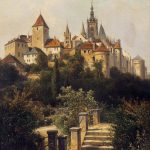
Karlštejn rises dramatically above the landscape southwest of Prague. Charles IV founded the castle in 1348, and its role developed in connection with royal treasures, relics, and ultimately the imperial coronation treasure. Its architecture climbs toward the Great Tower, a massive structure that became the setting for the castle’s most extraordinary sacred interior.
In the early 1360s, Charles decided to place the imperial coronation treasure at Karlštejn. A chamber in the Great Tower was consequently transformed into the Chapel of the Holy Cross. The chapel was consecrated on February 9, 1365. Its decoration matched the exceptional value of what it protected.
The walls combined gilded surfaces with precious stones, relief ornament, relics, and paintings. This was not decoration for decoration’s sake. The whole room worked as a sacred environment. Gold caught the light. Precious materials separated the chapel visually from ordinary rooms. Images of holy figures surrounded the treasures entrusted to the space. The result must have seemed less like entering another chamber and more like crossing into a jeweled vision of heaven.
Theodoric’s Great Company of Saints
The most famous part of the chapel is the great series of painted panels produced by Master Theodoric and his Prague workshop. Karlštejn’s detailed historical account describes an original arrangement of 130 panels, while the castle’s current visitor information highlights the surviving set of 129 paintings. The distinction is useful because it separates the original decorative program from what visitors encounter today.
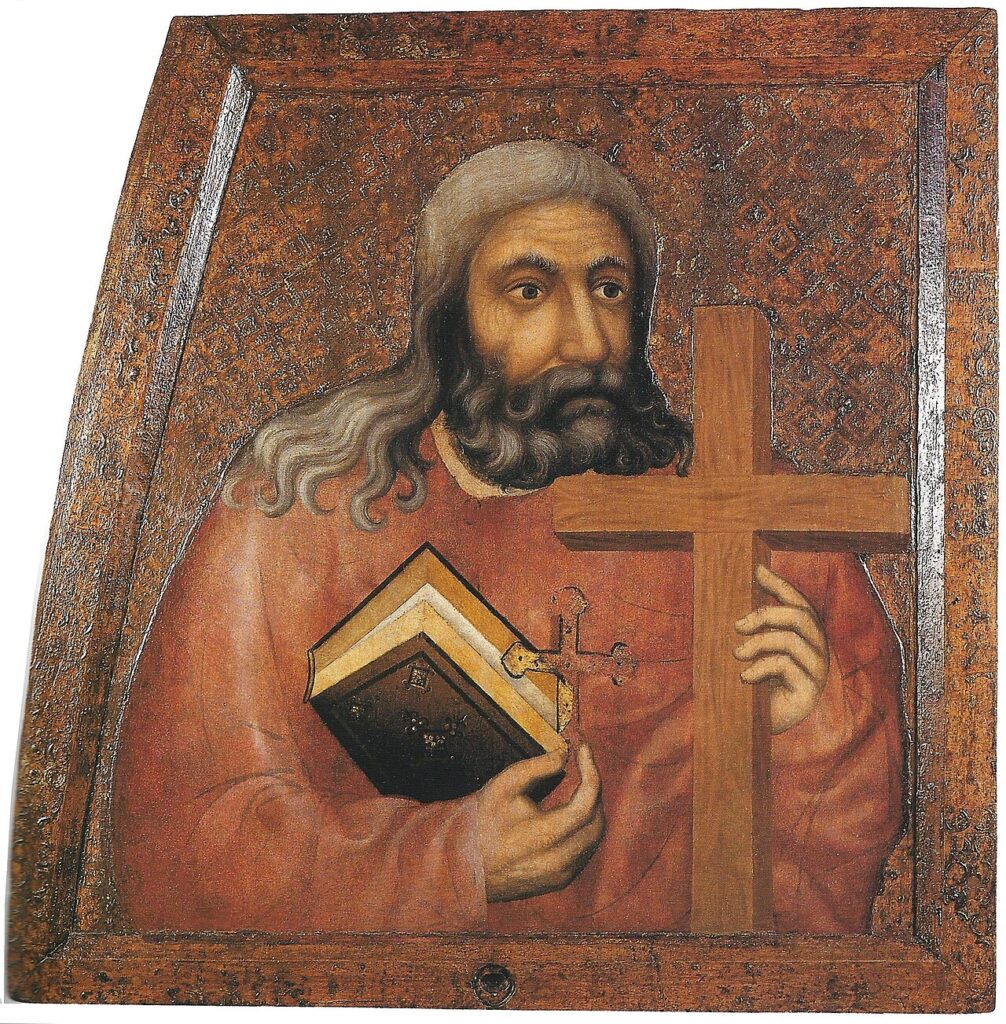
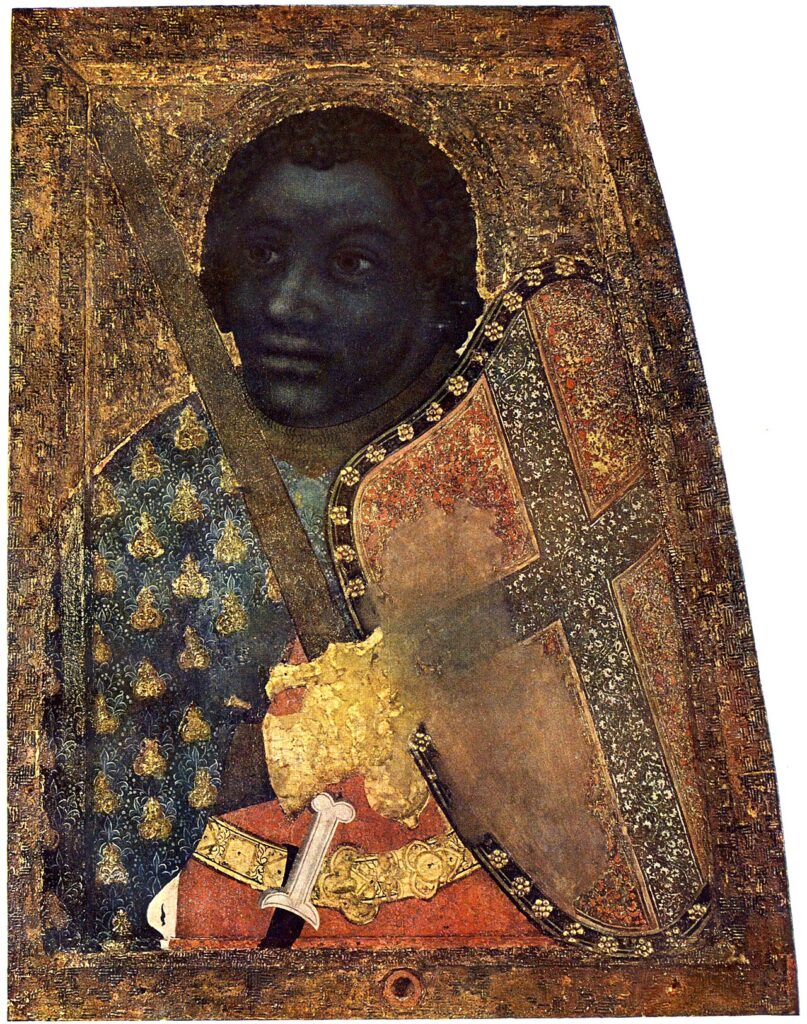
The subjects form an immense gathering of sacred figures rather than a conventional narrative sequence. Saints and other holy personages appear against precious backgrounds, turning the walls into a heavenly assembly. Their placement was closely connected with the religious purpose of the chapel and the treasures protected there.
It would be misleading, however, to imagine Theodoric sitting alone and personally completing every panel from beginning to end. Medieval masters directed workshops, especially when commissions reached this scale. The surviving Karlštejn ensemble is associated with Theodoric and his workshop, and differences among individual paintings have long encouraged study of workshop practice.
That does not diminish Theodoric’s achievement. Quite the opposite. Directing a major workshop was part of being a successful medieval master. The extraordinary unity of the chapel depended upon artistic organization as well as individual skill.
What Made Master Theodoric’s Painting Different?
Saints Who Look Strikingly Human
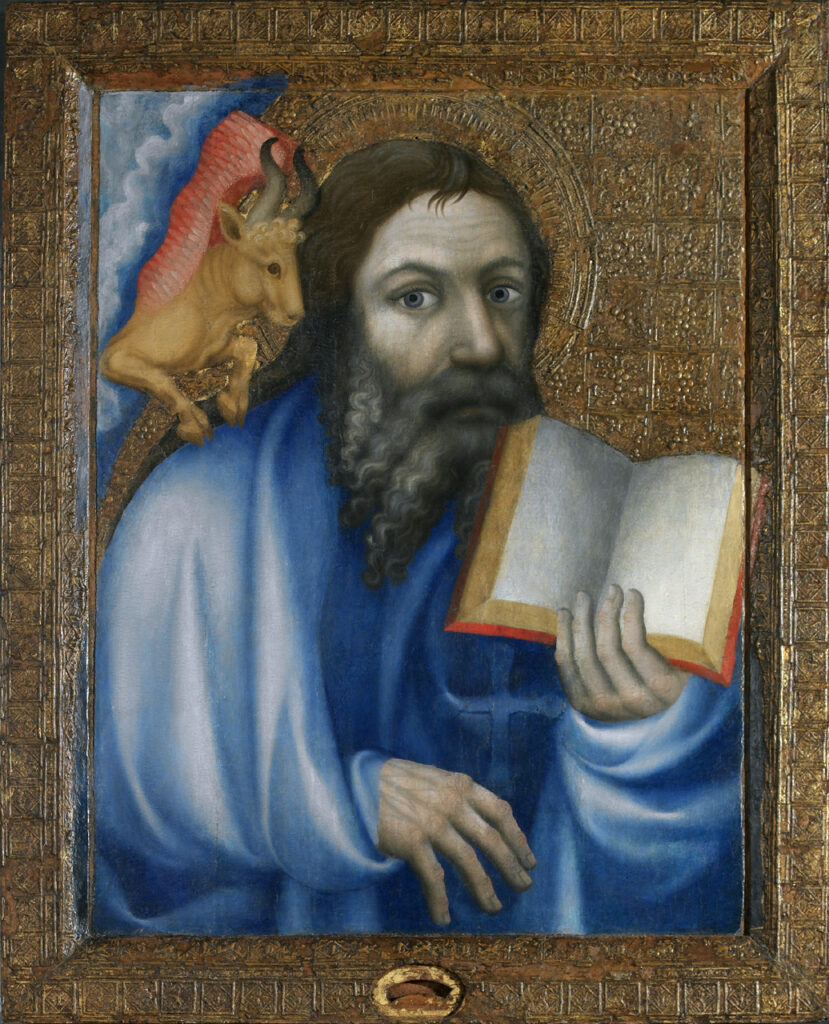
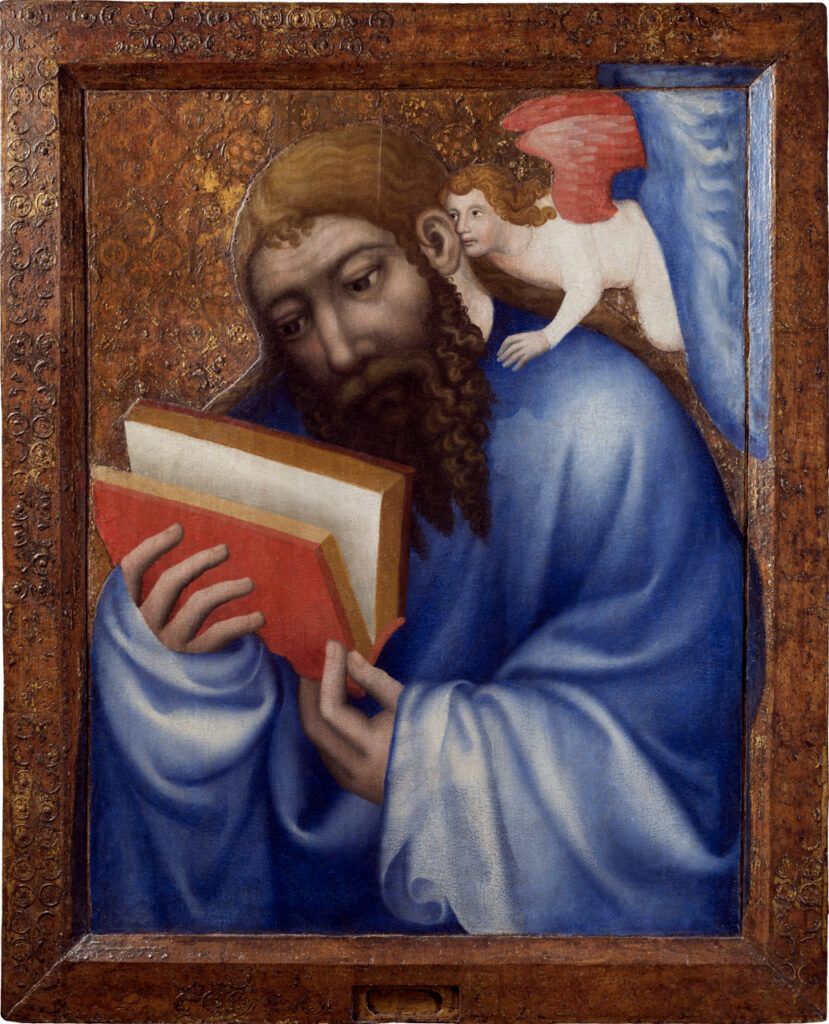
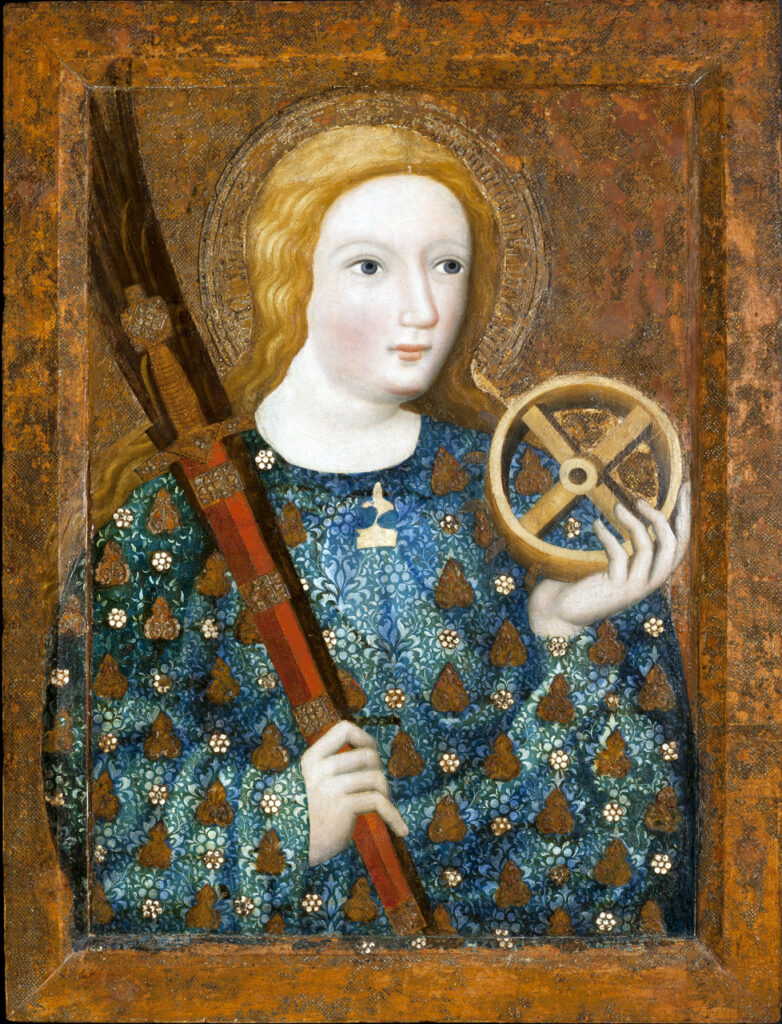
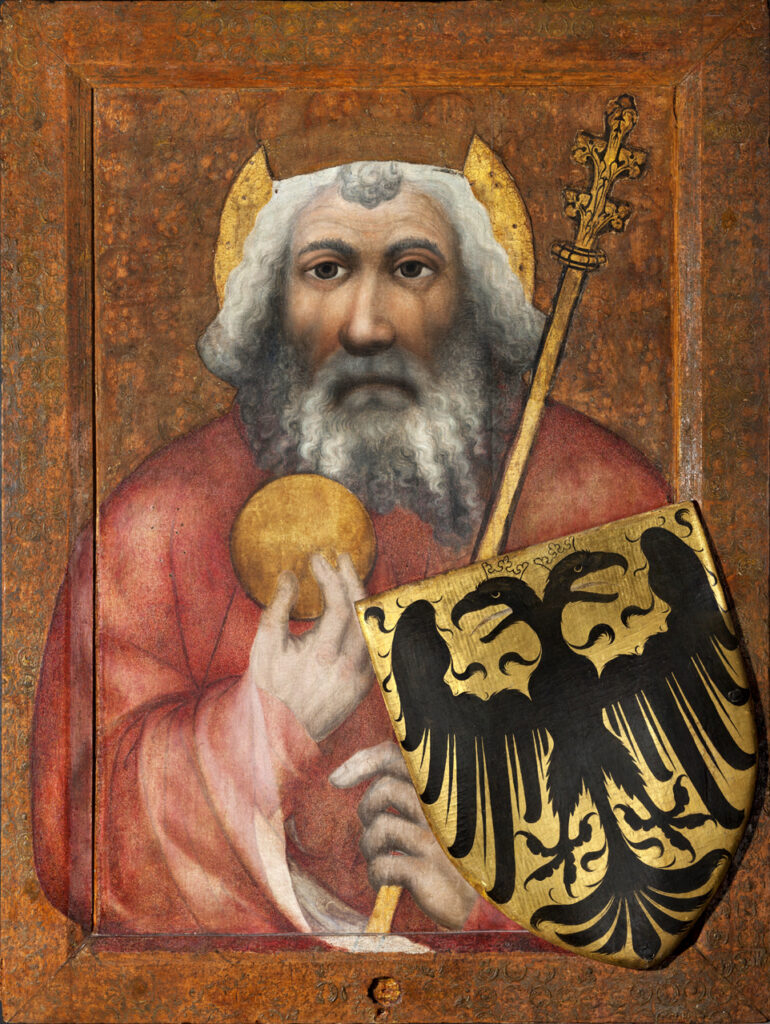
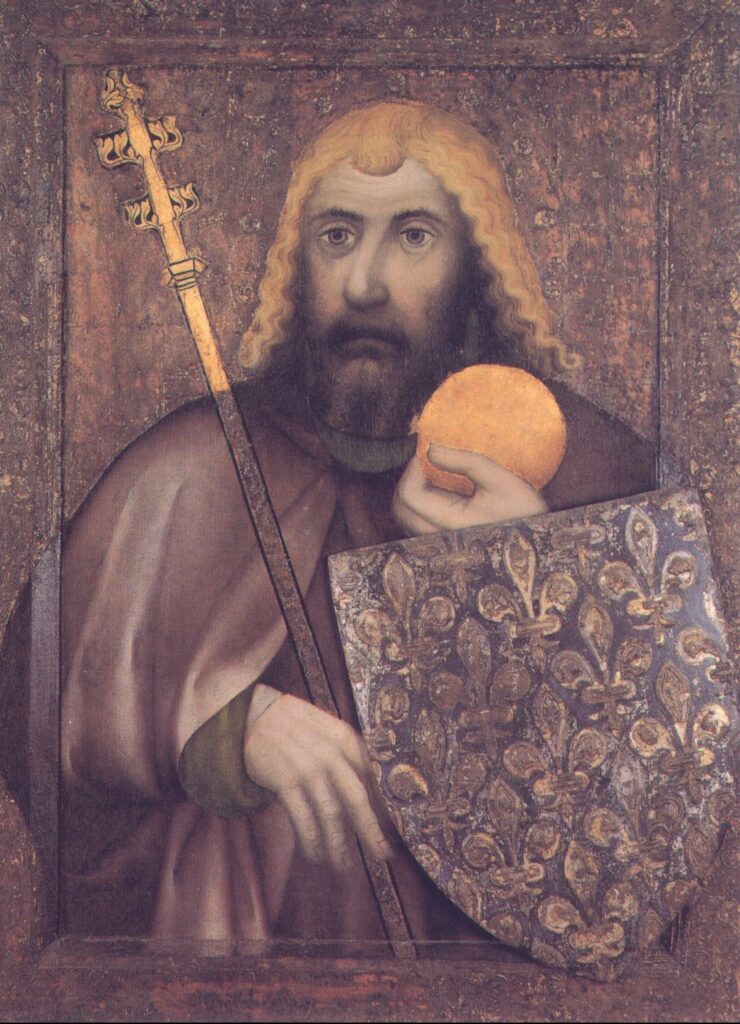
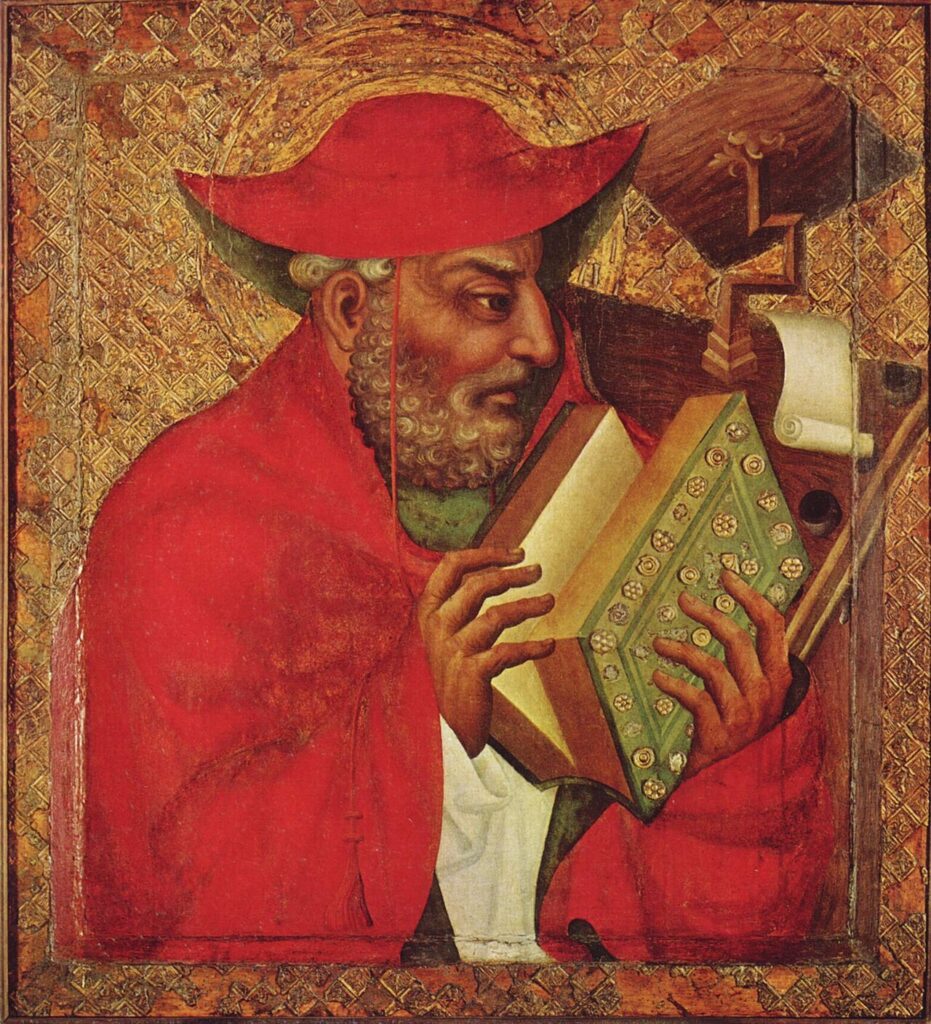
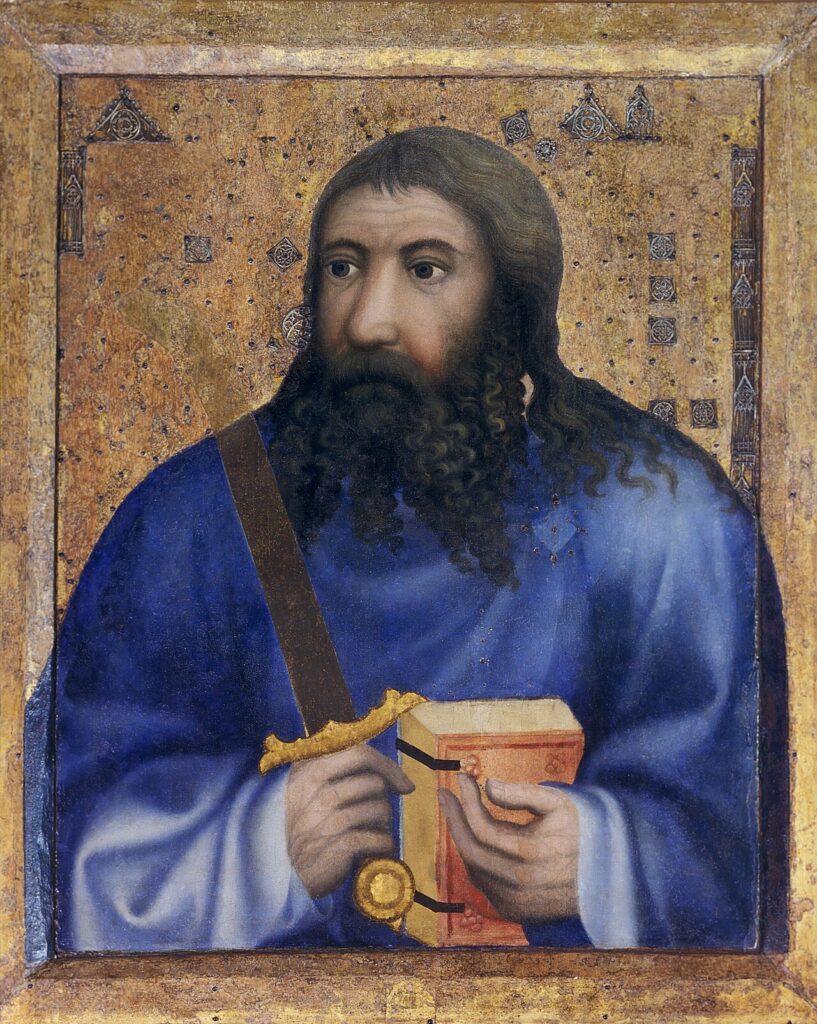
Theodoric’s saints possess an extraordinary physical presence. Their heads can be broad and heavy. Cheeks swell outward, noses project strongly, and thick necks support substantial bodies. Instead of seeming weightless, these holy men and women appear firmly anchored in the world before us.
Their faces are equally memorable. One figure may have a dense beard and tired eyes, while another possesses smoother features and a quieter expression. Hair, wrinkles, eyebrows, mouths, and facial structures vary enough to create a striking sense of individuality. Look at several paintings together and they begin to feel like a gathering of distinct personalities.
We should be careful with the word “portrait.” These are sacred images created according to medieval religious purposes, not modern portraits painted from living saints posing in Theodoric’s studio. Yet the degree of individuality gives them a remarkable human immediacy. Theodoric makes holiness feel substantial.
That quality helps explain why the paintings still communicate so directly. Medieval symbolism can sometimes require explanation before a modern viewer understands it. A human face does not. The solemn eyes and weighty bodies of Theodoric’s saints provide an immediate doorway into a far more complex sacred program.
Gold, Color, and Bohemian Gothic Style
The figures were never intended to be seen in isolation against plain museum walls. They belonged to an interior rich with gold, precious stones, relics, and ornamental surfaces. The visual effect depended upon the relationship between painting and architecture. A painted saint was one element in a much larger experience.
Color reinforces the strength of the figures. Rich clothing, modeled flesh, dark outlines, and luminous backgrounds help distinguish one figure from another. The bodies possess enough volume to suggest three-dimensional presence, yet the precious backgrounds remind us that they inhabit a sacred realm rather than an ordinary room.
This combination places Theodoric among the great figures of Bohemian Gothic painting. His art belongs to the flourishing visual culture created around Charles IV, but it is not simply an imitation of one foreign school. Prague was connected to a broader European world, and artistic ideas moved across political borders much as scholars, clergy, merchants, and craftsmen did.
Theodoric absorbed that cosmopolitan atmosphere while producing paintings with a highly recognizable character. His saints can be grand without becoming distant. They are richly decorated without dissolving into ornament. Their golden world promises heaven, but their faces retain the weight and variety of humanity.
The Man Behind the Paintings
What Theodoric’s Success Reveals About His Life
When documentary biography becomes thin, professional achievement can still tell us something about a person’s life. Theodoric maintained a workshop in Hradčany and worked for one of the most powerful rulers of his age. He became associated with a sacred commission of exceptional importance. None of those things suggest an obscure or unsuccessful craftsman.
The workshop itself is particularly revealing. Large medieval commissions required materials, preparation, assistants, planning, and coordination. Paintings had to fit an architectural program. The production of so many panels for Karlštejn therefore points toward an organized artistic enterprise rather than a painter casually producing pictures one after another.
His career also challenges the cliché that medieval artists were universally anonymous and socially invisible. Many certainly remain unknown to us, but circumstances varied enormously. Theodoric possessed an identifiable professional status, and Charles IV’s patronage brought his work into an elite court setting.
We should nevertheless stop where the evidence stops. Success does not tell us whether Theodoric was charming, difficult, humorous, stern, generous, or ambitious. His paintings tempt us to imagine the personality behind them, but imagination is not documentation.
The Final Mystery of Master Theodoric
The later stages of Theodoric’s biography are consequently quieter than the dramatic Karlštejn commission. We do not possess the kind of continuous personal record that would let us follow him comfortably into old age. His life eventually recedes from view.
This uncertainty is sometimes frustrating because modern biographies train us to expect completeness. We want an artist to be born on page one, discover a talent, meet important people, produce masterpieces, grow old, and die on the final page. The Middle Ages rarely cooperate so neatly.
There is also no reason to fill the gaps with legends. Claims about Theodoric’s family, personality, journeys, or private relationships require evidence before they can be presented as facts. A responsible biography can admit that some questions have no secure answer.
In Theodoric’s case, the silence creates a striking contrast. We cannot confidently reconstruct the face of the painter himself, yet he left behind an entire society of faces. His saints survived even as so much information about their maker disappeared.
Master Theodoric’s Legacy
A Master of Medieval Bohemian Art
Theodoric’s importance reaches beyond a single castle chapel. His work belongs to the remarkable artistic flowering of Bohemia under Charles IV. During this period, Prague stood among the significant artistic and intellectual centers of Europe, and the emperor’s patronage encouraged works of unusual scale and ambition.
Karlštejn demonstrates that ambition particularly clearly. The chapel united architecture, panel painting, precious materials, relics, and imperial treasure within one carefully conceived environment. Theodoric’s paintings were essential to that whole. Removing them mentally from their setting means losing part of their original meaning.
The National Heritage Institute describes Theodoric’s Karlštejn achievement as belonging among the high points of European medieval art. Such importance does not depend upon knowing every detail of the artist’s childhood. It rests upon what actually survives.
Master Theodoric therefore occupies an unusual position. His personal biography is fragmentary, yet his artistic identity is powerful. Few facts tell us who he was at breakfast or how he spent an ordinary afternoon. His paintings tell us what he could accomplish when entrusted with an extraordinary commission.
Why Theodoric Still Matters Today
More than six centuries separate modern viewers from Theodoric’s workshop. Almost everything about the world surrounding his paintings has changed. The political structure of the Holy Roman Empire is gone. The devotional habits of medieval courts can seem distant. Even the way we normally encounter paintings—in museums, books, or on screens—is radically different.
Karlštejn gives us a rare chance to reduce that distance. The surviving paintings remain tied to the place for which the ensemble was created. Architecture and images can therefore still be understood together. That makes the chapel more than a container for valuable old pictures.
The paintings also remind us not to underestimate medieval artists. Theodoric and his workshop understood how faces, color, materials, repetition, and architectural setting could work together. The effect is both intellectual and emotional. Dozens of separate sacred figures become a single overwhelming company.
Perhaps that is Master Theodoric’s most enduring achievement. His personal voice has been lost, but his visual language remains remarkably strong. We cannot hear him speak. We can still recognize the world he painted.
Key Takeaways
Five Facts to Remember
- Master Theodoric was a court painter of Charles IV and an important figure in 14th-century Bohemian Gothic painting.
- Much of Theodoric’s early biography remains uncertain, including his exact birthplace, birth date, childhood, and artistic training.
- His masterpiece is associated with the Chapel of the Holy Cross at Karlštejn Castle, consecrated in 1365.
- Karlštejn records an original program of 130 panels from Theodoric’s Prague workshop, with 129 paintings highlighted in the surviving ensemble today.
- Theodoric’s art is distinguished by monumental figures, individualized faces, rich color, and its integration into an exceptionally precious sacred interior.
Why His Mysterious Biography Matters
The gaps in Theodoric’s life are not merely inconveniences. They reveal something important about studying medieval art. Surviving objects can sometimes tell us far more than surviving documents, while documents themselves may record property, rank, and commissions but leave personality untouched.
The best way to approach Master Theodoric is therefore to accept the limits of the evidence. Doing so does not make his story weaker. It lets the genuine facts stand out more clearly. We discover a documented court painter, an established Prague workshop, an imperial patron, and a masterpiece that still survives at Karlštejn. That is already an extraordinary biography.
Frequently Asked Questions About Master Theodoric
Master Theodoric’s Life and Career
- Who was Master Theodoric? Master Theodoric was a 14th-century painter active in Bohemia. He became a court painter to Charles IV and is chiefly associated with the magnificent painted decoration of the Chapel of the Holy Cross at Karlštejn Castle.
- When did Master Theodoric live? Theodoric worked during the 14th century, particularly during the reign of Charles IV. His early life and precise birth date remain uncertain, so biographies should avoid presenting speculative dates as settled facts.
- Was Master Theodoric really Charles IV’s court painter? Yes. The National Gallery Prague identifies Theodoric as Charles IV’s court painter and records the presence of his workshop in medieval Hradčany.
Master Theodoric’s Paintings and Where to See Them
- What is Master Theodoric famous for? He is best known for the large ensemble of sacred panel paintings created with his workshop for the Chapel of the Holy Cross. The saints are notable for their substantial forms, distinctive faces, rich colors, and commanding presence.
- Where can you see Master Theodoric’s paintings? The defining surviving ensemble remains associated with the Chapel of the Holy Cross at Karlštejn Castle in the Czech Republic. The setting is particularly important because it helps visitors understand the paintings as parts of an integrated medieval sacred interior rather than merely individual works of art.
The questions surrounding Theodoric’s life will probably continue to interest scholars because documents and paintings offer different kinds of evidence. That uncertainty should not be mistaken for complete ignorance. We know enough to place him securely within Charles IV’s artistic world and to recognize the extraordinary importance of his Karlštejn work.
Conclusion: The Painter Who Survived Through His Saints
What We Know—and What We May Never Know
A conventional biography wants beginnings and endings. Master Theodoric gives us something different. His origins remain uncertain, his education cannot be reconstructed with confidence, and large parts of his private life have disappeared. Yet when the historical record becomes clearer, we encounter a successful professional painter working close to the center of imperial power.
We know that his workshop was located in Hradčany. We know that the National Gallery Prague identifies him as the court painter of Charles IV. Above all, we can connect his name and workshop with the extraordinary artistic project created for the Chapel of the Holy Cross at Karlštejn.
Those are not minor scraps of information. Together they establish Theodoric as a major artist within the cultural world of Charles IV. They also give us a rare opportunity to connect a named medieval painter with a surviving monumental ensemble.
What we should not do is invent the missing chapters. Theodoric does not need a fictional childhood, imaginary journeys, or invented conversations with the emperor to become interesting. The documented story is more compelling because it is real.
Master Theodoric’s Enduring Presence
Return mentally to Karlštejn and the mystery changes. Instead of searching for a missing birth certificate or a lost personal letter, look at the faces. One saint appears stern. Another seems almost weary. Beards curl around heavy jaws, eyes stare outward, and large bodies press against the boundaries of their painted spaces.
The man who organized this extraordinary painted world remains elusive. The artistic intelligence behind it does not. Through scale, color, facial variety, precious surfaces, and repetition, Master Theodoric and his workshop transformed a chapel into a gathering place for a heavenly court.
That may ultimately be the most fitting biography we can give him. Master Theodoric entered history through his profession rather than his private life. He served an emperor, ran a Prague workshop, and became associated with one of medieval Bohemia’s greatest artistic achievements.
We may never know Master Theodoric as completely as we know artists who lived centuries later. But stand before the saints of Karlštejn and the missing details cease to be the whole story. The painter disappeared. His faces did not.