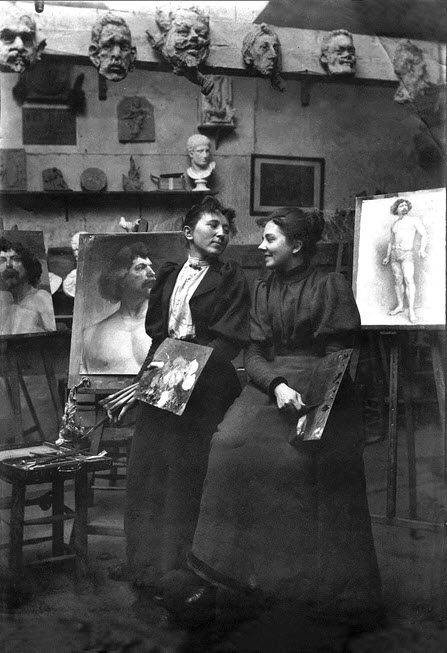
In the heart of Montparnasse, far from the ivory towers of the École des Beaux-Arts, a radical new vision for art education took root in 1904. This vision became the Académie de la Grande Chaumière—a humble yet groundbreaking institution founded on the principle of freedom in artistic expression. Its birth came during a pivotal era in Parisian culture, when the city pulsed with bohemian energy and rebellion against the rigid traditions of academic art. Here, in a converted building at 14 Rue de la Grande Chaumière, the school offered artists something rare: autonomy, community, and the right to paint or sculpt without institutional interference.
The founders of the academy were two remarkable women: Martha Stettler, born in 1870 in Bern, Switzerland, and Alice Dannenberg, born in 1861 in Mitau (then part of the Russian Empire). These women, both accomplished painters and partners in life, wanted to break from the rigid expectations of the École des Beaux-Arts, which at the time rarely accepted women and was notoriously hierarchical. Stettler and Dannenberg had studied at the Académie Julian but saw the need for something more egalitarian and creatively open. Together, they established a haven where all serious students could work in their own style, without being judged by antiquated rules.
At the Académie de la Grande Chaumière, students were not bound to strict curricula, rigid critiques, or competitive rankings. Instead, the school placed emphasis on personal development and daily practice, especially in the presence of live models—a practice central to the academy’s teaching. The “open studio” or atelier libre model allowed students to drop in and draw or sculpt from life for a small fee, making it accessible to local and international talent alike. This model stood in stark contrast to the stifling traditions upheld by other Parisian institutions at the time.
In many ways, the school’s formation was a declaration of independence—both from academic tyranny and from societal constraints placed especially on women and foreign-born artists. The Académie de la Grande Chaumière quickly became a magnet for free thinkers and avant-garde creators from around the world. Even in its early years, it welcomed students who were discouraged or excluded elsewhere, a sign of its commitment to artistic liberty. The founders’ decision to break away from formal institutional methods would change the trajectory of modern art in Europe and beyond.
The People Behind the School
Martha Stettler, who lived from 1870 to 1945, had been trained in Geneva before moving to Paris to immerse herself in the city’s burgeoning artistic life. Her works, often impressionistic, reflected a deep sensitivity to light and interior space. But it was her commitment to artistic equality that set her apart. She wanted a space where women could learn alongside men, not as exceptions but as peers, and this philosophy became a cornerstone of the Académie de la Grande Chaumière.
Alice Dannenberg, who passed away in 1948, was equally vital to the school’s ethos. A painter known for domestic scenes and children’s portraits, Dannenberg had experienced firsthand the challenges female artists faced in the conservative art world of the late 19th and early 20th centuries. Like Stettler, she sought to level the playing field, ensuring women had the same access to instruction and professional opportunity as their male counterparts. Together, the two women formed not just a pedagogical alliance but a life partnership that defied the expectations of their era.
Their leadership was rare and powerful in an age when women seldom occupied positions of authority in academic or artistic institutions. Not only did Stettler and Dannenberg establish the academy, but they also personally oversaw its operation, maintained its inclusive philosophy, and actively recruited faculty and models. Their approach emphasized integrity and merit over pedigree or academic lineage, creating a distinctive atmosphere that attracted passionate students from across the globe. The very existence of the school was a quiet but firm act of cultural rebellion.
Supporting their vision were influential artists who occasionally taught or advised at the school. These included Antoine Bourdelle, a renowned sculptor and former student of Rodin; Eugène Carrière, whose soft-focused, ethereal portraits had inspired the Symbolist movement; and Émile-René Ménard, a classical landscape painter who supported alternative teaching methods. These mentors brought not just technical knowledge but artistic legitimacy to the new school, bolstering its status as a credible, if unorthodox, alternative to traditional academies.
A Hub for Modernist Masters and Aspiring Artists
One of the academy’s greatest legacies is the dazzling list of names that once roamed its corridors and worked in its light-filled studios. Among the most famous was Amedeo Modigliani, the Italian painter and sculptor born in 1884, who arrived in Paris in 1906 and became a regular presence at the Académie de la Grande Chaumière. Known for his elongated forms and soulful portraits, Modigliani was deeply influenced by the emphasis on life drawing that the school championed. His years there allowed him to refine his craft while mingling with fellow expatriate artists and the city’s intellectual elite.
Alberto Giacometti, born in 1901 in Switzerland, enrolled at the academy in the 1920s and studied sculpture under the guidance of Bourdelle. His later work, especially the haunting, elongated bronze figures that defined existential modernism, owes much to the anatomical precision and raw observation skills honed in those early years. Giacometti would go on to represent Switzerland at the Venice Biennale in 1956, but the seeds of his genius were sown in Montparnasse. The school’s embrace of individual style over strict technique gave him room to evolve his haunting aesthetic.
The American kinetic sculptor Alexander Calder also passed through the academy in the 1920s, during his first European trip after graduating from Stevens Institute of Technology in 1919. At the Grande Chaumière, Calder encountered the freedom to explore abstraction without ridicule or constraint. It was here that he first began sketching human figures with wire, an early experiment that would lead to his famous mobiles. The academy’s open environment helped him move from engineering to artistic invention with confidence and vision.
Other notable alumni include Louise Bourgeois (1911–2010), a French-American artist whose psychological sculptures redefined feminist art in the 20th century; Isamu Noguchi (1904–1988), a Japanese-American artist and landscape architect who studied sculpture at the academy; and Tamara de Lempicka (1898–1980), the Polish-born painter known for her stylized Art Deco portraits. Each found at the Académie de la Grande Chaumière not just instruction but a vibrant community and the rare gift of creative permission. This was not a factory for conformity—it was a forge for originality.
Contrast with the Académie Julian and École des Beaux-Arts
The French academic system in the early 1900s was notoriously rigid, especially at the École des Beaux-Arts, which emphasized classical techniques, composition rules, and historical subject matter. Admission was competitive, and the curriculum often discouraged deviation from established norms. Students were expected to copy classical sculptures and reproduce idealized forms under strict supervision. This system left little room for innovation or personal voice, especially as modern art began to break all the old rules.
By contrast, the Académie Julian, established in 1868, was a bit more liberal but still maintained a somewhat structured academic model. Though it allowed female students and foreign nationals, it still offered critiques, competitions, and ranking systems that echoed the École des Beaux-Arts. While the Académie Julian was a step forward, it didn’t go far enough for many artists eager to experiment. It offered more access, but not always more freedom, especially in the years leading up to World War I.
The Académie de la Grande Chaumière diverged from both these schools by eliminating entrance exams and structured coursework entirely. Anyone with a passion for art could enroll in the open studios, regardless of background, training, or nationality. The school also avoided giving grades or diplomas, believing that artistic merit could not be quantified by bureaucratic means. This made it incredibly attractive to international students—especially women—who were often turned away from other institutions or subjected to limiting gender norms.
Because it allowed full creative freedom, the school became a safe harbor for the avant-garde. Whether students were experimenting with Fauvism, Cubism, or Surrealism, the Grande Chaumière welcomed them without hesitation. This radical approach, rooted in personal exploration and direct observation, helped birth some of the most dynamic movements of the 20th century. Where the École and Julian trained imitators, the Grande Chaumière cultivated innovators.
Sculpture, Drawing, and the Live Model Tradition
At the core of the Académie de la Grande Chaumière’s identity was its unshakable commitment to the live model. From its earliest days, students came not for lectures or tests but to spend long hours drawing or sculpting from life. The human figure was considered the ultimate test of skill and the most honest form of study. Whether a student was working in charcoal, pencil, clay, or paint, the model served as muse and teacher alike.
Antoine Bourdelle, one of Rodin’s most talented protégés, taught sculpture classes here and helped elevate the school’s reputation in this discipline. Born in 1861 and active until his death in 1929, Bourdelle believed in balancing classical discipline with emotional intensity—a philosophy perfectly suited to the school’s values. His classes were known for being rigorous yet liberating, encouraging students to feel the material and to imbue their forms with both structure and soul. His influence can still be traced in the works of students like Giacometti and Noguchi.
Even those not formally enrolled would often pay a daily fee just to work from the live model, making the atelier libre a democratic space of learning and practice. These sessions became a rite of passage for artists in Paris, where the room’s quiet focus and the still presence of the model created an almost sacred atmosphere. The model sessions didn’t favor any one style—realism, expressionism, abstraction—they simply encouraged close, honest study. This consistency anchored the school even as the art world evolved around it.
The academy’s emphasis on the figure didn’t wane, even as abstraction took hold in the mid-20th century. While many institutions abandoned traditional draftsmanship, the Grande Chaumière kept it alive—not out of nostalgia, but out of a belief that foundational skills empower artistic freedom. This fidelity to the human form allowed artists to innovate with intention rather than imitation. In a world obsessed with novelty, the school’s reverence for the eternal human body gave its students a timeless foundation.
Surviving Wars, Shifting Styles, and Changing Times
Despite its humble origins and lack of official state support, the Académie de la Grande Chaumière endured through the most turbulent decades of the 20th century. During World War I (1914–1918), the school remained open, though many instructors and students left to serve or were otherwise displaced. After the war, Paris experienced a surge of artistic energy known as the “Années folles” or “Crazy Years,” and the academy thrived as a hub for the many expatriates and creatives who poured into Montparnasse. The school’s resilience was a testament to its flexible structure and strong artistic identity.
World War II posed even greater challenges. Under the German occupation of Paris from 1940 to 1944, many artists fled the city, and creative institutions struggled to maintain operations. Nonetheless, the Grande Chaumière managed to remain open intermittently, offering its space as a quiet refuge for those still in the city. While some sessions were canceled and the roster of teachers changed, the school did not bow to political pressures or abandon its values. Unlike government-funded institutions, it operated without mandates, allowing it to sidestep much of the censorship that crippled official academies.
In the postwar years, especially through the 1950s and 1960s, the academy adapted to new movements without betraying its roots. It welcomed abstract expressionists, surrealists, and experimental sculptors while continuing to uphold the figure drawing tradition. Instructors like André Lhote (1885–1962), known for his Cubist theories, and Ossip Zadkine (1890–1967), a Russian-born sculptor, brought contemporary perspectives into the classrooms. These postwar years were some of the most vibrant in the school’s history, as it balanced continuity with innovation.
Throughout changing artistic climates—be it the rise of Dadaism, the heyday of Surrealism, or the postmodern turn—the school kept its doors open and its mission steady. It never became trendy or commercial, and that very resistance to fashion made it relevant in every era. Artists knew that at the Grande Chaumière, they could escape the politics and pretension often found in elite galleries or institutional settings. In its simplicity and honesty, the school survived while many others faded into irrelevance.
Legacy and Current Status of the Académie
Today, more than a century after its founding, the Académie de la Grande Chaumière still operates at 14 Rue de la Grande Chaumière, tucked quietly between the Luxembourg Gardens and the bustling cafes of Montparnasse. Though its fame has dimmed in comparison to its glory days, it remains a living monument to the values of artistic freedom and personal growth. The school now offers short-term workshops, drop-in model sessions, and summer courses, continuing to attract students from around the world. Its presence is a quiet but enduring echo of Paris’s once-thunderous artistic revolution.
In contrast to many contemporary art schools, the Grande Chaumière still refrains from offering degrees or certifications. This absence of formal credentials is intentional—it allows the academy to preserve its ethos of freedom, avoiding the pressures of accreditation, government oversight, and institutional conformity. Artists attend not for prestige or resume-padding, but for the pure discipline of practice and the magic of drawing from life. The result is a studio culture that feels refreshingly authentic in an era increasingly dominated by digital and conceptual art.
The academy’s name appears in countless memoirs and biographies of 20th-century artists. Its humble rooms have served as the backdrop for moments of discovery, inspiration, and deep artistic struggle. Though it is no longer the epicenter of the avant-garde, it continues to nurture serious students seeking to connect with timeless principles. The legacy of Stettler and Dannenberg lives on in every sketch, every sculpture, and every hour spent studying the human form in respectful silence.
In cultural terms, the Académie de la Grande Chaumière represents more than just an art school—it stands for the enduring value of craftsmanship, the dignity of labor, and the belief that talent flourishes best in freedom. While the art world shifts toward commercialism and ideological pressure, the Grande Chaumière reminds us that art is, at its heart, a human endeavor. It exists to reveal truth, not enforce orthodoxy. And in its enduring presence, the school quietly continues to shape the soul of modern art.
Key Takeaways
- Founded in 1904, the Académie de la Grande Chaumière promoted freedom over formal academic instruction.
- Female artists Martha Stettler and Alice Dannenberg led the school with a unique vision of equality and independence.
- Notable students included Amedeo Modigliani, Alexander Calder, Louise Bourgeois, and Alberto Giacometti.
- The academy emphasized life drawing, sculpture, and live model sessions without rigid curricula or exams.
- Still active today, the school offers workshops and remains a symbol of traditional artistic values.
FAQs
- Is the Académie de la Grande Chaumière still open?
Yes, it remains open in Paris and offers open studio sessions and art workshops. - Can international students attend classes there?
Absolutely—students from around the world are welcome without needing to pass exams. - What makes it different from the École des Beaux-Arts?
The Grande Chaumière offers freedom and informality, while the École enforces structured, academic programs. - Who are some famous artists associated with the school?
Modigliani, Calder, Giacometti, Bourgeois, Noguchi, and de Lempicka are all alumni. - Does the Académie offer degrees or certificates?
No, it maintains its original philosophy of non-academic, practice-based artistic development.