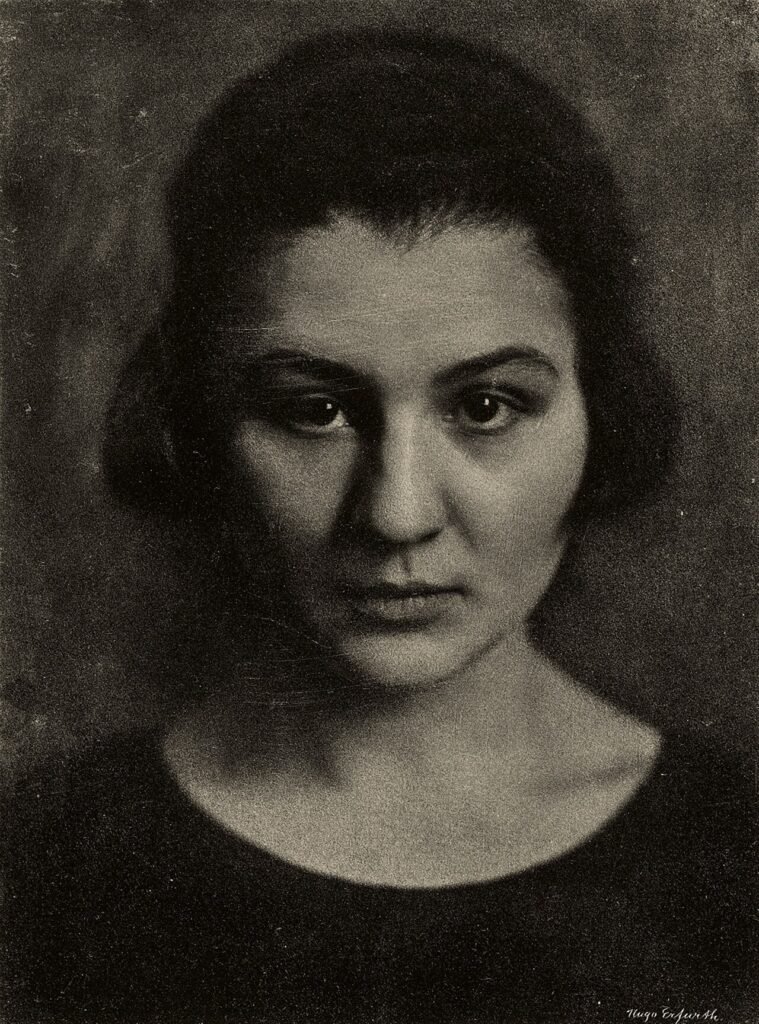
The circumstances in which Otto Dix met Martha Koch sound almost too perfectly constructed for a story about an artist and his muse. Martha was married to another man, and that man collected modern art, knew Dix, and invited the painter into his home to make his portrait. During the commission, Dix and Martha fell in love.
The resulting upheaval did not produce an ordinary scandal. Martha’s husband, Dr. Hans Koch, accepted the relationship. Martha divorced him in 1922 and married Dix the following year. Koch subsequently married Martha’s sister Maria. The former husband remained connected to the new couple and, years later, even provided the Dix family with a place to live.
For Otto and Martha, the encounter of 1921 began a relationship that lasted until the painter’s death in 1969. It was neither simple nor conventionally faithful. Yet Martha became one of the most important people in Dix’s life and one of the most persistent subjects in his art. Between 1921 and 1933 alone, he represented her again and again in paintings, watercolors, drawings and sketches. More than seventy portraits of Martha are known in different techniques. The result is something unusual in art history: a marriage whose changing character can be followed through the eyes of one of the 20th century’s most penetrating portraitists.
The Portrait Commission That Changed Two Marriages
Martha Koch Before Otto Dix
Martha was born Martha Lindner in Cologne on July 19, 1895. Her background differed sharply from Otto Dix’s. Dix, born in Untermhaus near Gera on December 2, 1891, grew up in a working-class household and trained initially as a decorative painter. Martha came from a prosperous upper-middle-class family. Her father, Bernhard Lindner, was an insurance director.
She received the education expected in a comfortable household, learning several foreign languages and playing the piano. More important for what followed, she developed a serious interest in modern art. In 1915, Martha married the Düsseldorf urologist Hans Koch, born in 1881. Koch was more than a physician: he was also a writer and art collector with strong interests in contemporary culture.
Martha and Hans became involved with the Graphisches Kabinett von Bergh & Co., informally known as the “Graphinett,” which exhibited modern artists including Emil Nolde, Erich Heckel, Lyonel Feininger and eventually Otto Dix. Martha therefore did not enter the modern-art world because she happened to marry Dix. She was already part of it when he appeared.
She and Koch had two children, but the history of their marriage was unusual even before Dix arrived. Koch had originally wanted to marry Martha’s sister Maria. The eventual arrangement among the Kochs, Lindners and Dix would be remarkably unconventional, yet the surviving evidence indicates far less hostility than might be expected from such circumstances.
Otto Dix Walks Into the Koch Home
Dix arrived in Düsseldorf toward the end of 1921, encouraged by the influential art dealer and patron Johanna Ey and by Hans Koch. He was thirty years old and emerging from a period of extraordinary experimentation. A veteran of the First World War, Dix had returned to Dresden and thrown himself into the radical artistic movements of the postwar years. His reputation was growing, but financial security had hardly followed.
Hans Koch asked Dix to paint him. It was Dix’s first portrait commission. The artist worked on it in the Koch home, where he met Martha, then twenty-six. Artist and sitter’s wife fell in love.
What followed could easily have become a bitter triangle. Instead, Hans Koch supported the developing relationship. Martha and Hans divorced in 1922. Koch later married Martha’s sister Maria, the woman he had originally wished to marry. That produced a family arrangement difficult to summarize without drawing a diagram: Martha’s former husband became her sister’s husband. He was simultaneously Otto Dix’s predecessor as Martha’s husband and, through Maria, his brother-in-law.
The connection did not simply disappear after the divorce. Martha married Otto Dix in Düsseldorf in 1923, and their daughter Nelly was born on June 14 of that year. Within roughly two years, Martha Koch had become Martha Dix, and Otto Dix had acquired the woman who would become the most frequently portrayed member of his family.
Martha Becomes the Woman Dix Cannot Stop Painting
From Lover to Muse
Martha’s importance to Dix is measurable in paint, pencil and paper. Kunstmuseum Stuttgart has documented approximately seventy representations of Martha produced in different techniques. In the concentrated period from 1921 to 1933, she appears repeatedly as lover, elegant society woman, companion, wife and mother.
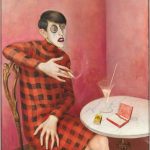
That quantity is significant because Dix was not an artist known for flattering people. His portraits of the 1920s are famous precisely because he noticed what other portraitists might have softened: an unusual nose, a nervous hand, pale skin, wrinkles, fashionable affectation, fatigue or an uncomfortable stare. Yet he kept returning to Martha.
The images consequently do not function like a single official portrait. They record different versions of the same woman. Martha changes her clothes and hairstyles, she ages, her family grows, and the emotional atmosphere shifts. Kunstmuseum Stuttgart has described a progression in these images from admiration and intimacy toward increasing distance. It is a rare visual record of a relationship developing over time.
The Martha of 1923
One image stands at the beginning of their married life: Bildnis Frau Martha Dix (Portrait of Mrs. Martha Dix), Otto Dix, 1923. Oil on canvas, 99.5 × 89 × 10 cm as catalogued by Kunstmuseum Stuttgart. Kunstmuseum Stuttgart, Stuttgart.
Dix painted it during the year of their marriage, when Martha was twenty-eight. She appears in three-quarter profile, dressed in black. A luxurious black fur envelops her while leaving part of her neck and shoulder exposed. Against these dark areas, Dix placed one of the picture’s most memorable elements: an intense red velvet hat. Her dark bob frames a pale face, her lips are painted deep red, and a white-gloved hand gathers the fur against her chest while the other hand is bare. The contrast is carefully constructed—black clothing, white glove, pale skin and brilliant red.
But Martha does not simply look happy. Her eyes are directed into the distance, and her expression carries the psychological ambiguity typical of Dix’s portraits. She is elegant and composed, yet something about her remains inaccessible. This is not the sentimental image of a painter idealizing his new bride. Dix was already looking at Martha as both husband and portraitist, and Martha appears to understand perfectly well that she is being looked at.
A Marriage Becomes a Family
In the autumn of 1925, Otto, Martha and their daughter Nelly moved to Berlin, where Martha’s father reportedly paid the apartment rent several years in advance. Berlin placed Dix in the center of the cultural world that suited his art: theaters, cabarets, artists, writers, collectors and the extravagant personalities who populate his portraits of the period.
Their son Ursus was born on March 11, 1927, and their second son, Jan, followed on October 10, 1928. That same year Dix created another important portrait of Martha: Portrait of Mrs. Martha Dix, Otto Dix, 1928. Mixed media on wood, 60 × 59.5 cm. Museum Folkwang, Essen.
Only five years separate this Martha from the woman in the red hat, but the effect is strikingly different. The palette is restrained. Her fashionable short haircut becomes a strong geometric feature surrounding her face. The treatment is flatter and more severe, emphasizing Martha’s distinctive features rather than surrounding her with the conspicuous luxury of fur and velvet. The young lover of the early 1920s has become a wife and mother of three, yet she remains unmistakably modern.
Marriage, Children, and a Complicated Private Life
Another Artist Looks at Otto and Martha
One of the most revealing surviving images of the couple was not made by Dix at all: The Painter Otto Dix and his Wife Martha, August Sander, 1925. Silver gelatin print on baryta paper, sheet 18 × 18.8 cm. Städel Museum, Frankfurt am Main.
Sander was one of the great German portrait photographers of the period. His enormous photographic project, later known as People of the Twentieth Century, attempted to record a cross-section of German society through carefully observed portraits. His photograph of the Dixes reverses the normal relationship. Otto is no longer the person studying Martha; both husband and wife have become somebody else’s subjects.
They are physically close but visually separate. Martha faces Sander’s camera directly while Otto is shown in profile. The Städel Museum notes that despite their proximity, the photograph conveys little conventional intimacy. Instead, it has the cool, controlled character associated with New Objectivity. That makes it especially compelling in retrospect: here are two people joined together, yet looking in different directions.
The Marriage Was Not a Fairy Tale
The distance should not be exaggerated into a simple explanation of what came later. A photograph cannot diagnose a marriage. But the Dix marriage did become complicated. Beginning in 1927, Otto Dix maintained a relationship with Käthe König, born in 1902 and living in Dresden. The relationship continued for years, and in 1939 König gave birth to Dix’s daughter Katharina.
Dix nevertheless remained married to Martha. This changes the character of their story. Martha was not the single romantic love who displaced all others after the dramatic collapse of her first marriage, nor did Dix abandon Martha when another woman entered his life. Instead, the marriage endured alongside Dix’s long relationship with König.
Martha continued to occupy the central family position. She remained his wife, managed a household containing their three children and remained connected to his artistic life. The portraits acquire additional interest in this context, although caution is necessary. It is tempting to look at a colder expression in a later Martha portrait and declare it evidence of betrayal or disappointment, but paintings cannot provide that degree of biographical certainty.
What can be said is that Dix’s representations of Martha changed, and that Kunstmuseum Stuttgart itself has identified increasing distance among the attitudes visible across the series. The young woman Dix had fallen for in another man’s home was becoming something more complicated than a muse. She was becoming the permanent figure in his life.
The Woman Who Remained at the Center of Dix’s Life
Martha Holds the Family Together
Events after 1933 tested the marriage in ways the fashionable Düsseldorf and Berlin years could not have anticipated. Dix had become professor of painting at the Dresden Academy in 1927. After the National Socialists came to power, he lost that position in April 1933. His work came under official attack, and his opportunities to exhibit were severely restricted. The family left Dresden, and here the strange history of Martha’s first marriage reappeared.
Hans Koch—the former husband whose portrait commission had brought Otto and Martha together—owned Schloss Randegg near Lake Constance. He allowed the Dix family to live there. The arrangement is one of the most extraordinary footnotes to the entire story. More than a decade after Dix had fallen in love with Koch’s wife, Koch helped provide shelter for Dix, Martha and their children during a difficult period.
Randegg was not a permanent solution. The building was in poor condition, and the family’s circumstances had changed drastically from their metropolitan years. Martha eventually supplied the answer. Her father died in 1933, and an inheritance allowed her to finance a new home. In 1935–1936, a house and studio were constructed at Hemmenhofen on Lake Constance, designed by Dresden architect Arnulf Schelcher. Martha herself was registered as the client.
The family moved into the house in 1936. It was spacious, with large studio windows, a wraparound balcony and extensive views across the lake toward Switzerland. Martha’s money had created the place that would become the family’s permanent home and Otto Dix’s principal working environment for more than three decades. Martha was therefore much more than the woman in the portraits. At a moment when her husband’s career had been badly disrupted, she provided the financial foundation for the family’s new life.
More Than Forty Years Together
The marriage survived the Second World War, Otto’s military service late in the conflict, his period as a French prisoner of war and the difficult rebuilding of his career after 1945. It also survived personal tragedy. Their daughter Nelly, who became both a writer and painter, died in 1955 at only thirty-two. Otto and Martha subsequently helped care for their granddaughter Bettina.
Otto Dix died on July 25, 1969, in Singen am Hohentwiel. He was seventy-seven. The marriage that had begun under such peculiar circumstances in 1923 had lasted more than forty-six years. Martha lived another sixteen years.
After suffering a heart attack in 1979, she moved to Sarrians in Provence, where her granddaughter Bettina lived. She remained active in preserving Dix’s legacy. In 1983, she founded the Otto-Dix-Stiftung and transferred the Hemmenhofen house and rights associated with her husband’s estate to the foundation. Martha Dix died in Sarrians on March 6, 1985, aged eighty-nine.
The Woman Behind Seventy Portraits
Martha’s story resists the usual categories assigned to an artist’s wife. She was a muse, certainly. More than seventy representations make that impossible to deny. But “muse” alone is inadequate. She had been immersed in modern art before meeting Dix. She came from a prosperous family, spoke several languages, played the piano and trained as a gold- and silversmith. She helped establish the material conditions in which Dix could work. Her inheritance financed the Hemmenhofen house that became his home and studio, and after his death she played an important role in securing his legacy.
Most remarkably, she remained present through the enormous changes in Dix’s life. She knew the ambitious young artist who arrived at Hans Koch’s house in 1921. She experienced the artistic excitement of Düsseldorf and Berlin, the birth of their children, Dix’s professorship in Dresden, his loss of that position in 1933, the retreat to Lake Constance, war, postwar rehabilitation and old age.
Their relationship also contained contradictions. Dix’s relationship with Käthe König prevents the story from being reduced to lifelong romantic devotion. Martha’s first marriage and Hans Koch’s continuing presence make its beginnings equally difficult to fit into a conventional pattern. Yet the most extraordinary evidence of the relationship remains visual.
Again and again, Dix looked at Martha and made another image: young Martha, elegant Martha, fashionable Martha, wife, mother and companion. She is observed with affection in one work and greater psychological distance in another. The face changes because the woman changes—and because the man looking at her changes too.
It began with a portrait that was supposed to be of somebody else. Hans Koch invited Otto Dix into his home to paint him. Instead, the encounter ultimately produced one of the longest and richest sequences of portraits in Dix’s career. The doctor’s wife became the painter’s wife, and for decades afterward, Otto Dix kept looking at Martha.