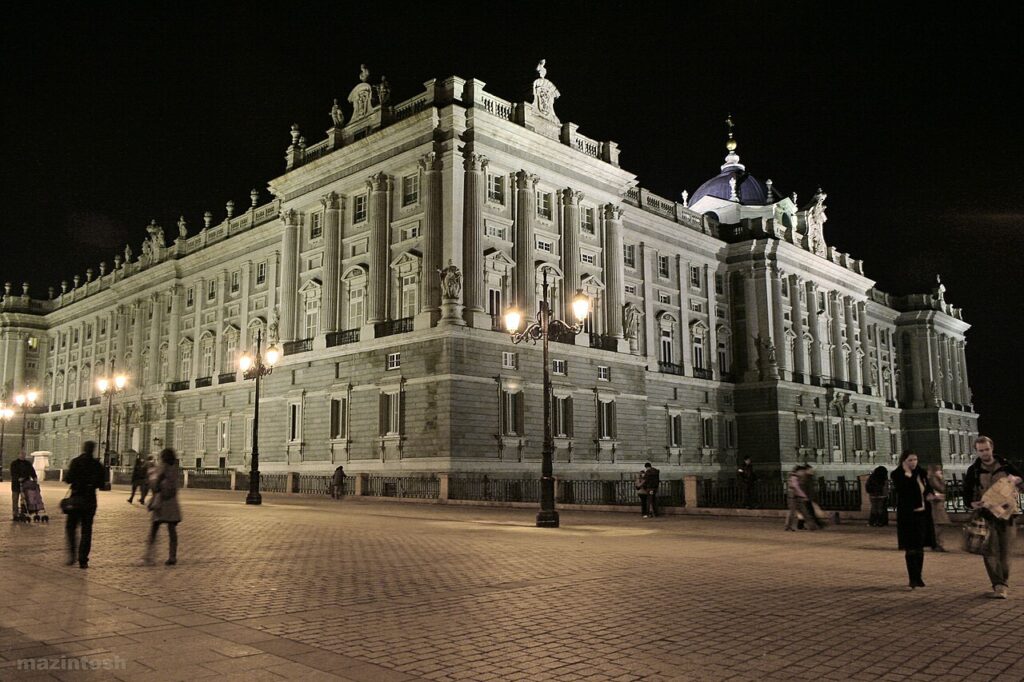
The Royal Palace of Madrid does not ease quietly into the skyline. It commands it. Rising above the western edge of old Madrid, the vast stone palace looks across the Campo del Moro toward the Manzanares and the country beyond. Its position is no accident. Kings occupied this strategic height centuries before the present building existed, and the site became closely tied to the rise of Madrid as Spain’s royal capital. Yet the palace seen today was born from catastrophe. On Christmas Eve in 1734, fire consumed the old Alcázar of Madrid, destroying the residence that generations of Spanish monarchs had enlarged and decorated. From its ashes came one of Europe’s greatest royal building projects.
The numbers alone hint at the scale of the result. The Royal Palace of Madrid contains 3,418 rooms and covers more than 135,000 square meters. Patrimonio Nacional describes it as the largest palace in Western Europe. Yet size is only the beginning of its story. Behind the immense façades are rooms shaped by Bourbon kings, Italian architects, Spanish craftsmen, royal workshops, musicians, armorers, cabinetmakers, sculptors, and painters. The palace was simultaneously a royal home, government center, workplace, ceremonial stage, treasury, and visible expression of the Spanish Crown.
Its history also stretches far beyond the eighteenth century. The present palace occupies the site of the former Alcázar of Madrid, which itself grew from Madrid’s medieval fortified past. Philip II transformed the city’s importance when he established his court in Madrid in 1561. From then on, the Alcázar became the official residence of the kings of Spain. The palace therefore stands at a point where several layers of Spanish history meet: medieval Madrid, the Habsburg monarchy, the arrival of the Bourbons, the eighteenth-century transformation of the capital, and the modern Spanish Crown.
What makes the Royal Palace of Madrid especially compelling is that this history never became completely frozen. Its rooms changed as monarchs changed. Charles III favored magnificent Italian Rococo interiors. Charles IV introduced important Neoclassical ensembles and French furnishings. Ferdinand VII acquired elaborate French chandeliers after the upheavals of the Napoleonic period. Alfonso XII carried out another major decorative renovation in 1879. Today, historic rooms and royal collections share the building with the continuing ceremonial life of the Crown. Few places allow visitors to walk so directly through centuries of Spanish royal history.
From the Alcázar to the Royal Palace of Madrid
Madrid Before the Present Palace
Long before the eighteenth-century palace appeared, the western edge of Madrid was valued for its defensive position. The medieval Alcázar occupied the same general site and gradually changed from a fortress into a royal residence. Its position above the surrounding terrain made practical sense. From the height, the occupants could look west toward the Manzanares and the approaches to the settlement. As Madrid grew in importance, the fortress grew with it. What began as a defensive site eventually became a setting for royal government, ceremony, collecting, and court life.
The decisive change came under Philip II. In 1561, he established the royal court in Madrid. That decision transformed the city’s future. Madrid was no longer simply one of many places visited by an itinerant monarchy. It became the permanent center of court life, and the Alcázar became the official royal residence. Government officials, nobles, diplomats, artists, craftsmen, servants, soldiers, petitioners, and merchants increasingly gravitated toward the court. The political decision of 1561 therefore helped turn Madrid into the capital that later generations would recognize.
The Alcázar was not merely a gloomy medieval fortress preserved out of habit. Successive monarchs altered and enriched it. During the Habsburg period, it contained significant works belonging to the Spanish royal collections. The palace became associated with the extraordinary culture of the Spanish Golden Age. Court painters, decorators, architects, and craftsmen contributed to a royal environment in which politics and artistic patronage were closely connected. The building itself was irregular because it had developed through centuries of additions rather than according to one unified plan.
That older palace is essential to understanding the Royal Palace of Madrid. The present building did not create royal Madrid from nothing. It replaced a residence already loaded with dynastic memory. Philip II, Philip III, Philip IV, and Charles II belonged to the Habsburg chapter of that story. When the Bourbon Philip V inherited the Spanish throne at the beginning of the eighteenth century, he inherited the Alcázar as well. He could renovate it, decorate it, and adapt it, but its complicated medieval and Habsburg fabric remained. Then, in December 1734, the situation changed with extraordinary speed.
The Christmas Eve Fire of 1734
The fire that destroyed the Alcázar began on Christmas Eve, December 24, 1734. Flames spread through the old royal residence and proved devastating. The catastrophe destroyed the building that had served as the official residence of Spain’s monarchs since Philip II established the court in Madrid in 1561. The loss was architectural, historical, and artistic. A royal palace accumulated far more than furniture. It held paintings, tapestries, papers, precious objects, furnishings, and countless physical reminders of generations of court life.
A colorful legend later attached itself to the disaster. According to the story, French members of Philip V’s court deliberately caused the fire so that the king could replace the old Alcázar with a palace inspired by French royal architecture, particularly Versailles. Patrimonio Nacional explicitly treats that claim as a legend rather than established fact. There is therefore no sound reason to present Philip V or his courtiers as the authors of the disaster. The documented consequence of the fire is dramatic enough without embellishment: the old royal residence was ruined, and Spain’s first Bourbon king needed a new palace.
Philip V had been born at Versailles in 1683 as Philippe, Duke of Anjou. He was a grandson of Louis XIV of France. In 1700, the death of the childless Charles II of Spain opened a major dynastic crisis. Charles II’s will named Philip as his heir, but the resulting struggle helped produce the War of the Spanish Succession. Philip ultimately remained King of Spain and founded the Spanish branch of the Bourbon dynasty. His background inevitably connected the new Spanish court with wider European artistic currents, but the Royal Palace of Madrid would not simply become a Spanish copy of Versailles.
The destruction of the Alcázar offered something rarely available to monarchs: a chance to create an enormous royal residence almost from the ground up. Instead of adapting medieval walls and inherited rooms, Philip V could commission a palace conceived on a monumental scale. Fire had erased centuries of architectural compromise. The new building could be regular, carefully planned, structurally robust, and suitable for the machinery of an eighteenth-century monarchy. That opportunity led Philip V to one of Europe’s most celebrated architects.
Philip V, Juvarra, and a New Vision
Philip V turned to Filippo Juvarra, the Sicilian-born architect whose career had flourished in Italy. Juvarra had earned a formidable reputation through grand architectural projects, particularly in Turin. His arrival in Spain brought the experience of Italian Baroque court architecture directly into the Madrid project. Philip V was not looking for a modest replacement for the Alcázar. The commission demanded a residence worthy of a major European monarchy, capable of accommodating royal life, administration, ceremony, and an enormous household.
Juvarra conceived an extraordinarily ambitious project. Yet he did not live to see the Royal Palace of Madrid rise. He died in Madrid in 1736. His death created a practical problem because the project still needed an architect capable of translating its monumental ambitions into a buildable palace. That responsibility passed to his disciple Giambattista Sacchetti, whose name is sometimes rendered in Spanish as Juan Bautista Sachetti. Sacchetti adapted Juvarra’s vision to the actual site of the old Alcázar and became the central architectural figure in the palace that survives today.
The first stone was laid in 1738. Construction continued for years under Sacchetti’s direction. Patrimonio Nacional records that the main construction was completed in 1751, although exterior and sculptural work continued until 1759. These dates reveal how misleading it can be to imagine royal palaces springing into existence at a king’s command. Philip V had commissioned the project, but he died in 1746, years before the building was ready for royal occupation. Like many monumental projects, the palace outlived the monarch who initiated it.
Sacchetti’s design also answered a lesson brutally demonstrated in 1734. Fire resistance mattered. Patrimonio Nacional notes that the building was constructed with vaulting and without wood in its structural system. Stone and masonry gave the enormous residence a very different character from the old Alcázar. The many floors were not simply displays of extravagance. The palace had to contain government offices, the official business of the Royal Household, servants, courtiers, storage areas, kitchens, ceremonial spaces, private apartments, and countless supporting functions. It was a royal city contained inside a single architectural mass.
Charles III Finally Moves In
Philip V never occupied the palace he had commissioned. Nor did his immediate successor, Ferdinand VI, become the monarch permanently associated with its first occupation. That distinction belongs to Charles III. Before becoming King of Spain in 1759, Charles had ruled in Italy, including as King of Naples and Sicily. He brought extensive experience of royal government and artistic patronage with him when he returned to Spain. His reign would leave one of the deepest marks on the interior character of the Royal Palace of Madrid.
Charles III moved into the new palace in 1764. More than a quarter century had passed since the first stone was laid in 1738. The change must have been striking. The irregular, ancient Alcázar had vanished. In its place stood a carefully organized eighteenth-century palace, monumental in scale and unmistakably European in artistic ambition. Sacchetti had directed the project through decades of construction, but Charles III’s architect, Francesco Sabatini, subsequently altered parts of the scheme and played an important role in the palace’s further development.
A useful snapshot of the palace’s basic history makes the chronology easier to grasp:
- Philip II established the royal court in Madrid in 1561, making the Alcázar the official residence of Spain’s monarchs.
- The Alcázar was destroyed by fire on Christmas Eve in 1734.
- Philip V commissioned Filippo Juvarra to design a new royal palace, with Giambattista Sacchetti later adapting and directing the project.
- The first stone of the new palace was laid in 1738, and the main construction was completed in 1751.
- Charles III became the first monarch to inhabit the new Royal Palace, moving into it in 1764.
The dates tell a story of continuity as much as destruction. From 1561 to 1734, the Alcázar served as the royal center of Madrid. From 1738 onward, a new structure slowly replaced it. By 1764, Charles III could finally inhabit a palace conceived for the Bourbon age. Yet even then, the building was not finished in the broader sense. Royal palaces are rarely finished. Every monarch brings new tastes, furniture, ceremonial requirements, technologies, and fashions. The Royal Palace of Madrid became a framework within which successive generations continued to build.
Architecture and Interiors Built for Kings
A Palace Designed on an Imperial Scale
The Royal Palace of Madrid is difficult to understand through photographs alone because its scale depends on movement. A façade that seems merely grand at a distance becomes immense as a visitor approaches. Courtyards, stairways, galleries, apartments, and ceremonial rooms unfold one after another. The palace contains 3,418 rooms and occupies more than 135,000 square meters. Patrimonio Nacional identifies it as the largest palace in Western Europe. Those figures place it among the monumental royal residences of the world.
Yet the scale had a practical purpose. An eighteenth-century monarch did not simply need a large bedroom and an impressive dining room. A royal residence supported a complete court. Ministers and officials required working areas. Servants needed quarters and service routes. Guards needed space. Ceremonial occasions required rooms large enough to receive ambassadors and aristocrats according to carefully regulated rules of rank. Kitchens had to feed large numbers of people. Chapels supported religious observance. Storage rooms held everything from textiles and tableware to state furnishings.
The architecture therefore reflects the nature of monarchy before modern government departments became physically separated from royal households. Palace and government could overlap. The king’s daily movements carried political meaning, and access to certain rooms could signal status. A doorway was not always just a doorway. Passing through one sequence of rooms rather than another could reveal how close a courtier was permitted to approach the sovereign. Architecture helped organize hierarchy.
The building’s fire-resistant construction was equally practical. The loss of the Alcázar in 1734 remained a warning written into the palace’s very fabric. Vaulted construction and the avoidance of wood in the main structural system reduced the danger that a similar blaze would destroy the entire residence. The new palace was therefore both magnificent and defensive in a less obvious sense. It was designed to protect the continuity of the monarchy’s physical setting.
Charles III and the Italian Character of the Interior
Charles III’s arrival in 1764 began the palace’s most important early phase of interior occupation. He had spent decades in Italy before inheriting the Spanish throne, and his artistic world was deeply connected to Italian court culture. Patrimonio Nacional describes the Throne Room and Gasparini Chamber as especially representative of his taste. Their decoration demonstrates the exuberant Italian Rococo that flourished within parts of the palace.
Charles III also brought internationally prominent artists into the decorative campaign. The Venetian painter Giambattista Tiepolo and the German-born Anton Raphael Mengs, who had developed his career within the Roman artistic world, both worked in the palace environment. Their presence reveals the international character of eighteenth-century court patronage. Madrid was not artistically isolated. The Spanish court could attract leading figures from across Europe while supporting Spanish craftsmen and royal workshops at the same time.
Francesco Sabatini became another central figure under Charles III. Born in Palermo in 1721, Sabatini had worked in Italy before entering Spanish royal service. He became closely associated with Charles III’s architectural transformation of Madrid as well as with work on royal residences. At the Royal Palace, his involvement followed Sacchetti’s long period of direction. The result was not a building frozen according to one architect’s drawings but a palace shaped by several generations of architectural decisions.
Charles III’s reign also illustrates how misleading it is to think of the Royal Palace as the king’s year-round home. Patrimonio Nacional records that Charles III and his son Charles IV lived there for only about eight weeks each year. Their stays included periods in December, around Holy Week, and part of July. At other times, the court moved among other royal residences, notably El Escorial, Aranjuez, and La Granja. Royal life followed a seasonal geography. The king did not merely own several palaces; the court physically migrated among them.
The Throne Room and Gasparini Chamber
The Throne Room remains one of the spaces most closely associated with royal ceremony. Its decoration belongs to the world of Charles III and the elaborate court culture of the eighteenth century. Patrimonio Nacional identifies the room as one of the palace ensembles that most clearly represents the king’s Rococo taste. Its furnishings were conceived as part of an integrated decorative environment rather than as a random collection of expensive objects.
Royal furniture was part of this visual program. Patrimonio Nacional records that the Throne Room was designed by the Neapolitan painter G. B. Natale and furnished with twelve consoles and matching mirrors carved by Gennaro di Fiore. Their imagery represented the four parts of the world, four seasons, and four cardinal virtues of the monarch. Chairs and mirrors designed by Mattia Gasparini and produced by José Canops and his workshop also became important examples of courtly Rococo cabinetmaking. Every surface could contribute to the message of magnificence.
The Gasparini Chamber takes this principle even further. Mattia Gasparini was closely involved with decorative schemes for Charles III, and the rooms associated with his designs show the Rococo taste at its most intricate. Pattern, texture, furniture, wall decoration, and ornament were coordinated rather than treated as unrelated elements. Such rooms were designed to surround the monarch with a complete visual environment. Even visitors who know little about furniture history can sense that almost nothing was left to chance.
These interiors also help explain why the palace cannot be reduced to architecture alone. Sacchetti’s walls provided the framework, but royal identity emerged through the combination of architecture and movable objects. Furniture could be rearranged. Textiles could be replaced. clocks and chandeliers could arrive under later monarchs. Rooms could change function. A palace that appears timeless is actually a record of repeated alterations, each generation laying another layer over the last.
From Charles IV to Alfonso XII
Charles IV succeeded Charles III in 1788. His artistic tastes helped move parts of the royal environment toward Neoclassicism. Patrimonio Nacional credits him with significant Neoclassical ensembles and important French furniture. His reign was also a notable period for royal decorative arts. The contrast with his father’s exuberant Rococo taste helps make the palace an unusually rich record of changing European styles.
The Napoleonic invasion and the upheavals of the early nineteenth century disrupted this world. Ferdinand VII returned to a royal environment that had suffered losses and looting. Patrimonio Nacional’s clock collection records that after the War of Independence, Ferdinand ordered inventories of what remained in royal properties and began acquiring mainly French clocks. His reign favored the Empire style, then fashionable across Europe. The palace consequently preserves another layer of taste quite distinct from that of Charles III.
Ferdinand VII was also responsible for the palace’s striking collection of French bronze-and-crystal chandeliers. Lighting in a royal palace was never merely practical. Before electric light, chandeliers multiplied candlelight through glass and reflective surfaces, turning evening ceremonies into glittering displays. Bronze mounts added sculptural richness. A grand chandelier suspended from a decorated ceiling could transform an entire room after sunset.
Later monarchs continued altering the residence. Isabella II, Alfonso XII, and Alfonso XIII added furnishings that reflected the changing fashions of the nineteenth and early twentieth centuries. Patrimonio Nacional identifies the decorative renovation undertaken for Alfonso XII in 1879 as the last major intervention leading to the palace’s present historic decorative state. The rooms along the eastern façade associated with Charles IV and Queen Maria Luisa continued to be occupied by successive sovereigns until 1931. The palace visitors encounter today is therefore not simply Charles III’s palace. It is the accumulated work of generations.
Royal Collections, Armour, and Palace Treasures
A Palace Filled by Generations
A royal palace without its contents is an architectural shell. The Royal Palace of Madrid matters because so much of its history survives through objects as well as rooms. Patrimonio Nacional administers Royal Collections covering painting, sculpture, graphic arts, textiles, tapestries, armor, furniture, glass, silver, precious metals, porcelain, clocks, musical instruments, carriages, scientific objects, and other categories. Many objects remain connected to the royal settings for which they were acquired or created.
The roots of Spanish royal collecting stretch back centuries before the present palace. Monarchs accumulated objects through commissions, purchases, gifts, inheritance, diplomacy, marriage, and dynastic succession. Isabella I possessed important Flemish paintings. Later Habsburg monarchs developed collections that included major Italian and Spanish works. Philip II’s vast cultural interests accompanied his transformation of Madrid and the creation of El Escorial. Philip IV’s reign became particularly important for Spanish court painting and collecting.
The Bourbon monarchs added new tastes rather than simply erasing the Habsburg inheritance. Philip V’s reign brought stronger French and Italian currents into Spanish royal interiors. Charles III supported the Rococo decorative arts and royal workshops. Charles IV developed sophisticated Neoclassical tastes. Ferdinand VII acquired objects suited to the Empire style. The result is not a collection created according to one plan. It is a physical record of changing royal preferences over several centuries.
This accumulation gives the palace its distinctive richness. A chair may reveal court etiquette. A clock can demonstrate technological sophistication and international trade. A tapestry can transform the visual temperature of a room while providing insulation. Porcelain speaks to luxury manufacturing and royal patronage. Armor records warfare, tournament culture, dynastic identity, and craftsmanship. Musical instruments reveal what court life sounded like. Seen together, these objects make the palace feel inhabited rather than merely monumental.
The Royal Armoury and the Habsburg Kings
Among the palace’s greatest treasures is the Royal Armoury. Patrimonio Nacional ranks it among Europe’s most important collections, alongside the Imperial Armoury in Vienna. That comparison is especially fitting because both collections owe much of their importance to the Habsburg dynasty. The same extended ruling house that connected Madrid with Vienna also created a culture in which armor could serve practical, ceremonial, dynastic, and artistic purposes.
Philip II installed the collection beside the old Alcázar. This placed armor associated with the dynasty close to the royal residence and the center of court government. The collection survived the transformation of the site after the Alcázar disappeared. In 1891, it was transferred to its current pavilion. That move gave the Royal Armoury the setting through which later generations came to know it.
Armor in a royal collection was never simply military equipment piled in storage. High-status armor could proclaim rank and lineage. Some pieces were designed for warfare, while others belonged to tournaments, ceremony, or display. The craftsmanship involved could be astonishing. Steel surfaces might be shaped to the body, polished, engraved, gilded, darkened, or otherwise decorated. A complete harness had to combine protection with movement, which demanded exceptional technical skill.
The Armoury also brings the palace’s Habsburg past into the Bourbon building. The present Royal Palace was commissioned by Philip V, yet the objects associated with earlier dynasties did not lose their significance simply because the royal house changed. That continuity matters. Spanish monarchy was built through inheritance as well as innovation. The Royal Armoury allows the visitor to move backward from the eighteenth-century palace toward the age of Philip II and the wider Habsburg world.
Music, Clocks, and the Decorative Arts
Court life had a soundtrack. Patrimonio Nacional’s musical-instrument collection contains 379 objects dating from the sixteenth through the twentieth centuries and distributed among the Royal Sites and royal foundations. These instruments document changing musical fashions over hundreds of years. The collection includes stringed instruments, keyboards, organs, harps, guitars, brass instruments, mechanical music devices, phonographs, and gramophones.
One of the most important surviving musical installations in the palace is the organ of the Royal Chapel, built by Jorge Bosch in 1778. The instrument belongs to the world of royal worship and court music under Charles III. Its presence reminds visitors that the palace contained a chapel where music and religious observance formed part of court routine. A royal residence was not merely a place for banquets and diplomatic receptions. The spiritual calendar shaped palace life as well.
The royal clock collection tells a different story about time, technology, and luxury. Charles IV was a particularly enthusiastic collector. Patrimonio Nacional records that his agents acquired sophisticated clocks for royal interiors, including large marble-and-bronze examples used in the palace. After the disruption of the Napoleonic period, Ferdinand VII purchased mainly French clocks. Later sovereigns continued adding examples according to the fashions of their own periods.
Furniture provides an equally revealing guide to changing taste. Under Philip V, French and Italian influences became prominent. The eighteenth century brought consoles, chests of drawers, bureaux, sofas, and an enormous range of specialized seating. Under Charles III, Rococo design flourished alongside royal workshops for cabinetmaking, bronzes, and embroidery. Charles IV favored Neoclassical and Directory styles. Ferdinand VII embraced Empire taste. A visitor can therefore read European design history almost room by room.
Treasures Beyond Paintings
It is tempting to enter a palace and concentrate only on paintings. That approach misses much of what made court interiors extraordinary. Royal households invested heavily in tapestries, furniture, porcelain, clocks, glass, silver, embroidery, carpets, and lighting. These objects interacted with architecture. A tapestry changed the appearance of a wall. A mirror multiplied light. A carpet softened a stone or wooden floor. A clock brought mechanical movement into a decorative scheme.
Porcelain had its own prestige. European courts competed to acquire and manufacture luxury ceramics during the eighteenth century. Furniture also became increasingly specialized, with objects designed for writing, dressing, gaming, dining, conversation, and formal reception. The royal workshops encouraged craftsmen to produce pieces specifically suited to court requirements. These were practical objects, but practicality did not exclude extraordinary decoration.
Five categories are especially useful for understanding the palace’s surviving richness:
- The Royal Armoury preserves an exceptional dynastic collection connected especially with Spain’s Habsburg rulers.
- Rococo furnishings reveal the elaborate decorative taste encouraged during the reign of Charles III.
- Historic clocks show the mechanical sophistication and changing fashions favored by Charles IV, Ferdinand VII, and later monarchs.
- Royal musical instruments preserve evidence of centuries of court performance and private entertainment.
- Furniture, porcelain, textiles, glass, silver, and chandeliers show how royal magnificence depended on entire decorative ensembles rather than isolated masterpieces.
These collections also preserve the work of people who rarely dominate political histories. Cabinetmakers, metalworkers, embroiderers, clockmakers, armorers, instrument makers, upholsterers, gilders, stoneworkers, and other craftsmen made royal splendor possible. Kings could commission a palace, but they could not carve every chair or forge every hinge. The Royal Palace of Madrid is therefore a monument to skilled labor as well as royal ambition. Its magnificence depended on thousands of hands.
A Royal Palace That Still Serves Spain
From Royal Home to Ceremonial Palace
The Royal Palace of Madrid belongs to history, but it has not been reduced to a historical relic. It remains the official residence of the King of Spain and continues to be used for major state and royal ceremonies. At the same time, large portions are open to the public under the care of Patrimonio Nacional. This combination makes the palace unusual. Visitors are entering a historic monument that still has an active ceremonial function.
The distinction between official residence and everyday home is important. Modern Spanish sovereigns do not live their ordinary domestic lives in the enormous state apartments as Charles III once did. The palace instead serves the Crown for formal occasions, audiences, receptions, and ceremonies requiring a setting appropriate to the Spanish state. The vast ceremonial rooms that once organized eighteenth-century court life can therefore still perform public functions.
That continuing use also explains why access may sometimes respond to official events. A palace employed for state ceremonies cannot function exactly like an ordinary museum. Rooms are not merely displays behind glass. They belong to a working ceremonial environment whose historic purpose has evolved but has not disappeared. The same architectural grandeur that once impressed eighteenth-century ambassadors remains suited to diplomatic occasions today.
This continuity changes the experience of the building. The palace does not simply tell visitors what Spanish kings once did. Its spaces remain connected to the institution for which they were created. The meaning has changed with Spain itself, but the ceremonial relationship survives. Stone façades, grand staircases, state rooms, and courtyards still provide a stage on which formal national occasions can unfold.
The Monarchs Who Shaped the Palace
Philip V stands at the beginning of the present palace’s history. Born in 1683, he became Spain’s first Bourbon king after the death of Charles II in 1700. The destruction of the Alcázar in 1734 forced a decision that would reshape Madrid’s royal center. Philip commissioned Filippo Juvarra, setting the new palace project in motion. Yet he died in 1746 and never saw the finished residence.
Charles III became the monarch most closely associated with the palace’s first great decorative age. Born in Madrid in 1716, he spent much of his earlier career ruling in Italy before succeeding to the Spanish throne in 1759. He occupied the Royal Palace in 1764. His Italian experience helped shape the courtly environment created around him. Under his reign, the palace gained interiors associated with Rococo splendor and the work of leading European artists and craftsmen.
Charles IV inherited the throne in 1788. His taste differed from his father’s, and Neoclassical interiors and French furnishings became increasingly important. His reign ended amid the crisis created by Napoleon’s intervention in Spain in 1808. Ferdinand VII’s eventual restoration brought yet another decorative phase. The returning monarch acquired French clocks and chandeliers and favored the Empire style that had spread through early nineteenth-century Europe.
The nineteenth-century story continued through Isabella II and the Bourbon restoration. Alfonso XII became king in 1874, and the major decorative renovation of 1879 helped establish much of the historic presentation now associated with the palace. Successive sovereigns occupied rooms along the eastern façade until 1931. Each generation inherited an already magnificent building, then adjusted it according to new habits and tastes. The result is a palace that resembles a family history written in stone, silk, bronze, crystal, and wood.
A Court That Moved with the Seasons
One of the most surprising facts about royal life in eighteenth-century Spain is how little of the year Charles III and Charles IV actually spent at the Royal Palace of Madrid. Patrimonio Nacional states that they lived there for only about eight weeks annually. Those periods included December, Holy Week, and part of July. For much of the remaining year, the court occupied other palaces belonging to the Crown.
El Escorial formed one part of this royal circuit. Aranjuez formed another. La Granja de San Ildefonso provided yet another royal setting. These residences were not simply weekend houses in the modern sense. Moving the court meant moving a substantial social and administrative world. Servants, officials, guards, furnishings, supplies, papers, and members of the royal household all had to fit into the seasonal rhythm.
This pattern explains why Spain possesses several major Royal Sites rather than one overwhelmingly dominant royal residence. Each had its own character and landscape. El Escorial combined monastery, royal residence, church, and dynastic monument. Aranjuez developed around gardens and the Tagus landscape. La Granja reflected Philip V’s personal tastes and his experience of French formal gardens. Madrid remained the political heart, but royal life extended far beyond the capital’s palace walls.
The seasonal movement also shaped the meaning of the Royal Palace itself. Madrid was a crucial ceremonial and governmental center, but the monarchy existed within a network of residences. To understand the palace properly is therefore to see it as the largest piece of a much broader royal geography. Roads connected these places just as dynastic customs connected their rooms. The Spanish court moved through a landscape of palaces.
Campo del Moro and the Western View
The western side of the Royal Palace opens toward one of its most impressive landscapes: the Campo del Moro Gardens. The gardens cover more than 20 hectares and descend toward the Manzanares. Their history is much older than their present appearance. Philip II acquired land beside the Alcázar in the sixteenth century, and it became a leisure area for the Madrid court. The destruction of the Alcázar in 1734 altered the area’s importance, and the landscape continued changing under later rulers.
The name Campo del Moro has its own long historical association. Patrimonio Nacional connects it with an attempt by Ali Ben Yusuf to retake Madrid in 1109, when his forces camped in the area. Yet the institution notes an important distinction: the name itself is not officially documented until 1809. That difference between later naming and earlier historical events is exactly the sort of detail that keeps colorful history from slipping into legend.
The gardens visible today owe much to nineteenth-century planning. Under Isabella II, Narciso Pascual y Colomer undertook their construction in 1844. His straight principal avenues remain part of the landscape. Two historic fountains stand on the central axis. Later, during the regency of Maria Cristina of Habsburg, Ramón Oliva completely reworked the park according to a picturesque landscape design in 1890. The result combines formality with winding, naturalistic effects.
The central avenue provides one of the finest ways to appreciate Sacchetti’s palace. From below, the enormous western façade rises above the gardens, making the building’s commanding position obvious. The palace was meant to be seen across distance as well as experienced from within. From the Campo del Moro, architecture and landscape finally join. The immense stone residence no longer feels like an isolated block in central Madrid. It becomes what its builders intended: the dominant feature of a royal landscape.
Key Takeaways
- The present Royal Palace of Madrid replaced the Alcázar, the royal residence used after Philip II established his court in Madrid in 1561. The Alcázar was destroyed by fire on Christmas Eve in 1734.
- Philip V commissioned Filippo Juvarra to design the new palace. After Juvarra’s death in 1736, Giambattista Sacchetti adapted the project. The first stone was laid in 1738, and the main construction was completed in 1751.
- Charles III became the first monarch to inhabit the palace in 1764. His reign gave several of its interiors their rich Italian Rococo character, while later monarchs added Neoclassical, Empire, and nineteenth-century decorative layers.
- The palace contains 3,418 rooms and covers more than 135,000 square meters. Its Royal Armoury, furniture, clocks, musical instruments, textiles, porcelain, silver, and other collections preserve centuries of Spanish court culture.
- The palace remains connected with the ceremonial life of the Spanish Crown, while the neighboring Campo del Moro preserves a royal landscape whose history stretches from Philip II’s sixteenth-century Madrid to major nineteenth-century redesigns.
Frequently Asked Questions
- When was the Royal Palace of Madrid built? The project followed the destruction of the old Alcázar in 1734. The first stone was laid in 1738. Patrimonio Nacional records that the main construction was completed in 1751, although exterior and sculptural work continued until 1759. Charles III became the first monarch to occupy the new palace in 1764.
- Who designed the Royal Palace of Madrid? Philip V first called upon the celebrated Italian architect Filippo Juvarra. Juvarra died in Madrid in 1736 before the project could be completed. His disciple Giambattista Sacchetti adapted the ambitious design to the site and directed the long construction process. Francesco Sabatini later made important changes under Charles III.
- How big is the Royal Palace of Madrid? The palace covers more than 135,000 square meters and contains 3,418 rooms. Patrimonio Nacional identifies it as the largest palace in Western Europe. Its extraordinary size reflects its original purpose as much more than a private royal home. It had to support government business, royal ceremonies, servants, officials, guards, and an extensive court household.
- Did Spanish kings live in the palace all year? Not always. Patrimonio Nacional records that Charles III and Charles IV spent only about eight weeks of each year in the Madrid palace. During other parts of the year, the court moved among Crown residences including El Escorial, Aranjuez, and La Granja. Seasonal movement was an established feature of Spanish court life.
- Is the Royal Palace of Madrid still used by the Spanish Crown? Yes. It remains an official royal residence and an important setting for ceremonial and state functions, although it is also open extensively to the public. That combination gives the palace an unusual continuity. Rooms created for royal ceremony centuries ago remain connected with the ceremonial institution they were built to serve.
The Royal Palace of Madrid rewards more than a quick look at its enormous façade. Its real story begins beneath the eighteenth-century stonework, with the vanished Alcázar and Philip II’s decision to establish his court in Madrid in 1561. It continues through the disaster of 1734, Philip V’s architectural ambitions, Sacchetti’s decades of work, Charles III’s magnificent interiors, and the changing tastes of later monarchs. Even the gardens preserve different chapters of royal history.
The palace is equally valuable as a record of craftsmanship. Royal history is often told through kings, marriages, wars, and successions. Here, it can also be read through vaulted masonry, carved furniture, armor, clocks, chandeliers, musical instruments, textiles, porcelain, and carefully planned gardens. Those objects reveal how a royal household actually created its surroundings. Magnificence was not abstract. It had to be designed, forged, woven, carved, polished, tuned, maintained, and used.
That may be the best reason to look beyond the familiar postcard view. Stand in the Campo del Moro and consider the palace from below. Imagine the old Alcázar occupying the height before the fire of 1734. Then picture the construction site after 1738, when Sacchetti’s enormous new residence began to rise. Finally, step mentally into 1764, when Charles III became the first king to inhabit it. Three very different Madrids occupy the same ground.
The Royal Palace survives because those layers were never entirely erased. Habsburg collections entered a Bourbon palace. Rococo rooms stood beside later Neoclassical interiors. Nineteenth-century monarchs added their own furnishings to eighteenth-century spaces. A royal residence became both a historic monument and a ceremonial setting for modern Spain. For anyone interested in architecture, monarchy, craftsmanship, or the history of Madrid, it deserves to be explored slowly. The grand façade is only the cover; the centuries inside are the real story.