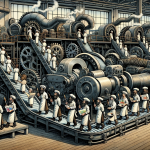
Few buildings tell a story as vividly as an abandoned factory. Massive brick walls, towering smokestacks, worn steel beams, and cavernous production halls preserve the memory of generations of workers who once kept machines running day and night. When industry leaves, these structures often stand silent for years. Yet around the world, artists, architects, preservationists, and community leaders have discovered that these forgotten industrial giants can be given a remarkable second life.
The transformation of abandoned factories into art spaces is one of the most successful examples of adaptive reuse in modern architecture. Instead of demolishing buildings that shaped local economies and identities, communities have found ways to preserve them while creating new cultural destinations. Former textile mills, coal mines, steel works, and manufacturing plants have become museums, galleries, performance venues, artist studios, and educational centers.
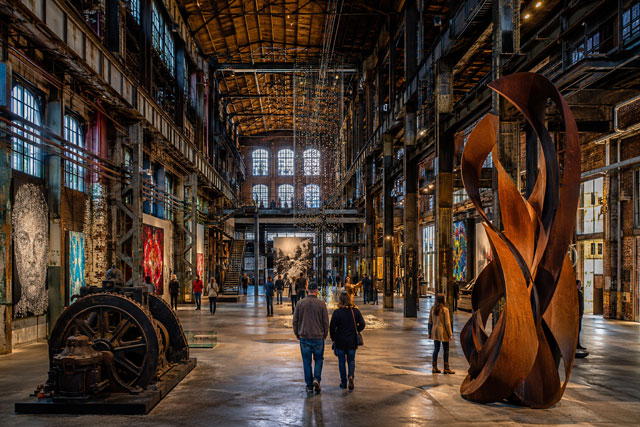
These projects do more than provide walls for artwork. They preserve local history, attract visitors, create jobs, and give communities a renewed sense of purpose. The industrial architecture itself often becomes part of the artistic experience. Visitors are not simply viewing art inside a building. They are walking through history.
The best examples demonstrate that abandoned factories are not relics of a vanished age. They are valuable assets waiting for imaginative reuse. Their enormous spaces, durable construction, and rich historical character make them uniquely suited to cultural purposes that would be difficult to achieve in conventional buildings.
Why Abandoned Factories Attract Artists and Cultural Organizations
The Unique Appeal of Industrial Architecture
Artists have long been attracted to industrial buildings because they offer qualities rarely found in modern construction. Factory floors were designed to accommodate large machinery, assembly lines, and storage systems. As a result, they provide wide-open spaces that can support ambitious installations, performances, and exhibitions.
High ceilings are another major advantage. Many nineteenth-century and early twentieth-century factories were built with vast interior volumes to improve ventilation and accommodate heavy equipment. Today, these same spaces allow curators to display monumental sculptures, suspended artworks, and immersive environments that would be impossible in ordinary galleries.
Natural light is often abundant. Before the widespread use of fluorescent lighting, factories relied on large windows to illuminate work areas. Rows of tall industrial windows now provide ideal conditions for artists and visitors alike. The changing daylight throughout the day can dramatically alter the appearance of artworks.
Industrial architecture also possesses an authenticity that cannot be manufactured. Exposed brick, riveted steel, weathered concrete, and aging timber create a sense of character and permanence. These surfaces tell stories about labor, innovation, and economic change. Many artists deliberately engage with those stories when creating site-specific works.
Preserving Industrial Heritage Through Art
Factories often occupy a special place in local memory. Entire towns grew around textile mills, steel plants, mines, and manufacturing complexes. Generations of families earned their living inside these buildings. When industrial operations ended, communities frequently faced economic hardship and population decline.
Demolition may remove maintenance costs, but it also erases history. Adaptive reuse offers an alternative. By converting industrial buildings into cultural spaces, communities preserve important landmarks while creating new opportunities for public engagement.
Art provides a particularly effective method of preservation because it encourages people to visit and interact with historic sites. A building that might otherwise remain empty becomes a destination. Visitors learn about local history while experiencing contemporary creative work.
The most successful projects preserve visible traces of industrial activity. Original machinery, rail systems, loading docks, cranes, and production equipment are often retained as interpretive features. Rather than hiding the past, these projects embrace it.
Economic and Community Benefits
Cultural redevelopment can have significant economic effects. Art centers attract visitors who spend money at restaurants, hotels, shops, and other local businesses. Communities that once depended on manufacturing can develop new tourism and service-sector opportunities.
Large industrial complexes are particularly valuable because they can support multiple activities at once. A single site may include galleries, studios, classrooms, event venues, cafés, and retail spaces. This diversity helps generate sustainable revenue streams.
Community engagement is another important benefit. Former factories can host educational programs, workshops, exhibitions, and public events that bring residents together. Local artists gain affordable workspaces while young people gain access to creative opportunities.
Perhaps most importantly, successful factory conversions demonstrate that historic buildings still have value. They challenge the assumption that progress requires demolition and replacement. Instead, they show how preservation and innovation can work together.
Successful Examples of Factories Transformed Into Art Destinations
MASS MoCA, North Adams, Massachusetts
One of the most influential examples is MASS MoCA, the Massachusetts Museum of Contemporary Art in North Adams, Massachusetts. The site originated as part of the Arnold Print Works complex, one of the world’s leading textile-printing operations during the late nineteenth century. By 1905, Arnold Print Works employed approximately 3,200 workers and occupied an enormous industrial campus. The company closed its North Adams operations in 1942. Later, the complex was acquired by Sprague Electric Company, which used the buildings for electronics manufacturing. After Sprague’s departure during the 1980s, the vast factory complex stood largely vacant.
The buildings that survive today were largely constructed between the 1870s and 1900. Their brick construction, long production halls, and interconnected layout made them unusually adaptable for cultural reuse. Local leaders and preservation advocates recognized that the site offered possibilities far beyond demolition.
MASS MoCA officially opened in 1999 and quickly became one of the largest centers for contemporary visual and performing arts in the United States. The scale of the former factory buildings allowed curators to exhibit enormous installations that many museums could not accommodate.
Today, visitors experience art within a setting that still reflects its industrial origins. Brick walls, steel framing, and factory proportions remain visible throughout the campus. Rather than concealing history, the museum uses it as part of the visitor experience.
Zollverein Industrial Complex, Essen, Germany
The Zollverein Industrial Complex in Essen represents another extraordinary transformation. Its history began in 1847 when sinking of the first shaft commenced. Coal extraction started in 1851, and over the following decades the site expanded into one of the most important mining operations in Europe. By 1900, more than 5,300 miners worked across its facilities.
The mine reached international prominence during the twentieth century. Shaft XII, completed in 1932, became famous for its striking industrial architecture. Designed by architects Fritz Schupp and Martin Kremmer, it remains one of the most recognizable industrial structures in Germany.
Coal production ended in December 1986. Rather than demolishing the site, preservationists and regional planners pursued a long-term strategy of cultural reuse. The former mine and coking plant gradually evolved into a center for art, design, education, tourism, and cultural events. The complex received UNESCO World Heritage status on December 14, 2001.
Today Zollverein welcomes large numbers of visitors each year and serves as a symbol of the Ruhr region’s transition from heavy industry to cultural activity. Museums, exhibitions, performances, and design institutions now occupy spaces once devoted to coal production.
Lessons Shared by Successful Projects
Although MASS MoCA and Zollverein differ greatly in scale and location, they share several important characteristics. Neither project attempted to erase industrial history. Instead, both embraced it as a defining feature.
Long-term planning played a critical role. Successful conversions often require years of investment, preservation work, and community support. Quick solutions rarely produce lasting results.
Flexibility is equally important. Industrial buildings must accommodate changing exhibitions, performances, educational programs, and public events. The ability to adapt helps ensure long-term viability.
Common traits of successful factory-to-art conversions include:
- Preservation of historic character
- Flexible interior spaces
- Strong community involvement
- Diverse sources of revenue
- Educational and cultural programming
- Long-term management strategies
Creative Uses for Abandoned Factories Beyond Traditional Galleries
Artist Studios and Maker Spaces
Many former factories are ideally suited for artist studios. Large work areas, freight elevators, loading docks, and durable construction make them practical environments for creative production. Artists working with sculpture, woodworking, metalworking, ceramics, and large-scale installations often require more space than conventional studios can provide.
Shared facilities can further reduce costs. Equipment such as kilns, woodworking machinery, welding stations, and digital fabrication tools can be made available to multiple users. This creates collaborative environments that encourage experimentation and innovation.
Artist residency programs also benefit from industrial settings. Former administrative offices can be converted into living quarters, classrooms, or meeting spaces. Visiting artists gain room to develop ambitious projects while interacting with local communities.
These creative ecosystems frequently attract designers, craftspeople, architects, and entrepreneurs. Over time, entire creative districts can emerge around former industrial sites.
Performance and Event Venues
Factory buildings often possess remarkable acoustics and spatial qualities. Large assembly halls can accommodate concerts, theatrical productions, dance performances, and multimedia events. Their scale creates opportunities unavailable in conventional theaters.
Industrial architecture also contributes to atmosphere. Audiences frequently enjoy experiencing performances in unusual environments that retain visible traces of their original function. A former machine hall can provide a dramatic backdrop for contemporary dance or experimental theater.
Film festivals and screenings have also found homes in former factories. High ceilings and expansive walls allow for large projection surfaces and flexible seating arrangements. Temporary installations can be configured to suit different events.
Event rentals provide an important source of income as well. Weddings, conferences, exhibitions, and community gatherings help support ongoing operations while introducing new visitors to historic industrial sites.
Educational and Community Arts Centers
Many converted factories serve educational purposes. Their size allows organizations to offer classes, workshops, lectures, and demonstrations across multiple disciplines. Art education can be combined with local history, architecture, and industrial heritage programming.
Youth programs are particularly valuable. Former factories can become places where young people learn painting, sculpture, photography, filmmaking, music, and design. These opportunities help strengthen community connections and encourage creative development.
Some facilities partner with schools, colleges, and universities. Students gain access to unique learning environments while institutions benefit from additional exhibition and event space.
Community exhibitions can also play an important role. Local artists, historical societies, and civic groups gain opportunities to share their work with wider audiences. The result is a cultural center that serves both residents and visitors.
Mixed-Use Cultural Campuses
The most resilient projects often combine multiple functions. Galleries alone may struggle financially, but a mixed-use campus can support a variety of activities that generate income throughout the year.
A former factory might include exhibition halls, artist studios, classrooms, cafés, restaurants, offices, retail spaces, and event venues. Each component supports the others. Visitors attending an exhibition may dine on-site, purchase locally made goods, or attend a performance.
Creative businesses often find industrial environments attractive. Design firms, architecture studios, publishing companies, and technology startups may choose to locate within redeveloped complexes.
This diversity creates economic stability while preserving historic architecture. Instead of relying on a single use, the site becomes a dynamic cultural ecosystem.
What Could Be Done With Future Factory Art Projects?
Large-Scale Immersive Art Installations
Future projects may increasingly focus on immersive experiences. Former factories provide ideal settings for large-scale projection mapping, interactive lighting systems, and multimedia environments. Their vast interiors allow visitors to move through art rather than simply observe it.
Industrial surfaces can become part of the artwork itself. Brick walls, steel structures, pipes, and machinery provide textures and forms that artists can incorporate into installations. The building becomes both gallery and artistic medium.
Digital technology opens additional possibilities. Motion sensors, sound systems, and interactive displays can transform former production spaces into evolving environments that respond to visitor movement.
Because these buildings were designed on an industrial scale, they can accommodate experiences that would be difficult or impossible elsewhere.
Industrial History Interpretation Through Art
Art can also help preserve historical memory. Many former factories contain stories that deserve wider recognition. Workers, engineers, inventors, and local families all contributed to the development of these sites.
Future projects could incorporate oral histories, archival photographs, recorded interviews, and historical documents into artistic presentations. Visitors would encounter both creative expression and historical interpretation.
Original machinery can become part of exhibitions rather than being removed. Massive presses, turbines, conveyors, and manufacturing equipment often possess a sculptural quality of their own.
Such approaches help ensure that industrial heritage remains visible to future generations while avoiding the atmosphere of a traditional museum.
Creative Innovation Centers
Former factories are well suited to innovation-focused programs. Their size allows room for fabrication labs, design workshops, engineering exhibits, and collaborative research spaces. Educational institutions could partner with cultural organizations to create interdisciplinary centers.
Students might learn traditional crafts alongside digital manufacturing technologies. Historical industrial buildings would become places where new ideas are developed rather than simply remembered.
Architecture, engineering, industrial design, and visual arts could share facilities and resources. This mirrors the collaborative spirit that originally drove industrial innovation.
Such centers would honor the productive history of these buildings while preparing future generations for new challenges.
Sustainable Models for Long-Term Success
Long-term sustainability remains essential. Many redevelopment projects fail because they depend too heavily on a single funding source. Successful future projects will likely combine earned income, memberships, grants, donations, rentals, and commercial partnerships.
Energy efficiency improvements can also reduce operating costs. Historic preservation and modern environmental performance are not mutually exclusive. Careful upgrades can improve comfort while preserving architectural character.
Future ideas for abandoned factory art projects include:
- Interactive digital museums
- Artist residency villages
- Public sculpture parks
- Industrial heritage learning centers
- Creative entrepreneurship hubs
Across the world, abandoned factories continue to demonstrate their remarkable potential. Structures once devoted to manufacturing can become places of creativity, learning, and community engagement. Their stories do not end when production stops. In many cases, a factory’s most inspiring chapter begins only after the machines fall silent.
Key Takeaways
- Abandoned factories provide large, flexible spaces well suited to artistic use.
- Adaptive reuse preserves industrial heritage while creating cultural destinations.
- MASS MoCA and Zollverein demonstrate successful long-term redevelopment.
- Mixed-use cultural campuses often achieve greater financial stability.
- Future projects may combine art, technology, education, and historical interpretation.
FAQs
- Why are factories attractive to artists? Large spaces, high ceilings, and industrial character provide unique creative opportunities.
- What is adaptive reuse? It is the process of giving an existing building a new purpose while preserving much of its original structure.
- When did MASS MoCA open? The museum opened in 1999.
- When did coal mining end at Zollverein? Mining operations ended in December 1986.
- Can abandoned factories support more than galleries? Yes, they can include studios, schools, performance venues, businesses, and community spaces.