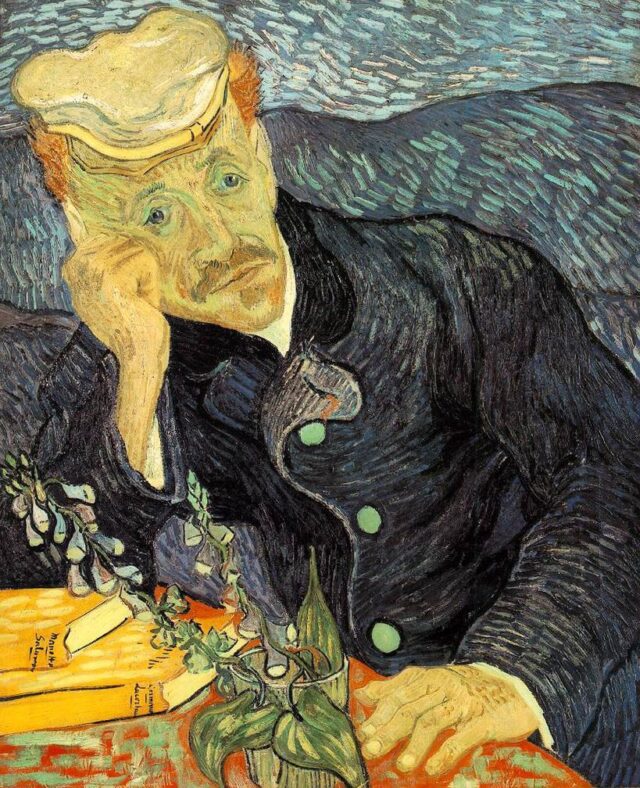
Vincent van Gogh spent the final months of his life in the small French village of Auvers-sur-Oise, a short train ride from Paris. He arrived in May 1890 on the recommendation of his younger brother Theo van Gogh, seeking both a peaceful environment and proximity to medical care. At this point, Vincent had just left the asylum at Saint-Rémy-de-Provence, where he had voluntarily admitted himself after a series of mental breakdowns. Hoping for a fresh start, he settled near the home of a local physician who had an interest in art — Dr. Paul-Ferdinand Gachet.
Dr. Gachet, a widowed homeopath with connections to the Impressionist circle, was tasked with overseeing Van Gogh’s health. Van Gogh quickly developed a complicated relationship with the doctor, whose melancholy temperament mirrored his own. In letters to Theo, Van Gogh described Gachet as an odd character, writing on May 20, 1890: “I think that we must not count on Dr. Gachet at all. In the first place, he is sicker than I am, I think, or shall we say just as much.” Despite this misgiving, he soon painted one of his most emotionally resonant portraits — a seated likeness of the doctor resting his head in his hand.
The Creation of the Portrait of Dr. Gachet
The painting known as Portrait of Dr. Gachet was completed in June 1890, just weeks before Van Gogh’s death in July of that year. The first version, which is the subject of this article, depicts Dr. Gachet in a seated, reflective pose, resting his head on one hand beside a table holding a sprig of foxglove — a plant used to produce digitalis, a heart medication. The foxglove likely symbolizes the doctor’s profession and perhaps Van Gogh’s own desire for healing. This version is widely regarded as one of the most psychologically intense portraits in Van Gogh’s body of work.
Verified details of the painting:
- Title: Portrait of Dr. Gachet
- Artist: Vincent van Gogh
- Year: 1890
- Medium: Oil on canvas
- Dimensions: 67 cm × 56 cm (26.4 in × 22 in)
- Last Known Location: Private collection (sold in 1990)
- Source: Van Gogh Museum, Amsterdam
Van Gogh painted two versions of the portrait. The first version — with vibrant blues and greens and thick brushwork — was considered superior by Theo and was the one that gained prominence. Van Gogh himself referred to the portrait as “an expression of the heartbroken expression of our time.” The second version, which now resides in the Musée d’Orsay in Paris, is a slightly more subdued interpretation of the same pose.
Gachet’s Controversial Reputation
Though Dr. Gachet became one of Van Gogh’s most famous subjects, his reputation has long been controversial. Some scholars and critics argue that he was compassionate and preserved Van Gogh’s legacy by safeguarding his works. Others suggest he was eccentric to the point of incompetence. As a doctor, he had a preference for homeopathic treatments, which were unorthodox even by late 19th-century standards. Gachet also practiced art under the pseudonym Paul van Ryssel and enjoyed painting and printing in his free time.
To Van Gogh, Gachet was both a source of comfort and frustration. He appreciated the doctor’s artistic leanings but doubted his medical abilities. The painting captures this emotional ambiguity. Gachet’s downcast eyes and slouched posture suggest both intellectual depth and profound sadness. After Van Gogh’s death, Dr. Gachet retained several of the artist’s works and sketches, which were passed down through his family, helping preserve Van Gogh’s output during a time when the artist’s reputation was still being established.
Key Facts About Dr. Gachet’s Role in Van Gogh’s Life
- Homeopathic doctor with ties to Impressionist artists
- Treated Van Gogh for approximately 70 days in 1890
- Posed for two major oil portraits by Van Gogh
- Preserved drawings and letters from Van Gogh
- Described by Van Gogh as both artistically gifted and mentally unstable
The Painting’s Provenance and Ownership Trail
From Theo van Gogh to German Collectors
Following Van Gogh’s death in July 1890 and Theo’s death in January 1891, the portrait passed to Theo’s widow, Johanna van Gogh-Bonger. She played a critical role in building Vincent’s posthumous reputation by promoting his works and publishing his correspondence. The portrait remained in her possession until it was sold to a series of collectors in the early 20th century. By the 1910s, it came into the hands of the German art collector Franz Koenigs, who had amassed a remarkable collection of Old Masters and modern art.
Koenigs stored his collection in the Netherlands, where it was later seized during World War II. Some confusion surrounds this phase of the painting’s history, but records from the Dutch Institute for Art History (RKD) confirm that Portrait of Dr. Gachet eventually returned to private hands after the war. It was acquired by the German-born Jewish banker Siegfried Kramarsky, who had fled Europe in the 1930s and brought the painting to the United States. From 1951 onward, the Kramarsky family lent the painting to the Metropolitan Museum of Art in New York, where it remained on long-term loan for nearly four decades.
The Record-Breaking Christie’s Auction in 1990
On May 15, 1990, the Kramarsky heirs placed Portrait of Dr. Gachet up for auction at Christie’s New York. The auction house billed it as one of the last great Van Goghs still in private hands. Interest from collectors worldwide drove the final price to a staggering $82.5 million (including buyer’s premium), a world record at the time for any painting sold at auction.
The winning bidder was Ryoei Saito, a reclusive Japanese businessman and chairman of Daishowa Paper Manufacturing. Saito had also purchased Renoir’s Bal du moulin de la Galette in the same week, spending over $150 million in total. He shocked the world shortly after the auction by stating publicly that he wished to be cremated alongside both paintings, to avoid future tax burdens. This statement caused outrage in the international art community and led to demands for better regulations around cultural heritage sales.
Ryoei Saito’s Death and the Painting’s Vanishing
Ryoei Saito died in 1996, and the painting has not been seen publicly since. His controversial cremation remark was later walked back by his aides, who claimed he was joking. However, with his estate heavily in debt following the 1990s Japanese asset bubble collapse, several of his prized possessions were discreetly sold off to unnamed buyers. What became of Portrait of Dr. Gachet is uncertain.
Most art historians believe the painting still exists and is likely held in a private collection, possibly in Europe or North America. Christie’s, Sotheby’s, and other major institutions have declined to confirm whether they have tracked the painting’s movements. Some suggest it may be stored in a secure art vault, such as those in Switzerland or Luxembourg, where anonymity and tax shielding allow owners to maintain secrecy.
Timeline of the Painting’s Ownership
- 1890 – Painted by Van Gogh in Auvers-sur-Oise
- 1891–1900s – Inherited by Johanna van Gogh-Bonger
- 1910s–1930s – Sold to Franz Koenigs in Germany
- Post-WWII – Acquired by Siegfried Kramarsky in New York
- 1951–1990 – On loan at the Metropolitan Museum of Art
- 1990 – Sold to Ryoei Saito at Christie’s for $82.5 million
- 1996–present – Vanished from public view following Saito’s death
Theories and Speculation on Its Disappearance
Cremation Rumor — Was It Destroyed?
The most sensational theory surrounding the painting is that it was destroyed in accordance with Ryoei Saito’s wishes. In the days following the 1990 auction, Saito told Japanese reporters that he wanted to be cremated with both the Van Gogh and Renoir to avoid burdensome inheritance taxes. His comment sparked international headlines and raised questions about Japan’s cultural stewardship policies. However, no credible evidence has ever emerged to support the claim that the painting was destroyed.
Japanese government officials later clarified that there was no indication the paintings had been harmed, and members of Saito’s company stated privately that the comment was a metaphor or exaggeration. Many believe it was meant to express his frustration with Japan’s inheritance laws rather than signal actual intent. Given the painting’s immense value, both monetary and historical, deliberate destruction seems unlikely.
Underground Art Trade and Private Collections
A more plausible theory is that Portrait of Dr. Gachet was quietly resold after Saito’s death. Many artworks of comparable value are traded privately to avoid taxes, publicity, or legal entanglements. High-security storage facilities in Switzerland, Singapore, and the United States offer wealthy collectors the means to purchase and store such works without ever displaying them publicly.
These facilities, sometimes referred to as “freeports,” allow for discreet ownership and indefinite holding. There is speculation that the painting may have been sold to a private American collector, or even repatriated to Europe, where it resides in a family trust. Without legal obligation to declare ownership of non-looted artworks, private buyers have little incentive to reveal themselves.
Legal and Ethical Barriers to Reappearance
One of the chief obstacles to locating the painting is the lack of legal requirement for its owner to disclose its whereabouts. Unlike looted or stolen art, Portrait of Dr. Gachet was acquired legally, meaning its possession is protected by standard property rights. Unless the owner chooses to sell or publicly exhibit it, the painting may remain hidden indefinitely.
Museums and art recovery organizations have expressed concern over the broader implications of such disappearances. While groups like the Art Loss Register and Interpol maintain databases of stolen or missing works, legally held private acquisitions fall outside their scope. Ethically, many believe a painting of such historical importance should be accessible to the public, but legal mechanisms to enforce this are virtually nonexistent.
Legacy, Influence, and Modern Efforts to Locate It
Cultural Significance of the Portrait
Portrait of Dr. Gachet is considered one of the most emotionally profound works in Van Gogh’s short but prolific career. Painted during the final weeks of his life, it embodies his internal struggle, his perception of isolation, and his attempt to find empathy in another tortured soul. The sitter’s expression, with downturned eyes and a weary pose, mirrors the fatigue Van Gogh himself often described.
The portrait is often cited as a pinnacle of psychological realism in modern art. Alongside works like The Scream by Edvard Munch, it helped usher in an age of art that explored the human mind, rather than just its surroundings. The painting also reflects Van Gogh’s mastery of color and brushwork — the thick, swirling lines create a sense of movement that borders on the spiritual. Reproductions of the painting appear in countless books, documentaries, and exhibitions, underscoring its enduring power.
The Second Version and Its Public Display
The second version of the Portrait of Dr. Gachet resides in the Musée d’Orsay in Paris and remains accessible to scholars and the public. This version was painted shortly after the first, using the same pose and elements, though the colors are slightly more restrained. The dimensions are nearly identical — 66 cm × 57 cm — and the subject’s hand, face, and foxglove remain central.
Verified details of the second version:
- Title: Portrait du docteur Gachet
- Artist: Vincent van Gogh
- Year: 1890
- Medium: Oil on canvas
- Dimensions: 66 cm × 57 cm
- Location: Musée d’Orsay, Paris
- Source: Musée d’Orsay
This second version was retained by Dr. Gachet’s family after Van Gogh’s death and eventually entered the French national collection. Its public presence provides a valuable reference point for understanding the missing original and ensures that at least one interpretation of this powerful portrait remains part of the cultural record.
Calls for Transparency and Recovery
In recent years, there have been renewed calls from curators, historians, and art institutions to clarify the status of Portrait of Dr. Gachet. Although there is no evidence of foul play, some believe the painting should be registered in international archives to improve accountability. The Van Gogh Museum in Amsterdam has voiced support for greater transparency around lost or hidden works of major cultural significance.
Interpol and the Art Loss Register do not list the painting as stolen, but private recovery firms have occasionally expressed interest in tracing its current owner. However, without cooperation from the parties involved, any recovery effort remains purely speculative. Until the painting reemerges — either through sale or exhibition — it will remain one of the most haunting disappearances in the history of art.
Key Takeaways
- Vincent van Gogh’s Portrait of Dr. Gachet (1890) is one of his most emotionally charged and culturally significant works, painted just weeks before his death.
- The first version of the painting was sold in 1990 for $82.5 million to Japanese industrialist Ryoei Saito, who later made controversial remarks about taking it to the grave.
- Since Saito’s death in 1996, the painting has vanished from public view, with no confirmed sightings or exhibitions.
- Theories about its fate range from destruction to quiet transfer into a private collection, likely held in Europe or the United States.
- Despite its legal sale, art historians and institutions continue to hope for its return to public exhibition due to its immense cultural importance.
FAQs
1. What is the current location of Portrait of Dr. Gachet?
Its current location is unknown. The painting has not been seen publicly since 1996 following the death of its last known owner, Ryoei Saito.
2. Did Van Gogh paint more than one version of the portrait?
Yes. Van Gogh painted two versions in June 1890. The first version is missing; the second is housed at the Musée d’Orsay in Paris.
3. Why is the painting so valuable?
Its emotional depth, historical context, and connection to Van Gogh’s final days contribute to its value. It also set a world record at auction in 1990.
4. Was the painting actually destroyed?
There is no evidence that the painting was destroyed. Although Ryoei Saito once joked about being cremated with it, this was never confirmed and is widely doubted.
5. Could the painting legally be recovered or seized?
No. Since it was acquired legally, there is no basis for seizure unless new evidence suggests illicit activity. Its owner is under no obligation to display or report its location.