In Thessaloniki, art is not a matter of surfaces but of depths. To walk its streets is not merely to traverse a cityscape, but to descend through epochs compressed into stone, brick, and gold leaf. It is a city whose aesthetic identity is not a unified image but a layered accumulation of ruptures and returns, the result of two thousand years of continuous habitation under shifting dominions. The traveler who pauses at the intersection of Egnatia and Venizelou is as likely to be confronted by a Roman arch as by a Byzantine church, an Ottoman minaret, or a neoclassical façade half-erased by the architectural ambitions of the twentieth century. Thessaloniki resists cohesion. Its art history is not the progression of a national style but a fragmented narrative of imperial residue—of successive regimes that built, razed, converted, and reimagined the city as an ideological and sacred stage.
Founded in 315 BC by Cassander of Macedon and named after his wife Thessalonike, sister of Alexander the Great, the city’s inception already bore the marks of dynastic ambition. It was intended as a node of power in the newly Hellenized world, a port-city linking the northern Greek interior to the Aegean. Yet this initial political purpose, which shaped the first generation of civic monuments, quickly gave way to the gravitational pull of empire. Thessaloniki became not merely a local center but a keystone of broader imperial strategies—from Roman administrative schemes to Byzantine theological battles, from Ottoman urban reforms to the nationalist agendas of modern Greece. Each of these epochs left behind not only structures and images, but conceptual shifts in the very meaning of art, its patrons, and its public.
What distinguishes Thessaloniki from other cities with long historical arcs is the uneven visibility of these layers. It is not, like Rome, a city whose ruins are monumentalized into a coherent past. Nor is it like Paris, with its nineteenth-century imposition of a unifying visual order. Thessaloniki is both denser and more elusive. Its layers are often buried, literal palimpsests in which a Christian mosaic lies beneath an Islamic mihrab, beneath a modern traffic artery. Its basilicas were turned into mosques, then museums, and now function again as churches—a cycle that both preserves and effaces, that leaves traces not as heritage but as stratigraphic evidence. The art historian approaching Thessaloniki must thus think like an archaeologist, sifting through accretions, aware that meaning often lies in what is missing or altered, not merely in what survives.
This fractured continuity has given Thessaloniki an aesthetic of ambiguity, an urban art history that is as much about adaptation and conversion as about creation. It is not a city of grand origin myths or singular schools. It is a city of confluences: Hellenistic sculpture refined into Roman monumentality; Roman civic spaces transformed into Christian basilicas; Byzantine iconography overlaid with Ottoman arabesques; Jewish tombstones reused in twentieth-century construction; neoclassical mansions razed for socialist apartment blocks. What persists is not a style but a condition—a visual and material record of relentless transformation.
Moreover, Thessaloniki’s role as a second city has shaped its artistic production in subtle but profound ways. Rarely the imperial capital, it was nevertheless crucial: the second city of the Roman province of Macedonia, later the second city of Byzantium after Constantinople, and still later the Ottoman Empire’s key port in the Balkans. As such, it became a site of both reception and experimentation. Its artists and patrons borrowed imperial forms and adapted them to local conditions. The churches of Thessaloniki contain mosaics that rival those of Ravenna and Constantinople, yet their iconographic programs often betray regional theological concerns. Ottoman Thessaloniki, while never a primary seat of power, was a hub for the Sephardic Jewish diaspora and an incubator of hybrid forms of commercial, religious, and domestic architecture. In every age, it was a city of intermediaries and thresholds—between east and west, sacred and secular, memory and erasure.
If one wishes to grasp the full trajectory of art in Thessaloniki, one must resist the temptation of teleology. The city is not a narrative of progress or decline, not a tale of lost glories or recovered roots. Rather, it is a site of recurring confrontation: between tradition and innovation, between conquest and preservation, between the sacred demands of empire and the local pulse of daily life. Its art history is not a tidy lineage but a series of breaks stitched together by reoccupation. The Hagios Demetrios church is a case in point: a fifth-century martyr’s shrine that became a triumphal basilica, then a mosque, then a bombed ruin, and finally a national monument. Each iteration imposed a new visual language, and yet none erased the resonance of what came before.
To study the art of Thessaloniki is thus to accept a methodology of entanglement. One must trace influence not in a line, but in a weave. It demands a gaze that is at once historical and topographical, alert to the movements of populations, the redeployment of materials, and the shifting claims to meaning inscribed in the built environment. It is to follow not the story of a people but of a city, and to treat that city as an artifact in its own right.
This essay will unfold that stratigraphy, layer by layer. Beginning with its Hellenistic foundations and moving through Roman, Byzantine, Ottoman, and modern eras, it will consider not only what was made, but how and why it was remade. It will examine how art in Thessaloniki served power and piety, how it was altered in defeat and reasserted in rebirth. And it will attend always to the specific materiality of place: the marble reused in conquest, the plaster chipped by iconoclasts, the bricks bearing invisible inscriptions of forced labor or forced conversion. The goal is not to recover a lost unity, but to articulate the complexity that has always defined Thessaloniki’s artistic identity.
Hellenistic Foundations: Macedonian Urbanism and Civic Aesthetics
When Cassander of Macedon founded Thessaloniki in 315 BC, his decision was not a matter of mere strategic convenience. The choice to consolidate twenty-six smaller settlements into a single urban entity along the Thermaic Gulf signaled a new vision of power in the late Classical and early Hellenistic world. This was no longer the polis as an organic outgrowth of tribal or civic tradition, but a constructed city—an urban project serving dynastic ambition, territorial control, and economic centrality. In this sense, Thessaloniki was born not as a village made large but as a metropolitan abstraction: a city whose art, architecture, and spatial logic would reflect the post-Alexandrian paradigm of statehood, a world now ruled by heirs to empire rather than citizen-assemblies.
The Hellenistic period is often defined by its synthesis: of Greek form with Eastern scale, of naturalistic sculpture with theatrical presentation, of urban logic with imperial display. Thessaloniki emerged at the heart of this aesthetic and political experiment. The city’s original plan, though now largely obscured by later reconstructions, reveals the imprint of Hippodamian ideals adapted to new geopolitical realities. Streets ran orthogonally, with public spaces defined in axial relation to major roads—a format that facilitated both military control and commercial flow. The agora, located near what is today Dikastirion Square, formed the nucleus of civic life, ringed with stoas and administrative buildings whose scale suggests both regional importance and dynastic pretension. While much of this early infrastructure has been buried or effaced, its logic endures beneath the Roman and Byzantine overlays.
Architecturally, the Hellenistic Thessaloniki was characterized by an effort to project order, prosperity, and cultural legitimacy. Cassander, seeking to legitimize his rule amidst the turbulent succession of Alexander’s empire, understood that the arts—particularly monumental architecture and public sculpture—could articulate a visual narrative of continuity and supremacy. Temples, altars, and civic buildings were adorned with friezes that combined idealized myth with political allegory. Though few full structures survive from this era, inscriptions and fragmentary reliefs testify to a vocabulary in keeping with the broader Macedonian tradition: Doric and Ionic orders coexisting with the emerging Corinthian mode, decorative programs blending pan-Hellenic iconography with localized cult.
Sculpture during this foundational period reflects the transitional aesthetic of the time: a movement away from Classical restraint and toward emotional intensity, theatrical composition, and individualized physiognomy. Funerary stele fragments excavated in the city’s periphery bear likenesses that break from the impersonal serenity of fifth-century models, suggesting instead a desire to capture interior states—grief, longing, familial pride. Such shifts were not merely stylistic; they reflected a transformed conception of the self in a world no longer defined by civic equality but by social stratification and dynastic spectacle.
Thessaloniki’s art during this period must also be understood in relation to the broader Macedonian landscape, particularly the cultural gravitas of Pella and Vergina. The tomb paintings at Vergina, with their illusionistic depictions of hunting scenes and Dionysian rites, set a precedent for visual ambition across the region. Though Thessaloniki did not initially rival these centers in artistic innovation, it benefited from their proximity and influence. The city’s elite, many of whom traced their lineage to the Macedonian nobility, commissioned artworks that signaled both Hellenic erudition and local prestige. Numismatic evidence—from coins bearing the image of Nike, Poseidon, and later Alexander himself—reveals a city participating in the symbolic economy of Hellenistic kingship, aligning itself with both divine favor and martial legacy.
Religious art and ritual were likewise central to Thessaloniki’s early visual identity. The city housed temples to Olympian deities, including Zeus, Athena, and Dionysus, whose cults reflected the syncretic spirituality of the Hellenistic world. These shrines, often situated at key urban junctures, served both theological and political functions: they embedded divine sanction into the spatial order of the city. Processional routes linked civic institutions with sacred precincts, ensuring that public festivals operated as both religious devotions and spectacles of civic unity. The visual culture surrounding these rites—votive offerings, garlanded statues, inscribed altars—was not ornamental but performative, a means of enacting communal identity through aesthetic form.
The maritime position of Thessaloniki, a natural harbor nestled at the edge of the Thermaic Gulf, further shaped its early artistic development. As a node on east-west trade routes and a port connecting Macedon to the wider Aegean, the city attracted artisans, merchants, and immigrants whose visual languages enriched the local idiom. Imported wares—from Attic pottery to Egyptian faience—testify to the cosmopolitan texture of early Thessalonian material culture. Yet this influx did not produce incoherence. Instead, the art of Hellenistic Thessaloniki reveals a striking synthesis: foreign motifs recontextualized within local iconographic frameworks, regional narratives recast in international forms.
It would be mistaken, however, to overstate the stability of this aesthetic landscape. By the second century BC, Thessaloniki—like much of the Hellenistic world—found itself caught in the gravitational pull of Rome. Though nominally autonomous for a time, the city increasingly adapted its visual culture to Roman tastes and administrative structures. The transition would become definitive after 168 BC, when the Roman Republic dismantled the Antigonid monarchy and integrated Macedonia into its growing empire. Yet the artistic seeds planted in the Hellenistic era—its civic planning, sculptural idioms, and syncretic religiosity—would prove enduring. They formed the substratum upon which Roman, Christian, and later Byzantine aesthetic logics would build. Even the architectural rhythm of Roman Thessaloniki—the alignment of cardo and decumanus, the monumentalization of public space—was less an imposition than a recalibration of earlier Macedonian forms.
Thus, the art history of Thessaloniki begins not with conquest but with construction: a city imagined into being at the intersection of dynastic will and civic form. Its Hellenistic foundations, though largely overwritten by later imperial layers, remain discernible in the grid beneath the modern city, in the fragments preserved in museums, and in the enduring tension between local identity and cosmopolitan ambition. These early centuries established not only the city’s physical contours, but its habit of visual adaptation—its ability to receive, reform, and reassert itself through art.
Imperial Rome in the Aegean: Civic Monuments and Imported Grandeur
The Roman conquest of Macedonia in the second century BC did not usher in immediate devastation for Thessaloniki. Rather, it marked the beginning of an era in which the city’s status, wealth, and artistic ambition grew in tandem with its strategic importance. Unlike other Hellenistic centers absorbed and diminished under Roman rule, Thessaloniki flourished. By the first century AD, it had become the capital of the Roman province of Macedonia, a key node on the Via Egnatia, and a major port linking the eastern and western limbs of the empire. This elevation in imperial hierarchy reshaped the city’s urban fabric, introducing new monumental forms and aesthetic ideals that both emulated and localized Roman visual authority.
The Via Egnatia, constructed by the Romans in the second century BC, was more than a military and commercial artery. It was a vehicle of aesthetic transmission, carrying with it not only goods and legions but sculptural styles, architectural models, and urban norms. Thessaloniki’s integration into this network meant its public spaces now had to speak the visual language of Rome. The city’s transformation was not superficial; it reoriented the very experience of space. The rectilinear Hellenistic plan was overlaid and expanded with Roman logic. Forums, baths, aqueducts, and theaters emerged, structured around axial alignments and framed by colonnades, arches, and sculptural niches.
Chief among these civic reconfigurations was the Roman forum (or agora), whose remains still testify to the ambition of its design. Located near the heart of the modern city, the forum was a two-level complex bordered by stoas, administrative offices, and public fountains. It functioned as the epicenter of civic and commercial life, yet it also embodied the Roman ideology of urban grandeur. The architecture was not merely functional—it was a statement. Polished marble, ornamental Corinthian capitals, and statuary in honor of imperial personages declared Thessaloniki’s alignment with Rome. This performative visual rhetoric—one that merged urbanity with power—was the hallmark of Roman provincial art.
The most commanding symbols of Thessaloniki’s Roman phase, however, are the monumental structures associated with the Tetrarch Galerius, whose eastern imperial court was based in the city in the late third and early fourth centuries AD. Galerius, tasked with defending the Balkans and Danube frontier, chose Thessaloniki as the seat of his authority not merely for strategic reasons but as an aesthetic project. He refashioned the city into a ceremonial axis of imperial presence, commissioning a series of interlinked monuments that redefined its visual identity.
Foremost among these is the Arch of Galerius, erected around AD 298–299 to commemorate the emperor’s victory over the Persians. Unlike the triumphal arches of Rome, which typically stood as freestanding gateways to civic spaces, the Arch of Galerius was part of a broader ceremonial avenue, a spine of imperial symbolism. Its sculptural program, partially preserved, remains one of the most important examples of Late Roman relief work outside Italy. The panels depict Galerius in battle, receiving homage, and parading in triumph—visual narratives that dissolve the boundary between historical record and imperial mythology. The figures are rendered not with the Classical idealism of earlier Roman sculpture but in the stylized, frontal idiom that anticipates Byzantine abstraction. This transition is not accidental; it reflects a shift in artistic priorities from naturalism to legibility, from earthly realism to divine authority.
Adjoining the arch is the Rotunda, originally conceived as a mausoleum or perhaps a temple to Zeus or the imperial cult. Its sheer scale—nearly 30 meters in diameter and over 29 meters high—commands attention. The Rotunda’s circular form and massive dome place it in formal dialogue with the Pantheon in Rome, yet its aesthetic logic is distinctly eastern. Internally, the Rotunda was once covered in sumptuous mosaics, fragments of which still glimmer from its upper reaches. These mosaics, with their gold backgrounds and stylized figures, prefigure the Christian iconography that would soon dominate the city’s religious art. Though converted into a Christian church in the late fourth century, and later into a mosque under Ottoman rule, the Rotunda’s original construction under Galerius testifies to a Roman will to impose eternal presence through architecture. It was a building meant to last, not just structurally but symbolically.
Roman Thessaloniki was not only a city of imperial spectacle, however. It was also a city of daily life, of domestic spaces and craft production. Excavations have revealed insulae (urban housing blocks), villas adorned with floor mosaics, and workshops for ceramics, metalwork, and glass. These more modest artistic forms—mosaics with geometric patterns, frescoed walls, terracotta lamps—tell us as much about the visual experience of Roman Thessalonians as do the grand monuments. They demonstrate how Roman aesthetics permeated all strata of urban life, not through coercion but through emulation and desire. The adoption of Roman decorative modes in domestic contexts suggests that artistic Romanization was not merely political but aspirational: to be Roman was to live within a certain aesthetic regime.
Religious art during the Roman era occupied an ambivalent space. On one hand, Roman Thessaloniki retained many of its Hellenistic cults, now supplemented by imperial altars and mystery religions imported from the East. The cult of Serapis, for instance, found new adherents in the city, blending Egyptian, Hellenic, and Roman motifs in both statuary and sanctuary design. On the other hand, by the third century AD, Christianity had begun to make its quiet entrance—initially in hidden spaces, catacombs, and private homes, but soon in increasingly public gestures. The art of this early Christian community, still embedded within a Roman visual world, repurposed existing forms—sarcophagi, frescoes, iconographic motifs—into new theological registers. The adaptation of the shepherd figure, for example, transformed from a bucolic motif into an image of Christ, marks one such semiotic shift.
This layering of meanings—pagan, imperial, Christian—would soon dominate Thessaloniki’s visual identity. The city, already architecturally Roman and administratively imperial, would become one of the easternmost crucibles for the Christianization of art. But even as this transformation accelerated, the Roman substrate endured. The use of arches, basilicas, mosaics, and forums did not disappear with the fall of the Western Empire. They were, rather, reinterpreted. Roman artistic forms became the very grammar through which Byzantium would later construct its sacred imagery.
Thus, the Roman era in Thessaloniki must be seen not as an interruption but as a recalibration. It introduced a monumental scale, a centralized ideology of space, and a visual rhetoric of power that would echo through all subsequent iterations of the city’s artistic life. Galerius may have erected his arch to enshrine a particular victory, but its survival—damaged, repurposed, and reinterpreted over centuries—reveals the deeper legacy of Roman art in Thessaloniki: the imposition of form as a lasting claim to memory.
The Christianization of Space: Early Basilicas and Iconographic Revolutions
The transformation of Thessaloniki from a Roman administrative hub to a Christian metropolis was not marked by a single rupture, but by a gradual and often contested reconfiguration of space, symbol, and sight. By the fourth century AD, under the twin pressures of imperial policy and growing popular conversion, the visual and architectural languages of the city began to shift. Sacredness, once a quality localized in temples and embodied in anthropomorphic statues of pagan gods, migrated into new spatial forms and iconographic systems. The aesthetic vocabulary of imperial Rome—arches, basilicas, mosaics, apses—was not discarded, but reoriented toward new theological ends. In Thessaloniki, this process was especially intense, as the city became both a stage for imperial favor and a battleground for doctrinal conflict. The art of this era bears the imprint of urgency: a need to assert, to codify, to sanctify the visible world.
At the center of this Christian reimagining of space was the basilica—an architectural type inherited from Roman civic life and repurposed as a house of worship. The basilica was well suited to Christian liturgy: longitudinal, processional, hierarchical. In Thessaloniki, some of the earliest and most significant examples of Christian basilicas survive in form, if not always in their original decoration. Chief among them is the Acheiropoietos Basilica, constructed in the mid-fifth century, and today one of the best-preserved examples of early Christian architecture in the Mediterranean.
The Acheiropoietos, whose name refers to a miraculous “not-made-by-hand” image of Christ (though this tradition dates later than the building itself), presents a striking synthesis of classical and Christian forms. Its nave, flanked by two aisles and separated by colonnades of reused Corinthian columns, culminates in an apse that once housed the altar and bishop’s throne. The use of spolia—recycled materials from pagan temples or Roman public buildings—was not simply pragmatic but symbolically charged. Columns that once upheld the civic architecture of empire now served the ecclesial architecture of salvation. This act of reuse expressed continuity even as it declared rupture; it inscribed Christian triumph into the very matter of the city.
The basilica’s decoration further articulated this theological reorientation. Fragments of mosaic and marble revetment suggest an iconographic program designed not for contemplation alone, but for instruction. In contrast to pagan temples, where the divine was often veiled or symbolically distant, Christian churches presented sacred narrative directly to the eye. Mosaics served not merely as decoration but as pedagogy. Christ, martyrs, prophets, and angels formed a visual hierarchy that mirrored the cosmic order. The architectural space became a didactic cosmos, and the viewer a participant in salvation history.
Another crucial monument of this transformation is the Church of Saint Demetrius (Hagios Demetrios), the most important religious building in Thessaloniki for over a millennium. Demetrius, a Roman soldier and Christian martyr allegedly killed during the Diocletianic persecutions, became the city’s patron saint, his cult central to Thessaloniki’s Christian identity. The church erected over his tomb, first built in the early fourth century and reconstructed in grander form in the fifth and seventh centuries, functioned as both a shrine and a civic symbol. Pilgrims came not only to venerate relics but to enter a space saturated with visual memory—of martyrdom, intercession, and divine protection.
The mosaics of Saint Demetrius, though many were lost in the great fire of 1917, preserve a unique iconographic tradition. Unlike the aloof and abstracted figures typical of later Byzantine art, these mosaics depict Demetrius flanked by donors—local officials and church patrons—who are named and individualized. This gesture was not merely commemorative; it was theological. It asserted the saint’s ongoing presence in the civic life of Thessaloniki, his intercession bridging heaven and city. The visual inclusion of patrons within sacred narrative speaks to the early Christian fusion of religious authority with urban identity. The city itself became sacred space, and its walls a canvas for eschatological meaning.
Yet the Christianization of Thessaloniki’s visual culture was not without tension. The transition from pagan to Christian involved not only the construction of new buildings but the systematic desacralization of the old. Temples were closed or repurposed, statuary destroyed or hidden. In some cases, pagan imagery was incorporated into Christian art in palimpsestic fashion—erased partially, overwritten theologically. Reliefs once celebrating Dionysus or Athena were reinterpreted as symbols of spiritual truth or cosmic order. This ambivalence—between destruction and appropriation—haunts the early Christian art of Thessaloniki. It is an art of transition, of unresolved negotiations between past and future.
The aesthetic consequences of this transformation were profound. In contrast to Roman ideals of balance, perspective, and verisimilitude, Christian art in Thessaloniki began to favor hieratic scale, frontal figures, and symbolic color. Gold backgrounds, abstracted forms, and linear composition replaced the illusionism of classical fresco and mosaic. This was not a decline in skill but a redefinition of purpose. Art was no longer meant to represent the world, but to signify the invisible. The image became a theological statement, its style dictated by dogma rather than nature.
This shift coincided with the broader theological debates of the fourth and fifth centuries—particularly the Christological controversies and the development of orthodoxy. Art became a terrain on which doctrine was visualized and contested. The Council of Nicaea (325), though not held in Thessaloniki, had implications for its art: the affirmation of Christ’s divinity and humanity necessitated new iconographic solutions. The early image of Christ evolved from the Good Shepherd or youthful philosopher to the enthroned Pantocrator—majestic, eternal, omniscient. Such imagery began to appear in apses, domes, and liturgical furnishings, embedding doctrinal orthodoxy into the fabric of worship.
It is also during this period that Thessaloniki begins to generate its own artistic idioms within the larger Byzantine milieu. While clearly influenced by Constantinopolitan trends, its mosaic programs and architectural variations exhibit regional particularities. Local workshops developed distinctive techniques, especially in the use of color, tesserae size, and figure proportion. The result was not a provincial imitation but a vibrant adaptation—an assertion of identity within empire.
Christianization in Thessaloniki was thus not simply a matter of religious conversion. It was an artistic and spatial revolution: a reorientation of the city’s visual logic from civic grandeur to sacred narrative, from imperial presence to divine mediation. The basilicas and mosaics of the fifth and sixth centuries reveal a city in the throes of theological invention, constructing a new visual language to articulate its faith, its fears, and its future. The city had become a reliquary of memory and miracle, and its art a witness to the birth of Christian civilization.
The Macedonian Renaissance and the Golden Age of Mosaics
By the ninth century AD, Thessaloniki stood poised between recovery and renewal. The prior centuries had witnessed iconoclastic upheaval, Arab raids, Slavic encroachments, and periods of political instability. Yet with the consolidation of the Macedonian dynasty in 867 and the gradual stabilization of the Byzantine state, Thessaloniki entered a period of cultural efflorescence that would define its visual legacy for centuries. This era, often termed the “Macedonian Renaissance,” was not a rebirth in the classical sense, but a sophisticated reengagement with the past—an aesthetic and intellectual project of selective retrieval, creative synthesis, and theological refinement. In the arts, and particularly in mosaic, Thessaloniki achieved a level of compositional and spiritual depth unmatched since the early Christian period.
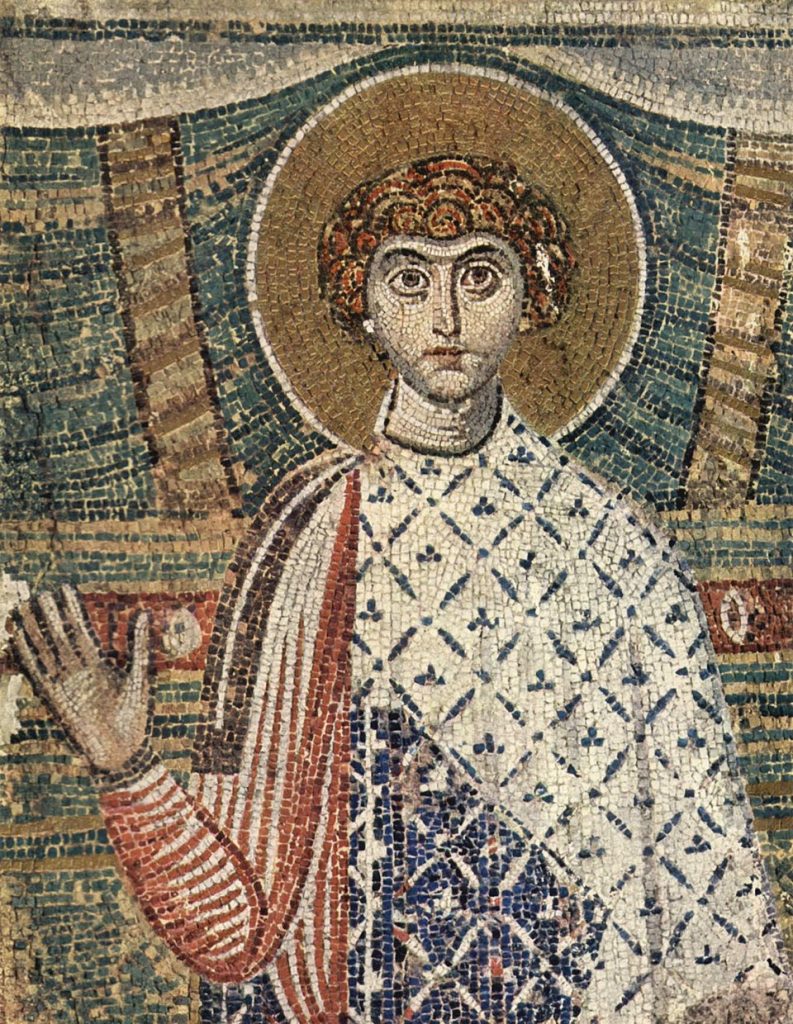
Mosaics in this period were not mere decoration. They were theological statements, spatial instruments, and manifestations of imperial orthodoxy. In the churches of Thessaloniki, mosaic reemerged as the dominant medium for sacred representation, not only because of its visual richness, but because of its metaphysical resonance. The glittering tesserae, especially those laid in gold and reflective glass, created a visual effect that blurred the boundaries between material and immaterial, surface and depth, image and vision. To the Byzantine viewer, these mosaics were not illustrations; they were manifestations—points of contact between the heavenly realm and the liturgical present.
One of the most exquisite examples of this revival is found in the Church of Hosios David, also known as the Latomou Monastery. Though originally built in the late fifth century, it was during the Macedonian period that its mosaic program achieved its fullest expression. The apse mosaic, among the earliest known depictions of a beardless Christ in a theophanic vision, stands as a profound statement of theological complexity. Christ is shown seated upon a rainbow, flanked by symbolic beasts representing the evangelists, his right hand raised in blessing, and his left holding a scroll. The surrounding background glows with gold tesserae, interspersed with abstract vegetal motifs and punctuated by delicate shading that gives the figure both presence and mystery.
What distinguishes this mosaic is not only its iconography but its tension between stillness and dynamism. Christ’s figure is hieratic, frontal, and symmetrical, yet the rainbow beneath him and the gestures of the evangelists’ beasts introduce a subtle energy. This interplay reflects the broader Byzantine aesthetic of the Macedonian period: an embrace of clarity and order suffused with symbolic vitality. The image is not static; it radiates. Its theological depth is inseparable from its formal precision.
The Church of the Panagia Chalkeon, built in 1028 under the patronage of the imperial official Christophoros, exemplifies the synthesis of Middle Byzantine architectural and mosaic traditions. Though many of its interior decorations have been lost or overpainted in later centuries, the church’s design—cross-in-square with domed nave and radiating chapels—provides the architectural canvas for mosaic cycles that once narrated the Incarnation, Passion, and Resurrection of Christ. The surviving decorative elements suggest a tight integration between architectural space and iconographic program. The dome likely once contained a majestic Pantocrator, encircled by angels and Old Testament prophets—a cosmic hierarchy descending into the nave, where the life of Christ unfolded in narrative bands.
This vertical logic—from divine enthronement to human salvation—was a hallmark of the period. It reflected a theological system in which architecture, liturgy, and art formed a unified cosmology. The faithful did not merely attend a service; they inhabited a symbolic universe, choreographed through color, line, and gold. In Thessaloniki, these spaces were often funded by local elites or imperial administrators, whose patronage both affirmed their loyalty to Constantinople and asserted their local piety. Their names, often inscribed in dedicatory plaques or woven into mosaic borders, remind us that Byzantine art was never anonymous in intention, even when it was in execution.
The revival of mosaic art in Thessaloniki also signified a deeper intellectual renaissance. The city, long a center of Orthodox learning, produced a generation of theologians, hagiographers, and iconographers whose work shaped the Byzantine worldview. The influence of the School of Thessaloniki—both a literal institution and a broader intellectual network—can be seen in the consistency and sophistication of the city’s visual theology. Iconographers were not artisans in the Western medieval sense, but theologians with pigment and tesserae. Their compositions drew upon a shared repository of biblical exegesis, liturgical texts, and patristic commentary. Every gesture, garment fold, and architectural backdrop carried exegetical weight.
This is evident in smaller-scale works as well. Portable icons, fragments of mosaic panels, and devotional objects found in Thessaloniki’s monastic complexes and domestic chapels reveal the diffusion of high visual language into private devotion. These works, while often more modest in scale, demonstrate an equally rigorous attention to theological nuance. A miniature icon of the Theotokos, for instance, might echo the grand apse compositions of urban churches, its line and light shaped to evoke not sentiment but spiritual clarity.
Thessaloniki’s mosaics during this golden age also reflect its geopolitical position within the empire. Situated between Constantinople and the Slavic and Latin frontiers, the city was both guardian and transmitter of Byzantine culture. Artistic workshops in Thessaloniki served not only the city’s churches but the wider Balkans. Mosaics and icons produced here traveled along trade routes and pilgrimage paths, their aesthetic forms disseminating a distinctly Thessalonian orthodoxy—a visual catechism forged in the city’s basilicas and refined in its monastic cells.
This exportation of style was not without consequence. Thessaloniki’s artistic influence provoked emulation and adaptation in Serbian, Bulgarian, and even Venetian contexts. Its mosaic techniques, chromatic schemes, and iconographic formulas appeared in the churches of Ohrid, Sofia, and Mount Athos. What emerged was a zone of shared visual theology centered on Thessaloniki—a kind of sacred stylistic empire that paralleled the political reach of Byzantium but often endured beyond it.
Yet the triumph of this visual culture was always shadowed by fragility. The durability of mosaic as a medium belies the precarity of its institutions. Fires, invasions, theological controversies, and economic pressures continually threatened the continuity of patronage and production. The fact that so many of Thessaloniki’s mosaics survive is not merely a testament to their craftsmanship but to the city’s persistent role as a theological and aesthetic stronghold. It withstood—not unscathed, but unbroken—the tides of disruption.
In the Macedonian Renaissance, Thessaloniki fulfilled its vocation as Byzantium’s second city—not by replicating Constantinople, but by distilling its spirit into luminous form. The gold of its mosaics was not an opulence, but an argument: that divine beauty was not only real, but visible, and that through image, heaven might be glimpsed on earth.
Icons and Orthodoxy: The Aesthetic Politics of the Hesychast Controversy
In the fourteenth century, Thessaloniki once again became a crucible of artistic and theological innovation—though this time under the sign not of imperial expansion, but of spiritual intensification and doctrinal tension. As the Byzantine Empire contracted politically under the weight of internal strife and external siege, its inner life turned increasingly toward contemplation, mysticism, and the visual codification of divine presence. Nowhere was this more vividly enacted than in the Hesychast movement—a theological and monastic current that not only reshaped Orthodox spirituality, but transformed the visual language of iconography in the late Byzantine world.
Thessaloniki stood at the center of this storm. In this period, the city was not merely a political entity or a cultural outpost; it became an epicenter of theological conflict and artistic reform. The Hesychast controversy, though formally a doctrinal dispute about the nature of divine light and mystical experience, had profound implications for the production and perception of sacred images. Icons, long accepted as vehicles of veneration and windows into the divine, were now caught in a renewed metaphysical debate: what, precisely, did they represent? How could the divine be seen, and in what manner might it be rendered?
At the heart of the Hesychast movement was Gregory Palamas, a monk of Mount Athos and later Archbishop of Thessaloniki, whose theological writings articulated the distinction between God’s essence and His energies. According to Palamas, though the divine essence remained utterly unknowable, human beings could experience the uncreated energies of God—most especially the uncreated light witnessed during contemplative prayer. This light, he argued, was the same light that transfigured Christ on Mount Tabor, and was not a metaphor but a real, perceptible phenomenon accessible to the purified soul.
For the iconographer, this claim was revolutionary. If divine light could be experienced, could it also be depicted? Could the gold ground of icons—long used as a symbolic placeholder for the heavenly realm—be understood as a visual manifestation of that same uncreated radiance? The Hesychast theologians said yes, and in doing so, they reoriented the metaphysics of Byzantine art. The icon was no longer simply a didactic tool or a cult object; it became the material correlate of spiritual illumination. To paint an icon was not merely to represent holiness, but to participate in it.
The iconography of Thessaloniki in this period reflects this theological recalibration. Figures become increasingly abstracted—not in the sense of distortion or stylization, but in the deliberate negation of corporeal weight. Saints and angels hover, suspended in fields of unmodulated gold or deep ultramarine, their bodies dematerialized, their gestures hieratic. Faces are elongated, eyes widened, skin tones rendered in translucent layers of ochre and green-gray. These are not portraits, nor are they narrative characters; they are presences, irradiated by a light that comes not from behind or above, but from within.
Consider the icons of the Virgin and Child produced in Thessaloniki during the fourteenth century, many of which survive in monastic collections and the Church of the Prophet Elijah (Profitis Ilias). These works adhere to canonical compositional forms—the Hodegetria, Eleousa, or Oranta types—yet their execution marks a shift. The Virgin’s face, often sorrowful yet serene, is constructed with almost mathematical symmetry, the folds of her maphorion meticulously balanced to draw the eye toward the Christ child, whose blessing hand and disproportionately large features suggest preternatural awareness. The image is not sentimental but theological: it confronts the viewer with an incarnate paradox—the infinite rendered in infant form.
This stylization is not the result of declining technique or aesthetic rigidity, as older Western narratives once claimed. Rather, it reflects a fully developed theory of anagogical vision—the idea that the icon should lift the soul upward, not by mimicking the world but by disclosing the structure of divine reality. The flattened perspective, inverse spatial cues, and immaterial coloration are not defects, but invitations: to see not with the eye, but with the nous, the purified intellect.
Thessaloniki’s icons of this era were often produced in conjunction with monastic and theological circles aligned with Palamite thought. Workshops operated in close relation to the monasteries of Mount Athos and the intellectual salons of the city’s ecclesiastical elite. The painter was no longer a craftsman in the traditional sense, but a liturgical actor, participating in the transmission of revealed truth. Icon-painting manuals, such as the later Hermeneia of Dionysius of Fourna, reflect this heightened status, though their roots can be traced to the teachings and techniques crystallized in Palamite Thessaloniki.
Architecturally, the city also witnessed developments that echoed Hesychast priorities. The churches built or renovated in this period—such as the Church of the Holy Apostles—demonstrate a heightened emphasis on interior illumination, with domes pierced by small windows, walls thickened to absorb and reflect light, and aniconic decoration balanced by concentrated iconographic focal points. The interior became a space not of spectacle but of inwardness—a setting for prayer, silence, and divine encounter. Fresco cycles in these churches reflect this same sensibility: scenes from the life of Christ or the saints rendered with emotional restraint, symbolic clarity, and compositional discipline.
The Hesychast influence also led to a codification of sacred space. The separation between the sanctuary and nave became more pronounced, with iconostases assuming greater liturgical and symbolic importance. The icons displayed on these screens were arranged in hierarchical order, not only to mark liturgical divisions but to mirror the celestial hierarchy. The visual ascent from local saint to the Theotokos to Christ Pantocrator was an ascent of the soul itself—an iconostasis not merely of wood and paint, but of prayer and metaphysics.
Yet this rich visual culture unfolded in a context of political decline. Thessaloniki in the fourteenth century was besieged repeatedly by external forces—Serbians, Turks, Latins—and internally divided by civil wars and economic hardship. In 1342, the city was briefly seized by a populist movement known as the Zealots, who challenged aristocratic and imperial authority. Though the movement was eventually suppressed, the episode underscored the fragility of Thessaloniki’s unity. And yet, even amid this turmoil, the city continued to produce theological clarity and artistic brilliance. The icon, as ever, was not a mirror of worldly power but a witness to transcendent reality.
This paradox—that spiritual refinement coincided with imperial disintegration—is one of the defining features of late Byzantine Thessaloniki. Its Hesychast icons do not speak of triumph, but of perseverance. They embody a theological vision in which light shines most clearly in darkness, and in which beauty survives not by force, but by fidelity. In their luminous stillness, we glimpse a city that, even as it trembled on the edge of history, rendered eternity visible.
Walls, Fortresses, and the Gothic Shadow: Defensive Architecture and Latin Influence
As the Byzantine Empire lurched through the crises of the late Middle Ages, Thessaloniki increasingly became a city under siege—both figuratively and literally. By the fourteenth century, it had evolved into a fortress of Orthodoxy, encircled not only by physical walls but by the theological and cultural defenses of a civilization under duress. The city’s art and architecture, while luminous in its spiritual aspirations, now also bore the marks of confrontation. Against the backdrop of military threat and cultural exchange, Thessaloniki became a frontier: a place where Eastern Christian aesthetics collided with Western incursions, and where the urban fabric itself was reshaped by the imperatives of survival and the echoes of Latin influence.
The most tangible evidence of this transformation is found in the city’s defensive architecture. Thessaloniki’s walls, originally constructed in the late Roman period, were significantly reinforced and extended during the Byzantine centuries, particularly from the ninth to the fifteenth centuries. These fortifications—massive stone ramparts, flanked by towers and punctuated by ceremonial gates—are among the most formidable in the medieval Eastern Mediterranean. They encircled the city in a complex topography of enclosure, stretching from the harbor at the south to the heights of the Heptapyrgion fortress in the north.
This architecture was not purely functional. The design and ornamentation of the walls, especially near the gates and key towers, reveal a symbolic as well as a military purpose. Brickwork arranged in intricate patterns, the inclusion of Christian symbols such as crosses and Chi-Rho monograms, and the careful integration of ancient spolia into the masonry all suggest that these structures were meant to be read, not merely to resist. The walls communicated a message: here stood not just a city, but a sacred stronghold, a bastion of the true faith.
Yet even as the city built up its walls, it absorbed influences from beyond them. In 1204, after the Fourth Crusade, Thessaloniki fell into Latin hands and was briefly transformed into the capital of the short-lived Kingdom of Thessalonica—a Crusader state subordinate to the Latin Empire of Constantinople. Though this occupation was relatively brief (ending in 1224 with the city’s capture by the Despotate of Epirus), it left enduring traces in both the city’s administrative structure and its visual culture. The encounter between Eastern Orthodox and Western Latin forms during this period did not result in fusion, but in tension—and sometimes, inadvertent hybridity.
The Latin occupation introduced Gothic elements into the city’s architectural vocabulary, particularly in fortifications and ecclesiastical structures built or modified during this period. While few pure examples of Gothic ecclesiastical architecture survive in Thessaloniki, owing in part to the rapid reconquest and subsequent “re-Orthodoxization” of religious buildings, fragments of pointed arches, ribbed vaulting, and rose window tracery suggest the temporary imposition of Western forms. These were not simply stylistic imports; they carried ideological freight, asserting the supremacy of Latin Christianity and its claim to universal jurisdiction.
The response of the Orthodox community was complex. On one hand, many churches defaced or repurposed by the Latins were restored to Orthodox liturgical use after 1224, often with deliberate visual signals of reclamation. Frescoes overpainted in iconographic cycles that emphasized Orthodoxy’s continuity, mosaics reinstalled with local saints or theological themes that reaffirmed the Palamite vision—these acts were aesthetic reassertions of identity in the face of external occupation.
On the other hand, the encounter left subtler, lingering marks. The inclusion of Western compositional elements in local painting, the adoption of certain architectural features in monastery design, and even the occasional incorporation of Western saints into Orthodox iconography reveal a city whose borders were more porous than its walls might suggest. In the Monastery of Vlatadon, founded shortly after the Latin expulsion, one finds a conscious return to Byzantine visual norms—yet the structure’s layout and spatial sensibility betray knowledge of Western monastic typologies. The artistic reaction was not rejection, but cautious filtration.
What emerged was a Thessaloniki that was simultaneously embattled and cosmopolitan. As the Latin threat receded only to be replaced by the rising Ottoman advance, the city’s artistic response turned increasingly defensive—not merely in military terms, but in cultural posture. Churches became more fortress-like; iconography turned inward. Gone was the expansive cosmopolitanism of the Komnenian period, replaced by a guarded aesthetic of introspection and formal discipline. Art became a bulwark: a memory palace for a besieged civilization.
This defensive aesthetic extended even to funerary art. Tombs from this period, particularly those of ecclesiastical or aristocratic patrons, often incorporated iconographic programs that emphasized judgment, resurrection, and the intercessory power of the saints. Stone sarcophagi, richly carved with scenes of the Last Judgment or the ladder of divine ascent, reveal a society obsessed with spiritual vigilance. Even death became a kind of frontier—a final wall between Orthodoxy and dissolution.
The Heptapyrgion, the massive citadel at the northern edge of the city, crystallizes this martial-sacred duality. Though its origins date to the Roman period, its current form is largely the result of late Byzantine and early Ottoman renovations. Built with stone and brick in alternating bands, with towers reinforced against cannon fire, it dominates the skyline as both protector and prison. In later centuries, it would become infamous as a place of incarceration; yet in the fourteenth century, it stood as the final redoubt of Christian Thessaloniki—a sentinel of faith cast in stone.
Ironically, the very acts of defense—the raising of walls, the consolidation of sacred space, the rigid codification of form—also presaged decline. As art became increasingly tied to theological polemic and architectural production shifted toward maintenance rather than innovation, the city’s aesthetic vocabulary began to narrow. By the time of the Ottoman conquest in 1430, Thessaloniki had become a spiritual fortress but a cultural outpost: rich in symbolic capital, but isolated from the broader currents of Mediterranean artistic experimentation.
And yet, within these walls, something enduring had been preserved. The art of late Byzantine Thessaloniki—its mosaics, icons, fortifications, and theological spaces—was not a retreat from history, but a final flowering of a civilization that, sensing its own mortality, strove to encode eternity in every surface. The Gothic shadow passed; the Ottoman crescent would rise. But in the textures of stone and gold, Thessaloniki had inscribed its resistance—not as a denial of the future, but as a refusal to forget.
Ottoman Conquest and Visual Continuity: Minarets over Mosaics
When Thessaloniki fell to Sultan Murad II in 1430, it was not the sudden imposition of a foreign regime upon an unsuspecting city. The Ottoman conquest, while forceful, was the culmination of decades of encroachment, political negotiation, and intermittent sieges. Yet in its finality, it marked a profound shift—not merely in political sovereignty but in the visual and spiritual grammar of the city. What had been a bastion of Byzantine Christianity became, within a generation, one of the most significant Islamic urban centers in the Balkans. The process was neither an erasure nor a wholesale replacement. Instead, it was a complex act of cultural rearticulation, in which Byzantine forms were retained, repurposed, and layered with Ottoman meanings. In Thessaloniki, the conquest did not level the artistic past—it translated it.
The first and most visible sign of this new order was the conversion of churches into mosques. This practice, standard across the newly expanded Ottoman territories, was both symbolic and practical. The great basilicas of Byzantine Thessaloniki, with their spacious interiors, monumental domes, and prominent city-center locations, were well suited for Islamic worship. Yet these conversions were more than acts of utility or domination. They were aesthetic negotiations—adaptations that altered spatial experience while preserving much of the architectural skeleton of the Christian past.
The Church of Saint Demetrius, long the spiritual heart of the city, was transformed into the Kasımiye Camii. While its relics were removed and its Christian mosaics concealed or destroyed, its basilical form remained intact. Mihrab and minbar were installed, the apse reoriented toward Mecca, and the vast nave repurposed for communal prayer. The Church of the Acheiropoietos was similarly converted into the Eski Camii (Old Mosque), one of the first in the newly conquered city. The Ottomans did not seek to erase the Christian past so much as to subordinate and overwrite it—visually, spatially, theologically. The result was a city filled with hybrid religious spaces, where architectural continuity met iconographic discontinuity.
Aesthetically, these transformations inaugurated a new urban rhythm. The Byzantine skyline—once punctuated by domes and cruciform outlines—now rose vertically with slender minarets, architectural statements of Islamic presence. These structures, built from stone and brick, were not intrusive additions but carefully integrated interventions. They marked the auditory and visual territory of the Muslim call to prayer, re-centering the sacred acoustics of the city. Ottoman Thessaloniki was no longer organized around the Christian liturgical cycle but around the rhythms of the adhan, the communal congregations of jumu’ah, and the festive processions of Islamic feasts.
This shift was further solidified through the construction of new religious and civic buildings. Mosques such as the Alaca Imaret Camii and the Hamza Bey Mosque, purpose-built in Ottoman styles, introduced the formal language of Islamic visual culture: central domes surrounded by half-domes, mihrabs decorated with Iznik tilework, and façades bearing calligraphic inscriptions in Arabic script. These inscriptions—often verses from the Qur’an or dedications to the sultan—replaced the iconographic imagery of Byzantine art with textuality as ornament, a key feature of Islamic aesthetics. Yet even here, the visual culture of the past persisted. Builders reused spolia from earlier Christian and Roman structures, embedding marble columns, capitals, and cornices into the new edifices. The past was not buried—it was reframed.
Ottoman Thessaloniki did not merely adapt Christian forms; it also created a distinctive artistic identity of its own, reflecting its role as a major Balkan port and multiethnic metropolis. The city became a node in a vast imperial network stretching from Cairo to Istanbul, and its art absorbed influences from across this cultural geography. The Bey Hamam, a monumental bathhouse built in the late fifteenth century, exemplifies this new aesthetic synthesis. Its domes, squinches, and flowing interiors exemplify the logic of Ottoman public architecture, where spatial luxury was achieved through repetition, rhythm, and refined proportion. The decorative program—floral motifs, arabesques, and calligraphy—conveyed not narrative but visual ecstasy, the sensual pleasure of geometry and pattern.
This new ornamental language extended into domestic and commercial architecture. The Ottoman konak (residential mansions), with their latticed windows, inner courtyards, and elaborately painted interiors, offered a different kind of visual culture: intimate, restrained, and governed by the principles of privacy and seclusion. These houses, many of which survived into the modern era, often featured wooden ceilings painted with stylized vegetal forms, geometric rosettes, and even abstracted landscapes—a delicate echo of Persian and Anatolian miniature traditions. The emphasis was on inward beauty, concealed behind austere exteriors, reflecting the Islamic valorization of the private sphere.
While Islamic art in Thessaloniki avoided figural representation in religious contexts, it embraced textile arts, metalwork, and ceramics with a fervent intensity. Ottoman Thessaloniki became known for its production of embroidered silks, engraved copper wares, and glazed ceramics, often blending local techniques with Anatolian and Levantine motifs. These objects, while portable, carried the aesthetics of empire into the everyday—transforming tableware, dress, and architectural details into canvases for ornament and meaning.
But perhaps the most striking continuity in Ottoman Thessaloniki was its layered visual ambiguity. The city did not erase its past; it lived among its ruins, its conversions, its palimpsests. A mosque might retain a half-visible mosaic beneath its plaster. A minaret might rise beside a basilica nave. The very urban texture became a kind of visual argument: a dialogic layering of faiths, empires, and aesthetics. The Ottomans, unlike the Latin Crusaders, did not seek to replace the city’s artistic identity wholesale. They inhabited it, reinterpreted it, and made it speak in new tones.
This was not, however, a utopia of coexistence. The Christian population, though allowed to retain their religion under the millet system, saw their visual culture pushed into private and marginal spaces. New churches were built in subdued architectural idioms, often below street level or without external domes, to avoid drawing attention. Religious painting persisted but retreated from monumental expression into the iconostasis and panel icon—the small-scale image as a defense against visual marginalization. The once-public face of Orthodox art became inward, condensed, and fiercely guarded.
In this context, Thessaloniki’s artistic identity became one of superimposition rather than succession. The city’s walls enclosed not a coherent visual narrative, but a series of overlapping aesthetic regimes, each asserting its own truth over the same ground. Byzantine mosaic, Ottoman tile, Latin rib vault, Hellenistic column—they all persisted, not in harmony, but in proximity. This visual simultaneity is Thessaloniki’s inheritance: a city whose art speaks not in unison, but in polyphony, sometimes dissonant, always rich.
By the sixteenth century, Ottoman Thessaloniki had emerged as a cosmopolitan port of nearly unrivaled diversity, with Muslims, Christians, and Jews each contributing to its visual and cultural landscape. But that Jewish contribution, profound and singular, deserves its own sustained attention—a new voice in the city’s layered aesthetic chorus.
Sephardic Settlement and Jewish Art Forms in the Ottoman Milieu
The arrival of Sephardic Jews in Thessaloniki following their expulsion from Spain in 1492 marked not merely a demographic shift, but an aesthetic and cultural inflection point in the city’s history. Within a generation, Thessaloniki—already a city of layered religious traditions and contested visual space—became a preeminent center of Jewish life in the Ottoman world. It is no exaggeration to say that between the sixteenth and early twentieth centuries, Thessaloniki was the most important Jewish city in the Mediterranean, often referred to as the “Jerusalem of the Balkans.” Yet the Jewish contribution to the city’s visual culture remains one of its most underexplored chapters—perhaps because it did not manifest in monumental buildings or grand narrative cycles, but in more intimate, community-centered forms: synagogues, manuscripts, funerary art, textiles, and print.
The Sephardic refugees who arrived in Thessaloniki brought with them a rich Iberian heritage, one forged over centuries in the cultural melting pot of medieval Spain. Their Judaeo-Spanish language (Ladino), liturgical customs, and artistic sensibilities reflected a synthesis of Hebrew, Arabic, Gothic, and Mozarabic influences. In Thessaloniki, these traditions did not dissolve into the broader Ottoman milieu but adapted to it, forming a distinctive visual idiom that blended Sephardic memory with Ottoman materiality.
The earliest expressions of this hybrid aesthetic can be seen in the synagogues established by different waves of immigrants, each named after their city of origin—Castilia, Aragon, Calabria, and so on. These synagogues were not grand temples in the European sense, but modest, functional spaces often tucked into dense urban neighborhoods near the port or Jewish quarters. Their architecture followed traditional Sephardic layouts: a central bimah (platform) surrounded by benches, with the Torah ark (hekhal) on the eastern wall, oriented toward Jerusalem. The interiors, however, reflected Ottoman decorative sensibilities—wood-carved ark facades, painted ceilings with floral and geometric patterns, and lamps of blown glass or metal filigree.
One of the best-known synagogues of this period, the Monastir Synagogue, though built later in 1927 by immigrants from Monastir (modern Bitola), exemplified the continuity of earlier design traditions: a rectangular plan, high vaulted ceiling, and a synthesis of Balkan, Ottoman, and Sephardic architectural vocabularies. Sadly, most of Thessaloniki’s historic synagogues were destroyed during the Great Fire of 1917, Nazi occupation, or postwar urban redevelopment. What remains, therefore, is fragmentary—but the fragments themselves are eloquent.
Equally significant is the Sephardic contribution to the arts of the book. Thessaloniki became a major center of Hebrew printing as early as the mid-sixteenth century, when exiled Spanish printers such as the Yaabetz and Soncino families set up presses in the city. These workshops produced religious texts, commentaries, and liturgical manuals adorned with woodcut illustrations, ornate Hebrew calligraphy, and title pages influenced by Italian and Ottoman graphic conventions. The books were not mere vessels of text; they were objects of devotion and identity, circulated across the Jewish diaspora and bearing visual traces of Thessaloniki’s cultural hybridity. Borders framed with vegetal motifs, printer’s marks evoking Jerusalem, and flourished initial letters demonstrated a visual literacy that was both cosmopolitan and grounded in tradition.
Perhaps the most poignant visual legacy of Sephardic Thessaloniki is found in its cemeteries, which for centuries lay just outside the city walls. The Jewish cemetery of Thessaloniki was once one of the largest in the world, with estimates suggesting over 300,000 graves, many of which bore elaborately carved headstones. These stones, now largely destroyed or scattered, reflected a Sephardic epigraphic tradition that emphasized textual eloquence over figural imagery. Epitaphs were written in Hebrew, Ladino, or a mix of both, often framed by geometric motifs, floral patterns, or symbolic elements—grapes, stars, lions of Judah.
Some headstones bore carvings of hands in priestly blessing (indicating Kohanim), jugs (for Levites), or books (for scholars), but never the anthropomorphic imagery typical of Christian tombs. The Jewish aesthetics of the tomb were restrained, symbolic, and linguistic—rooted in the belief that memory was a function of word, not image. And yet, these stones were themselves images: visual articulations of community, learning, continuity, and devotion.
The domestic arts of Thessaloniki’s Sephardim also contributed to the city’s aesthetic texture. Embroidered textiles—Torah mantles, ark curtains, wedding canopies—were produced by women’s guilds and household workshops, employing techniques passed down across generations. These textiles were often adorned with inscribed blessings, stylized crowns, menorah forms, and rosettes. The stitching was both a craft and a form of silent authorship: a way for women, often excluded from public religious roles, to inscribe themselves into the sacred spaces of the community. Though ephemeral compared to stone or wood, these textiles bear witness to a deep devotional artistry rooted in ritual and repetition.
Sephardic Thessaloniki also had a vibrant musical and performative culture, which—though primarily aural—found visual expression in manuscripts, sheet music, and performance spaces. The chants of the piyyutim (liturgical poems), sung in ornate modal scales, influenced the acoustic design of synagogues, encouraging vaulted ceilings and interior layouts that amplified voice over spectacle. The very architecture of prayer was tuned to a tradition of sound passed down from Andalusian courts to Ottoman salons.
In the broader urban context, the presence of a dominant Jewish community shaped the city’s commercial and artisanal landscapes. Jewish-owned shops often displayed signage in Ladino, Hebrew, and Greek, and their interiors bore traces of both Ottoman decorative style and Iberian spatial logic. The marketplaces of Thessaloniki, especially the Allatini and Modiano markets, were spaces where Jewish merchants, Muslim craftsmen, and Christian artisans coexisted in a sensory dialogue of goods, smells, textures, and designs. Here, the aesthetic boundaries between confessional groups blurred—not in doctrine, but in the material language of commerce and craft.
By the late nineteenth century, as Thessaloniki modernized under both Ottoman reform and European influence, the Jewish visual presence began to shift. Jewish architects trained in Paris or Vienna returned to build synagogues, schools, and hospitals in the styles of Beaux-Arts, Art Nouveau, and Neoclassicism—integrating Jewish purpose with modernist visual language. The Alliance Israélite Universelle, for example, promoted architectural modernization alongside educational reform, leaving a visual legacy of buildings whose symmetrical façades and restrained ornamentation embodied the aspirations of an increasingly Westernized Jewish elite.
And yet, the deep visual culture of Thessaloniki’s Sephardic community remained rooted in continuity, memory, and sacred text. It was not a culture of monumental art or imperial aesthetics, but of embedded tradition: book, cloth, word, ritual. The catastrophe of the twentieth century—the destruction of the cemetery, the burning of the Jewish quarter in 1917, the near-total annihilation of the community in the Holocaust—obliterated much of this legacy. But its traces persist, encoded in surviving objects, dispersed manuscripts, architectural fragments, and the collective memory of a city that once spoke Ladino as fluently as Greek or Turkish.
In the grand narrative of Thessaloniki’s art history, the Sephardic chapter stands not as an interlude but as a sustained transformation of the city’s sensory life—a layer of devotion, text, and craft that, though largely invisible today, remains vital to understanding the full topography of Thessaloniki’s artistic identity.
Commercial Cosmopolitanism and the Rise of Bourgeois Aesthetics
By the late nineteenth century, Thessaloniki had entered a new phase of transformation—no longer defined by religious conquest or theological ferment, but by the accelerations of capital, commerce, and cosmopolitan modernity. Under the late Ottoman Tanzimat reforms, and especially in the final decades of imperial rule, the city became an emblem of commercial prosperity and social hybridity. The demographic mosaic—Muslims, Jews, Greeks, Bulgarians, Armenians, Italians, and Frenchmen—coexisted not in perfect harmony, but in sustained interdependence, their presence registered most palpably in the city’s evolving architecture and domestic material culture. A new class emerged: the bourgeoisie, whose aesthetic sensibilities broke decisively with the inward-looking, religiously coded traditions of the past and embraced a worldly, often Westernized, visual language.
At the heart of this shift was the remapping of urban space. The Great Fire of 1890, and the even more devastating fire of 1917, would ultimately destroy much of the historical fabric, but even before those events, the city’s elite were redrawing its aesthetic contours. Commercial success—particularly in tobacco, shipping, and banking—had created a class of families who sought to inscribe their wealth and modernity into the very form of the city. The result was a new bourgeois architectural idiom, one that fused imported European styles with local materials and Ottoman urban rhythms.
The most visible manifestation of this aesthetic reorientation was the construction of neoclassical and eclectic mansions in neighborhoods like Exoches, on the city’s periphery. These villas—built by Jewish, Greek, and Muslim entrepreneurs—employed European architects, particularly Italians and Frenchmen, who brought with them the idioms of the Beaux-Arts, Renaissance Revival, and Art Nouveau. The Allatini family, prominent Jewish industrialists, commissioned a number of such buildings, including the now-ruined Villa Allatini, a fusion of Moorish arches, neoclassical columns, and ornate ironwork, set amidst gardens inspired by English landscape design. These houses were not just residences—they were social statements, spatial projections of cosmopolitan identity, education, and taste.
Inside, these villas revealed a new domestic aesthetic. Painted ceilings with allegorical figures, imported chandeliers, parquet floors, and furniture in the Louis XVI or Biedermeier style replaced the inward-focused Ottoman konak with its secluded courtyards and harem rooms. Here, public visibility and private refinement coexisted in tension. The Greek Orthodox banker or Jewish industrialist hosting a soirée beneath a neoclassical pediment was not rejecting his cultural origins, but translating them into a modern visual idiom. The parlor became a stage for hybrid performance: European manners, local cuisine, Ottoman hospitality.
This transformation extended beyond domestic space into commercial architecture. The markets of Thessaloniki—especially the Modiano and Bezesteni markets—were redesigned or rebuilt along European lines, with iron-and-glass roofing, arcaded façades, and regulated storefronts. These structures reflected a new conception of urban order and spectacle, influenced by the grands magasins of Paris and the arcades of Milan. They also demonstrated the material logic of the capitalist marketplace: visibility, circulation, and display. Goods were not just sold—they were arranged, lit, and framed in ways that turned consumption into an aesthetic experience.
Within this expanding commercial milieu, print culture also flourished. Thessaloniki became a center of publishing in multiple languages—Greek, Ladino, French, Turkish, Armenian—and newspapers, advertisements, and pamphlets filled the city’s cafés and bookstores with new forms of visual communication. Typography became an aesthetic in its own right, combining Ottoman script, Latin typefaces, and modernist graphic design. Posters announced theatrical performances, political rallies, and commercial sales, often in several languages at once. The multilingualism of the city became a visual texture, a sign of its layered identities and aspirations.
Religious architecture, too, was reshaped by bourgeois patronage and reformist ambition. New synagogues, Orthodox churches, and Catholic chapels were built in styles that departed from medieval precedent. The Yeni Cami (New Mosque), built in 1902 for the Dönmeh (Muslim converts from Judaism), combined Islamic motifs with neoclassical symmetry and Art Nouveau ornamentation—embodying the ambivalence of a community caught between traditions. The Agia Sofia Cathedral, rebuilt in the early twentieth century, echoed Byzantine forms but with structural reinforcements and aesthetic choices informed by archaeological revivalism and nationalist historicism. Sacred space was now mediated through modern sensibility: ordered, stylized, curated.
Parallel to architecture, there was a growing interest in visual fine arts, though Thessaloniki did not yet rival Athens or Constantinople in institutional infrastructure. Art exhibitions, private collections, and the circulation of European prints and paintings brought new visual genres to public attention—landscape, portraiture, still life—genres long marginal in Orthodox and Islamic art. The local intelligentsia, often educated abroad, began to cultivate secular aesthetics, informed by realism, romanticism, and even early impressionism. Though few painters of note emerged from Thessaloniki in this period, the city became a receptive node in the larger networks of European artistic modernity.
Education played a crucial role in this cultural reorientation. The Alliance Israélite Universelle, the American and British missionary schools, and the Greek and Armenian gymnasia all promoted visual literacy as part of their civilizing mission. Drawing classes, architectural drafting, and even early photography entered the curriculum, shaping a generation of students who saw aesthetic cultivation as social advancement. The visual was no longer confined to ritual or ornament; it became a medium of self-fashioning and civic ambition.
Yet for all its cosmopolitan glamour, this bourgeois aesthetic was built upon fragile foundations. Beneath the surface of wealth and style lay deepening national tensions, political violence, and social inequalities. The very hybridity that made Thessaloniki a cultural capital also made it vulnerable to rupture. Competing nationalisms—Greek, Bulgarian, Serbian, Turkish—sought to fix identity where the city had long been fluid. As the Ottoman Empire unraveled, and as Thessaloniki was eventually incorporated into the Greek state in 1912, the city’s bourgeois aesthetic began to falter under the weight of ideological polarization.
Nevertheless, the decades between 1870 and 1917 remain a singular moment in Thessaloniki’s art history—a time when commerce, cosmopolitanism, and bourgeois aspiration created a distinctive visual culture. It was not a revival of ancient forms, nor a continuation of religious iconography, but a new mode of urban beauty, rooted in hybridity, spectacle, and private refinement. The fire of 1917 would destroy much of this world, but for a few generations, Thessaloniki offered a vision of aesthetic modernity unmatched in the Eastern Mediterranean: plural, polished, and precarious.
Fire and Fragmentation: The 1917 Inferno and the Destruction of Memory
The great fire of 1917 did more than reduce Thessaloniki’s architectural core to ash. It eradicated the material record of centuries, collapsing the palimpsest city into a tabula rasa upon which a new national narrative could be inscribed. In less than thirty-six hours, over one-third of the urban fabric—housing more than 70,000 people—was obliterated. Nearly 9,500 buildings were destroyed, including synagogues, churches, mosques, markets, libraries, and countless private homes. Yet the 1917 fire was not merely a disaster; it was a pivotal moment in the aesthetic unmaking of Thessaloniki—a rupture through which modernist urbanism, nationalist ideology, and bureaucratic rationalism would replace the deep stratigraphy of memory and form.
The fire began on August 18 in the densely built Jewish quarter, ignited accidentally in a kitchen on Olimpiados Street. Strong winds and inadequate firefighting infrastructure allowed the flames to sweep southeast across the heart of the city, consuming the Modiano and Allatini markets, the chief synagogues, Ottoman baths, Orthodox churches, and much of the commercial district. It halted only when it reached the sea and the open spaces of the eastern suburbs. The destruction was not evenly distributed. The Muslim and Christian upper classes, whose homes were often located in the newer or more elevated districts, suffered less damage, while the central Jewish and commercial neighborhoods were devastated. This geographic asymmetry would have lasting implications, not only socially and politically, but in the visual reconstruction of the city’s identity.
What was lost cannot be precisely quantified. Photographs, travelers’ accounts, and municipal records provide some indication of the architectural diversity that vanished—Moorish-revival synagogues, baroque façades, Ottoman konaks, neoclassical villas, Art Nouveau shops, Byzantine churches, medieval fountains, and entire blocks of vernacular housing built of timber and stone. But it was not only buildings that were destroyed. The fire consumed entire aesthetic ecosystems: artisan workshops, signage in Ladino and Ottoman Turkish, carved doors and tiled hearths, painted ceilings and cast-iron balconies. The visual grammar of cosmopolitan Thessaloniki—its polychrome surfaces, linguistic pluralism, and ornamental density—was reduced to smoldering uniformity.
In the immediate aftermath, the Greek state—newly in control of Thessaloniki following the Balkan Wars—faced a critical decision: whether to rebuild what had been lost or to remake the city according to a new ideological and urban vision. The choice was unambiguous. The government, under the influence of Venizelist modernization and French urban theory, saw the destruction not as a tragedy to be reversed but as an opportunity for national and hygienic rebirth. Within months, the city had been placed under the authority of the French urban planner Ernest Hébrard, whose “New Plan for Thessaloniki” would become one of the most ambitious reconstruction efforts in modern European history.
Hébrard’s plan was, in many respects, an aesthetic revolution. It rejected the organic, polyglot, and labyrinthine city that had preceded it in favor of a rationalized urban grid, punctuated by grand boulevards, public squares, and neoclassical façades designed to evoke a purified Hellenic identity. Byzantine and classical motifs were selectively reintroduced as decorative and ideological tropes, but the multicultural and Ottoman layers of the city were systematically excluded. Markets were reconstructed with symmetry and hygiene in mind. Religious buildings—especially mosques and synagogues—were minimized in the visual hierarchy of the new cityscape. Hébrard himself openly declared his intention to “Hellenize the physiognomy” of Thessaloniki, making its appearance congruent with the nation-state to which it now belonged.
This aesthetic re-engineering had consequences beyond mere architecture. The destruction of the Jewish quarter, and the state’s subsequent refusal to allow its return, displaced tens of thousands of residents and dismantled the spatial coherence of one of the most culturally and visually distinctive Jewish communities in the world. The Allatini and Modiano families, whose patronage had once shaped the bourgeois visual idiom of the city, found their influence diminished. Even as new synagogues were eventually built, they stood as islands in a redesigned urban sea, stripped of the density and vernacular richness that had characterized Sephardic Thessaloniki. The fire, in effect, allowed for a soft erasure of pluralism under the guise of rational planning.
Orthodox Christian architecture, meanwhile, was selectively preserved and promoted, though even here the emphasis was on Byzantine revivalism rather than continuity. Surviving churches were restored in ways that emphasized their alignment with the national mythos. Mosaic fragments were collected, catalogued, and sometimes relocated to museums or new ecclesiastical spaces where they could serve as relics of a narrative cleansed of Ottoman or Latin contamination. What emerged was a curated memory, in which Thessaloniki’s complex artistic past was recast as a linear progression toward Greek Christian modernity.
The architectural idioms of the 1920s and 1930s further consolidated this vision. Public buildings, apartment blocks, and institutions were constructed in variations of neoclassical, Bauhaus, and art deco styles—forms that echoed Western European trends but were often stripped of ornament and regional specificity. The new Thessaloniki was meant to look modern, efficient, and Greek. It bore little visual resemblance to the city that had preceded the fire. In fact, it was designed not to.
Even where visual continuity might have been possible, it was frequently denied. The Ottoman-era Bey Hamam, for example, survived the fire and stood as a masterpiece of fifteenth-century Islamic architecture. Yet for decades it remained neglected, fenced off from the city’s reconfigured visual axis. Mosques that survived the fire were often repurposed as warehouses, cinemas, or simply left to decay. Their minarets were dismantled, their calligraphic panels painted over or removed. The goal was not only to erase the aesthetic markers of Islam, but to sever their spatial logic from the everyday life of the city.
The 1917 fire thus became not only a historical trauma, but a visual caesura—a moment when the dense palimpsest of Thessaloniki’s artistic history was forcibly peeled back, leaving a new surface upon which an idealized modernity could be imposed. This was a modernity predicated not on continuation but on curated rupture, a model in which memory was preserved only insofar as it conformed to the narratives of nation, hygiene, and rational progress.
Yet memory is rarely so easily managed. Even in the interstices of the new city, traces of the old persist: a fragment of painted plaster beneath whitewash, a displaced lintel reused in a modern façade, a Ladino inscription on a salvaged gravestone. These fragments resist the imposed unity of the Hébrard plan. They speak of a city that once shimmered with contradictions, of a visual culture born not of synthesis but of coexistence and conflict.
In this sense, the 1917 fire was not the end of Thessaloniki’s art history, but a radical dislocation within it—a moment in which the city’s aesthetic identity was redefined not by what was built, but by what was permitted to burn.
Modernism and the National Imagination
In the wake of the 1917 fire and the sweeping transformations that followed, Thessaloniki entered the twentieth century not as a city recovering its past, but as a city consciously remade. The cosmopolitan, multiethnic landscape that had defined its premodern character was increasingly marginalized in favor of a nationalized vision—both architecturally and ideologically. The post-fire reconstruction under Ernest Hébrard laid the physical groundwork, but it was the decades following the incorporation of Thessaloniki into the Greek state in 1912, and especially the post-1923 period after the Greco-Turkish population exchange, that saw a full aesthetic realignment. The city’s art and architecture became the battleground on which modernism and national identity negotiated uneasy terms.
The transformation was not an organic process but a state-driven one, often pursued through institutions, competitions, and legislation. Art was harnessed as an instrument of cultural consolidation. The multiplicity of forms and languages that once adorned Thessaloniki—Ottoman arabesques, Jewish epigraphy, Ladino street signs, Byzantine layering—was now considered either irrelevant or dangerous to the emerging narrative of Greek continuity. In their place emerged a new visual rhetoric: an official Hellenism, filtered through the logics of classicism, Byzantine revival, and, increasingly, international modernism.
The architecture of this era bears the marks of this ideological tension. In public buildings—the new university complex, the law courts, the post office, and the archeological museum—one sees a hybrid of styles: simplified neoclassical elements evoking antiquity, symmetrical façades and axial plans drawn from Beaux-Arts training, and the stripped ornamentation of early Bauhaus and art deco. This blending was not purely aesthetic; it was a deliberate expression of the state’s desire to balance European modernity with national authenticity.
Residential architecture followed suit. The city’s new apartment blocks—often funded by private capital from the emerging Greek bourgeoisie or from the influx of Asia Minor refugees—were built according to rationalist principles: steel-framed construction, flat roofs, minimal ornamentation, and efficient layouts. Yet even these modernist forms were often softened with subtle gestures to local tradition: stylized acroteria, Byzantine-inspired arches, or mosaics referencing Orthodox iconography. The result was an ambivalent modernism—neither utopian nor brutalist, but cautious, introspective, and always inflected by national imperatives.
This architectural ambivalence mirrored broader cultural debates about the nature of Greek modernity. The “Generation of the ’30s”, a loose movement of writers, architects, and artists centered in Athens, argued for a reconciliation of the classical and the contemporary, the Western and the Eastern, the modern and the Greek. Though Thessaloniki was not its primary arena, the city absorbed its debates, especially in the realm of the visual arts.
The Salonika School, a regional constellation of painters active from the 1930s through the 1950s, illustrates this dialectic. Figures like Nikolaos Gyzis, Konstantinos Parthenis, and Spyros Papaloukas, though not based in Thessaloniki, exerted a powerful influence on local artists such as Spyros Vassiliou, George Zongolopoulos, and Stelios Miliadis. Their work sought to integrate Byzantine formality, folk motifs, and modernist abstraction, rejecting both Western academic realism and socialist realism in favor of a distinctly Greek visual idiom.
In Thessaloniki, this translated into a series of murals, church restorations, and public art projects that reimagined Orthodox iconography through the lens of European modernism. Dome paintings, for instance, were now executed in flattened planes, with angular drapery and geometric composition—more akin to Cubism than to traditional Byzantine stylization. The influence of Fotis Kontoglou, a leading theorist of Greek modern iconography, was especially significant, as he promoted a return to Orthodox forms stripped of both Western sentimentality and Byzantine decadence.
This movement was further institutionalized in the postwar period through the Aristotle University of Thessaloniki’s School of Fine Arts, which became a center for artistic experimentation and pedagogy. Here, the tension between tradition and innovation was not only aesthetic but pedagogical. Students were trained in icon painting and fresco techniques, even as they engaged with abstraction, expressionism, and conceptual art. The goal was not simply to create new forms, but to create forms that could bear the weight of Greek identity in a fractured modernity.
Yet this vision was never universally accepted. The modernization of Thessaloniki was always shadowed by anxieties of loss. Critics lamented the destruction of Ottoman buildings, the neglect of Jewish heritage, the flattening of the city’s pluralistic past into a monolithic national present. The visual field of Thessaloniki had been narrowed—even as it was enlarged by new styles and global currents. The old layering had been replaced by aesthetic homogeneity, a cityscape that mirrored the ideological imperative to unify, purify, and project.
Nonetheless, fragments of resistance persisted. Photographers like Nelly’s (Elli Sougioultzoglou-Seraidari) and Yiannis Stylianou documented the disappearing textures of premodern Thessaloniki: peeling Ottoman doorways, Sephardic balconies, half-buried Roman arches. Their work did not challenge the modernist agenda directly, but it archived what could not be assimilated, offering a counter-image to the clean lines and national myths of the new city.
This tension came to a head in the 1960s and 70s, as international modernism matured into brutalism and conceptualism. Thessaloniki, like other Greek cities, saw the rise of concrete megastructures, large-scale urban planning, and the marginalization of the historical center. Yet even here, artists and architects found ways to reintegrate memory, incorporating ancient fragments into façades, reusing Byzantine motifs in sculptural form, or situating performance art within decaying Ottoman baths. The past, though officially bracketed, refused to disappear.
By the end of the twentieth century, the modernist project in Thessaloniki stood as both a triumph and an unfinished argument. It had given the city a new visual coherence, infrastructure, and international standing, but it had also overwritten much of what made Thessaloniki singular. The national imagination had succeeded in constructing a modern Greek city—but in doing so, it had built over ruins whose meanings remained unresolved.
Modernism in Thessaloniki was never an ideology of rupture alone. It was a site of negotiation—between state and citizen, tradition and innovation, memory and erasure. In this, as in so much else, the city mirrored the deeper contradictions of Greek modernity itself: proud, self-consciously historical, and yet haunted by the very layers it had buried.
Postmodern Excavations: Contemporary Art and the Return to Byzantine Memory
In the final decades of the twentieth century and into the twenty-first, Thessaloniki began to experience a curious reversal. After a century marked by rationalization, modernization, and the imposition of national homogeneity upon its urban and visual identity, the city turned again to its own buried past—not nostalgically, but analytically, and at times subversively. In this era, Thessaloniki ceased to be merely the object of archaeological restoration or state-sponsored memory. It became a site of contemporary artistic excavation—a laboratory where artists, curators, and architects began to probe the aesthetic residues left beneath modernism’s surface.
This shift was not the product of a single institution or ideology, but of a broad postmodern sensibility, one attuned to absence, fragmentation, and the instability of grand narratives. Thessaloniki, with its long history of superimposed identities and half-erased traditions, proved fertile ground for such a reorientation. Artists increasingly rejected the modernist desire for coherence, turning instead toward the ruin, the fragment, and the palimpsest as both motif and method.
Nowhere is this turn more evident than in the Thessaloniki Biennale of Contemporary Art, inaugurated in 2007 and organized by the State Museum of Contemporary Art. From its inception, the Biennale explicitly positioned itself within the historical depth of the city, drawing upon the past not as heritage to be celebrated, but as a field of unresolved tensions. Installations have been staged in disused Ottoman baths, Byzantine cisterns, derelict synagogues, and modernist buildings—settings chosen not for neutrality but for their historical charge. The curatorial strategy has emphasized site-specificity, memory, and spatial critique. The art produced and exhibited in this context often challenges the very foundations of Thessaloniki’s aesthetic history, asking: What was lost? Who remembers? Who speaks for the silenced stones?
This mode of engagement is particularly visible in the work of Greek and diasporic artists who have returned to the city’s Byzantine legacy—not to revive it, but to interrogate it. Contemporary icon painters such as Giorgos Kordis and Yannis Balaskas have developed a postmodern Byzantine idiom that merges traditional techniques with secular or ambiguous content. Kordis, for instance, employs egg tempera, gold leaf, and the strict geometry of icon composition to depict modern figures, emotional states, or even abstract theological paradoxes. His work reframes the icon not as a relic of Orthodoxy, but as a living formal language capable of irony, lament, or metaphysical inquiry.
Other artists have focused on the city’s Jewish absence—a presence now felt most acutely through its voids. Installations such as “The Campfire Project” by Dimitris Alithinos and the work of Panos Kokkinias engage with the traumatic invisibility of the Sephardic past. They utilize photography, video, and spatial intervention to expose the sites of historical amnesia: vanished cemeteries, lost synagogues, faceless apartment blocks built upon bones. Here, the aesthetics of minimalism and conceptualism become tools of ethical attention—a way of holding space for what has been systematically unacknowledged.
This aesthetic of excavation also shapes architectural and museological practice. The Rotunda of Galerius, once a pagan temple, then a church, then a mosque, and now a museum, has in recent decades been restored not to a singular function but to its full historical complexity. Conservationists have chosen to retain traces of each phase—mosaics, Arabic inscriptions, Christian apse, Ottoman minbar—presenting the building not as a unified whole but as a material biography. This approach represents a philosophical shift in heritage management: from reconstruction to curated stratigraphy.
In the city’s museum culture, too, this change is evident. The Museum of Byzantine Culture, opened in 1994, resists triumphalism. Its exhibitions emphasize material process, theological ambiguity, and the regional distinctiveness of Thessaloniki’s religious art. In contrast to older models of nationalist museology, the Museum invites viewers to dwell within historical complexity—to consider the icon not as a timeless image but as an object situated in history, labor, and doctrine.
More radical are the interventions of urban artists and independent curators, who use the city itself as canvas and archive. Graffiti, performance, and ephemeral installations appear in neglected alleys, former marketplaces, and industrial ruins, reclaiming spaces of abandonment as zones of aesthetic attention. In such projects, the past is not cited reverently but juxtaposed, sometimes violently, against the present. A stenciled Byzantine saint in a derelict port warehouse, a Ladino poem projected onto a brutalist façade—these are not reconciliations but aesthetic confrontations, forcing the city to acknowledge its layered inheritance.
This postmodern approach to Thessaloniki’s art history also reconfigures time itself. The city is no longer read linearly—from classical to Roman to Byzantine to Ottoman to Greek—but radially, as a series of coexisting durations, each accessible through material clues. In this framework, a single marble block might signify three civilizations. An architectural cornice might speak of imperial ambition, theological dogma, and late-capitalist decay. The contemporary artist’s task is to make these durations resonate, to reveal the simultaneity of pasts beneath the smooth surface of the present.
This shift in temporal consciousness has found resonance in literary and philosophical discourse as well. Writers such as Thanassis Valtinos and Amanda Michalopoulou, though not native to Thessaloniki, have evoked the city as a metaphor for historical discontinuity, a place where memory fails and meaning becomes provisional. The visual arts echo this instability, employing montage, distortion, and reuse to disrupt the coherent narratives once imposed by church, state, and planner.
Yet this postmodern reengagement is not merely intellectual. It has a material urgency. The pressures of tourism, commercial development, and state neglect continually threaten the fragile residues of Thessaloniki’s non-Hellenic past. Artists and preservationists work not only to represent this past, but to protect it from erasure. In this sense, the return to Byzantine, Ottoman, and Jewish memory is not a retreat from the modern but a demand upon it: a call to reckon with the costs of coherence.
The art of contemporary Thessaloniki does not seek unity. It seeks resonance. It does not restore the past; it unearths it, unsettles it, reframes it. In the flickering shadows of installations in a former hamam, or the golden glow of a digitally reimagined mosaic, the city reclaims its right to be incomplete, unresolved, alive.
Conclusion: Thessaloniki as a City of Incomplete Palimpsests
Thessaloniki’s art history resists synthesis. To attempt to reconcile its myriad epochs, styles, destructions, and renewals into a single aesthetic narrative is to do violence to the very conditions of its cultural life. Unlike cities that project visual coherence through imperial monumentality or Enlightenment-era planning, Thessaloniki remains a city of fragments—a palimpsest not only by historical accident, but by structural condition. It is a city whose forms, materials, and artistic languages betray continual overwriting, incomplete erasure, and perpetual return.
From its Hellenistic foundation as a political and mercantile center, through Roman monumentalism, Byzantine theological splendor, Ottoman layering, Sephardic domestication, and modernist recalibration, Thessaloniki has functioned not as a stage for a singular civilizational arc but as a theater of collisions and conversions. Each regime, each faith, each artistic impulse has sought to inscribe itself into the urban and visual matrix of the city—not by obliterating the past, but by bending it to new ends. The result is not an aesthetic equilibrium, but a historical tension rendered in stone, pigment, glass, and void.
Its early basilicas—Acheiropoietos, Saint Demetrius—preserve, even in their repairs and reconstructions, the imprint of martyrdom, mosaic theology, and sacred procession. Galerius’ imperial arch and Rotunda, Byzantine in afterlife, remind us that monuments may outlast meanings, yet remain inexhaustibly interpretable. The Ottoman mosques, baths, and markets repurpose Christian and Roman foundations, asserting continuity and rupture simultaneously. The traces of Sephardic Thessaloniki survive not in monumental synagogues but in the afterimage of textile, print, and stone—a visual culture of devotion and diaspora rendered invisible by fire and genocide, yet still audible in the language of silence.
In modernity, Thessaloniki was reimagined as a national city, rebuilt as a Greek polis atop the ruins of its pluralist past. The architectural language of this project—stripped neoclassicism, modernist apartment blocks, curated Byzantine revival—spoke a grammar of statehood and modern belonging, even as it suffocated the informal, the vernacular, and the hybrid. The fires of 1890 and 1917 cleared space not merely for new buildings, but for new ideological aesthetics, substituting coherence for complexity.
And yet the city refused, ultimately, to be unified. Its cracks reopened in the late twentieth and early twenty-first centuries, not through decay but through aesthetic re-engagement. Postmodern artists, curators, and scholars began to peel back the layers—literally and figuratively—exposing the interstitial spaces where Jewish, Muslim, Orthodox, and secular memories persist. In installations, performances, and revised conservation practices, a new Thessaloniki began to emerge: one that did not pretend to wholeness but claimed its right to remain incomplete, stratified, and multiplicitous.
This is the paradox and the power of Thessaloniki: it is a city that endures by accumulating ruptures. Its art history is not a genealogy of forms, but a cartography of temporal dissonance. A Byzantine mosaic may lie beneath an Ottoman mihrab, which itself is hidden within a neoclassical museum gallery. An icon’s theological logic may be repurposed by a secular painter. A synagogue’s floorplan may survive only in municipal blueprints or in the names of vanished streets.
Thessaloniki is a city not of ruins, but of residues. It refuses the serenity of completed meaning. It demands an eye trained not only on what stands, but on what has been covered, concealed, overwritten, or forgotten. Its beauty lies not in visual harmony, but in the pressure of its layers, the friction between competing claims to memory, space, and form.
To write the art history of Thessaloniki, then, is not to trace a lineage but to map a stratigraphy. It is to recognize that the image here is never only what it seems: it is also what it was, what it became, and what it refuses to be. A marble capital is a Roman ornament, a Christian column, an Islamic spolia, a modern museum piece. An icon is a liturgical object, a nationalist token, a conceptual reference. A city is never just itself; it is the ghost of its futures and the echo of its pasts.
In this sense, Thessaloniki offers a model not of purity, but of endurance through complexity. Its art does not soothe; it unsettles. It calls upon the viewer not to celebrate continuity, but to confront the stratified and unresolved nature of history itself.
Thessaloniki is not a museum. It is not a ruin. It is a living palimpsest—unfinished, restless, and essential.