Palazzo Vecchio, one of the most commanding structures in Florence, began construction in 1299 as the Palazzo della Signoria, named after the Signoria, the governing body of the Florentine Republic. The design was entrusted to Arnolfo di Cambio, an architect and sculptor also responsible for parts of Florence Cathedral and Santa Croce. The site was chosen for both symbolic and practical reasons—it stood atop the ruins of palaces belonging to the Uberti family, who had been banished from Florence for political treason. Building the seat of republican government over the foundations of a disgraced noble family sent a powerful message of civic supremacy.
The construction took nearly two decades, with the main structure completed by 1314. Its function was to serve as the stronghold of Florence’s republican ideals, a role it would play on and off for centuries. In these early years, the building was a blend of architectural necessity and ideological assertion. It had to protect its occupants from uprisings while also projecting the dignity of civic rule.
Key Architectural Features
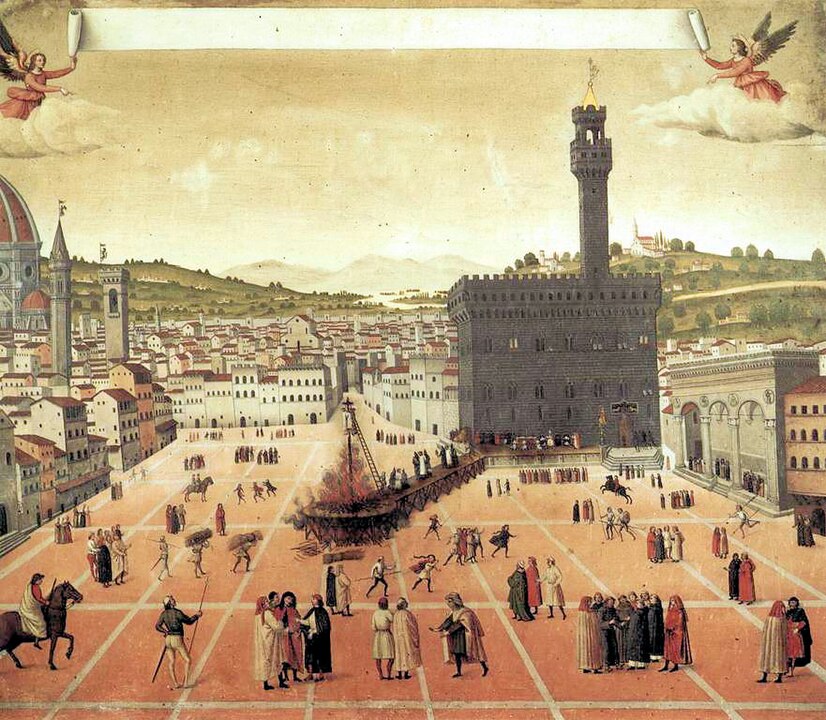
Palazzo Vecchio stands out with its fortress-like exterior, built from rusticated stone with small arched windows and thick walls designed to withstand both siege and rebellion. The structure features deeply projecting battlements and a pronounced crenellated roofline. One of its most distinctive features is the tower—commonly known as the Tower of Arnolfo—which rises 94 meters (about 308 feet) above the square. This tower, built slightly off-center to avoid the former Uberti foundations, contains a small prison historically used for political enemies.
The ground-floor courtyard, redesigned in 1453 by Michelozzo di Bartolomeo under the patronage of Cosimo de’ Medici the Elder, represents a clear shift toward Renaissance elegance. Michelozzo added classical columns, arches, and decorative stucco elements that softened the building’s military tone. Later frescoes added by Giorgio Vasari’s workshop in 1565 depict cities of the Habsburg Empire, painted to honor the marriage of Francesco I de’ Medici to Joanna of Austria.
Evolution Over the Centuries
Throughout the 14th and 15th centuries, Palazzo Vecchio served as the seat of various republican governments, enduring multiple political shifts and external threats. During this time, Florence’s power structure remained in flux, with factions vying for control between merchant oligarchies, populist movements, and exiled noble families. Yet the Palazzo endured, embodying the continuity of civic governance through tumultuous eras.
A major transformation occurred in 1540 when Cosimo I de’ Medici moved into the palace, turning it into the official ducal residence. This marked a profound change in its symbolism. Once a stronghold of republican governance, it became a stage for autocratic power. Cosimo commissioned Giorgio Vasari to remodel the interiors, aligning them with the grandeur expected of a Renaissance court. The palace retained this dual identity for centuries—part fortress, part palace—until the ducal family eventually relocated to Palazzo Pitti in 1565.
Key Architectural Highlights
Palazzo Vecchio is not only a seat of government but also a treasure trove of architectural detail. Key elements include:
- Tower of Arnolfo – The iconic bell tower and watchtower with commanding views over Florence.
- Cortile di Michelozzo – A Renaissance courtyard filled with columns and grotesques.
- Salone dei Cinquecento – The grand hall originally built for the Great Council.
- Studiolo of Francesco I – A small, elaborately decorated private study.
- Hall of Maps – A room featuring detailed Renaissance-era cartography.
Art and Decoration Inside the Palazzo Vecchio
Salone dei Cinquecento (Hall of the Five Hundred)
The Salone dei Cinquecento is the largest room in Palazzo Vecchio and one of its most impressive. Originally built in 1494 during the short-lived republic led by Savonarola, the hall was designed to accommodate the newly created 500-member Great Council. Architect Simone del Pollaiolo began the initial construction, creating a hall suitable for public assemblies and major political functions. Measuring 54 meters long and 23 meters wide, it remains one of the largest secular halls of the Renaissance.
In 1563, Duke Cosimo I ordered Giorgio Vasari to radically transform the space to celebrate Medici power. Vasari raised the ceiling and installed a series of monumental frescoes glorifying the duke’s military campaigns, including the Battle of Marciano in Val di Chiana (1565), which depicts the 1554 victory over the Republic of Siena. The frescoes blend history, myth, and propaganda into a powerful visual narrative of Medici authority. The coffered ceiling is covered in gilded panels illustrating allegorical themes and moments from Cosimo’s reign.
Private Chambers and Studiolo
While the public halls celebrated Medici power on a grand scale, the private rooms were designed for comfort, reflection, and elite display. Among the most fascinating is the Studiolo of Francesco I, a small barrel-vaulted chamber created in the 1570s for the Grand Duke’s personal use. Designed by Vasari and his assistant Vincenzo Borghini, the space was intended to serve as a combination of art gallery, scientific cabinet, and retreat. The room contains dozens of small paintings and wooden panels illustrating alchemical, natural, and mythological themes.
Elsewhere in the palace, Eleonora of Toledo, Cosimo I’s Spanish wife, had her own private chapel decorated with frescoes by Agnolo Bronzino. The apartments also include richly decorated ceilings, furniture, and tapestries, many of which highlight the Medici family’s wealth, learning, and dynastic ambition. These private areas contrast sharply with the public rooms, offering a more intimate view of Renaissance court life.
Hidden Passages and Secret Spaces
Palazzo Vecchio is filled with secret staircases, concealed doors, and hidden passageways. Many of these were designed for security, allowing members of the ruling family or government officials to move unseen during times of crisis. Some routes lead to escape points, while others connect to adjoining buildings such as the Uffizi or the Bargello.
One of the most famous secret features is the entrance to the Vasari Corridor, built in 1565. Though the corridor itself extends from the Uffizi Gallery across the Arno River to Palazzo Pitti, its origin lies within Palazzo Vecchio. This elevated passage allowed the Medici to walk above the streets of Florence unseen, symbolizing both their control and their isolation from the common people.
Political Power and the Medici Influence
From Republic to Ducal Seat
For over two centuries, Palazzo Vecchio served as the nerve center of the Florentine Republic. It housed the Signoria, various councils, and the Gonfaloniere of Justice. These bodies governed the city through a system of rotation and term limits, designed to prevent the concentration of power. But this balance was often precarious, and by the early 16th century, the Medici had reasserted their dominance.
In 1540, Duke Cosimo I de’ Medici officially took up residence in the palace, bringing Florence under centralized control. This marked the beginning of Florence’s transformation from a republic into a duchy, then into a Grand Duchy in 1569. Cosimo’s decision to inhabit the old republican palace was a masterstroke of political symbolism: he placed his rule directly atop the former civic government.
Cosimo I’s Renovations and Vasari’s Role
Cosimo I wasted no time in making the palace reflect his authority. He commissioned Giorgio Vasari, painter, architect, and author of Lives of the Most Excellent Painters, Sculptors, and Architects, to oversee the transformation. Between 1540 and 1565, Vasari reimagined nearly every major room, replacing republican symbols with Medici emblems and inserting grand cycles of historical and mythological art.
Vasari’s work elevated Palazzo Vecchio into a living theatre of dynastic propaganda. The grand frescoes in the Salone dei Cinquecento, the elaborately carved ceilings in the apartments, and even the decorative maps in the Hall of Geography all served to present the Medici as ordained by divine right and destined for greatness. The palace became a mirror of Cosimo’s political vision—a tightly controlled, orderly, and glorified state under one ruler.
Public and Private Power Structures
Palazzo Vecchio maintained its dual character as both a civic building and private residence. Even as the Medici rulers added their personal apartments and chapels, they retained many of the palace’s original public functions. Council chambers continued to host meetings, and foreign dignitaries were received in rooms steeped in republican memory now coated with Medici imagery.
The architectural layout reinforced this duality. The lower levels were devoted to administrative and judicial purposes, while the upper floors became the private domain of the ruling family. Hidden corridors allowed the duke and his family to bypass the public areas entirely, underscoring the merging—but not complete dissolving—of public and private power in the early modern Florentine state.
Medici-Era Additions
Several key artistic and architectural additions were made during the Medici period:
- Vasari’s fresco cycles throughout the Salone dei Cinquecento.
- The private Studiolo of Francesco I, filled with symbolic paintings.
- The Hall of Maps (Sala delle Carte Geografiche), with its large globe and wall panels depicting 16th-century world geography.
- The private chapel of Eleonora of Toledo, painted by Bronzino with religious themes and Medici portraits.
Palazzo Vecchio Today: Museum and Symbol
Role as a Museum
Today, Palazzo Vecchio serves as both Florence’s town hall and a major museum. The transformation into a public museum began in the 19th century, with a more structured system of preservation and presentation put into place after the unification of Italy in 1861. In 1872, it officially became the seat of Florence’s civic government once again, but with growing accessibility for historical and artistic tours.
The museum offers access to nearly all major rooms, including the Salone dei Cinquecento, the Medici apartments, and the various council chambers. Many rooms have been restored to their Renaissance-era appearance, giving visitors a clear sense of the building’s role across centuries. Museum guides also point out details of interest such as the partially preserved wall where Leonardo da Vinci began work on the now-lost Battle of Anghiari.
Civic Role and Cultural Events
Despite its museum status, Palazzo Vecchio still functions as Florence’s city hall. The mayor’s office is located within its walls, and meetings of the city council are held in historic chambers. This continuity of public function is rare among Renaissance palaces and underscores its ongoing importance to Florentine identity.
The building also hosts cultural events, scholarly conferences, and exhibitions. State visits and diplomatic receptions often take place in the same rooms that once echoed with the footsteps of Cosimo de’ Medici. Through these modern functions, the Palazzo bridges past and present, maintaining its legacy as a center of power.
Public Access and Visitor Highlights
Visitors can explore many highlights of the palace through guided or self-guided tours. Among the most popular attractions is the climb to the top of the Tower of Arnolfo, offering unmatched views of Florence’s historic skyline. Inside, the Hall of Maps, with its antique cartographic panels and massive rotating globe, attracts both art lovers and historians.
The palace also features digital reconstructions and audio guides in multiple languages, helping to interpret complex historical narratives. Special exhibitions are often held in side galleries, while the cellars and basement chambers give insight into medieval foundations and early Florentine architecture.
Key Takeaways
- Palazzo Vecchio was built in 1299 as the seat of the Florentine Republic and transformed into a Medici ducal residence in 1540.
- Architect Arnolfo di Cambio designed the fortress-like structure; Vasari later remodeled its interiors for Cosimo I.
- The Salone dei Cinquecento is the palace’s most important hall, adorned with grand frescoes celebrating Medici military victories.
- Hidden stairways, private studies, and secret passageways reflect the palace’s blend of political power and personal rule.
- Today, it serves as both a museum and the city hall of Florence, preserving centuries of civic and dynastic history.
Frequently Asked Questions
1. When was the Palazzo Vecchio built?
Construction began in 1299 and was largely completed by 1314 under the guidance of Arnolfo di Cambio.
2. Can the public visit the tower?
Yes, visitors can climb the Tower of Arnolfo, which offers panoramic views of Florence.
3. What famous artworks are inside?
Highlights include Vasari’s frescoes in the Salone dei Cinquecento and Bronzino’s paintings in the private chapel of Eleonora of Toledo.
4. Is the Palazzo Vecchio still used for government?
Yes, it serves as Florence’s city hall and hosts official municipal functions.
5. What is the significance of the Hall of Maps?
It features Renaissance-era geographical panels and a massive globe, reflecting the Medici’s global ambitions and interest in science.