In Japan there is a chilling phenomenon known as “evaporation” — people simply vanish from their lives and disappear without a trace. These individuals, part of what is called Jōhatsu, walk away from their homes, jobs, even families, often for reasons bound up in shame, debt, collapse, or social pressure. Estimates vary, but many observers cite annually tens of thousands of missing‑person reports in Japan — some sources suggest between 70,000 and 90,000 people go missing each year. Not all vanish by choice, but many do, slipping away deliberately and quietly.
The act of disappearing in this way reflects deep cultural and economic strains: loss of face, failed businesses, crushing debt, social alienation, or unbearable work stress. For some, vanishing offers a bleak but tangible escape from what feels like a dead‑end life. For others, it’s about avoiding stigma or the shame of personal failure. The gap left — a silent absence — resonates more painfully than words.
But these invisible lives sometimes find a presence in art: visual, emotional testaments to absence. Artists have tried to make palpable what society often refuses to acknowledge. Art becomes a medium for memory, loss, and the human toll of societal pressure. When families remain silent and governments turn away, art listens and responds.
In this article, we explore how art reflects the phenomenon of Jōhatsu — how absence is rendered visible, how disappearance becomes metaphor, and how contemporary artists respond through creation. From documentary-style photography to metaphor-rich installations, art tells the stories that Japan’s culture of silence leaves untold.
The Phenomenon in Focus: Who Are Japan’s Jōhatsu?
Jōhatsu — literally “evaporation” in Japanese — refers to individuals who deliberately vanish from their established lives. The term first gained traction in the 1960s, initially referring to people who fled unhappy marriages to avoid divorce. Over time, it grew to describe a wider trend of social vanishing, especially among those burdened by debt, job loss, or personal failure. This silent act of escape found a place in the shadows of Japan’s rigid society.
In 2015, the National Police Agency recorded over 80,000 missing persons across Japan. While many are found or return, experts believe tens of thousands vanish intentionally every year. These disappearances often go unreported by families who feel too ashamed to alert authorities. Social norms in Japan discourage confrontation, and many people choose not to chase after relatives who vanish.
Motivations behind these disappearances range from bankruptcy, domestic abuse, and failed marriages to overwork, academic pressure, or even personal existential crises. In many cases, people feel they cannot continue within the bounds of their current life. Disappearing becomes a way to regain control, even at the cost of identity, safety, or connection.
Not Just Men: Women and Families Who Disappear
Although often associated with middle-aged men, Jōhatsu includes women and entire families. Women facing domestic violence or extreme financial pressure may choose to vanish instead of seeking public help. The shame of being divorced, single, or unemployed still carries a strong social stigma. For many women, disappearing is seen as less humiliating than staying.
There are also families who disappear together. In such cases, the entire household packs up quietly and moves away in the middle of the night. Specialized companies known as “yonige-ya,” or “night movers,” assist in these disappearances by offering secretive relocation services. These businesses offer a way out without confrontation.
The existence of such companies shows how normalized this phenomenon has become in certain circles. Though technically legal, these services operate in moral gray areas. By offering a means to vanish, they also reinforce a culture that avoids open conflict or personal resolution.
In these quiet exoduses, children often become the unseen victims. Pulled from schools, disconnected from relatives, and forced into secrecy, they live in the long shadow of decisions made under extreme pressure. And yet, few speak of them.
Art as Witness: How Artists Visualize Absence
Art has long offered a lens to examine social shadows — to give form to what is often hidden. In the case of Jōhatsu, some contemporary artists attempt to confront these disappearances head-on, creating works that capture the emptiness left behind. Rather than offering portraits of those who vanished, these artists often focus on the silence, the void, or the emotional residue that follows.
Photography, installation, and minimalist sculpture are among the common mediums used to explore this theme. Some artists use abandoned spaces as metaphors for lost lives, while others photograph empty rooms once filled with people. Even the act of photographing an absence becomes an act of testimony.
These artworks serve as a counterweight to Japan’s culture of silence around disappearance. Where families may never speak of lost members, artists make space for grief, confusion, and memory. Art becomes a mirror held up to the societal reluctance to face uncomfortable truths.
The Aesthetic of Erasure
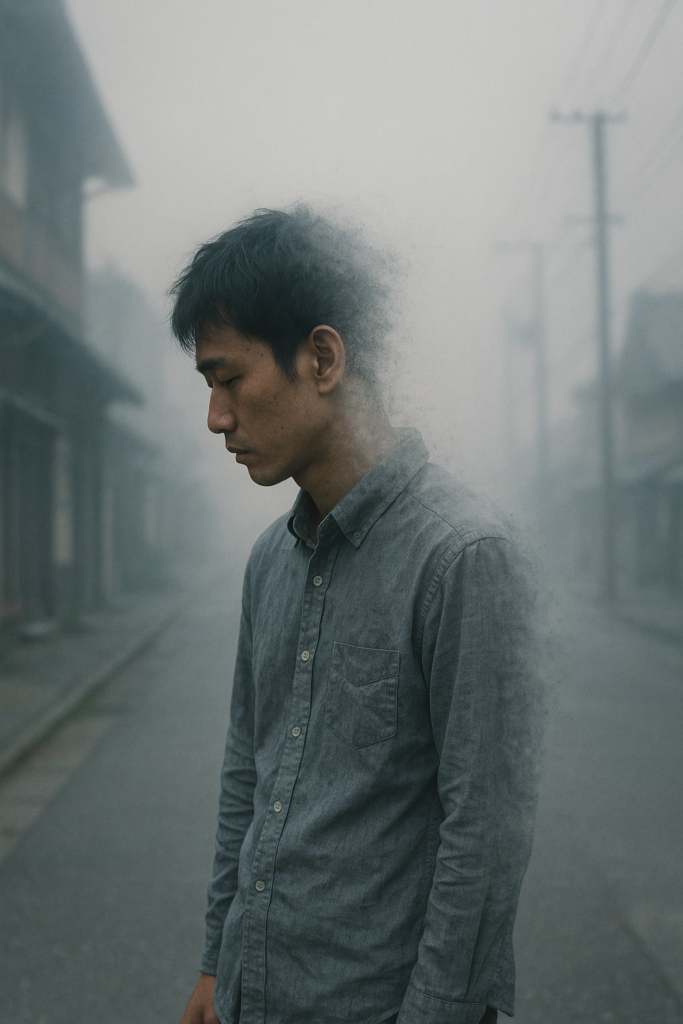
A recurring technique in this genre is erasure — partial blurring, blank silhouettes, or ghost-like outlines. This aesthetic choice mimics the psychological disconnection between the vanished and the life they left behind. The more a figure fades from view, the more the viewer is forced to consider what was lost.
Other artists use negative space — empty beds, unoccupied chairs, or desolate corridors — to highlight the emotional weight of absence. These spaces ask the viewer to project their own fears, losses, or imaginations into the void. The missing figure becomes everyone and no one.
Some installations even simulate the experience of being erased. Dim lighting, muffled sounds, or fragmented reflections leave the viewer disoriented and introspective. The artwork doesn’t just depict disappearance — it induces it.
Through these techniques, artists turn the concept of Jōhatsu from a private event into a shared experience. They force confrontation with what has been culturally ignored.
Maika Elan and the Photography of the Invisible
Maika Elan, born in 1986 in Hanoi, Vietnam, is a documentary photographer known for her emotionally charged series that explore hidden lives. Though not Japanese, Elan’s interest in social invisibility led her to work on a photographic series in Tokyo that featured individuals living as Jōhatsu. Her project, “Like a Leaf,” visually documents these individuals without fully revealing their faces or identities.
Elan earned global attention with her earlier work, “The Pink Choice,” which documented same-sex couples in Vietnam. She graduated from Hanoi University of Social Sciences and Humanities in 2008, later transitioning from editorial to documentary photography. Her style is intimate, emotionally vivid, and focused on real-life stories behind cultural silences.
For “Like a Leaf,” she collaborated with a Japanese journalist who helped her reach the hidden Jōhatsu communities. These people were living under assumed names or without official documentation in secluded towns or industrial suburbs. Gaining their trust took time, and photographing them required careful negotiation.
Portraits Without Names
The resulting portraits show people hiding in plain sight — sleeping on floors, eating alone in darkened rooms, or standing half in shadow. They are always partially obscured. Their names are never given. Yet their pain, their isolation, and their quiet dignity resonate clearly.
By choosing to keep her subjects’ identities veiled, Elan respects their choices while still bringing their existence to light. The images force viewers to see those who live beyond society’s reach, not as criminals or cowards, but as human beings with complex stories.
Her work invites viewers to question what it means to truly see someone. If a person chooses invisibility, what right do we have to uncover them? And what obligations do we still hold to recognize their suffering?
In these haunting portraits, absence becomes presence. Elan’s work gives voice to those who have chosen silence, reminding the world that even the vanished leave traces.
Manabu Ikeda: Microcosms and Disappearances
Born in Saga, Japan, in 1973, Manabu Ikeda is known for his extraordinary pen-and-ink drawings that explode with intricate detail. A graduate of Tokyo University of the Arts in 1999, Ikeda’s works are microcosmic landscapes that blend natural disasters, urban chaos, and fragile human figures. His work often echoes themes of disappearance, though not always explicitly tied to Jōhatsu.
In pieces like “Rebirth” (2013–2016), created during a residency at the Chazen Museum of Art in Wisconsin, he illustrates landscapes fractured by catastrophe. Tiny people and buildings emerge and vanish inside whirlwinds of destruction, suggesting the fragility of life and the invisibility of individual suffering in mass events.
While not directly referencing Japan’s evaporating people, Ikeda’s works metaphorically capture the experience of being lost in a larger system. His figures are often overwhelmed, disappearing into scenes that consume them. His chaotic beauty mirrors Japan’s emotional and physical earthquakes — both literal and societal.
Hidden Lives in Labyrinthine Landscapes
Ikeda’s work requires close viewing — what first appears to be a tree might reveal dozens of hidden houses, machines, or people. Within these dense landscapes, one can find hints of solitude, exile, and resignation. These elements evoke the quiet exits made by Jōhatsu, vanishing into life’s background noise.
His figures are neither heroes nor victims. They are small, almost anonymous, swallowed by a world indifferent to their stories. This sense of insignificance captures the emotional state that drives many to disappear.
By immersing viewers in a sea of details, Ikeda invites contemplation. The overwhelming density becomes a metaphor for psychological overload — a condition many Jōhatsu report before their disappearance.
Though his drawings are silent, they speak volumes about isolation. In Ikeda’s vision, disappearance is not just a physical act; it is a spiritual condition of modern life.
Disappearing Spaces: Installations and Empty Architecture
Japan’s contemporary art scene features several artists who use space, light, and silence to reflect themes of absence. This is particularly evident in installations that evoke emotional weight through what is not shown. These minimalist or abandoned spaces become metaphors for lives once lived — and now missing. Absence becomes the central subject.
Artists like Chiharu Shiota and Rei Naito use unconventional materials and architectural emptiness to express disappearance. Shiota, born in Osaka in 1972, is best known for her thread installations — often red or black yarn forming complex webs across entire rooms. These installations fill space while also suggesting entanglement, memory, and absence. Naito, born in 1961 in Hiroshima, works with subtle light, fragile materials, and quiet spaces to conjure the presence of invisible lives.
Their installations often evoke the rooms left behind by the Jōhatsu — vacant beds, forgotten shoes, untouched tea cups. In Japan, where silence and restraint are cultural values, these artists speak powerfully without words. The viewer is asked not to observe but to feel — to listen for something no longer there.
When Emptiness Becomes a Portrait
In Rei Naito’s work “Being Given” (2001), a single small room contains just a faint beam of light, small objects, and near silence. It is not designed to be looked at but to be experienced. In this setting, absence becomes a form of presence. The viewer becomes aware of their own body in the space — and of the missing others.
Chiharu Shiota’s “House of Memory” (2017) uses black thread woven tightly through a space containing empty chairs and framed photos without faces. It evokes the rooms of people who left, whether through death, war, or quiet disappearance. The effect is disquieting and deeply intimate.
These spatial metaphors allow artists to evoke the human cost of disappearance without ever naming names. A bare floor or an untouched plate can say more than a police report. In the stillness, the echo of lives once lived becomes almost audible.
Through these installations, absence takes on shape and texture. In the hushed air and pale light, the art doesn’t just reflect vanishing — it becomes it.
Global Echoes: Jōhatsu and Vanishing as a Universal Theme
Although Japan’s Jōhatsu are culturally specific, the deeper themes of disappearance, escape, and social erasure are globally resonant. Across countries, people vanish from societies for many reasons: shame, debt, abuse, politics, or despair. Contemporary artists around the world have taken up similar themes in their work, reflecting the universal nature of disconnection and invisibility.
South Korean artists, for example, have explored themes of post-war disappearance and North Korean defections. American and European artists have addressed missing persons, urban alienation, and even bureaucratic erasure. The shared theme is emotional exile — being physically present but socially erased, or leaving without being missed.
This global resonance has led to group exhibitions focused on absence and loss. Artists from multiple cultures have used photography, sound, and performance to explore the quiet catastrophe of disappearing lives. Some projects document refugees, others depict those lost to suicide or homelessness. In all, the message is clear: vanishing is not always an escape — sometimes it’s a symptom.
Disappearance in the Digital Age
Modern disappearance is no longer just physical. With digital life becoming dominant, erasure now includes deleting online profiles, ghosting loved ones, or removing all presence from social media. Digital Jōhatsu can vanish with the click of a button — and often do.
Artists have started addressing this as well. Some use data corruption as a metaphor, showing pixelated portraits or incomplete digital archives. Others simulate deleted memory files, lost emails, or half-loaded images. These digital metaphors mirror the psychological experience of being lost or erased.
In the age of constant connectivity, choosing silence becomes radical. Turning off the phone, vanishing from the grid, or declining to perform an identity online is now seen as a powerful act of disappearance.
As the boundary between physical and digital continues to blur, artists are rethinking what it means to disappear. Whether in flesh or pixels, vanishing continues to haunt the human experience.
Key Takeaways
- The Japanese term Jōhatsu refers to people who deliberately vanish from their lives, often due to shame, debt, or despair.
- Contemporary art reflects the Jōhatsu phenomenon through themes of absence, silence, and emotional vacancy.
- Photographers like Maika Elan and artists like Manabu Ikeda explore disappearance both literally and metaphorically.
- Installations using empty space and fragile materials bring viewers face-to-face with what is missing.
- Jōhatsu themes resonate worldwide, reflecting a broader human struggle with identity, pressure, and escape.
Frequently Asked Questions
- What does the word “Jōhatsu” mean?
It literally means “evaporation” in Japanese and refers to people who disappear intentionally. - Why do people choose to disappear in Japan?
Reasons include shame, debt, abusive relationships, or a desire to escape societal pressure. - Are there companies that help people vanish?
Yes, businesses known as “yonige-ya” assist people in secretly relocating and starting over. - How do artists depict disappearance?
Through photography, installation, and metaphor — often using emptiness or erasure. - Is this just a Japanese issue?
No — themes of disappearance are universal and explored by artists worldwide.