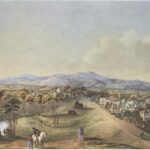
The story of Sapporo’s art begins not with a brushstroke but with a surveyor’s line—an act of geometry imposed upon wilderness. When the Meiji government founded Sapporo in the 1870s as the administrative center of Hokkaido, it was less a city than a vision of modernity carved into snow and forest. The grid plan, inspired by American urban models and executed with remarkable precision, gave Sapporo an aesthetic of rationality from the start. It was a city designed to look planned—to be read, even before it was lived in, as an emblem of progress.
The Meiji Project and Urban Design
The Meiji leadership saw Hokkaido as both frontier and laboratory. In their desire to project a modern, industrial Japan, the colonization and cultivation of the island were as much visual enterprises as economic ones. American advisor Horace Capron, invited to oversee agricultural development, brought with him the ideals of Western town planning—straight streets, public squares, and civic symmetry. The resulting cityscape, stark against the volcanic ridges and birch forests, represented a striking new aesthetic for Japan: clarity, efficiency, and control over nature.
Art in this early period was largely architectural and documentary. Painters and photographers accompanying survey expeditions—such as the government photographer Shinichirō Koizumi—recorded the evolving landscape as both scientific evidence and national mythmaking. These images, often distributed in illustrated journals, portrayed Sapporo as a miracle of modern planning rising from an untamed land. The interplay between map and landscape became the first visual dialect of the city: geometry meeting wilderness.
Imported Styles and Local Adaptations
By the 1880s, Sapporo had acquired the look of a transposed Western township. The red-brick buildings of the Kaitakushi (Colonial Development Commission) and the Sapporo Beer Brewery displayed the influence of late Victorian industrial design. The use of brick—still rare in Japan—had practical origins, offering insulation against the severe winters. Yet it also signaled participation in a global architectural language of progress. The Sapporo Clock Tower, completed in 1878 as part of the Sapporo Agricultural College, stood as a literal and symbolic marker of imported modernity: an American-style wooden structure with a clock that measured Japan’s new mechanical age.
Inside these buildings, imported aesthetics met the northern climate’s demands. Architects and artisans learned to adapt Western construction to the realities of snow load, frost, and limited daylight. The thickened walls, raised foundations, and steep-pitched roofs of Sapporo’s early buildings created an architecture of necessity that gradually became an expression of place. Practical invention acquired aesthetic value. The look of the city—brick, snow, and sky—became its own visual identity.
Three particularly telling materials defined Sapporo’s early design vocabulary:
- Brick, carrying the scent of industry and permanence.
- Wood, abundant yet fragile, requiring constant maintenance against cold.
- Glass, symbolizing aspiration toward transparency and light.
Each material carried a double meaning—economic and aesthetic, foreign and local, temporary and eternal.
The Architecture of Order and Aspiration
What distinguished Sapporo from other Meiji-era cities was the clarity of its founding narrative. Tokyo was an inherited capital; Osaka a mercantile organism grown over centuries. Sapporo, by contrast, was pure invention. Its art and architecture were never secondary to function—they were the function, the visible proof that the frontier could be civilized. Churches, schools, and government halls served as both institutions and performances of order. Even the arrangement of trees along Ōdōri Park, originally a firebreak, became a kind of environmental ornament, delineating a civic axis through snowfields.
Yet beneath this order lay an ambivalence that would later surface in the city’s art. The effort to impose Western formality upon northern wilderness created an enduring tension between geometry and nature, between imported vision and local material. The artist and the architect alike contended with the same question: how to make beauty from constraint, identity from adaptation.
A micro-narrative from 1879 captures this spirit. A student at the Sapporo Agricultural College—where future prime minister Uchimura Kanzō studied—recorded in his diary how he and his classmates sketched the surrounding landscape for a drawing exercise. “The snow was so bright that the paper seemed to glow from beneath,” he wrote. “We drew not what we saw but what we imagined civilization would look like here.” That imagined civilization became, in many ways, Sapporo’s first artistic act.
The city’s founding aesthetic—rational, optimistic, and faintly melancholic—would echo through its later art movements. The clean lines of Meiji architecture would resurface in the stark minimalism of postwar photography; the dialogue between imported and local sensibility would continue in every generation. Even today, when snow covers the grid and muffles its order, one can sense the underlying geometry—the silent discipline that shaped the city’s art from the beginning.
Sapporo’s early years were less about art as object than art as blueprint. The beauty lay in the plan itself, a frozen diagram of national ambition drawn across a northern plain. From that grid would grow a city—and an artistic identity—defined by its refusal to remain provincial, even at the edge of the world.
Western Shadows: Art Education and Early Institutions
Art in Sapporo first took institutional shape under the shadow of Western models. Where the city’s founding had been an act of engineering, its early art education was an act of imitation—earnest, disciplined, and sometimes uncertain of its own purpose. The question was no longer how to build a city, but how to cultivate a culture worthy of it.
The Founding of Schools and Technical Colleges
The Sapporo Agricultural College, established in 1876 under the guidance of William S. Clark, was not an art school, yet it became the crucible for the city’s first encounters with Western aesthetics. Clark’s motto, “Boys, be ambitious,” often quoted to the point of cliché, captured the aspirational ethos of early Sapporo: to learn from abroad and transcend provincial limitations. Drawing was included in the curriculum, not as fine art but as a tool of precision—a way to record scientific specimens, architectural plans, and agricultural studies. Yet from this pragmatic beginning, a new visual literacy emerged.
The city’s Technical School, later the Hokkaido Industrial Institute, expanded this foundation in the 1890s, offering instruction in drafting, mechanical drawing, and architectural design. Many of its students went on to shape Sapporo’s early civic architecture. Art, for them, was an applied discipline—measured, purposeful, and aligned with industry. The Meiji state encouraged such an approach: beauty was useful insofar as it served modernization.
Still, within these institutions, the act of drawing began to acquire an emotional dimension. Students learned perspective, shading, and proportion from European manuals translated into Japanese. They copied engravings of classical sculpture, Renaissance paintings, and technical illustrations from English textbooks. For young Sapporo artists, these exercises were less about mastering European art than about accessing an unseen world—a realm of ordered beauty that felt remote from the harsh winters and wooden barracks of Hokkaido.
European Models in Japanese Art Instruction
The national art education system introduced during the Meiji era drew heavily from European academies. The Tokyo School of Fine Arts, founded in 1887, set the tone, emphasizing realism, anatomy, and the disciplined observation of nature. Sapporo’s smaller schools mirrored this curriculum in simplified form. Western teachers—often engineers or architects by training—brought with them lithographs and plaster casts as teaching aids. Their influence extended beyond technique: they instilled a belief that art could embody modern virtue, that aesthetic order was a sign of moral and intellectual progress.
In Sapporo, this translated into a curious duality. The local artists of the late 19th century produced landscapes and portraits modeled on Western prototypes, yet their subjects remained unmistakably northern: snowbound barns, volcanic hills, and distant forests. The imported academic style could not entirely suppress the rawness of the environment. Even the most disciplined pencil lines seemed haunted by the immensity of Hokkaido’s land and light.
A small but significant milestone came with the establishment of the Sapporo Bijutsu Kyōkai (Sapporo Art Society) in the early 20th century. Composed of teachers, engineers, and civil servants with artistic interests, the society held annual exhibitions that combined European oil painting with traditional Japanese ink work. These exhibitions were modest in scale but ambitious in tone: a declaration that the northern city could participate in Japan’s growing art culture. The critics in Tokyo often ignored them, but the effort itself marked the emergence of a local artistic conscience.
Three recurring themes characterized Sapporo’s early art societies:
- Learning by imitation — mastery through replication of Western examples.
- Local pride — portraying Hokkaido’s distinct landscapes within imported styles.
- Institutional modesty — art as civic duty rather than individual expression.
These modest beginnings laid the foundation for a uniquely disciplined yet quietly defiant art scene.
The Birth of a Local Artistic Consciousness
By the 1910s, Sapporo’s art education began to mature into something more self-aware. The graduates of Tokyo’s art academies who returned to Hokkaido brought with them both training and skepticism. They admired the realism of Western art but sought a vocabulary that would suit their own environment. Painters such as Shunsuke Matsumoto and Takeo Irie—figures who would later become central to northern art circles—experimented with tonal contrasts and muted palettes to capture the peculiar light of the region. The sun in Sapporo, filtered through snow and cloud, demanded a different understanding of color and atmosphere.
This was also the period when photography began to play a growing role in visual education. The portability of cameras allowed artists to document scenes for later reference, but the resulting images soon took on independent aesthetic value. Early exhibitions often displayed photographs alongside sketches and watercolors, blurring the line between documentation and art. In a city where the environment constantly changed under snow and thaw, photography provided both immediacy and memory.
A revealing anecdote from around 1915 recounts a teacher at Sapporo’s Normal School instructing his pupils to paint the same tree in each of the four seasons. The exercise, intended to teach observation, instead awakened something deeper. The resulting series of paintings—now lost, but described in school records—was said to have astonished the teacher. Each student, constrained by the same subject, found a different truth in it: one emphasized the pale geometry of winter branches; another the violent greens of spring; another the melancholy light of autumn. From such exercises, a northern sensibility began to form: observant, restrained, and haunted by change.
The broader context of Japan’s modernization framed these developments in tension. Tokyo and Kyoto defined taste; Sapporo responded with its own dialect of discipline and endurance. Art was not a luxury here—it was a method of seeing clearly amid hardship. That ethos would shape Hokkaido’s later movements in photography, design, and conceptual art. The northern artist learned early to make beauty from scarcity, to find eloquence in restraint.
By the 1920s, as the Taishō period opened Japan to new forms of liberalism and experimentation, Sapporo’s institutions stood ready. The students of technical drawing and academic realism would soon collide with avant-garde impulses from Tokyo, producing the first distinct wave of modern northern art. The old Western shadows would not disappear—they would simply be reinterpreted in a new, colder light.
Snow and Structure: The Rise of a Distinct Northern Aesthetic
Every city eventually paints its own light. In Sapporo, that light is snow—cold, mutable, and quietly theatrical. During the early twentieth century, as the city matured from a government colony into a true urban community, artists began to recognize that their environment was not a backdrop but a collaborator. The northern climate imposed limits on color, texture, and even mood, yet within those limits lay an unexpected freedom. A new visual language was forming—one born of frost, restraint, and endurance.
Climate as Cultural Force
The winter in Sapporo lasts nearly half the year. Snow does not merely fall; it defines space. It buries boundaries, absorbs sound, and refracts light into a diffuse silver glow. Early painters and photographers found themselves contending with an optical puzzle: how to depict a landscape that was simultaneously blank and blinding. The traditional Japanese approach to landscape—ink wash, gradations of gray and black—could not easily accommodate such whiteness. Nor could the saturated pigments of Western oil painting, which risked vulgarity against the monochrome field of snow.
The solution emerged gradually, through experiment. Painters began to favor subdued tonal harmonies—grays with a trace of blue, ochres softened by white. Shadows became crucial compositional elements, the only way to suggest form amid radiance. Even brushwork changed: thick, dry strokes conveyed the granular texture of frozen surfaces. In these adjustments lay the beginnings of what might be called the Northern aesthetic: clarity without brightness, melancholy without sentimentality.
Sapporo’s artists came to understand that climate was not merely subject matter but structure. Snow forced simplification. It eliminated distraction. A fence, a barn, a figure walking through a field—these elements gained monumental significance against the blankness. The environment demanded an economy of means and rewarded precision of feeling. In this way, the visual habits of survival—watchfulness, patience, understatement—translated naturally into art.
Three environmental facts shaped this artistic temperament:
- Excessive brightness, requiring tonal control rather than coloristic exuberance.
- Extended darkness, fostering inwardness and attention to minor variations of light.
- Physical isolation, which encouraged independent development and long observation.
Out of such constraints, style emerged—not imposed by theory but born of necessity.
The Emergence of Winter Imagery in Painting and Design
By the 1920s and 1930s, painters in Sapporo and the wider Hokkaido region were turning repeatedly to winter scenes. Exhibitions in local department stores displayed canvases of frozen rivers, snow-laden roofs, and silent streets illuminated by lamplight. These works were not sentimental postcards; they carried a psychological charge. The snowfields were spaces of reflection, endurance, and sometimes loneliness.
Artists such as Kiyoharu Narazaki and Kenjiro Nomura—though better known for their later roles in Hokkaido’s modernist circles—began in these years to treat the northern landscape as a field of abstraction. The endless gradations of white and gray suggested not emptiness but rhythm. A line of telephone poles became a compositional device, like a musical staff across the page. The built environment, with its rigid geometries and dark verticals, offered contrast and order within the surrounding vastness.
This sensibility extended into design. Poster artists and architects in Sapporo began to incorporate snow motifs not as decoration but as structural principle. The heavy roofs of wooden houses, the simplified silhouettes of civic buildings, and even the typography of local advertisements reflected an aesthetic of compression and clarity. Snow, paradoxically, had become a teacher of form.
A revealing example appeared in a 1931 exhibition catalog for the Hokkaido Art Association. The cover design—a series of intersecting diagonal lines suggesting windblown snow—was printed in pale gray ink on white paper, nearly invisible unless caught by light at an angle. Viewers complained they could hardly see it. The designer reportedly replied, “That is what it means to live here.” Visibility itself had become part of the art.
Material Constraints and Creative Innovation
The material difficulties of working in Sapporo shaped its artists as much as the climate. Oil paints thickened in the cold; canvases warped with humidity; photographic chemicals froze in unheated studios. These hardships encouraged ingenuity. Some painters switched to tempera or dry pastel, which required less drying time. Photographers built makeshift darkrooms from insulated cellars. The struggle to create became inseparable from the content of the work: persistence was aesthetic.
This practical creativity gave rise to a quiet tradition of craftsmanship. Local artisans developed pigments mixed with volcanic ash for texture; sculptors experimented with regional timbers that resisted cracking. Even in student studios, improvisation was constant—snow served as a natural diffuser for lighting models, while frost patterns on windows inspired studies of line and repetition. The city’s limited resources forced artists to make do, but the results were often strikingly original.
One story from the late 1930s illustrates this ethos. A young painter, unable to afford canvas, used discarded flour sacks from a nearby mill, stitching them together and priming them with skimmed milk. When he exhibited his work, critics noted the unusual surface texture, unaware of its origin. The resourcefulness became a kind of hidden signature, a local authenticity born of constraint.
By mid-century, this ingenuity had matured into a defining character. Sapporo’s artists were known not for flamboyance but for discipline. Their art carried the mark of endurance—the same stoic beauty seen in the snowbound architecture of the city itself. Structure, necessity, and climate had fused into an aesthetic that was neither wholly Japanese nor wholly Western, but unmistakably northern.
If Tokyo’s art world sought novelty, Sapporo’s sought truth. The snow was its teacher, the structure its grammar. From this foundation, the modern Hokkaido art movement would rise—a movement that would soon confront the turbulence of war, reconstruction, and a changing Japan. But the essential vision was already in place: beauty drawn from clarity, strength shaped by cold.
The Taishō Spirit: Modernity, Experiment, and the Hokkaido Art Association
The Taishō era (1912–1926) was short, but its influence on Japanese culture was transformative. In Sapporo, the period marked the awakening of artistic self-awareness—the moment when the city’s painters, designers, and photographers began to see themselves not merely as recorders of northern life but as contributors to modern art itself. The optimism of national modernization gave way to curiosity, restlessness, and a hunger for new forms. What had begun as imitation now sought independence.
Young Artists Against Convention
The generation that came of age during the Taishō years was the first in Sapporo to grow up surrounded by the city’s early institutions and its emerging urban culture. They had studied technical drawing in school, seen European prints in textbooks, and followed the artistic ferment of Tokyo’s Hakubakai and Shirakaba circles through magazines. Yet distance bred independence. Cut off from the capital’s artistic hierarchies, Sapporo’s young artists felt free to experiment without the burden of approval.
In 1918, a group of students and teachers formed the Hokkaido Bijutsu Kyōkai—the Hokkaido Art Association. Its founding aim was simple: to hold regular exhibitions and encourage local creation. But behind that modest charter lay a larger ambition. The members sought to prove that Hokkaido could produce art of sophistication equal to the mainland’s, yet distinct in sensibility. Their exhibitions, first held in borrowed school halls and municipal buildings, soon became annual events that drew visitors from across the island.
The works displayed in those early shows reflected a striking diversity. Alongside landscapes and portraits appeared daring experiments in Fauvism and Cubism, filtered through the artists’ exposure to reproductions rather than originals. They painted the snowfields in fractured planes, rendered barns as geometric forms, and applied color with an intensity that startled conservative viewers. The critics in Sapporo newspapers debated whether such styles were genuine art or mere imitation of foreign fashion. But the discussion itself was a sign of vitality: art had entered public life.
A small anecdote from the 1922 exhibition captures the spirit. When one artist displayed a vividly abstracted view of the Toyohira River—its ice rendered in purple and yellow—an elderly visitor reportedly asked if the painter had ever actually seen the river. The artist replied, “Yes, but I wanted to paint what it feels like before it freezes.” That answer, half humorous, half defiant, marked a turning point. Feeling had become as legitimate as observation.
Printmaking and the Spread of Modern Design
Printmaking became the movement’s most accessible and influential medium. The simplicity of tools—woodblock, ink, paper—allowed wide participation, while the aesthetic suited Sapporo’s preference for clarity and line. Local workshops began producing small editions of prints that circulated through schools, offices, and cafés. The subjects ranged from street scenes to mountain views, but the treatment was modern: flattened perspective, bold composition, and an emphasis on design over description.
The Hokkaido Shin Hanga (New Print) movement emerged in parallel with similar currents in Tokyo, yet it developed its own tone. Where Tokyo artists often pursued refinement and delicacy, Sapporo’s printmakers favored austerity and strength. They used coarse-grained wood to leave visible texture, suggesting the roughness of local timber and the tactile presence of the north. Some even experimented with overprinting white ink to evoke snow—a technique both simple and poetic.
Design sensibilities spread beyond the arts into commerce. The labels of Sapporo Beer, the signage of local shops, and the posters for regional fairs began to adopt cleaner typography and geometric layout. Modernism, once an imported style, was becoming a civic language. The visual culture of the city grew sharper, more confident, less sentimental.
Three intertwined developments defined this period of creative expansion:
- Collective organization, as artists formed societies to share resources and promote exhibitions.
- Print culture, which democratized art and fostered design innovation.
- Urban visibility, with art entering public and commercial life.
These forces gave Sapporo’s modernity a visible face—structured, modest, and unmistakably northern.
Early Exhibitions and the Dream of a Hokkaido Style
As the Hokkaido Art Association matured through the 1920s, its members began to articulate a collective ambition: the creation of a “Hokkaido Style.” The phrase did not denote a strict aesthetic doctrine but an aspiration for coherence—a belief that the northern environment, history, and temperament could yield a distinctive artistic language. In essays published in local newspapers, artists argued that Hokkaido’s isolation was a strength. Freed from Tokyo’s academic rivalries, they could pursue sincerity and directness.
The Association’s 1925 exhibition crystallized this confidence. Critics noted the consistent restraint of color and the architectural solidity of composition across otherwise varied works. Landscapes, portraits, and still lifes all shared an undercurrent of clarity and discipline. It was as if the climate itself had imposed a moral order upon the art. One reviewer wrote that Hokkaido painters “see the world as through ice—sharply, and with no distortion.”
This clarity also carried melancholy. Many works of the period depicted human figures dwarfed by snowfields or industrial structures. The sense of solitude—never theatrical, always calm—became a hallmark of Sapporo’s art. Even celebrations of progress, such as paintings of new rail lines or factories, conveyed quiet endurance rather than triumph. The northern aesthetic remained stoic, even in modernity.
A vivid example is the painter Ryōsuke Takashima’s Winter Field, 1924. The work shows a single power line cutting across an expanse of snow, beneath a low gray sky. Nothing moves, nothing glitters. Yet the composition radiates tension—the silent dialogue between man’s geometry and nature’s emptiness. The painting’s discipline would echo decades later in Sapporo’s minimalist architecture and photography. It was, in essence, a manifesto without words.
By the time the Taishō era gave way to early Shōwa, Sapporo’s art scene had established its foundation: self-organized, regionally conscious, and aesthetically mature. The city no longer looked to Tokyo for validation. Its artists had learned to see modernity through frost—a modernity not of speed or excess, but of endurance and precision.
That self-possession would soon face its greatest test. The coming decades would bring industrial expansion, war, and ideological control. Yet the ethos formed in the Taishō years—the conviction that clarity and restraint could be forms of strength—would sustain Sapporo’s art through every upheaval that followed.
Art in the Age of Industry: Sapporo Between War and Reconstruction
When the 1930s opened over Sapporo, the air carried a new rhythm: the sound of machinery, of railways and factories expanding through Hokkaido’s plains. The optimism of Taishō modernity gave way to the discipline of industrial Japan. Sapporo, once a planned frontier city, was becoming a node in a national system of production. For its artists, the transformation was both opportunity and confinement. The same rational order that had defined the city’s founding now pressed upon its culture with ideological weight.
Industrial Expansion and State Projects
The 1930s saw rapid industrialization across Hokkaido. Coal mining, forestry, and food processing—especially the brewing industry—turned Sapporo into an administrative hub for the northern economy. Urban growth brought new architecture: rail depots, warehouses, and offices built in reinforced concrete. The aesthetic of modernity, once exploratory, hardened into a language of control. The Ministry of Communications and the Hokkaido Development Bureau sponsored murals and exhibitions promoting industrial achievement.
Artists who had once painted snowfields now found themselves sketching machinery, workers, and construction sites. The shift was not purely propagandistic. Many genuinely admired the geometry of modern technology—the silhouettes of cranes against pale skies, the rhythm of pipes and girders. A few saw in these forms an echo of the discipline that had long shaped Sapporo’s art: clarity, endurance, precision. But the emotional tone changed. What had been introspective now became declarative.
Three motifs came to dominate visual culture in this decade:
- The machine, symbolizing national strength and collective purpose.
- The worker, presented as disciplined rather than heroic.
- The landscape, redefined as a resource rather than a mystery.
Even when artists sought personal expression, these images framed their work, reflecting the prevailing ethos of industrious order.
Architecture mirrored this sensibility. The construction of government offices along Kita Sanjō Street introduced a sober modernism stripped of ornament. Smooth façades, narrow windows, and functional layouts reflected both economy and ideology. These buildings, many still standing today, formed the physical counterpart to the art of the era: restrained, rational, and slightly austere.
Wartime Art and Propaganda in the North
As Japan entered the war years, artistic independence contracted under state control. Sapporo’s artists, like their counterparts across the country, were drawn into the machinery of propaganda. The Greater East Asia Co-Prosperity exhibitions and the wartime art associations demanded contributions that glorified production, patriotism, and sacrifice. Local painters received commissions to depict Hokkaido’s agricultural and industrial strength—the “food base” and “energy artery” of the empire.
The Hokkaido Art Association, which had once prided itself on experimental freedom, became largely ceremonial. Its exhibitions displayed state-approved themes: soldiers departing through snow, factory workers laboring under banners, harvests gathered for the nation. Yet even within these constraints, traces of the earlier northern sensibility remained. The compositions were calm, the palette subdued. The artists’ discipline, originally aesthetic, now doubled as a form of moral endurance.
One poignant example survives in a wartime mural at a Sapporo vocational school, painted around 1943. It depicts a group of young men operating a locomotive in a winter storm. The scene could easily be mistaken for propaganda, but its execution reveals something more intimate: the faces are weary, the snow nearly indistinguishable from smoke, the horizon dissolving into blankness. Rather than triumph, the painting conveys quiet resignation. Its restraint speaks volumes about the psychological cost of duty.
Photography, too, became entangled in the state apparatus. Documentary photographers recorded industrial projects, infrastructure, and military exercises across Hokkaido. Yet some used their assignments to capture moments of stillness—empty fields, abandoned tools, and the quiet aftermath of snowstorms. Their images, intended to glorify productivity, sometimes read instead as meditations on futility. The northern light, impartial and unsparing, made it difficult to disguise fatigue as glory.
By the war’s end in 1945, Sapporo’s art world had been silenced by exhaustion. Many artists were drafted; others turned to subsistence work. Studios were requisitioned, exhibitions canceled. The city’s cultural life, once so self-consciously modern, seemed buried under the very snow that had inspired it.
The Postwar Void and Artistic Reawakening
In the first winters after the war, Sapporo was a city of scarcity. Coal was rationed, food scarce, and buildings damaged by neglect. Yet it was precisely in this void that art began to reassert itself—not as luxury but as necessity. Young artists returning from the front or from other cities found themselves searching for meaning amid ruins. They gathered in cold rooms, sharing supplies and conversation, sketching from memory and from the fragments of daily life.
In 1947, the Hokkaido Art Exhibition (later the Dōten) resumed under civilian administration. Its revival was modest but symbolically immense. The first postwar entries were austere: charcoal drawings, small oil studies, and watercolors of city streets half-buried in snow. The subject was reconstruction, but the tone was introspective. Painters and sculptors turned away from heroic imagery toward silence and endurance.
A short piece from a local newspaper that year described the exhibition as “an art of breathing again.” Indeed, the works carried the rhythm of survival—the muted colors, the deliberate lines, the refusal of sentimentality. The earlier ideals of discipline and structure had not vanished; they had simply shifted from civic pride to personal resilience.
The postwar years also saw the arrival of new materials through American occupation forces: chemical pigments, photographic paper, and even film stock. Artists who had once struggled for supplies now faced a different challenge—the influx of images and styles from abroad. Abstract expressionism, surrealism, and documentary realism arrived in rapid succession, often mediated through Tokyo. Yet Sapporo’s response was measured. Its artists absorbed foreign ideas selectively, filtering them through their own climate and temperament.
A painter like Takeo Irie, who had experienced both wartime discipline and postwar hunger, began producing canvases of astonishing restraint—fields of muted gray and pale blue, evoking snow and sky without direct depiction. His generation’s stoicism found visual form in minimalism. In architecture, too, the rebuilding of Sapporo favored functionalism over flourish. The grid plan endured; simplicity became moral as well as practical.
By the early 1950s, Sapporo’s art had entered a phase of quiet renewal. The city’s industrial base, rebuilt under peacetime programs, supported modest prosperity. Artists could once again exhibit, publish, and teach. Yet the memory of deprivation lingered, shaping the postwar ethos of honesty and precision. Art in Sapporo would never again be naïvely celebratory. Its beauty would be tempered by awareness—of loss, endurance, and the fragility of civilization itself.
In those years, the snow returned as both subject and metaphor. It covered the ruins, softened the scars, and reminded artists of continuity. The northern aesthetic, born in frontier optimism and tested by war, survived through humility. The light had dimmed, but the structure held. Out of the cold emerged a renewed commitment to clarity—the quiet conviction that truth, even when stark, remains a form of grace.
Concrete Dreams: Postwar Architecture and the Idea of Renewal
When Sapporo began to rebuild after the war, its artists and architects faced a city that was both intact and wounded. Unlike Tokyo or Osaka, Sapporo had escaped the worst destruction, yet it bore the subtler scars of neglect—rotting timbers, abandoned factories, and a lingering sense of fatigue. The postwar years brought a paradoxical opportunity: to modernize without erasing memory. In this period, architecture became Sapporo’s dominant art form, the medium through which the city reimagined itself.
The Sapporo Clock Tower and Its Afterlife
The city’s most famous landmark, the Sapporo Clock Tower (Tokeidai), had survived the war physically unscathed but symbolically diminished. Once a proud emblem of Meiji optimism, it now stood as a relic—a wooden vestige surrounded by new concrete buildings. Yet its endurance carried emotional weight. Citizens saw in it a continuity of spirit, a reminder that order and aspiration could survive disillusionment.
Architects of the 1950s debated what to do with the structure. Some argued for demolition; others insisted on preservation as a civic conscience. In the end, the building was restored in 1958, its bright white paint renewed against the city’s gray palette. The decision reflected more than nostalgia—it signaled an acknowledgment that Sapporo’s modernity must include its own history. The Clock Tower’s persistence became a lesson in aesthetic balance: memory embedded in progress.
Young architects studied the building not for its style but for its principle. The mix of imported form and local adaptation mirrored the challenge of their own time. They sought a modern architecture that could function in the northern climate without repeating the failures of wartime monumentalism. The answer lay not in imitation of Tokyo’s concrete towers but in restraint, in materials and forms that spoke quietly yet confidently.
Modernism in the Cold North
The 1950s and 1960s saw a surge of construction across Sapporo—housing complexes, government offices, schools, and cultural centers. Japan’s economic recovery fueled expansion, but the city’s particular conditions demanded innovation. Architects had to contend with deep snow, fluctuating temperatures, and limited daylight. The resulting style, often called Kita no Modānizumu (“Northern Modernism”), translated international modernist principles into regional terms.
Concrete became the defining material—not the monumental concrete of government buildings, but a softer, more tactile form. Surfaces were left raw or lightly brushed, revealing texture rather than hiding it. Flat roofs gave way to shallow slopes; window frames were recessed for insulation; stairwells doubled as light wells to capture precious sun. The geometry was clean but never severe. Functionality coexisted with a subtle lyricism drawn from the landscape.
Three principles guided this northern modernism:
- Honesty of material, leaving surfaces exposed to express endurance.
- Adaptation to climate, balancing efficiency with warmth and light.
- Integration with nature, using orientation and scale to harmonize with snow and sky.
Architects such as Masao Horie and Takeyuki Okada became central to this ethos. Their designs for public libraries and civic halls combined concrete and glass with timber detailing, creating buildings that looked both modern and native. The Hokkaido Prefectural Office Annex (completed 1953) exemplified this approach: austere yet humane, its façade mirrored the vertical rhythm of nearby birch trees. Critics praised it for embodying a “silent modernity”—a phrase that might equally describe Sapporo’s broader artistic temperament.
Inside these buildings, artists found new spaces for expression. Muralists and sculptors were commissioned to decorate lobbies and courtyards, bringing art into public life once more. Unlike the propagandistic murals of the 1930s, these works celebrated endurance and renewal. Abstract motifs suggested ice, wind, and movement; materials ranged from aluminum to volcanic stone. The boundaries between art and architecture began to blur, echoing the unity of structure and environment that had defined Sapporo from its inception.
Civic Architecture as Cultural Symbol
The apex of this synthesis came in the 1960s with projects like the Sapporo Education and Culture Hall and the Hokkaido Museum of Modern Art. Both were products of the city’s new civic confidence, yet both retained the humility of northern design. They were not grand gestures but thoughtful responses to setting. The Culture Hall, completed in 1967, featured broad concrete planes softened by vertical glass panels that caught the shifting light of winter. The museum, opened in 1977 but conceived earlier, carried forward this lineage with restrained elegance: low-slung, rectangular, surrounded by snow-friendly courtyards.
For Sapporo’s citizens, these buildings were more than functional spaces—they were emblems of collective recovery. Entering their wide, echoing foyers, one felt the city’s aspiration toward calm order after decades of upheaval. Public architecture offered reassurance that progress need not erase the past. The structures seemed to breathe with the same rhythm as the surrounding landscape: slow, steady, enduring.
A story often told among local architects concerns the design competition for a new municipal library in the early 1960s. One proposal, striking in its simplicity, showed a rectangular building half-buried in earth, its roof covered with grass to blend with the snow in winter. The jury rejected it as impractical, yet years later similar principles would appear in Sapporo’s environmental architecture. The idea—that a building could disappear into its surroundings rather than dominate them—reflected a distinctly northern humility.
By the time the 1972 Winter Olympics arrived, Sapporo’s postwar architectural identity was firmly established. The city presented to the world a modern face that was neither ostentatious nor provincial: clean lines, rational planning, and subtle harmony with the environment. Visitors remarked on the calm coherence of the urban landscape. What they did not see—but what Sapporo’s citizens felt—was the moral dimension beneath that coherence. Every building was an act of faith in stability, a quiet defiance of impermanence.
Concrete, in this sense, became the medium of memory. It held the city together through the freeze and thaw of decades, aging gracefully under snow. The postwar architects of Sapporo transformed necessity into expression, crafting a language that spoke of endurance without melancholy. In their hands, modernism shed its arrogance and became something human: a way to build beauty from cold.
The result was a city whose aesthetic integrity matched its geography. The same clarity that once defined its grid now shaped its skyline. Sapporo’s art and architecture had survived frontier ambition, industrial control, and wartime silence. In rebuilding, it discovered something close to grace—the realization that modernity, to be honest, must bear the marks of weather.
The 1972 Winter Olympics: Art, Design, and Global Attention
In February 1972, the eyes of the world turned northward. For the first time in history, the Winter Olympics were held in Asia—and Sapporo, long perceived as Japan’s remote provincial capital, suddenly stood on the global stage. What followed was not merely a sporting event but an artistic and cultural redefinition. The Olympics transformed Sapporo’s identity from industrious city to symbol of northern modernity, and in doing so, left an enduring mark on its art, architecture, and design.
The City on Display
Preparation for the Games began almost a decade earlier. The Japanese government saw the event as a chance to demonstrate postwar recovery and technological prowess, while Sapporo’s planners viewed it as an opportunity to prove that a northern city could embody modernity with elegance. The urban transformation that followed was unprecedented in Hokkaido’s history. Roads were widened, the subway system was inaugurated, and a new generation of civic buildings rose against the snowy skyline.
Architecturally, the Olympics served as both showcase and laboratory. The centerpiece was the Makomanai Ice Arena, designed with a sweeping roofline that mimicked the surrounding hills, merging function and landscape in a gesture of restraint rather than spectacle. The Ski Jump Stadium at Okurayama, with its minimalist concrete form, became a visual icon—a sculptural statement of precision and daring that would feature prominently in Olympic photography. Even utilitarian structures, such as the athletes’ housing and transport hubs, reflected careful design: simplicity, clarity, and adaptation to climate.
The event forced Sapporo to think of itself as image. The city had to communicate visually, not only through its architecture but through every detail—posters, signage, uniforms, and broadcasts. For the first time, Sapporo’s aesthetic choices would be seen and judged internationally. The result was a coordinated design effort that remains a milestone in Japanese graphic history.
Posters, Mascots, and Visual Identity
The visual identity of the 1972 Games embodied both modern confidence and northern restraint. The official emblem, designed by Kazumasa Nagai, combined Japan’s red sun disc with a stylized snowflake and the word Sapporo in clean sans-serif type. It was a triumph of reduction—three symbols aligned in perfect balance, merging national pride with regional character. The emblem appeared everywhere, from banners along Ōdōri Park to packaging and television broadcasts. Its disciplined geometry echoed the city’s grid and climate alike.
The posters, too, carried this clarity. Each featured a photographic image of an Olympic sport against a white background, the athletes frozen in motion, framed by minimalist typography. The whiteness was not emptiness but identity—the snow rendered as visual silence. Compared with the exuberant design of later Games, Sapporo’s graphics were austere, even ascetic, yet their elegance made a deep impression. They announced a distinctly Japanese modernism: refined, disciplined, and unpretentious.
Perhaps most surprisingly, the Olympics introduced Sapporo’s first mass-market mascot—Ezo-Maru, a playful character inspired by the local spotted seal. While initially intended to appeal to children, the mascot became a quiet cultural symbol: a fusion of whimsy and restraint, warmth within coldness. It represented a humanizing element amid the precision of the city’s modern face.
Behind these designs stood a generation of artists and typographers who saw in the Games a chance to express regional identity through universal language. The use of pale tones, sparse layouts, and sharp contrasts in posters and signage reflected the visual habits formed by decades of northern life: light absorbed by snow, shapes simplified by distance. Sapporo’s climate, once considered an obstacle, had become its aesthetic advantage.
The Afterglow of Internationalism
The success of the Olympics brought with it a new self-consciousness. For the first time, Sapporo was seen by the world not as an outpost but as a cultural capital in its own right. Television broadcasts showed its clear skies and orderly streets; visitors praised its cleanliness and understated beauty. The city’s image became synonymous with calm precision—a northern modernity distinct from Tokyo’s frenetic energy or Kyoto’s historical gravitas.
In the years that followed, this perception profoundly influenced local art and architecture. The influx of international attention encouraged the establishment of new institutions: the Hokkaido Museum of Modern Art opened five years later, while art programs at Hokkaido University expanded their scope to include modern design and photography. The city’s artists, inspired by the exposure, began to see themselves as part of a global dialogue.
Yet the aftermath of the Games was not purely celebratory. Some critics in Sapporo lamented that the Olympic modernization had flattened local character—that the city’s quiet dignity had been sacrificed for the sake of international image. The new concrete towers, they argued, lacked the warmth of earlier architecture. But even these critics acknowledged that the transformation was irreversible. The Olympics had fixed Sapporo’s identity in the national imagination: modern, northern, and self-contained.
A revealing episode illustrates the dual legacy. During the closing ceremony, as snow fell gently over the stadium, the lights were dimmed and the Olympic flame extinguished. The crowd, instead of cheering, fell silent for several moments—an unplanned pause that television commentators later described as “the sound of snow.” That silence captured something essential about Sapporo’s spirit: restraint as beauty, stillness as meaning. It was a moment when the city’s long aesthetic history—its geometry, endurance, and grace—seemed to crystallize in public view.
In the years after 1972, artists and photographers would return repeatedly to that image of silence. It appeared in paintings, films, and poems as shorthand for Sapporo itself—a city illuminated by cold light yet animated by quiet warmth. The Olympics had not so much changed Sapporo as revealed what had always been latent within it: a capacity for elegance under pressure, and for art born from clarity.
By the mid-1970s, Sapporo stood renewed—its architecture modern, its design refined, its identity global. Yet beneath the concrete and glass, the same northern aesthetic persisted: measured, modest, and enduring. The Games had given the city visibility, but the deeper transformation was internal. Sapporo had learned to see itself as art.
Hokkaido’s Photographic Vision: Landscapes, Isolation, and Light
If architecture was the language through which postwar Sapporo rebuilt itself, photography became the medium through which it learned to see anew. By the 1970s and 1980s, a generation of photographers had emerged across Hokkaido who found in the region’s light, emptiness, and weather a subject both local and universal. They made images that were not mere documents of place, but meditations on distance, endurance, and the peculiar intimacy of isolation. Their work transformed how Japan—and eventually the wider world—perceived the North.
The School of Moriyama and Northern Photographers
No discussion of Hokkaido’s photographic sensibility can begin without mention of Daidō Moriyama. Though not born in Sapporo, his formative years in the region during the 1950s shaped his eye. Moriyama’s later fame in Tokyo as the poet of urban chaos has obscured how deeply his aesthetic was rooted in northern experience. The grain, blur, and high contrast of his street photography echoed the visual conditions of Hokkaido itself: the overexposure of snow, the sudden darkness of storm, the constant oscillation between clarity and blindness.
Moriyama’s influence reached Sapporo indirectly, through magazines, exhibitions, and word of mouth. Young photographers in the city admired his defiance of conventional beauty but recognized in his work something that belonged to them—a visual language born of cold. They began to explore their own surroundings with similar intensity, yet without imitation. Where Moriyama’s Tokyo was frenetic and claustrophobic, Sapporo’s streets offered silence and distance. The northern photographers developed an opposite kind of modernism: deliberate, minimal, patient.
Among them was Hiroshi Suga, whose stark images of rural Hokkaido in the 1970s combined formal precision with emotional restraint. His snowbound barns and solitary trees, printed in delicate tonal gradations, transformed emptiness into structure. Others followed—Takashi Homma, Osamu Kanemura, and later, Rinko Kawauchi drew upon the northern landscape as metaphor for solitude and clarity. In each case, the aesthetic impulse was the same: to find order in transience, to treat light as both subject and philosophy.
Three visual habits defined this northern school of photography:
- Respect for silence, allowing emptiness to carry emotional weight.
- Attention to texture, from windblown snow to the grain of film itself.
- Moral clarity, where understatement replaced spectacle.
The result was not documentary in the usual sense. It was contemplation through exposure—each image a record of time’s temperature.
Documentary Realism in the Snow Belt
The 1970s also saw the rise of documentary photography in Sapporo, driven by small magazines and civic exhibitions. Photographers recorded rural depopulation, industrial decline, and the encroachment of urban life on natural landscapes. Their tone, however, differed from the social criticism common elsewhere in Japan. In Sapporo, realism was tempered by quiet dignity. Subjects were not politicized but observed with sympathy and restraint.
One of the earliest collective efforts was the Hokkaido Documentary Workshop, founded in 1974 by a group of teachers and journalists. They traveled through the island photographing fishermen, miners, and farmers as traditional industries faded. The resulting images—stark, unsentimental, yet deeply humane—formed an archive of a changing world. Exhibited in community centers and later compiled in self-published books, the project had enormous influence on younger photographers. It established the camera as a tool of preservation rather than protest.
A particularly moving series from this period depicted the closure of coal mines around Yūbari. The photographers captured not the drama of machinery but the stillness that followed: empty locker rooms, silent tunnels, children playing on slag heaps under falling snow. The imagery resonated with Sapporo audiences because it mirrored their own sense of impermanence. Progress, once celebrated in concrete and steel, now appeared fragile. The landscape itself seemed to remember.
In the city proper, photographers turned their lenses on new suburbs and commercial districts. The uniform apartment blocks, the bright neon against snow, the quiet commuters at dusk—these became visual shorthand for the paradox of modern Sapporo: efficiency without exuberance. The northern light flattened contrasts, turning scenes of daily life into compositions of tone and geometry. Even ordinary parking lots and convenience stores acquired a strange dignity under that pale illumination.
By the 1980s, photography clubs and galleries flourished across the city. Exhibitions were held in cafés, bookstores, and university halls. What unified these disparate efforts was not style but atmosphere—a shared belief that beauty could be found in restraint. The cold was no longer a challenge but a muse.
Photography as a Meditation on Place
The deeper significance of Hokkaido’s photography lay in its philosophy of seeing. The act of photographing in the North required endurance—waiting in subzero temperatures, protecting equipment from frost, confronting solitude. The process itself became a form of meditation, a dialogue between human patience and natural indifference. Out of that dialogue emerged images of extraordinary calm.
Photographers often spoke of snow not as subject but as medium, the surface upon which light inscribed meaning. One described it as “a natural darkroom,” where exposure happened in silence. This metaphor captured something essential about the northern vision: art as the residue of waiting, of being present long enough for light to reveal its structure.
A revealing anecdote tells of a Sapporo photographer who spent an entire winter documenting the same field outside the city. Each morning he took a single photograph, always from the same spot, until spring melted the snow. When he later developed the series, he found that every image was different—shadows shifting, textures changing, light thickening or thinning. What he had captured was not the field itself but the passage of time, measured by cold.
This approach paralleled developments in conceptual and minimalist art elsewhere, yet it grew organically from the conditions of Hokkaido. The northern artists did not theorize their restraint; they lived it. The landscape demanded patience, and patience became style. Their work bridged art and life with rare sincerity.
The influence of this photographic vision soon extended beyond the medium. Painters adopted photographic compositional methods—cropping, serial repetition, and the aesthetics of understatement. Architects drew inspiration from photographic attention to light and surface. Even the city’s design culture, from advertising to public sculpture, absorbed the photographic principle of simplicity as truth.
By the end of the twentieth century, Sapporo had established itself as Japan’s quiet center of photographic excellence. Its artists did not shout; they observed. Theirs was a vision shaped by latitude and temperament, by the discipline of looking closely when the world seemed blank. In the glare of snow and the hush of isolation, they found not emptiness but order.
Photography gave Sapporo what painting and architecture had long sought—a way to make its light visible. It turned the northern cold into warmth of perception, proving that beauty could emerge from restraint, and that silence, when seen clearly, can speak forever.
The Sapporo Snow Festival and the Ephemeral Art of Ice
Every February, Sapporo transforms itself into a temporary city of monuments. Ice palaces rise overnight along Ōdōri Park, armies of sculptors labor through the night under floodlights, and for one week the snow—ordinarily a silent, restraining force—becomes the medium of exuberance. The Sapporo Snow Festival, first organized in 1950 by a group of local high school students, grew from a modest display of snow sculptures into one of the world’s largest winter art events. Its evolution reflects not only civic pride but the city’s peculiar dialogue with impermanence.
Public Spectacle and Popular Art
The origins of the Snow Festival were improvised and innocent. Postwar Sapporo, still recovering from scarcity, needed celebration as much as shelter. In that winter of 1950, students carved six small sculptures in the park: animals, figures, and a model of the Clock Tower. Crowds gathered, delighted by the unexpected beauty of ordinary snow. The event became annual almost by accident, each year larger and more ambitious. By the mid-1950s, the city had embraced it as a civic ritual—a public assertion that art and play could survive even amid hardship.
As the festival grew, it fused artistry with engineering. The city’s Self-Defense Forces began assisting with large-scale construction in the 1950s, allowing the creation of monumental works—temples, castles, and cathedrals built entirely of snow and ice. These collaborations transformed the event into a civic theater of cooperation. Soldiers, students, and artists worked side by side, their boundaries blurred by cold and exhaustion.
The sculptures themselves were astonishing feats of scale: full-sized replicas of historic buildings, some reaching heights of fifteen meters. Floodlit at night, they glowed against the dark sky like visions of frost-forged architecture. Yet the spectacle remained grounded in community. Local businesses donated materials and tools; families brought food to the workers. The art of ice became the art of collaboration.
Three elements defined the festival’s early identity:
- Collective authorship, dissolving the distinction between artist and artisan.
- Material impermanence, accepted as intrinsic, not tragic.
- Public intimacy, transforming the city’s open space into shared celebration.
These principles made the Snow Festival unique among modern art forms—an event where transience and community were inseparable.
Ephemerality as Aesthetic
What distinguishes snow sculpture from traditional art is its mortality. Every work begins with the certainty of disappearance. By the time the festival opens, the sculptures are already dying, their surfaces softening under the weak sunlight of late February. This inevitability gives the event its peculiar emotional power. Visitors come not to see permanence but to witness grace in dissolution.
Artists quickly recognized that the medium’s fragility offered expressive possibilities unavailable to stone or metal. Texture, transparency, and light became central. Carving in subzero temperatures, sculptors discovered how snow holds different densities—powdery for rough shaping, crystalline for fine detail. Ice, when polished, acted as glass, refracting streetlights into subtle color. The materials demanded humility: one careless movement, one sudden thaw, could undo hours of work.
This vulnerability lent the sculptures a kind of nobility. Even the most ornate designs—Gothic spires, dragons, or scenes from classical mythology—seemed purified by the knowledge of their brevity. Children clambered over small works; adults photographed the grand ones; everyone understood they would be gone in days. The impermanence became a shared truth, a communal meditation on time.
In the 1970s and 1980s, as the festival gained international attention, artists from abroad joined the competition. Teams from Canada, Finland, Thailand, and the United States brought their own traditions, introducing new tools and techniques. Sapporo’s sculptors learned to blend these influences with local sensibility. While Western teams favored literal realism, Japanese artists often pursued abstraction—curved planes, pure geometry, the suggestion of movement rather than depiction. The contrast gave the festival its visual rhythm: exuberance beside restraint, spectacle beside stillness.
One memorable piece from 1985, titled Frozen Wind, consisted of a series of tall, spiral forms that seemed to twist upward into invisibility. Made entirely of compacted snow reinforced with internal ice ribs, it shimmered in sunlight like smoke made solid. Viewers stood silently before it, aware that the first warm day would erase it completely. When it finally collapsed, the crowd applauded. In that gesture lay the essence of Sapporo’s aesthetic: to honor the moment of disappearance as part of beauty.
Sculptural Innovation in Frost
Behind the festival’s spectacle lies a culture of craftsmanship. Each sculpture begins as a block of packed snow—some weighing over 500 tons—created by layering and compressing snowfall trucked in from the surrounding hills. Artists then carve using chisels, saws, and even heated wires to achieve precision. The process is physical and communal, more akin to architecture than studio art. Teams live by strict schedules, working through storms and night freezes, guided by sketches pinned to scaffolds.
Over time, this discipline bred technical mastery. By the 1990s, Sapporo’s sculptors had developed methods for achieving delicate curvature and transparency rivaling glass. They experimented with color by embedding LED lights within translucent ice, turning sculptures into glowing nocturnal installations. Others incorporated sound and motion—wind-driven chimes, rotating prisms—extending the medium’s boundaries into performance.
The Snow Festival also fostered unexpected artistic crossovers. Architects treated it as a laboratory for temporary structures; engineers tested load-bearing principles; fine artists explored ephemeral composition. For students at local universities, participation became a rite of passage—a hands-on education in the tension between form and decay. The snow taught lessons no textbook could: balance, patience, acceptance.
Anecdotes from participants reveal how deeply personal the experience became. One sculptor described the night before an opening when a sudden thaw threatened to destroy his team’s massive Buddha figure. They worked for thirty hours straight, patching and freezing, only to watch it melt two days later. “It was perfect,” he said later, “because it reminded us that nothing we build here belongs to us.” That humility—art as offering rather than possession—remains the festival’s moral core.
By the twenty-first century, the Sapporo Snow Festival had evolved into a global stage of ephemeral art. Millions of visitors arrived each winter, cameras in hand, yet the spirit of the event remained remarkably faithful to its origins: community, impermanence, and the aesthetic of endurance. It turned the most ordinary substance of Sapporo’s existence—snow—into its highest art form.
The festival’s deeper meaning lies not in spectacle but in philosophy. Each sculpture, as it melts, returns quietly to the city that shaped it. The snow becomes water, the water freezes again, and the cycle continues. In this rhythm Sapporo finds its identity: an art of transformation rather than preservation. To live in such a place is to understand that beauty does not need to last; it only needs to be seen clearly before it disappears.
The Underground and the Avant-Garde: 1980s to 1990s
Beneath the polished modernism that defined post-Olympic Sapporo, another city quietly emerged—an undercurrent of experimentation, rebellion, and noise. By the 1980s, while official institutions celebrated the cleanliness and order of northern design, a generation of young artists, musicians, and performers turned deliberately toward the opposite: imperfection, distortion, and risk. Their art was not about endurance in cold but about friction within it. Sapporo’s avant-garde was born not from privilege but from winter boredom, fluorescent basements, and the hum of amplifiers buried in snow.
Alternative Spaces and Independent Galleries
The spark came from space—both the physical emptiness of Sapporo’s urban grid and the absence of established venues for contemporary art. In the early 1980s, artists began occupying disused warehouses and shop basements, converting them into studios and exhibition halls. These were makeshift, often unheated environments: concrete floors, metal walls, condensation dripping from the ceiling. Yet the austerity became part of the aesthetic. Art shown in such places felt urgent, provisional, alive.
One of the earliest collectives, Gallery Saishū Heiki (“Final Weapon”), opened in 1982 in an abandoned factory near Susukino. Its founders—painters, photographers, and sound artists—sought a space free from both academic rules and municipal taste. Their exhibitions were erratic but fearless: installations made of melted plastic and snow, sound performances using industrial fans, projections on sheets of ice. Critics in Tokyo dismissed them as provincial provocateurs; the artists replied by printing their rejection letters as posters.
This do-it-yourself ethos spread quickly. By the late 1980s, small galleries such as CONTEMP Sapporo and Space Tetra had become centers for experimental work. They hosted everything from minimalist sculpture to improvised dance. The lack of hierarchy fostered collaboration. Painters joined musicians; architects designed temporary structures for performances; photographers documented everything with grainy black-and-white intensity. What emerged was less a movement than a mood: anti-elitist, self-aware, and defiantly local.
Three qualities distinguished Sapporo’s underground scene:
- Resourcefulness, turning scarcity into creative method.
- Cross-disciplinary energy, dissolving the line between media.
- Resistance to centralization, defining identity through distance from Tokyo.
These artists did not aim to rival the capital—they sought to prove that peripheral vision could see differently.
Performance, Punk, and the Cold Underground
The sound of this new Sapporo was punk. By the early 1980s, imported records by The Clash and Sex Pistols circulated through university dorms, and local bands began forming in garages and basements. Groups such as The Plastics Factory and Noise Syndrome used cheap equipment and performed in unheated clubs, where condensation froze on the ceiling. Their shows were part concert, part performance art: musicians played wearing ski masks, instruments occasionally replaced by power tools or typewriters.
Visual artists joined these events, projecting films and creating ephemeral stage designs from found materials. A particularly infamous 1986 performance at a converted fish market involved an artist covering himself in snow while a guitarist played feedback for an hour. The audience—half freezing, half laughing—understood it as both parody and endurance test. The act captured the strange humor of Sapporo’s avant-garde: rebellion expressed through cold restraint rather than rage.
The Hokkaido University Art Circle, once a mild student club, evolved during this time into an incubator for radical ideas. Members studied international performance artists—Joseph Beuys, Marina Abramović—but adapted their concepts to northern conditions. Outdoor installations in midwinter became a hallmark: burning sculptures in snowfields, sound pieces using ice as resonating chambers. These acts were ephemeral by necessity but left lasting photographs and memories.
Anecdotes from the period circulate like folklore. One describes an artist who filled a downtown alley with dozens of old televisions tuned to static, creating a blizzard of light that mirrored the falling snow outside. Police shut it down within an hour, but the image endured—a perfect metaphor for Sapporo’s underground: luminous, transient, ungovernable.
What made the movement remarkable was its tone. Unlike the political radicalism of Tokyo’s student art groups in the 1960s, Sapporo’s avant-garde was apolitical in the usual sense. Its defiance was existential, not ideological. The artists confronted isolation and climate with humor and invention. They found meaning in absurd endurance, crafting beauty from scarcity and frost.
The Emergence of Northern Conceptualism
By the 1990s, as Japan’s economic bubble burst, Sapporo’s underground matured into a more reflective form of conceptual art. The energy of punk gave way to inquiry—how could art exist authentically in a peripheral city shaped by transience? Out of that question grew what critics later called Northern Conceptualism: a movement not formally organized but unified by temperament. Its practitioners explored themes of memory, time, and disappearance using minimal means—ice, light, text, found objects.
Artists like Yukio Sasa and Mika Tanabe created installations that blurred boundary between art and weather. Sasa’s Room Temperature Project (1994) consisted of a small chamber maintained at freezing point inside a gallery, where ordinary household objects slowly frosted over. Tanabe’s Snow Letters series arranged words carved in ice that melted to reveal phrases on the floor beneath—simple acts that turned entropy into meaning.
These works owed much to the lessons of the previous decades: the architectural discipline of the 1950s, the silence of the photographic tradition, the impermanence of the Snow Festival. The avant-garde did not reject Sapporo’s past—it distilled it. The cold became metaphor; structure became method. In that synthesis lay the maturity of Sapporo’s contemporary art.
The city’s institutions, once skeptical, began to take notice. The newly founded Sapporo Art Park (1986) offered studios and outdoor exhibition spaces, attracting artists from across Japan. Its winter installations, scattered through forest paths, extended the underground’s spirit into official culture. Visitors encountered sculptures half-buried in snow, sound pieces triggered by wind, and frozen pools that glowed from beneath. For the first time, the avant-garde and the civic found common ground: a shared reverence for the northern environment as both constraint and muse.
By the end of the 1990s, Sapporo’s underground scene had shaped an enduring ethos. It rejected glamour and permanence, choosing experimentation and humility. Its artists proved that distance from the center could be freedom—that from cold isolation might come originality. The legacy of those unheated warehouses and snowbound performances persists today in Sapporo’s galleries and biennales. They remind the city that art, at its most vital, is not comfort but courage: a refusal to grow numb in the cold.
Sapporo International Art Festival and the Contemporary Scene
When the Sapporo International Art Festival (SIAF) opened in 2014, it felt less like a beginning than a culmination—a public recognition that the city’s long, quiet pursuit of modernity had matured into a fully international voice. For decades, Sapporo’s artists had refined an aesthetic grounded in climate, restraint, and endurance. Now that sensibility was poised to converse with the world. Yet even amid global attention, the city’s art retained its distinctive tone: patient, lucid, and free of self-promotion.
From Regional to Global
The idea for SIAF arose in the early 2010s, inspired partly by the success of other regional biennales across Japan but also by Sapporo’s unique cultural temperament. The city had the infrastructure—museums, parks, and a disciplined civic administration—and, more importantly, a coherent artistic identity rooted in place. The challenge was to translate that local clarity into international relevance without losing authenticity.
The first edition, curated by the artist Ryuichi Sakamoto, took as its theme “City and Nature.” It was an apt choice. Sakamoto, known for his sensitivity to sound and silence, understood Sapporo’s rhythm—the hush of snow, the hum of power lines, the delicate boundary between built and natural environments. The festival’s installations unfolded across museums, subway stations, and outdoor sites, inviting visitors to perceive the city itself as a living artwork.
One of the most haunting pieces was an environmental soundscape installed in the disused Sapporo Printing Factory. Microphones placed in frozen soil outside transmitted subtle vibrations into the hall—faint crackles, the shifting of ice, distant footsteps. Audiences stood in near-darkness, listening to the land breathe. The work required no spectacle; its power lay in restraint. It exemplified what Sapporo had long embodied: beauty drawn from silence.
SIAF’s organization reflected the city’s collective spirit. Rather than relying solely on imported prestige, it engaged local universities, craftspeople, and volunteers. This inclusiveness echoed the ethos of the Snow Festival—art as communal endeavor, not elite entertainment. For many residents, it was their first direct encounter with large-scale contemporary art, and the experience was transformative. Sapporo, often modest about its own culture, began to see itself anew.
The Role of Guest Directors and Global Curation
Each edition of SIAF has been shaped by a different artistic director, a strategy that keeps the festival intellectually agile. Sakamoto’s contemplative 2014 edition emphasized ecological awareness; the 2017 festival, directed by performance artist Otomo Yoshihide, explored sound, noise, and public participation. Future curators would continue this rhythm of renewal, ensuring that no single aesthetic hardened into orthodoxy.
Otomo’s 2017 edition marked a shift from quiet observation to active dialogue. Titled “How Do We Define Art Festival?”, it questioned the very format of cultural spectacle. Instead of monumental installations, Otomo commissioned ephemeral performances and sound-based interventions throughout the city—street musicians interacting with traffic noise, improvised concerts in subway tunnels, lectures broadcast through public speakers. The boundary between art and everyday life dissolved, echoing Sapporo’s history of underground experimentation.
The involvement of international artists brought fresh perspectives while reaffirming local values. Scandinavian participants, familiar with similar latitudes, found kinship in the northern light and weather. Their minimalist sensibilities resonated naturally with Hokkaido’s visual traditions. European and American artists, by contrast, often struggled with the city’s restraint, learning to scale down their habitual grandiosity. The result was dialogue rather than dominance—a rare equilibrium in global art events.
Three curatorial patterns distinguished SIAF from other Japanese biennales:
- Integration with the environment, treating the city and its climate as co-authors.
- Fluidity of form, embracing sound, performance, and temporality alongside objects.
- Humility of tone, avoiding the inflated rhetoric that often surrounds global art spectacles.
Through these principles, SIAF positioned Sapporo not as a satellite of Tokyo but as a genuine cultural counterpart—different in scale, equal in integrity.
The Challenge of Continuity in a Peripheral City
Yet SIAF’s success revealed its paradox. Large-scale festivals demand resources, organization, and sustained political will—all difficult to maintain in a city whose climate and economy resist constant activity. After each edition, questions of funding and purpose reemerged. Should the festival serve tourism or artistic development? Should it attract global stars or nurture local voices? These tensions mirrored the broader dilemma of regional modernity: how to remain authentic while engaging the world’s attention.
Sapporo’s answer, characteristically, has been moderation. Rather than chase spectacle, the city has treated each festival as an experiment—periodic, deliberate, and evolving. Between editions, smaller initiatives continue the conversation: artist residencies at Sapporo Art Park, collaborations with Scandinavian museums, and local workshops exploring sustainable materials. The rhythm of activity and quiet reflection suits the northern temperament.
Artists working in the city today—figures like Tetsuya Umeda, Aiko Miyanaga, and Taro Shinoda—embody this balance. Their installations often involve natural processes: melting ice, condensation, or light that shifts with time of day. The works seem to breathe with the same patience as the landscape itself. They are less statements than conditions of attention, inviting viewers to slow down, to notice.
One memorable installation from the 2017 edition featured a transparent cube filled with slow-falling snowflakes generated by a hidden cooling system. Visitors stood watching as the flakes accumulated and melted, an infinite cycle contained in glass. Children pressed their hands against the surface; adults whispered. It was a perfect emblem of Sapporo’s art: precise, modest, ephemeral, profound.
The Sapporo International Art Festival thus stands as the city’s mirror—an event that gathers its historical threads into contemporary coherence. From the discipline of Meiji planners to the resourcefulness of the avant-garde, from the photography of silence to the architecture of endurance, all the city’s traditions converge in this ongoing experiment.
Sapporo remains a peripheral capital, geographically distant from Japan’s power centers, but its very distance has become an aesthetic advantage. It offers perspective, clarity, and a kind of moral coolness absent from more crowded art scenes. Each festival reaffirms that art here is not an industry but a conversation between people and place.
The challenge now lies in sustaining that conversation without turning it into routine. Continuity, for Sapporo, must never mean complacency. The city’s art has always thrived on contrast—between warmth and cold, noise and silence, permanence and thaw. The festival’s future, like its past, depends on maintaining that delicate equilibrium.
In the end, the Sapporo International Art Festival did more than place the city on the world map. It confirmed what decades of northern art had already proven: that remoteness can sharpen vision, and that true modernity sometimes grows best in the snow.
Nature, Memory, and Future: Sapporo’s Current Artistic Direction
In the early twenty-first century, as cities across Japan contended with aging populations, shrinking budgets, and cultural fatigue, Sapporo quietly persisted—measured, calm, and inventive. Its art scene no longer sought to prove itself against Tokyo, nor to announce its modernity to the world. Instead, it turned inward and downward, to the ground itself: to nature, memory, and the steady rhythm of northern time. The question was no longer what to build, but how to live beautifully within decline.
Environmental Themes and Material Honesty
The contemporary generation of Sapporo’s artists has inherited a dual consciousness—scientific precision from the city’s architectural heritage and emotional restraint from its photographic tradition. The result is an art deeply concerned with ecology yet devoid of sentimentality. Environmental themes are treated not as moral crusades but as meditations on coexistence.
Artists such as Aiko Miyanaga and Shun Komatsuzaki exemplify this approach. Miyanaga’s installations use salt crystals, condensation, and ice to explore impermanence. Her works are almost invisible at first glance—clear objects that absorb and reflect their surroundings. Komatsuzaki constructs sculptures from local cedar and volcanic stone, leaving surfaces unfinished so that moisture and temperature alter them over time. These are not gestures of protest but acts of attention, allowing nature to participate in the creative process.
The city’s museums and outdoor spaces have adapted to this ethos. The Sapporo Art Park, spread across forested hills on the city’s outskirts, has become both gallery and ecosystem. Paths lead past sculptures half-covered in moss or snow, works that deliberately blur into landscape. The park’s philosophy—art as habitat, not ornament—has made it a model for sustainable cultural development.
Three tendencies define this contemporary environmental art:
- Use of living materials, subject to decay and regeneration.
- Minimal intervention, favoring observation over domination.
- Integration of scientific process, from meteorology to acoustics.
In a world preoccupied with visibility, Sapporo’s art insists on modesty. Its beauty lies in subtle change, in the patience to perceive transformation that most eyes overlook.
Artists Reworking the Idea of “Hokkaido”
A parallel current in Sapporo’s art concerns memory—specifically, the evolving idea of Hokkaido itself. For generations, the island had been imagined as frontier, resource, or escape; now, artists treat it as a palimpsest of migrations and absences. The challenge is to represent place without mythologizing it.
Photographers have led this inquiry. The Hokkaido Landscapes Project, ongoing since the late 2000s, invites artists to document the same rural sites each year, charting the slow retreat of agriculture and the encroachment of forest. The resulting images are quiet, nearly abstract—fields reduced to lines and tones, barns collapsing under snow. They function as elegies, yet without despair.
Painters have followed suit, turning from grand vistas to intimate fragments: a single fence post emerging from snow, a window rimmed with frost. These minimal compositions resist nostalgia. They depict Hokkaido not as frontier but as home—a place where beauty and hardship are inseparable.
Meanwhile, younger multimedia artists use archival photographs and found objects to explore personal and collective memory. One installation, Ghost Map, projected historic aerial images of Sapporo onto the city’s present street grid, aligning past and present through shifting light. Viewers walked through the projection, watching history dissolve beneath their feet. It was a poetic continuation of the city’s founding geometry, transformed from symbol of order into metaphor for time.
Such works demonstrate how Sapporo’s art now treats history: not as burden or myth, but as weather—ever-present, shaping perception, impossible to separate from daily life. The “idea of Hokkaido” has moved from narrative to texture, from story to surface.
The City as Laboratory for New Aesthetic Ecologies
What distinguishes Sapporo today is not the scale of its art but the clarity of its experiment. The city functions as a laboratory for new aesthetic ecologies—ways of uniting environment, community, and technology without losing humility. This experimentation takes many forms: temporary installations along frozen rivers, sound projects mapping urban noise as data, architectural prototypes designed to melt safely with snow. Each is local in material, universal in implication.
At Hokkaido University’s Faculty of Design, researchers collaborate with artists to explore materials that respond dynamically to weather—biodegradable plastics, translucent ceramics, fabrics that change color with temperature. Their prototypes are displayed each winter in open-air exhibitions, where visitors can watch them decay or transform. These shows blur the boundary between art and science, echoing Sapporo’s Meiji origins as a city founded on planning and adaptation.
Public participation remains central. Community workshops teach children to build small sculptures from ice and recycled glass; neighborhood projects turn snowbanks into projection screens for video art. This civic engagement is less about outreach than continuity—the same cooperative ethos that once animated the Snow Festival and postwar reconstruction now reappears in contemporary form.
A vivid example occurred in 2022, when local artists created a “melting clock tower” out of ice, modeled after the city’s iconic Tokeidai. As the sculpture slowly deformed in the thawing sun, it revealed embedded copper fragments that glowed like embers. The piece was both homage and critique: a meditation on memory’s decay and renewal. Spectators watched quietly, recognizing their city’s image dissolving and reforming before them. The symbolism was unmissable—Sapporo’s art remains faithful to its origins precisely by accepting change.
The city’s current artistic direction might be summarized as clarity without certainty. It values process over permanence, humility over spectacle. Its artists understand that in a northern climate, endurance itself is form. Their works are rarely loud or rhetorical; they operate like the city’s seasons, unfolding slowly and demanding attention.
Sapporo’s art has completed a long arc—from Meiji geometry to Taishō modernism, from postwar restraint to contemporary ecology. Yet throughout, one thread has remained constant: the pursuit of balance between human order and natural indifference. The city’s creators, whether carving snow, photographing silence, or building with concrete, have always sought not to conquer their environment but to converse with it.
In that conversation lies Sapporo’s enduring lesson for art everywhere. Beauty need not shout; modernity need not destroy. A city built on cold has shown that warmth can be cultivated through discipline, and that fragility, when understood rather than denied, becomes strength.
The northern light still falls softly over the grid of streets drawn a century and a half ago. Snow drifts across roofs, erasing detail, renewing form. Somewhere, an artist waits for the right hour to begin. The scene has changed, yet the purpose remains the same—to see clearly, to endure gracefully, and to let the world reveal its shape through frost.