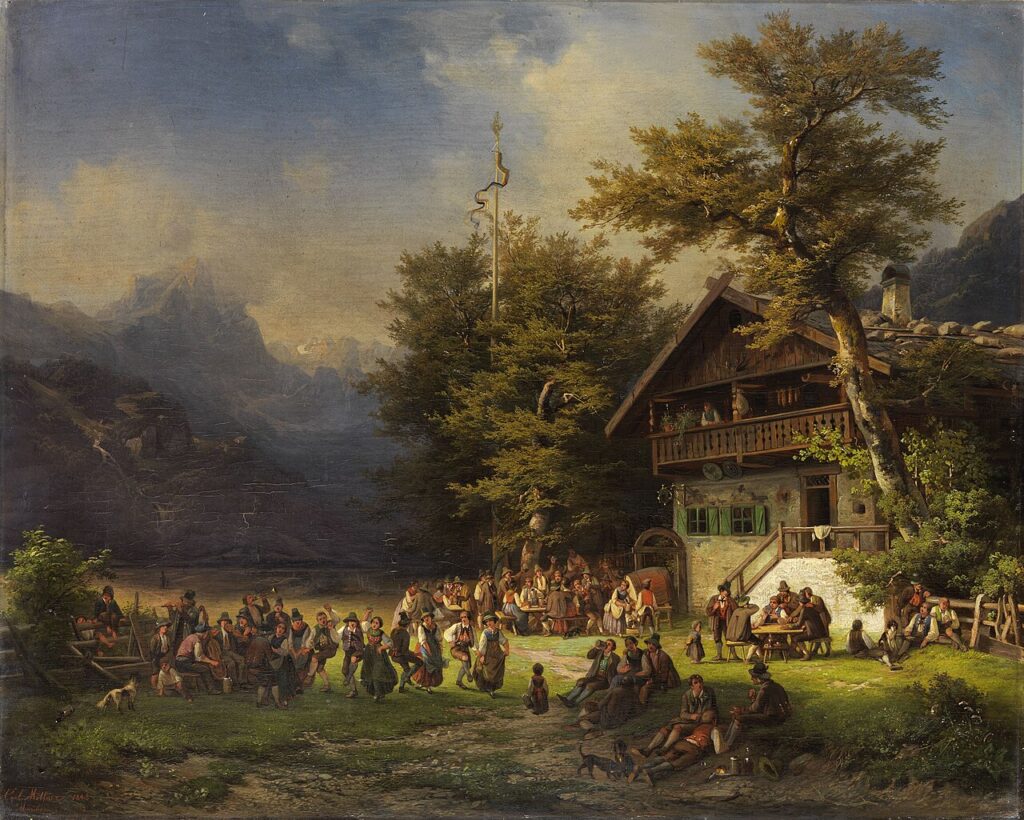
Few images capture the joy of spring quite like a maypole rising above a village green. Decorated with flowers, greenery, ribbons, and bright colors, the maypole has long served as the centerpiece of community celebrations marking the arrival of warmer weather. For centuries, artists have been drawn to these scenes of dancing, music, courtship, and festivity. Whether painted in the villages of the Low Countries or remembered through later depictions of English folk customs, May Day celebrations offered artists a rich subject filled with movement, symbolism, and human connection.
The maypole itself became more than a simple decorated pole. It evolved into a powerful symbol of local identity, seasonal renewal, and communal life. As European society changed through wars, religious conflicts, industrialization, and urban growth, artists often looked to traditional customs as a way of preserving memories of an older world. Their paintings provide valuable insight into how people celebrated, gathered, and expressed shared cultural traditions.
Today, many of the customs associated with the maypole survive in modified forms. Historical paintings remain among the best visual records of these traditions. They reveal not only the appearance of the celebrations but also the values and social relationships that shaped village life for generations.
The Origins and Meaning of the Maypole Tradition
Medieval and Early Modern Roots of the Maypole
The origins of the maypole tradition reach deep into the Middle Ages. By the late medieval period, records from England, Germany, and parts of the Low Countries describe communities erecting decorated poles as part of spring festivities. Although historians continue to debate the precise origins of the custom, there is broad agreement that maypole celebrations became widespread throughout northern Europe by the fifteenth century.
May Day, celebrated on May 1, marked the transition from winter to spring. In agricultural communities, this seasonal change carried tremendous importance. The end of cold weather meant the return of planting, livestock grazing, and outdoor social life. Villagers gathered greenery, flowers, and branches from nearby woodlands to decorate their settlements. The maypole became the visual centerpiece of these festivities.
English records from the late fifteenth and early sixteenth centuries frequently mention parish-sponsored maypoles. Some communities selected exceptionally tall tree trunks and transported them great distances before erecting them in prominent locations. The event itself often required the cooperation of dozens of villagers, reinforcing bonds within the community.
Religious and political disputes affected these traditions during the seventeenth century. During the English Civil War, many Puritan authorities viewed maypole celebrations as disorderly and inappropriate. In 1644, Parliament ordered the removal of maypoles throughout England. Following the restoration of King Charles II in 1660, many communities revived the custom, and maypoles once again appeared in towns and villages across the country.
Why Artists Were Drawn to Maypole Celebrations
Artists found maypole festivities irresistible because they combined many elements that make compelling visual art. A maypole scene offered movement, color, costume, landscape, architecture, and human interaction within a single composition. Unlike formal portraits or religious paintings, these celebrations provided opportunities to depict ordinary people enjoying everyday life.
The circular dances associated with maypoles naturally created dynamic compositions. Artists could arrange figures in flowing patterns around a central pole, guiding the viewer’s eye through the scene. Musicians, children, spectators, and vendors added further visual interest and narrative possibilities.
The tradition also carried symbolic meaning. Spring represented renewal, growth, and hope. Artists often used festive gatherings to evoke feelings of prosperity and social harmony. Even when individual participants appeared engaged in ordinary activities, the larger scene conveyed a sense of communal unity.
For painters interested in documenting contemporary life, May Day celebrations offered an opportunity to record local customs. These works now serve as valuable historical documents, preserving details of clothing, architecture, social practices, and public festivities that might otherwise have been forgotten.
Symbolic Meanings Associated with the Maypole
The maypole accumulated multiple layers of meaning over time:
- Renewal and the arrival of spring
- Community cooperation and shared celebration
- Local traditions and village identity
- Courtship and social interaction
- Seasonal abundance and agricultural prosperity
These themes helped ensure the maypole remained an attractive artistic subject for centuries.
Maypole Celebrations in Northern European Genre Painting
Pieter Brueghel the Younger and Village Festivities
One of the most important artistic representations of the tradition is Dance Around the Maypole, painted by Pieter Brueghel the Younger around 1625–1630. The work is an oil painting on panel and is now housed in the Utah Museum of Fine Arts in Salt Lake City.
Pieter Brueghel the Younger was born around 1564 or 1565 and was the son of the celebrated Flemish painter Pieter Bruegel the Elder. Following his father’s death in 1569, the younger Brueghel developed a successful career that often involved producing versions and adaptations of compositions associated with the family workshop tradition. His paintings preserved many themes that had made his father’s work famous, particularly scenes of peasant life and village celebrations.
Dance Around the Maypole presents a lively communal gathering centered on a decorated pole. Villagers dance, converse, and participate in festivities that appear both joyful and familiar. Rather than focusing on noble patrons or religious subjects, the painting celebrates ordinary people and their customs.
The work demonstrates the enduring popularity of festival scenes in Flemish art. It also provides valuable visual evidence of how artists imagined and recorded communal celebrations during the early seventeenth century. Through its crowded composition and detailed figures, the painting invites viewers into a vibrant world of music, movement, and shared experience.
Folk Culture as a Legitimate Artistic Subject
The rise of genre painting in the Low Countries transformed the artistic landscape during the sixteenth and seventeenth centuries. Increasingly, painters devoted attention to scenes from everyday life rather than exclusively religious or aristocratic subjects. Markets, weddings, taverns, seasonal festivals, and village gatherings became worthy themes for serious artistic treatment.
This shift reflected broader social and economic changes. Expanding urban populations and prosperous merchant classes created demand for paintings that depicted familiar experiences. Collectors often appreciated works that combined entertainment, observation, and subtle commentary on human behavior.
Festival scenes allowed artists to showcase large groups of figures engaged in different activities simultaneously. Viewers could discover new details with each examination of the painting. A dancing couple might occupy one area of the composition while musicians, children, and spectators animated another.
Maypole celebrations fit naturally within this artistic tradition. They provided opportunities to depict communal life at its most energetic while preserving local customs for future generations.
Visual Elements Commonly Seen in Maypole Paintings
Artists portraying May Day festivities frequently included recurring visual features. The decorated pole itself usually occupies a central position, serving both as a symbolic focal point and as a compositional anchor.
Dancers often form circular patterns around the pole. These arrangements create a sense of rhythm and movement that enhances the festive atmosphere. Musicians are commonly placed nearby, emphasizing the importance of music in communal celebrations.
Village buildings, churches, and open greens frequently appear in the background. These elements help establish a specific setting and reinforce the connection between the celebration and local identity. Trees, flowers, and greenery further emphasize the seasonal context.
Children, courting couples, elderly spectators, and community leaders often appear together within the same scene. Their presence highlights the broad participation that characterized traditional May Day festivities.
The Revival of May Day Imagery in Nineteenth-Century Art
Victorian Interest in Historic Customs
The nineteenth century witnessed renewed fascination with traditional customs throughout Britain and parts of Europe. Rapid industrialization transformed landscapes, economies, and patterns of daily life. As cities expanded and factories multiplied, many writers, artists, and scholars became increasingly interested in preserving memories of older rural traditions.
Antiquarians played a significant role in this movement. Researchers collected folklore, documented local festivals, and recorded customs that seemed threatened by modernization. Their work helped inspire artistic interest in celebrations such as May Day festivities.
The Romantic movement also contributed to this renewed attention. Romantic artists and writers often emphasized emotion, nature, history, and cultural heritage. Traditional festivals offered rich material that aligned with these interests.
As a result, maypole imagery reappeared in paintings, illustrations, books, and public celebrations. Although some depictions reflected historical reality, others blended historical traditions with Victorian ideals about rural life and social harmony.
Rural Festivals and National Identity
By the nineteenth century, many observers viewed traditional festivals as symbols of national character. Local customs appeared to connect modern societies with their historical roots. Maypole celebrations became associated with continuity, heritage, and community spirit.
This perspective was particularly strong in England, where interest in folk traditions grew throughout the Victorian period. Historical societies, local historians, and cultural organizations sought to preserve customs that seemed increasingly rare.
Artists responded by portraying village celebrations as enduring expressions of communal identity. Their works often emphasized cooperation between generations and the continuity of shared traditions. These themes resonated with audiences concerned about the pace of social change.
The maypole became more than a decorative object. It served as a visual shorthand for an idealized vision of village life, one rooted in history and collective memory.
Common Victorian Themes Connected to Maypole Imagery
Victorian depictions of May Day celebrations frequently emphasized several recurring themes:
- Nostalgia for rural traditions
- Community cooperation
- Childhood innocence
- Historical continuity
- Seasonal renewal
These themes helped make Maypole imagery appealing to audiences seeking connections with the past.
Interpreting Maypole Imagery in Art Today
What Maypole Paintings Reveal About Society
Historical paintings of Maypole celebrations offer more than attractive scenes of dancing villagers. They provide valuable evidence about social relationships, public customs, and communal life. Through careful examination, historians can gain insights into how people interacted within their communities.
The participation of different age groups often reveals the inclusive nature of these celebrations. Children, adults, and older residents frequently appear together, suggesting that May Day festivities served as important community events rather than activities limited to a particular segment of society.
Clothing depicted in these works can provide clues about regional fashions and social distinctions. Artists sometimes recorded details that might otherwise be absent from written records. Architecture, tools, musical instruments, and decorative elements also contribute valuable historical information.
At the same time, viewers must remember that paintings reflect artistic choices. Artists selected which details to emphasize and which to omit. These works should therefore be understood as both historical documents and creative interpretations.
Art as a Record of Vanishing Traditions
Many customs represented in historical Maypole paintings declined during the nineteenth and twentieth centuries. Changes in population, economics, transportation, and entertainment altered patterns of community life. Some festivals disappeared entirely, while others survived only in modified forms.
Artworks became increasingly important as records of these traditions. Paintings preserved visual evidence of celebrations that later generations might never witness firsthand. In some cases, artists documented customs that were already becoming rare when the works were created.
This documentary value enhances the significance of Maypole imagery today. Historians, folklorists, and cultural researchers often consult such works when studying historical festivals and community practices.
The survival of these paintings allows modern audiences to glimpse aspects of everyday life that written sources alone cannot fully capture.
The Enduring Appeal of the Maypole in Visual Culture
The maypole continues to attract interest because it combines several enduring themes. It represents celebration, community, tradition, and the natural cycle of the seasons. These ideas remain meaningful even in societies very different from those that first developed the custom.
Modern heritage festivals, historical reenactments, and cultural events often incorporate maypoles as symbols of continuity with the past. Artists, illustrators, and designers continue to draw inspiration from traditional imagery associated with May Day celebrations.
Paintings such as Pieter Brueghel the Younger’s Dance Around the Maypole remind viewers that communal celebrations have long played an important role in human society. They capture moments of shared joy that transcend centuries and cultural change.
The lasting popularity of these images demonstrates the power of art to preserve traditions long after the original celebrations have evolved or disappeared. Through paint, color, and composition, artists ensured that the spirit of the maypole would endure far beyond the villages where it once stood at the center of spring festivities.
Key Takeaways
- Maypole celebrations became widespread across northern Europe during the late medieval period.
- The maypole symbolized renewal, community identity, and the arrival of spring.
- Artists favored May Day scenes because they combined movement, color, landscape, and social interaction.
- Pieter Brueghel the Younger’s Dance Around the Maypole (ca. 1625–1630) remains one of the best-known artistic depictions of the tradition.
- Historical paintings preserve valuable evidence about customs, clothing, architecture, and community life.
Frequently Asked Questions
What is a maypole?
A maypole is a tall decorated pole traditionally erected during May Day celebrations to mark the arrival of spring.
When did maypole celebrations become common?
They were widely established across parts of northern Europe by the late medieval period and remained popular through the early modern era.
Why did artists paint maypole celebrations?
Artists were attracted by the colorful festivities, dancing figures, communal atmosphere, and symbolic connection to seasonal renewal.
Who painted Dance Around the Maypole?
The painting was created by Pieter Brueghel the Younger around 1625–1630.
Where is Dance Around the Maypole located today?
The painting is housed in the Utah Museum of Fine Arts in Salt Lake City, Utah.