The story of Susanna and the Elders comes from the Book of Daniel, where a virtuous woman is falsely accused after refusing the sinful advances of two corrupt men. Though she faces death, her righteousness is ultimately defended through the wisdom of the prophet Daniel, and justice prevails. This episode has been a reminder for centuries that truth will be revealed, and that false witnesses will face consequences. It’s a warning against moral corruption and a defense of female modesty and dignity.
For generations, artists across Europe chose this scene not only for its drama but for its clear moral structure. Susanna is the victim of evil men, but she refuses to yield, remaining faithful to what is right. Her courage under pressure became a symbol of upright character and inner strength. Many paintings sought to uphold that message clearly.
Though some painters used the subject to explore the beauty of the human figure, the foundation of the story remained intact. It was about temptation resisted, evil exposed, and innocence protected. The viewer is not meant to side with the corrupt elders, but to sympathize with Susanna — not as an object, but as a person who suffers because she does what is right.
This article explores how artists handled this biblical account throughout history. From early religious manuscripts to Renaissance paintings and beyond, each era brought new interpretations. But the lesson of the story — the defense of virtue against corruption — remained central to its meaning.
The Origins of Susanna’s Story: Sacred Text and Interpretation
The story of Susanna is part of the additions to the Book of Daniel, found in Christian Bibles since ancient times. She was a faithful and modest wife, living in Babylon, who became the target of two wicked elders. These men, judges in her community, watched her while she bathed and then tried to blackmail her into sin. When she refused, they accused her of adultery, which carried the death penalty under the law.
God answered her prayer for help by raising up the young Daniel, who cross-examined the elders and exposed their lies. Susanna’s name was cleared, and the false accusers were condemned. From the earliest times, this account was taught in churches as a lesson in standing firm under pressure. It warned against both lust and false judgment — two sins that destroy families and society alike.
Susanna in Medieval Manuscripts
During the Middle Ages, the story of Susanna appeared in religious books, usually as part of biblical or moral teaching. Artists illustrated the scene to show her piety and the wickedness of her accusers. These were not paintings made for entertainment, but images designed to teach the faithful about the importance of chastity and honest judgment.
Susanna was often pictured fully clothed, or with her modesty protected. The focus was not on her body, but on her distress, her prayer, and the moment of deliverance. The elders were shown as scheming and dishonest, symbols of how men in power can abuse their position. These early illustrations reflect a time when art served truth plainly, without compromise.
Renaissance Transformations: The Birth of a Pictorial Tradition
With the rise of Renaissance painting came new styles of representation, including a focus on the human body and classical themes. Many artists of this period were interested in anatomy and proportion, and biblical stories like Susanna and the Elders gave them a way to depict the nude figure while staying within acceptable religious subjects. Some of these works remained respectful, while others strayed into questionable territory.
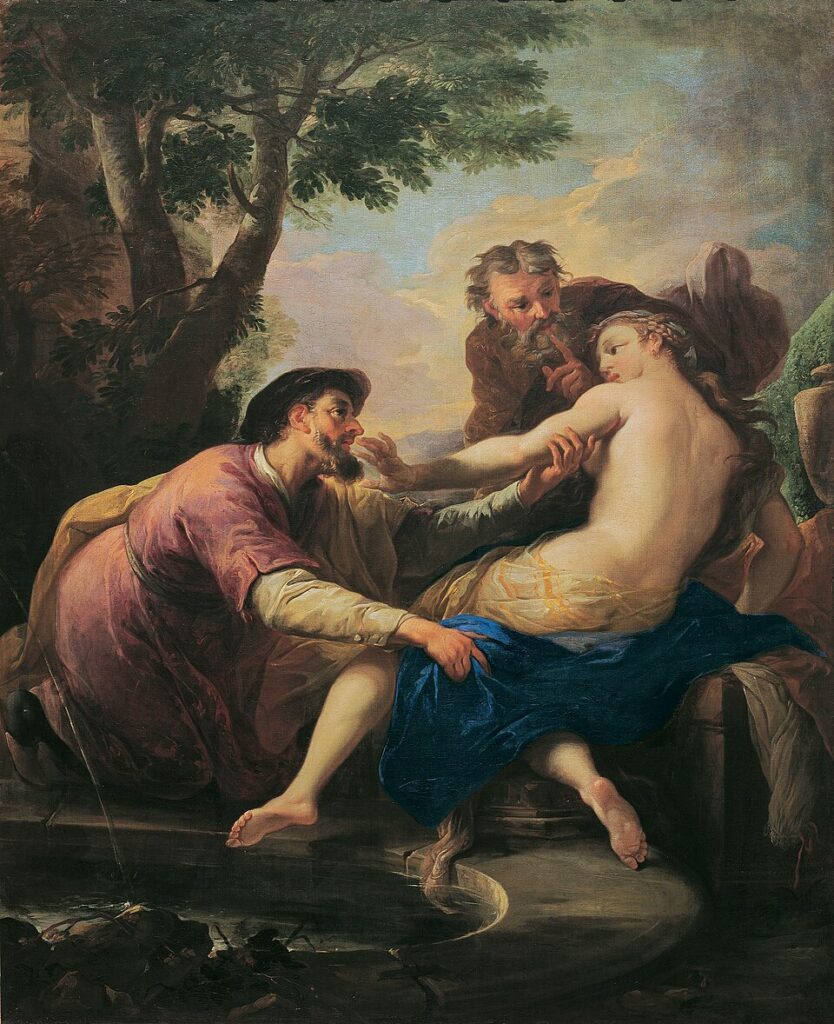
In the best examples, artists used Susanna’s story to show not sensuality but danger — the moment when virtue is threatened by evil. When done correctly, her nudity is not meant to entice, but to underline her vulnerability and the injustice she faced. The elders are cast not as curious old men, but as villains whose lust led them to betray their position of trust. The moral balance of the story remains clear.
Famous Works: Lorenzo Lotto and Tintoretto
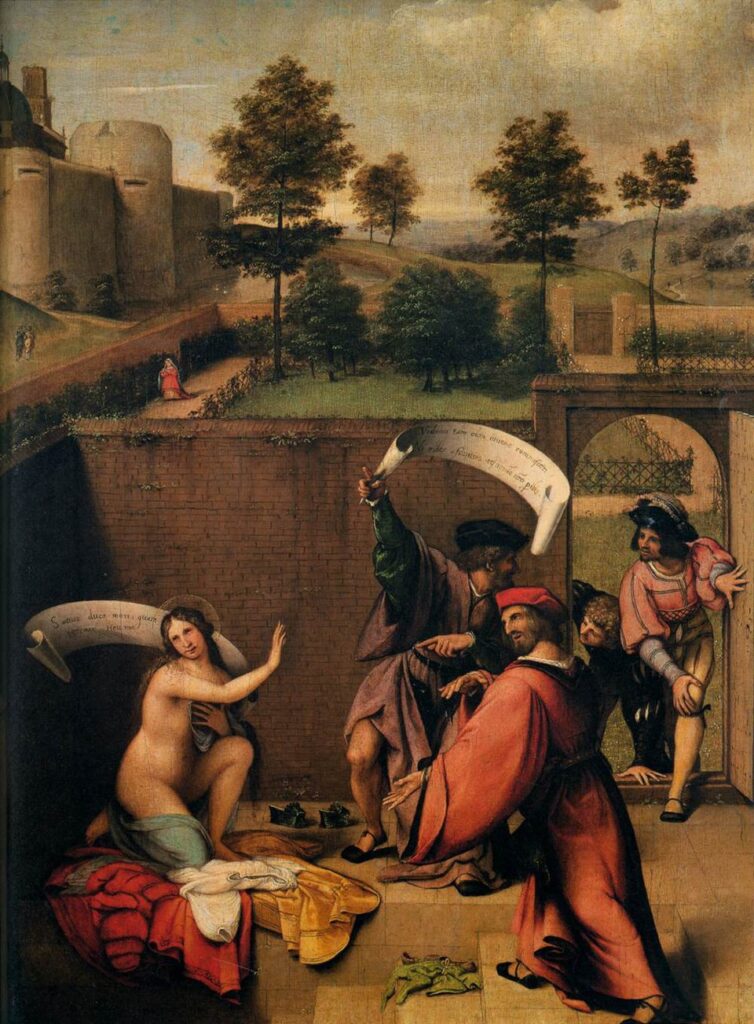
Lorenzo Lotto (c. 1480–1556) painted a version of Susanna that focused on her spiritual distress. In his work, Susanna is not shown as inviting attention but rather as a woman startled and shamed. Her expression and posture show her modesty and her fear, while the men are hidden, peering at her from behind a wall — depicted as sneaky and dishonorable.
Tintoretto (1518–1594), one of Venice’s great painters, created several versions of Susanna. Though his scenes are more dramatic, he still maintained the contrast between Susanna’s virtue and the elders’ corruption. In his best-known work, Susanna sits with her head turned away, trying to shield herself. The viewer sees her modest posture and the men leering from behind. It’s a moral lesson in the abuse of authority and the cost of maintaining decency.
Northern Interpretations: Morality and Intimacy
As the story of Susanna moved north into the Dutch and Flemish traditions during the 17th century, artists placed new emphasis on realism and personal virtue. These Protestant and Catholic painters often worked within a culture that still upheld biblical values, including modesty and moral restraint. In this environment, Susanna was not an excuse for indulgence, but a lesson in resisting temptation and remaining honorable, even when wrongfully accused.
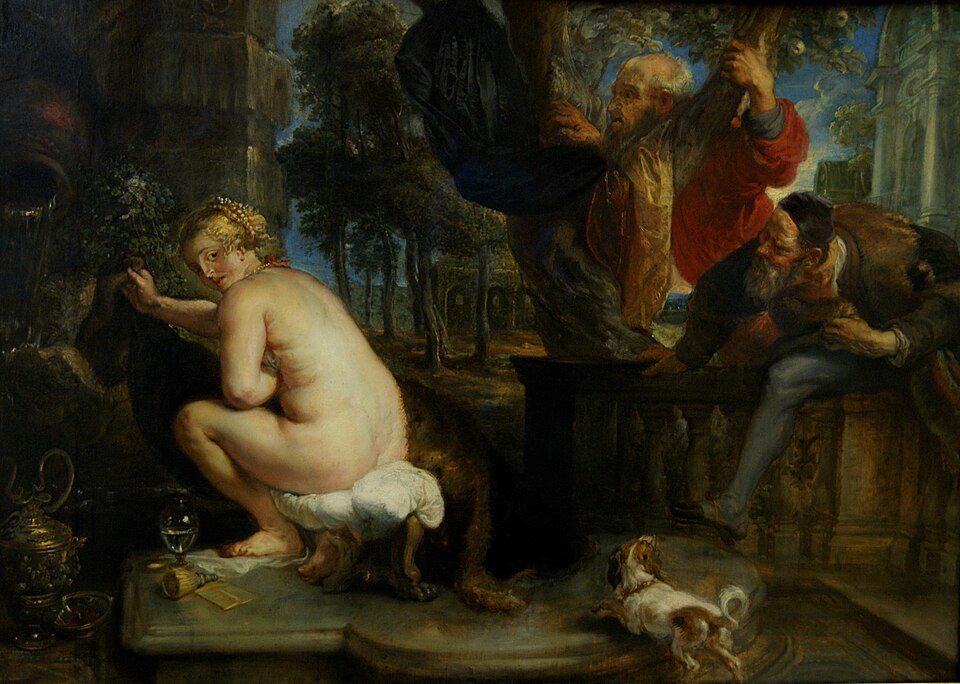
Northern artists showed a concern for domestic settings, sober colors, and carefully observed expressions. Susanna was often painted with downcast eyes, folded arms, or gestures that clearly signaled distress. There was no confusion about what the viewer was supposed to feel: sympathy for a woman whose modesty had been violated and contempt for the elders who preyed on her. The artistic choices supported the story’s original purpose — to condemn false judgment and uphold virtue.
Rembrandt and Artemisia Gentileschi: A Tale of Two Perspectives
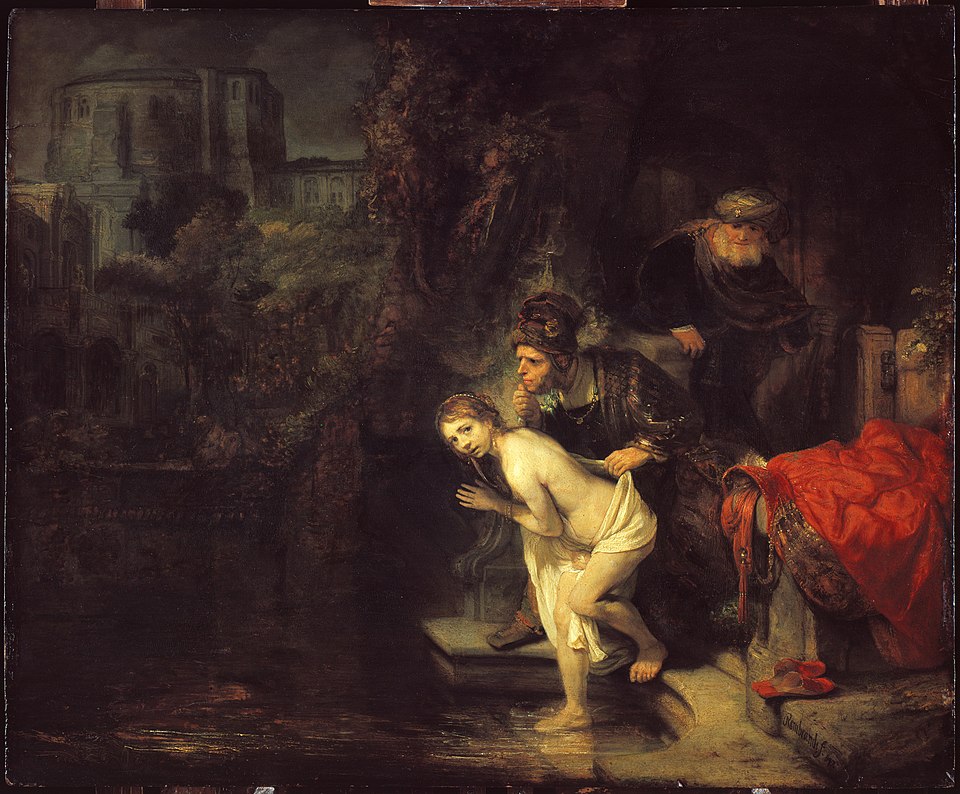
Rembrandt van Rijn (1606–1669), one of the greatest masters of Dutch painting, created a version of Susanna that avoids any glorification of the female body. In his 1647 work, Susanna recoils in fear, attempting to cover herself as she becomes aware of being watched. Her body is turned away from the viewer, and her facial expression shows embarrassment and shame. Rembrandt’s focus on inner emotion rather than outward display made his painting a powerful moral statement.
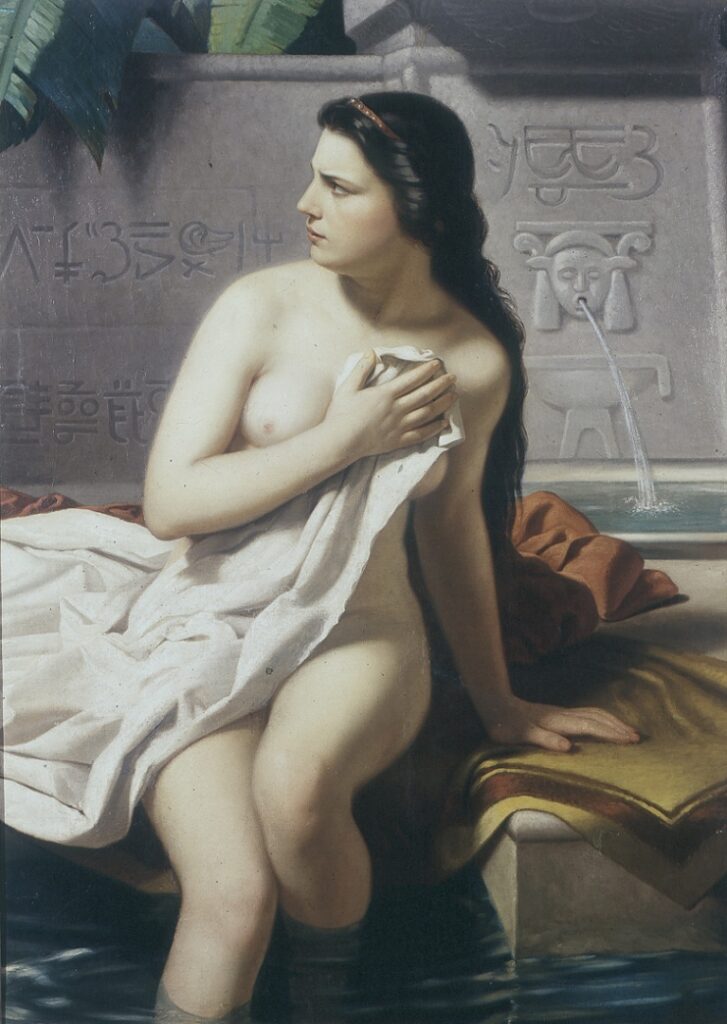
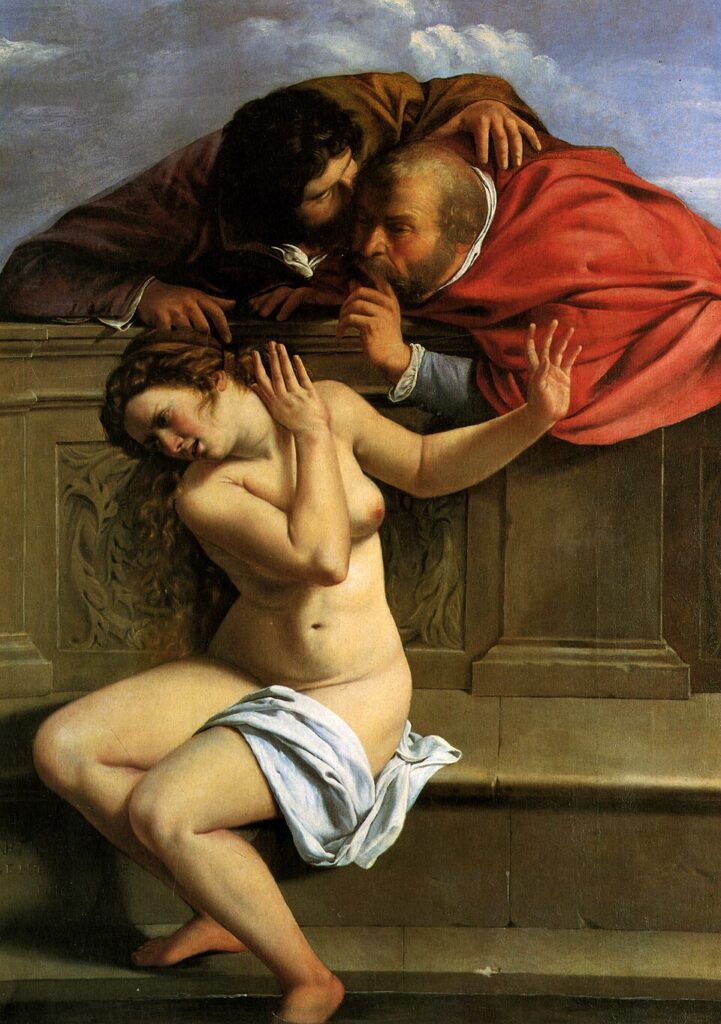
Artemisia Gentileschi (1593–c.1654), though raised in Italy, painted her version of Susanna with similar seriousness. In her 1610 painting, the elders are shown physically imposing and menacing. Susanna leans away in a tense posture, deeply disturbed by the intrusion. Though modern critics have tried to impose ideological narratives onto her work, the painting itself aligns with traditional values. It shows evil men abusing power, and a decent woman resisting them with strength and conviction.
Artemisia Gentileschi’s Interpretation in Context
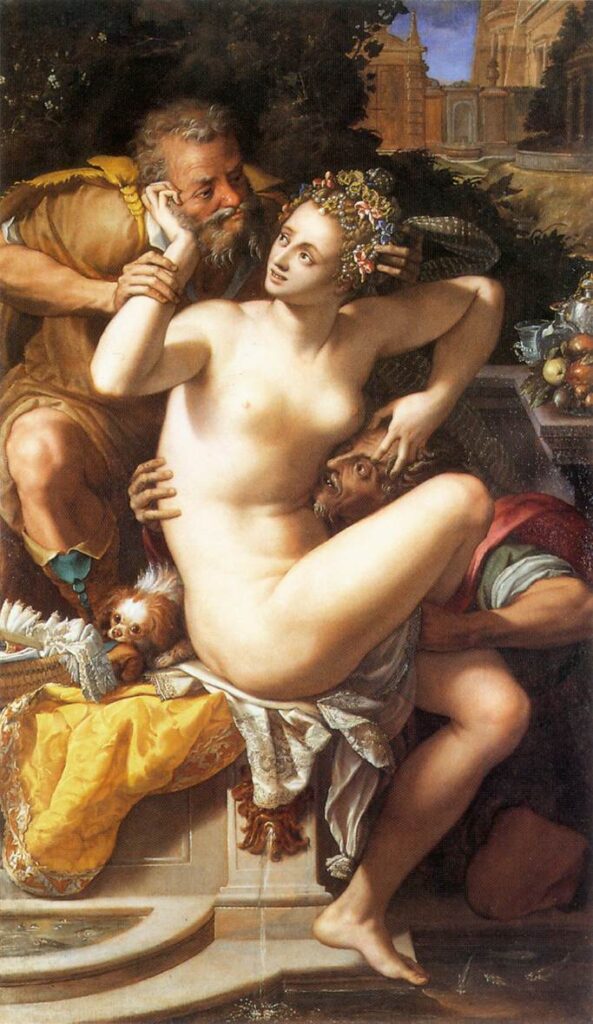
Among all the depictions of Susanna and the Elders, the painting by Artemisia Gentileschi stands out for its emotional weight and moral clarity. Painted in 1610–1611 when she was around seventeen years old, the work shows Susanna in genuine distress. Her body is twisted away, her head turned in pain, and her expression makes it clear that she is not a willing participant. There is nothing celebratory or sensual in the scene — only the clear presence of injustice and virtue under pressure.
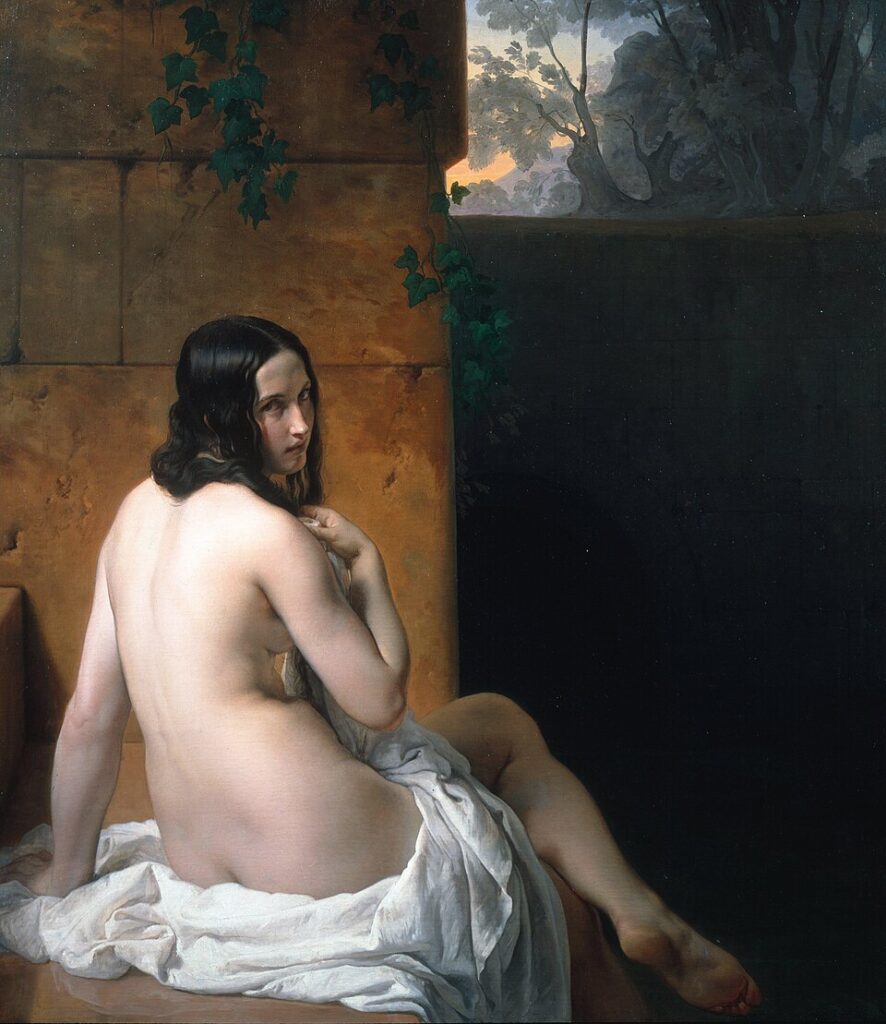
Gentileschi, the daughter of Orazio Gentileschi, was trained in her father’s workshop in Rome. Her education in painting was rigorous and rooted in traditional biblical themes. Despite later efforts by some to politicize her legacy, her works are marked by seriousness and respect for Scripture. Her portrayal of Susanna does not invite the viewer to linger on the body, but rather to confront the cruelty of the elders and the strength of Susanna’s resistance.
Contextualizing the Work Without Modern Reframing
There have been attempts in recent years to reshape Artemisia’s legacy through the lens of modern politics, often focusing on her personal history rather than the actual content of her paintings. However, such interpretations distort the plain meaning of her art. Her painting of Susanna speaks for itself: a chaste woman under pressure, standing firm in the face of evil. That message does not need to be twisted to fit a modern agenda.
Instead of reinventing her as a modern symbol, she should be appreciated for what she was — a skilled artist working within a biblical tradition, producing works that condemned immorality and praised righteousness. Her Susanna and the Elders remains one of the most compelling visual statements of moral clarity in 17th-century art. Its power lies not in rebellion or defiance, but in its quiet insistence that evil must be exposed and innocence preserved.
Rococo to Neoclassicism: Aestheticization and Moral Ambiguity
By the 18th century, Europe had entered a period where artistic styles shifted toward the ornamental and decorative. The Rococo era, especially in France, tended to focus on elegance, soft forms, and emotional lightness. In this cultural climate, some portrayals of Susanna began to lose the weight of their moral message. Rather than a symbol of virtue under threat, she was sometimes painted as merely a beautiful woman in an idealized garden, and the wicked elders were treated almost comically.
These treatments often lacked the seriousness that the subject demanded. Artists emphasized the soft curves of the body, the textures of drapery, and the lushness of setting, while neglecting the deeper moral crisis at the heart of the story. The viewer’s eye was directed more toward the aesthetic experience than the narrative of injustice. This shift marks a turning point — where in many cases, biblical themes began to serve decorative tastes rather than truth.
Jean-Baptiste Santerre and the Sensual Susanna
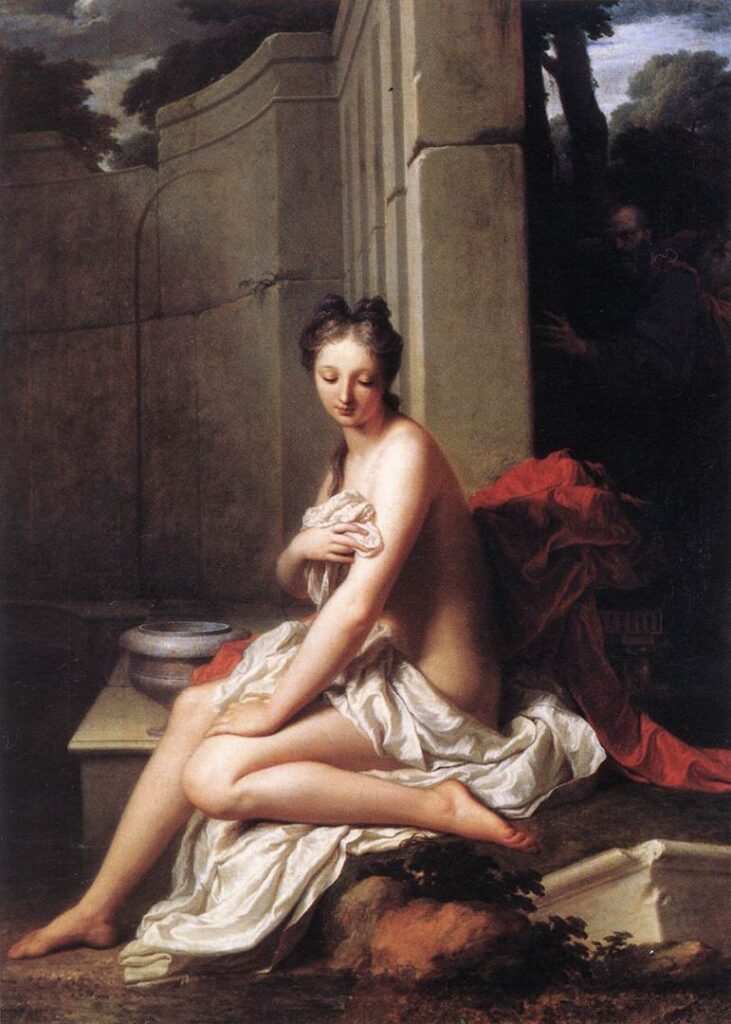
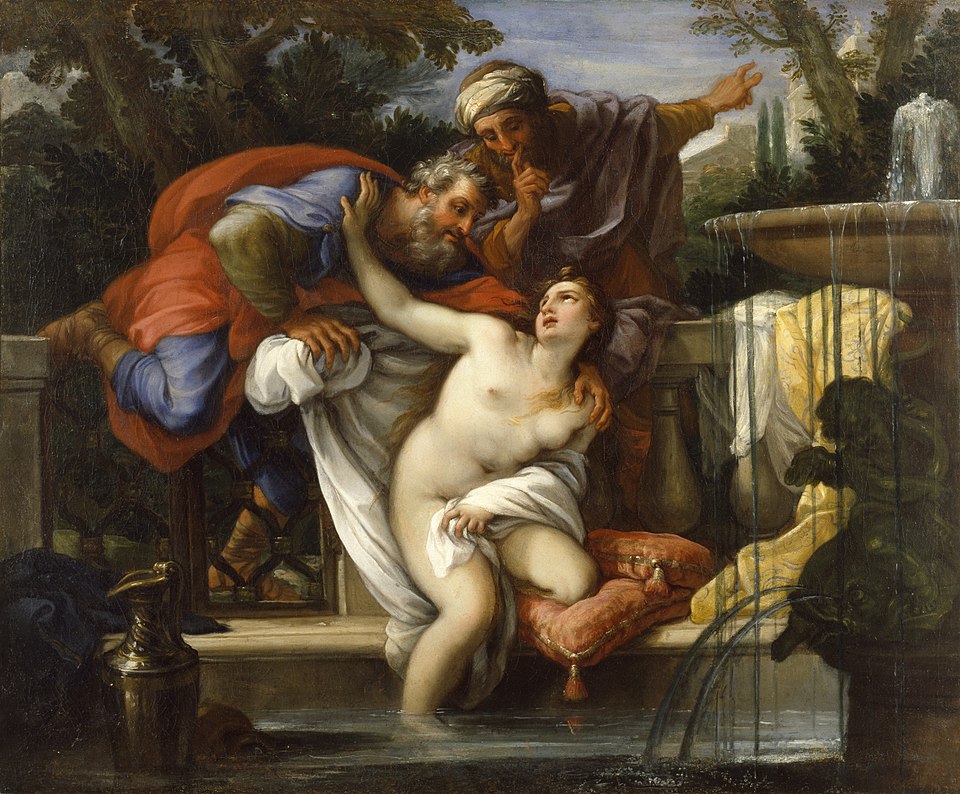
One of the clearest examples of this shift is found in the 1704 painting by Jean-Baptiste Santerre (1651–1717). Though technically skillful, Santerre’s Susanna and the Elders leans heavily into sensuality. Susanna appears at ease rather than distressed, and the elders are shown more as background figures than active villains. The painting lacks the moral structure that defined earlier works — no clear condemnation, no righteous struggle.
Santerre was admitted to the French Académie in 1704 and enjoyed favor at the royal court. His style matched the prevailing tastes of his time, but in this case, the subject deserved more weight. His Susanna seems unaware or unconcerned, and the message is unclear. Instead of inspiring moral reflection, the work drifts into ambiguity. While skillfully executed, it illustrates the danger of turning sacred stories into fashionable decoration.
19th and 20th Century Reinterpretations
During the 19th century, artists revisited Susanna’s story, often within the academic art tradition. Painters in this period valued classical balance and formal composition, but the moral clarity of earlier works was sometimes missing. As biblical literacy declined in many elite circles, the meaning behind these images became more symbolic than scriptural. Susanna was still painted, but increasingly as a vague emblem of female beauty, not as a woman enduring false accusation.
Some artists, particularly those influenced by the Symbolist movement, tried to explore psychological themes. But these attempts were usually disconnected from the original biblical message. Paintings became more abstract, or else treated Susanna as a mythological figure rather than a real person with a moral struggle. The clear line between good and evil was often blurred, leaving the viewer without guidance.
Symbolist and Postmodern Visions
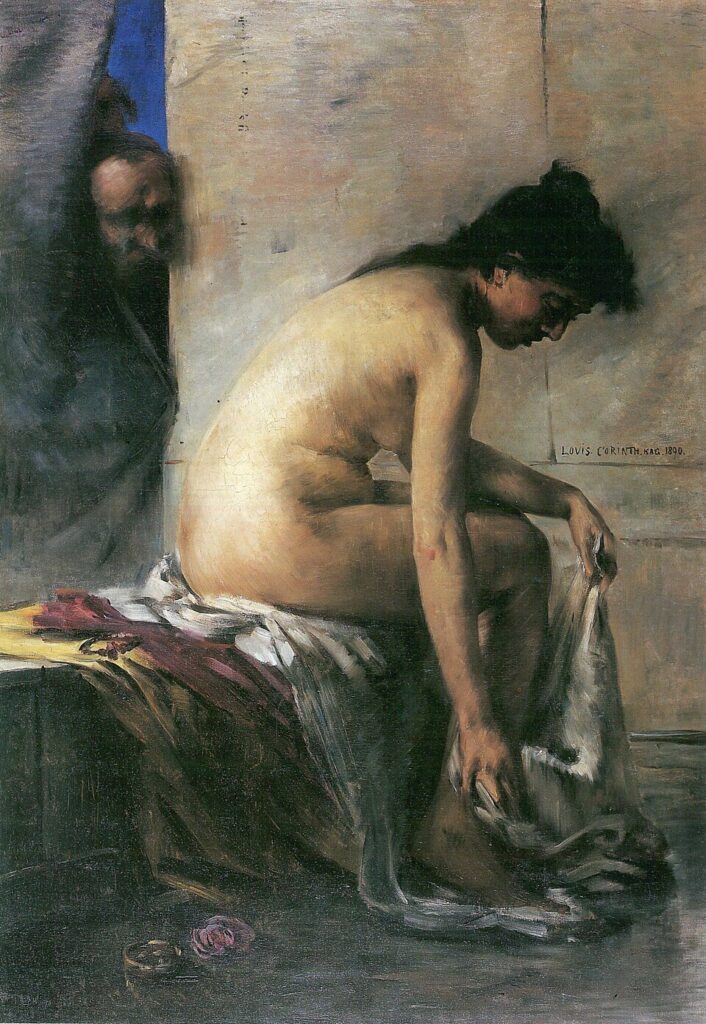
Lovis Corinth (1858–1925), a German painter associated with the Berlin Secession, painted Susanna and the Elders in 1890. His work, while bold in color and composition, strayed far from the original story. The figures are rough, the emotions exaggerated, and the setting theatrical. Instead of focusing on virtue, Corinth’s painting invites interpretation but offers little clarity.
In the 20th century, some modern and postmodern artists appropriated the Susanna theme for their own purposes — often disconnected from Scripture and more concerned with provoking reaction than teaching truth. Photography, performance art, and installations used the story in ways that emptied it of moral content. This marked a departure not only from the Bible, but from the artistic traditions that treated subjects with reverence.
The Enduring Appeal: Why Susanna Still Matters Today
Despite the changes over the centuries, Susanna’s story has never completely disappeared. Artists continue to find meaning in her example — not because of fashion, but because of the eternal truth it represents. Her story speaks to anyone who has been falsely accused, anyone who has stood firm under pressure, and anyone who believes that truth will eventually prevail. That message is timeless.
The scene’s dramatic tension still makes it powerful material for painters, sculptors, and other artists. But more than that, it gives modern viewers a reminder that virtue is not weakness. Susanna was not rescued because she cried out, but because she remained faithful. It was God who delivered her, using Daniel as His instrument, and that divine order should not be forgotten when interpreting the story.
Susanna in Contemporary Media
Susanna occasionally appears in literature, theater, or visual art today, but much of it lacks the reverence that earlier generations showed. Many modern interpretations twist the story to fit ideological narratives, rather than preserving its biblical lesson. When this happens, the focus shifts from moral clarity to confusion. The result is a loss of meaning.
Still, among Christians, traditional artists, and others who value virtue, the story of Susanna remains a source of strength. She is a reminder that modesty is not something to be mocked, and that courage can come in quiet forms. The story is not just about a woman in ancient Babylon — it is about the unchanging nature of truth, justice, and the need for righteous judgment in every era.
Key Takeaways
- Susanna’s story in the Book of Daniel illustrates the defense of virtue against false accusation.
- Artists have returned to this theme for centuries to reflect on modesty, justice, and moral strength.
- Early and Renaissance depictions focused on innocence under threat, not sensual display.
- Later periods sometimes diluted the story’s moral weight for aesthetic or ideological purposes.
- When treated seriously, Susanna remains a timeless example of righteousness in a corrupt world.
Frequently Asked Questions
- Who was Susanna in the Bible?
Susanna was a virtuous woman falsely accused of adultery after refusing the advances of two elders. - Why did artists paint Susanna and the Elders so often?
The story allowed artists to explore moral themes while working within a biblical subject. - Which artists painted the most respected versions?
Lorenzo Lotto, Tintoretto, Rembrandt, and Artemisia Gentileschi are among the most well-known. - How did portrayals change over time?
Earlier works focused on virtue, while some later pieces lost moral focus in favor of visual style. - Does Susanna’s story still matter today?
Yes, it continues to teach the value of truth, the danger of false witness, and the reward of righteousness.