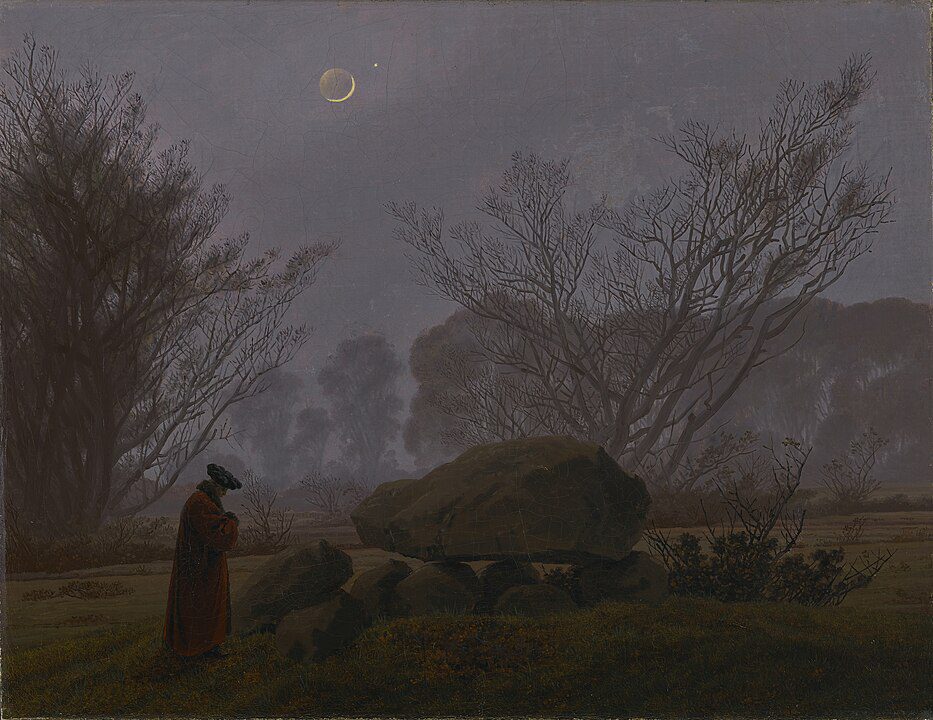
Throughout the history of art, silence and solitude have served as powerful themes, offering a quiet yet profound commentary on the human experience. Artists across cultures and centuries have depicted moments of stillness—not as empty or lifeless—but as deeply meaningful, brimming with spiritual weight or psychological insight. The absence of noise, figures, or activity often communicates more than a chaotic scene could ever convey. In solitude, both artist and viewer are invited to listen to the whispers of the soul.
Solitude in art can evoke peace or unease, depending on context, technique, and subject matter. Silence may suggest retreat, inner reflection, or even divine connection. Conversely, it can also hint at loneliness, isolation, or a lack of human warmth, especially in modern and urban settings. This dual nature has made silence a versatile motif, adaptable to various eras and philosophies.
Why Silence and Solitude Resonate in Art
Artists gravitate to these themes not only for their emotional depth but also because they resist spectacle. Silence isn’t performative—it’s inward. This quality aligns with the meditative nature of art-making itself, where stillness is part of the creative process. Whether in the quiet glow of a Vermeer interior or the barren geometry of an Agnes Martin painting, solitude pulls us into contemplation.
This article explores artistic representations of silence and solitude through a curated selection of artists, from Caspar David Friedrich’s sacred landscapes to Do Ho Suh’s ghostly architectural memories. We’ll journey through Western and Eastern traditions, Symbolism and Minimalism, Romanticism and Modernism. These works, though varied in time and place, share a quiet reverence for what cannot be said aloud—what we feel when we are alone, face to face with the eternal hush of existence.
The Romantic Era: Sublime Isolation
In the early 19th century, Romantic artists turned their focus inward, responding to the industrialization of Europe with a renewed interest in emotion, nature, and the spiritual self. One of the era’s foremost figures, Caspar David Friedrich, was born in 1774 in Greifswald, a port town in what is now northeastern Germany. His mother died when he was seven, and later the death of his brother in 1787 shaped his melancholic view of life. Friedrich studied at the Academy of Copenhagen, graduating in 1798, before settling in Dresden, where he created some of his most iconic paintings.
Friedrich’s landscapes—vast, moody, and often populated by solitary figures turned away from the viewer—embody a kind of sacred silence. In Wanderer above the Sea of Fog (c. 1818), a lone man stands atop a rocky precipice, gazing out over a foggy expanse of mountains. This image is not just a celebration of nature but a metaphor for existential reflection. The figure’s back is to us, inviting viewers to project themselves into the scene and feel the weight of individual solitude in the face of the infinite.
Caspar David Friedrich’s Haunting Landscapes
His friendship with German poet and philosopher Johann Gottfried Herder and correspondence with Goethe influenced his belief that nature was a spiritual force. Friedrich saw silence not as emptiness but as divine presence. In Monk by the Sea (1808–1810), a minuscule figure stands against a brooding seascape, dwarfed by the enormity of nature. The lack of human activity intensifies the sense of awe and isolation, reflecting Friedrich’s Lutheran faith and romantic sense of the sublime.
Friedrich died in 1840 after a long illness, financially unstable and largely forgotten. Yet his influence would later resurge, especially among 20th-century artists and filmmakers who found in his work a model for meditative depth. The silence in his paintings is not resignation—it is reverence. His work invites us to step away from the noise of modernity and enter a visual chapel of stillness, where solitude is a form of grace.
Symbolism and the Inner World
As the 19th century gave way to the 20th, the Symbolist movement emerged as a reaction against materialism and realism, turning instead to dreams, mysticism, and psychological depth. Belgian painter Fernand Khnopff, born in Grembergen in 1858, was one of the central figures in this movement. He studied law at the Free University of Brussels before switching to art at the Académie Royale des Beaux-Arts. By the 1880s, he was exhibiting at the Paris Salon and aligning himself with other Symbolists like Gustave Moreau and Odilon Redon.
Khnopff’s works are known for their frozen emotional tone and mysterious subjects, often focused on ethereal women, solitary figures, or closed interior spaces. His 1891 painting I Lock My Door Upon Myself is one of his most famous, inspired by a Christina Rossetti poem and filled with Symbolist ambiguity. A woman sits passively in an enclosed room, surrounded by flowers and surreal objects. Her withdrawn gaze and the enclosed setting suggest emotional self-isolation, a retreat into the inner world.
Fernand Khnopff and the Echo of Silence
Khnopff was deeply influenced by his sister Marguerite, who served as a model and emotional muse. Their relationship was close—some say too close—and her image haunts many of his works, often idealized and dreamlike. Silence, for Khnopff, was psychological armor, a way to preserve the sanctity of the self. His interiors are not comforting—they are sacred, almost hermetic, as if the outside world must be kept at bay.
He died in 1921, leaving behind a body of work that resists easy interpretation. Critics have long debated whether his depictions of silence were about repression or transcendence. In any case, Khnopff’s influence on later Surrealists and Jungian thinkers is undeniable. His paintings do not just portray solitude—they induce it, pulling the viewer into a meditative, almost trance-like state where silence becomes the dominant force.
Modernist Explorations of Alienation
The rapid urbanization of the 20th century brought with it a new kind of solitude—crowded, anxious, and impersonal. Edward Hopper, born in Nyack, New York, in 1882, captured this modern loneliness like no other American painter. He studied illustration at the New York School of Art, graduating in 1906, and spent formative years in Paris before returning to the U.S. to focus on painting. Though his style was realistic, his themes were profoundly psychological, reflecting a deep sense of detachment within familiar settings.
Hopper’s 1942 painting Nighthawks is perhaps the most iconic image of urban alienation: a late-night diner glowing against the darkness, its patrons locked in silent contemplation. Another work, Morning Sun (1952), depicts a woman sitting on a bed in an empty room, staring out a window. These are not just pictures of people—they’re psychological portraits of isolation. Hopper’s silence is not sacred, like Friedrich’s, but clinical, even oppressive.
Edward Hopper: Loneliness in Urban Life
Hopper married fellow painter Josephine Nivison in 1924, a partnership that would shape his career both creatively and personally. She managed his career, documented his process, and even posed for many of his female figures. But their marriage was also marked by tension and distance, echoing the emotional disconnection seen in his art. Solitude, in Hopper’s world, was not always chosen—it was often imposed by the rhythms of modern life.
Hopper died in 1967, but his vision of the lonely city still resonates in today’s art and film. Directors like Alfred Hitchcock and Wim Wenders have cited him as an influence, drawn to his stark compositions and emotional ambiguity. His work offers no easy answers—only the silent spaces between human encounters. In a world that often feels overconnected, Hopper reminds us of the deep and aching silence that can exist even in a room full of people.
Abstract and Minimalist Responses
While earlier artists depicted solitude through figurative scenes, 20th-century abstractionists explored silence through formal reduction. Agnes Martin, born in Macklin, Saskatchewan, in 1912, became a leading voice in this arena. After moving to the United States in the 1930s, she studied at Columbia University and eventually settled in New Mexico. Martin associated with the Minimalist movement, though she resisted the label, favoring emotional and spiritual interpretations of her work.
Her signature style—grids of soft, hand-drawn lines and pale washes of color—embodied a quiet rigor. Unlike the bold geometries of her male contemporaries like Donald Judd or Frank Stella, Martin’s works breathe with a subtle, rhythmic calm. In paintings like Untitled #10 (1975), the repetition feels like a chant, a visual liturgy. The silence here is not cold—it is deeply human, offering peace rather than detachment.
Agnes Martin and the Silence of the Grid
Martin’s writings reveal her deep interest in Zen Buddhism and the teachings of Laozi. She believed that art should transcend the intellect and express emotional truth. Her 1960s writings speak of happiness, innocence, and freedom—words rarely associated with grids and minimal forms. Yet in her work, the grid becomes a symbol of serenity, a way to hold silence gently in place.
She died in 2004, leaving behind a legacy of restraint and introspection that continues to influence artists seeking emotional clarity. Her work is proof that solitude need not be sad—it can be the bedrock of joy. In a noisy world, Agnes Martin created spaces of profound calm. Her paintings are not empty—they are full of the kind of silence that restores the soul.
Eastern Perspectives on Solitude
In Eastern art, solitude and silence are not viewed as problems to be solved but as essential aspects of enlightenment. Japanese ink painting, or sumi-e, offers a compelling contrast to Western depictions of silence. Originating in the 14th century, this tradition reached new heights through artists like Sesshū Tōyō, who was born in 1420 in Akahama, Japan. Sesshū trained in Zen monasteries and traveled to China in 1468 to study Song Dynasty techniques before returning to Japan in 1473.
His works, like Winter Landscape (c. 1470s), are masterpieces of negative space, using silence as a compositional force. The sparse brushwork, pale mountains, and drifting mists evoke more with less. Solitude in these paintings is not sadness—it is serenity, the visual embodiment of Zen detachment. There’s a humility in the art that says, “The world is vast. We are small. And that is good.”
Zen Aesthetics in Japanese Ink Painting
In Zen Buddhism, silence is a means to transcend the self and connect with universal truth. This principle guided not only Sesshū but generations of ink painters who followed him. The lack of detail, the openness of the canvas, and the emphasis on empty space mirror the meditative state of mind. This is not silence as lack—it is silence as fullness, as presence.
Western viewers often interpret these scenes as lonely, but that reflects a cultural bias. In the East, solitude is a path to peace, not despair. The ink painting tradition encourages viewers to enter the landscape with a quiet mind. In doing so, we do not encounter emptiness—we encounter truth.
Contemporary Interpretations
In the globalized art world of today, themes of silence and solitude often intersect with identity, displacement, and memory. South Korean-born artist Do Ho Suh, born in Seoul in 1962, offers a contemporary lens on these timeless concepts. After serving in the military, Suh moved to the United States in 1991, earning degrees from the Rhode Island School of Design and Yale University. His experience of cultural dislocation profoundly shapes his work.
Suh is best known for his fabric sculptures of domestic spaces—full-scale replicas of his childhood home in Seoul and later apartments in New York and London. These translucent structures, made of sheer polyester, are simultaneously present and ghostly. Walking through one feels like stepping into a memory, an echo of a place once familiar. The solitude here is tied to longing, to the spaces we leave behind and carry within us.
Do Ho Suh and the Architecture of Absence
Unlike the existential silence of Hopper or the spiritual stillness of Martin, Suh’s quiet spaces are emotional archives. They hold the sorrow of departure and the tenderness of memory. His work suggests that solitude is not always chosen—it sometimes arrives when we are far from home. But in representing these spaces so delicately, he offers a form of reconciliation.
Suh’s installations have been exhibited worldwide, including the Tate Modern and the Smithsonian. His practice blends sculpture, architecture, and autobiography, showing how silence can be spatial, emotional, and political. In today’s hyperconnected world, his work serves as a gentle reminder of what cannot be shared online or digitized: the quiet ache of being alone with one’s past. Silence, for Suh, is not absence—it is the shape of memory itself.
Key Takeaways
- Silence and solitude have been explored across centuries, from Romantic landscapes to modern sculpture.
- Artists like Friedrich and Khnopff used solitude to express spiritual or psychological depth.
- Modernists like Hopper revealed how isolation persisted in urban, crowded environments.
- Abstract and Eastern traditions approached silence as a source of peace, not just emptiness.
- Contemporary artists like Do Ho Suh redefine solitude in the context of memory and migration.
FAQs
- Why do artists use silence and solitude in their work?
To convey deep emotional or spiritual states beyond what words can express. - Which Romantic painter is most associated with solitude?
Caspar David Friedrich, known for his moody, reflective landscapes. - What role does Zen play in Eastern depictions of silence?
It promotes stillness as a spiritual practice and a gateway to enlightenment. - How does modern art treat solitude differently from older art?
Modern art often views solitude as alienation, especially in urban settings. - Is solitude always negative in art?
No, many artists see it as a source of serenity, clarity, or sacred insight.