Few inventions have transformed civilization as quietly as paper. Empires have risen and fallen, religions have spread across continents, and scientific discoveries have been preserved for generations because someone had a durable surface on which to write. Long before digital files and printing presses, paper carried royal decrees, merchant accounts, sacred texts, personal letters, maps, and works of art. Its story is not simply the history of a material. It is the history of human knowledge itself.
Paper changed the way societies stored information. Earlier writing materials often required expensive resources, specialized craftsmen, or difficult preparation. Paper offered something revolutionary: a relatively lightweight, adaptable, and increasingly affordable surface that could be produced in large quantities. As techniques improved, paper became one of the foundations of education, government, commerce, and culture.
The craft did not emerge fully formed. It evolved over centuries through experimentation, trade, and innovation. Different civilizations adapted papermaking to local conditions, using available fibers and developing distinct methods. The result was a rich tradition that stretched from China to Central Asia, from Baghdad to Italy, and eventually around the globe.
The journey of paper reveals how ideas travel. It also demonstrates how practical inventions can reshape history more profoundly than many battles or political events. Across nearly two thousand years, papermaking traditions helped preserve the written record of humanity.
The Origins of Paper and Early Innovations
Before Paper: Papyrus, Bamboo, Silk, and Parchment
Long before paper appeared, civilizations relied on a variety of writing materials. Ancient Egyptians used papyrus as early as the third millennium BC. Made from the pith of the papyrus plant, it served the needs of government, religion, and trade along the Nile. Although useful, papyrus was vulnerable to humidity and was largely dependent on Egyptian production.
In China, bamboo strips were widely used for writing. Bamboo was durable, but it was also heavy. A lengthy text could require bundles of strips tied together with cords. Transporting large collections of records became cumbersome. Silk offered a lighter alternative, yet its high cost limited widespread use.
Meanwhile, parchment and vellum became important across the Mediterranean world. Produced from animal skins, these materials were durable and could last for centuries. However, they required substantial labor and expense. A single manuscript might consume dozens of animal hides.
The limitations of these materials encouraged experimentation. Governments needed efficient record keeping. Merchants needed reliable accounting systems. Scholars needed affordable surfaces for copying texts. These practical demands set the stage for one of history’s most significant innovations.
Cai Lun and the Development of Paper in Han China
Traditional Chinese sources credit Cai Lun, a court official of the Eastern Han Dynasty, with improving papermaking around AD 105. While archaeological discoveries indicate that forms of paper existed before his lifetime, Cai Lun is associated with refining and standardizing the process. His improvements helped transform paper from a limited material into a practical tool for administration and communication.
According to historical accounts, Cai Lun experimented with materials that included mulberry bark, hemp waste, old rags, and worn fishing nets. These fibers could be broken down, suspended in water, and formed into thin sheets. The resulting product was cheaper than silk and easier to produce in quantity.
The timing was important. The Han government managed a vast bureaucracy. Officials generated enormous amounts of correspondence, tax records, census information, and legal documents. A more efficient writing material provided clear advantages.
Cai Lun’s reputation endured for centuries. Later generations regarded him as a central figure in the history of papermaking. Although modern historians recognize that paper existed before AD 105, his role in improving production methods remains significant.
Early Chinese Papermaking Techniques
Early Chinese papermakers developed a remarkably sophisticated process. Fibers were soaked and cooked to soften them. Workers then beat the material into pulp using wooden mallets. The pulp was mixed with water to create a suspension from which sheets could be formed.
A screen or mould was dipped into the mixture and lifted carefully. As water drained away, fibers interlocked into a thin mat. The sheet was then pressed, dried, and often polished. The basic principles remain recognizable in handmade papermaking today.
Common raw materials included:
- Mulberry bark
- Hemp fibers
- Old cloth
- Fishing nets
- Other plant fibers
By the third and fourth centuries AD, papermaking had spread across much of China. Improvements in quality allowed paper to replace bamboo and silk for many purposes. As literacy expanded and government administration grew more complex, demand increased steadily.
The Spread of Papermaking Across Asia and the Islamic World
Papermaking Moves Along Trade Routes
Trade routes carried more than goods. They carried ideas, technologies, and skills. The vast network commonly known as the Silk Road connected China with Central Asia, Persia, India, and the Mediterranean world. Along these routes, merchants exchanged products while craftsmen shared knowledge.
Paper gradually moved westward through these networks. Fragments discovered in Central Asia demonstrate that paper was known beyond China centuries before many traditional accounts suggest. Travelers, merchants, monks, and officials all contributed to its spread.
The movement was not a single event but a gradual process. Different regions adapted papermaking according to local needs and available materials. As knowledge traveled, techniques evolved.
Central Asian cities became particularly important because they stood at the crossroads of major trade routes. Among them, Samarkand emerged as one of the most influential centers in the history of paper.
The Battle of Talas and the Reality Behind the Legend
One of the most repeated stories in papermaking history centers on the Battle of Talas in AD 751. According to a later tradition, Chinese papermakers were captured by Abbasid forces and brought to Samarkand, where they revealed the secrets of their craft.
Modern scholarship treats this story cautiously. Archaeological evidence indicates that paper was already present in Central Asia before the battle. Documents and paper fragments found in the region suggest that knowledge of the material had spread earlier than the traditional narrative claims.
Historians also note that contemporary Chinese and Arabic sources do not clearly describe captured papermakers introducing the technology after the battle. The detailed story appears in sources written centuries later. As a result, many scholars regard the famous account as an oversimplification.
What is beyond dispute is that papermaking expanded dramatically across the Islamic world during the late eighth and ninth centuries. Whether Talas accelerated that process or merely became associated with it afterward remains a matter of debate.
Innovations in Islamic Papermaking Centers
Samarkand became one of the great papermaking centers of the medieval world. Local craftsmen adapted techniques to regional materials and developed methods that differed from those used in China. Rag fibers became increasingly important.
The Abbasid Caliphate recognized the value of paper quickly. By AD 794–795, a major paper mill operated in Baghdad. The city was becoming one of the world’s foremost centers of scholarship, administration, and commerce. Paper proved ideal for all three.
Production spread to Damascus, Cairo, and other cities. Islamic craftsmen refined processes involving sizing, polishing, and finishing. Many sheets were burnished until they achieved a smooth writing surface suitable for elegant calligraphy.
The quality of these papers impressed travelers and merchants. Paper became a major commodity, helping to connect distant regions through trade.
Paper’s Role in the Golden Age of Learning
The expansion of paper production coincided with extraordinary intellectual activity. Scholars translated Greek, Persian, and Indian works into Arabic. Libraries accumulated vast collections of manuscripts. Scientific, mathematical, and medical texts circulated more widely than ever before.
Paper lowered costs compared with parchment. More books could be copied. More records could be preserved. More correspondence could be exchanged across long distances.
Government administration also benefited. Tax records, legal documents, military reports, and diplomatic communications all relied increasingly on paper. Bureaucracies became more efficient as supplies became more abundant.
The result was a remarkable flowering of written culture. Knowledge moved more rapidly, and ideas could reach wider audiences than had previously been possible.
European Paper Mills and the Printing Revolution
Papermaking Arrives in Medieval Europe
Paper entered Europe through several channels, including Islamic Spain and Mediterranean trade networks. By the twelfth century, papermaking was established in parts of the Iberian Peninsula. From there, the craft continued its westward expansion.
Italy became especially important. The town of Fabriano emerged as a major papermaking center during the thirteenth century. Local craftsmen introduced innovations that improved both quality and efficiency.
European demand grew steadily. Governments required records. Merchants needed contracts and account books. Religious institutions required manuscripts and administrative documents.
As production increased, paper gradually challenged parchment’s long-standing dominance. By the late Middle Ages, its advantages were becoming impossible to ignore.
Water-Powered Mills and Technical Improvements
European papermakers embraced mechanical power. Waterwheels drove heavy hammers that reduced fibers into pulp more efficiently than manual labor alone. This innovation increased production while reducing costs.
Fabriano’s craftsmen developed several improvements that influenced papermaking for centuries. Among the most important were watermarks. Created by attaching wire designs to moulds, watermarks became identifiers of origin and quality.
Gelatin sizing also improved the durability of European papers. Sheets became more resistant to ink penetration and wear. Writers benefited from cleaner, sharper text.
These technical advances transformed papermaking from a small-scale craft into a growing industry capable of meeting increasing demand.
Paper and the Rise of Printing
The invention of movable-type printing by Johannes Gutenberg around AD 1450 changed the history of communication. Yet printing could not have achieved its full impact without paper.
Paper provided an economical surface for mass-produced texts. Books that once required months of copying by hand could now be produced in large numbers. Costs fell dramatically.
Literacy expanded gradually. Universities acquired more books. Merchants maintained more extensive records. Governments issued printed regulations and announcements. Religious texts reached broader audiences.
The combination of paper and printing created one of the most powerful information revolutions in human history. Knowledge that had once been confined to small circles became accessible to far larger populations.
Regional Papermaking Traditions
Several European regions developed distinctive reputations for paper production.
Major centers included:
- Fabriano in Italy, known for technical innovations and quality
- Troyes and Angoulême in France, important manufacturing hubs
- Nuremberg and other German cities with strong paper industries
- English mills that expanded production from the late fifteenth century onward
Each region adapted techniques to local resources and markets. Competition encouraged innovation. By the sixteenth century, paper had become an essential part of European economic and cultural life.
The growth of these regional traditions ensured that paper supplies could support expanding governments, universities, publishers, and commercial enterprises.
Industrialization, Preservation, and Modern Handmade Traditions
The Shift from Rag Paper to Wood Pulp
For centuries, most paper depended on recycled textiles such as linen and hemp rags. By the nineteenth century, demand had become too great for traditional sources alone.
A major breakthrough came in the 1840s with the development of wood-pulp paper. New industrial processes made it possible to convert timber into paper on a massive scale. Production increased dramatically.
Machine-made paper transformed publishing. Newspapers expanded circulation. Books became cheaper. Business records multiplied. Educational materials became more widely available.
The industrial age turned paper into a truly global commodity. Production levels reached scales unimaginable to earlier generations.
Challenges of Modern Paper Production
Industrial methods brought advantages, but they also introduced new problems. Many nineteenth-century papers contained acids that caused sheets to become brittle over time.
Archivists and conservators discovered that countless books, newspapers, and documents were deteriorating. Preservation became a major concern for libraries and museums.
Earlier rag papers often proved more durable than some later machine-made products. Documents created centuries earlier sometimes survived in better condition than those produced only decades before.
These challenges encouraged research into conservation techniques and improved manufacturing standards. Modern archival papers are often designed specifically for longevity.
Survival of Traditional Papermaking Crafts
Despite industrialization, traditional papermaking never disappeared. In Japan, washi continued to be produced using techniques passed down through generations. Korean craftsmen preserved the production of hanji, renowned for its strength and durability.
Across Europe, artisan workshops maintained handmade traditions. Fine artists, bookbinders, and conservators often preferred handmade papers for specialized purposes.
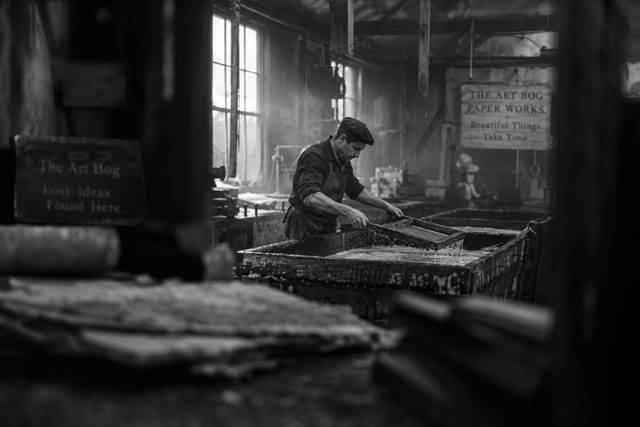
Many of these workshops operate much as their predecessors did centuries ago. Fibers are prepared by hand, sheets are formed individually, and drying methods remain largely traditional.
The continued survival of these crafts offers a living connection to the past. They preserve techniques that industrial production largely replaced.
Why Historic Papermaking Still Matters Today
Paper remains deeply connected to cultural heritage. Museums, archives, and libraries depend upon an understanding of historical papermaking to preserve priceless documents and manuscripts.
Artists continue to value handmade paper for its texture, durability, and character. No machine can perfectly replicate the subtle variations produced by traditional methods.
Educational programs and heritage workshops have also revived interest in historical crafts. Visitors can watch sheets being formed and gain a deeper appreciation for the labor involved.
The story of paper demonstrates how practical skills can influence the course of civilization. A simple sheet carries within it centuries of experimentation, craftsmanship, and human ingenuity.
Conclusion
The history of paper is a story of innovation, adaptation, and cultural exchange. From its early development in Han China to its spread across Asia, the Islamic world, and Europe, paper transformed the way people recorded and shared knowledge. Every stage of its journey introduced new materials, new techniques, and new possibilities.
Trade routes carried papermaking beyond its place of origin. Craftsmen refined methods and adapted them to local conditions. Governments, merchants, scholars, and artists all found new uses for the material. Over time, paper became indispensable to civilization.
The invention of printing multiplied its impact, while industrialization expanded its availability. Yet even in an age of machines and digital technology, traditional papermaking survives. Handmade sheets continue to reflect skills that have been passed down through centuries.
Every surviving manuscript, map, letter, and drawing serves as a reminder of paper’s enduring importance. Few materials have done more to preserve humanity’s memory. Few inventions have left a greater mark on history.
Key Takeaways
- Paper developed gradually, with important improvements traditionally associated with Cai Lun around AD 105.
- Earlier writing materials such as papyrus, bamboo, silk, and parchment had significant limitations.
- Papermaking spread westward through trade networks and expanded rapidly in the Islamic world during the eighth and ninth centuries.
- European innovations and the printing revolution dramatically increased paper’s influence.
- Traditional handmade papermaking survives today alongside modern industrial production.
FAQs
- Did Cai Lun invent paper? Traditional accounts credit him with major improvements, but archaeological evidence shows paper existed before his lifetime.
- Was the Battle of Talas solely responsible for spreading papermaking westward? Modern historians debate this claim, and evidence suggests paper was already known in Central Asia before AD 751.
- What materials were used in early papermaking? Common materials included mulberry bark, hemp, old cloth, fishing nets, and other plant fibers.
- Why was paper better than parchment for many purposes? It was generally cheaper and easier to produce in larger quantities.
- Are traditional papermaking methods still used today? Yes, especially in Japanese washi, Korean hanji, and various artisan workshops around the world.