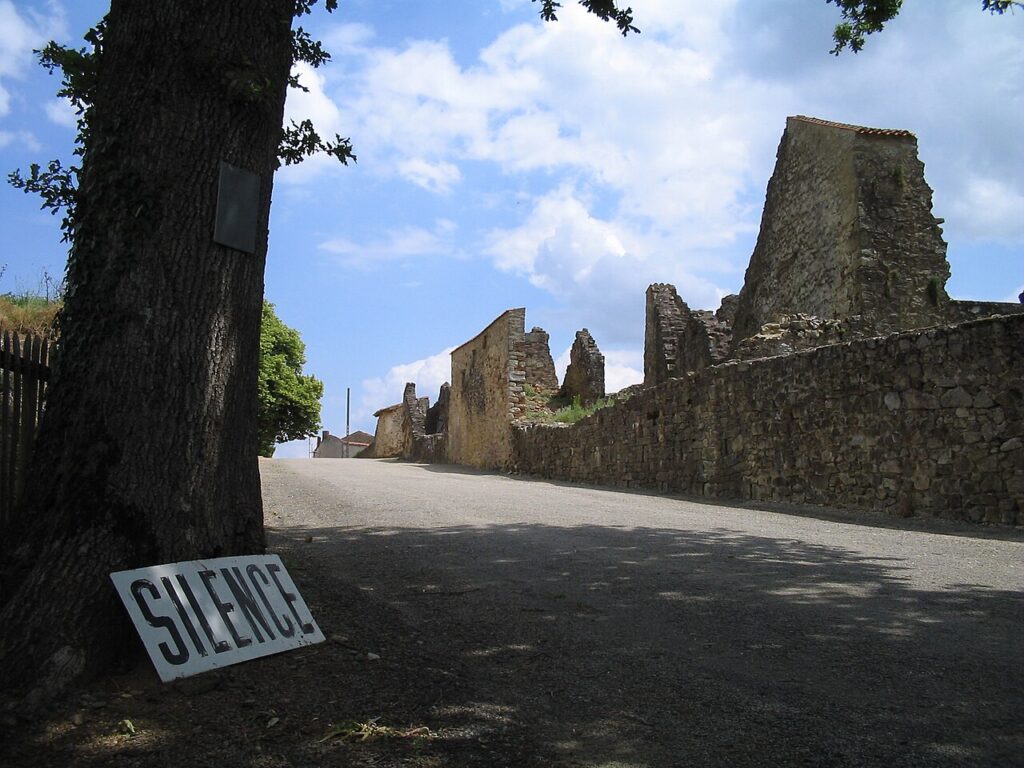
On a quiet road in the Haute-Vienne department of west-central France sits one of the most haunting visual landscapes in Europe. Rusted automobiles remain frozen beside crumbling stone buildings. Tram tracks vanish into grass and silence. Burned sewing machines still rest where they were abandoned on June 10, 1944. The village of Oradour-sur-Glane is not merely a historical site. It is a preserved wound, a place where architecture, destruction, memory, and time combined to create an accidental work of memorial art unlike anything else in the modern world.
Many ruined cities from the Second World War were rebuilt within a few years. Warsaw rose again from rubble. Dresden reconstructed its skyline. Coventry restored its churches and streets. Oradour-sur-Glane followed another path entirely. After the massacre carried out by soldiers of the Waffen-SS 2nd SS Panzer Division “Das Reich,” French leader Charles de Gaulle ordered the original village preserved exactly as it had been left. The ruins became both evidence and memorial. The result was a strange fusion of archaeology, architecture, and emotional testimony.
Today, visitors do not encounter statues celebrating victory or enormous patriotic monuments. Instead, they walk through silence. Empty windows stare into the countryside. Walls blackened by fire frame open skies. Household objects become artifacts more powerful than many museum collections. A child’s toy carriage carries more emotional weight than marble sculpture because it was left behind in a real human catastrophe.
The visual power of Oradour-sur-Glane comes from authenticity. Nothing about the village was designed to become art. The streets were ordinary. The buildings were practical. The objects were humble possessions used in daily life. Yet destruction transformed the entire setting into one of the most emotionally overwhelming memorial environments in Europe. The village became a permanent composition shaped by absence.
Oradour-sur-Glane as a Landscape of Memory
The Village Before Destruction
Before the war, Oradour-sur-Glane was a modest but prosperous market village located roughly 14 miles northwest of Limoges. Its population in 1944 stood at around 330 permanent residents, though the number inside the village often increased because refugees from other parts of France had settled there during the German occupation. The village sat along a tram route connecting rural communities to larger commercial centers. That tram line later became one of the most haunting visual features preserved inside the ruins.
The architecture of Oradour-sur-Glane reflected the practical traditions of rural Limousin. Stone houses lined narrow streets. Family-owned garages stood beside cafés and bakeries. There were wine shops, grocery stores, schools, and blacksmith workshops. Most buildings were constructed from local granite with tile roofs and wooden shutters. Unlike grand Parisian boulevards, the village possessed the understated charm of ordinary French provincial life.
Several surviving visual details help historians reconstruct daily life before June 1944. Painted advertisements remain visible on some walls even today. Shop signs identify tailors, mechanics, and merchants who once worked there. The village doctor operated a medical office near the center of town. Children attended school in modest classrooms furnished with wooden desks and chalkboards. In many respects, Oradour-sur-Glane looked much like hundreds of other quiet French villages untouched by modern industrial expansion.
That ordinariness became part of the site’s later emotional force. Visitors walking through the ruins are not looking at castles or military installations. They are seeing the remains of familiar civilian life interrupted in a single afternoon. A rusted Peugeot parked beside a curb carries enormous symbolic power precisely because it belonged to nobody famous. The village preserved the visual language of ordinary existence.
Ruins and the Visual Power of Absence
European artists had painted ruins for centuries before the destruction of Oradour-sur-Glane. During the eighteenth and nineteenth centuries, Romantic painters often depicted crumbling abbeys, fallen temples, and abandoned castles surrounded by dramatic skies. Artists such as Hubert Robert painted poetic visions of decay that emphasized beauty, nostalgia, and the passage of time. Those earlier ruins usually represented civilizations separated from viewers by centuries.
Oradour-sur-Glane changed the emotional meaning of ruins entirely. The destruction was modern. The objects belonged to recognizable contemporary life. Visitors were not separated from the catastrophe by ancient history. Instead, they encountered sewing machines, bicycles, automobiles, eyeglasses, and kitchen utensils that looked painfully familiar. The village erased the comfortable distance often associated with historical ruins.
Silence became one of the site’s strongest artistic elements. The streets contain no commercial activity and almost no mechanical noise. Wind moves through roofless structures. Grass grows through cracked pavement. This absence creates an effect similar to negative space in painting, where emptiness becomes emotionally active. The missing people become more present precisely because they are gone.
Photographers recognized this visual power soon after the war ended. Black-and-white images taken during the late 1940s transformed Oradour-sur-Glane into an international symbol of civilian suffering. The stark contrast between pale stone and burned interiors gave the village an almost theatrical appearance. Yet nothing was staged. The visual intensity came entirely from preservation.
Why the Ruins Feel Like an Installation Artwork
Modern visitors often describe Oradour-sur-Glane as feeling similar to a large-scale installation artwork. That impression comes from the arrangement of preserved objects throughout the village. Burned vehicles remain where they stopped. Metal bed frames stand inside roofless bedrooms. Pots and pans still hang in kitchens. The placement of these items creates accidental compositions shaped by catastrophe.
One of the most famous objects in the village is the burned shell of a physician’s automobile parked near the center of town. Its collapsed roof and twisted metal have become visual symbols of the massacre itself. Nearby, tram tracks cut through empty streets toward nowhere. The tracks function almost like visual lines in a drawing, guiding visitors through the memorial landscape.
Texture also plays an important role in the village’s emotional atmosphere. Rough stone walls contrast with warped metal and shattered glass. Fire blackened many surfaces while leaving others strangely untouched. Sunlight moves through empty windows and roofless rooms, creating changing patterns throughout the day. These details give the ruins a painterly quality despite their historical reality.
Unlike traditional memorial sculpture, Oradour-sur-Glane was not designed by an artist. No single creator controlled the composition. Time itself became the sculptor. Weather, decay, silence, and preservation combined to shape the visual experience over decades. That accidental quality makes the site unusually powerful because visitors understand they are seeing genuine remains rather than symbolic recreations.
The Massacre and the Creation of a Memorial Ruin
June 10, 1944 — Violence Against Civilians
On June 6, 1944, Allied forces landed in Normandy during Operation Overlord. In the days that followed, German military units across France faced growing resistance activity and increasing pressure to move north toward the invasion front. The Waffen-SS division “Das Reich,” commanded by SS-General Heinz Lammerding, began advancing through southwestern France amid rising tension and confusion.
On the afternoon of June 10, 1944, soldiers under the command of SS-Sturmbannführer Adolf Diekmann entered Oradour-sur-Glane. Residents and visitors were ordered into the village square for what many believed was an identity inspection. Men were separated from women and children. The men were divided into groups and taken to several barns and garages around the village.
At approximately 4:00 PM, machine guns opened fire inside those buildings. Survivors later reported that the gunfire appeared aimed first at the legs, preventing escape before the structures were set ablaze. Women and children were confined inside the village church. A device producing smoke and flames was placed inside before soldiers opened fire and ignited the building. By evening, much of Oradour-sur-Glane had been burned.
A total of 642 civilians were killed that day, including more than 200 children. Only a handful of people escaped. Among the survivors was Marguerite Rouffanche, who climbed through a church window despite severe injuries. Her testimony later became one of the most important eyewitness accounts of the massacre.
Burned Architecture as Historical Evidence
The destruction of Oradour-sur-Glane transformed architecture into evidence. Every damaged wall and burned structure documented what had happened. Unlike cities rebuilt after bombing campaigns, the village remained frozen at a specific historical moment. Investigators after the war examined bullet marks, collapsed roofs, and burned interiors as part of official inquiries.
This preservation created a rare form of architectural testimony. Most memorials rely on symbolic representation. Oradour-sur-Glane relied on direct physical survival. Visitors do not imagine destruction there. They walk through it. The village became both historical document and emotional experience.
The church remains among the site’s most powerful spaces. Melted bells and burned religious objects remain visible inside the ruined structure. Sunlight enters through shattered openings where stained glass once stood. The absence of reconstruction allows the building to communicate loss more forcefully than restoration might have done.
Historians of memorial architecture often note that untouched ruins carry a different emotional weight from rebuilt spaces. Reconstruction can restore civic pride and continuity. Preservation, by contrast, keeps trauma visible. France chose the second path at Oradour-sur-Glane because officials believed forgetting would be more dangerous than preserving the scar.
Photography, Documentary Film, and Visual Testimony
Photographers began documenting Oradour-sur-Glane almost immediately after liberation. Early images circulated throughout Europe as evidence of wartime atrocities against civilians. Many of those photographs emphasized empty streets, burned automobiles, and destroyed interiors rather than graphic human remains. The focus remained on absence and destruction.
French documentary filmmakers also recognized the unusual visual character of the village. Newsreels from the late 1940s often used slow tracking shots through ruined streets. The camera movements emphasized stillness and silence. Unlike battle footage filled with action, Oradour-sur-Glane appeared motionless. That stillness became central to its visual identity.
The village later influenced broader traditions of memorial photography. Many photographers approached the site not merely as journalists but as visual historians studying memory itself. Light, weather, and texture became recurring themes. Morning fog drifting through empty streets created images resembling stage scenery or dream landscapes.
Because the village remained physically unchanged, generations of photographers captured remarkably similar scenes across decades. The rusted vehicles slowly deteriorated. Stone walls weathered. Vegetation expanded. Yet the essential composition stayed intact. Oradour-sur-Glane became a living archive where time itself could be observed passing through physical decay.
Memorial Architecture and the Art of Preservation
Charles de Gaulle’s Preservation Decision
After the war ended in 1945, French authorities faced a difficult decision regarding Oradour-sur-Glane. Rebuilding the village would restore practical life to the community. Preserving the ruins would transform the site into a permanent memorial. Charles de Gaulle ultimately chose preservation, declaring that the destroyed village should remain as testimony for future generations.
Construction of a new Oradour-sur-Glane began nearby after the war. Residents gradually moved into newly built homes while the original village remained untouched behind memorial gates. This separation between old and new created a striking symbolic contrast. One village represented continuity and survival. The other represented irreversible loss.
The preserved ruins became known as a “martyr village,” a term used in France for communities destroyed during wartime violence against civilians. Yet Oradour-sur-Glane differed from many memorial sites because nearly the entire village survived in damaged form. Streets, storefronts, and homes remained standing long enough to preserve the visual atmosphere of 1944.
Over time, preservation itself became an artistic and philosophical statement. France deliberately rejected beautification. The ruins were not cleaned into picturesque monuments. Damage remained visible. Burn marks stayed on walls. Rust continued spreading across metal surfaces. The goal was honesty rather than elegance.
The Centre de la Mémoire d’Oradour
The Centre de la mémoire d’Oradour opened in 1999 near the entrance to the ruined village. Designed by architect Yves Devraine, the memorial center avoids dramatic monumental architecture. Much of the structure appears partially buried in the earth, allowing the preserved ruins themselves to remain visually dominant.
Inside the memorial center, exhibitions provide historical context through documents, photographs, film footage, and survivor testimony. The design encourages gradual emotional transition. Visitors move from historical explanation into direct physical encounter with the ruins outside. This sequence prevents the village from becoming merely an abstract historical symbol.
The architecture of the center uses restrained materials including concrete, steel, and glass. Narrow corridors and controlled lighting create a solemn atmosphere without theatrical excess. Designers avoided patriotic spectacle. Instead, they emphasized reflection and historical clarity.
One of the most effective aspects of the memorial center is its refusal to compete visually with the village itself. The modern structure functions almost like a frame surrounding a work of art. Once visitors leave the museum space and enter the ruins, the preserved streets become the central visual experience.
The Ethics of Preserving Tragedy
Preserving a destroyed village raises difficult ethical questions. Some critics have argued that sites like Oradour-sur-Glane risk turning suffering into tourism. Others believe preservation is necessary because physical evidence communicates history more honestly than textbooks alone. The debate continues even today.
Oradour-sur-Glane avoids many of the problems associated with commercialized memorial sites because of its restraint. There are no dramatic reenactments or entertainment attractions inside the ruins. Visitors move quietly through the streets much as they would through a cemetery or cathedral.
The passage of time has also changed the emotional experience of the village. In the late 1940s, many visitors personally remembered the war. Modern visitors often arrive with no living memory of the conflict at all. As survivor generations disappear, the physical environment itself carries increasing responsibility for preserving emotional truth.
Material decay became part of the memorial over decades. Rust, erosion, moss, and weathering slowly altered the appearance of the ruins while preserving their essential structure. This gradual transformation adds another layer to the site’s artistic power. Visitors witness not only wartime destruction but the visible passage of eighty years.
Oradour-sur-Glane in Art, Photography, and Cultural Memory
Why Artists and Photographers Return to the Village
Artists and photographers continue returning to Oradour-sur-Glane because the village offers something rare in modern visual culture: authenticity untouched by theatrical design. Every object carries historical weight. Every damaged wall reflects real events rather than symbolic invention.
Documentary photographers often focus on small details rather than wide panoramic scenes. A rusted child’s bicycle leaning against a wall can communicate more emotional truth than large memorial statues. Light passing through shattered windows creates compositions resembling carefully staged still-life photography even though nothing has been arranged.
Painters have also responded to the village, though many approach the subject cautiously out of respect for its history. Most artistic interpretations emphasize silence, texture, and absence rather than dramatic violence. The emotional tone tends toward reflection rather than outrage.
The village resists sentimentality because its physical reality remains so stark. Artists do not need to exaggerate the setting. The preserved environment already contains extraordinary visual force. That restraint contributes to Oradour-sur-Glane’s enduring impact across generations.
Ruins in European Artistic Tradition
European art has long been fascinated by ruins. During the eighteenth century, artists painted crumbling Roman temples as symbols of vanished civilizations. Nineteenth-century Romantic painters treated ruined abbeys as emblems of mystery and melancholy. Oradour-sur-Glane belongs to this tradition while also transforming it.
Unlike ancient ruins softened by centuries of distance, Oradour-sur-Glane remains painfully modern. The automobiles, sewing machines, and storefronts belong to recognizable twentieth-century life. Visitors can imagine the people who used them because the historical gap feels small.
This modernity changes the emotional meaning of decay. Romantic ruins often inspired nostalgia or poetic reflection. Oradour-sur-Glane inspires confrontation. The village forces viewers to recognize how quickly ordinary civilization can collapse into violence.
Yet the site also contains undeniable visual beauty. Sunlight falling across empty stone streets creates striking compositions. Ivy climbing damaged walls introduces color and softness. The beauty feels unsettling precisely because it exists beside evidence of suffering. That tension gives the village much of its artistic complexity.
The Village as a Warning Preserved in Stone
Oradour-sur-Glane ultimately functions as more than historical evidence. It stands as a permanent warning preserved in physical form. The village demonstrates how modern violence can erase ordinary civilian life within hours. Unlike abstract statistics, the ruins make that reality visible.
The emotional power of the site comes largely from small objects left behind. A sewing machine. A child’s toy. A rusted automobile. These ordinary possessions transform history into something intimate and immediate. Visitors understand that real families once lived behind those walls.
In 2013, German President Joachim Gauck and French President François Hollande visited Oradour-sur-Glane together in a ceremony symbolizing reconciliation between former enemies. Such events show that the village continues shaping European historical memory decades after the war ended.
The greatest artistic power of Oradour-sur-Glane lies in what is missing. Empty streets speak louder than monuments. Silence replaces speeches. The village remains unfinished because history itself remains unfinished. Its ruined walls continue asking difficult questions about civilization, memory, and the human capacity for destruction.
Key Takeaways
- Oradour-sur-Glane was preserved after June 10, 1944 as a permanent memorial village.
- The ruins function as both historical evidence and an accidental form of memorial art.
- Preserved everyday objects create much of the site’s emotional power.
- Photography and documentary imagery helped transform the village into an international symbol of civilian suffering.
- The site remains one of Europe’s most powerful landscapes of memory and architectural testimony.
FAQs
Why was Oradour-sur-Glane never rebuilt?
Charles de Gaulle ordered the original village preserved as a memorial to the victims and as evidence of wartime destruction.
How many people were killed at Oradour-sur-Glane?
A total of 642 civilians were killed on June 10, 1944.
What makes the village visually unique?
The preserved ruins contain original streets, vehicles, shops, and household objects left largely untouched since 1944.
Is there a museum at the site?
Yes. The Centre de la mémoire d’Oradour opened in 1999 near the preserved village.
Why do photographers often study Oradour-sur-Glane?
The combination of silence, decay, preserved objects, and authentic historical atmosphere creates extraordinary visual and emotional depth.