There is a moment—often right after one steps off Wilshire Boulevard—when the sensory overload of Los Angeles seems to pause. It’s not quiet, exactly. The cars still rumble past, helicopters draw slow loops overhead, and tourists meander under the palm trees. But entering the grounds of the Los Angeles County Museum of Art feels like stepping into a different register of attention. The museum isn’t a retreat from the city; it is the city, processed, magnified, and re-presented in concrete, glass, and steel.
LACMA is not the most elegant museum in the world. Nor the oldest, nor the most coherent. But it may be the most recognizably Los Angeles—in its patchwork sprawl, its ambition and self-questioning, its dependence on private capital, and its uneasy relationship to permanence. Founded as a freestanding institution in 1965 after splitting from the Natural History Museum, LACMA was always something of an experiment. It was the largest art museum west of the Mississippi, positioned to bring world art to a city often seen, at least in the cultural capitals of Europe and the East Coast, as lacking seriousness.
The museum’s original slogan was modest but telling: The Museum is Open. That understated invitation captured a civic optimism rooted not in elite tradition but in accessibility. Unlike the Getty, which rose on a hill with oil money and a taste for order, LACMA was always closer to the ground—physically and philosophically.
A Museum in Flux
The location, at the eastern edge of Hancock Park, was significant from the start. Situated adjacent to the La Brea Tar Pits, LACMA was built quite literally on uncertain ground. The tar occasionally bubbles up in the landscaped gardens, an unsettling reminder that the surface of things in Los Angeles is rarely what it seems. This geological unease has become metaphorically appropriate. LACMA has been in near-constant transformation since its founding—adding wings, reshuffling galleries, and most recently demolishing much of its original campus in favor of a highly controversial redesign by Swiss architect Peter Zumthor.
The sense of flux is not just architectural. Curatorially, LACMA has never adhered to a strict hierarchical vision of art history. It has collected widely, if unevenly, with major holdings in Japanese, Islamic, and Latin American art that rival more famous institutions. But the museum has often struggled with how to present these strengths coherently. Exhibitions come and go; departments are reorganized; galleries close for construction. For regular visitors, it’s a familiar rhythm: arrival, adjustment, reorientation.
And yet, in the middle of all this impermanence, LACMA has managed to anchor itself in the cultural life of the city. Its outdoor installations—Chris Burden’s Urban Light, Michael Heizer’s Levitated Mass—are among the most photographed artworks in the world. Free jazz nights, film screenings, and family days draw Angelenos of every background. While some major museums intimidate or exclude, LACMA has maintained a strangely democratic atmosphere, even as ticket prices and donor walls suggest otherwise.
The Ghosts of Mid-Century Ambition
To understand the soul of LACMA, one must look backward—to the moment of its founding and the men who built it. Chief among them was William Pereira, the architect responsible for the museum’s original three buildings. His vision was a gleaming modernist complex surrounded by reflecting pools, evoking an image of serene cultural power. Within a decade, the pools were drained due to leaks, and the buildings began to show signs of decay. Pereira’s legacy, like LACMA itself, was grand in conception and fragile in execution.
Pereira’s project was part of a larger mid-century push to make Los Angeles a “world city”—a place not just of industry and entertainment, but of art, thought, and refined taste. That dream never fully died, but it fractured. LACMA today reflects those fractures: it is a museum shaped by ambition but haunted by instability. One can still see traces of its original utopian logic, especially in archival photographs of the 1965 campus, gleaming and hopeful under the Southern California sun.
The irony is that LACMA’s very imperfection may be what makes it enduring. Unlike New York’s Metropolitan Museum or London’s British Museum—places that project cultural authority—LACMA moves more like a studio in progress. It adapts. It tears itself down and builds again. It leans, sometimes awkwardly, into the question of what a museum should be in a place like Los Angeles.
For those who visit now, in the midst of its greatest transformation since its founding, LACMA is both a construction site and a repository. To walk its grounds is to witness not just artworks, but the drama of cultural aspiration itself—sometimes successful, sometimes stumbling, always in motion.
Entering the Campus: First Impressions and Their Echoes
Where to Begin, and Why It Matters
The museum experience begins long before the first painting or sculpture comes into view. At LACMA, the threshold is part of the performance. There is no grand staircase, no imposing façade in the European tradition. The entrance is ambiguous, fragmented—deliberately porous. Depending on your approach, you might wander through a grove of palm trees, pass beneath a levitating boulder, or emerge from a parking structure into what looks, at first, like a campus without a center. The traditional choreography of arrival—formality, procession, awe—is disrupted.
This ambiguity is not incidental. LACMA was conceived during a period when American museums were beginning to abandon the neoclassical template and instead engage with the surrounding city as part of the museum’s terrain. The original 1965 complex placed its galleries atop plinths, separated from Wilshire Boulevard by moats and lawns. Over time, this defensive posture gave way to something more open, if less defined. The addition of open-air sculpture gardens, informal seating, and pedestrian walkways blurred the line between museum and public space. Visitors arrive not through a monumental door but by wandering in from multiple angles.
That wandering can be disorienting. For first-time visitors, the lack of a clear front entrance is often confusing. Signage is inconsistent. The current state of construction—pending the completion of the Peter Zumthor building—further fragments the experience. But there is a kind of pleasure in this lack of directive force. It invites a different kind of engagement: not a march through art history, but a drift, a chance to discover.
This fluidity also reflects the city around it. Los Angeles is famously horizontal, and so is LACMA. There are no vertical towers, no cathedral-like halls. Instead, the museum unfolds at eye level, across plazas, low-slung buildings, and outdoor installations. The visitor’s gaze doesn’t rise upward toward authority; it moves outward, laterally, into a field of possibilities.
The Language of Layout
LACMA’s campus, especially in its transitional state, reads more like a novel rewritten mid-chapter than a single architectural statement. The current footprint includes remnants of William Pereira’s 1965 structures, Renzo Piano’s Broad Contemporary Art Museum (BCAM) and Resnick Pavilion, the Pavilion for Japanese Art by Bruce Goff, and the construction zone for Zumthor’s new building, slated to unify many of the collections under one sprawling roof.
Each of these structures speaks a different architectural dialect. BCAM, completed in 2008, was built in pale travertine, a nod to the Getty’s aesthetic language but without its commanding elevation. Its steel truss roof and massive elevators reflect an ambition to handle large-scale contemporary works, but the interior proportions feel at times oddly disconnected from the art it houses.
The Resnick Pavilion, opened in 2010 and also designed by Piano, offers a more flexible and neutral volume, but its vastness can render certain exhibitions adrift, particularly when curators fail to articulate the space. The Japanese Pavilion, spiraling and translucent, is almost entirely out of sync with the rest—a good thing, in many ways—but stands as a kind of poetic anomaly rather than an integrated part of the whole.
And then there’s the Zumthor site. Flattened, fenced, and dominated by cranes and rebar, it offers little to see beyond architectural renderings and public speculation. The promise is a single continuous gallery hovering above the ground, amoebic in shape, covered in sand-colored concrete, stretching across Wilshire Boulevard on a bridge-like armature. Whether this radical approach will unify or further dilute LACMA’s identity remains an open question.
But for now, the layout is a museum of fragments. Some visitors find this frustrating; others, liberating. The lack of a central axis or sequential order means that the museum experience can be shaped by whim as much as by plan. You can walk from a 17th-century Spanish painting to a Richard Serra sculpture without crossing a threshold. You might spend an hour outside, then re-enter into an entirely different cultural world. This elasticity makes LACMA difficult to summarize—and difficult to forget.
Palm Trees, Concrete, and the Perceptual Stage
The physical materials of LACMA’s environment—concrete walkways, palm-lined alleys, the dark glass of BCAM’s upper floors—interact with the Southern California light in subtle and shifting ways. The plaza, for all its unevenness, is not just a circulation space but a perceptual arena. Shadows stretch across minimalist sculptures. Reflections flicker on metal surfaces. Street noise bleeds into the museum’s periphery. Even on an ordinary weekday afternoon, the space feels alive.
A micro-narrative plays out in the experience of Urban Light, the most recognizable portal to the museum. Composed of 202 restored cast-iron streetlamps from the 1920s and ’30s, Chris Burden’s sculpture stands at the museum’s edge like a gate from a dream. Tourists pose, wedding photographers linger, children dart between the poles. It is theatrical, yes, but also strangely civic—a moment where private play meets public art.
Elsewhere, Levitated Mass by Michael Heizer stages a more austere drama. A 340-ton granite boulder perched above a concrete trench, it requires physical descent and psychological adjustment. Visitors often walk its length in silence, emerging with expressions of slight disorientation or subdued awe. It’s a monument to nothing except material scale—a fitting commentary on a city that often confuses mass with meaning.
The outdoor spaces at LACMA don’t just link the galleries; they frame them. In a city where so much is visual noise, the museum’s fragmented campus creates opportunities for careful looking. A concrete bench beneath a eucalyptus tree becomes an observatory. A slanted shadow across a sculpture alters its form. The architecture and grounds, for all their chaos, offer one thing that Los Angeles rarely does: a space to slow down and look without interruption.
Even in its current disassembled state, LACMA’s layout asks something quietly radical of its visitors: not to follow a path, but to make one. In that sense, it doesn’t just reflect Los Angeles. It trains you in how to see it.
Urban Myth and Media Magnet: LACMA in Film and Pop Culture
Art as Backdrop, Museum as Character
Los Angeles is a city perpetually reenacting itself on screen. Its buildings, boulevards, and landscapes are conscripted into fictions—some glamorous, some banal, many barely distinguishable from reality. Among these locations, LACMA holds a curious status. It is not just a filming site; it is a cultural prop. Its image circulates through film, television, music videos, and social media not primarily as a museum, but as a recognizable symbol of civic aspiration, public beauty, and metropolitan cool.
The camera loves LACMA, or at least parts of it. The museum’s most media-friendly persona arrived with the installation of Urban Light in 2008, which transformed a once-ambiguous corner into one of the most photographed outdoor spaces in the city. But the museum’s on-screen life began much earlier. In the 1980s, it appeared in films like Body Double (1984), where its stark modernism was deployed to eerie effect. In The Truth About Cats & Dogs (1996), Uma Thurman and Janeane Garofalo wandered its grounds during a flirtatious interlude, turning the museum into a backdrop for romantic comedy. And in Michael Mann’s Heat (1995), a key character played by Al Pacino strolls past LACMA’s campus during a quiet, daylight moment—a fleeting gesture toward introspection in a film defined by violence.
More recently, La La Land (2016) staged one of its most stylized sequences at LACMA. Emma Stone and Ryan Gosling waltz through Urban Light at dusk, the camera gliding between columns, the streetlamps glowing like a constellation. The effect is mythic. The museum isn’t just a place where people look at art—it becomes a place where they fall in love, reinvent themselves, and declare their longing for something ineffable. This is the cinema of Los Angeles as dream machine, and LACMA, by accident or design, has become one of its recurring symbols.
The Streetlamp Effect: “Urban Light” and the Instagram Pilgrimage
It’s difficult to overstate the cultural reach of Urban Light. Composed of nearly two hundred antique streetlamps sourced from around Southern California, Chris Burden’s sculpture was initially met with skepticism by some critics, who saw it as decorative kitsch. But it quickly transcended those debates. It became not only LACMA’s unofficial gateway but also one of the city’s most visited and photographed public artworks.
Instagram, in particular, turned Urban Light into a digital landmark. Its symmetry, verticality, and diffused glow made it irresistibly photogenic. Couples posed for engagement photos. Influencers built entire personas around its geometry. Tour buses now pause in front of it daily, and on weekends it teems with visitors from across the globe—some of whom never actually enter the museum.
This phenomenon has sparked complicated reactions. For traditionalists, Urban Light represents the shallow triumph of aesthetics over meaning—a sculpture that serves as little more than a photo backdrop. For others, it is a triumph of accessibility, a genuinely public artwork that doesn’t require an entry ticket or an art history degree to enjoy. It’s also a deeply local object: a monument made from the city’s own discarded infrastructure, restored and recontextualized. The streetlamps once stood in working-class neighborhoods, along forgotten boulevards. Now they form a luminous colonnade—a civic plaza as imagined by a conceptual artist.
There is irony here. Chris Burden, known for his radical early performance works—including having himself shot and crucified—spent his final years creating monumental sculptures that attracted crowds rather than disturbing them. Urban Light was his most public, most beloved, and most commodified creation. It exists at the strange intersection of art and spectacle, sincerity and self-display. And it has reshaped how people arrive at LACMA—not only physically, but psychologically. They come ready to pose, to share, to be seen.
Cinema, Celebrity, and the Institution’s Aura
In a city where fame is currency, museums compete with movie studios, concert halls, and social media platforms for public attention. LACMA has adapted by leaning into its visibility. Red-carpet galas, film premieres, and celebrity endorsements are now part of its institutional fabric. Nowhere is this more evident than in the annual Art+Film Gala, sponsored by Gucci, which attracts an almost absurd concentration of actors, models, directors, and patrons. Photos from the event circulate widely, blurring the lines between fashion spectacle and cultural fundraising.
This blending of artistic and celebrity culture is not unique to Los Angeles, but LACMA has made it a defining feature of its public persona. Museum director Michael Govan, who arrived in 2006, has played a key role in this shift. With a background in contemporary art and a gift for public relations, Govan understood early that LACMA’s success would depend not only on its collections but on its visibility. He positioned the museum as a place where high art meets popular culture—an institution that embraces film, media, design, and the spectacle of fame without apology.
This strategy has its risks. The more a museum becomes a brand, the more its authority as a cultural institution can erode. There is always the danger that the artworks themselves become secondary to the event. Critics have raised concerns about the museum’s reliance on private donors, many of whom come from the worlds of entertainment and fashion. Some fear that LACMA is becoming less a museum than a kind of cultural stage set: beautiful, glamorous, but hollow.
Yet it is precisely this instability—this friction between substance and appearance—that makes LACMA such a revealing case study. It doesn’t pretend to sit outside the culture of spectacle. It reflects it, absorbs it, sometimes exploits it. And for better or worse, that makes it one of the most honest museums in America.
People go to LACMA not just to see art, but to take part in a broader performance: of beauty, of identity, of place. Whether they’re shooting a film, staging a fashion campaign, or simply snapping a photo in front of some old streetlamps, they are participating in something more than tourism. They are entering, however briefly, into a citywide ritual—the act of being seen at the place where art lives, or at least, where it appears to.
The Bing, the Resnick, and the Broad: Decoding the Architecture
Naming Power and Private Wealth
Museums often mask their financial underpinnings in the language of civic generosity. But at LACMA, the architecture speaks plainly. Buildings are named not for historical figures or artistic ideals but for donors: the Bing Theater, the Broad Contemporary Art Museum, the Resnick Exhibition Pavilion. Their names are not whispered acknowledgments carved into marble corners—they’re emblazoned on façades, etched into maps, integrated into the very syntax of the museum. To move through LACMA is to move through a geography of private wealth made public.
This is not unusual in American art museums, but the prominence of donor naming at LACMA reflects a deeper structural reliance. Unlike institutions with vast endowments or state subsidies, LACMA has long depended on private philanthropy to fund expansions, acquisitions, and operations. In Los Angeles—where oil, entertainment, and real estate fortunes fuel much of the city’s cultural landscape—the museum’s physical form mirrors its patronage network.
Consider the Broad Contemporary Art Museum (BCAM), opened in 2008 with funding from Eli and Edythe Broad. Designed by Renzo Piano, the building promised a new era for LACMA’s contemporary holdings. But the Broads’ decision to loan rather than donate most of the artworks sparked tension. Within a few years, they pivoted to create their own museum—The Broad—in downtown Los Angeles, taking with them not only their collection but their institutional allegiance. BCAM remains, but its core identity is unmoored.
The Resnick Pavilion, also by Piano and funded by Lynda and Stewart Resnick, followed in 2010. It is the largest purpose-built, naturally lit museum gallery in the world. Like BCAM, it is a space of promise—but also of opacity. The Resnicks are major agribusiness figures whose wealth derives from water-intensive crops in drought-prone California. Their philanthropic imprint is everywhere at LACMA, from building names to board influence. But what, precisely, they believe a museum should be is less clear.
The Bing Theater, part of the original 1965 complex, carries the name of Lucille and Maurice Marciano Bing—not Bing Crosby, as many assume. It has hosted films, lectures, and performances for decades. Yet even it is now slated for demolition, a casualty of the Zumthor redesign. The names will remain in records, plaques, perhaps in donor halls. But the buildings themselves—the spaces shaped by those names—are vanishing.
A History of Additions and Subtractions
LACMA’s architectural history is a story of layering, demolition, and aesthetic contradiction. Its original design by William Pereira featured a modernist trio of buildings—Ahmanson, Hammer, and Bing—linked by elevated walkways and surrounded by reflecting pools. The pools leaked, the buildings aged poorly, and by the 1980s, the museum began adding structures in search of coherence it never quite found.
In the 1986 addition by Hardy Holzman Pfeiffer Associates, a postmodern façade was attached to the original Ahmanson building, giving it the look of a high-concept shopping mall. Critics panned it, but it served its purpose—expanding gallery space, creating new entrances, and signaling a willingness to experiment. That experiment, like so many at LACMA, was eventually discarded.
The turn to Renzo Piano in the early 2000s marked a desire for architectural legitimacy. Piano, already renowned for his work at the Centre Pompidou and the Menil Collection, brought a language of lightness and rationality. But BCAM and the Resnick Pavilion, for all their geometric clarity, never quite integrated with the rest of the campus. They seemed to float beside it rather than extend from it. Piano’s refusal to overpower the art was admirable, but the result lacked narrative force.
Into this muddle stepped Peter Zumthor. His proposed design—initially black, later changed to sand-colored concrete—was conceived as a single unbroken form that would replace most of the existing buildings. Inspired in part by the organic curves of the tar pits next door, Zumthor envisioned a gallery that hovered above the ground, supported by slender legs, meandering like a stream across the landscape. Critics compared it to a coffee table, a freeway overpass, a pancake. Supporters praised its boldness, its embrace of non-hierarchical exhibition space, its architectural humility.
The irony is rich: to achieve unity, LACMA must first demolish almost everything it once built. The Pereira buildings are gone. The Bing will follow. Even the well-regarded Piano wings will now stand awkwardly beside a structure they were never meant to accompany. The museum, like the city it inhabits, grows not by refining a vision but by shedding one skin after another.
The Govan Gambit and the Zumthor Rebuild
At the center of this architectural transformation is Michael Govan, the museum’s director since 2006. Charismatic, media-savvy, and unafraid of controversy, Govan has staked his legacy on the Zumthor project. He sees it as a corrective to the traditional museum model—a rejection of hierarchical layouts, departmental silos, and the “temples of culture” model imported from Europe.
Under Zumthor’s plan, there are no wings, no grand staircases, no implied journey from past to present. Instead, galleries snake along a continuous loop, mixing media, cultures, and time periods. The layout resists chronology, preferring thematic juxtapositions. For Govan, this reflects a more honest and pluralistic view of art history. For critics, it risks confusion, superficiality, and curatorial incoherence.
The rebuild has not proceeded quietly. The projected cost ballooned to over $750 million. Concerns were raised about reduced gallery space, loss of historic architecture, and the sidelining of donor and community input. Preservationists mourned the destruction of Pereira’s mid-century campus. Some donors threatened to withhold funding. Others doubled down in support.
There is something distinctly Californian about the scale of the gamble. In a city addicted to reinvention, the idea of demolishing and rebuilding an entire museum doesn’t seem radical—it seems inevitable. But the stakes are high. Zumthor’s design could redefine what a 21st-century encyclopedic museum looks like—or it could become an expensive architectural curiosity, admired from the outside but hard to navigate within.
Govan, for his part, has remained consistent. He sees LACMA not as a fixed monument but as a living system. The Zumthor building is not an endpoint, he insists, but a continuation. Whether visitors will feel the same remains to be seen.
For now, the museum stands as a collage of ambitions—some visible, some vanished. Its architecture records not just the taste of its donors or the skill of its architects, but the instability of the institution itself. Every structure at LACMA is a message. What those messages say when read together is another question entirely.
Masterworks and Missed Connections: Navigating the Collection
The Gaps and the Glories
For a museum that calls itself encyclopedic, LACMA is both impressively broad and strangely uneven. Its collection spans thousands of years, dozens of cultures, and every major artistic movement—but not always with the depth or cohesion one might expect. Visitors wandering the galleries often find themselves confronted with moments of genuine brilliance flanked by puzzling absences or sudden stylistic leaps. This is not failure, exactly. It is the artifact of a museum that has grown by negotiation: with donors, with budgets, with space, and with the shifting ideals of what it means to collect.
The European holdings are a case in point. LACMA’s collection of Old Master paintings is respectable but small. There are no Rembrandts, no Caravaggios, no Titians. What it does have—works by Georges de La Tour, Claude Lorrain, François Boucher—is presented with care, but without the critical mass to establish a narrative. The museum lacks the density that makes European painting feel immersive in institutions like the Met or the Louvre. Instead, it offers glimpses: a haunting Ribera here, a luminous Zurbarán there. The gaps are palpable, but so is the quality.
This leaner model can occasionally work in the museum’s favor. In place of overfamiliar masterpieces, LACMA offers less predictable encounters. The visitor is not dragged through the canonical march from Giotto to Goya. Instead, there are moments of surprise, intimacy, even estrangement. A delicate Morandi still life can hold a room. A single Van Dyck portrait may speak more clearly than an entire wall of Dutch faces.
But the absence of context can also limit understanding. When paintings appear unmoored from their peers and predecessors, they risk becoming decorative objects rather than historical arguments. The museum’s ambition is encyclopedic; its infrastructure has not always caught up.
European Paintings in Southern California Light
One of the oddities of LACMA is how European art looks different in Los Angeles. The museum’s architecture and climate alter the terms of viewing. Natural light pours into many of the galleries—particularly in the newer wings designed by Renzo Piano—making chiaroscuro paintings appear brighter, less mysterious. The Mediterranean palette of Southern California gives a strange affinity to Italian and Spanish Baroque works, while Northern European pieces can feel somewhat adrift in this luminous setting.
This mismatch is not necessarily a weakness. It can make the works feel more contemporary, more integrated with the life outside the museum walls. A painting by Poussin or El Greco, seen against the filtered light of a Los Angeles afternoon, acquires a new timbre—less about dogma or aristocratic splendor, more about form and gesture. The art doesn’t change, but the atmosphere does, and that change can be revealing.
LACMA’s galleries are not arranged in an academic progression but in clusters. Visitors can wander from 18th-century French paintings into 20th-century photography without crossing a boundary. This non-linear layout mirrors the museum’s broader philosophy: to encourage looking, not obedience. For some, this is liberating. For others, it can feel unmoored, even incoherent.
In one of the more quietly moving corners of the European galleries, a small room is devoted to devotional paintings from the Renaissance and Baroque periods. The works are not grand altarpieces but more modest panels and canvases—Virgin and Child, saints, martyrs. Their presence is understated, their placement almost accidental. Yet they offer a depth of emotional resonance that cuts through the surrounding eclecticism. It’s here, in the quiet zones, that LACMA most closely fulfills the traditional mission of an art museum: to offer a space for slow, reflective, and serious looking.
The Fragility of Permanent Display
LACMA’s most significant strength may also be its greatest challenge: it is a museum built on flux. Because of construction, reinstallation, and curatorial turnover, its galleries change often. Works are moved, loaned, recontextualized, or taken off view entirely. For frequent visitors, this can be exhilarating—there is always something new. But it also means that few pieces achieve the status of fixtures. The museum has masterworks, but it doesn’t always present them as such.
Among the standouts that have become touchstones: the late-period Magritte The Treachery of Images (the famous “Ceci n’est pas une pipe” painting); a superb Giacometti sculpture group; a delicate Bonnard interior; a massive and unsettling Baldessari mural. These works anchor their respective galleries. But elsewhere, the experience can feel provisional.
Part of the issue is spatial. LACMA’s collection outpaces its display capacity, and the museum’s rotating exhibitions often displace major holdings. The Zumthor redesign promises a new, more unified gallery experience, but it comes at the cost of reduced square footage. Critics have asked how an encyclopedic museum can function effectively while cutting its permanent display space nearly in half.
There’s also the problem of context. Without large ensembles, individual works can struggle to assert their importance. A remarkable Matisse may be hung beside an uneven Picasso. A small Cézanne might share a room with works from entirely different periods. The effect can be stimulating, but it can also flatten the sense of progression and influence that a more chronological layout might provide.
Still, there are moments of unexpected brilliance. A case of 18th-century porcelain, lovingly arranged. A wall of German Expressionist prints that feels freshly inked. A single painting by Georges de La Tour—The Magdalen with the Smoking Flame—whose quiet intensity stops visitors in their tracks. These flashes, unadvertised and often unremembered by press materials, are where the museum earns its keep.
LACMA’s collection is not exhaustive. It is not even, strictly speaking, encyclopedic in the way the term is usually understood. But it is full of character. Its galleries reflect the peculiarities of taste, the constraints of space, and the improvisations of history. The museum may not always present its best foot forward, but it always offers something to see—and, occasionally, something to remember.
The Pavilion for Japanese Art: An Oasis of Precision
Bruce Goff’s Organic Modernism
On a campus shaped by demolitions, expansions, and contradictions, the Pavilion for Japanese Art remains untouched. Tucked into the northeast corner of LACMA’s grounds, slightly apart from the main cluster of buildings, it feels less like a museum wing than a self-contained world. Designed by the American architect Bruce Goff and opened in 1988, the structure is an anomaly: eccentric, translucent, and unlike anything else in Los Angeles.
Goff was not a conventional modernist. He worked outside the dominant East Coast architectural establishment, blending influences from nature, music, and Asian aesthetics into an unclassifiable style sometimes referred to as “organic architecture.” The Pavilion is one of his last major works, and it embodies his idiosyncratic approach: spiraling walkways, curving walls, and a skin of translucent fiberglass that filters light into a constant, milk-white glow. From the outside, it resembles a seashell or a crystalline greenhouse. From within, it feels almost unbuilt—less like a structure than a vessel for seeing.
This gentleness of design is not accidental. The Pavilion was created to house one of LACMA’s most delicate and demanding collections: Japanese screens, scrolls, ceramics, and lacquerware, much of it centuries old and light-sensitive. The building’s filtered daylight, soft edges, and ascending walkways were intended to mirror the rhythm of the artworks themselves, many of which were originally meant to be viewed slowly, and in motion.
It is one of the few places in the museum where the architecture and the collection speak the same visual language. And it is, quite possibly, the only part of LACMA that no one has ever proposed to tear down.
Scrolls, Screens, and Stillness
To enter the Pavilion is to enter a different tempo. There are no crowds. No blockbuster labels. No audio guides chattering away. The space rewards silence and attentiveness. Visitors ascend gently along a spiraling ramp, pausing at intervals to look at paintings, textiles, and sculptural objects displayed in vitrines or hung with a kind of ceremonial restraint.
The art here is not made for immediate comprehension. Many of the painted scrolls are narrative works, unfolding over time and across paper with a delicacy that resists scanning. A single screen may depict a thunderstorm, a court procession, or the passage of seasons—all rendered in shimmering pigments and carefully modulated lines. The longer one looks, the more these images begin to animate—not literally, but emotionally, rhythmically. The viewer must adjust to the work’s time signature.
One of the Pavilion’s most remarkable effects is how it preserves a sense of seasonal and temporal variation, even in a static exhibition. Part of this is due to the rotating nature of the collection—many of the works can only be displayed for short periods, so there is often something new to see. But it’s also due to the character of the art itself. So much of Japanese visual tradition is rooted in cycles: cherry blossoms falling, waves crashing, geese migrating. The Pavilion’s softly lit spaces give these images the room they need to breathe.
A standout is the Edo-period screen paintings, especially those that depict idealized landscapes with gold-leaf skies and dreamlike trees. These works, often anonymous, combine stylization and specificity in ways that can seem abstract to the Western eye. The absence of linear perspective, the emphasis on negative space, and the fluidity of brushwork all contribute to a vision of the world that feels both precise and open-ended.
The Pavilion also includes Buddhist sculpture, rare ceramics, and examples of decorative arts that reveal the technical sophistication of Japanese craftsmanship. But even in these cases, the display avoids clutter or didacticism. The objects are presented with a kind of visual courtesy—never overwhelmed by explanatory text, never crowded. The assumption is that the viewer can find their own way in.
Walking the Spirals: Movement and Contemplation
What distinguishes the Pavilion from almost every other part of LACMA is not just what it shows, but how one moves through it. The continuous spiral walkway—modest in slope, generous in width—creates a rhythm of gradual discovery. There are no abrupt transitions, no sharp corners. Instead, the viewer is invited to drift upward in a single, flowing motion, guided not by chronology or geography, but by mood and sightlines.
This kind of architectural movement subtly alters the act of looking. In most museum galleries, the visitor must stop, reorient, move laterally or backward. Here, the motion is forward and up, like a dance. It becomes easier to lose track of time, to linger. Children walk slowly without being told. Adults lower their voices without instruction. There’s no sense of theatricality—just a quieting.
Occasionally, the building reveals glimpses of the outside world. Its translucent skin admits changing light—bright in the afternoon, diffuse in the morning, softly glowing at dusk. This interplay between interior and exterior subtly mirrors many of the artworks inside, which so often depict nature as both observed and imagined. One might stand before a 17th-century painting of cranes in a rice field, then glance through the wall to see a palm tree swaying in the breeze. The continuity between image and world is never complete, but it is suggestive. The museum becomes a kind of threshold.
In the Pavilion, architecture is not just background. It is part of the viewing experience. Unlike the didactic corridors of traditional museum wings or the cavernous neutrality of contemporary “white cube” galleries, this space seems to ask: How should one move through art? What does it mean to see slowly?
LACMA has bigger buildings, louder exhibitions, more famous works. But it is here, in this luminous spiral of quiet looking, that the museum feels most whole. It is here that the viewer becomes not a consumer of culture, but a participant in a kind of ceremony—one that values precision, humility, and sustained attention.
American Art: Empire, Landscape, and Modern Echoes
Spanish Colonial and Religious Art
The story of American art at LACMA begins not with cowboys, seascapes, or Abstract Expressionism, but with an altar. More specifically, with the intricate wood-carved altarpieces, paintings, and devotional objects that form the core of its Spanish Colonial holdings. These works, many created in the 17th and 18th centuries, reflect a complex cultural interchange—part missionary project, part imperial iconography, part local craftsmanship.
Much of this material comes from regions now part of Mexico, Central America, and the American Southwest. It sits in a gray zone between categories: not quite “Latin American,” not quite “American” in the narrow national sense. The museum has chosen to present these works in dialogue with both traditions, and their placement within LACMA’s larger narrative remains somewhat unsettled—geographically peripheral, but aesthetically central.
These religious objects are often dazzling in surface and severe in tone. Gold leaf, vivid pigments, and expressive figuration collide in images of martyrdom, divine ecstasy, and spiritual terror. A particularly striking example is an 18th-century painting of Saint Michael weighing souls—a celestial drama in which demons grasp at sinners while the archangel stands calm above the chaos, his armor gleaming. It is a vision of divine justice that offers no comfort, only order.
Such works remind viewers that American art, in the broadest sense, begins with conquest, conversion, and cultural negotiation. LACMA’s curators have been careful not to impose modern moral readings onto these objects, instead presenting them as visual records of belief systems that shaped the visual language of two continents. The craftsmanship is extraordinary, the faith behind it complex, and the violence it accompanied inescapable.
The California Viewpoint
From these early altarpieces, LACMA’s American galleries move gradually toward the landscape tradition. By the mid-19th century, American painters—especially those working in the Hudson River and Rocky Mountain schools—had embraced the vastness of the continent as subject and symbol. LACMA owns several compelling examples of this genre, including panoramic views of the Sierra Nevada and Yosemite Valley. These works, painted with precision and awe, reflect a vision of nature as both spectacle and destiny.
But LACMA’s particular strength lies in its collection of California landscape painting—especially works made between the 1890s and 1930s, when the state’s image was being reshaped by tourism, real estate, and artistic retreat. Painters such as William Wendt, Granville Redmond, and Guy Rose created glowing images of coastlines, canyons, and eucalyptus groves that blur the line between observation and myth-making. These canvases—golden, still, and luminously quiet—became visual emblems of a region inventing its own identity.
In these galleries, one senses an implicit question: what does it mean to paint a land that is always being resold, reimagined, rebranded? The California Impressionists saw nature not as untouched wilderness, but as something already aestheticized—by climate, by leisure, by commerce. Their works offer beauty, yes, but also an odd feeling of detachment. It is the landscape as promise, not memory.
One surprise in these galleries is the presence of painters working outside the major schools—immigrants, women, and regional figures who documented the state with quieter intensity. One standout is Henrietta Shore, whose early 20th-century works hover between realism and abstraction, often depicting flowers and coastal scenes with a sensuous, almost hallucinatory clarity. Her work, long overshadowed by her male contemporaries, is receiving renewed attention, and LACMA has been among the institutions to bring her back into view.
Rothko, Reinhardt, and Postwar Gravity
The American collection culminates—at least in terms of historical progression—with the mid-20th-century abstractionists. Here, the mood shifts. Gone are the glowing hills and Catholic saints; in their place are floating rectangles, monochromatic fields, and the spiritual anxieties of a world after Hiroshima.
LACMA holds several major works by Abstract Expressionist and post-painterly abstraction figures, including Mark Rothko, Ad Reinhardt, Clyfford Still, and Sam Francis. These paintings, often monumental in scale and austere in content, have been installed with ample breathing room. Their visual impact lies in the space they occupy as much as in the paint on canvas. Rothko’s work in particular—the large, hovering veils of color—requires time, proximity, and silence. Seen up close, they become less about design and more about perception: how one sees, feels, and physically responds to form.
Reinhardt’s black-on-black compositions offer a darker, more ascetic form of spiritual engagement. His late works, nearly monochrome, are not minimalist in the decorative sense but rather meditative. They push against the boundaries of visibility itself, forcing the viewer to confront the limits of optical certainty.
In these galleries, one feels the weight of postwar introspection. The optimism of the California landscapists is gone. The world has changed—technologically, politically, philosophically—and the art reflects that change. These are not paintings of the world but paintings about what it means to look at all, when the world can no longer be trusted.
Yet even here, there are moments of openness. Sam Francis, whose explosive color fields shimmer with light and energy, brings a kind of West Coast exuberance to a movement often defined by its New York austerity. LACMA’s installation suggests that modern American art was not a single movement, but a spectrum—at times solemn, at times ecstatic, always searching.
What emerges from this section of the museum is not a unified vision of American art, but a fragmented, evocative history. From Spanish altarpieces to mystical abstraction, the story is not linear. It unfolds in moments—dramatic, quiet, haunting—and leaves the viewer with an impression of a country still being invented.
Modern and Contemporary Wings: Disruption as Display
When Movements Become Furniture
Walking into LACMA’s Broad Contemporary Art Museum (BCAM) is a sensory shift. The scale opens up. Walls rise, windows flood the space with Southern California light, and everything feels freshly unwrapped. Unlike older wings of the museum, which sometimes convey the feeling of borrowed history, BCAM was built for now—or at least, for the idea of “now” as imagined in 2008. It’s a space designed to house large works, major names, and big gestures. But scale, as always, is a double-edged sword.
Contemporary art depends on context. When movements like Minimalism, Pop, or Conceptual Art are shown in traditional galleries, their disruptive intent often remains legible. But when housed in cathedral-sized rooms with polished floors and architectural spotlighting, they risk becoming furniture. The sharp edge dulls. Provocation becomes décor.
Take the case of Jeff Koons, whose shiny balloon dogs and steel renditions of childhood trinkets occupy prime real estate in BCAM. The sheer craftsmanship and scale of the works are difficult to ignore. They catch the light, photograph well, and fascinate the eye. But it’s equally difficult to shake the sense that they’ve become too comfortable—so fully absorbed into the economy of prestige that whatever irony they once held has been flattened into brand recognition.
This tension extends to much of the permanent contemporary installation. Richard Serra’s torqued ellipses, for instance, command the ground floor of BCAM with monumental authority. They are physically arresting—walking inside one is a full-body experience of spatial disorientation—but they also suggest a kind of institutional safety. These are known quantities. Their place in the canon is assured. The thrill of the unknown has been replaced by the satisfaction of confirmation.
What’s most striking in BCAM is how much space is devoted to the known. The big names are here—Warhol, Ruscha, Hirst, Sherman—but their works are sometimes installed with an air of inevitability rather than inquiry. This is not a failure of curation so much as a function of the contemporary museum model itself: to gather, to display, to reassure. There are brilliant works in these galleries, but they are rarely allowed to misbehave.
Ferus Gallery Figures and LA’s Homegrown Modernism
Not all the modern and contemporary holdings fall into this polished pattern. LACMA has also made efforts to reflect the specific history of Los Angeles art, especially the Ferus Gallery scene of the 1950s and ’60s. This was the crucible in which West Coast modernism took its own shape—less austere than New York, more tactile, more sensual. Artists like Ed Ruscha, Billy Al Bengston, Ken Price, and Ed Kienholz rejected formalism in favor of narrative, irony, and material invention.
LACMA owns several significant works from this circle, and when they are installed together, they speak in a different register. Ruscha’s sly, deadpan paintings of gas stations and one-word slogans—OOF, HONK—retain their punch, especially when viewed in the city that shaped their cultural references. Ken Price’s ceramic sculptures, glazed to a near-anatomical sheen, resist easy classification as either fine art or craft. And Kienholz’s assemblage pieces—gritty, confrontational, physically immediate—still manage to provoke discomfort, a rare achievement in an environment so often flattened by consensus.
These works are reminders that Los Angeles has never been merely a branch office of New York’s art world. Its artists developed their own languages—rooted in surfing, aerospace, car culture, suburbia, and a general distrust of hierarchy. LACMA’s recognition of this lineage is uneven, but when it appears, it brings a specificity and texture that the more global sections sometimes lack.
One particularly striking work is John Baldessari’s Wrong (1967), a photographic image of a man standing in front of a palm tree, deliberately misframed. It’s a joke, a conceptual critique, a statement about seeing—and a very local one. The image is mundane, the idea sharp. When shown in proximity to more bombastic pieces, it has a quiet authority. It does not demand attention. It earns it.
This spirit—arch, local, anti-grand—sits uneasily beside the big-name international installations that dominate BCAM. And that unease is productive. It reminds viewers that art doesn’t just reflect the culture that makes it. It also questions it, sometimes from the margins.
Institutional Critique Inside the Institution
LACMA has not ignored the art that interrogates museums themselves. It owns important works of institutional critique—by artists like Hans Haacke, Andrea Fraser, and Michael Asher—though these are rarely on permanent display. When they do appear, they tend to be placed at oblique angles to the institution’s own structure, acknowledged but not foregrounded.
This is understandable. Museums are rarely comfortable presenting art that challenges their existence, funding, or authority. But LACMA’s willingness to engage this tradition, even cautiously, is important. Fraser’s performances, for instance, in which she adopts the voice of docents, donors, or critics to reveal the hidden language of museums, are devastating in their precision. Haacke’s data-based works—which expose the political or financial entanglements of cultural institutions—have not lost their relevance.
In recent years, LACMA has also commissioned site-specific works that reflect on its own identity. Some do this playfully, others critically. A now-dismantled piece by Barbara Kruger, installed on the museum’s facade, asked passersby: Who owns what? Who speaks? Who is silent? These questions hang in the air, even after the text is gone.
The museum’s architecture makes such questions literal. The names on the buildings, the donors on the plaques, the brands on the gala programs—they are not hidden. They are built into the visitor experience. To encounter art that critiques these structures inside the very institution they address is to see the museum not as a neutral space, but as a site of tension.
That tension is rarely resolved. But it is there—visible, felt, sometimes spoken. LACMA’s modern and contemporary galleries don’t just present artworks; they present an evolving conversation about what art is for, who gets to show it, and who gets to decide what matters. In that sense, the disruption isn’t just historical. It is ongoing.
Latin American Collections: Range, Depth, and Crosscurrents
Viceregal Altarpieces and Modern Experiments
LACMA’s Latin American collections are among its most distinctive strengths, yet they remain underrecognized compared to the museum’s holdings in European or modern American art. This is not due to quality or scope. Few museums in the United States offer such a sustained visual history of Latin America—from 16th-century religious works to mid-20th-century abstraction. What sets this material apart at LACMA is not only its breadth, but its ability to complicate tidy art-historical narratives. These works are not easily grouped. They pull in many directions.
The story begins with the viceregal period, when colonial Latin America was a thriving center of religious and artistic production. LACMA’s collection of devotional paintings, sculptures, and liturgical objects from Mexico, Peru, and Ecuador is particularly strong, much of it dating from the 17th and 18th centuries. These works were produced in cities such as Lima, Cuzco, and Mexico City—urban centers with workshops that rivaled their European counterparts in both scale and refinement.
What makes this art distinctive is not merely its iconography—Christ, the Virgin, saints, miracles—but its hybrid visual language. European techniques (oil on canvas, gold leaf, anatomical modeling) blend with local aesthetics and materials. A painting of the Virgin of Guadalupe might echo Italian Baroque composition while incorporating indigenous floral motifs. A carved Christ may have a body shaped with Spanish naturalism but wear a robe painted in the manner of Andean textile patterns.
These artworks are not syncretic in the shallow sense. They are complex responses to cultural hierarchy, religious imposition, and artistic negotiation. The results are sometimes unnerving. The emotional directness of a bleeding saint, the glittering surface of a monstrance, the intensity of divine suffering rendered in human flesh—these are not polite images. They are meant to move the viewer, spiritually and sensorially.
LACMA has done well to give these objects room to speak on their own terms. They are often displayed with minimal interpretive text, allowing their formal power to emerge without being drowned in curatorial framing. The result is one of the more quietly intense experiences in the museum.
The Pan-American Concept
By the 20th century, the art of Latin America had shifted dramatically. National schools began to assert themselves—Mexico, Brazil, Argentina, Chile—each developing a modernism that was not merely derivative of Europe or the U.S., but deeply engaged with its own social, political, and visual traditions. LACMA’s holdings from this period reflect an effort to construct a truly Pan-American vision: one in which the Americas, North and South, are treated as a shared field of modern artistic inquiry rather than as separate continents of taste.
Key figures from the Mexican modernist generation appear here: Diego Rivera, Rufino Tamayo, and David Alfaro Siqueiros. Their work, steeped in revolutionary ideals, monumental scale, and nationalist imagery, is shown alongside artists from Brazil and Argentina who moved in different directions—embracing geometric abstraction, constructivism, or lyrical figuration.
One strength of LACMA’s approach is its refusal to lock these artists into expected roles. Rivera’s murals, for example, are not isolated as nationalist propaganda but understood as part of a wider conversation about public space, allegory, and scale. A geometric abstraction by Lygia Clark or Hélio Oiticica is not presented as a South American echo of European modernism, but as a distinct—and often more radical—exploration of viewer participation and material form.
There are tensions here. The attempt to unify such disparate traditions under the label “Latin American” inevitably flattens some distinctions. Mexican political muralism and Brazilian Neo-Concrete art share little except geography. But the museum handles this risk by juxtaposing rather than blending—placing works in visual dialogue without forcing them into premature consensus.
This strategy produces its own kind of insight. A visitor may move from a brightly colored, symbol-heavy painting by Francisco Toledo to a restrained wood-and-wire sculpture by Gego, and in that leap experience something rare: a sense of multiplicity without confusion. The collection does not tell a single story. It offers a series of proposals.
Style, Geography, and the Limits of Grouping
LACMA’s Latin American galleries raise a question that haunts many encyclopedic museums: when does geography clarify, and when does it obscure? Grouping artists by national or continental origin can illuminate cultural contexts—but it can also reinforce arbitrary boundaries. Why is Wifredo Lam, a Cuban artist who lived in Europe and painted under the influence of both Surrealism and Afro-Caribbean religion, filed under “Latin America” while his European peers occupy a different wing? Why is a 20th-century Colombian abstractionist shown alongside a 17th-century Mexican altar?
The issue is not academic. It shapes how viewers understand what they see. In a museum organized by geography, the Latin American section can appear self-contained, even marginal—tied together by origin rather than by influence, technique, or innovation. LACMA has worked to counter this by cross-referencing its collections in temporary exhibitions and catalogues, but the core layout still bears the marks of an older model.
This problem is compounded by the museum’s changing footprint. With much of the original campus now demolished and the new Zumthor building under construction, gallery space is limited. Collections once shown in dedicated rooms are now distributed across temporary layouts. The Latin American holdings, like others, are in flux—rotated, relocated, sometimes removed from view altogether. This creates opportunities for reinterpretation, but also risks inconsistency.
Yet even within this unsettled structure, the strength of the collection is undeniable. LACMA is one of the few American museums that treats Latin American art not as a niche category but as a major cultural tradition in its own right. It does so not through token gestures or trendy rhetoric, but through serious acquisitions, thoughtful presentation, and sustained scholarly attention.
Some of the most striking works in the museum are here: a quietly unsettling painting by Remedios Varo, a labyrinthine canvas by Roberto Matta, a towering totemic form by Beatriz González. These are not regional curiosities. They are major works by artists engaged with the full complexity of modernity, belief, and image-making. They belong not only in Latin American galleries, but in the museum’s central conversation about what art is, and why it matters.
Islamic, South Asian, and Southeast Asian Holdings: A Quiet Gravity
A Separate World Within the Museum
Tucked away from the more publicized wings and marquee exhibitions, LACMA’s galleries devoted to Islamic, South Asian, and Southeast Asian art feel like another institution entirely. There is no theatrical signage, no crowds jostling for photos, no star pieces elevated on pedestals like relics of celebrity. Instead, there is stillness—an invitation to linger. Here, the museum sheds its outward-facing performance and becomes something closer to its original function: a place to encounter form, history, and devotion.
The Islamic galleries, in particular, are among the finest in the United States. Built largely from the collection of Nasser D. Khalili, and expanded through careful acquisitions, they encompass a wide temporal and geographical span: from 8th-century Syria to 19th-century India, with major examples from Iran, Central Asia, North Africa, and the Ottoman Empire. The works include manuscripts, textiles, architectural fragments, metalwork, and ceramics—objects made not for gallery display but for prayer, scholarship, ritual, and daily life.
Unlike the monumental sculptures or oil paintings elsewhere in the museum, these objects operate on a smaller scale. Their power lies not in their size, but in their precision. A Qur’anic manuscript from 14th-century Persia, written in fluid naskh script on dyed paper with delicate gold illumination, rewards close study. The calligraphy is not decorative in the modern sense—it is the embodiment of the word. Similarly, a ceramic bowl from Samarkand, inscribed with proverbs in Kufic script, turns a utilitarian object into a vessel of thought.
These works do not dramatize themselves. They wait. And the galleries in which they are shown—dimly lit, sparsely labeled, acoustically hushed—amplify that waiting. In an age of rapid scanning, this part of LACMA demands a different kind of attention.
Miniatures, Manuscripts, and Monumentality
The South and Southeast Asian collections bring a different register of visual experience. While the Islamic galleries emphasize refinement and script, these galleries often pivot toward figuration and volume—sculptures of gods and kings, scenes from epics, architectural fragments from temples and palaces. Yet here too, the works are more intimate than grand.
Among the most absorbing are the Indian miniature paintings: jewel-like compositions painted on paper, often small enough to fit in a hand. These were not meant to be viewed on walls, but leafed through, studied, perhaps even whispered over. Their themes range from courtly romance to cosmological speculation. In one, Krishna lifts Mount Govardhan to shield villagers from a rainstorm sent by the god Indra; in another, a Mughal emperor receives foreign ambassadors under a canopy of celestial blue. The perspective is compressed, the colors saturated, the detail almost obsessive.
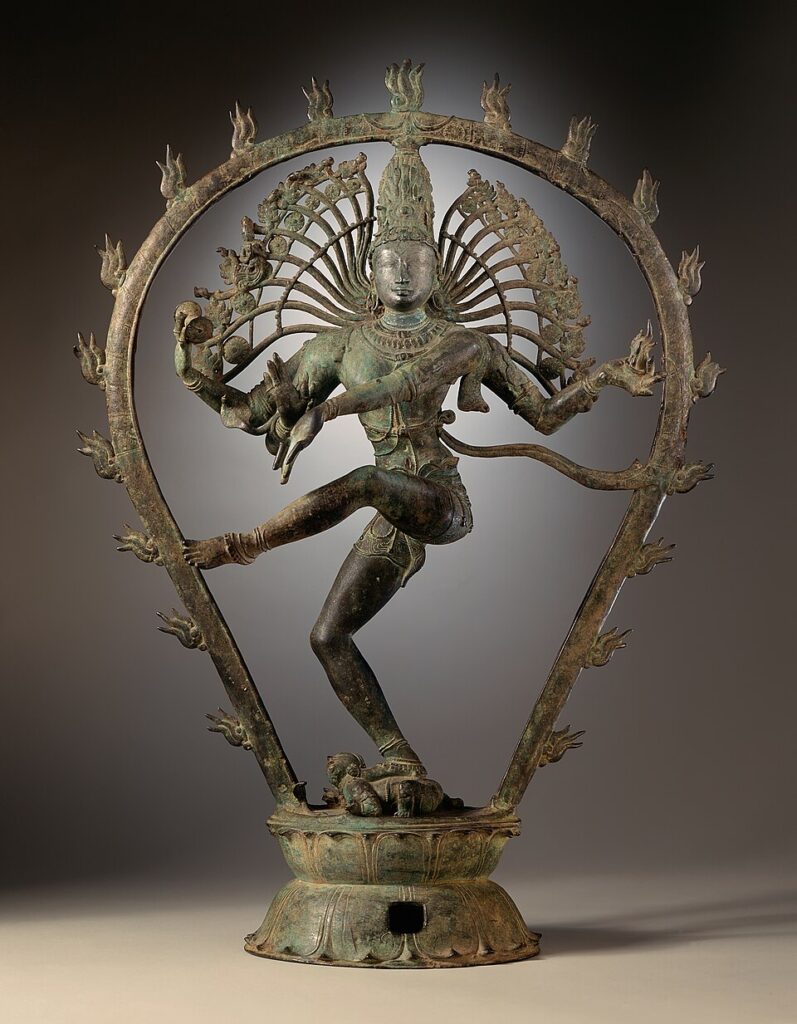
These miniatures share the space with much larger and older works: sandstone Bodhisattvas from Gandhara, bronze Shiva figures from Chola India, Javanese temple guardians carved from volcanic rock. Many of these sculptures have survived centuries of weather, war, and movement. Their presence is undeniable. But they do not explain themselves. A Shiva Nataraja dances in a ring of fire—creation and destruction joined in gesture—but unless the viewer knows the myth, the symbolism may remain opaque.
LACMA does not always resolve this opacity. Some interpretive materials are detailed; others minimal. The museum seems to rely on the object’s ability to generate its own aura, and often it does. A seated Buddha from Thailand, hands resting in dhyana mudra, radiates calm. Not sentimentality, not moralism—just stillness. One does not need to know every doctrinal nuance to feel that.
This balance between monumentality and microcosm—between the weight of stone and the delicacy of paint—is what gives this part of the museum its unique tone. It is not trying to impress. It is trying to hold time.
Fragile Beauty, Enduring Forms
One of the quiet triumphs of LACMA’s presentation of these collections is its refusal to force them into contemporary narratives. These works are not framed as rebuttals to Western art history, nor are they overloaded with present-day cultural commentary. Instead, they are allowed to exist within their own logics—religious, aesthetic, philosophical. This is increasingly rare in major museums, where the pressure to explain, contextualize, or politicize every object can become overwhelming.
That does not mean the galleries ignore complexity. Many of the works on view came from now-fragmented civilizations, shifting borders, or periods of violent upheaval. Some were excavated, others purchased through long, tangled chains of ownership. Their presence in an American museum raises questions of origin, movement, and the ethics of collecting—questions LACMA acknowledges but does not resolve on placards or walls. The approach is measured. There is no performance of guilt, no theatricality of restitution. The objects are here, and they are given space to speak.
That space matters. In the Islamic and Asian galleries, the architectural layout reinforces the content. Rooms are often small, connected by narrow corridors or rounded walls, creating a sense of internal progression. Lighting is subdued, not theatrical. There are no screens flashing text, no sound installations. The viewer must supply the silence themselves.
This restraint allows something rare to occur. A visitor might spend twenty minutes with a single object: a Jain cosmological diagram painted in mineral pigment, or a carved stele of Vishnu reclining on the serpent Ananta. In other parts of the museum, such sustained looking is almost unthinkable. Here, it becomes natural.
LACMA’s commitment to these collections—acquired over decades with little fanfare—signals something deeper than trend. It reflects a conviction that art made outside the familiar frames of Western modernism is not ancillary but central. Not because it serves a moral narrative, but because it contains its own beauty, its own order, its own gravity.
Sound, Time, Space: LACMA’s Engagement with the Immersive
Chris Burden, James Turrell, and the Art of Immensity
Some artworks are built to be looked at. Others are built to be entered. At LACMA, this second category—art that engages the full body, that unfolds over time, that takes space as seriously as subject—has grown steadily over the past two decades. This is not a matter of following trends. Rather, it reflects the museum’s recognition that certain forms of contemporary art cannot be confined to walls, frames, or quiet corners. They demand volume, scale, and a kind of architectural partnership.
Chris Burden’s Metropolis II, permanently installed on the museum’s second floor, is a controlled frenzy of miniature motion: a sprawling cityscape of highways and towers through which toy cars race on tracks at 240 scale-miles per hour. The piece activates every few minutes with a roar, as magnetic conveyor belts pull the cars to the top of their runs and release them to gravity. Visitors gather around it in anticipation, not to admire a static image but to witness a cycle—a mechanical spectacle that mirrors, satirizes, and distills the rhythm of urban life.
Burden’s earlier and more iconic Urban Light is less kinetic but just as immersive. A field of restored cast-iron streetlamps arranged in a dense grid, it is not just an artwork—it is an environment. People walk through it, pose within it, experience it not as viewers but as participants. It glows from within the city and becomes part of its memory. That LACMA chose to install it permanently outside the museum’s entrance, exposed to light, weather, and selfie culture, speaks volumes about the institution’s embrace of interaction over preservation.
Inside, James Turrell’s Light Reignfall offers a more contemplative, even unsettling immersion. Experienced by one person at a time, this enclosed sensory chamber subjects the viewer to shifting fields of colored light that affect depth perception, bodily orientation, and emotional tone. The work is rooted in Turrell’s decades-long exploration of perception, using technology and architectural control to simulate something that feels like both outer space and inner vision. It’s not a painting, not a sculpture, not a film. It’s an altered state—administered in fifteen-minute doses.
These works share little in medium, but they articulate a shared question: how does one make meaning at scale? For Burden, scale is a form of irony and excess. For Turrell, it is an opening into the sublime. For LACMA, it is a curatorial challenge—how to integrate large, immersive works into a museum ecosystem built around objects, not experiences.
Light, Sound, and the Perception of the Sublime
Immersive art often courts the language of the sublime: vastness, disorientation, sensory overload. But in a museum context, this sublime is carefully managed—installed with fire codes, time limits, and curatorial framing. LACMA’s more ambitious immersive exhibitions have often walked this line between spectacle and reflection, pushing against the limits of traditional gallery behavior while never fully abandoning institutional control.
A memorable example was the 2015 exhibition Rain Room by Random International, which attracted enormous crowds and widespread media coverage. Visitors entered a large darkened room where artificial rain fell continuously—except where their bodies disrupted it. The result was a theatrical simulation of power over nature: to walk through a downpour and remain dry. The piece was undeniably beautiful, but it also raised questions about technological awe, audience management, and the growing expectation that museums deliver experiences as much as ideas.
Sound-based installations have also played an increasingly visible role at LACMA. The museum has hosted works by sound artists like Janet Cardiff and Susan Philipsz, whose pieces blend spoken word, ambient noise, and music into environments that require slow, directional listening. These installations often occupy transitional spaces—hallways, stairwells, courtyards—making the viewer more aware of how space shapes sound, and how hearing shapes attention.
What distinguishes LACMA’s approach is its refusal to treat the immersive as novelty. The institution does not merely rent crowd-pleasing installations from digital collectives or tech brands. Instead, it pursues artists whose use of time and space is grounded in rigorous exploration—of vision, of cognition, of place. The result is a more demanding, and more rewarding, encounter.
This seriousness can unsettle visitors who expect entertainment. Unlike projection-based “immersive Van Gogh” experiences, which reduce painting to animation, LACMA’s immersive works preserve a sense of difficulty. They do not always explain themselves. They may require solitude, darkness, or physical discomfort. But they repay attention with something deeper than delight: a sense of being recalibrated.
The Challenge of Maintenance and Ephemerality
There is a quiet irony to the immersive turn in museums: the more embodied and immediate the experience, the more difficult it is to preserve. Paintings can hang for centuries with minimal intervention. But large-scale, time-based, or tech-driven installations break down. Motors fail. Lightbulbs burn out. Software becomes obsolete. The very conditions that make these works powerful also make them fragile.
LACMA has wrestled with this problem in real time. Maintaining Metropolis II, for instance, is an engineering task as much as a curatorial one. Staff monitor the piece constantly. Parts are replaced. Motion sensors adjusted. Burden’s work, though built of toy cars and aluminum, requires institutional commitment more akin to a kinetic sculpture laboratory than a traditional gallery.
The problem extends to digital and media-based works as well. A video installation by Bill Viola may rely on outdated formats or display equipment no longer manufactured. A sound piece may become inaudible due to changing acoustics or building renovations. These issues are not theoretical—they affect how and whether the art can continue to be experienced.
Museums are increasingly forced to decide whether to restore, reinterpret, or retire such pieces. LACMA has taken a largely case-by-case approach, working closely with living artists when possible and documenting installations extensively when not. But the larger question remains: how do you collect and exhibit something whose essence is not a thing, but an experience?
In this regard, the museum becomes not a vault but a steward of moments. The work cannot be stockpiled; it must be enacted. And that enactment requires planning, space, resources, and above all, attention.
Perhaps this is what gives the immersive works at LACMA their gravity. They are not permanent, but they are serious. They are not easy, but they are not gimmicks. They unfold in time, require your presence, and vanish when you leave. Like the museum itself—ever in flux, ever being rebuilt—they exist in a state of becoming.
Dining, Loitering, Watching: The Social Life of the Museum
Food as Civic Offering
Most museums treat food as an afterthought—concession stands disguised as cafés, gift-shop adjacent bistros where the coffee is overpriced and the chairs too hard. LACMA, by contrast, has long understood that eating is part of looking. The act of pausing to sit, eat, and watch becomes a continuation of the museum experience, not an interruption. At its best, the museum doesn’t just feed its visitors—it integrates them into its landscape.
The central culinary space, for many years, was Ray’s and Stark Bar, a restaurant nestled between BCAM and the main plaza. Conceived not as a tucked-away annex but as a social hub, it offered outdoor seating under shade trees, a view of Urban Light, and a menu that leaned toward Mediterranean California fare. For a time, it was one of the few museum restaurants in the country where the art crowd, the fashion crowd, and the lunch crowd collided.
The presence of a well-regarded bar at the foot of a contemporary art wing is more than a lifestyle flourish. It speaks to LACMA’s ethos: the museum as public square. Just as Urban Light blurred the line between sculpture and civic space, Ray’s blurred the line between dining and museum-going. People came to eat, to drink, to meet—sometimes without ever entering a gallery.
This openness, however, has always walked a line between accessibility and exclusivity. Prices at Ray’s were not modest. Reservations were often required. For many visitors, the museum’s food offerings felt aspirational rather than inviting. But LACMA’s leadership seemed aware of the tension. They emphasized design, comfort, and visibility—qualities that reinforced the idea of the museum as a space where culture includes pleasure, not just instruction.
During construction and COVID-related interruptions, the dining facilities have shifted. Pop-up options and food trucks have temporarily filled the gaps. Still, the idea remains: that to eat on-site is to remain within the museum’s atmosphere—not just geographically, but socially and psychologically.
Museum as Meeting Place
At LACMA, loitering is not just permitted—it is quietly encouraged. Benches are placed generously, courtyards are not cordoned off, and the outdoor areas between buildings form natural gathering points. Teenagers gather under the lights. Parents push strollers past sculpture. Elderly visitors rest in shaded spots to read or people-watch. The museum becomes a stage not only for art but for public behavior.
In this sense, LACMA functions less like a traditional museum and more like a civic plaza. It is one of the few major art institutions in the U.S. where someone might spend an entire afternoon on the premises without entering a gallery—and not feel out of place. The boundary between “visitor” and “local” begins to dissolve.
The museum’s design contributes to this effect. Its semi-permeable campus, with multiple points of entry and no singular gate, invites casual passage. A jogger might cut through the sculpture garden. A tourist might pause for a photo and end up staying for coffee. Events—film screenings, jazz nights, children’s workshops—punctuate the calendar, creating regular reasons to return that have nothing to do with a changing exhibition schedule.
This openness has not gone unnoticed by the city. For many Angelenos, LACMA is not just a museum; it is a landmark of civic rhythm. It anchors a stretch of Wilshire that includes the La Brea Tar Pits, the Academy Museum of Motion Pictures, and soon, the Wilshire/Fairfax subway stop. The entire area is in transition, and LACMA’s evolving role is part of that larger civic redefinition: from car-centric sprawl to walkable corridor, from cultural outpost to dense urban node.
Of course, this permeability also raises questions of security, ownership, and public use. Can a museum truly be a commons? Or does the presence of entry fees, surveillance, and donor branding always reassert hierarchy? LACMA doesn’t resolve these tensions, but it does accommodate them. It allows itself to be many things at once: gallery, plaza, café, shelter, spectacle.
Who Visits, and What They See
The demographics of LACMA’s audience are difficult to summarize. On any given day, the crowd might include school groups from across the city, art students sketching in corners, tourists hunting photo ops, couples on first dates, solitary locals working through lunch breaks, and neighborhood residents who come to walk, sit, and breathe. The museum’s scale and structure make it unusually hospitable to different modes of being.
This diversity is not always matched by the museum’s programming or marketing. Like many major institutions, LACMA has struggled to present itself equally to all parts of its public. Its exhibitions often cater to international audiences, art world trends, or donor expectations. And the cost of admission—while free for certain groups—remains a barrier for others. Efforts to mitigate this include “Free After 3” programs for Los Angeles County residents and a variety of community-focused initiatives, but the tension between openness and exclusivity persists.
Still, the museum’s visitors have shaped it more than any campaign. The informal choreography of movement through the campus, the way people use its spaces, the habits they form—these have become part of LACMA’s identity. It is not a building into which people are inserted. It is a fabric they help weave.
One can track the changing face of the museum through its unofficial uses:
- Skaters who practice along the smooth perimeter paths.
- Musicians who busk near the entrance after hours.
- Photographers who return weekly to document the shifting light on Levitated Mass.
None of these people are “curated,” but all are integral to the museum’s life. LACMA, perhaps more than any museum in Los Angeles, is a place where formal culture and informal culture coexist—and sometimes collide.
In the end, the social life of the museum may be its most democratic offering. Exhibitions come and go, buildings rise and fall, but the experience of being at LACMA—of sharing space, watching people, feeling time pass among objects and strangers—remains stable. It is not always art that draws people in. Sometimes it is light, music, or the smell of coffee. Sometimes it is simply the invitation to linger.
The Museum of the Future: LACMA’s Controversial Rebirth
Peter Zumthor’s Blob and the Idea of a Non-Hierarchy
LACMA is building something no other museum in the world has attempted: a continuous, elevated loop of gallery space without departments, without clear chronological order, and without traditional wings. Designed by the Swiss architect Peter Zumthor, the new building—known alternately as the David Geffen Galleries or simply “the blob”—is a sweeping, single-story structure raised on stilts, meandering across Wilshire Boulevard like a poured ribbon of concrete.
At the heart of this design is a curatorial gamble: that art should not be sorted by geography or chronology but seen across cultures, eras, and materials. The plan is to mix Islamic calligraphy with modernist abstraction, to place European painting near African sculpture, to abandon the encyclopedic model in favor of associative connections. The ambition is not just architectural, but ideological—a museum that refuses hierarchy, that asks the viewer to draw their own connections.
This idea is both radical and divisive. Advocates see it as a bold correction to the rigid, colonial-era classifications that have long structured Western museums. Opponents see it as incoherent at best, revisionist at worst. How, they ask, can a visitor understand the development of artistic traditions if those traditions are disassembled and rearranged by theme or mood? Is context being expanded—or erased?
Zumthor, whose previous buildings include minimalist chapels, spas, and museums across Europe, has built a reputation for material sensitivity and human scale. But his LACMA design marks a departure in ambition. With a projected cost of over $750 million and a total area of 347,000 square feet, it is by far the largest and most complex project of his career. The building’s continuous floorplan, hovering above ground, reflects his aversion to fragmentation. He wants viewers to move as if in a landscape—not climbing stairs, not turning corners, just flowing from one space to the next.
The result, if it succeeds, will be one of the most original museum layouts in the world. If it fails, it will be a labyrinth without logic. Either way, it will redefine LACMA—not only in physical shape, but in conceptual structure.
Demolition, Memory, and Architectural Debate
To build this future, LACMA has erased much of its past. The original 1965 Pereira buildings, despite their shortcomings, were part of Los Angeles’ mid-century civic identity. Their demolition, completed in 2020, was met with protest from preservationists, architects, and longtime visitors. For some, it marked a cultural amnesia—the destruction of history in the name of novelty. For others, it was a necessary clearing of architectural deadwood, freeing the institution from its own awkward sprawl.
Even supporters of the Zumthor project have expressed unease at the erasure. The Bing Theater, once the museum’s cultural heart, is gone. So too are the Ahmanson and Hammer buildings, with their once-familiar grid of galleries. What remains is a memory palace under construction, its contents in storage, its logic untested.
The process has been anything but smooth. Early renderings of Zumthor’s building drew criticism for its bulk and its proximity to the La Brea Tar Pits. The original dark color scheme earned it nicknames like “the inkblot” and “the oil slick.” In response to environmental concerns and donor pressure, the design was lightened and reshaped. Costs ballooned. Groundbreaking was delayed. Departments were displaced.
The current plan is for the new museum to open in late 2026, though the timeline remains fluid. In the meantime, LACMA exists in a kind of suspension—partially closed, partially present, reliant on satellite programming, traveling exhibitions, and temporary installations. For many Angelenos, the museum is no longer a place they visit, but a project they await.
This in-between status has raised larger questions about what kind of institution LACMA wants to be. Is it shedding the encyclopedic model for good? Or simply reorganizing it? Is it following a cultural logic—toward fluidity, decolonization, remixing—or creating a new form that future institutions will imitate? No one, including the leadership, seems entirely sure.
What is clear is that the project reflects a decisive break with the past. The museum is no longer additive. It is subtractive and recombinant. It does not grow by accretion, but by reinvention.
The Museum as an Ongoing Proposition
Museums, by their nature, tend to resist change. They preserve. They stabilize. They become the still point in a city’s motion. LACMA has always been an exception. It has torn itself down more often than it has expanded. It has rearranged its collections, changed its curatorial philosophies, rebuilt its campus, and recalibrated its public voice. What it has preserved is not a building or a model, but a willingness to adapt—even to the point of disorientation.
Whether this adaptation will bear fruit remains to be seen. The new building will have less gallery space than the complex it replaces. Some major donors have expressed concern over how their gifts—especially to the European and American departments—will be displayed. The idea of displaying objects across cultures may work beautifully in some cases, awkwardly in others. The museum’s ability to explain and support this experiment will determine how visitors respond.
But there is also potential. The new galleries may break habits of passive viewing. They may force fresh connections, reward wandering, challenge assumptions. They may also, simply, make the act of looking feel different. Not as a lesson in culture, but as a form of movement.
LACMA’s identity has always been hybrid: part public plaza, part encyclopedic institution, part contemporary forum, part Los Angeles myth. Its rebirth will not resolve that hybridity. It may, in fact, deepen it. The museum of the future may not look like a temple or a palace or a warehouse. It may look like a question mark stretched across a boulevard.
What is a museum in a city that reinvents itself every decade? What should be saved? What can be changed? What kind of seeing belongs to the present?
At LACMA, these questions are not theoretical. They are poured into concrete, raised above Wilshire, and left for visitors to walk through—one room, one loop, one uncertain step at a time.