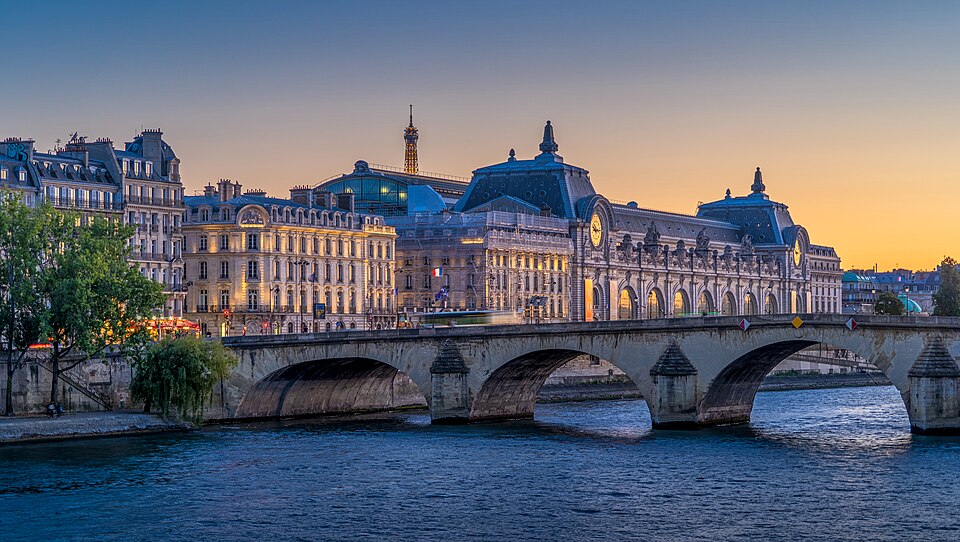
The Beaux-Arts façade and its deceptive grandeur
There is something both familiar and uncanny about arriving at the Musée d’Orsay for the first time. From across the Seine, its symmetrical stone façade, monumental clocks, and iron flourishes might suggest a grand civic palace—or perhaps a bank from the Belle Époque. But as you draw closer, the illusion fractures. This is not a palace but a ghost of infrastructure: a former railway station reimagined as a museum. And yet the deception feels appropriate. The entire 19th century, whose art fills the building’s interior, was a century preoccupied with surface, style, and reinvention.
Located on the Left Bank directly opposite the Louvre, the museum is ideally placed for a second act. It once welcomed travelers to the Gare d’Orsay, the terminus for the southwestern rail line to Orléans. Opened for the 1900 Exposition Universelle, the station was conceived as a cathedral of modernity, with its soaring iron vaults and hidden electric tracks. But by 1939, the building had already become obsolete. The platforms were too short for newer trains. For decades it fell into disuse, serving as a mail depot, a film set, even a temporary hotel for liberated prisoners after the war.
What now stands is not just a repurposed building, but a structure that has metabolized its own past. Its transformation into a museum in the 1980s—under President Valéry Giscard d’Estaing and architect Gae Aulenti—did not aim to erase its origin, but to elevate it. Today, the preserved clocks, arching ironwork, and cavernous central aisle lend a fitting theatricality to a collection that dramatizes the collapse of old regimes and the emergence of new ways of seeing.
A railway reborn: From Gare d’Orsay to art museum
The idea to convert the disused station into a museum came in the late 1970s, when the French government sought a new home for artworks that fell between the canonical periods of the Louvre and the Centre Pompidou. There was a surplus of masterpieces from the mid-19th century through the early 20th—Impressionists, Post-Impressionists, Symbolists, Realists, and others—many of them languishing in storerooms or poorly lit side galleries. The Gare d’Orsay, with its generous daylight and central location, offered both metaphor and utility. It would house the art of a transitional age in a building that was itself a relic of transformation.
The conversion was not without resistance. Purists worried that a former train station could not offer the solemnity expected of a national museum. Aulenti’s design answered by embracing the building’s contradictions. Rather than suppressing the station’s industrial bones, she underscored them—turning the central nave into a dramatic exhibition hall, echoing the salon-style hanging methods of the era, but opening up the space to light and motion. The layout is intuitive but not entirely linear, inviting the visitor to explore chronologies but also to wander.
Upon entering, the initial impression is one of openness. The glass and iron barrel vault above, measuring over 30 meters high, diffuses natural light with a softness that flatters the painted surface. Sculptures populate the central aisle like silent travelers waiting for trains that will never arrive. The interplay between the industrial and the exquisite sets the tone: art here is not a relic to be entombed, but a product of movement, labor, risk, and speed.
Planning your entry: Lines, tickets, and smart timing
Despite its elegance and contemplative atmosphere, the Musée d’Orsay is no secret. It draws millions each year—second only to the Louvre among Parisian museums. Planning ahead is essential if you want to experience it with any degree of quiet. Entry lines, particularly in high season (May through September), can stretch down the esplanade by mid-morning. Pre-booking online is strongly advised, ideally for an early morning or late afternoon slot.
There are two main entrances: Entrance A for individual visitors without advance tickets, and Entrance C for those with timed tickets, museum pass holders, or members. Unless you enjoy standing in queues for their own sake, aim for Entrance C. Visitors under 26 from the EU enter free, and the first Sunday of each month is free for everyone—though crowds swell accordingly. The museum is closed on Mondays, a holdover from older academic rhythms.
If you’re seeking relative quiet, arrive around 9:15 am, shortly after doors open. The central hall is most tranquil in the first hour. Alternatively, the late Thursday evening opening (until 9:45 pm) offers a more meditative experience, especially in the side galleries, where light grows theatrical as it fades. Be warned, though: the museum enforces a firm exit at closing, with docents gently but steadily herding visitors out before the clocks strike.
Those unfamiliar with French museum etiquette should know: photography is allowed (without flash), backpacks must be worn on the front or stored, and while the guards are friendly, they are watchful. Speak softly, move slowly, and don’t bring food or water into the galleries. The atmosphere invites reflection—if you let it.
Visitors often rush to the fifth floor, where the major Impressionists hang, but lingering downstairs offers unexpected rewards. The ground-level sculpture court, with its Rousseau-esque jungle animals and allegorical nudes, presents one of the most visually satisfying introductions to the museum’s mission: to chronicle a century that refused to remain still. And it’s here, even before you’ve climbed a staircase, that the past begins to press up against the present—not in silence, but in motion.
A Building with Memory: Architecture as Experience
The iron-and-glass cathedral of light
The Musée d’Orsay does not merely contain art—it stages it. Unlike the subdued hush of the Louvre’s stone corridors or the white-cube abstraction of the Centre Pompidou, the Orsay invites you into a space where light, height, and history conspire to frame everything you see. The building itself is a primary object in the collection, and its architectural presence shapes how visitors move, look, and feel. The structure—once a Beaux-Arts train station completed just in time for the 1900 World’s Fair—still bears the marks of speed and spectacle, but now slows the body and stills the gaze.
The central nave stretches like a great iron ribcage, echoing the industrial ambitions of its origin while softening them with the golden aura of filtered daylight. During the station’s original use, this vaulted hall was crowded with travelers, porters, and the shriek of steam engines. Now it is silent but never lifeless. The natural light that once helped passengers read their train schedules now reveals the marble curve of a statue’s back, or the exact shade of blue in a Cézanne sky.
From almost any vantage point, the building asserts itself. Whether standing on the upper terrace looking down into the main hall, or tracing the sinuous balconies that run along each side, one sees art placed not against neutrality but against architectural drama. Sculptures are arranged like figures in a civic procession. Paintings line the walls of former waiting rooms. The symmetry of the building—the inheritance of its Beaux-Arts bones—gives the experience an odd kind of rhythm, as if the eye is expected to march rather than wander. And yet there’s something deeply humane about it. The proportions are generous but not overwhelming, the materials refined but not precious. Visitors find themselves alternately dwarfed and embraced.
Aulenti’s renovation in the 1980s honored this dual identity. Rather than stripping the structure of its past, she elevated it into a kind of historical theater. Her additions—mildly postmodern, rigorously textured—never try to compete with the building’s own vocabulary. Instead, they offer contrast: limestone, steel, dark wood, velvet gray. The result is a conversation between periods, just like the museum’s collection. Walking through the Orsay is not merely chronological; it is experiential, layered, and unexpectedly cinematic.
Choices of preservation: What the architects kept—and what they invented
The transformation of the Gare d’Orsay into a museum could easily have followed a path of erasure. Brutalist intervention or minimalist insertions were both in vogue at the time. But instead, Aulenti and her collaborators made selective decisions to preserve certain original elements, embellish others, and invent anew where needed.
Three choices in particular define the museum’s current atmosphere:
- The grand station clocks—particularly the one in the upper-level café—were not just kept but restored and framed as aesthetic events in themselves. They remind the visitor, again and again, of time as a subject: historical time, painterly time, and the moment of the gaze.
- The glass canopy overhead, which originally sheltered steam trains from the rain, was preserved to pour light into the galleries below. Where other museums control lighting with cold precision, the Orsay uses light expressively, allowing shadows and seasons to shift the viewing experience.
- The central aisle was left open and unpartitioned, an unusual choice in museum design. Rather than corralling visitors into single-file circuits, the architects offered a kind of plaza: a space for sculpture, for stasis, and for pause. It feels more like a forum than a corridor.
Some critics objected to Aulenti’s interventions at the time. Her tiered exhibition spaces, with their dark platforms and stone cubicles, were described by one architectural historian as “a mausoleum of ideas.” But time has proven kinder. The museum’s structure, like its contents, has weathered the decades with grace. It does not vanish in service of the art—it joins in.
One telling example is the positioning of Jean-Baptiste Carpeaux’s La Danse near the sculpture court. Originally created for the façade of the Paris Opera, the piece dances anew under Orsay’s glass sky. Its kinetic exuberance is amplified by the space around it, which catches and repeats the rhythm of raised limbs and twisting forms. The building doesn’t merely house the sculpture—it completes it.
How the layout guides the eye (and the feet)
Unlike many encyclopedic museums, the Orsay does not attempt an exhaustive display. It does not stretch across centuries or civilizations. Instead, it focuses tightly on a pivotal era—roughly 1848 to 1914—and uses its architecture to structure that focus.
The museum unfolds across multiple levels, but the experience is more vertical than it first appears. The main aisle grounds the visit, offering sculptures and monumental works. From there, visitors move upward to the galleries where painting dominates. The fifth floor houses the core of the Impressionist collection—Monet, Renoir, Sisley, Pissarro—arrayed in rooms with controlled lighting and hushed tones. These rooms are not neutral; their architecture mirrors the art’s aesthetic of clarity and air.
A side passage brings you to works by Berthe Morisot, where the domestic interiors she painted reflect back the museum’s own layered intimacy. In one small gallery, you might catch a canvas by Eva Gonzalès, whose luminous touch and compressed compositions find an uncanny echo in the surrounding space: the long lines of the ironwork, the cool stone panels, the sudden bloom of color on a wall.
Elsewhere, the layout encourages indirect movement. Narrow staircases, mezzanine lookouts, and intimate alcoves reward curiosity. A visitor might ascend from a somber room of Symbolist works—thick with shadow and allegory—only to emerge into the high sunlit galleries of Post-Impressionism, where Van Gogh’s spiraling brushwork pulses under daylight.
This spatial choreography reflects the curators’ intent: to let the building guide the visitor through a psychological as well as historical journey. The museum begins in the certainties of Academic classicism, and ends—quite literally—in abstraction and fragmentation. The structure serves that narrative without spelling it out.
There are moments when the visitor feels gently manipulated, as if the building knows when to hush the crowd or coax them forward. One enters a gallery from the side rather than head-on. A bench appears at just the right distance for contemplation. A sculpture is lit not from above but from behind, casting its shadow on a neighboring canvas. None of this is accidental.
In this sense, the Orsay is more than a museum of 19th-century art. It is a continuation of that art’s ambitions. Like the works it displays, the building seeks to shape how you perceive the world—not through shock or spectacle, but through structure, light, and the slow unfolding of form.
Before the Impressionists: Academic Titans and Realist Rebels
David, Ingres, and the lingering power of neoclassicism
To understand the revolution that Impressionism would eventually ignite, one must begin in the long shadow of neoclassicism. At the start of the 19th century, history painting still reigned as the highest genre in the academic hierarchy. The École des Beaux-Arts and the state-sponsored Salons promoted a visual language of moral clarity, idealized form, and carefully orchestrated composition. In these paintings, ancient Rome and Napoleonic France often appeared indistinguishable: each a backdrop for allegory, authority, and control.
Jacques-Louis David, though born in the 18th century, looms over the early galleries of the Musée d’Orsay as the architect of this visual regime. His works—including The Death of Socrates and The Intervention of the Sabine Women—are not on display here (they remain in the Louvre), but his influence is everywhere. Ingres, David’s spiritual successor and a dominant figure in Orsay’s early-19th-century holdings, brought an icy perfection to the classical model. His portraits—such as Madame Moitessier—are less depictions of people than studies in restraint. Smooth surfaces, porcelain flesh, implausible anatomy: Ingres painted a world purified of accident.
And yet even in Ingres’s most formal works, a fracture is visible. The faces may be idealized, but the eyes often betray a cooler, more contemporary awareness. There is calculation in these women, elegance edged with unease. The society Ingres painted was no longer unified by shared myths or singular narratives. By the 1830s, France had entered a period of political instability and cultural self-doubt, and neoclassicism, once a language of certainty, began to feel brittle.
This crack in the edifice would soon widen.
Gustave Courbet’s scandalous realism
Few artists at the Orsay rupture the space around their work as powerfully as Gustave Courbet. His canvases are heavy, large, and unapologetically coarse—both materially and thematically. When The Burial at Ornans was first exhibited in 1850–51, it was met with outrage. Here was a provincial funeral, rendered on a scale previously reserved for biblical epics. There were no divine interventions, no uplifted souls, just a huddle of farmers and townspeople, painted with unsentimental precision, presiding over a grave dug into cold, French soil.
Courbet’s realism was not just stylistic; it was ideological. He rejected allegory, scorned idealization, and made it his mission to paint “the real, the visible, the tangible.” In works like The Stone Breakers (destroyed during World War II but remembered here through sketches and context), he depicted labor without heroism—just the grind of daily survival. The brushwork is tactile, the colors raw. There is nothing romantic in Courbet’s peasants. They do not stand for something. They simply stand.
One of Courbet’s most infamous works, The Origin of the World, now occupies a discreet room behind a curtain at the Orsay. This explicit portrayal of a woman’s genitals, painted in 1866 and hidden from public view for more than a century, is both jarring and strangely clinical. Courbet renders flesh without metaphor, without coyness. Yet the work’s transgressive power lies not in its eroticism, but in its refusal to flinch. In a museum once a train station, where so much art stages arrival or departure, The Origin insists on the irreducible fact of being.
His radicalism did not exist in isolation. Courbet paved the way for an entire generation of artists who rejected academic protocol. He influenced not just his contemporaries, but younger painters who would carry realism into new terrain—like Jean-François Millet, Édouard Manet, and even the Impressionists he once scorned.
Jean-François Millet and the dignity of the rural poor
Millet occupies an unusual place in the Orsay’s early galleries: a painter of peasants, revered by socialists and conservatives alike. His best-known works—The Gleaners, The Angelus—elevate the rituals of agricultural life into scenes of hushed solemnity. Unlike Courbet, Millet was not a provocateur. His peasants are not brutes or martyrs, but figures imbued with a kind of tragic dignity. He painted them not as symbols, but as inheritors of time: bent under the same sky that hung over classical shepherds and biblical prophets.
His palette is muted—ochres, browns, dusty greens—and his compositions spare. In The Gleaners, three women crouch to collect leftover grain, their backs bent in a rhythm that mirrors the lines of the earth behind them. In the distance, haystacks gleam golden in the light, while a foreman rides away on horseback. The social structure is visible but unstated. What Millet gives us is not protest but atmosphere, not accusation but memory.
And yet the political reading was inevitable. In the revolutionary atmosphere of 1848 and the decades following, paintings of peasants acquired meaning beyond their formal content. Critics accused Millet of socialist leanings, though he denied it. What is undeniable is his sympathy: a sense that these lives—so often excluded from the salons and academies—deserved a scale and seriousness once reserved for gods and kings.
Millet’s influence was wide. Vincent van Gogh revered him, writing in letters of his deep admiration for Millet’s “entirely sincere art.” But it’s also in contemporary Paris that his impact can be felt: in the way the Orsay juxtaposes his work with later Symbolist explorations of toil and melancholy. One sees a thread of feeling—human, earthbound, and unresolved—that continues to tug at the century’s aesthetic ambitions.
The Rise of Light: How Impressionism Transformed Painting
Monet’s serial vision and the shimmering surface
When Claude Monet’s Impression, Sunrise appeared at the 1874 exhibition of the Société Anonyme des Artistes, it gave a name—derisively at first—to a movement that would unravel centuries of academic tradition. The painting, a loose, glowing sketch of Le Havre’s harbor at dawn, seemed unfinished to many viewers. The brushwork was quick, the forms indistinct, the palette cool and ephemeral. But Monet’s aim was never completion in the classical sense. He wanted to capture not what the eye saw, but what it perceived—moment to moment, light to light.
The Musée d’Orsay preserves this impulse across an extraordinary suite of works, from early riverscapes to the late studies of Rouen Cathedral and the Houses of Parliament. Monet’s canvases rarely stand still. Even his domestic scenes, like The Lunch or Camille Monet on a Garden Bench, seem more concerned with atmosphere than narrative. Shadows shift, flowers dissolve into dabs, and time feels suspended—not stopped, but stilled in the act of moving.
Among the most captivating pieces in the Orsay’s Impressionist wing is The Magpie (1868–69), painted during a harsh winter in Normandy. At first glance, it appears almost monochrome: a snow-blanketed field with a single black magpie perched on a gate. But step closer and color begins to emerge—pinks in the snowdrifts, gold in the sky, blue shadows across the fence. Here, Monet gives snow the same attention he once gave to water: a surface that absorbs and reflects light, shaped less by form than by sensation.
Monet’s serial paintings—of haystacks, poplars, water lilies—pushed this logic to its limit. By painting the same subject at different times of day and in different seasons, he turned painting into a form of temporal observation. These canvases do not describe a landscape. They describe how that landscape changes, how light edits reality with every passing hour.
In this way, Monet turned the canvas into a kind of screen—not a window onto a stable world, but a surface where nature and consciousness flicker together.
Degas behind the scenes: Ballet, bathing, and surveillance
Where Monet celebrated the exterior world in flux, Edgar Degas turned his gaze inward—to interiors, to bodies, to moments of pause. Yet his work, no less than Monet’s, is obsessed with movement. His dancers bend and twist in awkward rehearsals. His bathers crouch, stretch, and clean themselves with unceremonious gestures. Nothing is composed in the grand tradition. Everything is partial, cropped, glimpsed.
Degas—more studio-bound than his plein air peers—was a master of the fragment. Influenced by photography and Japanese prints, he frequently placed his subjects off-center or partially obscured, their limbs cut by the edge of the frame. In The Ballet Class, the viewer is not granted the best seat in the house but rather hovers like a chaperone or an intruder, watching as the girls rest, fidget, and wait. The focus is not on performance but preparation. Not the show, but the effort behind it.
There is a tension in these images—between intimacy and detachment, observation and intrusion. Degas often maintained that he preferred to portray women “as animals,” by which he meant without narrative or idealization. And yet in works like Woman Combing Her Hair or After the Bath, the effect is less voyeuristic than strangely forensic. These are not eroticized nudes. They are humans engaged in necessary, private acts. The brushwork is dry, the palette cool, the mood detached.
His techniques reinforced this distance. Degas worked frequently in pastel, a medium that allowed for both precision and looseness. In his later years, he layered color onto abrasive surfaces, creating textures that seem at once raw and airy. The result is a body of work that resists emotional resolution. Where Monet offers comfort in repetition, Degas offers unease in isolation.
And yet, within this detachment lies an extraordinary empathy—not for individual characters, but for the human condition itself. For the body as task. For the self as observer and observed. In this, Degas remains profoundly modern.
Renoir’s pursuit of pleasure
If Monet gave Impressionism its light, and Degas its edge, Pierre-Auguste Renoir gave it flesh. His paintings revel in softness: of skin, of fabric, of light filtered through leaves. Where Courbet once shocked with coarse realism, Renoir seduced with sunlit reverie. And yet his art, often dismissed as merely pretty, possesses a technical and psychological subtlety that rewards close looking.
Bal du Moulin de la Galette, one of the Orsay’s star attractions, is often described in terms of joy: a crowd of working-class Parisians dancing under dappled light, laughter on their faces, couples lost in flirtation. But beneath the surface, there is a careful structure. The composition spirals subtly, guiding the eye from figure to figure, never letting it rest. The interplay of shadow and color is anything but random. The illusion of spontaneity is, in fact, choreographed.
Renoir’s women—rosy, relaxed, rounded—are often treated by critics as interchangeable muses. But some of his most interesting portraits reveal a more individualized gaze. In Portrait of Madame Georges Charpentier, the sitter appears poised, intelligent, fashionable—and surrounded by signs of her influence: children, drapery, floral arrangements. This is not mere beauty. It is composure as statement.
Even so, Renoir often slipped into a visual vocabulary of ease. After the 1880s, his brushwork tightened, and his figures became more classical, almost sculptural. He had fallen under the sway of Renaissance art, particularly Raphael, and abandoned some of the shimmer that defined his earlier works. This change alienated some of his fellow Impressionists, but for Renoir, the body—especially the female body—remained central to painting. Not as subject alone, but as a problem of form, volume, and light.
Renoir’s commitment to pleasure should not be mistaken for naivety. In a century marked by revolution, war, and ideological fracture, his insistence on beauty could be seen as resistance—or perhaps retreat. But the sensuality of his work is never careless. It is built, not wished. Structured, not escaped.
And in the museum today, amid the harder edges of Courbet or the inwardness of Degas, Renoir’s canvases offer a counterpoint: not to deny the real, but to redeem it through sensation.
Post-Impressionism and the Birth of Modernism
Van Gogh’s torment and breakthrough
There is a perceptible shift in energy as one moves into the Post-Impressionist galleries of the Musée d’Orsay. The palette thickens, the brushwork grows urgent, and the tranquil light of Monet’s world begins to fragment into something more interior and volatile. Nowhere is this transition more dramatic than in the work of Vincent van Gogh.
Van Gogh arrived late to painting and lived most of his working life in obscurity. Yet the Orsay’s collection reveals how quickly—and violently—his style evolved. Early canvases like The Potato Eaters (housed elsewhere) show his roots in Dutch realism, but the pieces on display in Paris are the product of feverish transformation. Bedroom in Arles, Portrait of Dr. Gachet, and Starry Night Over the Rhône—each one testifies to a man possessed by both vision and instability.
In Starry Night Over the Rhône, color is no longer a descriptive tool but an expressive force. The water glows with unnatural golds and greens; the sky pulses with blue halos around each star. Perspective becomes subjective, and brushstrokes function more like nerves than lines. Van Gogh’s world does not sit still—it trembles, sways, and breathes.
There’s a quiet tragedy beneath the surface of these works. Created during periods of mental collapse, institutionalization, and isolation, they reflect a painter whose internal state shaped every mark. And yet Van Gogh was no outsider artist; he was deeply engaged with artistic theory, Japanese prints, and the legacy of Delacroix. His letters to his brother Theo contain rigorous discussions of composition and color, ambition and failure.
What the Orsay’s display clarifies is that Van Gogh’s modernism was not a break from tradition, but an intensification. He carried the Impressionist concern for perception into the realm of emotion, where color and form mirrored the psyche rather than the eye. His legacy was not simply expressive—it was prophetic. Modernism would follow where his brush led.
Gauguin, exoticism, and myth
If Van Gogh was the anguished visionary, Paul Gauguin was the mythmaker. Restless, calculating, and often self-dramatizing, Gauguin rejected bourgeois France in favor of what he imagined to be purer, more elemental ways of life. His journeys to Brittany, Martinique, and Tahiti were not merely geographic—they were aesthetic quests, fueled by a desire to strip away the conventions of European painting.
At the Orsay, his canvases radiate strangeness. Where Do We Come From? What Are We? Where Are We Going? dominates the room with its scale and allegorical sprawl. Nude figures recline and reach under banana leaves. A blue idol stares with blank serenity. Time collapses—infancy, adulthood, and death coexist in a single continuous space. Yet the colors are rich, even intoxicating: ochres, violets, jungle greens. The brushwork is smoother than Van Gogh’s, but no less charged.
Gauguin’s use of “primitive” imagery—borrowed or invented—has prompted rightful scrutiny. His depictions of Tahitian women reflect not just fantasy but power, filtered through a colonial lens. The Orsay’s curators walk a careful line: acknowledging the beauty and innovation of his work while resisting uncritical celebration. Wall texts now contextualize the ethical complexities of Gauguin’s travels, relationships, and representations.
And yet his influence on modern art is undeniable. Gauguin flattened space, distorted proportion, and subordinated naturalism to idea. He showed that painting could be symbolic rather than observational, decorative rather than mimetic. Matisse, Picasso, and the Nabis all followed this path. So did Paula Modersohn-Becker and Emil Nolde. If Gauguin’s art is troubled, it is also foundational.
In a museum so concerned with continuity, Gauguin stands out as an agent of rupture. His paintings feel less like reflections of a moment than declarations of an invented world. Not the world as it is, but as he willed it to be—for better and worse.
Seurat and Signac’s dots of logic
In a room not far from Van Gogh’s swirling cosmos, Georges Seurat’s The Circus hangs with eerie precision. The painting is unfinished—he died at 31—but its structure is rigorous, almost mathematical. Every curve, every color patch, has been plotted in accordance with a theory of optical harmony. Seurat believed that color and form could be systematized, that emotion could emerge from order.
His method—Pointillism—was based on science. Small dots of pure color are placed side by side, meant to blend in the viewer’s eye. The result is both vibratory and static, like an animation paused mid-motion. A Sunday Afternoon on the Island of La Grande Jatte (in Chicago, but well represented in studies and sketches here) remains the best-known example. But The Circus shows a bolder, more abstract impulse: figures become silhouettes, space becomes pattern, and time seems suspended.
Paul Signac, Seurat’s disciple and co-theorist, carried the technique into more decorative terrain. His coastal scenes—on view at the Orsay in luminous blues and purples—combine scientific detachment with a kind of dreamy lyricism. The dots dissolve into haze. His sailboats seem less concerned with water than with wavelength.
What’s remarkable is how quickly Pointillism receded from the center of modern art. It was too slow, too laborious, too bound by theory. But its implications lingered. The Fauves would explode color entirely. The Cubists would deconstruct form. Yet both inherited something from Seurat: the sense that painting could be analytical and emotional at once.
The Orsay’s Post-Impressionist rooms do not simply mark the end of an era. They announce a beginning. Here, painting detaches from natural light and moves toward the mind. The canvas becomes a field of invention, no longer beholden to sight alone. A generation of painters stepped away from the window and into abstraction—not yet fully, but decisively.
Sculpture in the Age of Change
Rodin’s movement in marble
In a museum largely known for the optical experiments of the Impressionists and Post-Impressionists, the sculptural collection of the Musée d’Orsay offers a different—but equally radical—approach to 19th-century art. Here, motion is not captured through brushstroke or broken color, but through the contortion of bronze, the heaving of plaster, the suggestion of weight and breath in stone. Chief among these efforts is Auguste Rodin, whose works appear at the Orsay less as monuments than as living organisms—figures that twitch, twist, and remember.
Rodin’s arrival in the art world was anything but smooth. His early submissions were repeatedly rejected by the Salon, dismissed for lacking finish. The Age of Bronze, one of his first major successes, was so lifelike that critics accused him of casting it directly from a model. In fact, Rodin had simply looked harder—and sculpted differently—than anyone expected. His figures did not pose in idealized stillness. They shifted, slumped, and strained. Muscles clung to bone, flesh folded with gravity.
At the Orsay, The Thinker and The Kiss are represented not in their polished, public versions, but in casts and maquettes that reveal the experimental underpinnings of Rodin’s process. Particularly revealing is The Gates of Hell, a vast portal crawling with tormented figures, originally conceived for a decorative arts museum that was never built. Rodin worked on it for decades, treating it as both a narrative and a laboratory. Many of his most famous figures began life here—The Thinker, The Three Shades, Ugolino and His Sons. They are less illustrations of Dante than embodiments of internal crisis.
Rodin’s surfaces pulse with texture. He allowed imperfections to remain visible, hands rough and faces fragmented. This was not negligence, but intent: a sculptural equivalent to the broken brushwork of his painter contemporaries. The goal was not to idealize but to activate. In The Walking Man, a headless, armless torso strides forward with uncanny energy. It is incomplete, yet more vivid than many finished statues.
Rodin brought sculpture back to life—but he did so by abandoning much of what had once made it noble.
Carpeaux, Claudel, and the human form in conflict
Before Rodin, and often in conversation with him, sculptors such as Jean-Baptiste Carpeaux and Camille Claudel helped redefine the emotional and narrative range of the medium. Their works—some heroic, some intimate, many unsettling—populate the Orsay’s sculpture gallery with a human drama that resists classical containment.
Carpeaux, a generation older than Rodin, had already begun to loosen the grip of neoclassicism. His Ugolino and His Sons (also seen in Rodin’s Gates) shows a desperate, starving father surrounded by his children in a tangle of limbs and agony. The composition breaks the smooth symmetry of academic form, replacing it with physical and moral anguish. In The Dance, originally commissioned for the Paris Opera, Carpeaux’s figures whirl and strain in a near-chaotic ecstasy, baring teeth and flesh in a manner deemed indecent at the time. The tension between vitality and vulgarity runs through all his work.
Claudel, a student and sometime lover of Rodin, brought a different sensibility—at once more refined and more psychologically acute. Her sculptures at the Orsay are fewer in number but deeply affecting. The Waltz, with its entwined lovers wrapped in drapery, balances eroticism and grace. The Age of Maturity, her masterpiece, depicts an allegorical struggle: a youthful female figure reaching desperately for a man being pulled away by an older, spectral woman. The emotional complexity—love, betrayal, renunciation—is unmistakable.
Claudel’s career was overshadowed by Rodin’s, both during her life and after. But her work has gained renewed recognition, not as a derivative of his, but as a parallel investigation into vulnerability, motion, and form. Where Rodin often monumentalized despair, Claudel sculpted its moments of stillness.
The museum’s decision to present their works near one another—not merged, but in proximity—allows visitors to trace both divergence and affinity. Claudel’s hands are more delicate, her gestures more interior. Carpeaux, by contrast, moves between violence and exhilaration with theatrical verve. Together, they remind us that sculpture in the 19th century was not frozen tradition—it was a crucible of human feeling.
Monumentality and modernity in bronze
The Orsay’s sculpture collection does not end with the emotive work of Rodin and Claudel. Throughout the galleries, one encounters a wide spectrum of sculptural aims—some commemorative, some symbolic, some decorative. Many were originally destined for public plazas, palaces, or cemeteries. Here, removed from context, they gather into a different kind of city: one shaped by gesture, surface, and suggestion.
Bronze, the medium of choice for many sculptors of the time, allowed for both repetition and experimentation. Artists such as Emmanuel Frémiet used it to create naturalistic animals with uncanny presence—his gorilla carrying off a woman is more Gothic than zoological. Emmanuel Villanis sculpted female figures with sensual abstraction, merging Art Nouveau aesthetics with Symbolist motifs. Jules Dalou, a committed Republican, used sculpture as a political instrument, crafting public monuments to labor and education that celebrated civic virtue in muscular form.
Not all these works were radical. Many adhered to the academic standards of the École des Beaux-Arts. But even here, subtle ruptures appear: a tilt of the head that breaks symmetry, a textured surface that refuses polish. The old hierarchies of genre were beginning to dissolve.
And it’s not only French sculpture that fills the Orsay. Pieces from Belgium, Italy, and Germany appear in dialogue with their Parisian counterparts, revealing a Europe-wide search for new visual languages. The museum wisely includes lesser-known figures alongside canonical names, allowing for discovery rather than dictation.
What unites these sculptors—regardless of fame or style—is a shared urgency to represent the body not as emblem, but as experience. The strain of muscle, the sag of grief, the clasp of an embrace: these are the moments that anchor the collection. Sculpture at the Orsay does not ask to be admired from a distance. It asks to be approached, walked around, inhabited.
Unlike painting, which plays with illusion, sculpture insists on the real: on gravity, texture, volume. And in the age of railroads, revolutions, and ruptured empires, the need to ground feeling in form became not just an artistic choice—but a necessity.
Beyond the Easel: Decorative Arts and Design
Art Nouveau interiors and organic ornament
At the edge of the Musée d’Orsay’s painting and sculpture wings, a quieter, more enveloping world begins to unfold. Step through a discreet threshold and you enter rooms furnished not with canvases, but with total environments: dining rooms, salons, and private studies conceived not as collections of objects, but as coherent, living spaces. This is the world of Art Nouveau, and in it, the boundaries between architecture, furniture, sculpture, and painting dissolve.
Art Nouveau arose in the 1890s as both a rebellion against academic historicism and a response to industrial alienation. Its advocates sought not to replicate the past, but to craft something organic, immersive, and sensuous. In these Orsay rooms, the style blooms with rhythmic curvature—whiplash lines, blooming flowers, and undulating woodwork. Chairs mimic tendrils. Banisters seem to grow. The materials—walnut, wrought iron, enamel, stained glass—carry the fluidity of natural forms into domestic life.
One of the highlights is the reconstructed Dining Room of the Hôtel Guimard, designed by Hector Guimard for his own Parisian home. Guimard, best known for his cast-iron entrances to the Paris Métro, here turned his talent for visual rhythm inward. The chairs and table curve toward one another with subtle anthropomorphism, as if designed for an invented species with impeccable taste. Every joint, every panel, every hinge has been considered—not ornamented after the fact, but born from the form itself.
In an adjacent room, Henry van de Velde’s desk and armchair set stands in contrast: more austere, yet no less integrated. Van de Velde rejected clutter and eclecticism in favor of harmony, proportion, and tactile grace. His work exemplifies the ideal of the Gesamtkunstwerk—the “total work of art”—where every element of an interior contributes to a unified aesthetic experience.
Art Nouveau was not merely a style. It was a vision of life in which beauty, function, and material were inseparable. And in these preserved environments, the museum invites not just viewing, but immersion.
Furniture, jewelry, and the Gesamtkunstwerk
While much of the Orsay dazzles with large-scale drama, the decorative arts galleries demand intimacy. Here, the radicalism lies in detail: a sinuous inlay on a cabinet, the curve of a chair leg, the shimmer of a translucent brooch. These objects do not cry out for attention. They invite a kind of visual whispering—a slower, more attentive way of looking.
Émile Gallé, one of the most inventive figures of the Art Nouveau movement, saw no distinction between a table and a poem. His cabinets—some of which are held at the Orsay—are marquetry dreams: butterflies, reeds, orchids, and water motifs rendered in layered wood veneers. Their surfaces are not just decorative but allegorical. One sideboard depicts dragonflies hovering above lilies, the legs twisting like stalks. Gallé often included inscriptions, etched in microscopic script, drawing from literature and botany.
In the realm of jewelry and objets d’art, the Orsay offers works by René Lalique and Lucien Gaillard that combine metallurgy and myth. Lalique’s pieces—particularly his dragonfly-woman corsage ornament—blend enamel, horn, and gemstones into luminous hybrids. These are not passive accessories but wearable sculptures. They shimmer with fantasy and latent violence, as if plucked from a dream just before it turned sour.
Even the glassware, seemingly delicate, reflects technical daring. Gallé’s cameo glass vases, with their layers of acid-etched color, change depending on the angle of light. The medium’s fragility enhances its mystery: each piece is a vessel of labor and risk, beauty and breakage.
What these objects share is an ethic of integration. They do not serve art for art’s sake, nor function for function’s sake. They live in the space between. Art Nouveau’s ideal was not to elevate the decorative to the level of fine art—but to dissolve the distinction altogether. And in these rooms, that vision feels not just plausible but necessary.
Gallé and Lalique’s experiments in glass
Glass, more than any other material in the Orsay’s decorative arts wing, captures the tension between utility and illusion. Translucent, fragile, alchemical—glass resists certainty. In the hands of Émile Gallé and René Lalique, it became not merely a medium, but a message.
Gallé approached glass as a botanical medium. His forms borrow from seed pods, ginkgo leaves, and aquatic flora. Through acid-etching, casing, and enameling, he coaxed from each vessel a layered symbolism. One vase may suggest a late summer twilight; another, the decay of autumn. Some are tinged with melancholy—flowers drooping, colors deepening toward dusk. In these pieces, light is not decoration—it is meaning.
Lalique, more theatrical in temperament, leaned toward figuration and fantasy. His glass works often incorporate female figures, insects, and wings, fused in otherworldly combinations. While Gallé sought inspiration in the swamp and the meadow, Lalique aimed for the dream and the myth. His Suzanne vase—figures pressed in pale relief against a milky ground—evokes both classical calm and erotic tension.
Both artists used new technologies to expand old forms. Gallé’s multi-layered cameo glass involved repeated firing and carving. Lalique pioneered mold-blown glass, allowing for greater control of detail and replication. But neither embraced mass production. Each object, even if reproducible, was treated as unique.
The museum’s lighting of these works is deliberate. Spotlights catch iridescence, throw shadows, reveal the fluidity of each curve. Unlike the great oil paintings of the Orsay, which demand frontality and scale, the glasswork encourages movement—circling, peering, returning. It is not the image that matters, but the encounter.
In a century defined by factories and revolutions, these objects seem almost anachronistic—artifacts of pleasure, introspection, and private life. But they are no less modern for it. They represent a wager: that beauty can exist in daily things, and that a vase or a necklace might offer not escape, but engagement.
A New Way of Seeing: Photography and the 19th Century
Nadar and the early pioneers
When Félix Nadar ascended in a balloon over Paris with a clunky camera apparatus in the 1850s, he wasn’t merely staging a publicity stunt—though he loved those. He was mapping out the future of vision. Photography, still in its infancy, was transforming not only how people saw the world, but how they expected the world to be seen. At the Musée d’Orsay, a compact but revealing series of rooms tracks this evolution: from the earliest daguerreotypes to the atmospheric pictorialism of the fin de siècle. These images, often overlooked by hurried visitors, constitute one of the museum’s most quietly radical zones.
Nadar’s portraits anchor the experience. Known as the most flamboyant of the early Parisian photographers, he produced stark, psychologically charged likenesses of figures such as Baudelaire, Sarah Bernhardt, Gustave Doré, and Delacroix. Unlike the formal painted portraits of the Salon, Nadar’s images were stripped of allegory. He used a plain backdrop and subtle lighting to emphasize gesture, gaze, and attitude. What mattered was not idealization, but presence. In one of his most iconic portraits, the novelist George Sand looks calmly at the camera, her face lined and unsmiling, her intelligence unconcealed.
Nadar’s studio became a hub of bohemian and intellectual life, but his contributions weren’t limited to portraiture. He was the first to photograph Paris from the air and ventured into the catacombs with artificial light to document the city’s underground. These experiments were technical feats, yes, but also provocations: proof that the world could be captured from previously unimaginable perspectives.
What distinguished early photography was not just its fidelity to the visible world, but its claim to truth. It collapsed the distance between art and document, between portrait and record. For some, it promised democratic access to self-representation. For others—particularly academic painters—it was a threat. The camera could outpace the brush, but it also challenged the idea that beauty needed to be constructed. Suddenly, what was became what could be shown.
Photography’s ambiguous place in the museum
Despite its popularity and proliferation, photography struggled to claim a place within the art institutions of 19th-century France. The Salons largely excluded it. The École des Beaux-Arts ignored it. Critics debated whether it could even be considered an art form, or whether it was simply mechanical reproduction. Baudelaire, a friend of Nadar, denounced photography as a “servant of the sciences and the arts,” but not art itself. He feared it encouraged visual laziness and diluted imaginative power.
The Musée d’Orsay takes this history seriously. Its curation presents photography not as a supplement to painting, but as a visual language developing in parallel—sometimes in conflict, sometimes in harmony. The early works by Gustave Le Gray, Édouard Baldus, and Henri Le Secq demonstrate photography’s fascination with ruins, cathedrals, and monumental spaces. These images often mimic the compositional strategies of academic landscape painting, but with an eerie stillness that no hand could replicate.
Le Gray, especially, stands out. His seascapes—The Great Wave, Sète, for instance—are meditations on motion and immobility. Using a combination of glass negatives for the sea and paper negatives for the sky, he achieved a layered luminosity that rivaled any oil painting. His clouds move with ghostly slowness. His horizons shimmer with unplaceable time. This was not mere documentation. It was invention through exposure.
Later photographers such as Julia Margaret Cameron and Eugène Atget pushed photography toward mood and atmosphere. Cameron’s portraits blur slightly, capturing the tremor of breath and thought. Atget’s empty Parisian streets, taken at dawn, feel more like memories than records. These artists embraced the imperfections of the medium—its grain, its softness, its tendency to see both more and less than the human eye.
The Orsay’s inclusion of these works in its permanent collection signals more than curatorial correction. It acknowledges that photography, like painting and sculpture, helped shape the century’s visual imagination. And perhaps most significantly, it admits that photography changed what it meant to look.
The portrait, the document, the illusion
One of the most arresting sections of the Orsay’s photographic collection lies in its presentation of identity—how people used the camera to construct, protect, or perform the self. Here, portraiture merges with sociology, costume with psychology. Visiting these rooms feels less like entering an art gallery and more like entering a mirror maze of ambitions, fears, and vanities.
Studio portraits from the 1850s and ’60s show middle-class sitters dressed in their finest, posed beside painted backdrops, eyes locked into the lens. The exposures were long, the expectations formal. Yet within the rigid frames, personality flickers: a slight lean, a clenched hand, a look of distraction. For the newly empowered bourgeoisie, the photographic portrait was both a declaration and a defense: proof of status, taste, and continuity. Photography did for the family what painting had done for aristocracy.
But other uses of the medium complicate this picture. Police mugshots, medical studies, ethnographic documentation—these were also products of the camera’s supposed objectivity. Photography was not neutral. It served power as often as it subverted it.
In this context, a portrait by Pierre Loti of an “Oriental” woman—posed and staged—sits uncomfortably close to the visual tropes seen in some of Gauguin’s Tahitian paintings. Both rely on the exoticizing gaze. Both reflect a colonial desire to frame and possess. The Orsay does not resolve these tensions, but its presentation allows viewers to confront them, side by side.
Some of the most haunting images in the museum are the least adorned: anonymous photographs, faded and foxed, showing unknown faces. A girl in a dark dress, staring into the lens with unselfconscious solemnity. An old man with rheumy eyes, his face caught between fatigue and suspicion. These are not artworks in the traditional sense. They are remnants of lived time—souvenirs of people who once held still for a machine and now look back from the wall with no story but their own.
In the end, the Orsay’s photography wing argues not just for photography’s inclusion in the canon, but for its necessity. To understand the 19th century is to understand how it saw itself—and photography, more than any other invention, made that self visible.
The Politics of the Salon Wall: Taste, Rejection, and Fame
The academic juries and their control of reputation
To enter the Musée d’Orsay is, in part, to step behind the wall of the 19th-century Salon—the great battleground where careers were made, reputations shattered, and the aesthetics of an era were shaped in real time. While the museum’s calm lighting and curatorial balance may suggest historical inevitability, the truth behind what hangs there today is anything but orderly. The rise of the artists who now dominate the Orsay—Monet, Courbet, Manet, Degas—was often achieved not through acceptance, but defiance. And to understand that struggle, one must understand the wall itself.
The Salon, overseen by the Académie des Beaux-Arts, was the official exhibition of the French state. Participation, and especially acceptance by its jury, conferred visibility, validation, and often financial survival. Tens of thousands of Parisians would attend each year, crowding into the cavernous halls of the Palais de l’Industrie, where paintings were stacked frame to frame, top to bottom. The phrase être salonnière—to be “in the Salon”—was a status in itself.
But inclusion was not merely a matter of quality. The academic jury upheld strict rules about subject, technique, and decorum. History painting—classical, mythological, or religious—remained the highest genre. Portraits, still lifes, and landscapes were tolerated but not revered. The brushwork was expected to be smooth, the compositions balanced, and the content morally upright. A nude might be shown, but only if cloaked in allegory.
This gatekeeping was effective. Artists who deviated from accepted modes—whether by depicting contemporary life, using visible brushstrokes, or painting without preparatory sketches—were often excluded outright. Rejection was not just artistic; it was economic. Many artists, denied access to buyers and patrons, slipped into obscurity.
The Orsay holds many examples of works once rejected or ridiculed: Manet’s Olympia, now a cornerstone of modern painting, was considered scandalous in 1865. Courbet’s realist scenes were derided as vulgar. Even Monet, whose shimmering canvases now draw crowds, spent much of his early career outside the official system, selling paintings at a loss to a small circle of collectors.
The tension between tradition and innovation did not unfold quietly. It was staged, every year, in public, on the Salon wall.
The Salon des Refusés and the myth of marginal genius
In 1863, following an especially large wave of rejections, the outcry from artists reached such a pitch that Emperor Napoleon III intervened. In an unprecedented decision, he ordered that the rejected works be exhibited in a separate venue. Thus was born the Salon des Refusés—the Exhibition of the Refused—an event that would become a turning point in the history of modern art.
Among the rejected works was Manet’s Le Déjeuner sur l’herbe, which stunned and infuriated audiences. A nude woman sits casually among clothed men in a wooded setting, her gaze unflinching, her nakedness not mythologized but matter-of-fact. Behind her, another woman bathes, oddly scaled, ghostlike. The brushwork is bold, the perspective unsettling. Critics accused Manet of incompetence, perversity, even madness. But the painting’s impact was seismic.
The Salon des Refusés did not end the Académie’s dominance, but it exposed its limitations. It allowed the public to judge for themselves, and many were intrigued—if not always persuaded—by what they saw. Over time, independent exhibitions became more frequent. By the 1870s, the group of artists we now call the Impressionists began organizing their own shows. They bypassed the Salon entirely.
This new model—artist-led exhibitions outside official institutions—eventually redefined the role of the art market, the critic, and the collector. Dealers like Paul Durand-Ruel began championing these marginalized painters, offering financial support and international exposure. Critics such as Émile Zola, initially a novelist, defended their work in essays that treated painting as a battlefield of ideas, not just technique.
Yet with the rise of the independent artist came a new mythology: that of the misunderstood genius. Painters once excluded from the Salon were recast not as failures but as prophets. Their rejections became credentials. Over time, this narrative hardened into cliché. Today, it’s easy to forget that many “refusés” were not radicals at all—and that others, more daring, were never rediscovered.
The Orsay, in its thoughtful hanging, avoids romanticizing this too neatly. Paintings by lesser-known figures—Armand Guillaumin, Marie Bracquemond, Léon Bonvin—appear beside those of the now-canonized. Their presence complicates the myth: some were quietly radical, others conventionally skilled, none easily dismissed. Genius, it turns out, is not always flamboyant.
Institutional gatekeeping and the long arc of recognition
The institutions that shaped 19th-century art—academies, juries, state commissions—did not vanish with Impressionism. They adapted. By the late 19th century, a number of the avant-garde artists who had once been rejected were receiving official honors. Monet was awarded the Legion of Honour. Rodin, once denounced for his rough handling of clay, received major state commissions. The Salon itself loosened, admitting works that would once have been unthinkable.
But new forms of gatekeeping emerged. The art market, once a haven for the excluded, developed its own hierarchies. Dealers played favorites. Critics formed factions. Museums—those arbiters of posterity—made acquisitions that conferred legitimacy on one style while neglecting another. Even today, the presence of a work in the Orsay is often the result of complex institutional histories: chance donations, curatorial lobbying, delayed recognition.
Women artists faced particular obstacles. Though figures like Berthe Morisot and Mary Cassatt achieved moderate success in their lifetimes, they were often described in diminutive terms—“feminine,” “charming,” “intuitive.” Their male counterparts were “bold,” “serious,” “visionary.” The Orsay, to its credit, has worked to correct this. Morisot’s shimmering interiors and Suzanne Valadon’s robust portraits now hang prominently. But gaps remain.
One of the quiet strengths of the museum’s layout is its willingness to show ambiguity. Not every wall is filled with masterpieces. Some rooms contain the merely competent, the almost-famous, the forgotten. This is not curatorial indifference—it’s a reflection of historical truth. Fame is not fixed. Taste is not eternal. What hangs in the Orsay is not a final judgment, but an evolving conversation.
The politics of the Salon wall may no longer decide an artist’s fate, but the question remains: Who decides what matters? The Orsay’s answer is provisional, plural, and open to revision—a wall that listens, not just proclaims.
Masterworks Not to Miss: A Strategic Tour
Van Gogh’s Starry Night Over the Rhône and the myth of genius
Near the fifth floor of the Musée d’Orsay, away from the crush of Monet’s water lilies and the pastel ballet of Degas, a small crowd often forms in front of a single canvas—Van Gogh’s Starry Night Over the Rhône. Less famous than the version at MoMA, but no less hypnotic, this painting is a portal into the mind of a man who saw in darkness not terror, but rapture. The river glimmers. Gaslights flicker like twin constellations. A couple strolls in the foreground, tiny, half-forgotten. All around them, the night pulses with color.
Van Gogh painted this work in September 1888, standing on the riverbank near Arles. His brush moved quickly, instinctively, yet each stroke contributes to a dense emotional architecture. The stars are encased in a cobalt sky that seems to breathe. The water does not reflect, it sings. Color—ultramarine, chrome yellow, viridian—is not mimetic but emotional, pitched toward ecstasy.
Yet for all its serenity, the painting’s creation was anything but. At the time, Van Gogh was living in isolation, his mental health unraveling. Within months he would sever his ear, quarrel bitterly with Gauguin, and enter a hospital. The romance of genius has long clung to Van Gogh’s legacy—his work mythologized as the product of madness. But Starry Night Over the Rhône complicates that narrative. This is not an irrational painting. It is structured, precise, and visionary. It shows not the breakdown of perception, but its transcendence.
To stand before it is to feel the air shift. Few works in the museum so fully absorb and recalibrate the viewer’s mood. And though its brushwork is unmistakably Van Gogh’s, its emotional grammar belongs to anyone who has stood by water at night, hoping for something nameless to appear.
Courbet’s The Origin of the World and its locked-door history
Tucked behind a doorway, in a quiet corner of the Orsay, hangs one of the most notorious paintings in Western art: Gustave Courbet’s L’Origine du monde (The Origin of the World). Painted in 1866, it was kept hidden for most of its existence—passing from private collector to private collector, often concealed behind a false front or stored out of sight. The subject: the lower torso of a reclining nude woman, rendered with almost medical frankness. No face. No name. Just hair, skin, and the blunt fact of anatomy.
Even today, the painting’s presence startles. Not because it is pornographic—it isn’t—but because it refuses metaphor. Courbet, a self-proclaimed realist, offers no mythological frame, no coy staging. There is nothing here to distract or elevate. It is a painting of sex, reproduction, power, and gaze, all compressed into a rectangle of canvas. And yet, paradoxically, it is also a void. Without identity or story, the figure becomes abstracted: origin and object, presence and absence.
For decades, the painting was too incendiary to show. Its provenance reads like a chain of secrets. Owned by Khalil-Bey, an Ottoman diplomat and art collector with a taste for the erotic, it later passed through the hands of French intellectuals and psychoanalysts. Jacques Lacan, the famed theorist, kept it hidden behind another painting—André Masson’s surrealist panel designed to obscure it. Only in 1995 did The Origin of the World enter the public collection and emerge from literal and symbolic obscurity.
Its display at the Orsay is anything but sensationalist. Hung without fanfare, surrounded by context and comparative works, it invites contemplation more than provocation. The painting demands that viewers confront their own reactions—unease, fascination, discomfort, indifference. It resists allegory, and in doing so, strips away much of what the 19th-century art world built itself upon.
The irony, of course, is that Courbet—so reviled in his day—now has one of the most discussed works in the museum. The Origin of the World is no longer a secret. But it remains a challenge. Not to decency, perhaps, but to convention, category, and comfort.
Manet’s Olympia: Shock and evolution in the salon
Few paintings in the Musée d’Orsay have been more analyzed, attacked, imitated, and revered than Édouard Manet’s Olympia. Exhibited at the 1865 Salon, the work caused immediate uproar. The subject: a nude woman reclining on a bed, staring directly at the viewer, her hand resting over her groin. A black maid stands beside her, holding a bouquet. A cat perches at her feet. The composition references Titian’s Venus of Urbino, but the effect is altogether different—cooler, more direct, disquietingly modern.
The scandal was not merely the nudity. Paris had seen plenty of that. The scandal was Olympia’s gaze—unflinching, transactional, almost bored. She was no passive ideal. She was a courtesan, fully aware of the viewer’s presence, unapologetic in her confidence. Critics were vicious. They called her corpse-like, vulgar, animalistic. Some claimed she had dirt on her feet. The painting became a lightning rod in debates about modernity, morality, and representation.
At the Orsay, Olympia now hangs with solemn authority. The wall text acknowledges the controversy, but the painting no longer needs explanation. Its presence alone does the work. Manet’s brushwork—flat, abrupt, sculptural—forces a confrontation. The flowers are a riot of white. The sheets shimmer with cool detachment. The model, Victorine Meurent, looks out not as muse, but as collaborator.
In recent years, Olympia has also been the subject of renewed scrutiny regarding race, gender, and class. The black maid, often overlooked in early analyses, has become a focus of critical attention. Her name—Laurie—is seldom mentioned in older catalogues. Yet her presence alters the dynamics of the scene. She is not simply a foil. She is part of the painting’s modernity: the unacknowledged labor, the blurred lines of power and visibility.
Despite (or because of) its history, Olympia has become a monument of transformation. It marks a fault line in art history—the moment when the nude stopped being timeless and became contemporary. When beauty became confrontation. When the salon wall no longer mediated between artist and audience, but shattered the distance entirely.
Hidden Corners and Unexpected Pleasures
The clock room and the city beyond
In a museum filled with masterpieces, some of the most moving experiences at the Musée d’Orsay are architectural rather than artistic. Ascend to the upper level, beyond the crowds pressing into Monet and Van Gogh, and you’ll find one of the quietest—and most evocative—spaces in the building: the clock room.
Formerly the site of the railway station’s grand horloge, this vast window-clock now offers a panoramic view across the Seine to Montmartre. Behind its translucent Roman numerals, Paris unfolds as both abstraction and cityscape. The hands tick silently. The iron framing recalls the station’s industrial past. For a moment, time and art dissolve into the same experience.
Few visitors realize that they can step directly into this space. And even fewer stay long enough to feel what it offers: a vantage point, a breathing pause, a way to place all the intense looking in a larger rhythm. After hours immersed in painted illusion, this sudden glimpse of the actual sky—filtered through the machinery of time—feels oddly liberating. A reminder that even in a museum of memory, the present remains inescapable.
It is also one of the best places to reflect on the strange unity of the Orsay’s collection. Below, Impressionists chase light across canvas. Around, bronze figures reach through space. But here, the medium is time itself. You don’t look at the clock—you stand inside it.
Forgotten gems in the decorative arts wing
While the Orsay’s grand galleries command attention, the side passages and peripheral rooms offer a different kind of pleasure: small works, often overlooked, that reward patience and proximity. The decorative arts wing, in particular, contains a sequence of objects whose craftsmanship and invention rival that of any painting or sculpture.
One such gem is the jewel-like Serpent Bracelet by Lucien Falize, a coiled form that gleams with enamel and pearls, perfectly balanced between ornament and menace. Another is an inlaid music cabinet by Georges de Feure—each surface a harmony of wood, brass, and silk, designed not for mass production but for intimate aesthetic experience. These objects were made to be used, yet their artistry elevates them to the status of private sculpture.
Even the furniture rewards attention. A chair by Louis Majorelle curves like a stem, with mother-of-pearl embedded along the arms. A writing desk by Émile Gallé blooms with marquetry depicting iris and willow, the wood itself treated as canvas. To encounter these works is to understand the 19th-century dream of aesthetic unity—the hope that every element of life might be shaped by form and feeling.
These objects rarely appear in tourist brochures. They don’t attract Instagram crowds. But they speak with their own kind of authority: tactile, close, resolute in their refusal to separate beauty from daily life.
Lesser-known painters worth a pause: Caillebotte, Bazille, Toulouse-Lautrec
Beyond the canonical masters, the Orsay’s painting galleries offer encounters with artists who remain just outside the frame of fame. Some, like Gustave Caillebotte, are now gaining the recognition long overdue. Others, like Frédéric Bazille, remain cult figures. Still others—Toulouse-Lautrec chief among them—straddle worlds: bohemian chroniclers, stylists of the night, forgotten by no one yet rarely understood.
Caillebotte, once dismissed as a minor Impressionist, now emerges as one of the most psychologically complex painters of the period. His Floor Scrapers and Young Man at His Window capture urban alienation with eerie calm. His figures are often passive, introspective, suspended in moments of quiet estrangement. He painted not just scenes but states of mind. In an era obsessed with vision, Caillebotte gave us distance.
Bazille, killed in battle at age 28, left behind a small but luminous body of work. His Family Reunion and Summer Scene balance academic training with a startling freshness of color and composition. Unlike some of his peers, Bazille maintained clarity of form, painting figures with sculptural solidity even as he bathed them in outdoor light. A canvas like The Pink Dress seems to breathe—the folds of the fabric catching both light and memory. There’s a sense of promise unfulfilled, of a painter who might have shaped modernism had he lived.
Toulouse-Lautrec, meanwhile, offers a different proposition. His lithographs and paintings of the Parisian nightlife—dancers, drinkers, prostitutes—combine caricature, tenderness, and visual rhythm. His line is graphic, his palette acidic. Yet beneath the theatricality lies real observation. Lautrec painted performers not as spectacle but as professionals: weary, proud, defiantly alive.
None of these artists fit easily into categories. But each expands the story the Orsay tells—not by contradiction, but by addition. They show that modernism was not a monolith. It was a mosaic: made of fragments, perspectives, lives unfinished and visions unresolved.
After the Visit: Dining, Books, and Reflections
Where to eat without losing the mood
Emerging from the Musée d’Orsay is a disorienting experience. After hours of intense concentration—colors, textures, brushwork, forms—the sensory world outside can feel too loud, too quick. The question is not just where to eat, but how to carry the atmosphere of the museum into the next part of the day. Paris offers abundance, but not every café honors the contemplative state the Orsay induces.
Fortunately, the museum itself contains one of the most beautiful dining rooms in Paris: the former restaurant of the Gare d’Orsay, now repurposed as the museum’s main restaurant. Its Belle Époque interior—gilded ceilings, mirrored walls, and glowing chandeliers—has been impeccably preserved. Eating here is less about the food (which is decent) than about prolonging the spell. The menu leans toward French classics, with a few seasonal flourishes. A glass of white wine, a salade niçoise, the echo of Degas still in your mind: it’s enough.
For something quieter and less formal, the Café Campana at the upper level near the Impressionist galleries offers a sleek, coral-toned space designed by the Campana brothers. It’s a good place for a late lunch or restorative coffee before plunging back into the city. The large station clock, visible from inside, reminds you that time still moves—even when art seems to pause it.
Just outside the museum, a short walk toward the rue de Lille or across the Seine to the Tuileries will bring you to a range of cafés and bistros. Le Voltaire offers dark wood, strong coffee, and a reputation as a quiet haunt for artists and editors. Café de l’Empire, more casual and less performative, offers solid food and no tourist frills. What matters is not style, but stillness—the chance to metabolize what you’ve just seen.
The museum bookshop: What to buy and why
The Orsay’s bookshop, tucked near the main entrance, is more than a souvenir stand. It functions as a postscript, a second gallery, and in some ways a mirror. Here, the visual intensity of the museum shifts into the printed page. Catalogues, monographs, postcards, reproductions—all await the visitor who wants to carry something home. The question becomes: what kind of after-image do you want?
The museum’s official catalogues, though hefty, are worth the weight. The permanent collection volume offers excellent reproductions and concise, well-researched texts. Specialized books—on Art Nouveau design, Van Gogh’s color theories, or women painters of the 19th century—offer more focused routes for deeper study. Many are bilingual. Some are rare. And while online images can replicate content, they can’t replicate the material pleasure of these volumes: heavy paper, embossed covers, and the quiet smell of ink and glue.
More surprising finds often lie in the side racks: illustrated editions of Zola, Baudelaire’s Les Fleurs du mal with contemporary engravings, or quirky reprints of 19th-century art manuals. The children’s section is unusually well curated, with picture books that introduce Manet and Monet through gentle narrative. There are also exquisite notebooks, calendars, and reproductions—not kitsch, but thoughtfully made objects that echo the museum’s aesthetic without cheapening it.
Postcards remain a timeless choice. And not only of the masterpieces. A lesser-known Seurat, a pastel by Redon, or a sculptural detail from Carpeaux may catch the eye differently when seen alone. What you choose to take with you says something about what held your gaze—and why.
Taking the museum with you—what stays after you leave
No visit to the Musée d’Orsay ends cleanly. You leave through the stone vestibule, out into the light or the dusk, and the city returns. But something in the rhythm of the day has shifted. The museum lingers—not just as memory, but as a new way of noticing.
You may walk more slowly. Color may assert itself differently: a splash of green on a zinc rooftop, the curve of a river bridge, the angled shadow of a passing figure. The compositional habits of the museum—foreground, gesture, light—begin to filter back into reality. Art becomes not just something seen, but a way of seeing.
Later, at dinner or in the metro or lying in bed, certain images recur. The empty field in a Millet. The glint of glass in a Lalique vase. The sharpness of Olympia’s gaze. These are not memories so much as touchstones, parts of the mind now rearranged.
And perhaps the greatest reward of the Orsay is this: it does not shout. It does not insist. It waits for you to return—not necessarily to the building, but to the mood. To the space inside where time slows, surfaces speak, and beauty becomes not a luxury but a necessity.