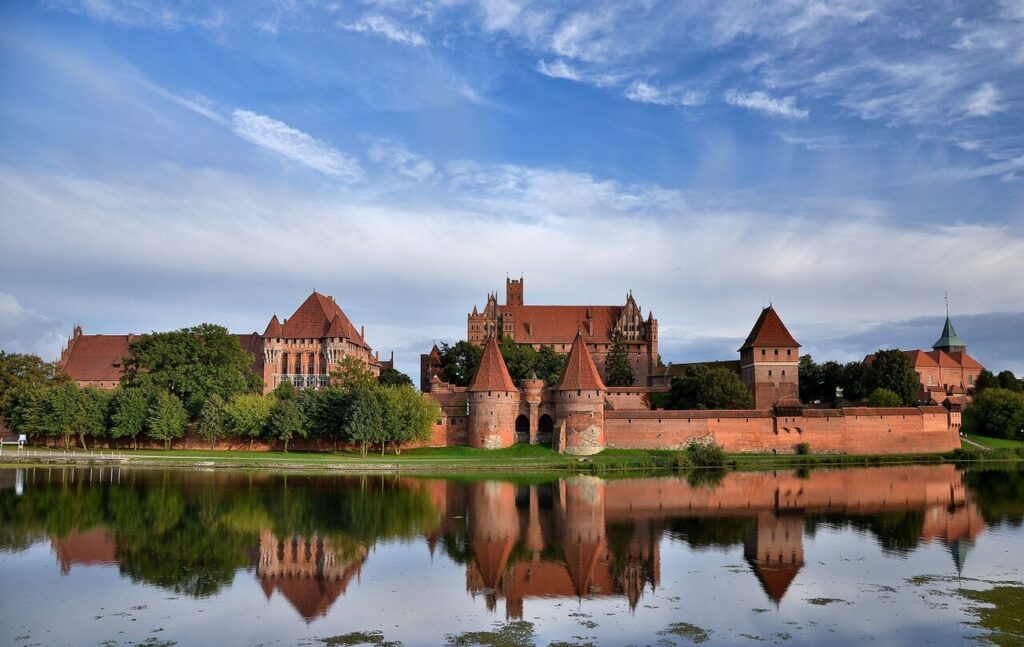
Few medieval fortresses in Europe make a stronger first impression than Malbork Castle. Rising above the Nogat River in northern Poland, the immense red-brick stronghold looks less like a single castle and more like an entire fortified city enclosed within walls. Its towers, courtyards, gates, and defensive works reflect centuries of military planning, religious authority, and political power. Even today, visitors are often surprised by its sheer size. Measured by land area, it is widely recognized as the largest brick castle complex in the world and one of the most significant surviving monuments of the Middle Ages.
Malbork Castle began as a fortress-monastery of the Teutonic Order during the late thirteenth century. Over time it developed into the capital of a powerful state that controlled much of the southeastern Baltic region. Kings, grand masters, diplomats, merchants, soldiers, and craftsmen all passed through its gates. The castle witnessed wars, sieges, political upheavals, occupations, destruction, and restoration on a scale few European monuments have experienced.
Its importance extends beyond military history. Malbork is also one of the finest examples of Brick Gothic architecture ever constructed. The techniques used in its design and later conservation influenced restoration practices across Europe. Recognizing its exceptional value, UNESCO added the Castle of the Teutonic Order in Malbork to the World Heritage List in 1997.
Today the castle stands as one of Poland’s greatest historic landmarks. Its story stretches from the age of crusading military orders to the modern era, offering a remarkable window into nearly eight centuries of European history.
The Origins of Malbork Castle and the Teutonic Order
Why the Teutonic Knights Built Malbork
The origins of Malbork Castle are closely tied to the rise of the Teutonic Order. Founded in Acre during the Third Crusade in 1191 AD, the Order began as a hospital brotherhood serving German pilgrims in the Holy Land. Over time it evolved into a military-religious organization similar to the Knights Templar and the Knights Hospitaller. After Christian strongholds in the eastern Mediterranean collapsed, the Order shifted its focus to northeastern Europe.
During the thirteenth century, the Teutonic Knights became deeply involved in campaigns against the pagan Prussian tribes living along the southeastern coast of the Baltic Sea. Following the suppression of the Great Prussian Uprising, which lasted from 1260 to 1274, the Order sought to strengthen its hold over the conquered territory. A network of fortified castles was constructed throughout the region to secure trade routes, project authority, and support military operations.
Construction of Malbork Castle began around 1274. The site was carefully chosen on the eastern bank of the Nogat River, a branch of the Vistula Delta. The location offered several advantages. River traffic could be monitored and taxed, supplies could be transported efficiently, and the surrounding wetlands added an extra layer of natural defense.
The fortress was originally known as Marienburg, meaning “Mary’s Castle,” in honor of the Virgin Mary, patroness of the Teutonic Order. Although the earliest phase was relatively modest compared with what followed, the foundation had been laid for what would become one of the greatest castle complexes in medieval Europe.
From Monastic Fortress to Political Capital
The turning point in the castle’s history came in 1309. On 14 September of that year, Grand Master Siegfried von Feuchtwangen officially established his seat at Malbork after relocating from Venice. This decision transformed the fortress from a regional stronghold into the administrative center of the Teutonic State.
The move triggered decades of expansion. The existing convent fortress was no longer adequate for the needs of a government that managed diplomacy, taxation, military campaigns, and trade across a large territory. New residential quarters, ceremonial halls, administrative offices, and defensive structures were added. Construction continued well into the early fifteenth century.
As the castle grew, so did the surrounding settlement. Merchants, craftsmen, and laborers were drawn to the economic opportunities created by the expanding headquarters. Malbork became an important center within the Hanseatic trading network that linked cities around the Baltic and North Seas.
By the middle of the fourteenth century, the castle had become both a religious center and a political capital. Foreign envoys visited regularly. Noble guests from across Europe stayed within its walls. The Grand Masters governed one of the most powerful states in the Baltic world from offices overlooking the Nogat River.
Architectural Design and Defensive Strength
The Three-Part Castle Complex
One of the most remarkable features of Malbork Castle is its unique three-part arrangement. Rather than functioning as a single structure, the complex developed into three interconnected sections, each serving a distinct purpose.
The High Castle formed the spiritual and monastic heart of the complex. This section housed the brethren of the Order and contained religious facilities, including the Church of the Blessed Virgin Mary. The High Castle was surrounded by powerful defensive walls and designed to function as an independent fortress if outer sections fell.
The Middle Castle served as the political and administrative center. Here visitors encountered some of the most impressive interiors in the entire complex. Distinguished guests were housed within this area, and many official functions took place here. The Grand Master’s Palace became one of the finest examples of secular Gothic architecture in northern Europe.
Beyond these sections lay the Outer Bailey, often called the Lower Castle. This area contained workshops, warehouses, stables, armories, breweries, and numerous support facilities. Together, the three zones created a highly organized fortified city capable of supporting a large population during both peace and war.
Brick Gothic Engineering on a Monumental Scale
Unlike many famous castles of western Europe, which relied heavily on stone construction, Malbork was built primarily from brick. The relative scarcity of building stone in northern Poland encouraged architects and builders to develop sophisticated brick-building techniques that became a defining feature of the Brick Gothic style.
The scale of construction was extraordinary. Massive walls enclosed courtyards, defensive passages, and residential buildings. Decorative brickwork added visual richness without sacrificing durability. Pointed arches, vaulted ceilings, and elegant tracery demonstrated that brick could achieve both strength and beauty.
Among the castle’s architectural highlights is the Grand Masters’ Palace. Its combination of defensive practicality and refined decoration reflected the wealth and prestige of the Teutonic leadership. The palace included reception rooms, living quarters, and official chambers that rivaled princely residences elsewhere in Europe.
Another masterpiece is the Great Refectory. This enormous hall features a remarkable palm-shaped vault supported by a single slender granite column. The engineering achievement remains impressive even by modern standards. The hall hosted banquets, diplomatic gatherings, and ceremonial events that reinforced the authority of the Order.
Why the Castle Was So Difficult to Capture
Malbork’s defenses reflected centuries of military experience. The castle’s builders understood that a headquarters of such importance would inevitably become a target. As a result, every stage of expansion incorporated additional layers of protection.
Attackers faced multiple rings of walls, fortified gates, towers, moats, and heavily defended approaches. Even if an enemy breached one section, defenders could retreat into stronger inner positions. This layered design significantly increased the difficulty of any assault.
The Nogat River also contributed to the fortress’s security. Water barriers complicated enemy movements and facilitated the transport of supplies. During sieges, provisions could often be delivered more efficiently than at inland strongholds.
The castle’s reputation for strength was demonstrated after the Battle of Grunwald on 15 July 1410. Although the Teutonic Knights suffered a devastating defeat against the combined Polish-Lithuanian forces, Malbork itself did not fall. The subsequent siege failed, preserving the fortress and prolonging the Order’s political survival.
Key Architectural Features
- High Castle, Middle Castle, and Outer Bailey layout
- Massive Brick Gothic defensive walls
- Grand Master’s Palace
- Great Refectory and palm-vaulted ceiling
- Extensive moat and gate systems
- River-based logistical advantages
- Integrated military, religious, and administrative functions
Wars, Political Change, and Restoration
The Castle During the Polish–Teutonic Conflicts
The fifteenth century brought increasing challenges to Teutonic power. The Order’s military ambitions strained finances and created growing tensions with neighboring states. The defeat at Grunwald in 1410 marked a major turning point, even though the castle itself remained unconquered.
Throughout the following decades, political and economic pressures weakened the Order’s position. The fortress remained a symbol of authority, but maintaining such a vast complex required enormous resources. Internal disputes and military setbacks gradually eroded the Order’s influence.
The outbreak of the Thirteen Years’ War in 1454 intensified these difficulties. Prolonged conflict placed severe financial burdens on the Teutonic administration. Unable to pay some of its mercenary forces, the Order found itself facing an extraordinary situation.
In 1457, Bohemian mercenaries controlling the castle sold it to King Casimir IV Jagiellon of Poland. The transfer represented one of the most dramatic shifts of power in the castle’s history and effectively ended Malbork’s role as the capital of the Teutonic State.
Under Polish Rule
After 1457, Malbork entered a new chapter under Polish authority. Following the Second Peace of Thorn in 1466, the castle became part of Royal Prussia within the Kingdom of Poland.
Rather than abandoning the fortress, Polish rulers integrated it into their administrative system. The castle served as a royal residence for more than three centuries. Kings traveling between major cities frequently stayed within its walls, while government officials managed regional affairs from its chambers.
Several important institutions were housed there during this period. In 1568 the Polish Admiralty established operations within the complex. In 1584 a royal mint was created at the castle. The site also became home to one of the largest arsenals in the Polish-Lithuanian Commonwealth.
Although military technology gradually reduced the strategic value of medieval fortifications, Malbork remained an important administrative and symbolic center well into the modern era.
Destruction and Reconstruction
The castle experienced periods of neglect after the First Partition of Poland in 1772, when the region came under Prussian control. Portions of the complex were used for military and administrative purposes, while other areas deteriorated.
A new appreciation for medieval architecture emerged during the nineteenth century. Beginning in 1816, major restoration efforts sought to preserve and rebuild significant sections of the complex. Architect Conrad Steinbrecht played a particularly important role in these projects, which continued into the early twentieth century.
The most severe destruction occurred during the final months of the Second World War. Heavy fighting in 1945 left large portions of the castle damaged or ruined. Some sections suffered catastrophic losses, and many historic interiors were devastated.
Fortunately, nineteenth-century conservation work had produced extensive documentation of the complex. Using these records, Polish specialists launched one of Europe’s most ambitious restoration programs. Reconstruction efforts began in the 1960s and continue today, ensuring that future generations can experience this remarkable monument.
Malbork Castle Today and Its Lasting Legacy
UNESCO Recognition and Cultural Importance
Modern visitors encounter a castle that reflects centuries of preservation, scholarship, and restoration. UNESCO recognized the site’s outstanding universal value in 1997 by adding it to the World Heritage List.
The designation acknowledged several factors. Malbork is one of the finest surviving examples of a medieval brick castle. It also represents a unique architectural tradition developed by the Teutonic Order and demonstrates exceptional achievements in conservation history.
Historians value the castle because it provides insight into medieval military organization, religious life, administration, trade, and architecture. Few sites offer such a comprehensive picture of how a powerful medieval state functioned on a daily basis.
The castle also serves as a reminder of the complex history of the Baltic region. Its walls have witnessed changing borders, competing kingdoms, military orders, and evolving national identities over nearly eight centuries.
Inside the Malbork Castle Museum
The Castle Museum, established in 1961, oversees preservation and interpretation of the site. Its collections help visitors understand both the castle and the broader history of the region.
Exhibitions explore the rise of the Teutonic Order, medieval warfare, religious practices, architecture, and everyday life. Artifacts recovered during archaeological excavations provide valuable evidence about the people who lived and worked within the fortress.
The museum is also known for its collections of amber, a material closely associated with the Baltic coast. Displays trace the cultural and economic significance of amber across many centuries.
Research remains an important part of the institution’s mission. Archaeologists, historians, conservators, and architectural specialists continue to study the castle, uncovering new information about its construction and development.
Why Visitors Continue to Be Drawn to Malbork
What sets Malbork apart from many historic castles is its overwhelming sense of scale. Visitors can spend hours exploring courtyards, halls, chapels, towers, and defensive passages without seeing every corner of the complex.
The castle also offers an unusually complete picture of medieval life. Religious spaces stand alongside military installations, administrative offices, kitchens, workshops, and residential quarters. This variety creates a richer understanding of how the fortress functioned as a living community.
Seasonal events, historical exhibitions, and educational programs add further depth to the visitor experience. The castle remains both a monument and an active cultural institution.
Standing on the banks of the Nogat River, Malbork Castle continues to dominate the landscape much as it did centuries ago. Its red-brick walls tell a story of ambition, faith, conflict, resilience, and preservation that remains one of the most remarkable chapters in European history.
Top Reasons to Visit Malbork Castle
- Largest brick castle complex in the world
- Outstanding example of Brick Gothic architecture
- Former capital of the Teutonic Order
- UNESCO World Heritage Site
- Extensive museum collections and restored interiors
Key Takeaways
- Malbork Castle began construction around 1274 and became the headquarters of the Teutonic Order in 1309, transforming it into one of the most important political and military centers in the Baltic region.
- The castle is recognized as the largest brick castle complex in the world and represents one of the finest surviving examples of Brick Gothic architecture.
- Its three-part design—consisting of the High Castle, Middle Castle, and Outer Bailey—created a highly effective defensive and administrative system.
- After entering Polish possession in 1457, the castle served for centuries as a royal residence, military center, and administrative hub within the Kingdom of Poland.
- Extensive restoration efforts following severe damage in 1945 helped preserve the monument, leading to its inscription as a UNESCO World Heritage Site in 1997.
Frequently Asked Questions
Why was Malbork Castle built?
Malbork Castle was built by the Teutonic Order beginning around 1274 to secure its control over conquered Prussian territories and protect important trade and transportation routes along the Nogat River.
When did Malbork Castle become the capital of the Teutonic Order?
The castle became the administrative headquarters of the Teutonic Order in 1309 when Grand Master Siegfried von Feuchtwangen transferred the Order’s seat from Venice to Malbork.
Is Malbork Castle the largest castle in the world?
Malbork Castle is widely recognized as the largest brick castle complex in the world by land area. Its vast network of walls, courtyards, towers, and buildings covers more than 20 hectares.
What happened to the castle during World War II?
Heavy fighting in 1945 caused extensive destruction throughout the complex. Large sections were damaged or ruined, prompting decades of careful restoration and reconstruction after the war.
Why is Malbork Castle a UNESCO World Heritage Site?
UNESCO inscribed the Castle of the Teutonic Order in Malbork on the World Heritage List in 1997 because of its outstanding architectural significance, its importance in medieval European history, and its exemplary conservation and restoration efforts.