Joaquín Sorolla y Bastida was born on February 27, 1863, in Valencia, Spain, a city whose intense Mediterranean light would later define his artistic vision. Orphaned at just two years old when both his parents died in a cholera epidemic, Sorolla was raised by his aunt and uncle. Despite early adversity, his creative talent blossomed quickly, and he was enrolled at the Escuela de Bellas Artes de San Carlos in Valencia by the age of 15. From his youth, Sorolla’s sensitivity to light and naturalism set him apart from his peers, foreshadowing the mastery that would earn him global acclaim.
Throughout his career, Sorolla became renowned for his vivid seascapes, portraits, and genre scenes painted in plein air, capturing shimmering reflections and glowing skies with unmatched skill. Art historians often describe him as the “master of light” — a title well-earned through decades of committed exploration of Mediterranean brilliance. But to understand the man behind the brush, one must explore not just his technique but the people who grounded and inspired him. Chief among them was Clotilde García del Castillo, his beloved wife and the subject of dozens of his most intimate works.
Clotilde was not simply a recurring figure in his paintings — she was Sorolla’s anchor, both spiritually and practically. Their relationship, deeply rooted in shared values, familial responsibility, and enduring love, influenced not only his domestic life but also his professional decisions. Whether managing household affairs, accompanying him across continents, or simply sitting for him in golden silence, Clotilde helped shape the atmosphere in which Sorolla’s genius thrived.
Together, they formed a partnership that was rare for its time: a union of affection, intellectual camaraderie, and creative interplay. This article traces that bond from their early days in Valencia to their final years in Madrid, revealing how Clotilde’s presence helped define Sorolla’s most personal and luminous works. To fully grasp the depth of Sorolla’s achievements, one must walk with him through the rooms of his home, the sunlit Spanish beaches, and the heartfelt letters he wrote — always with Clotilde at the center.
Clotilde García del Castillo – More Than a Muse
Clotilde García del Castillo was born on September 2, 1865, in Valencia, into a respected and well-connected family. Her father, Antonio García Peris, was a prominent photographer, known for his portraits of Valencian society. This environment of visual artistry, refinement, and intellectual pursuit laid a strong foundation for Clotilde’s later life with Joaquín Sorolla. From an early age, she demonstrated poise, intelligence, and a quiet strength that would later define her role in one of Spain’s most prominent artistic households.
It was in her father’s photography studio that Clotilde first met Sorolla in the early 1880s. At the time, Sorolla was a young apprentice under García Peris, honing his eye for light, detail, and human expression. Though still in their teens, the connection between Joaquín and Clotilde grew steadily over several years, marked by mutual respect and an emerging romantic affection. They shared cultural interests, particularly a love for Spanish traditions and the arts, forming the basis of a courtship that would last through Sorolla’s early travels and studies.
Her Early Life, Education, and Family Background
In 1885, Sorolla left for Rome, having secured a grant from the Spanish government to further his studies in Italy — a common rite of passage for promising painters of the era. Despite the physical distance, he remained emotionally close to Clotilde, writing her passionate letters that revealed both his artistic ambitions and his deep devotion to her. During this time, Clotilde continued to develop her own quiet sophistication, often engaged in family responsibilities and cultural activities in Valencia. Their bond remained firm, rooted in shared experiences and faith in each other’s character.
They became engaged in 1887 and married on September 8, 1888, in Valencia, when Clotilde was 23 and Joaquín 25. Their marriage marked the beginning of a life woven with partnership, family, and mutual sacrifice. Though Joaquín would achieve international fame in the decades to come, Clotilde was never left behind; she was always at his side — not only in presence but in purpose. Her early upbringing and education had prepared her for more than domesticity — it prepared her to be the confidante, assistant, and inspiration to one of Spain’s greatest painters.
A Lifelong Love Story in Letters and Paint
From the day of their marriage in 1888, Joaquín and Clotilde Sorolla began to build a family life grounded in traditional values, enduring faith, and creative energy. They settled in Madrid, where Sorolla began his rise to artistic prominence, but always maintained strong ties to their native Valencia. Their home was not only a residence but a working studio, a family haven, and eventually the heart of the Sorolla legacy. In this home, the couple would raise three children — María (born 1890), Joaquín Jr. (born 1892), and Elena (born 1895) — all of whom appeared frequently in Sorolla’s paintings.
The letters Joaquín wrote to Clotilde during his exhibitions and travels reveal a man profoundly attached to his wife and family. In one letter from 1909, while exhibiting in New York, he called her his “beloved Clota” and confessed he found the city exciting but longed for “her quiet eyes and the warmth of home.” These writings are full of emotion, showcasing a sensitive husband who depended on his wife for more than practical matters. Sorolla often sketched images in the margins of his letters, little caricatures of himself or their children, adding a personal and artistic touch to his affectionate words.
Marriage, Family Life, and Emotional Connection
Their children became subjects of dozens of paintings, often shown playing on beaches, reading in sunlit rooms, or walking beside their mother. These domestic scenes capture the essence of familial warmth, but they also showcase Clotilde’s poise as a mother and a lady of her time. Sorolla’s portraits of Clotilde with the children — such as Mother (1895) — emphasize her grace, calm presence, and moral clarity. Rather than sentimentalizing, Sorolla elevated the domestic role, presenting his wife not only as nurturer but as the emotional pillar of their world.
The strength of their marriage was not merely emotional but practical. During Sorolla’s extended trips for international exhibitions — in Paris (1906), London (1908), and New York (1909) — Clotilde stayed involved in decision-making, finance, and even networking. Her grace and fluency in several languages made her a capable social partner when she did accompany him abroad. Their enduring communication and shared trust allowed Sorolla to travel with confidence, knowing Clotilde had their family affairs under control. Through 35 years of marriage, they created not only a family but an institution of loyalty, service, and shared vision.
Clotilde on Canvas – Sorolla’s Favorite Subject
Joaquín Sorolla painted Clotilde more than any other subject in his lifetime. Her presence in his art was not just habitual but intentional; she symbolized not only his love but his ideals. One of his earliest portraits, Clotilde Seated on a Sofa (1890), already displays a tenderness in brushstroke and an intimacy in gaze. Sorolla didn’t just paint what he saw — he painted what he felt. With Clotilde, he captured the fullness of womanhood: dignity, beauty, serenity, and wisdom.
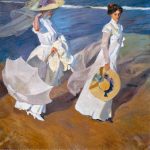
Perhaps his most famous depiction of her is Walk on the Beach (1909), where Clotilde strolls along the Valencian shore with their daughter María. The wind lifts her white dress and veil, the sea sparkles, and the sunlight glances off the sand in waves of color. This work is a triumph not only of technique but of storytelling — Clotilde as protector, mother, and noble presence amid the changing world. Here, Sorolla masterfully combines Impressionist flair with emotional narrative, turning a moment of domestic peace into high art.
The Evolution of a Muse Across Decades
As the years passed, Sorolla’s portrayals of Clotilde matured in tone and technique. In Clotilde in Black (1906), she stands tall, dressed in a fashionable dark gown, poised with confidence. The brushwork is refined, and the palette more restrained — a contrast to his beach scenes — but the intimacy remains. These portraits show the evolution of a relationship and a woman’s life: from young bride to established matron. Each canvas acts as a diary entry, recording not just her appearance but the changing seasons of their marriage.
Clotilde’s constant presence in his studio allowed Sorolla to experiment with angles, poses, and lighting. He painted her reclining in a sunlit room, gazing out a window, reading a letter — always in moments of reflection. Far from the passive role often assigned to muses, Clotilde engaged Sorolla’s full creative attention. She didn’t merely sit for him — she inspired him. Through her, Sorolla explored the relationship between light and love, capturing a timeless grace that transcends artistic fashion.
Managing the Master – Clotilde’s Role Behind the Scenes
Clotilde García del Castillo was not only a subject of Sorolla’s work but a vital force in his career behind the scenes. She organized travel schedules, managed household finances, and maintained a stable domestic environment during his most productive years. As Sorolla’s fame grew, Clotilde’s role expanded from that of supportive wife to full-fledged partner in the business of art. She managed correspondence, handled invitations, and advised her husband with discernment and tact.
During Sorolla’s most active exhibition period between 1906 and 1911, the couple traveled extensively across Europe and the United States. In Paris, London, and New York, Clotilde attended events, spoke with patrons, and built relationships with dealers and critics. Her fluency in French and basic English proved invaluable, and she helped navigate the often treacherous waters of elite art circles. Without her steady presence, Sorolla might have struggled to maintain the professional momentum needed to secure international commissions.
Travel, Exhibitions, and Family Management
Their 1909 trip to New York was a turning point. Sorolla’s exhibit at the Hispanic Society of America led to an invitation from Archer M. Huntington to paint the Visions of Spain series — 14 massive panels capturing regional Spanish life. While Sorolla labored for years on this monumental project (1912–1919), Clotilde managed the home, coordinated his workspaces, and traveled with him across Spain for studies. She was both witness and guide to his grueling yet inspired process.
Despite health concerns and aging children, Clotilde kept the family unified and Sorolla productive. She helped secure the purchase of their home in Madrid in 1911, which would later become the Museo Sorolla. Letters and diaries from this period reveal her balancing fatigue with duty, always prioritizing Sorolla’s well-being and success. Though rarely mentioned in public accolades, Clotilde’s logistical and emotional labor were essential to the grand scope and success of Sorolla’s late-career achievements.
Love in Decline – Sorolla’s Stroke and Final Years
By 1920, Joaquín Sorolla had already accomplished more than most artists could dream of. He had completed the monumental Visions of Spain for the Hispanic Society of America, held major exhibitions across Europe and America, and earned international praise. But in June 1920, while painting in his garden in Madrid, Sorolla suffered a debilitating stroke. The left side of his body became partially paralyzed, and his ability to paint, walk, and even speak began to decline sharply.
Clotilde stepped immediately into the role of full-time caregiver, setting aside any remaining personal interests to care for the man she had loved and supported for over thirty years. She oversaw his medical treatments, arranged for home care, and remained at his bedside through long days of discomfort and silence. The once-vigorous artist, whose hands had captured sunlight and movement, now sat confined and dependent. This period, though painful, illuminated Clotilde’s extraordinary devotion and strength of character.
Clotilde’s Caregiving and Lasting Devotion
In these last years, Sorolla painted very little, though he attempted small sketches with his non-dominant hand. The days of sun-drenched beaches and lively portraits were behind him, but Clotilde continued to surround him with reminders of his achievements. She read to him, kept letters from colleagues and admirers, and ensured he felt honored, even in his diminished state. She never sought public credit, and yet, behind closed doors, she managed his final years with unwavering love and faith.
Sorolla passed away on August 10, 1923, in Cercedilla, Spain, at the age of 60. Clotilde was by his side until the very end. After his death, she took it upon herself to protect and promote his legacy, donating their Madrid home and much of his remaining work to the Spanish state. Her work helped create the Museo Sorolla, which opened to the public in 1932. Clotilde died the following year, in 1932, just months after the museum’s opening — a fitting final chapter to a life devoted to art, family, and fidelity.
A Legacy Preserved – Art, Love, and Enduring Memory
The home Sorolla and Clotilde shared in Madrid — a graceful, sunlit residence with gardens and studios — became more than a house after their deaths. Thanks to Clotilde’s foresight, it became the Museo Sorolla, one of the most beloved single-artist museums in Europe. Visitors walking through its rooms can still see the original furnishings, family photographs, and the very easels Sorolla used. Clotilde’s image adorns the walls again and again, a quiet reminder of the woman who inspired so much of what we now call Sorolla’s legacy.
Over the decades, the portraits Sorolla painted of Clotilde have come to symbolize more than just an artist’s affection for his wife. They represent an ideal of womanhood grounded in grace, strength, and loyalty. From her elegant dresses to her serene expressions, Clotilde embodies a distinctly Spanish sense of virtue and character. Her image, painted in sunlight and shadow, reveals not only her beauty but her resilience — a tribute to enduring womanly strength in the face of fame, illness, and time.
How Their Story Continues to Inspire Viewers Today
Modern audiences, viewing these portraits, are struck not only by the light and brushwork but by the emotional truth within them. In a world often focused on individualism and fleeting success, the Sorolla-Clotilde story offers something enduring — the quiet strength of a marriage built on faith, tradition, and shared purpose. It is not flashy or dramatic but instead marked by constancy and sacrifice. These values resonate deeply with those who still believe that family and duty are worthy foundations for a meaningful life.
As long as Sorolla’s paintings are seen — in Madrid, in New York, or online — Clotilde’s story will be told as well. Her legacy lives not just in galleries but in the example she set: of standing faithfully beside greatness without seeking the spotlight for herself. She was the quiet power behind the master of light. And thanks to her, that light still shines.
Key Takeaways
- Joaquín Sorolla and Clotilde García del Castillo shared a 35-year marriage built on love, collaboration, and tradition.
- Clotilde was more than a muse; she managed Sorolla’s career, household, and exhibitions with grace and intelligence.
- Sorolla painted Clotilde in dozens of portraits, each revealing emotional depth and artistic evolution.
- After Sorolla’s stroke in 1920, Clotilde cared for him until his death in 1923, then preserved his legacy.
- The Museo Sorolla in Madrid stands as a lasting tribute to their life together and Clotilde’s enduring devotion.
FAQs
What year did Joaquín Sorolla and Clotilde García del Castillo marry?
- They married on September 8, 1888, in Valencia, Spain.
How many children did Joaquín and Clotilde Sorolla have?
- They had three children: María (1890), Joaquín Jr. (1892), and Elena (1895).
What was Clotilde’s role in Sorolla’s career?
- Clotilde managed travel, household affairs, correspondence, and social engagements, playing a key behind-the-scenes role.
What is the Museo Sorolla, and who helped found it?
- The Museo Sorolla was established in the family’s Madrid home and opened in 1932, thanks to Clotilde’s donation and planning.
What painting best represents Clotilde as Sorolla’s muse?
- Walk on the Beach (1909), showing Clotilde and her daughter by the sea, is considered one of the most iconic.