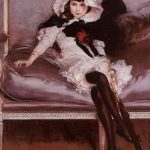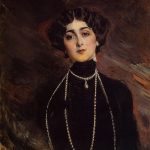
Giovanni Boldini had spent decades painting beautiful women, pursuing women, and moving through the glittering social circles of Paris. Then, in 1926, when the famous Italian portraitist was already in his eighties and losing his eyesight, a young journalist named Emilia Cardona arrived to interview him. Three years later she became his wife. On the surface, it has all the ingredients of an improbable final romance. Dig deeper, however, and another man appears in Emilia’s life, along with a suspicious brother, a private investigation, a remarkable archive of letters, and questions that followed her long after Boldini was dead.
Boldini was born in Ferrara on December 31, 1842, and had lived in Paris since 1871. He became one of the great society portraitists of the Belle Époque, painting for an international clientele rich enough to pay extraordinary prices. In 1910, he quoted between 30,000 and 50,000 francs for a portrait. He knew aristocrats, heiresses, artists, writers, models, and mistresses. The Petit Palais describes him as a favorite portraitist of wealthy international society. By the time Cardona appeared, however, the brilliant painter of fashionable Paris was an old man whose health and eyesight were deteriorating.
Cardona was no society lady arriving to commission a portrait. She was a journalist for Turin’s Gazzetta del Popolo. Their first meeting in 1926 began as an interview, but Boldini soon wanted to see her again. The relationship developed over the next three years. On October 19, 1929, they married in Paris. Boldini was eighty-six and would turn eighty-seven that December. Emilia, born in 1899 according to specialist Boldini research, was about thirty.
Their marriage lasted less than fifteen months. Boldini died on January 11, 1931. Cardona then published his first biography and eventually helped preserve an important part of his artistic legacy. Yet evidence recovered many decades later documented her relationship with the sculptor Francesco “Francis” La Monaca. The old story of Boldini finding uncomplicated romantic happiness at the end of his life suddenly became much harder to believe.
Giovanni Boldini Meets Emilia Cardona in Paris
The 1926 Interview That Became Something More
When Cardona entered Boldini’s world in 1926, she was meeting a living piece of nineteenth-century Paris. Boldini had first visited the city in 1867 and settled there permanently four years later. He had known Edgar Degas and moved among artists, writers, aristocrats, and wealthy patrons. In 1886 he took over John Singer Sargent’s former studio on Boulevard Berthier. That same address would become the setting for his marriage, final illness, and death.
Cardona’s interview quickly developed into a personal connection. Her later recollections describe entering Boldini’s enormous, cluttered studio and encountering the elderly painter among decades of accumulated work. Boldini invited her back after the interview appeared. By March 1927, his attachment was strong enough to appear in correspondence with his brother Gaetano. Boldini described Emilia as not particularly beautiful but “very good.” For an artist whose career had revolved around female beauty, the distinction is revealing.
Emilia gradually became more than a companion. She began working on Boldini’s biography while he was still alive, with assistance from Giovanni and Gaetano. Boldini asked his brother to provide her with information about his earlier life. She was therefore entering both his household and his personal history. She listened to memories reaching back to Ferrara, Florence, and the Paris of the 1870s. As Boldini’s physical world narrowed, Emilia became increasingly involved in organizing the story of the life he had already lived.
His need for help was also growing. Boldini suffered from rheumatism, underwent prostate surgery, and experienced a serious decline in his eyesight. His health problems do not prove that he was incapable of making decisions, and there is no solid evidence that Cardona coerced him into marriage. They do explain why the presence of an energetic younger companion could become so important. Boldini was approaching ninety. Emilia offered conversation, attention, practical assistance, and access to a younger world.
Boldini Marries Cardona: Love, Security, or Both?
A Wedding That Worried His Family
Gaetano Boldini was not delighted. Specialist research based on Boldini family documentation reports that the painter’s brother had Emilia investigated by a detective. Additional reports concerning her were presented to Ferrara’s podestà by Professor Leone Carovita. The resulting picture of Cardona was unfavorable. Those inquiries were not necessarily impartial, and later researchers have warned that they contained prejudice. Still, Gaetano’s suspicion itself is documented. He plainly worried about a woman roughly six decades younger marrying his elderly and increasingly infirm brother.
Emilia also had a previous marriage behind her. Boldini research records a civil marriage to Massimo Mencarelli in 1923. By 1929 she had obtained the legal termination necessary to marry Boldini. This was not, then, a story about an inexperienced young woman entering her first adult relationship. Boldini likewise had a long and complicated romantic history. The two people walking into this marriage carried plenty of baggage between them.
Boldini ignored the objections and married Emilia on October 19, 1929. Because his health was poor, the ceremony took place at his Boulevard Berthier home. At 9:30 that morning, Louis Bergeotte came to the residence to perform the marriage. Witnesses included Emilia’s sister Gabriella and several members of their social circle. In a letter written immediately afterward, Emilia told a friend that she was very happy and that Boldini was well and “felicissimo”—extremely happy.
Boldini apparently recognized the comic side of the age difference. Cardona later recalled his wedding speech, in which he joked that it was hardly his fault that he had been born so early and she so late. Beneath the humor was an unavoidable reality. Boldini was eighty-six. Emilia was about thirty. Their marriage could never resemble that of an ordinary young couple.
Was It Even a Conventional Marriage?
Years later, Cardona made an extraordinary claim. According to testimony recorded by art historian Raffaele Monti, she said her marriage to Boldini had never been consummated. She described something more emotionally complicated: deep affection accompanied by an erotic undercurrent that was never fully expressed physically.
That account cannot be independently proven. It was Cardona’s retrospective description of her own marriage. Yet it is documented well enough to be treated as her testimony rather than rumor. It also fits Boldini’s circumstances. He was elderly, increasingly ill, and suffering severe problems with his sight. During 1930 his health continued to decline despite Emilia’s care.
Money inevitably hangs over the story. Boldini had enjoyed a remarkably lucrative career, and Emilia became the wife of a wealthy and celebrated man near the end of his life. Later discoveries concerning her private life made the financial question even harder to ignore. Yet there is no verified document establishing that Cardona married Boldini simply to obtain his fortune. Financial security may have mattered. That is not the same thing as proving fraud.
Nor should Boldini be turned into a helpless innocent. He had spent half a century navigating sophisticated Parisian society and had experienced numerous romantic relationships. He knew women, money, ambition, and social maneuvering rather well. His brother warned him about Emilia. Boldini married her anyway. Whatever Emilia’s motives, the evidence indicates that Giovanni wanted the marriage.
The La Monaca Affair Changes the Story
The Letters That Complicated the Romance
The decisive complication arrived long after both Boldini and Cardona were gone. In 2008, Boldini scholar Tiziano Panconi brought the previously dispersed Boldini-Cardona Archive back to scholarly attention. Documentation hosted by MART describes approximately 370 unpublished letters and photographs in the archive. Among the matters they document is an extramarital relationship between Emilia Cardona Boldini and sculptor Francesco La Monaca.
That is considerably stronger than gossip repeated decades after the fact. A body of correspondence survives. Specialist research based upon it places Emilia’s involvement with La Monaca about a year before her October 1929 marriage to Boldini. If that chronology is correct, Emilia was already involved with another man while moving toward marriage with the elderly painter.
La Monaca did not disappear after a brief affair. Boldini biographical research records that Emilia married him about a year after Boldini’s death. That continuity matters. The younger sculptor was evidently an important figure in her life, not merely an incidental acquaintance. Whatever Emilia felt for Boldini, her romantic life was not confined to her husband.
This also makes Gaetano’s suspicions look less unreasonable in retrospect. His investigation cannot be treated as proof that every accusation against Cardona was correct. Yet the later correspondence demonstrates that there really was a major part of Emilia’s private life that would have concerned Boldini’s family. Whether Giovanni himself knew about La Monaca remains uncertain. No reliable evidence establishes his knowledge one way or the other.
There are more sensational claims connected with the recovered correspondence, including the assertion that Emilia became pregnant by La Monaca while Boldini was alive and that a daughter was subsequently placed for adoption. That account has been published by researchers associated with the recovered archive. However, it does not have the same independent institutional confirmation as the marriage, Boldini’s death, or the existence of the La Monaca correspondence. It should therefore remain separate from the secure core of the story rather than being treated as settled fact.
Emilia Cardona After Boldini: Widow and Legacy Keeper
The Evidence That Complicates the Fortune-Hunter Theory
Boldini’s health deteriorated badly during 1930. Emilia was present during his decline and communicated with Gaetano about his condition. Giovanni Boldini died at his Boulevard Berthier home on January 11, 1931, following worsening bronchopneumonia. His remains were returned to Ferrara, where he was buried in the Certosa Cemetery.
Emilia moved remarkably quickly to secure his biography. In 1931 she published Vie de Jean Boldini, which the Petit Palais identifies as the painter’s first biography. This was not a book suddenly conceived after his death. She had already been working on his life story with Boldini himself and with Gaetano. Whatever flaws later scholars found in the book, Cardona possessed firsthand access that subsequent biographers could never reproduce.
Her later behavior creates the biggest problem for the simple fortune-hunter interpretation. Several years after Boldini’s death, Cardona donated a collection of his works and personal memorabilia to Ferrara. According to the Petit Palais, that gift formed the first nucleus of the Museo Giovanni Boldini. She therefore helped return a significant part of the expatriate painter’s legacy to his birthplace rather than treating everything associated with him merely as property to be sold.
Cardona also remained deeply interested in Boldini’s early career. She pursued evidence of decorative paintings he had made as a young man at Villa La Falconiera near Pistoia, eventually acquiring the property in 1938. This was not the behavior of someone who had simply collected an inheritance and forgotten the old husband. Long after Giovanni was dead—and after her life had moved forward with La Monaca—Boldini remained a major concern.
So, Did Emilia Cardona Love Giovanni Boldini?
The safest answer is probably, but not in the uncomplicated way the phrase “last great love” suggests. Boldini’s attachment seems clearer. He pursued Emilia’s company, spoke affectionately about her to Gaetano, married her despite family concern, and was reportedly delighted by the wedding. His age does not make those feelings less real.
Emilia is harder to read. Evidence supports her care for Boldini during his decline and her extraordinary commitment to preserving his memory afterward. Her biography and donations had lasting consequences for Boldini’s reputation. Those actions deserve weight. So does the documented relationship with La Monaca.
What cannot be proved is that Emilia married Boldini purely for money. The age difference, inheritance, family suspicions, and La Monaca correspondence make financial self-interest a reasonable question. They do not supply a confession of motive. Turning suspicion into certainty would merely replace one romantic myth with another kind of myth.
The more interesting truth is untidy. Emilia Cardona could have loved Boldini, deceived him, benefited from him, cared for him, and protected his legacy—all within the same complicated relationship. People rarely behave with the consistency that later biographies demand. Boldini’s final marriage was neither the spotless autumn romance of legend nor a proven confidence trick. It was something stranger: an elderly artist’s profound attachment to a much younger woman whose loyalties were divided, but who nevertheless became one of the guardians of his memory.
That contradiction is what makes Emilia Cardona so difficult to dismiss. She may not have been the faithful final love that sentimental accounts would prefer. Yet without her, part of Giovanni Boldini’s story—and part of the material through which he is remembered today—might have disappeared with him.