Behind every great artist stands a figure who helps shape the unseen contours of their life. In the case of Georges Braque, the renowned French Cubist painter, that figure was Marcelle Lapré—his steadfast and deeply devoted wife. While art history tends to focus on brushstrokes and breakthroughs, the love story of Georges and Marcelle offers a quieter, more intimate portrait. Their partnership, forged in the early 20th century, remained unshaken through world wars, artistic revolutions, and personal trials, forming a bedrock of emotional stability for one of modern art’s greatest innovators.
Though Georges Braque is most often discussed alongside Pablo Picasso as a pioneer of Cubism, Marcelle’s influence on his life and work has long remained in the background. Yet without her quiet loyalty, Braque’s legacy might have taken a very different form. This article explores their lifelong relationship—a marriage of privacy, loyalty, and mutual respect—and reveals the love story that helped shape a master. From Paris studios to warfront hospital beds, their bond endured in ways that defy the typical art world drama. Let’s step behind the frame and discover the love story that stayed deliberately out of the spotlight.
A Quiet Beginning: How Georges Met Marcelle
Georges Braque was born on May 13, 1882, in Argenteuil, France, into a family of decorative painters. His father and grandfather both worked as house painters, giving Braque early exposure to craftsmanship and color. By 1902, Braque had moved to Paris to study painting seriously, first at the Académie Humbert and later at the École des Beaux-Arts. It was in Paris, the epicenter of avant-garde art, where he would eventually cross paths with Marcelle Lapré.
Marcelle Lapré was born in 1887, and although little is publicly known about her early life, her values—discretion, loyalty, and a preference for privacy—aligned closely with Braque’s. The couple met in the early 1910s, likely through mutual acquaintances in the Paris art scene. Their relationship quickly deepened, characterized by a quiet intimacy rather than flamboyant displays. Unlike many of their contemporaries, they were not drawn to the spectacle of bohemian excess.
A Romance Rooted in Simplicity
On August 31, 1912, Georges and Marcelle were married in Paris. The timing coincided with Braque’s increasing involvement in the Cubist movement, and their union offered him emotional steadiness during a time of intense creative experimentation. Rather than seeking the spotlight, Marcelle stood beside him, building a quiet life in support of his burgeoning career. The marriage was based on trust and emotional maturity, offering Braque a domestic refuge from the often chaotic world of modern art.
While Paris was filled with artistic couples who thrived on scandal, Georges and Marcelle charted a different course. Their relationship was neither transactional nor tempestuous. It was rooted in a mutual desire for a life marked by order, not upheaval. This shared sensibility would come to define the very rhythm of Braque’s artistic output and personal life for the next five decades.
A Painter and His Muse: Marcelle’s Role in Braque’s Early Career
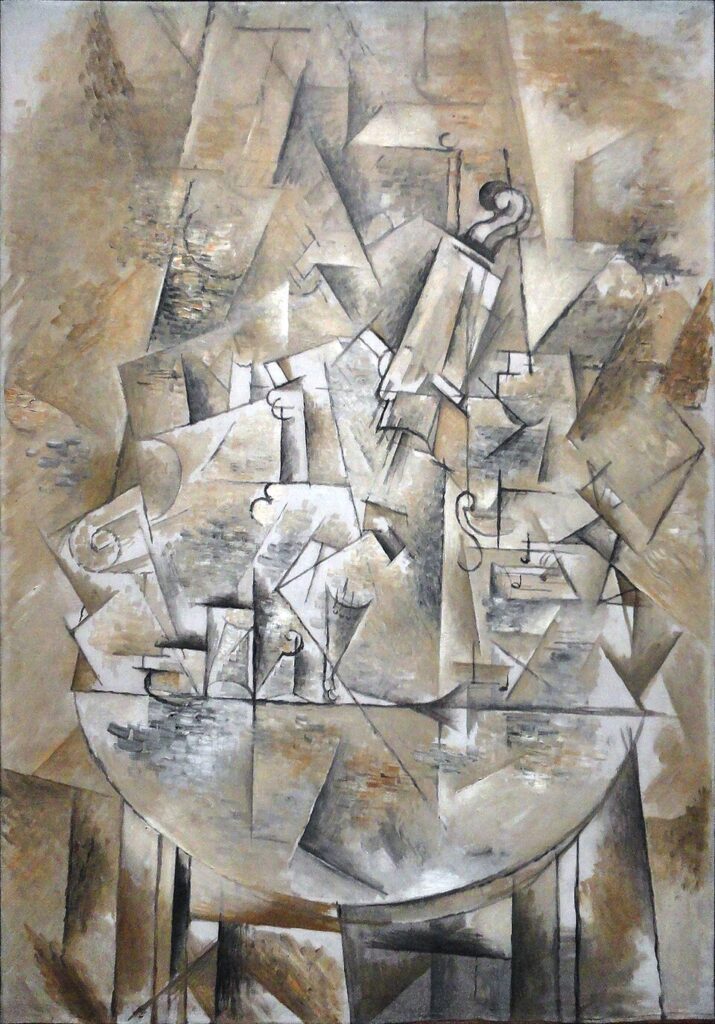
By 1907, Georges Braque had become closely aligned with the radical art developments taking place in Paris. After being deeply influenced by Paul Cézanne and the emerging work of Pablo Picasso, Braque co-founded the Cubist movement. Between 1908 and 1914, his collaboration with Picasso resulted in Analytic Cubism, a revolutionary style that deconstructed objects into geometric forms and subdued tones. While Picasso pursued fame and notoriety, Braque remained more reserved—a trait reinforced by Marcelle’s stabilizing presence.
From their early marriage onward, Marcelle took on roles that extended far beyond those of a traditional spouse. She became his emotional anchor, domestic organizer, and—on occasion—his model. Though she avoided the art world limelight, her behind-the-scenes influence was pivotal. She managed their household affairs with efficiency, ensuring Braque could work without distraction. During periods of financial instability and growing artistic pressure, she provided emotional steadiness and clear-headed counsel.
Muse, Manager, and Moral Anchor
Although Braque is not known for public declarations of affection, there are accounts of Marcelle posing for him in several lesser-known works. Even more important, however, was her role in shielding him from the external pressures of fame. Unlike other avant-garde artists who were often swept up in social drama, Braque deliberately maintained a quiet, ordered life—a choice supported and even engineered by Marcelle. She handled social obligations and correspondence, freeing him to focus entirely on the canvas.
In the growing Cubist movement, Marcelle served as an unseen but essential figure. While Picasso’s affairs made headlines and inspired canvases, Braque’s marriage remained steadfast, grounded in mutual support. Marcelle helped define the rhythm of his days, creating a private world in which he could explore radical visual forms. Her enduring presence gave him the confidence to innovate without fear of personal chaos—something few artists of that era could claim.
Wartime Separation and Its Silent Toll
In May 1915, Georges Braque enlisted in the French Army during World War I. Just a few months later, he suffered a severe head wound from a shell explosion during combat in the Argonne region. The injury left him unconscious for several days, and he underwent trepanning surgery to relieve pressure on his brain. Marcelle rushed to his side, remaining with him throughout the long and painful recovery process. Her care and attention were instrumental to his survival and eventual return to painting.
The war separated the couple physically but not emotionally. Braque’s convalescence was long and arduous, and during this time, Marcelle played the dual role of nurse and companion. She organized medical care, shielded him from undue stress, and encouraged him to return to his art when he was ready. Braque regained full motor function but bore lifelong effects from the injury, including fatigue and recurring headaches.
The Wound That Marked Their Marriage
This traumatic chapter strengthened their bond. Far from tearing them apart, the crisis deepened their mutual reliance. Braque’s post-war art shifted in tone, moving toward a quieter, more meditative style that some scholars attribute in part to his wartime trauma. Marcelle’s devotion during this period allowed him to re-enter the artistic world on his own terms.
Following his recovery, Braque returned to painting in 1917, but his approach had matured. No longer as close with Picasso, Braque took a more independent path—one that reflected not just artistic change, but also personal transformation. Throughout it all, Marcelle remained a constant, supporting him in ways that went unnoticed by the broader public but were vital to his continued work.
The Paris Years: Cubism, Collaboration, and a Life in the Shadows
In the 1920s and 1930s, Georges Braque emerged from the shadow of war and reestablished himself as a central figure in the Paris art world. Although Cubism had evolved, he continued to innovate with still lifes, interiors, and printmaking. His post-Cubist work blended structure with lyricism, using color and form in increasingly refined ways. During this period, Marcelle’s role shifted subtly—from caretaker to quiet curator of their shared life.
Their apartment and studio in Paris became a private sanctuary. Marcelle managed the home with precision, ensuring Braque’s workspace remained undisturbed. While he hosted collectors and fellow artists, she largely stayed behind the scenes. This was not out of obligation but by mutual choice. Georges valued privacy above all, and Marcelle made it possible by handling the social logistics he preferred to avoid.
A Studio for Two, A Spotlight for One
Braque continued to exhibit widely during these years, participating in major shows and building his reputation independently of Picasso. Yet while the public saw a solitary genius, the reality was a team of two. Marcelle was always present, though rarely acknowledged. She arranged travel, corresponded with galleries, and maintained the household—giving Braque the physical and mental space to create. Their lifestyle contrasted sharply with that of other art world couples, where scandal often overshadowed substance.
Unlike artists who sought controversy or acclaim, Braque and Marcelle chose serenity. Letters from friends and collectors suggest a household marked by calm, order, and unwavering mutual respect. In a world where relationships often faltered under the pressures of fame, theirs stood firm. Marcelle didn’t merely support Georges; she protected the rhythm of his creativity, allowing him to work with uninterrupted focus. Her absence from the spotlight was deliberate, and her loyalty uncompromising.
Illness and Devotion: Marcelle as Caretaker and Companion
By the 1950s, Georges Braque’s health began to decline. He suffered from arteriosclerosis and various respiratory issues that limited his ability to work for extended periods. Despite his growing fame—he was the first living artist to have a solo exhibition at the Louvre in 1961—his physical limitations became increasingly challenging. Throughout these years, Marcelle became not only his emotional support but also his full-time caregiver.
Marcelle managed the household and studio while attending to Braque’s medical needs. She arranged doctor visits, monitored medications, and helped him continue working in small doses. Their home was carefully organized to accommodate his condition. Friends and associates visiting during this time often noted her serene demeanor and the gentle atmosphere she maintained around him.
From Artistic Partner to Nurse
Even in illness, Braque continued to paint, albeit more slowly. He completed major works such as the “Ateliers” series between 1949 and 1956, and Marcelle’s support made that possible. She filtered visitors, protected him from unnecessary stress, and offered constant encouragement. Without her, his later career might have ended much earlier.
On August 31, 1963, Georges Braque died in Paris at the age of 81. Marcelle was by his side. Their marriage had lasted over 50 years—unbroken, undramatic, and deeply personal. They had no children, but their life together was complete in its own way. In the decades of artistic revolution that surrounded them, theirs was a story of constancy and grace.
Legacy of Loyalty: After Braque’s Death
After Braque’s passing in 1963, Marcelle Lapré lived quietly for nearly a decade, remaining in their shared home. She took on the role of silent steward of his legacy, overseeing the preservation of his studio and artworks. While galleries and institutions sought her insight, she declined all interviews and never wrote memoirs. Her goal was not to elevate herself but to honor the life and memory of her husband.
She worked with curators behind the scenes, ensuring the accuracy of exhibitions and publications about Braque’s work. When the Musée Georges Braque was established in Normandy, her contributions were acknowledged by those closest to the project, though she declined any public recognition. Her quiet determination to keep his legacy pure made a lasting impact on how his work has been presented since.
Widowhood and Memory-Keeping
Marcelle died in 1972, nine years after Braque. Her funeral was a modest affair, in keeping with her lifelong preference for privacy. No monument bears both their names, but those who knew them understood that their bond transcended stone or inscription. Through decades of partnership, Marcelle had shaped not only Georges Braque’s life but also his enduring place in modern art.
Today, her name is rarely mentioned in art history texts. Yet her influence remains imprinted on Braque’s oeuvre—in the serenity of his still lifes, in the balance of his compositions, and in the rhythm of a life lived far from chaos. Hers is a legacy not of canvas but of care.
Love in the Margins: Why Marcelle’s Story Matters
Art history often overlooks the quiet figures who shape the lives of its most celebrated creators. Marcelle Lapré is one such figure—a woman whose unwavering loyalty and discretion helped Georges Braque navigate the pressures of fame, war, and artistic reinvention. Her contributions were not made with brushes or chisels, but with devotion, care, and restraint. In a world obsessed with spectacle, she offered something far more lasting: constancy.
Marcelle’s story challenges the idea that influence must be loud to be meaningful. While other muses were immortalized in portraits or poems, she left behind no memoir, no letters, no scandal. Instead, she supported Braque through five decades of transformation, never seeking praise or recognition. Her absence from the public narrative is not a reflection of insignificance—but of intent.
Silent Partners, Lasting Impact
Without Marcelle, the Braque we know today might have faltered amid the chaos of war, illness, or fame. Her role was foundational, even if history tends to overlook it. She is a reminder that behind many so-called “solitary geniuses” stands someone holding the world together.
Recognizing Marcelle’s story doesn’t just honor one woman—it corrects the record of a quiet, beautiful partnership that shaped 20th-century art. And perhaps, it calls us to look a little more closely at the hidden lives behind great works.
Conclusion
The story of Georges Braque and Marcelle Lapré reveals a different kind of artistic legacy—one rooted in love, loyalty, and unseen support. Share this article or leave a comment to honor those whose devotion shapes history from the background. Behind every great artist, there’s often a great love.
Key Takeaways
- Georges Braque and Marcelle Lapré married in 1912 and remained together until his death in 1963.
- Marcelle supported Braque through WWI recovery, artistic evolution, and illness.
- She deliberately avoided fame, interviews, or self-promotion.
- Their marriage provided the stability Braque needed to work and innovate.
- Marcelle’s legacy is one of devotion, not documentation—but no less powerful.
Frequently Asked Questions
- When were Georges Braque and Marcelle Lapré married?
They were married in Paris in 1912. - Did Marcelle Lapré work in the art world herself?
No, but she played a crucial role in managing Braque’s household and preserving his legacy. - Was Marcelle ever depicted in Braque’s artwork?
Yes, she likely posed for him on occasion, although he rarely named his subjects. - Did Georges Braque have any children?
No, Braque and Marcelle did not have children. - Why is Marcelle Lapré not better known in art history?
She chose a private life and avoided publicity, focusing entirely on supporting Braque.