Berthe Morisot was born on January 14, 1841, in Bourges, France, into a well-educated and affluent bourgeois family. Her father was a top civil servant, and her mother came from a line of Rococo painter Jean-Honoré Fragonard. Eugène Manet, on the other hand, was born on November 21, 1833, in Paris, into a similarly well-off family of legal professionals. Eugène’s older brother, Édouard Manet, would later become a central figure in the development of modern art.
Mid-19th-century Paris was a city in the throes of transformation—industrially, culturally, and artistically. Conservative values shaped most institutions, especially regarding gender roles and artistic norms. Women, particularly those of upper-middle-class background, were expected to marry well and focus on domestic life. Art was dominated by the École des Beaux-Arts and the Salon, both of which dismissed more daring movements that would later define modernism.
Eugène was raised in an environment steeped in art and literature but chose not to pursue a public career as an artist. Though trained in law, he rarely practiced, instead focusing on supporting his family and observing the Parisian art world from the wings. Berthe, however, pushed against expectations by choosing to become a professional painter, a rare and controversial path for a woman of her standing. This difference in their personalities would later complement their marriage.
Artistic Paris in the 1800s
Paris was not just a backdrop but a central character in their lives. With the rise of Impressionism, the city became the hub of avant-garde innovation. Both Berthe and Eugène were shaped by this rich, transitional moment in art history. Their love story, when it eventually unfolded, was not separate from this context—but a product of it.
Berthe and the Brush—An Unusual Woman for Her Time
By the 1860s, Berthe Morisot had already set herself apart by refusing to remain confined to traditional female roles. She and her sister Edma took private lessons with Joseph-Benoît Guichard, a student of Ingres. From a young age, Berthe copied works at the Louvre and exhibited at the Salon—an impressive feat for any artist, let alone a woman. Her career gained more momentum after she met Édouard Manet in 1868.
Berthe quickly developed a close relationship with Édouard, who painted her numerous times, including in the iconic Berthe Morisot with a Bouquet of Violets (1872). Some biographers speculate that Berthe was romantically interested in Édouard, though there’s no confirmed evidence of a mutual romantic relationship. He was already married, and Berthe’s sense of propriety likely kept any feelings hidden. Still, the emotional intensity of their artistic connection was undeniable.
Morisot’s Artistic Rise
Berthe’s brushwork was light, free, and expressive—qualities that would define Impressionism. She often painted domestic scenes, landscapes, and portraits of women and children with a sensitivity that rivaled her male peers. She became the only female founding member of the Impressionist group, showing in their first exhibition in 1874 and many after that. Critics at the time either dismissed or patronized her, but her talent was never in question among fellow artists.
Her paintings broke new ground by showing women not as decorative subjects but as thinking individuals. Her decision to maintain her professional identity after marriage was radical in 19th-century France. Where other women were forced to abandon creative pursuits, Berthe pushed forward with a growing sense of independence. This would become a defining feature of her marriage to Eugène.
Enter Eugène Manet—The Brother in the Background
Eugène Manet did not crave the spotlight like his brother Édouard. He was quieter, more introspective, and less publicly ambitious. Trained in law, Eugène held various civil service positions in his youth but never sought a high-profile career. What set him apart was his deep engagement with art and his supportive nature, especially toward the women in his life.
Unlike Édouard, whose flamboyant style and brash personality shocked polite society, Eugène was gentle and even-tempered. He preferred quiet domesticity and intellectual pursuits. Despite living in the artistic heart of Paris, he remained somewhat of a background figure—until he emerged as Berthe’s steadfast partner. His personality was an anchor for her as she navigated the often hostile world of professional painting.
A Gentleman Without Ambition
Some sources suggest that Eugène had admired Berthe for years before proposing. Their families were acquainted, and he likely saw her frequently through his brother’s circle. When the time came, his proposal was seen as a logical if not passionate move, particularly by those who assumed Berthe still harbored feelings for Édouard. But in truth, Eugène offered something that few men could: respect for her work and a willingness to help her flourish.
His quiet loyalty and sincere admiration for her artistry laid the foundation for their relationship. In an era when women’s careers were often sacrificed for marriage, Eugène offered a different path. He did not compete with Berthe, nor did he view her success as a threat. Instead, he became her supporter, protector, and confidant.
A Marriage of Equals
Berthe Morisot and Eugène Manet were married on December 22, 1874, just months after Berthe’s participation in the first Impressionist exhibition. At the time, marrying Eugène surprised some in the art world who expected her to remain unattached or involved with Édouard. Yet it proved to be a well-matched union. The timing of their wedding also marked a professional turning point in Berthe’s life.
Their marriage defied conventional expectations. Eugène never demanded that Berthe give up painting or spend her time solely on household duties. Instead, he handled many logistical tasks—scheduling exhibitions, managing household finances, and organizing travel—so she could focus on her work. This collaborative domestic arrangement was virtually unheard of in 19th-century France. Together, they cultivated a home filled with creativity and mutual respect.
The 1874 Wedding
Their wedding was a modest affair, attended by close family and friends, including Édouard. Far from a dramatic or scandalous union, their marriage was built on steadiness, not spectacle. Eugène’s personality suited Berthe’s better than Édouard’s ever could have. She often said she valued peace, routine, and respect—qualities Eugène provided in abundance.
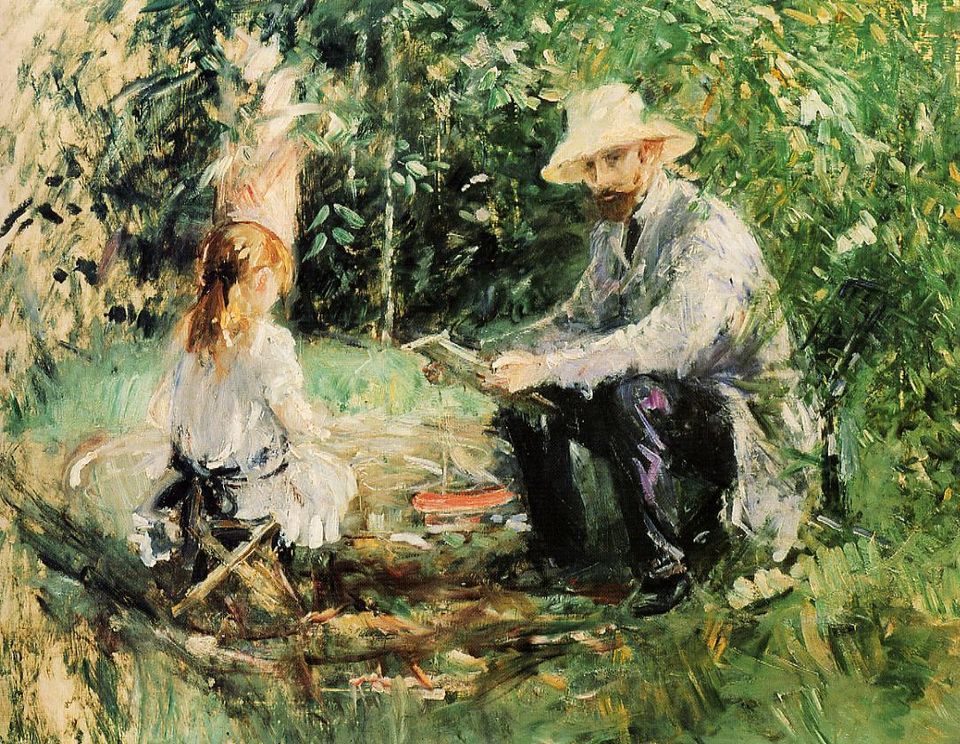
They traveled frequently to coastal towns and countryside estates, where Berthe painted en plein air and Eugène handled logistics. He often posed for her paintings and was a hands-on presence in her creative life. This intimacy between painter and subject gave Berthe’s later works a warmth and sincerity that was deeply personal. Their marriage was not just romantic—it was practical, enduring, and spiritually aligned.
Julie—Their Most Cherished Collaboration
In 1878, Berthe and Eugène welcomed their only child, Julie Manet, into the world. From the beginning, she was the heart of their household and the subject of many of Berthe’s tenderest paintings. Works like Julie Manet with a Cat and The Cradle captured the intimate moments of motherhood and family life. Through Julie, their love became visual, expressed in brushstrokes rather than public displays.
Julie’s presence also reinforced the bond between her parents. Eugène was a devoted father, deeply involved in his daughter’s education and upbringing. Unlike many men of his time, he took a hands-on role in parenting, offering emotional and practical support. This allowed Berthe to continue her career without sacrificing her child’s well-being. Their home balanced tradition with modernity in a way that reflected their values.
Parenthood and Portraits
Portraits of Julie often show her with Eugène—reading, playing, or simply resting in the garden. These were not just family keepsakes but artistic statements about love, childhood, and domestic harmony. Through these works, viewers saw the private side of the Manet-Morisot family—a glimpse of real affection unmarred by the spectacle of public life. Berthe’s paintings of Julie remain among her most beloved works.
Eugène also recognized the importance of documenting Berthe’s work and legacy. He kept her letters and journals organized, maintained her studio, and helped ensure her participation in Impressionist exhibitions. His role in preserving her work allowed their daughter to later publish Berthe’s writings. Together, they created a legacy of familial and artistic devotion that outlasted their lifetimes.
Final Years and Enduring Devotion
Eugène’s health began to decline in the late 1880s, though he remained active in Berthe’s life and career. He died on April 13, 1892, after a period of illness. Berthe was devastated. She had lost her closest companion, her helper, and her emotional rock. The years following his death were marked by a noticeable change in her energy and vitality.
After Eugène’s death, Berthe continued painting but with increasing physical exhaustion. Her final works, while still delicate and insightful, carry a visible weight of sorrow. In one of her last letters, she wrote that without Eugène, life had become “heavy and cold.” In March 1895, just three years after her husband’s death, Berthe died from pneumonia at the age of 54.
Loss and Legacy
Julie, only 16 at the time, was orphaned and taken in by extended family and family friends—including Renoir and Mallarmé. Yet she remained fiercely devoted to her parents’ memory. Later, she published Growing Up with the Impressionists, which included her diary entries and recollections. Through her, the love story between Berthe and Eugène became known to a wider public.
Today, the couple is buried side by side at Passy Cemetery in Paris, not far from Édouard Manet’s grave. Their story, often overshadowed by more dramatic romances in the art world, is one of steadfast affection. While they lived in a time that limited women, their partnership showed what could be achieved through trust and respect. Their love was not loud, but it was lasting.
The Quiet Strength of Their Love
In an age defined by rigid roles and theatrical romances, the relationship between Berthe Morisot and Eugène Manet was an outlier. They shared a bond based on mutual understanding and quiet support. While the world watched the flashier figures of Impressionism—Monet, Degas, and Édouard Manet—Berthe and Eugène built a private life filled with meaning. It was not fame but faithfulness that defined them.
Their love was modern before the modern age. Where many artist couples burned out in jealousy or competition, they grew stronger through cooperation. Berthe’s success as an artist was, in part, due to Eugène’s unwavering encouragement. He recognized her genius without needing to take credit or compete with it—a rare thing in any era, but especially in theirs.
A Relationship Ahead of Its Time
Their story offers a quiet lesson in love: real partnership often happens far from the spotlight. It is found in shared decisions, respect for each other’s work, and the freedom to grow. Eugène’s support allowed Berthe to be both a mother and a master painter—a balance that was almost unheard of in 19th-century France.
In remembering Berthe Morisot and Eugène Manet, we remember a love story that resisted the easy clichés. It was not forged in scandal or fueled by fame. Instead, it was rooted in daily acts of kindness, shared ideals, and artistic vision. Their life together wasn’t grandiose, but it was genuine—and that’s why it still matters.
Key Takeaways
- Berthe Morisot and Eugène Manet married in 1874 and remained deeply devoted until his death in 1892.
- Their relationship was marked by mutual respect and support for Berthe’s career as a professional artist.
- Eugène was not a competitive artist but managed family responsibilities so Berthe could paint.
- Their only child, Julie Manet, was central to their life and became the subject of many paintings.
- Their love story offers a model of artistic partnership grounded in trust and quiet companionship.
FAQs
- Did Berthe Morisot love Édouard Manet before marrying Eugène?
Some speculate she had feelings for Édouard, but she married Eugène and found lasting love with him. - Was Eugène Manet an artist like his brother Édouard?
No, he trained in law and never pursued an artistic career, though he was deeply engaged in the art world. - Did Eugène support Berthe’s painting career?
Yes, he was instrumental in managing their home and assisting with her exhibitions and studio needs. - How did their daughter Julie preserve their legacy?
Julie Manet published diaries and recollections that helped solidify her mother’s artistic importance. - Where are Berthe and Eugène buried?
Both are buried at Passy Cemetery in Paris, close to Édouard Manet’s grave.