At first glance, Kawasaki may appear to the outsider as merely a gray corridor between Tokyo and Yokohama—a place of warehouses, smokestacks, commuter lines, and functional modernity. But beneath that utilitarian shell lies a far older and more intricate history, marked not only by trade and transportation, but also by centuries of artistic evolution. Kawasaki’s place in Japanese art history is neither loud nor self-promoting. Instead, it is layered, often quiet, and deeply rooted in the everyday lives of its people—from pilgrims and fishermen to industrial laborers and municipal planners.
The River as Border and Bridge
The Tama River has long shaped Kawasaki’s destiny, carving a natural boundary that once divided the provinces of Musashi and Sagami. In premodern Japan, rivers were both connectors and separators—fluid borders that gave rise to ferry stations, inns, and bustling post towns. Kawasaki-juku, the second of the 53 stations on the Tōkaidō Road connecting Edo (modern-day Tokyo) to Kyoto, rose along this stretch of river in the early 1600s. The town thrived not because it was glamorous, but because it was necessary—a place where travelers stopped, rested, prayed, and observed the rhythms of life along the great thoroughfare of the Tokugawa shogunate.
This gave Kawasaki an early visual identity. The river crossings, roadside tea houses, and the stream of foot traffic all became subjects for woodblock artists and storytellers. While it lacked the monumental temples of Nara or the imperial glamor of Kyoto, Kawasaki had something else: proximity to the capital, a steady turnover of observers, and the advantage of being constantly watched, remembered, and drawn.
Urban Growth and Cultural Tension
As the Tokugawa era faded and the Meiji period dawned, the forces of industrialization reshaped Kawasaki with stunning speed. Railroads replaced footpaths, and the Tama River no longer marked a natural boundary but rather an obstacle to be overcome. Kawasaki Station opened in 1872, part of Japan’s first railway linking Tokyo to Yokohama. Within a generation, the town’s rural face began to vanish. Factories emerged, and with them came labor, soot, steel, and the stern efficiency of the modern age.
This transition was not merely economic—it altered the visual character of the city. Traditional crafts and local motifs faded, replaced by chimneys, concrete, and imported notions of “progress.” For artists, it posed a fundamental question: how to capture a place no longer defined by slow continuity, but by rapid, unceasing change. The city’s image shifted from woodblock to photograph, from painterly stillness to cinematic motion. It became harder to define what was uniquely “Kawasaki,” and easier to mistake it for any other Japanese industrial suburb.
Yet cultural memory is stubborn. Even amid industrial growth, traces of older Kawasaki survived: local festivals, shrines tucked between highways, and family-run businesses that retained echoes of past craftsmanship. The struggle between old forms and new ambitions gave rise to tensions that still shape the city’s art today—between rootedness and reinvention, nostalgia and necessity.
Kawasaki’s Understated Influence
Though often overshadowed by Tokyo’s prominence, Kawasaki has consistently contributed to the wider currents of Japanese art and culture. It has been a place of passage, absorption, and synthesis. While not a capital of any kind, it has repeatedly served as a conduit—bringing together influences from the courtly traditions of Kyoto, the commercial dynamism of Tokyo, and the foreign influx arriving through the nearby port of Yokohama.
The result is not a single artistic school or iconic style, but rather a more elusive character: a practical creativity, grounded in working-class sensibilities and shaped by motion rather than stasis. Kawasaki has been a city of travelers, laborers, and border-dwellers—people who left fewer grand monuments but more subtle imprints in daily objects, street aesthetics, and public spaces.
Its art history, then, is not to be found in gilded temples or prestigious salons. It is written in woodblock prints of travelers on rainy roads, in soot-covered photographs of factory silhouettes at dusk, and in quiet museums built near freeway interchanges. It is the story of a city both indispensable and underappreciated—a place that never sought the spotlight, but helped define the stage.
Kawasaki’s greatest artistic virtue may be its humility: a city that neither proclaims nor poses, but endures, adapts, and occasionally surprises. It remains a living archive of Japan’s transformation from an early modern society of piety and paper to a 21st-century industrial power. To study its art is to trace that journey not through manifestos or monuments, but through signs, textures, and the patterns of ordinary life.
Pilgrimage and Printmaking: Kawasaki Daishi and the Edo Imagination
There is a point in every great city’s past where art and religion meet—not in abstraction, but in stone, ink, and footfall. For Kawasaki, that meeting point is Kawasaki Daishi, a temple complex whose influence reached far beyond its gates. During the Edo period (1603–1868), when the Tokugawa shogunate imposed peace and order across the country, pilgrimage sites like Kawasaki Daishi flourished. But their significance extended beyond theology; they created visual cultures, supported craftsmen, and shaped how people imagined place. For artists working in woodblock print, the temple became not just a destination, but a subject—a symbol of collective movement, spiritual purpose, and the gentle theatrics of daily devotion.
Spiritual Magnetism of Kawasaki Daishi
Founded in 1128, Kawasaki Daishi—formally known as Heiken-ji—is one of the most important temples of the Shingon sect of Japanese Buddhism in the Kantō region. It is dedicated to Kōbō Daishi (Kūkai), the 9th-century monk, scholar, and civilizing figure who helped define Japanese Buddhism in its formative years. Over time, the temple developed a reputation for healing and exorcism, attracting pilgrims from the growing cities to the east and west.
By the early 18th century, Kawasaki Daishi had become one of the most visited pilgrimage destinations in Japan, especially around the New Year, when Edo residents sought blessings for health, fortune, and safety. The pilgrimage itself became a ritualized art form: people dressed in particular clothing, chanted traditional phrases, and bought charms or printed talismans. This regular flow of visitors fed not just religious devotion but a broader economy of images and objects.
The temple precinct grew into a bustling town of stalls, inns, and street performers. Craftsmen sold amulets, fans, small statues, and local sweets. Artists sketched the crowds. Poets recorded their impressions. All of it together formed a kind of spiritual theater, with Kawasaki Daishi as both stage and actor.
Ukiyo-e and the Tōkaidō Road
The great flowering of Edo-period printmaking—particularly in the form of ukiyo-e—thrived on movement. The Tōkaidō Road, Japan’s most important travel artery, linked the shogunal capital of Edo with the imperial capital of Kyoto. Kawasaki, located just one station away from Nihonbashi, the road’s eastern terminus, served as a key waypoint for both physical travelers and artistic depictions of travel.
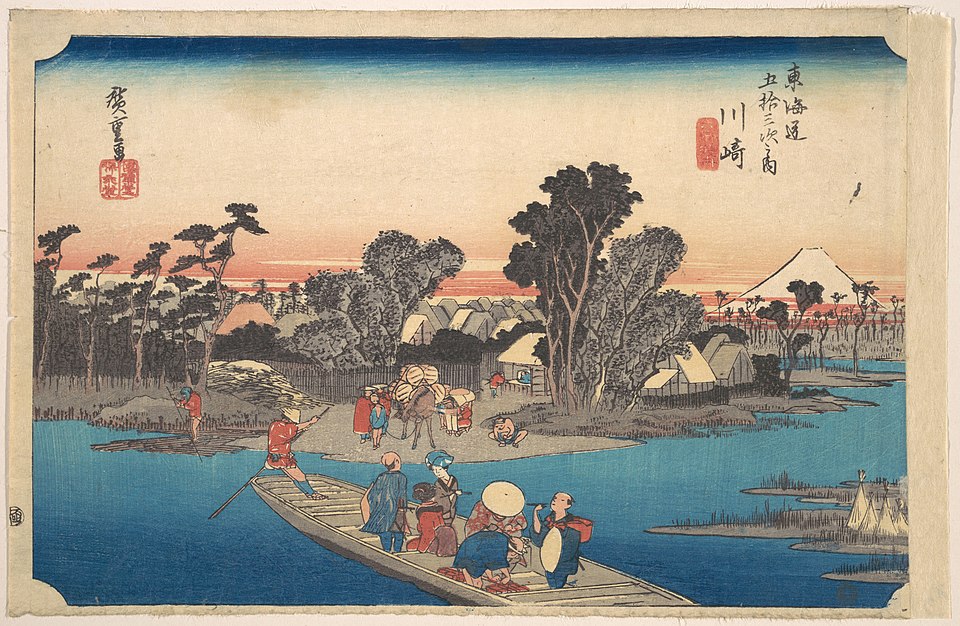
Artists like Utagawa Hiroshige (1797–1858), whose series The Fifty-Three Stations of the Tōkaidō remains one of the most iconic achievements in Japanese printmaking, consistently returned to Kawasaki as a subject. His depiction of Kawasaki Station (Kawasaki-juku) is subtle but telling: weary travelers crossing the Tama River on foot, aided by porters wading in the shallows. In the background, the flat land stretches into quiet anonymity. The scene is not grand, but purposeful. It captures the in-between quality of Kawasaki—neither city nor countryside, neither arrival nor departure, but something in transition.
These prints were more than souvenirs. They offered a window into the mood of the age: an era of peace, travel, and regulated mobility. The pilgrimage to Kawasaki Daishi, depicted in countless scenes, was part of this broader visual vocabulary. Artists conveyed not only the architecture of the temple but the rituals surrounding it: the lighting of incense, the purchase of trinkets, the quiet determination of the supplicant. In doing so, they elevated the ordinary and mapped the sacred into the landscape.
Three motifs frequently appeared in these works:
- Bridges and boats crossing the Tama River, evoking both passage and vulnerability.
- Crowds of pilgrims—always in motion, yet orderly—suggesting civic harmony.
- Seasonal markers, such as cherry blossoms or snow, reinforcing the temporal rhythm of devotion.
Each of these reinforced a larger cultural message: that to visit a place like Kawasaki Daishi was not just to seek spiritual aid, but to participate in a shared aesthetic and social order.
Kawasaki in Hiroshige’s Eye
Hiroshige, though never a resident of Kawasaki, understood its visual power. In his hands, the station became a metaphor for motion without climax—a scene where life continued without monumentality. Unlike later modern artists who sought drama in steel and smoke, Hiroshige found significance in restraint. His Kawasaki lacks a clear focal point; instead, it invites the viewer to enter, wander, and observe.
It was a visual philosophy in tune with the religious currents of the time. Pilgrimage was not about spectacle, but process. Similarly, the prints did not shout; they suggested. They taught the viewer to see the grace in the flat plain, the slow ferry, the distant temple roof. For Hiroshige and his contemporaries, Kawasaki offered a compositional challenge and a moral ideal: how to render motion, modesty, and meaning in a single frame.
As time passed and modernity encroached, much of this visual language faded. The river was tamed, the temple surrounded by pavement, the pilgrims replaced by tourists. But the images endured. The woodblocks remained in circulation, copied, collected, and studied. And the aesthetic they preserved—of modest passage, ritual motion, and communal stillness—continued to haunt Japanese visual culture well into the 20th century.
Today, Kawasaki Daishi remains active. Each New Year, the crowds return, though the mood has shifted. Pilgrims snap photos with smartphones. Vendors accept credit cards. The smells of incense still linger, but now mingle with fried snacks and bus exhaust. Yet even in this altered context, the essential structure persists. People still walk. They still pause. They still look. The visual culture that once birthed ukiyo-e lives on—not in its original form, but in the habits it taught: of watching the crowd, respecting the process, and seeking the sacred in motion.
Craft and Commerce: Folk Traditions and Everyday Aesthetics
There’s a quiet dignity in the way ordinary people shape the visual world around them—one brushstroke at a time, one bowl, one banner, one storefront. In Kawasaki, where grand aristocratic patronage was rare, the artistic tradition grew out of the daily labor and practical imagination of merchants, craftsmen, and townsfolk. These were not artists in the academic sense, but artisans who worked in lacquer, cloth, wood, and clay—people who made objects to be used, handled, sold, and passed down.
Their creations, once commonplace, now offer a rare glimpse into a world of local customs, regional style, and everyday virtue. The art history of Kawasaki cannot be understood without these objects: modest, enduring, and human.
Local Ceramics and Lacquerware
Though it never rivaled Kyoto or Mino in fame, the Kawasaki region supported a small but consistent production of functional ceramics throughout the Edo and Meiji periods. These were not delicate tea ceremony wares, but bowls, jars, and pots made for daily use. What distinguished them was their material economy and understated finish—usually earthy glazes in muted greens and browns, often with thick lips and a slightly uneven throw. Practicality was paramount, but there was also room for character. A tea bowl with a thumbprint. A sake flask with a glaze drip that looked like running ink.
Alongside ceramics, the town had a modest reputation for lacquered trays and boxes, particularly for use in religious or festive settings. Artisans used a subdued palette—dark reds, charcoal black, and the occasional gold highlight—and often incorporated local motifs: river reeds, temple eaves, and stylized pine trees. These designs weren’t bold declarations. They whispered tradition.
This quiet folk aesthetic was shaped by several realities:
- Limited materials, forcing artisans to innovate with texture, not color.
- Practical buyers, who demanded durability over ornament.
- Local pride, which encouraged subtle symbols of place—temple seals, ferry scenes, river grasses—rather than generic patterns.
Many of these wares are now only found in regional museums or the backs of old family kitchens. But their influence remains, especially in the way modern Japanese product design privileges simplicity, form, and honest materials.
Marketplaces as Art Scenes
In Kawasaki’s historical development, the market was not just an economic center—it was a visual environment. Street stalls, merchant signage, and festival booths turned commerce into spectacle. Bright banners flapped above produce carts; wooden signboards displayed stylized calligraphy, announcing wares with a mix of pride and poetry. These weren’t individual masterpieces, but the cumulative result was an artful cityscape: layered, loud in color, but harmonious in form.
During festivals, especially those tied to Kawasaki Daishi or seasonal events like Tanabata, local streets transformed. Craftsmen built temporary shrines. Vendors painted fresh lanterns. Children wore paper masks and carried fans bearing handmade prints. In these moments, art was public, participatory, and embedded in motion. It was not a separate sphere of high taste, but part of civic life.
Some of the best surviving records of this world come from kibyōshi—illustrated booklets popular in the 18th and 19th centuries—and ukiyo-e prints that showed festival scenes. They reveal a Kawasaki full of color, commotion, and human detail. A fishmonger with a wildly decorated cart. A sweet-seller under a cloth awning, handing candy to a child. A local fire brigade parading with painted standards.
This style of community-centered design carried a few enduring traits:
- Visual layering, where text, image, and pattern overlapped in harmonious confusion.
- Ephemerality, with many objects made to last only a day or a season.
- Gesture, where slight variations in brushstroke or form conveyed local personality.
Even as modern signage and industrial uniformity began to flatten these textures in the 20th century, echoes remained—in the way storefronts framed their goods, or how hand-painted elements endured on lanterns, menus, and festival décor.
Aesthetic Habits of the Merchant Class
By the late Edo period, Kawasaki’s growing class of shopkeepers and traders began to develop their own sense of aesthetic refinement—neither as lavish as samurai tastes nor as rustic as peasant life. This was a distinctly urban vernacular, marked by subtlety, seasonal awareness, and a fondness for wit.
Household items reflected this shift: tea sets with clever inscriptions, folding screens that depicted scenes of travel or trade, and ink paintings that favored humble subjects—cats, vegetables, birds—rendered with warmth and humor. The merchant’s world was one of calculation, but also display. Shop interiors were arranged not merely for efficiency but to reflect taste: a scroll here, a bonsai there, a seasonal flower tucked near the register.
This visual world upheld certain virtues:
- Modesty, in both form and material.
- Symmetry, reflecting moral balance and business order.
- Seasonality, a constant visual reminder of nature’s rhythm and man’s place within it.
The habits of the merchant class in Kawasaki laid the groundwork for later aesthetic movements that prized the ordinary: mingei (folk craft), wabi-sabi (the beauty of imperfection), and even elements of 20th-century Japanese modernism. What began in modest markets and corner shops became a model for how art could live alongside daily life—not set apart, but within reach.
What survives of this world now lies half-hidden. A carved box in an old house. A hand-painted shop curtain in a family-run soba restaurant. A well-worn seal used to mark paper bags. These are not artifacts of lost greatness, but testaments to a different understanding of art: as something lived, used, and handed down—not for glory, but for continuity.
The Meiji Shift: Modernization and Cultural Erosion
The Meiji Restoration of 1868 marked a rupture in nearly every aspect of Japanese life. For Kawasaki, which had long thrived on continuity—pilgrimage routes, seasonal markets, local craft—modernization brought both opportunity and devastation. The transformation was not gradual; it was surgical. In the name of national strength and Western alignment, the Meiji government dismantled old structures, introduced new laws, and redefined the purpose of art itself. What had once served communal memory and daily use was now judged by foreign standards: innovation, individual genius, industrial scalability.
In this upheaval, much of Kawasaki’s visual culture was swept aside. The shift was not merely aesthetic but civilizational. Old forms were not reinterpreted; they were discarded. The consequences still echo in the city’s fractured artistic memory.
Railroads and Reorientation
One of the earliest symbols of the Meiji regime’s modernization was the railway. Kawasaki Station opened in 1872, part of Japan’s first rail line connecting Shimbashi (Tokyo) to Yokohama. This development turned the city from a waypoint into a through-point—less a place to stop, more a place to pass through. The road-based culture of the Edo period, which had supported ukiyo-e, inns, and temple pilgrimages, began to atrophy.
Commerce adapted quickly. New districts sprang up around the station, built not for aesthetic unity but for function: warehouses, post offices, factories. The wooden forms of the past—designed to age gracefully—were replaced by brick and imported cement. In this new spatial order, the human scale of traditional streets gave way to straight roads, wire poles, and smokestacks. The city’s appearance, once tied to seasonal change and organic growth, now reflected timetables and production quotas.
Kawasaki’s geography—flat, accessible, and close to Tokyo—made it ideal for development. But that very suitability ensured the loss of many of its older forms. Shrines were hemmed in. Craftsmen were displaced. The logic of speed overtook the rhythm of place.
Three developments marked this shift:
- Zoning laws, which favored industry over preservation.
- Standardized architecture, reducing local variation.
- Western-style education, which marginalized traditional arts in favor of science and engineering.
The landscape that had once inspired Hiroshige became unrecognizable within a generation.
Western Influence and Loss of Local Forms
The Meiji government, eager to prove its modernity, opened Japan’s doors to Western teachers, architects, and artists. While some of this cross-pollination enriched Japanese visual culture, much of it came at the cost of erasing local styles. In cities like Kawasaki, which lacked the protective prestige of Kyoto or Nara, this meant a near-total collapse of premodern artistic traditions.
Local guilds dissolved or were folded into larger industrial operations. Children were taught European drawing methods in school. Western oil painting and academic sculpture—forms foreign to Kawasaki’s artistic lineage—were held up as standards. Even in craft, the shift was visible: lacquerware began imitating Victorian floral designs; ceramics were shaped to suit Western export tastes.
For the average craftsman, this was not progress but alienation. Skills passed down for generations no longer commanded respect or market value. The humble elegance of a locally made miso pot was no match for the porcelain tea set imported from Britain or newly manufactured in Aichi.
It wasn’t simply that old forms were abandoned. The entire logic of art had changed. Where once a shop curtain or paper lantern had aesthetic worth in its setting and use, the new era valued display, originality, and “art for art’s sake”—concepts that left little room for anonymous, functional beauty.
Yet even amid this aesthetic dislocation, fragments of the older culture persisted—sometimes in marginal forms. An old man carving temple votives. A mother teaching her daughter a traditional dyeing technique. These small acts, uncelebrated and largely invisible to official histories, formed a quiet resistance to cultural erasure.
Surviving Traditions in Flux
Despite the dramatic changes of the Meiji era, not everything disappeared. Certain religious institutions, particularly Kawasaki Daishi, adapted rather than vanished. The temple shifted its role from guardian of an older cosmology to symbol of national identity and community stability. Its festivals continued, albeit now staged alongside electric lines and concrete plazas.
The temple’s aesthetic also evolved. Modern signage and industrial paint intruded, but calligraphic banners, incense burners, and seasonal decorations endured. The visual culture of the pilgrimage adapted to new times: mass-printed amulets, machine-made lanterns, and synthetic fabrics replaced handmade items—but the form and meaning remained recognizably rooted.
Elsewhere in Kawasaki, a few artisans managed to straddle the divide. Some began producing hybrid forms—traditional items modified for Western interiors or export markets. A local lacquerer might create writing boxes with European floral inlay. A weaver might adjust kimono fabric to suit umbrellas or curtains. These efforts rarely achieved high art status, but they allowed fragments of the old sensibility to survive within the logic of modern commerce.
The preservation of these arts, however, was fragile. With each generational turnover, the connection between object and origin weakened. By the early 20th century, most of Kawasaki’s traditional arts had either vanished or been absorbed into anonymous factory processes.
Yet even in this erosion, something persisted: an aesthetic memory, buried but not extinguished. The values of proportion, simplicity, and seasonal awareness—rooted in the town’s earlier centuries—continued to guide taste, even if unconsciously. A modern Kawasaki apartment might lack old materials, but still display a single branch in a vase, carefully placed. That instinct, shaped by centuries of humble visual culture, refused to die.
Smoke and Steel: Art in the Industrial Age
There is an austere beauty in the machinery of civilization: smokestacks rising over rivers, furnaces glowing in the dark, men moving like clockwork through the clamor of production. In early 20th-century Kawasaki, this was not metaphor but daily reality. By the 1920s, the city had become one of Japan’s most important industrial centers—a hub for steel, shipbuilding, chemicals, and machinery. Art, in this new world, did not retreat, but it did change its posture. Gone were the scrolls, shrine banners, and seasonal motifs of old. In their place emerged new forms: photography, poster design, and a rough visual lexicon shaped by labor, speed, and modern ambition.
This era did not kill aesthetic instinct—it simply redirected it. Artists turned their gaze toward the factory, the port, the rail yard. They captured the dignity of work, the rhythm of repetition, and the stark geometry of industry. In Kawasaki, the industrial age created not just pollution and profit, but a new kind of beauty.
Kawasaki as a Symbol of Industrial Japan
By the end of the Taishō period (1912–1926) and into early Shōwa (1926–1989), Kawasaki had become synonymous with industrial strength. Major firms like Kawasaki Heavy Industries and Tokyo Electric Power established large-scale facilities along the city’s eastern flank, using the port and rail connections to ship goods across the empire. The city was transformed into a landscape of cranes, cooling towers, conveyor belts, and sirens—none of which would have been mistaken for traditional art.
Yet visual culture flourished in unexpected ways. Industrial promotion magazines, company posters, and government propaganda began to depict workers and machines as heroic subjects. These images, often bold and geometric, drew on European influences such as Constructivism and Futurism but were adapted to Japanese sensibilities: clarity, balance, and reverence for group effort.
Factories became stage sets for a new visual narrative: man mastering nature, progress through order. Workers were shown as disciplined, clean, and loyal—an image crafted not just for morale, but for public consumption. Art schools and design institutes began teaching industrial drawing as a vital skill, placing technical accuracy and aesthetic harmony on equal footing.
In this setting, art served:
- Industry, by elevating the image of labor.
- Government, by reinforcing national unity.
- Modernity, by rejecting old symbolism in favor of function and form.
These were not fine arts in the classical sense, but they were deeply visual. Billboards, factory logos, product labels—all reflected a new aesthetic: precise, metallic, forward-looking.
Factory Landscapes and Worker Identity
As Kawasaki’s skyline filled with silos and chimneys, a new genre of imagery took root: the factoryscape. Artists and photographers began recording industrial scenes not merely as documents, but as compositions. They treated rail lines, smokestacks, and gantries as structural elements—lines, forms, and light. These works were neither sentimental nor satirical. They were honest depictions of a new environment, sometimes bleak, sometimes sublime.
One of the most striking features of this art was its attention to atmosphere. In monochrome photographs from the 1930s, the factories of Kawasaki appear shrouded in mist and smoke, the sun filtering through particulate haze. What might seem oppressive becomes contemplative. The clutter of pipes and walkways resolves into a kind of architectural rhythm.
Worker identity, too, became a theme—not through portraits of individuals, but through mass representation. Men in uniform, standing shoulder to shoulder, became a recurring image in posters and magazine illustrations. These images idealized labor as clean, precise, and orderly—a vision that often clashed with the reality of factory life, but nonetheless shaped the way the public understood its industrial future.
This industrial aesthetic operated on three levels:
- Functional design, in the layout and operation of the factories themselves.
- Corporate imagery, through logos, letterheads, and advertisements.
- Civic visual identity, as Kawasaki came to define itself by its machinery.
Iron, glass, and concrete were not just materials—they were the city’s new palette.
Photography and Early Visual Records
Perhaps no medium better captured the industrial face of Kawasaki than photography. In the early 20th century, as the camera became more affordable and portable, both professional and amateur photographers turned their attention to the changing city. Factories under construction, workers at shift change, ships being loaded at the port—these scenes formed a new visual archive, one grounded not in nostalgia, but in momentum.
Among the most powerful images are those taken after sundown. Long-exposure shots show glowing furnaces, backlit silhouettes, and reflections of machinery in wet pavement. These photos did not romanticize poverty or lament the loss of old customs. They sought something else: the visual logic of a mechanized world.
Several photographic exhibitions in the prewar period showcased these works, particularly in Tokyo, where avant-garde circles appreciated the aesthetic potential of industry. While Kawasaki lacked its own artistic elite, its raw material—steel, smoke, structure—became central to national conversations about the future of Japanese visual culture.
By the 1930s, the camera had become a tool not just for recording but for interpreting. Artists used it to find pattern in the chaotic, to reveal form in the functional. And in Kawasaki, the camera saw clearly: grids, contrasts, repetition, force.
The art of this era may seem cold to modern eyes, stripped of warmth or ornament. But it held a kind of moral clarity. It treated work as noble. It acknowledged the city’s transformation without sentiment. And it reminded the viewer that even in the age of machines, form still mattered—perhaps more than ever.
War and Reconstruction: Memory, Ruin, and Resilience
Modern cities are often defined not by what they build, but by what they survive. Kawasaki, a vital industrial hub by the 1930s, bore the full weight of Japan’s militarization in the lead-up to World War II. Factories that once produced locomotives and heavy equipment were retooled for the war effort, churning out weapons, ammunition, and vehicles. With this strategic role came inevitable consequence. By 1945, Kawasaki was a prime target for American bombing campaigns, and its skyline—once marked by orderly industrial ambition—was reduced to rubble.
In this age of destruction, the city’s visual culture shifted once again. Art became witness. Photographers captured ruins instead of factories. Painters turned to soot-blackened landscapes and scarred city blocks. There were no manifestos, no grand proclamations. The mood was sparse, grim, and truthful. In the aftermath, the work of rebuilding gave rise to new forms of public art, new uses of space, and a new ethic of civic endurance. Kawasaki’s art history during and after the war is not one of triumph, but of survival.
Air Raids and Urban Destruction
Between April and August of 1945, Kawasaki was bombed repeatedly by American forces. The city’s factories, rail yards, and port facilities were the intended targets, but as in so many Japanese cities, the destruction extended far beyond the industrial zones. Residential neighborhoods, shrines, schools, and small shops were incinerated in the firebombing raids. Tens of thousands were displaced. Hundreds were killed. The built environment that had defined Kawasaki’s Meiji and Taishō-era character—its mixture of early modern form and traditional density—was nearly erased.
The visual record of this destruction is harrowing. Aerial photographs taken by the U.S. military show entire districts reduced to ash, with only steel skeletons and chimney stumps remaining. Japanese photographers, many of them amateurs, captured the ruins at ground level: scorched bicycles, collapsed roofs, the skeletal remains of schoolhouses.
In one widely circulated image from late 1945, a young boy stands barefoot on a railway platform, backlit by smoke from a still-smoldering warehouse. The scene is unscripted, stark, and devoid of comment. It speaks not only to the destruction of infrastructure, but to the psychic dislocation that followed.
Artistic production during this time was sparse. Paint and canvas were in short supply. Many artists had been conscripted or had turned to technical drawing for the war effort. Yet sketchbooks survived, hidden in attics or carried in soldiers’ packs. These works—quick charcoal drawings, ink on scraps, watercolors made from soot—convey a fragile, unvarnished vision of a city on its knees.
Three recurring images appear in these wartime sketches:
- Crumbling factory walls, depicted not as monuments, but as wounds.
- Abandoned tools, symbolizing lost work and halted routine.
- Children in bombed streets, their presence a quiet indictment of the war’s cost.
These were not political statements. They were records of what was seen, drawn not for galleries, but for memory.
Artists and the Experience of War
While many artists fled to the countryside or were relocated by government mandate, a few remained in or near Kawasaki during the war years. Their work, often unpublished at the time, reveals the tension between patriotic duty and personal grief.
Some were industrial illustrators who turned to private sketching, depicting the same machinery they had once drawn for manuals—now broken, scorched, or silent. Others were schoolteachers who painted scenes of students evacuating the city or practicing fire drills in temple courtyards. These images lack sentimentality. They are precise, observational, and restrained—reflecting the moral gravity of a nation unraveling.
After the war, surviving artists faced a difficult question: how to make art in a city where nearly everything had been destroyed. Some responded by turning inward. Others embraced abstraction, using geometric forms and blackened color palettes to suggest ruin without depicting it literally. Still others found in documentary photography a new moral purpose—using the camera to mark what had changed and what remained.
For Kawasaki, where prewar art had often been tied to industry, the postwar moment brought a strange silence. The factories, once so central to the city’s image, were now symbols of both strength and shame. Artists were forced to confront a paradox: the very machines that had built the city had also brought its destruction.
Postwar Expression in Ash and Asphalt
Reconstruction in Kawasaki began almost immediately after the war. The city, desperate for housing and economic stability, allowed rapid and often haphazard development. Shantytowns rose near the station. New factories were erected over the old ruins. Roads were paved with little regard for past grids or historic layouts. From an aesthetic standpoint, the result was chaotic—layers of old and new, planned and improvised, functional and broken.
Yet within this postwar confusion, new artistic movements began to stir. Community centers became spaces for exhibition. High school art clubs organized shows in gymnasiums and shrines. Public walls, once covered in wartime slogans, were painted with hopeful murals. A modest but sincere movement of local expression took root—not grand, not avant-garde, but deeply human.
Many of the works from this period are now lost or undocumented. They lived briefly—in shop windows, on festival banners, in the margins of a rebuilding society. But their influence persisted. The idea that art could help knit a city back together—not by idealizing it, but by reflecting its scars—became central to Kawasaki’s cultural rebirth.
By the mid-1950s, a new municipal vision took shape: one that viewed art not as luxury, but as necessity. Murals were commissioned for train stations. Sculptures appeared in public parks. A city that had once produced nothing but war material now began producing images of healing, movement, and endurance.
What began as survival had become expression. What rose from the ashes was not a return to past forms, but a new kind of visual language—one forged in hardship, honest in tone, and resilient in spirit.
The 1960s Cultural Boom: Avant-Garde in the Shadows
The 1960s were a fevered decade across Japan—a time of political protest, student uprisings, rapid urbanization, and technological ambition. Tokyo prepared for the 1964 Olympics with sleek modern infrastructure; Expo ’70 loomed on the horizon. It was an age of neon, concrete, and contradiction. Amid this national tumult, Kawasaki remained in the background—industrial, gritty, under-analyzed. But beneath its smog-streaked skyline, something unexpected was brewing: a surge of underground art, alternative performance, and experimental design that, though overlooked in its time, would quietly shape the city’s cultural DNA.
Unlike Tokyo’s official avant-garde—flush with patronage and gallery space—Kawasaki’s cultural boom was raw, improvised, and street-bound. Here, art did not aim to impress foreign visitors or reflect state ambition. It emerged from back alleys, basement theaters, and factory-floor side projects. It was unpolished, often anonymous, and defiantly local.
Tokyo’s Shadow and Kawasaki’s Margin
Geographically, Kawasaki was close enough to Tokyo to feel its cultural heat, but far enough to avoid its gaze. This in-betweenness created a kind of artistic freedom. Without the scrutiny of critics or institutions, creators in Kawasaki could experiment without pretense or hierarchy. Painters shared space with welders. Musicians borrowed rooms above pachinko parlors. Amateur theater groups staged political dramas in concrete courtyards or abandoned storefronts.
This marginal status was not a hindrance—it was a spur. Artists learned to make do, to improvise, to work with whatever materials and audiences they could find. And their work reflected the city itself: rough-edged, unsentimental, and physically grounded. Unlike the conceptual purity favored by elite circles in Ginza or Kyoto, Kawasaki’s cultural scene embraced contradiction and decay.
Three conditions fueled this underground movement:
- Cheap space, as former industrial buildings and defunct businesses provided room for art-making.
- Working-class audiences, who responded more to direct, visceral expression than to academic abstraction.
- Isolation from prestige, which paradoxically gave artists the freedom to ignore trends and develop personal styles.
The result was a fractured but vibrant creative world—a scene without a name, a school, or a manifesto, but with unmistakable vitality.
Underground Theatre and Performance Art
One of the most striking aspects of Kawasaki’s 1960s scene was its embrace of physical, confrontational performance. Small theater groups, many of them inspired by the radical politics of the decade, began staging experimental plays in nontraditional spaces: under highway overpasses, in community gymnasiums, on the platforms of old tram stations.
These were not polite productions. Influenced by the angura (underground) movement taking root in Tokyo, Kawasaki performers often employed nudity, shouting, ritual gestures, and violent physicality. Their themes were blunt: alienation, industrial dehumanization, sexual frustration, political betrayal. But while their peers in Tokyo often couched these subjects in abstraction or European theory, Kawasaki’s performers stayed closer to lived reality—factory noise, train schedules, urban heat.
One notable group, active in the late 1960s and early ’70s, repurposed an old cement warehouse near the port as a performance space. They held nighttime shows lit by car headlights and powered by stolen generators. Their stage was a raised pallet. Their props were scrap metal and bundled rope. The audience stood or squatted on concrete.
Though almost completely undocumented by mainstream media, this grassroots performance art left its mark on those who witnessed it. It suggested that art need not be beautiful to be truthful—that it could be urgent, uncomfortable, and fleeting.
This theatrical tradition introduced new visual elements to Kawasaki’s art:
- Body as medium, using movement and gesture as central aesthetic tools.
- Space as message, treating the performance site itself as a form of expression.
- Noise as texture, blending ambient sound—machines, trains, crowds—into the work.
Even after these groups dissolved, their methods persisted in dance, music, and installation work well into the 1980s.
Yoshihiro Tatsumi and Gekiga Roots
While performance artists transformed physical space, another kind of innovation was happening on paper. Yoshihiro Tatsumi (1935–2015), though not a Kawasaki native, spent time in the area during the 1960s and profoundly influenced its visual culture through his pioneering work in gekiga—a term he coined to describe dramatic, cinematic manga aimed at adults rather than children.
Tatsumi’s stories were set not in fantasy worlds, but in grimy apartments, alleyways, and workplaces—the same kinds of spaces Kawasaki knew too well. His characters were factory workers, clerks, outcasts, and misfits. His panels were shadowy, his dialogue sparse. While Tokyo publishers eventually embraced his style, the visual language he developed—flat cityscapes, flickering neon, sudden violence—resonated powerfully with Kawasaki’s younger generation of artists and illustrators.
Many of Kawasaki’s amateur manga circles in the 1970s drew directly from Tatsumi’s aesthetic: black-and-white urban scenes, themes of failure and fatigue, and a visual honesty about postwar life that cut against the optimism of state-sponsored narratives.
Tatsumi’s influence introduced:
- Visual minimalism, with heavy shadows and bleak compositions.
- Narrative restraint, focusing on mood over plot.
- Psychological realism, capturing the unease of industrial life.
Though gekiga would later evolve into more polished graphic novels, its early rawness remains one of the most enduring contributions to postwar Japanese art—and Kawasaki, in all its workaday melancholy, was one of its ideal canvases.
Civic Art and Concrete: Museums, Murals, and Public Space
By the 1980s, Kawasaki had begun to emerge from the shadows of postwar reconstruction and industrial obscurity. The city’s population was growing, its economy stabilizing, and its leadership—long focused on infrastructure—began to turn toward cultural development. Civic art was no longer an afterthought. It was seen as essential to a livable city. In this new phase, Kawasaki embraced the built environment not as a blank slate but as a canvas. Public art, community museums, and urban design projects became tools for expressing identity, cohesion, and pride.
The result was a city still dominated by concrete and steel, but softened by human intention. Murals began to appear on underpasses. Sculptures were installed in station plazas. Museums opened not as grand monuments to history but as accessible, functional spaces embedded in everyday life. Art, once the domain of temple precincts or avant-garde cellars, now met commuters and schoolchildren in the open air.
The Rise of the Kawasaki City Museum
In 1988, Kawasaki City took a major step by opening the Kawasaki City Museum in Tama Ward. The location was telling: not in the glamorous coastal district or the administrative center, but in a residential area near a park, embedded in daily life. The museum’s mission was equally grounded. Rather than focusing solely on high art or imported collections, it aimed to document and display the culture of the city itself—its industry, its migration, its pop culture, and its visual evolution.
The architecture of the museum, all clean lines and geometric bulk, matched the late-Showa taste for solemn modernism. But inside, the exhibits told a more dynamic story. One wing displayed ukiyo-e prints of the old Tōkaidō Road. Another showed photographs of factories and housing projects from the 1950s. The museum’s archive collected not only paintings and sculpture, but advertising posters, comics, and family snapshots. It treated Kawasaki’s history not as a sequence of masterpieces, but as a layered record of civic life.
Three key strategies defined the museum’s ethos:
- Pluralism, recognizing the value of high and low culture alike.
- Local focus, centering on Kawasaki’s neighborhoods, industries, and people.
- Educational function, making the museum a site for schools, clubs, and amateurs.
This democratic approach positioned the museum not as a gatekeeper of elite taste, but as a partner in community memory. It marked a turning point in how Kawasaki saw itself—not just as a place of work, but as a place worth remembering.
Public Sculpture and Municipal Identity
The 1980s and ’90s also saw an explosion of public sculpture across Kawasaki’s urban landscape. Some of this was driven by national funding initiatives tied to the bubble economy. But much of it reflected genuine local interest in improving the city’s appearance and quality of life.
At train stations, bronze figures were placed on platforms—children playing, laborers resting, mothers in motion. In parks, abstract steel and stone forms invited climbing and contemplation. Along riverbanks, artistic railings and patterned pavement subtly marked pedestrian space. None of this was radical or ambitious in an artistic sense. But it reflected a shift in priorities: a desire to humanize a city long shaped by utility.
One notable piece, installed in the early 1990s near Musashi-Kosugi Station, features three stylized cranes in flight—cast in metal, poised mid-air, with industrial towers visible behind them. The symbolism is unspoken but unmistakable: grace rising from steel, nature amidst the man-made.
This new layer of civic art brought:
- Texture, softening the hard edges of infrastructure.
- Symbolism, offering gentle metaphors without slogans.
- Continuity, referencing past forms—birds, trees, water—even in modern materials.
Unlike the monumental sculpture of European capitals or the grand pavilions of Tokyo, Kawasaki’s public art remained modest in scale and tone. It was civic, not imperial. And it reflected a city still learning how to see itself.
Subway Art and Commuter Aesthetics
As Kawasaki expanded its transportation network, a new opportunity arose: the station as gallery. Underground passageways, transfer halls, and platform walls became spaces for murals, tile mosaics, and large-format photography. These works were rarely abstract. More often, they depicted the city itself—its workers, its festivals, its seasons. In doing so, they turned transit into ritual. A daily commute became, however briefly, a moment of shared cultural contact.
At Shin-Kawasaki Station, for instance, a long tile mural shows scenes from the old Tōkaidō, merging Edo-period imagery with modern silhouettes. At Noborito, commuters are greeted by a photographic timeline of the neighborhood’s transformation—from rice paddies to rail yards to condominiums. These works do not moralize or preach. They offer quiet orientation: You are here, and this is where you’ve come from.
The effectiveness of this visual strategy lay in its repetition. People passed these images twice a day, every day. Over time, they became part of the city’s mental furniture—not masterpieces to be admired, but landmarks of the soul.
This mode of subway art emphasized:
- Familiarity, using local scenes and recognizable motifs.
- Durability, made in tile or treated print to withstand time and wear.
- Subtlety, blending into their environment rather than overpowering it.
In this way, Kawasaki created a kind of underground museum—not curated in the formal sense, but assembled through daily motion and memory. It was a civic art for the people, under their feet, waiting to be noticed.
Multiculturalism and the Brazilian-Japanese Fusion
No modern city remains unchanged by immigration. In Kawasaki, the cultural fabric shifted visibly in the late 20th century, shaped not by distant politics or abstract ideology, but by the movement of people—workers, families, and tradesmen—seeking opportunity. Among these, one group in particular stood out in both number and cultural influence: the Brazilian-Japanese community. These were not tourists or transients, but descendants of earlier Japanese emigrants to Brazil who returned after the 1980s in response to Japan’s labor shortages.
Their arrival brought more than manpower. It introduced new sounds, colors, rituals, and aesthetics into a city already accustomed to blending the old with the industrial. Over time, this migration left a distinct visual mark—most clearly in signage, religious iconography, and festival design. Though rarely acknowledged in art historical circles, the Brazilian-Japanese presence has quietly shaped Kawasaki’s street-level culture, especially in its working-class districts.
Kawasaki’s Brazilian Enclave and Its Visual Culture
The district of Sakuramoto in Kawasaki’s Saiwai Ward gradually became home to one of the largest concentrations of Brazilian residents in the Kanto region. What began as scattered company dormitories for factory workers in the late 1980s evolved into a vibrant, if informal, neighborhood where Brazilian Portuguese could be heard on the street, and São Paulo-style churrasco restaurants shared walls with soba shops.
Visually, the shift was subtle at first. Convenience stores added Portuguese-language signage. Brazilian flags appeared in storefront windows during World Cup season. Over time, other elements followed: bright paint colors, Catholic statuary in windows, and stylized graffiti mixing Japanese calligraphy with Brazilian motifs—feathers, drums, and crosses.
Unlike the curated fusion seen in upscale Tokyo design districts, Kawasaki’s Brazilian aesthetic was utilitarian. It emerged from grocery store flyers, homemade posters, and community center murals. These were made to communicate, not decorate. But in their honest function, they formed a distinct visual rhythm—hot colors against gray walls, music-inspired typography, and celebratory scale.
A typical Brazilian-Japanese shopfront in Kawasaki might display:
- Dual-language chalkboards, offering daily specials in both Japanese and Portuguese.
- Plastic banners, printed abroad, with saints or slogans in vibrant chroma.
- Tropical imagery, often hand-painted, including palms, birds, or carnival masks.
Together, these created a new kind of neighborhood visibility: not grand, not politicized, but quietly unmistakable.
Hybrid Religious Icons and Street Art
Religious imagery often serves as the most persistent marker of cultural memory. In Kawasaki’s Brazilian community, this has manifested in a distinct Catholic iconography—Madonna statues, crucifixes, and votive candles—not typically found in public Japanese spaces. These items, often imported or handmade, occupy thresholds: above doorways, inside taxis, or in small shop alcoves. Their presence doesn’t demand attention, but it alters the visual code of the street.
In a Shinto-Buddhist cityscape, where sacred imagery is usually abstract, seasonal, or architectural, these figural icons stand out. A statue of Our Lady of Aparecida, Brazil’s patron saint, placed beside a maneki-neko or a kamidana shelf, says more about cultural fusion than any academic symposium.
This religious blending also found its way into Kawasaki’s street art. Young graffiti artists—many of them second-generation Brazilian-Japanese—began using aerosol to depict angels, martial arts figures, and festival scenes in a manga-influenced but tropically colored style. Often painted illegally on construction barriers or river embankments, these murals blended Catholic and comic-book aesthetics, creating a new hybrid visual language.
Their work showed:
- Syncretic symbolism, merging halos with anime eyes, crosses with katakana.
- Gesture-based linework, influenced by both manga drawing and spray-paint technique.
- Celebratory energy, reflecting dance, drumming, and processional motion.
This was not political graffiti. It didn’t seek to critique the city, but to mark presence—to say, simply and colorfully, we are here.
Samba, Carnival, and Color Theory
Every summer, the streets of Kawasaki host a samba parade—one of several held in Japanese cities with significant Brazilian populations. Though smaller than its counterpart in Asakusa, Kawasaki’s version is more rooted in local community. Dancers, drummers, and children’s groups participate, and the event spills into nearby shopping arcades, where decorations linger long after the music stops.
Visually, the parade transforms the city. Banners appear overhead, often handmade. Costumes—feathers, sequins, masks—contrast sharply with Kawasaki’s industrial architecture. Portable shrines are sometimes reimagined as dance floats, and the color palette of the city, typically dominated by gray and white, explodes into blue, green, gold, and red.
For local artists and designers, these events offer a rare opportunity to experiment with vibrancy. Shop signs are temporarily repainted. Temporary murals go up on plywood. Amateur photographers and sketch artists fill their notebooks with costume studies and crowd scenes.
Three artistic effects emerge from this annual transformation:
- Contrast, as color and rhythm disrupt Kawasaki’s usual visual stillness.
- Impermanence, since the art is seasonal and fleeting by design.
- Participation, as art-making becomes communal and embodied.
In a city known for its mechanical efficiency, the samba parade offers a momentary rehumanization—a day when sound, movement, and pigment assert their own kind of civic order.
Noise, Neon, and New Media: Kawasaki in the Digital Age
As Japan entered the 21st century, Kawasaki’s identity no longer rested solely on factories, festivals, or freight lines. The city began to attract a new kind of attention—less for what it produced physically, and more for how it looked, sounded, and felt. Aesthetic energy that had once flowed through temples, murals, and street performances now surged through digital screens, cosplay gatherings, and urban subcultures. This wasn’t a total departure from the past. Instead, it was an acceleration, driven by media, technology, and the peculiar charisma of decay.
Kawasaki’s most distinctive contributions to contemporary Japanese visual culture now occupy liminal spaces: themed entertainment, cyberpunk nostalgia, video projection, and sound-based installation. In an age defined by image saturation and mediated experience, the city became a canvas for artificial atmospheres—often loud, flickering, and oddly beautiful.
Kawasaki Warehouse and Cyberpunk Imagery
Few sites have captured Kawasaki’s digital-age aesthetic as vividly as the now-defunct Kawasaki Warehouse, a video game arcade and entertainment complex modeled after the back alleys of Kowloon Walled City. Opened in 2009 and shuttered in 2019, the building’s interiors were meticulously designed to evoke a sense of controlled squalor: rusted signs, false mold, wires hanging like vines, dim lighting, and claustrophobic corridors—all constructed not by accident, but with theatrical precision.
Visitors entered through an eerily lit walkway with metal grates and dripping water effects. Inside, the illusion continued: replica balconies, laundry lines, old payphones, and Chinese-language graffiti layered over arcade machines. It was not an amusement center—it was an art installation disguised as one, immersive in the extreme and deliberately out of time.
This self-conscious embrace of ruin and fantasy had deep roots in both Japanese pop culture and Kawasaki’s industrial past. The appeal lay in aesthetic contradiction: filth rendered clean, decay made safe, noise arranged as experience.
The Warehouse marked several shifts in Kawasaki’s artistic landscape:
- From object to environment, as design moved from items to full spatial immersion.
- From tradition to simulation, as faux-history replaced real architectural continuity.
- From civic to subcultural, as design catered to niche communities—gamers, cosplayers, urban explorers.
Though the building was eventually demolished, its influence lingers in online forums, photography portfolios, and the visual language of themed venues across Japan and abroad.
Virtual Worlds and Subculture Aesthetics
As high-speed internet became ubiquitous and smartphones normalized digital photography, Kawasaki’s youth culture moved seamlessly between physical and virtual space. By the early 2010s, the city hosted small but passionate enclaves of otaku, cosplayers, and independent filmmakers—many of whom used Kawasaki’s post-industrial backdrops as stages for their work.
Old parking structures, concrete piers, and underpasses became popular settings for stylized photoshoots. The city’s sheer lack of visual polish—its visible wires, corrugated metal, and blocky housing—made it an ideal stand-in for dystopian or alternate-universe settings. A new aesthetic emerged: lo-fi futurism, where the visual clutter of daily life became a feature, not a flaw.
This subcultural energy produced:
- Short films and web series, set in recognizable but altered urban environments.
- Photo books and zines, celebrating Kawasaki as a playground of texture.
- Augmented reality art, with digital overlays that transformed buildings into interactive exhibits.
While Tokyo’s Harajuku and Akihabara cultivated polished and well-documented scenes, Kawasaki’s remained rougher, more self-directed, and more instinctively tied to the physical decay and repurposing of space.
These works did not aspire to mainstream recognition. Instead, they preserved a kind of urban intimacy—art made for the camera, the screen, and the moment.
Otaku Influence and the Aesthetics of Decay
It may seem ironic that a city so associated with hard labor and industry would become a haven for otaku subculture, but the connection is not as unlikely as it appears. Both worlds value immersion, detail, and total environment. And both are drawn to the aesthetics of obsession—be it in machine assembly or costume design.
In Kawasaki, the otaku influence manifests less in commercial centers than in visual attitude. Local design festivals began featuring booths for indie game creators, zine makers, and DIY fashion brands. Pop-up exhibits celebrated retro video game packaging or fan-made anime tributes. Even civic spaces played along: during certain public holidays, city halls or libraries projected vintage anime onto building walls or held manga-drawing workshops.
Amid this cultural shift, a particular visual grammar took hold:
- Layering, both physical and digital—collage, glitch, scanline effects.
- Dereliction as detail, where rust, grime, and broken signage became celebrated markers of place.
- Fragmented narrative, with installations or films built from disjointed, dreamlike scenes.
This aesthetic—sometimes called “urban ruinism” or “techno-nostalgia”—found a natural home in Kawasaki. Here, the aging infrastructure of mid-20th-century Japan was not replaced or hidden, but left to exist alongside digital overlays and repurposed culture. The result was a kind of accidental modernism: a city that never aimed to be beautiful, but ended up becoming photogenic in a completely new way.
Preservation vs. Progress: The Battle for Heritage
No city escapes the tension between what it builds and what it buries. In Kawasaki—a place shaped by motion, industry, and impermanence—the battle between preservation and progress has taken a distinct form. Unlike Kyoto, where cultural heritage is protected by national mandate, or Tokyo, where development is relentless and unapologetic, Kawasaki occupies a middle ground. It is not known for its landmarks. Its history lives in fragments. And in recent decades, even those fragments have come under threat.
This is not merely a struggle over buildings or zoning codes. It is a question of memory. What deserves to be saved in a city that has always prioritized work over beauty? Whose stories are carried forward, and whose are paved over? As high-rise developments and transit infrastructure continue to reshape Kawasaki’s landscape, local efforts to preserve cultural memory—however modest—have become a form of resistance: quiet, persistent, and rooted in duty rather than nostalgia.
Redevelopment and the Threat to Historical Sites
The economic logic of urban development in Kawasaki is straightforward. Land near stations is valuable. Aging structures are liabilities. Housing demand is high. As a result, many of the city’s oldest neighborhoods—especially those near Kawasaki Station and the Tama River—have been systematically rebuilt over the past two decades. Wooden homes, mom-and-pop shops, and prewar industrial buildings have been replaced by glass towers, corporate offices, and parking decks.
These changes are not without benefit. New construction brings tax revenue, improved safety, and modern amenities. But it also erases history at a rapid pace. Entire streets that once held visual continuity—taiko shops, Showa-era bathhouses, diners with hand-painted signage—have vanished without documentation.
The risk is not only architectural but cultural. In destroying physical spaces, the city risks severing its link to lived traditions: neighborhood festivals, seasonal displays, locally made crafts, and generational businesses. As these vanish, so too does the visual vocabulary of Kawasaki’s past.
Particularly endangered have been:
- Postwar industrial structures, dismissed as “too recent” for official protection.
- Religious outbuildings, like auxiliary shrines or temple gates, often viewed as expendable.
- Working-class housing blocks, which lack aesthetic prestige but carry deep communal history.
The pace of change has prompted growing concern—not from activists or academics, but from residents who see their neighborhoods altered beyond recognition.
Grassroots Preservation Efforts
In response to this quiet erasure, a number of grassroots initiatives have emerged—not to halt progress entirely, but to document and, where possible, protect what remains of Kawasaki’s visual heritage.
One such group, composed of retired teachers, architects, and local business owners, has undertaken a multi-year effort to photograph and catalog the city’s surviving Showa-era architecture. Their self-published booklets, printed in small runs and distributed through community centers, feature everything from shop façades to mailboxes to decorative tiles.
Another effort, centered around the Tama River district, involves oral history recordings tied to specific locations. Residents contribute stories and photos, which are mapped to the built environment via QR codes posted on light poles and storefronts. It’s a form of living museum—not grand or curated, but deeply local and accessible.
These citizen-led projects share a few core principles:
- Modesty, avoiding confrontation in favor of quiet documentation.
- Practicality, working with existing municipal frameworks rather than against them.
- Continuity, aiming not to fossilize the past, but to allow its patterns to guide present life.
Their work is not romantic. There is no call to freeze the city in amber. But there is a clear sense of duty—a belief that a city without memory becomes rootless, generic, forgettable.
The Meaning of Authenticity in a Manufactured City
Kawasaki’s challenge is not unique, but it is particularly acute. As a city that grew from ferry crossings and factories—not temples and tea gardens—it lacks the easy signifiers of “traditional” Japan. This makes preservation more difficult, because the visual markers at risk are humble: a rope shop, a staircase, a faded mural on a retaining wall.
The question, then, is not how to save the grand or ancient, but how to honor the ordinary. In recent years, city planners have begun to recognize this. Small heritage districts have been designated. Old signage is being incorporated into new buildings. Festivals are encouraged to retain traditional elements rather than adopting mass-produced substitutes.
Still, these are partial measures. The deeper issue is one of recognition: Can a city like Kawasaki claim an authentic cultural identity if its heritage is understated, unmonumental, and often invisible?
The answer may lie not in preservation alone, but in integration. Rather than creating open-air museums or historic theme parks, Kawasaki’s best path may be to treat history as a working element—woven into sidewalks, remembered in plaques, echoed in public art. Authenticity, in this view, becomes less about freezing the past than about allowing its character to guide the present.
This is not easily legislated. It must be cultivated through civic pride, personal memory, and the everyday choices of residents, designers, and builders. But it can be done. And in Kawasaki, where change has always outpaced ceremony, that very restraint may become a new kind of virtue.
Conclusion: What Kawasaki Teaches About Urban Art History
Every city tells its story through texture—brick, tile, noise, paper, light. In some, the tale is grand, gilded, and ordered by dynasties or capitals. In others, it’s erratic and unspoken, traced in the soot of rail yards, the rhythm of commuters, or the fading lines of a painted sign. Kawasaki belongs firmly in the latter group. It has never been a cultural capital. It was not built to impress. Yet its art history, when examined with patience and fidelity, reveals a truth as deep as any offered by more famous places: that a city’s visual character is formed not only by greatness, but by survival, labor, motion, and memory.
Kawasaki’s artistic story is not a single narrative, but a series of overlapping impressions—woodblock prints and factory photographs, festival banners and subway murals, performance art and cosplay. Each reflects a moment when the city tried to make sense of itself through form, color, and space. Some of these moments were fleeting; others endured. All of them deserve to be seen.
Cities as Living Palimpsests
Unlike Kyoto, where preservation dominates, or Tokyo, where reinvention is constant, Kawasaki lives somewhere in between. It layers new over old without much ceremony. A shrine sits beside an overpass. A samba float rolls past a smokestack. This layering is neither planned nor celebrated—it simply happens, because Kawasaki is a working city, a lived-in place. The result is a kind of urban palimpsest: not poetic, not curated, but honest.
This has implications for how we think about urban art history. It suggests that beauty need not be monumental, that culture can persist in functional forms, and that the deepest meanings of place are often found in the residue of use. In Kawasaki, heritage is not framed but inhabited—through rituals, signs, routes, and habits that accumulate slowly over time.
Such cities teach us that the history of art is not just the history of artists. It’s also the record of those who built, repaired, decorated, and adapted. It includes the unnamed craftsman who carved a shrine ornament, the shopkeeper who hand-lettered his sign, the student who filmed her neighborhood before it changed.
Art as Resistance and Renewal
In Kawasaki, art has repeatedly surfaced not as a luxury but as a response. When the Meiji era swept away old forms, local crafts adapted or went underground. When the city was bombed into ruin, artists picked up charcoal and captured what remained. When industry silenced natural rhythms, muralists and designers found new ways to insert color and human scale. And when global subcultures began flowing in—from Brazil, from the internet—Kawasaki absorbed them without losing itself.
This pattern—of art rising to meet challenge—is not romantic. It is simply the habit of a city that has had to rebuild, rethink, and reassert its identity without the aid of imperial favor or national spotlight. Its artists have rarely been famous, and its styles have rarely been codified. Yet through persistence, modesty, and a refusal to disappear, Kawasaki has built a legacy of its own.
That legacy lies in:
- Art that dignifies labor, from factory photography to manga grounded in working-class life.
- Design that resists erasure, preserving fragments of history amid relentless development.
- Culture that renews without spectacle, thriving not in museums but in streets, schools, and storefronts.
These are not minor achievements. They are the marks of a mature, if unglamorous, civic culture—one that values continuity over display.
The Beauty of the Overlooked
To study Kawasaki’s art history is to develop a new kind of seeing—one that finds significance in the uncelebrated, form in the functional, and poetry in repetition. It is a discipline of attention. It asks us to respect vernacular architecture, handwritten signs, public rituals, and quiet improvisations. In doing so, it enlarges our understanding of what counts as art, and where culture actually lives.
Kawasaki will never be a pilgrimage site for aesthetes or a fixture of glossy travel guides. But for those willing to look past the surface—through the scaffolding, past the neon, beyond the concrete—it offers something richer: a city that has shaped and reshaped its visual identity through time, pressure, and the stubborn creativity of ordinary people.
It is, in the end, not a city of masterpieces, but of continuity. And in a world that often trades depth for spectacle, that is its own kind of art.