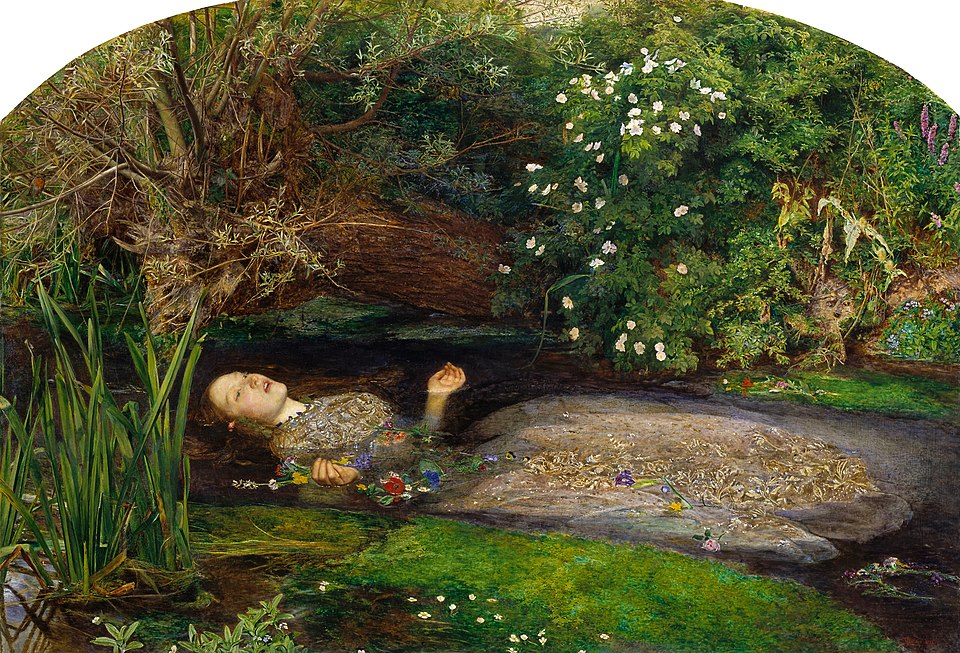
John Everett Millais’ Ophelia (1851–1852) captures a singular moment of poetic and emotional devastation. Inspired by Shakespeare’s Hamlet, the painting illustrates the final, tragic scene of Ophelia’s life—a character undone by grief, betrayal, and shattered innocence. While Shakespeare only describes her death through Queen Gertrude’s lyrical account, Millais brings that fleeting passage into vivid and poignant detail. In doing so, he elevates Ophelia from a side character to a haunting symbol of purity destroyed by a corrupt world.
Millais portrays Ophelia floating in a small English stream, her body limp, her palms open as though resigned to her fate. Her head is tilted slightly upward, lips parted softly, as if caught mid-song—just as the Bard wrote she was “chanting snatches of old tunes.” Around her, the riverbank teems with carefully rendered wildflowers, willows, and grasses, all painted with botanical precision. The water is still, yet alive with detail. Though she is lifeless, the world around her pulses with beauty. This visual contrast—Ophelia’s calm surrender against nature’s vibrant fullness—is what makes the painting so stirring.
Victorian audiences would have immediately understood the symbolic weight of Ophelia’s death. In a society that revered chastity, obedience, and emotional restraint, her fall into madness and suicide stood as both a cautionary tale and a tragedy to be mourned. Millais doesn’t sensationalize her mental breakdown or distort her story into some modern parable of rebellion. Instead, he treats her suffering with dignity, framing her death as a quiet collapse brought on by unbearable loss. There is no chaos here—only sorrow, grace, and a heavy sense of finality.
When Ophelia was first exhibited at the Royal Academy in 1852, reactions were divided. Some critics admired its technical brilliance; others found its lifelike clarity unsettling. One reviewer said the painting looked like “a clever piece of botanizing,” missing the emotional undercurrent entirely. Yet over time, its reputation grew. It became one of the defining works of the Pre-Raphaelite movement and remains today one of the most beloved pieces in the Tate Britain collection. Through it, Millais gave visual form to themes of faith, fragility, and death—timeless concerns that continue to resonate.
Shakespeare’s Ophelia – The Fallen Innocent
Ophelia’s story is one of quiet devastation. Introduced in Act I of Hamlet, she is the daughter of Polonius and the sister of Laertes—both important figures in the Danish court. Though she is in love with Prince Hamlet, her life is governed entirely by the commands of the men around her. Polonius forbids her from pursuing Hamlet, accusing the prince of dishonorable intentions. Hamlet, in turn, manipulates and rejects her as he descends into his own madness. Caught in the crossfire, Ophelia’s inner world collapses.
In Act IV, Ophelia returns to the stage disheveled and singing strange, fractured songs. Her language is loaded with symbolism—references to lost virginity, betrayal, and buried sorrow. It is clear to the audience that she has broken mentally, driven to the edge by emotional trauma. Soon after, Queen Gertrude reports that Ophelia has drowned, falling into a stream while trying to hang garlands on a willow tree. Whether it was an accident or suicide is left intentionally vague—a choice that only deepens her tragedy.
Millais based his painting on that single speech from Gertrude, and he remained remarkably faithful to Shakespeare’s description. The stream, the flowers, the willow—all are taken directly from the text. Yet he did not use these merely as props. Each element in the painting holds symbolic meaning rooted in Christian and moral traditions. Ophelia becomes more than just a literary figure; she is a visual embodiment of ruined innocence, a theme that Victorian audiences would have understood without explanation.
While many modern interpretations attempt to reframe Ophelia as a proto-feminist or victim of systemic oppression, Millais’ portrayal avoids politicization. He saw her as a person crushed by emotional betrayal—not as a metaphor for some ideology. This traditional view, rooted in faith and personal morality, is part of what gives Ophelia its quiet dignity. The painting speaks not just of one girl’s death, but of a universal sorrow—the tragedy of innocence undone by a fallen world.
Millais’ Visual Interpretation
Millais’ rendering of Ophelia’s death is filled with precision, but also poetry. Her position in the water reflects Shakespeare’s description exactly, yet the artist adds visual layers that deepen the narrative. Her face is pale and calm, eyes open but unseeing. Her red-gold hair floats like seaweed around her shoulders, while the fabric of her dress—richly embroidered—billows out beneath the surface. These small details transform the moment from mere illustration into fine art. They invite the viewer to stop, study, and reflect.
Millais used a real model—Elizabeth Siddal—for the figure of Ophelia. But the setting itself was also a real place: the Hogsmill River in Surrey. He spent months painting the background on-site, enduring harsh weather and slow progress. The result is a landscape that is not just background, but integral to the painting’s spiritual atmosphere. The viewer isn’t looking at a stage or a stylized world; this is nature as it really is, both beautiful and indifferent.
Importantly, Millais avoids sensationalism in his depiction. There is no graphic violence, no exaggerated grief. Instead, he presents Ophelia at the threshold between life and death with serenity. Her pose recalls religious imagery—open hands, upward gaze—echoing Christian martyrs or saints. In this way, Millais elevates her suffering into something sacred. This was not a woman destroyed by passion or politics, but one broken by sorrow and remembered with reverence.
Ophelia’s face, blank yet soft, resists interpretation. She doesn’t cry, scream, or resist. She simply floats—lost to the world, but held by it one last time. The emotional impact lies in that stillness. Millais invites us to witness her passing not as a spectacle, but as a moment of grace. It’s a rare kind of restraint, one that speaks volumes without shouting a word.
Symbolism in Nature and Water
The natural elements in Ophelia are more than just decorative. Millais, deeply committed to realism, also understood the spiritual weight of symbols. Every flower, tree, and plant carries meaning. Many of these references come directly from Shakespeare’s text, but Millais also added layers of Christian and moral allegory that Victorian viewers would have recognized.
Among the most notable symbols are the flowers floating around Ophelia or woven into her dress:
- Poppies: Traditionally symbols of sleep and death. Their bright red hue suggests martyrdom and final rest.
- Daisies: Represent innocence and purity—qualities Ophelia once embodied.
- Roses: Often connected to love and beauty, but also thorns and suffering.
- Violets: Referenced in the play when Ophelia mourns the loss of her father; symbolize faithfulness and mourning.
- Willow branches: Signify forsaken love, taken directly from the scene in Hamlet where she hangs her garlands.
Each flower serves as a clue to Ophelia’s story and her spiritual state. The river itself is also symbolic. In Christian tradition, water is a place of cleansing and transition—often baptism, but also death. Here, the water becomes her passage from sorrow into silence. It neither rages nor rescues. It simply carries her gently away.
Millais’ intense attention to natural symbolism connects the painting to older traditions of religious art, where every object held spiritual meaning. He wasn’t merely trying to impress with technical skill—though he certainly did—but to communicate a deeper moral reality. In Ophelia, nature is not a backdrop; it is a language, a silent witness to human grief.
Realism and Devotion: The Making of Ophelia
Millais’ Ophelia is celebrated not only for its poetic meaning but for the extraordinary labor and discipline that went into its creation. Every inch of the canvas reflects his intense dedication to accuracy and craftsmanship. He did not paint the scene in a studio using vague approximations of nature. Instead, he went into the countryside, studied his subjects firsthand, and worked for months under harsh conditions. The result is a painting that radiates both truth and reverence—firmly rooted in the natural world yet spiritually transcendent.
To paint the landscape, Millais set up his easel on the banks of the Hogsmill River near Ewell in Surrey during the summer and early autumn of 1851. He spent over four months there, painting six days a week, sometimes up to eleven hours a day. He recorded in letters how he was tormented by flies, soaked by rain, and at times deeply frustrated by the slow pace of progress. Yet he never compromised. His commitment to nature’s exact likeness was absolute. The light, foliage, water, and vegetation are all captured with such detail that modern botanists have identified nearly every species in the image.
This approach marked a turning point in British art. Before the Pre-Raphaelite Brotherhood, many landscape backgrounds were invented or composed from sketches. Millais, however, insisted on painting directly from life—a demanding and time-consuming method. His goal wasn’t just aesthetic; it was moral. He believed that to depict God’s creation honestly was a form of worship. This belief was consistent with Victorian ideals of truth, beauty, and moral integrity. Ophelia was not painted to shock or provoke but to awaken the viewer’s sense of order and spiritual loss.
By the time the landscape was complete, it was winter. Millais moved back indoors to paint Ophelia’s figure, using Elizabeth Siddal as his model. This transition marked another intense and sacrificial phase of the project. While the background may appear lush and tranquil, the story behind the figure’s creation is far from easy.
Painting the Riverbank – Months in the Wild
Millais’ dedication to painting the landscape outdoors in real time was almost obsessive. Beginning in July 1851, he returned day after day to the same spot along the Hogsmill River. He chose this location not just for its beauty, but for its historical associations with old English life and untouched nature. He believed that the river’s slow current, overhanging willows, and tangled undergrowth perfectly reflected the mood of the scene described in Hamlet.
Working en plein air (a French term meaning “in the open air”) was not common in England at the time. Millais’ choice to do so represented a dramatic break from studio-bound tradition. He brought with him a heavy canvas, easel, brushes, and oil paints—supplies that were difficult to transport and protect from the elements. His letters describe sweltering heat, passing thunderstorms, and the constant nuisance of midges and gnats. He even complained about boys from the village pelting him with stones.
But these hardships did not stop him. Millais saw nature not merely as a source of inspiration but as a standard of truth. The scene he captured in Ophelia is not an imagined grove, but a living place rendered with reverence and discipline. This approach reflected a distinctly conservative view: that art should be rooted in reality, not fantasy; in tradition, not fashion.
Elizabeth Siddal – A Muse in Suffering
The model for Ophelia was Elizabeth Siddal, a young artist and muse closely associated with the Pre-Raphaelite circle. She posed for Millais during the winter of 1851–1852, often lying fully clothed in a bathtub filled with water to simulate the floating posture of the drowned Ophelia. To keep the water warm, Millais placed oil lamps underneath the tub. Unfortunately, the lamps went out one day, and he failed to notice. Siddal remained in the cold water for hours, too polite or professional to complain. She became severely ill, developing a lung infection that lingered for months.
This incident caused a brief scandal. Siddal’s father, outraged at her treatment, demanded that Millais pay her medical bills. Millais did so, though it’s unclear whether this resolved the tension. What is clear, however, is the level of personal sacrifice made by both artist and model to achieve this work of enduring beauty. Siddal, pale and thin, had the exact physical type Millais sought for Ophelia—a woman who seemed both ethereal and earthly, innocent yet sorrowful.
Siddal was not merely a passive subject. She was an artist herself, later married to Dante Gabriel Rossetti, though her life ended in tragedy as well. In the context of Ophelia, she became an emblem of the very theme the painting portrays: the fragility of grace in a broken world. Her suffering was real, but it gave rise to one of the most moving images in Victorian art.
Millais’ treatment of her in this role remains a point of ethical discussion, but from a historical standpoint, it shows the intensity of his commitment. He didn’t just paint a girl in a stream. He recreated, through real effort and real human endurance, a moment of visual and spiritual truth that continues to speak across centuries.
Technical Mastery and Brushwork
What sets Ophelia apart technically is Millais’ stunning use of detail and color. The entire painting is executed in oil on canvas, measuring 76.2 cm by 111.8 cm (30 inches by 44 inches). Despite its size, no space is wasted. Every area—foreground, midground, and background—is packed with crisp, deliberate brushwork. Millais used fine, pointed brushes and layered his paint with great care, producing a luminous surface that glows even today.
The palette of the work is naturalistic but carefully harmonized. Greens, browns, golds, and soft blues dominate the background, evoking a calm summer’s day. Ophelia herself wears a silvery gown that shimmers with embroidered gold. Her skin tone, pale and ivory-like, contrasts with the dark water and wild vegetation. This balance of color draws the eye straight to her figure, while still allowing the viewer to linger on the countless details in the scene.
Millais achieved depth not through dramatic lighting, but through precision and tone. There are no sharp shadows or artificial effects. The realism is so complete that when viewed in person, many people feel as if they could step into the painting. This immersive quality is what Pre-Raphaelite painting aimed for—and few achieved it as completely as Millais did in Ophelia.
This level of craftsmanship was not quick, nor was it fashionable. It stood in contrast to the emerging trends of loose brushwork and emotional abstraction that would take hold later in the century. For Millais, discipline, truth, and beauty were inseparable. Ophelia was not a mood or an impression—it was a statement of enduring moral vision.
Cultural Legacy: Ophelia’s Enduring Power
Though painted in 1851–1852, Ophelia continues to captivate viewers nearly two centuries later. It remains one of the most visited and beloved artworks in Tate Britain’s collection, frequently reproduced in textbooks, documentaries, and even modern fashion and film. But Ophelia’s legacy goes deeper than surface fame. The painting stands as a lasting monument to beauty, moral seriousness, and artistic discipline—values often pushed aside in today’s cultural climate. Unlike much of today’s art, which leans into shock, irony, or nihilism, Millais’ Ophelia radiates timeless reverence.
Its enduring appeal lies partly in its synthesis of artistic mastery and emotional clarity. Millais didn’t rely on gimmicks or ideology to leave an impact. Instead, he trusted the power of technical skill and honest storytelling. That trust has paid off. Viewers of all ages, across all generations, are drawn into the painting’s calm yet sorrowful atmosphere. They see not just a dead girl, but a vanished world—a world where innocence mattered, where grief was sacred, and where nature still whispered of higher things.
In an era increasingly dismissive of traditional beauty and rooted meaning, Ophelia stands as a reminder of what art can be. It proves that the greatest works are not always the loudest, the boldest, or the most politically charged. Sometimes, a quiet, faithful depiction of one soul’s suffering can shake hearts more deeply than any slogan or protest. Millais’ work invites reflection, not reaction. It asks us to slow down, to look closer, and to remember what we’ve lost.
As the modern world grows louder and more chaotic, Ophelia offers something rare: stillness. That stillness is not empty—it is full of memory, morality, and the subtle echo of Shakespeare’s verse. It is a visual prayer for the broken-hearted, rendered in oil and water. And in that silence, many find something truly profound.
The Tate’s Beloved Masterpiece
Ophelia has been part of the Tate collection since 1894, when it was acquired by Sir Henry Tate for the newly formed National Gallery of British Art (now Tate Britain). It has rarely left its home, due to both its fragility and its status as a national treasure. The painting is consistently ranked among the top-viewed works in the museum, drawing attention from school groups, art historians, and tourists alike.
Its position in the Tate galleries is prominent, often showcased with other Pre-Raphaelite masterpieces. Conservationists at the museum take special care to maintain the vibrancy of its colors and the stability of its delicate canvas. Due to the richness of Millais’ materials and his refined technique, the painting has aged remarkably well. The luminous greens, soft blues, and golden accents still shine as they did over 170 years ago.
The Tate has included Ophelia in many major exhibitions, both in London and abroad. It has traveled sparingly—appearing in retrospectives in Japan and Australia—but such loans are rare due to the painting’s significance and fragility. Its permanent home, Room 1840 at Tate Britain, is a pilgrimage site for those seeking a deeper experience of British art’s golden age.
The museum provides detailed documentation on Ophelia, including close-up imaging, historical background, and conservation updates. Visitors can examine Millais’ technique through magnified studies, learning how every stroke contributed to the larger whole. This commitment to transparency and education reflects the reverence that the Tate—and the nation—hold for the painting.
Echoes in Film and Fashion
Though firmly rooted in the 19th century, Ophelia has echoed across modern visual culture. Its influence can be seen in period films, photography, and even high fashion—especially in Britain and Europe. The image of a woman floating in water, surrounded by natural beauty and tragedy, has become an archetype. Many stylists and directors have recreated the visual tone of Ophelia, paying homage (sometimes unknowingly) to Millais’ vision.
One of the most notable adaptations was in Kenneth Branagh’s 1996 film Hamlet, where actress Kate Winslet portrayed Ophelia with a visual reference to Millais’ painting. Her costume, pose, and watery surroundings were directly inspired by the artwork. The scene was lauded for its faithfulness and restraint, echoing the same haunting mood that Millais captured.
In fashion, designers have drawn on Ophelia’s floral themes and soft, romantic palette. Lace dresses, long sleeves, and flower crowns appear in seasonal campaigns as nods to Victorian melancholy. Pre-Raphaelite-inspired photo shoots have appeared in Vogue, Harper’s Bazaar, and various bridal magazines, reinforcing the aesthetic impact of the painting. Though these references often lack the spiritual depth of the original, they nonetheless show the image’s lingering resonance.
Even modern photographers have used the painting as a template for artistic portraiture. Images of women lying in shallow water, eyes open, surrounded by flowers and flowing fabric, are now familiar to social media and art platforms. While some of these images cheapen the meaning behind Millais’ work, others pay sincere tribute to its quiet power. What remains constant is the unmistakable visual code: serenity, sorrow, and fragile beauty.
Why It Still Matters Today
In a cultural moment where truth is often blurred and traditional standards are under siege, Ophelia still matters—perhaps more than ever. It is a counter-argument to the modern cult of shock and spectacle. It reminds us that beauty matters, that technical skill still counts, and that moral stories told with restraint have lasting power. Millais’ masterpiece offers a visual refuge for those weary of cynicism.
The painting speaks to the universal human experience: love, loss, faith, and the cost of broken trust. It doesn’t scream, mock, or pander. It simply shows. And in that showing, it restores something essential—a sense of quiet order in a disordered world. That kind of restoration is not political. It is spiritual.
Millais also reminds us that suffering should be treated with reverence, not reduced to slogans. Ophelia’s death isn’t dramatized for entertainment or politicized for an agenda. It is mourned, dignified, and made beautiful in its sorrow. That’s a lesson often lost in an age obsessed with utility and instant reaction.
Above all, Ophelia remains relevant because it tells the truth. Not in a shouted or boastful way, but with a steady hand and a quiet heart. For all the changes in taste, technology, and theory, that truth endures. And that, more than anything else, is what makes Ophelia a masterpiece.
Key Takeaways
- Ophelia was painted by John Everett Millais between 1851–1852 and is based on Shakespeare’s Hamlet.
- The painting exemplifies Pre-Raphaelite values: truth to nature, moral clarity, and detailed realism.
- Elizabeth Siddal posed for the figure of Ophelia under harsh conditions, reflecting the sacrifice behind the art.
- The painting is filled with symbolic flora, reflecting themes of purity, lost virtue, and spiritual decay.
- It remains a cornerstone of British art, housed at Tate Britain and revered for its lasting emotional and aesthetic impact.
FAQs
What is the significance of the flowers in Ophelia?
- Each flower holds symbolic meaning, often drawn from Christian or classical traditions. They represent innocence, grief, love, and death.
Where was Ophelia painted?
- The background was painted outdoors along the Hogsmill River in Surrey, England. Millais worked there for over four months.
Who was the model for Ophelia?
- Elizabeth Siddal, an artist and poet, modeled for the figure. She later married Dante Gabriel Rossetti.
What makes this painting important in art history?
- Ophelia exemplifies the Pre-Raphaelite Brotherhood’s commitment to naturalism and moral storytelling, influencing generations of artists.
Where is the painting located today?
- It is part of the permanent collection at Tate Britain in London, and rarely leaves the museum due to its importance and fragility.