Harvest time has always carried real weight in European life. For centuries, it meant the difference between comfort and hardship, between a secure winter and a dangerous one. That pressure shaped not only daily routines but also belief systems, celebrations, and eventually, art. Painters across Europe returned again and again to harvest scenes, not because they were simple, but because they captured something essential about human survival and order. These works reveal more than fields and labor—they show how people understood time, faith, and their place in the world.
The Cultural Roots of Harvest Festivals in Europe
Ancient Traditions and Pagan Origins
Long before Christianity took hold, European societies marked the harvest with rituals tied to the natural world. In ancient Greece, festivals honoring Demeter—the goddess of agriculture—date back at least to the 7th century BC. The Eleusinian Mysteries, celebrated annually near Athens, centered on the cycle of planting and reaping, symbolizing both agricultural renewal and the human experience of life and death. In Rome, the festival of Ceres followed similar themes, linking grain production to divine favor and civic stability.
These traditions shaped early visual culture. Roman mosaics from the 1st through 3rd centuries AD frequently show scenes of abundance—overflowing baskets, sheaves of wheat, and workers in the fields. These images were not decorative alone; they reflected a worldview in which prosperity depended on harmony between human effort and natural forces. The harvest stood as a visible sign that this balance had been achieved.
Even after the fall of the Western Roman Empire in the 5th century AD, these symbolic associations endured. Wheat remained a central motif, representing both sustenance and continuity. The act of harvesting carried deeper meaning, suggesting not only the gathering of crops but also the completion of a cycle. These early ideas would continue to influence European art for centuries.
Christian Adaptations and Feast Days
As Christianity spread across Europe between the 4th and 10th centuries AD, older agricultural traditions were reshaped rather than erased. The Church incorporated harvest celebrations into its calendar, giving them new meaning while preserving their seasonal timing. Instead of honoring pagan deities, these festivals became expressions of gratitude to God for the year’s yield.
One of the earliest recorded examples is Lammas Day, observed on August 1 in Anglo-Saxon England by the 7th century AD. The name comes from “loaf mass,” marking the baking of bread from the first harvested grain. Another important date was Michaelmas, held on September 29, which signaled the end of the harvest season and the preparation for winter. These events reinforced the idea that agricultural success was part of a larger divine order.
Common harvest observances included:
- Lammas (August 1)
- Michaelmas (September 29)
- Harvest Home (late September or early October)
These traditions appeared regularly in medieval art, especially in illuminated manuscripts. In the early 15th century, the Limbourg Brothers created the Très Riches Heures du Duc de Berry (c. 1412–1416), one of the most detailed visual calendars of the period. Each month is paired with a seasonal activity, including grain harvesting in summer scenes. The imagery blends daily labor with a sense of structure and purpose, reinforcing the idea that work in the fields was part of a larger, ordered world.
Rural Life as a Cultural Backbone
For most of European history, rural life was not a theme—it was reality. The majority of people lived and worked on the land, and agriculture formed the backbone of the economy. This reality naturally found its way into art, even when works were commissioned by nobles or wealthy patrons.
In the 14th and 15th centuries, tapestries produced in regions like Flanders began to include increasingly detailed depictions of agricultural labor. These were not symbolic gestures; they showed real tools, real clothing, and recognizable tasks. Harvest scenes often conveyed stability and prosperity, suggesting that the land was productive and well-managed.
By the late Middle Ages, artists were paying closer attention to the specifics of rural life. This growing interest in observation set the stage for a major shift during the Renaissance. Instead of using harvest imagery as background decoration, artists began to treat it as a subject worth exploring on its own terms.
Harvest Scenes in Renaissance and Northern Art
Pieter Bruegel the Elder and Peasant Life
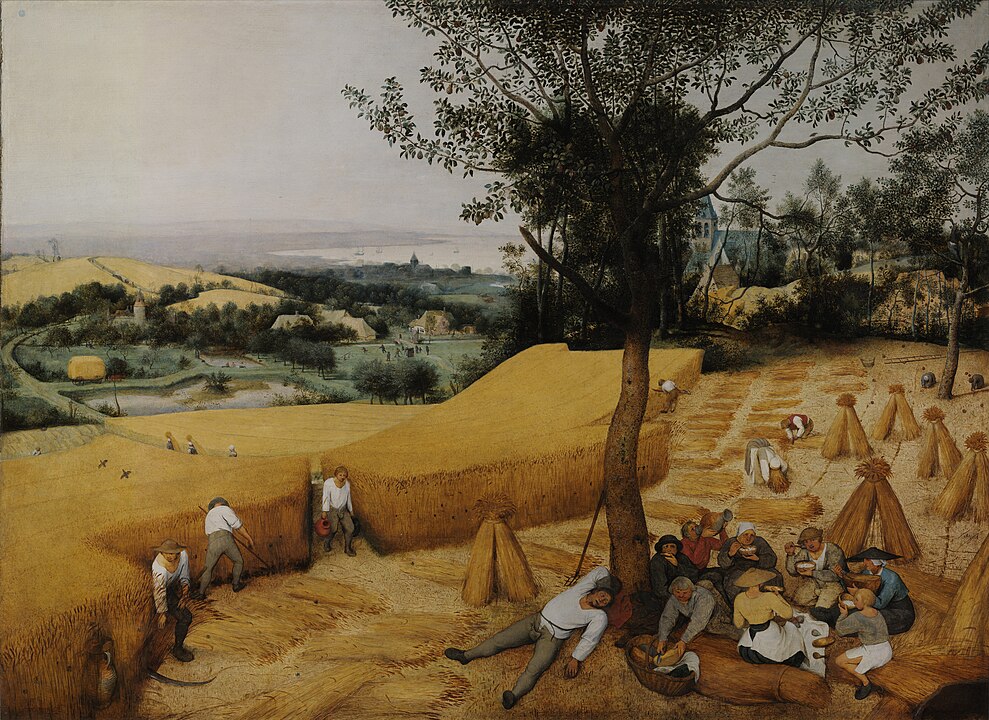
In the mid-16th century, painters in Northern Europe began to focus more directly on everyday life. Among them, Pieter Bruegel the Elder stands out for his detailed and structured depictions of rural activity. His painting The Harvesters, completed in 1565, is one of the most well-known examples. Executed in oil on wood panel and measuring approximately 118 by 161 centimeters, it is part of a larger series representing the months of the year.
In this work, Bruegel presents a wide view of harvest activity. Workers cut wheat in the foreground, while others gather, rest, or eat beneath a tree. The scene unfolds under a warm, golden light, suggesting the late summer season. Unlike earlier art, which often treated peasants as secondary figures, Bruegel places them at the center of the composition.
This approach reflects a broader shift in artistic priorities. Rather than focusing solely on religious or mythological subjects, Bruegel gives attention to the rhythms of ordinary life. The harvest becomes a subject worthy of careful observation, not just symbolic reference. The result is a painting that feels both grounded and deliberate.
Symbolism Within Everyday Labor
Although The Harvesters appears straightforward, it carries layers of meaning. Harvesting has long been associated with the passage of time. Crops must be cut at their peak, a reminder that all things reach a moment of completion. This idea would have been familiar to viewers in the 16th century, even without explicit symbols.
At the same time, the painting shows balance. Some figures work, while others rest or eat. This contrast suggests that life is not defined by labor alone. There is a rhythm to it—effort followed by recovery. That rhythm mirrors the agricultural cycle itself, reinforcing the connection between human activity and the natural world.
Bruegel avoids overt moral lessons, but the structure of the scene implies order. Each figure has a role, and each action contributes to the whole. The harvest is not chaotic; it is organized and purposeful. This sense of order reflects broader beliefs about how society should function.
Landscape as Narrative
One of Bruegel’s most important contributions is his treatment of landscape. In earlier works, landscapes often served as simple backdrops. In The Harvesters, the land itself plays a central role. Rolling fields stretch into the distance, dotted with workers and small clusters of activity. A village appears far off, linking the fields to a larger community.
This expanded view allows the viewer to understand the harvest as part of a broader system. The work being done in the foreground connects to everything beyond it—the storage of grain, the life of the village, and the coming winter. The painting does not isolate a single moment; it shows a process unfolding across space and time.
This approach influenced later artists across Northern Europe. By treating landscape as an active element in storytelling, Bruegel helped shape the development of both genre painting and landscape painting as independent forms. Harvest scenes played a key role in that transition.
Baroque to 19th Century: From Labor to Romanticism
Baroque Interpretations of Abundance
During the Baroque period, roughly from 1600 to 1750, artists approached traditional subjects with greater intensity. Harvest imagery did not disappear, but it changed in tone. Instead of focusing on the process of gathering crops, many works emphasized the results—full baskets, overflowing tables, and signs of plenty.
Painters in regions such as Flanders and Italy often included harvest elements in larger allegorical compositions. Fruit, grain, and livestock were arranged in dramatic displays, sometimes accompanied by figures representing seasons or virtues. These images highlighted abundance as a sign of prosperity and order.
Light played an important role in these works. Strong contrasts between brightness and shadow created a sense of depth and movement. Even when the subject was rural, the presentation could feel theatrical. The harvest was no longer just a task; it became a symbol of success and fulfillment.
Jean-François Millet and Rural Realism
By the mid-19th century, European society was changing rapidly. Industrialization was drawing people into cities, and traditional rural life was beginning to shift. In this context, some artists turned their attention back to the countryside, focusing on the realities of agricultural work. Jean-François Millet was one of the most important figures in this movement.
His painting The Gleaners, completed in 1857, shows three women collecting leftover grain after the main harvest. Painted in oil on canvas and measuring 83.5 by 111 centimeters, the work presents a quiet but powerful scene. The women bend low to the ground, repeating the same motion again and again.
In the distance, a larger harvest unfolds, with stacks of wheat and figures overseeing the work. The contrast is clear. While there is abundance, not everyone benefits equally from it. Millet does not exaggerate the scene. He presents it plainly, allowing the viewer to observe the difference between those who own the land and those who depend on what remains.
Romanticism and Nostalgia for Rural Life
As the 19th century progressed, many artists began to look at rural life with a sense of distance. Rapid urban growth created a divide between city and countryside, and that distance often led to nostalgia. Harvest scenes became less focused on hardship and more centered on atmosphere and memory.
Painters influenced by Romanticism often depicted the countryside as calm and stable. Fields were shown under warm light, and figures appeared integrated into the landscape rather than struggling against it. The harvest became a moment of quiet fulfillment rather than intense labor.
This shift did not erase earlier traditions, but it changed their tone. The same subjects—fields, workers, and crops—remained, but their meaning evolved. Instead of emphasizing survival, these works often suggested continuity and peace. For viewers living in rapidly changing cities, such images offered a sense of connection to an older way of life.
Symbolism and Meaning in Harvest Imagery
Cycles of Life and Death
Harvest imagery has long been tied to the idea of cycles. Crops are planted, grow, and are eventually cut down. This process mirrors the human experience, where life follows a similar path. Artists across centuries have used harvest scenes to reflect this connection, often without stating it directly.
The timing of the harvest reinforces this idea. It takes place at the end of a growing season, just before the onset of colder months. This position between growth and decline gives it a dual meaning. It represents both completion and transition, a moment when one phase ends and another begins.
In many works, this meaning is embedded in the structure of the scene. Figures work steadily, aware that their task must be finished before conditions change. The urgency is not always dramatic, but it is present. The harvest becomes a quiet reminder that time moves forward, whether noticed or not.
Community, Celebration, and Survival
While harvest scenes often show labor, they also include moments of rest and celebration. After long days in the fields, communities would gather to share food, drink, and time together. These gatherings marked the successful completion of a demanding season.
Artists frequently included these elements in their work. Figures might be shown eating under a tree, talking in small groups, or pausing from their tasks. These details add depth to the scene, showing that the harvest is not only about work but also about connection.
At the same time, these moments carry practical meaning. A successful harvest ensured survival through the winter months. The sense of relief and satisfaction visible in these scenes reflects that reality. Celebration was not separate from necessity—it was a response to it.
Moral and Religious Interpretations
Harvest imagery has also been used to express moral ideas. The concept of reaping what one has sown appears in both religious and everyday contexts. In Christian teaching, it often serves as a reminder that actions have consequences, both good and bad.
Artists incorporated this idea in subtle ways. A well-ordered harvest could suggest diligence and reward, while neglected fields might imply the opposite. These messages were rarely direct, but they were understood within the cultural context of the time.
Common symbols found in harvest imagery include:
- Wheat, representing sustenance and life
- Scythes, associated with cutting and completion
- Baskets, indicating gathering and provision
- Sunlight, suggesting growth and divine favor
These elements work together to create layered meanings. On the surface, they show a familiar activity. Beneath that, they reflect ideas about effort, reward, time, and belief. That combination is what has made harvest scenes such a lasting presence in European art.
Key Takeaways
- Harvest scenes reflect the central role of agriculture in European life for centuries
- Ancient traditions shaped later Christian and artistic interpretations of the harvest
- Renaissance artists like Pieter Bruegel elevated rural labor into a serious subject
- 19th-century painters such as Millet highlighted both dignity and hardship in rural work
- Harvest imagery carries layered meanings tied to time, survival, and moral order
FAQs
- Why were harvest scenes so common in European art?
Because agriculture was the foundation of society, making harvest a critical and meaningful subject. - What does the harvest symbolize in art?
It often represents cycles of life, effort and reward, and the passage of time. - Who painted famous harvest scenes?
Pieter Bruegel the Elder and Jean-François Millet are among the most recognized artists. - Were harvest scenes realistic or symbolic?
They were both—grounded in real life but often carrying deeper meanings. - Did industrialization affect harvest imagery?
Yes, it led to more nostalgic and reflective portrayals of rural life in the 19th century.