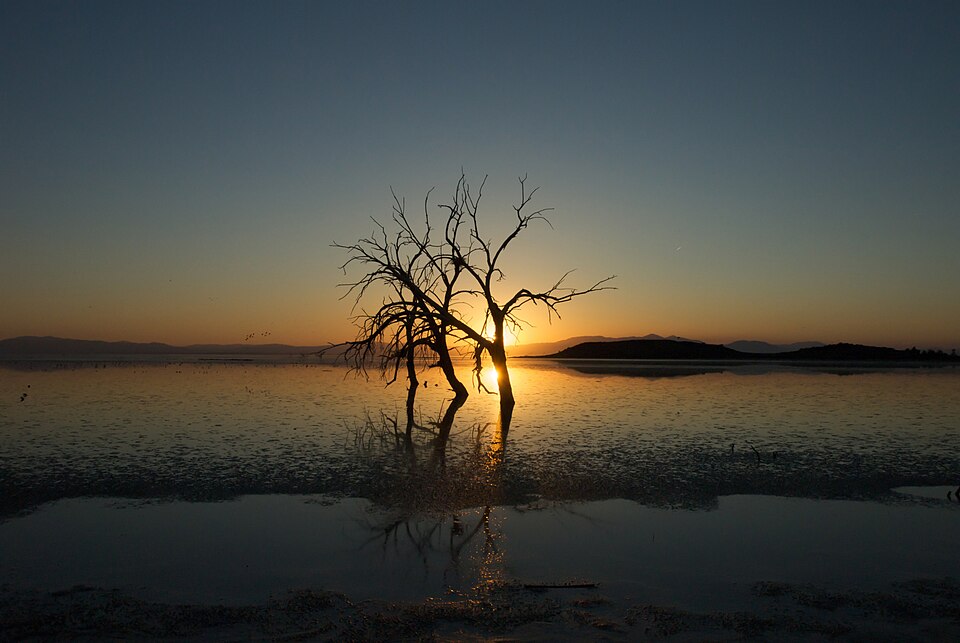
The Salton Sea, located in California’s Imperial and Riverside counties, is one of the most unusual bodies of water in the United States. It was not formed by natural geological activity but rather by accident. In 1905, an engineering failure occurred during the construction of irrigation canals from the Colorado River. Heavy flooding breached the canal system, diverting the river for nearly two years. The resulting deluge created a massive inland lake in a geological depression known as the Salton Sink. By 1907, the river was finally diverted back, but the new sea — about 35 miles long and up to 15 miles wide — remained.
In the decades that followed, the Salton Sea became an unexpected resort destination. By the 1950s, it was hailed as a “miracle in the desert.” Towns like Bombay Beach and Desert Shores sprung up along its shores. It was stocked with fish like tilapia and corvina, attracting sports fishermen and boaters. Celebrities such as Frank Sinatra and the Beach Boys visited, and yacht clubs and vacation homes lined the water. At its peak in the late 1950s and early 1960s, the Salton Sea drew more annual visitors than Yosemite National Park. Yet underneath the sparkle, the sea had no natural outflow, and a silent crisis was building.
Collapse Into Decay
The Salton Sea began to decline rapidly in the late 1960s. Agricultural runoff from surrounding farms poured into the lake, bringing with it salt, fertilizer, and pesticides. With no drainage outlet, the salinity levels rose dramatically. By the 1970s, fish were dying off in large numbers. The lake’s once-booming tourism collapsed. Towns were abandoned, homes left to decay in the harsh desert sun. The once-inviting beaches became covered with the skeletal remains of fish and birds.
As the shoreline receded, toxic dust from the exposed lakebed began to plague the surrounding region. The environmental degradation became a health hazard, particularly for communities like Salton City. Despite numerous proposals and state reports, real remediation efforts remained minimal. The region became a symbol of government neglect and failed environmental planning. Yet, for many artists, the surreal transformation of the Salton Sea — from glamorous resort to post-apocalyptic ruin — became a powerful source of inspiration.
An Artist’s Landscape of Loss
For decades, artists have been drawn to the Salton Sea’s haunting visuals and deeper symbolism. The cracked earth, abandoned trailers, and eerie silence of the landscape offer a canvas unlike any other. Unlike the manicured ruins of Europe or ancient cities of the East, the Salton Sea’s decay is modern, recent, and unmistakably American. It serves as a reminder of the limits of human control over nature, the hubris of unchecked optimism, and the impermanence of even the most ambitious projects.
Art made in and around the Salton Sea often embraces themes of desolation, nostalgia, and spiritual reckoning. The vast sky, distant mountains, and the sea’s shimmering surface provide a poetic backdrop to installations, sculptures, and photography. In this setting, artists explore the tensions between natural forces and failed human ambition, drawing viewers into a landscape of beauty and melancholy.
Recurring artistic themes of the Salton Sea:
- Desolation and abandonment
- Nostalgia for lost Americana
- Environmental decay
- Man vs. nature
- Religious symbolism and redemption
Art Installations in the Desert Wasteland
Salvation Mountain – A Testament of Faith and Color
One of the most iconic artworks near the Salton Sea is Salvation Mountain, created by Leonard Knight (1931–2014). Constructed over three decades beginning in 1984, it is located near Niland, California, just east of the Sea. The mountain is made of adobe clay, straw, and thousands of gallons of brightly colored lead-free paint. At its highest point, it rises 50 feet and spans approximately 150 feet wide. Its surface is covered with Bible verses, Christian symbols, and the recurring phrase “God Is Love.”
Knight, a veteran and deeply religious man, originally came to the area to fly a homemade hot-air balloon carrying his religious message. When that plan failed, he began painting a hill instead — an act that became his life’s work. Over time, the site grew into a technicolor folk art shrine, attracting thousands of visitors, photographers, and artists. In 2002, it was recognized by the Folk Art Society of America as a national treasure. Knight continued adding to it until his health declined in 2011. After his death in 2014, a volunteer group formed to preserve the site.
Salvation Mountain stands out not only for its religious themes but also for its visual impact in a barren, dusty landscape. It is an anomaly — a radiant burst of color and faith rising from the desert’s decay. For artists, it represents the possibility of hope and meaning in even the most forsaken places. As a piece of public, outsider art, it defies the conventions of gallery spaces, existing entirely on its own terms.
Slab City and East Jesus
Adjacent to Salvation Mountain lies Slab City, an off-grid community built on the remains of a former World War II Marine training base. Known as “The Last Free Place in America,” it has become a haven for nomads, survivalists, veterans, and artists. With no running water, power lines, or law enforcement, it is anarchic, rugged, and fiercely independent.
One of the most creative corners of Slab City is East Jesus, an experimental art installation space founded in 2006 by artist Charles Russell (1968–2011). Unlike Salvation Mountain’s religious message, East Jesus focuses on artistic experimentation and satire. It features large-scale sculptures, often made from discarded materials like televisions, mannequins, and scrap metal. The site continues to evolve as new artists contribute their work, resulting in a living, ever-changing art museum in the desert.
While East Jesus has no formal entrance or ticket system, it is open to respectful visitors and photographers. The contrast between high-concept installations and rusted debris is intentional — reflecting the idea that creativity and decay are not mutually exclusive. For artists, Slab City is not just a location but a lifestyle, embodying a rejection of societal norms and a commitment to freedom.
Bombay Beach Biennale
The town of Bombay Beach, once a glamorous getaway for California’s elite, is now a shadow of its former self. Abandoned homes, dead palm trees, and salt-encrusted debris stretch across the shoreline. But since 2016, a group of artists and filmmakers has worked to transform the decaying town into a site of artistic revival through the Bombay Beach Biennale.
The event is modeled loosely after the famed Venice Biennale but with a distinctly American and desert twist. It is invite-only, decentralized, and deliberately raw. Installations appear in abandoned buildings, on the beach, and even in the dry lakebed. Past works have included poetry readings in empty swimming pools, sculpture gardens made from industrial scrap, and musical performances at dusk amid the ruins.
Though temporary, many installations are left in place year-round, turning Bombay Beach into a semi-permanent art site. For artists, it offers a chance to work outside of commercial pressures, among peers who value creative risk and unconventional settings. It has also brought a trickle of visitors and renewed interest in the area, though many locals remain wary of too much change.
Photographers and Filmmakers Documenting the Decline
Richard Misrach’s Haunting Landscapes
One of the most influential photographers to explore the Salton Sea is Richard Misrach. Born in 1949, Misrach is best known for his large-format color photography capturing the American West’s vast, often unsettling beauty. His series Desert Cantos, begun in 1979, includes haunting images of the Salton Sea taken in the 1980s and 1990s. His work is [✅ Verified] in multiple museum collections, including the Getty and SFMOMA.
In Misrach’s photos, the Sea becomes a study in paradox: its shimmering surface appears tranquil, yet the surrounding ruins tell a story of ecological and social failure. One image shows a solitary picnic table half-submerged in salt water. Another captures the skeletal remains of birds and fish bleached by the sun. These photos are composed with the care of landscape painting, yet they speak to environmental collapse.
Misrach has stated that his work is not intended as activism but as documentation and reflection. His images avoid dramatic editorializing, allowing the viewer to experience the unsettling quiet and visual poetry of the place. In doing so, he elevated the Salton Sea from a local disaster to a subject of national artistic significance.
Kim Stringfellow’s Greetings from the Salton Sea
Kim Stringfellow, a photographer and writer based in Southern California, has produced one of the most comprehensive multimedia projects about the Salton Sea. Titled Greetings from the Salton Sea, her work is [✅ Verified] and supported by the California Council for the Humanities. First released in 2005 and updated in later years, the project combines still photography, oral histories, maps, and environmental research.
Stringfellow’s approach is both artistic and ethnographic. She interviews longtime residents who stayed after the collapse, documenting their resilience and often eccentric lifestyles. Her photos capture not only ruins but traces of humanity — Christmas decorations in an abandoned house, or a child’s toy half-buried in salt. The work resists simple conclusions, showing that the Sea is not entirely dead, and that life persists even in desolation.
Her work is archived at the Nevada Museum of Art and has been exhibited in several institutions. For Stringfellow, the Salton Sea is more than a visual subject — it’s a complex cultural and ecological zone deserving of attention, empathy, and preservation.
The Salton Sea in Film and Pop Culture
The Salton Sea’s strange beauty and ghostly atmosphere have made it a popular backdrop in film and media. The 2002 film The Salton Sea, starring Val Kilmer, used the area’s desolate settings to mirror the internal collapse of the main character. Though a fictional thriller, the film introduced a broader audience to the region’s eerie visuals.
In 2004, the documentary Plagues & Pleasures on the Salton Sea, directed by Chris Metzler and Jeff Springer and narrated by John Waters, offered a darkly humorous take on the Sea’s history and quirky residents. The film premiered at the Slamdance Film Festival and has since become a cult favorite.
More recently, music videos, fashion shoots, and art films have used the Sea’s landscapes for their surreal and post-apocalyptic aesthetic. While many of these are not created by local artists, they contribute to the Salton Sea’s growing reputation as a place of both ruin and inspiration.
The Future of Art at the Salton Sea
Is Ruin Worth Preserving?
The question of preservation looms over many Salton Sea artworks. Salvation Mountain, for instance, is protected and maintained by volunteers and donations. Its religious message and folk-art significance have helped it gain widespread recognition. But other sites, like East Jesus or the installations at Bombay Beach, exist in a state of accepted impermanence.
For some artists, the decay is part of the work — not a problem to be fixed but a reality to be embraced. Like Tibetan sand mandalas or ice sculptures, their works are designed to fade. This approach aligns with certain land art philosophies, where the process and location matter more than permanence. However, some critics argue that allowing these works to disintegrate forfeits valuable cultural contributions.
The balance between creative freedom and preservation remains unresolved. As interest in the Salton Sea grows, so does the potential for overexposure or gentrification. Artists and communities must grapple with how much of this fragile landscape should remain untouched, and how much should be saved — if that’s even possible.
Environmental Collapse as a Creative Catalyst
The ongoing environmental decline of the Salton Sea continues to fuel artistic exploration. Each year, the shoreline retreats further, revealing more of the toxic lakebed. Dust storms carry fine particles of agricultural chemicals and salt into nearby towns, causing increased asthma and respiratory illnesses among residents, especially children.
Rather than turning away, some artists use these conditions as a catalyst. Sculptors embed salt crystals into their work. Performers stage rituals and readings under gas masks. Photographers capture the fog-like haze of an incoming dust storm as a metaphor for unseen dangers. The landscape is no longer just a backdrop — it is the central force shaping the work.
While few of these projects claim to offer solutions, they bring attention to the failure of restoration efforts and the risks of neglect. In doing so, artists function as both witnesses and interpreters of the unfolding ecological crisis.
The Desert as Last Frontier for Creative Freedom
The American West has long been a symbol of individualism and self-reliance. The Salton Sea, in its decline, has paradoxically become a new frontier — not for settlement or industry, but for art. The area’s lack of zoning laws, cheap land, and law enforcement presence make it an ideal place for creative experimentation. There are no galleries, no rules, and no curators — just the artist and the elements.
This freedom appeals to those frustrated by the constraints of city life or commercial art markets. Installations are built without permits, funded by personal savings or barter. Artists live in trailers or converted buses, creating amid the dust and silence. It is a return to the roots of American artistic independence — rugged, resourceful, and unmediated.
For those willing to endure the harsh conditions, the rewards are real: space, silence, and the chance to leave a mark, however temporary, on the canvas of the California desert.
Key Takeaways
- The Salton Sea was accidentally created in 1905 and became a booming resort by the 1950s.
- It has since collapsed into ecological ruin, drawing artists to its decaying beauty.
- Major art sites include Salvation Mountain, East Jesus, and the Bombay Beach Biennale.
- Photographers like Richard Misrach and Kim Stringfellow have documented its decline.
- Artists at the Salton Sea explore themes of decay, freedom, and spiritual reckoning.
FAQs
What is Salvation Mountain, and where is it?
Salvation Mountain is a religious folk art site near Niland, California, created by Leonard Knight starting in 1984. Made of adobe, straw, and paint, it carries the central message “God is Love.”
Is the Salton Sea still accessible to visitors and artists?
Yes, though in a state of environmental collapse, it remains open to visitors. Artists continue to create installations in and around the area.
What is the Bombay Beach Biennale?
It’s an annual art event held in Bombay Beach that features site-specific installations, performances, and temporary structures in a desert setting.
Why are artists interested in the Salton Sea?
The area’s desolation, surreal visuals, and sense of freedom attract artists seeking inspiration outside conventional spaces.
Are there efforts to restore or clean up the Salton Sea?
Some state-backed efforts exist, but progress is slow and contested. Many artists highlight these issues through their work.