Long before Arkansas existed as a state—or even as a territorial concept—its rivers, ridges, and floodplains were home to some of the most visually complex pre-Columbian cultures in North America. From around AD 900 to 1600, people belonging to the Mississippian cultural sphere occupied large parts of what is now eastern and southern Arkansas. They built monumental earthworks, shaped ritual landscapes, and crafted objects that fused utility with symbolism. Today, much of this visual culture survives through excavation: carved marine shells, effigy pots, engraved stone tablets, and ceremonial copper. These were not “art” as modern institutions define the word. They were spiritual tools, expressions of lineage, and instruments of social order—designed to last long after the people who made them were gone.
Mounds as Stage and Structure
The most enduring public works in early Arkansas were not buildings, but earth. Throughout the Mississippi Valley, Native societies constructed mounds of compacted earth—some flat-topped, others conical or ridged. These were not haphazard piles but engineered platforms, aligned to celestial events and integrated into sacred landscapes. In Arkansas, the Toltec Mounds site (now Plum Bayou Mounds) near Scott is one of the most studied examples. Dating from AD 650 to 1050, it predates classic Mississippian centers like Cahokia, but shares key features: central plazas, elevated structures, and sightlines that reflect astronomical calculation.
Mounds served multiple purposes—ritual, political, funerary—but always in conjunction with visual display. Ceremonies performed atop these platforms would have been visible to surrounding spectators, transforming religious acts into communal theater. The objects placed within burial mounds or at their foundations—shell ornaments, fired clay figures, copper tools—served both symbolic and spiritual functions. They were offerings, but also messages: images designed to travel with the dead, or to assert the status of the living.
What makes these forms particularly compelling today is their integration of geometry and cosmology. Mound alignments often point to solstice events, lunar cycles, or cardinal directions. In other words, earth itself was shaped into a calendar. The placement of an image—an engraved shell, a stylized effigy—was never arbitrary. It existed within a landscape of ritual time.
Motifs in Clay and Shell
Some of the most intricate objects to survive from early Arkansas were not monumental, but portable. Among the most frequently recovered artifacts are shell gorgets—pendant disks carved from marine conch shell, often engraved with complex motifs. These were worn around the neck, typically buried with high-status individuals, and frequently display themes common across the Mississippian world: the so-called “Birdman” figure (a raptor-headed human form), serpents, sun circles, and cross-in-circle designs thought to reference the four cardinal directions. Though their meanings are still debated, the repetition of these motifs across hundreds of miles suggests a shared visual language—a system of sacred symbols understood from Illinois to Louisiana, and very much alive in what is now Arkansas.
In fired clay, another key form emerges: the effigy vessel. These are ceramic pots shaped in the form of animals, humans, or hybrids of both. Some are vividly expressive—glaring owls, squat frogs, grinning faces—while others are more schematic. The Parkin Site, located at the confluence of the St. Francis and Tyronza Rivers, has yielded a particularly rich set of effigy ceramics. The figures here often sit or crouch, their postures suggesting ritual roles. Many were found in burial contexts, reinforcing the idea that these objects accompanied the dead as symbolic protectors, guides, or ancestral markers.
It’s notable that these objects, while sophisticated in design, often show signs of everyday use: wear around the rim, traces of soot, repairs with clay. They were not merely ceremonial—they were part of daily life, brought into sacred contexts when needed. The boundary between use and veneration was porous.
Three especially striking forms found in Arkansas excavations include:
- Engraved sandstone tablets from the Spiro and Caddo-related cultures, depicting abstract symbols and possibly calendrical information
- Double-headed effigy pots, some thought to represent duality or conflict resolution in ceremonial settings
- Stylized human figurines with flattened heads and elaborate hair treatments, possibly linked to rites of status or puberty
These are not decorative objects. They are embedded in systems of belief, power, and kinship—systems no longer intact, but partly decipherable through the visual logic of their forms.
The Problem of Interpretation
Modern readings of Mississippian art are often speculative—and sometimes, misleading. Much of what we know about ancient Arkansas cultures comes from archaeological excavation, particularly from the early to mid-20th century. These digs, often conducted with inadequate context or without tribal consultation, led to misattribution and overreach. Scholars from the 1920s through 1950s sometimes imposed Eurocentric aesthetic categories on objects that were neither “primitive” nor “naive,” but deeply structured in their own visual systems. Early reports labeled figurines as “idols,” gorgets as “jewelry,” and mounds as “forts.” All of these terms reflect misunderstanding.
That said, more recent efforts—especially through collaborations with descendants of Mississippian-related groups, including the Quapaw and Caddo Nations—have begun to correct these assumptions. Tribal representatives have emphasized that many motifs traditionally described as “mythological” may in fact refer to specific stories, ceremonial roles, or clan structures. The use of animal imagery, for example, isn’t generic “totemism,” but grounded in social organization: hawks, panthers, snakes, and bears all carried layered meanings that connected individuals to lineage, geography, and task.
There’s also the question of who owns this legacy. Many of the finest Arkansas artifacts now reside in museums outside the state—collected during digs and dispersed through sales, donations, or institutional networks. The Spiro Mounds site in nearby Oklahoma, deeply connected to Arkansas’s Caddoan traditions, suffered significant looting in the 1930s. Thousands of items were taken, many never recovered. This loss has created a fragmented archive: we can piece together motifs, forms, and styles, but much of the surrounding ritual context is gone.
This gap matters. Without the context of performance, place, and memory, ancient art risks being flattened into aesthetic objecthood. Yet even through fragments, something powerful remains.
The art of pre-Arkansas cultures was never meant to be frozen in time. It moved—with traders, with priests, with the dead. It circulated through river routes, across seasons, among distant allies. And even now, dug from burial mounds or kept in drawers, these small, worn, precisely made forms still radiate meaning. Not just for what they are—but for what they endured.
First Contact: Early European Depictions of the Land and Its People
The first drawn images of Arkansas were not made by its inhabitants, but by those who arrived seeking to claim, convert, or conquer it.
By the late 17th century, French explorers and missionaries had begun charting the lands surrounding the lower Mississippi and Arkansas Rivers. For the European mind, this vast, river-laced region represented both opportunity and uncertainty—its contours only partly known, its inhabitants often described more through hearsay than contact. The earliest visual records of the area do not take the form of paintings or sculpture, but of maps, field sketches, and missionary reports—each shaped as much by European expectations as by observation. These documents offer early glimpses into Arkansas’s Indigenous populations, not through their own hands, but through the filtered, often strategic gaze of others.
French Cartographers and Missionary Illustrators
The French presence in Arkansas art history begins not with painters, but with draftsmen and Jesuits.
In 1686, Henri de Tonti established the first European outpost in the region—Poste aux Arkansas—on the lower Arkansas River, near present-day Arkansas Post. Though initially intended as a trade and military foothold, it also served as a base for missionaries who traveled upriver seeking to convert the local Quapaw people. These missionaries kept journals and sketches, some of which still survive in European archives. The images they created were rarely accurate depictions of daily life. Instead, they served religious, political, or diplomatic purposes.
Early illustrations—such as those attached to the travel writings of Father Jacques Marquette and others—typically depicted Native people in stylized, generic poses: kneeling before crosses, holding gifts, or grouped beside a river, their gestures carefully staged to signal alliance or submission. In some drawings, tribal distinctions blur entirely. Clothing, housing, and facial features are often misrepresented or made uniform, tailored to a European audience’s expectations of “the New World.”
Maps were similarly coded. Early French cartographers like Guillaume de L’Isle and Jean-Baptiste d’Anville included the Arkansas River in their renderings of Louisiana Territory, often populating the interior with named tribes, rivers, and settlement symbols that mixed fact with guesswork. Territories were drawn to emphasize French sovereignty; some added elaborate cartouches—decorative panels—that portrayed Indigenous figures as noble savages, seated among flora, weapons, and trade goods. These were not neutral embellishments. They conveyed an imagined relationship between land and empire, colonizer and subject.
What these illustrations show, in part, is how little the French actually saw. The visual record was thin, yet heavily interpreted. Arkansas appeared on paper before it had fully appeared in French experience—its image a projection, not a report.
Colonial Maps as Instruments of Power
No early artistic form in Arkansas was more ideologically loaded than the colonial map. Though often categorized as scientific documents, maps in the colonial period were political tools—expressions of ambition and control. They announced claims, outlined imagined boundaries, and visualized relationships that had not yet occurred. In 18th-century French and later Spanish maps of Arkansas, Indigenous settlements were sometimes marked in disproportionate size, or labeled according to their perceived loyalty to a colonial power. Rivers were straightened or exaggerated to suggest easier navigation. Territories occupied by Native groups were framed as open for trade—or conquest.
One especially revealing example appears in Thomas Jefferys’ 1762 map, produced during Britain’s brief control of the region after the Seven Years’ War. Though Arkansas was peripheral to British interests, it appears in a detailed rendering of the Mississippi Valley, with tribal names and geographical features labeled with imperial clarity. The Arkansas River is prominently traced, but its cultural richness is entirely absent. No mention of the Quapaw villages, no markers of French influence, no suggestion of local autonomy. The map suggests a silent land—one ready for the next arrival.
Later Spanish maps of the late 18th century, especially those produced by Vicente Sebastián Pintado, reflect a more administrative concern: roads, posts, distances between settlements. Here the visual record becomes drier, but still selective. Only those towns with relevance to the colonial administration are noted. Indigenous territories shrink or vanish. As Arkansas neared the 19th century, its presence on paper grew—but the people who lived there were increasingly erased from the image.
Even so, some maps included practical beauty. Watercolor washes, calligraphic labels, hand-tinted borders: these were crafted objects as well as tools. Their aesthetic qualities reveal a strange duality—intended both for the surveying room and for display. Arkansas, in this sense, was an idea meant to be seen before it was fully known.
Native Materials, Responses, and Continuities
If Europeans were busy drawing Arkansas into their imagination, what visual responses existed from the people already living there? The answer is partial but important. Most Indigenous peoples in Arkansas at the time—especially the Quapaw, Caddo, and Osage—did not maintain portable traditions of figurative drawing or painting in a European sense. Their visual systems were integrated into textiles, pottery, ceremonial architecture, and body adornment. These forms don’t leave behind sketchbooks or signed works, but they do represent coherent, symbolic systems—every bit as deliberate as the missionary illustrations or maps that now dominate the colonial archive.
There are a few rare accounts by French and Spanish observers of body painting, tattoos, and ceremonial dress among Arkansas tribes, often noted with curiosity or alarm. One 18th-century report describes Quapaw warriors with symmetrical facial tattoos and feathered headdresses, carrying shields painted with animal emblems. These were not decorative flourishes—they indicated clan identity, spiritual alliances, or wartime roles. Missionaries rarely understood the meanings behind such practices and often recorded them through the distorting lens of Christian iconography or classical allusion.
In the absence of direct visual counter-documents, continuity becomes the key to interpretation. Many Caddoan and Quapaw artistic motifs found on ceramics from the 18th and early 19th centuries echo older Mississippian forms—spirals, birds, eye motifs—suggesting a visual culture that adapted to new pressures without abandoning its symbolic vocabulary. Even under threat of relocation or cultural loss, certain patterns endured: in beadwork, in basketry, in the layout of ceremonial grounds.
There are also glimpses of creative adaptation. By the early 19th century, some Native artisans began incorporating European materials—glass beads, metal tools, wool cloth—into older forms. These were not acts of cultural capitulation but of pragmatic transformation. A Quapaw pipe with an iron stem, a Caddo vessel with European-style handles: these hybrid objects testify to a changing world, where survival required not only resistance, but reinvention.
The European image of Arkansas in the colonial period was, in many ways, a fiction—an overlay. But the land beneath that fiction was shaped by older symbols, deeper rhythms, and a visual logic that did not end when the French arrived. It continued in clay, in bead, in ceremony—and in silence, where nothing was drawn at all.
Folk Traditions: Quilts, Graves, and Handmade Art in the 1800s
In the quiet spaces of Arkansas’s 19th-century homes, churches, and cemeteries, a different kind of visual culture took root—made by hand, shared in community, and often overlooked by institutions.
The 1800s were not a period of formal art academies or major public commissions in Arkansas. Instead, the visual life of the region was deeply embedded in domestic labor, religious practice, and memory-making. Whether in the isolated hills of the Ozarks, the cotton towns of the Delta, or among the scattered Black communities that emerged after emancipation, art in this period was most often created anonymously. It lived in textiles, carvings, grave markers, storytelling, and makeshift paintings—objects passed between families, made for use rather than display. Yet despite their humble contexts, these works reveal complex systems of symbolism, pattern, and belief that shaped the state’s earliest aesthetic sensibility.
Black Grave Decoration and Rural Sculpture
Cemeteries in 19th-century Arkansas were often more visually alive than churches. Among African-American communities, particularly in rural southeastern Arkansas, graveyards became sites of artistic invention. On Decoration Day—an annual tradition with deep roots in the South—families gathered to clean, tend, and adorn the graves of loved ones. They brought flowers, yes, but also something else: personal objects placed directly on the ground. Bottles, ceramic plates, toys, tools, clocks, shoes, even broken mirrors—arranged around or atop the grave in symbolic formation.
This tradition, known broadly as grave decoration or spirit offering, was never officially documented by museums or critics at the time. But today, folklorists recognize it as one of the most distinctive visual traditions in the state’s cultural history. Its origins likely trace back to West African practices of ancestor veneration, carried through slavery and adapted under Christian frameworks. In these settings, the grave was not a sealed site of loss, but a point of contact. The objects served as gifts, markers, or metaphors—vessels for memory and spiritual presence.
A child’s grave might be surrounded by marbles or dolls. A farmer’s by broken tools. Sometimes the items were deliberately damaged—shattered pitchers, cracked bowls—as if to mark the passage into another world. These choices were visual, ritual, and personal. They created a kind of low relief sculpture across the cemetery surface: a language made not of inscriptions, but of arrangement.
Though many of these sites have vanished—cleared, overgrown, or paved over—some still exist in remote corners of Arkansas. At their best preserved, they rival formal sculpture in their poignancy and clarity of intent.
Ozark Quilt Designs and Symbolic Patterning
Far from the flatlands of the Delta, another visual tradition unfolded in the uplands: patchwork quilts sewn by women in the Ozark Mountains.
In 19th-century Arkansas, especially in isolated rural areas, quilting was one of the few socially sanctioned forms of creative expression available to women. Fabric scraps were salvaged from worn-out clothes, flour sacks, or traded materials. Patterns were passed down through families or circulated at church gatherings. While quilts were practical—used for warmth, bedding, and wall insulation—they were also canvases of memory and coded meaning.
Certain patterns recur across the Ozarks with striking regularity: Bear’s Paw, Log Cabin, Pine Burr, Flying Geese, and Jacob’s Ladder. Some were purely geometric; others referenced local flora, migration, or Biblical stories. The repetition of forms allowed for subtle variations—color choices, stitching techniques, or asymmetrical arrangements—that made each quilt distinct. These variations often carried personal or narrative weight.
Quilting bees became occasions for shared storytelling and aesthetic exchange. Women might gather for hours to piece a top, trade scraps, or compare embroidery. A finished quilt was both individual artifact and communal memory. In regions where literacy was low and books scarce, quilts also became mnemonic tools—ways of preserving stories, marking births or deaths, or commemorating hardships like droughts or epidemics.
A few Arkansas quilts from this period have survived in museum collections, but most remain in private hands or have disintegrated through use. Even so, the formal logic of these objects—grids, symmetry, rhythm—would later influence artists and designers far outside the quilting circle. What began as necessity became, over time, a visual archive of place and survival.
Three features often found in Ozark quilts include:
- Hidden signatures, stitched initials or names concealed in the inner seams or borders
- Symbolic color use, such as black for mourning or indigo for resilience
- Event-specific motifs, like drought symbols, wedding blocks, or wartime flags
These were not accidents. They were deliberate choices, encoded into cloth.
Handmade Painting, Storytelling, and Local Crafts
While formal painting was rare in Arkansas during the 1800s, it did exist—mostly as a sideline to other trades or as a religious or commemorative gesture. Self-taught painters in this period often emerged from other professions: carpenters, sign-makers, carpenters, or itinerant craftsmen. Their work ranged from tavern signs and religious banners to rudimentary portraits painted for funerals or marriages. Faces tended to be flat, features stiff, backgrounds abstract—but this stylization was not necessarily a flaw. It reflected both limited training and a different purpose: to preserve presence, not to display technique.
In certain counties—particularly around Washington and Independence—amateur painters decorated household items: painted chests, carved mantels, or images for home altars. These hybrid objects blur the line between furniture and art. Some incorporated local myths, Biblical verses, or family crests. Others followed folk motifs—birds, flowers, protective symbols—that echoed older European decorative traditions.
Perhaps the most distinctive example of local painting comes not from oil on canvas, but from narrative woodwork. In some parts of rural Arkansas, carved wooden panels—often mounted on walls or above fireplaces—were used to depict family stories, allegorical scenes, or warnings. One example from the early 1870s in northern Arkansas shows a snake encircling a flowering tree, with carved initials around the roots—believed to reference a lost child and the family’s survival through flood. The image is rough, but powerful. Its meaning is felt, not explained.
These forms of rural visual culture—painting, carving, crafting—rarely received attention outside their immediate setting. They were not considered “art” by outside observers, let alone by the people who made them. But they record an intense visual attentiveness to life, death, nature, and belief. In a state with little institutional infrastructure for the arts, these handmade works became the foundation of its early artistic identity.
They were local, specific, and grounded. And in their informality, they carried more truth than many of the polished portraits hanging in distant salons.
Regional Painters and the Arkansas Landscape
When Arkansas artists first began to turn toward painting as a primary medium, their subject was often already decided: the land itself.
In the decades following the Civil War, Arkansas remained largely rural and underdeveloped by national standards. The art academies of the East Coast, the patronage networks of major cities, and the cosmopolitan influences of Europe felt distant—sometimes irrelevant. Yet as regional stability slowly returned, and as railways connected once-isolated towns to broader markets, a generation of painters began to emerge across the state. Their tools were modest, their training often informal. But their shared subject—the rivers, forests, fields, and hills of Arkansas—formed the beginning of a coherent visual tradition. These landscapes were not only backdrops. They were sites of memory, nostalgia, and identity, shaped by a regional imagination that was both affectionate and idealized.
Adrian Brewer and Depression-Era Naturalism
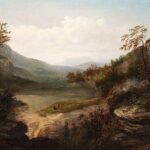
No painter is more closely associated with Arkansas landscape painting in the early 20th century than Adrian Brewer. Born in Little Rock in 1891 and trained partly in Chicago, Brewer returned to Arkansas after serving in World War I and made the state’s countryside his central subject. His paintings—most often small to mid-sized oils—depict rolling hills, tall oaks, autumn foliage, cabins, streams, and stretches of farmland in muted tones. There is little drama in these works. No great storms, no epic mountains. Instead, Brewer painted Arkansas as a place of stability and inner calm—rich in texture, quiet in mood.
Though influenced by tonalism and American impressionism, Brewer’s work never strayed far from regional specificity. His trees, for instance, are not generalized types—they are Arkansas hardwoods, knotted and irregular. The barns he painted are not nostalgic fantasies; they carry the sagging roofs and lean silhouettes of real structures he visited. Brewer saw the landscape not as an ideal form, but as a familiar one.
That sense of familiarity was essential to his popularity. During the Depression, Brewer sold paintings through local exhibitions, rotary clubs, department stores, and state fairs. He also accepted commissions from banks and civic institutions, producing murals and panels that projected a message of steadiness during unstable times. In this way, Brewer functioned both as artist and public figure. His Arkansas landscapes became visual affirmations—scenes of a place still intact, still worth anchoring to.
By the time of his death in 1956, Brewer had helped establish a visual vocabulary for the state. His influence extended beyond aesthetics; it shaped how Arkansas viewed itself.
Three recurring themes in Brewer’s work include:
- Late autumn colors, especially rust reds and ochres, symbolizing both decline and endurance
- Solitary cabins, often placed at the edge of a clearing, suggesting retreat rather than abandonment
- Still water, rendered with a soft brush, used to mirror trees and create subtle symmetry
Each of these choices reinforced a mood: introspective, stable, and rooted in the soil.
Rivers, Forests, and the Aesthetics of Nostalgia
While Brewer led the way, he was not alone. From the 1910s through the 1940s, a loosely connected circle of Arkansas painters began to treat landscape not just as scenery, but as a form of emotional expression.
Painters such as Louis Freund, Jenny Eakin Delony, and Doris Williamson Mapes produced portraits, still lifes, and occasional figure studies, but they returned consistently to natural forms—trees, rivers, rock outcroppings, and open fields. In many cases, these works carried a nostalgic tone. The scenes they depicted were not untouched wilderness but settled, cultivated land: cotton fields under clouded skies, rail fences disappearing into brush, paths worn by foot and wagon. These images were not documentary in nature. They were idealizations, meant to reflect a sense of cultural continuity in a time of rapid change.
This nostalgia was not always benign. In some cases, it veiled the economic hardships and racial inequalities of rural life. The idyllic cabins, for instance, rarely showed signs of poverty or disrepair. Fields glowed with golden light, untouched by boll weevils or debt. In this way, landscape painting could serve a consoling function—offering beauty in place of conflict, memory in place of critique.
But this tension between image and reality is precisely what gives the work its depth. These painters were not blind to hardship; they simply chose to depict what they valued—what they feared might vanish. Their Arkansas was one of trees remembered, paths walked, seasons marked by light. It was a place worth holding onto, if only on canvas.
This period also marked the rise of seasonal painting colonies in places like Eureka Springs, where artists gathered each summer to paint plein air scenes, trade techniques, and exhibit locally. These informal gatherings helped build a community around landscape painting and reinforced the idea that Arkansas’s visual identity could be developed from within, not imported from outside.
Art Between Memory and Myth
By the mid-20th century, Arkansas landscape painting had developed into a recognizable regional style: muted in color, modest in scale, and deeply personal in tone.
This style was not avant-garde. It did not engage with abstraction, surrealism, or the political movements reshaping art in New York or Paris. But it had its own strength—a slow, observational patience that treated the land not as an aesthetic object, but as a lived environment.
In this sense, Arkansas painters of the early 20th century were working between memory and myth. Their subjects were real—fields, trees, houses—but the way they framed them suggested something larger: a vision of Arkansas as a place apart, untouched by the worst of modern upheaval. Whether this was accurate or not, it shaped the visual imagination of the state for decades.
The persistence of certain motifs—smoke rising from chimneys, paths curving behind hills, trees in the act of turning—created a visual shorthand for “Arkansasness.” Even today, these elements appear in postcards, calendars, and amateur paintings. They are not clichés by accident; they became clichés through repetition, affection, and time.
And yet, within the repetition, variation remains. Each painter saw the landscape differently. Brewer saw calm. Freund found lyricism. Mapes rendered stillness. Together, they turned Arkansas into a painted place—familiar, beloved, and quietly shaped by the hand and eye.
The WPA and Art in Public Buildings
In the depths of the Great Depression, Arkansas became a canvas—not for private collectors or elite institutions, but for a federal program that sought to put artists to work and images in public view.
The Works Progress Administration (WPA), established in 1935 under President Franklin D. Roosevelt, was best known for building roads, schools, and dams. But one of its most enduring legacies was cultural: through the Federal Art Project, it employed thousands of artists to paint murals, create prints, teach classes, and design architectural ornamentation across the country. In Arkansas—a state with little existing infrastructure for the arts—this program functioned as both a lifeline and a beginning. It introduced professional art-making into civic buildings, brought visual education into rural schools, and gave voice to regional themes rarely seen in paint before. The art was meant to be accessible. But it was also, often, strikingly ambitious.
Murals in Post Offices and Courthouses
The most visible WPA artworks in Arkansas were murals painted in post offices, courthouses, and other federal buildings—works commissioned through a sister program called the Section of Fine Arts (often confused with, but separate from, the WPA’s own art project).
These murals were intended to reflect local history, economy, and values. Artists were chosen through national competitions, and while many were from outside the state, their proposals had to address Arkansas themes: cotton farming, river travel, early settlers, or Native interaction. The style was typically American scene painting—figurative, narrative, and easy to read. The goal was public clarity, not artistic difficulty.
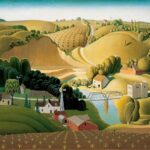
Among the most notable is “The Bauxite Mines” by Ethel Magafan, installed in the Benton post office in 1942. It shows a group of miners at work, surrounded by rolling hills and rail cars—a rare depiction of Arkansas’s industrial sector. Another example, “Harvest” by J. Floyd Yewell, in the Hope post office, celebrates agricultural labor with golden wheat fields and stylized farmhands under open sky. These images are neither romantic nor critical. They present work—physical, collective, and unadorned—as a kind of quiet dignity.
There were also murals of historical scenes, such as “Pioneer Arkansas” by Ludwig Mactarian in Heber Springs, which depicts fur trappers and steamboats. In Clarksville, Joseph P. Vorst painted “Cotton Pickers,” a composition that nods toward social realism with its heavy forms and somber faces, though without overt political commentary.
These works still hang in their original locations. Faded, sometimes overlooked, they remain embedded in the daily rituals of mail and paperwork—a silent background to public life. Yet they are also time capsules: images of what Arkansas was imagined to be in the 1930s and ’40s, as seen through the eyes of artists paid to look carefully.
Government Commissions and Community Scenes
Beyond murals, the WPA supported a wide range of visual projects in Arkansas: easel paintings, sculptures, posters, and decorative arts, many now lost or dispersed.
Local artists—some with formal training, others entirely self-taught—were hired to paint scenes for schools, libraries, and community centers. These works were less formal than the post office murals but often more intimate. They showed festivals, riverboats, church meetings, children playing. One painter, Olive Rush, created works in the style of folk illustration—flattened perspective, rhythmic repetition—that echoed local crafts and storytelling traditions. Her work in Arkansas has largely vanished, but written accounts describe her murals as “gentle and earnest,” emphasizing education, nature, and family.
The WPA also employed printmakers, particularly in Little Rock, where lithography and linocut workshops produced hundreds of affordable images for public display. These often featured stylized farm scenes, architectural studies, and portraits of anonymous workers. Their aesthetic—bold lines, minimal detail—matched the material constraints of the program. Paper was cheap; time was short.
Sculpture was less common in Arkansas, due to costs and transportation challenges. Still, a few small monuments and relief panels were commissioned, typically in stone or terra cotta. These emphasized regional materials and motifs: vines, trees, animals, and geometric patterns influenced by both Native design and Southern folk ornament.
Perhaps most surprisingly, the WPA helped fund art education programs across Arkansas. In places like Pine Bluff and Hot Springs, itinerant instructors ran workshops in drawing, painting, and crafts. Many students had never seen a painting before, let alone made one. These classes planted seeds that would grow—slowly—into a statewide infrastructure for art-making.
Three common themes in WPA-era Arkansas art include:
- Labor as dignity, with anonymous workers shown in steady, frontal poses
- Community rituals, such as fairs, dances, and harvests, idealized but not romanticized
- Regional landscape, not as wilderness, but as a space of human effort and seasonal rhythm
These themes helped anchor national ideals—resilience, cooperation, modesty—in local soil.
Arkansas Artists and New Deal Employment
For Arkansas-born artists, the WPA and its related programs were more than commissions—they were first chances.
Many artists who would shape mid-century visual life in the state got their start under New Deal support. Louis Freund, who later helped establish the art colony in Eureka Springs, painted and taught under WPA auspices. His early work from the 1930s blends American scene painting with slightly surreal touches—elongated limbs, moody color—that hint at later modernist impulses. His wife, Elsie Bates Freund, also worked in crafts and textile design, creating jewelry and fiber works that blurred the line between fine art and folk tradition.
These artists were not radicals. They were builders—of careers, of communities, of visual language. For many, the WPA offered something Arkansas had never provided before: a way to make a living from art without leaving home.
Even those who left—seeking more opportunities in Chicago, New York, or St. Louis—often carried Arkansas themes with them. Their subject matter remained close to the rhythms of rural life, the forms of the land, and the manners of small towns. The WPA made art possible, but Arkansas remained the ground it stood on.
In the end, the New Deal did more than place paintings on walls. It gave Arkansas a sense that public art could belong in public space—not as luxury, but as part of the common record. That legacy, though unevenly preserved, still shapes how the state thinks about what art is, and where it can live.
Building an Institution: The Arkansas Arts Center
In a state long defined by handmade traditions and regional painting, the founding of the Arkansas Arts Center marked a turning point—the shift from informal creativity to institutional structure.
By the mid-20th century, Arkansas had developed a modest but recognizable artistic identity rooted in local materials, landscape, and folk practice. What it lacked was a central institution capable of collecting, exhibiting, and teaching art on a sustained and serious level. That changed in 1960, when the Arkansas Arts Center opened its doors in Little Rock. Built with city support, philanthropic funding, and civic ambition, it aimed to become more than a gallery. It was a school, a stage, a museum, and a promise—that Arkansas could house a permanent, professional visual culture, not imported from elsewhere, but cultivated at home.
Founding, Growth, and Collecting Focus
The Arkansas Arts Center was born out of civic determination and careful compromise.
Plans for a state arts institution had circulated since the late 1940s, but it was not until 1959, under the leadership of Winthrop Rockefeller, that the project found serious momentum. As governor and a powerful advocate for the arts, Rockefeller pushed for a modern institution that could serve both educational and cultural roles. The building—modernist in design, modest in scale—was located in MacArthur Park, just east of downtown Little Rock. When it opened the following year, it became the only professional-level art museum in the state.
Rather than attempt to compete with larger metropolitan museums in terms of size or scope, the Arts Center chose a distinctive path: it focused on drawings. Under the guidance of founding director Townsend Wolfe, the Center began collecting works on paper—especially American and European drawings from the 17th through 20th centuries. This niche focus allowed the institution to acquire major pieces by important artists at a fraction of the cost of oil paintings or sculpture.
Over time, the collection expanded to include drawings by artists such as Rembrandt, Degas, Picasso, and Diebenkorn, as well as a growing roster of contemporary works. But the Center also committed to collecting Arkansas and Southern artists, particularly those working in printmaking, watercolor, and mixed media. This combination of international ambition and local investment became its defining character.
By the 1980s, the Arkansas Arts Center housed one of the most significant drawings collections in the American South—not in New Orleans or Atlanta, but in Little Rock.
Drawings, Prints, and Paper-Based Media
The focus on drawings gave the Arkansas Arts Center a practical edge—and a curatorial identity.
Works on paper are often undervalued in the public imagination. They lack the scale and permanence of sculpture, the grandeur of oil, or the commercial weight of contemporary media. But in curatorial terms, drawings offer something else: intimacy. They show the artist’s hand in mid-thought, lines laid down with immediacy, without polish or correction. To build a major collection of drawings was to build a collection of processes, hesitations, and raw invention.
Wolfe and his team pursued this strategy with consistency. They acquired preparatory sketches, figure studies, abstract compositions, and mixed-media experiments. They mounted exhibitions that emphasized the expressive potential of the line—not just as preliminary gesture, but as a complete visual statement.
Prints, too, became a major strength. The Center hosted print biennials, artist lectures, and studio demonstrations. It acquired woodcuts, etchings, lithographs, and monotypes, with particular interest in artists who worked across traditional boundaries. Arkansas-based printmakers were featured alongside national figures, creating an atmosphere of exchange rather than hierarchy.
This emphasis on paper also allowed the institution to function as a teaching collection. Students at the Center’s museum school—some of them beginners, others pursuing professional development—could see masterworks at close range, study them with minimal barriers, and learn from artists whose processes were visible in each stroke or cut.
Three defining strengths of the collection during its formative decades include:
- 19th-century European figure studies, especially in graphite, ink, and chalk
- Mid-century American abstraction on paper, including postwar experimentation
- Contemporary Arkansas printmaking, often rooted in landscape and social narrative
This collecting focus set the Arkansas Arts Center apart—not in spite of its limits, but because of them.
Education, Outreach, and Regional Impact
From the start, the Arkansas Arts Center was imagined not just as a repository, but as a teaching institution.
Its museum school offered classes in drawing, painting, ceramics, photography, and design to children and adults. This was not an elite conservatory model, but a broad civic program—designed to make art-making part of daily life. Local artists were hired as instructors, often working in both teaching and exhibition roles. This structure created a feedback loop: artists taught, exhibited, and shaped the next generation of Arkansas creatives in a single institutional setting.
Beyond its walls, the Center launched traveling exhibitions, sending curated shows to small towns and schools throughout the state. These were not diluted versions of the main gallery but carefully selected thematic exhibitions—landscape drawing, women printmakers, abstract forms—that brought high-quality work to places with no local access to galleries or museums.
The Center also hosted regional competitions, juried shows, and artist residencies. These events offered visibility to Arkansas-based artists and fostered dialogue between rural and urban practices. The Arts Center did not impose a single style or vision. Instead, it created a platform where different approaches could be shown, debated, and preserved.
By the 1990s, the Arkansas Arts Center had become both symbol and engine: a place where serious art could be made, seen, and understood without leaving the state. It trained artists, supported curators, educated the public, and anchored a broader cultural ecosystem.
Though modest in size, its impact was disproportionate. It helped convince Arkansans—and others—that serious art did not require coastal validation. It could grow from Little Rock, along the river, on paper, by hand.
Art Under Segregation: Black Artists in Midcentury Arkansas
The mid-20th century was a period of institutional silence for many Black artists in Arkansas—not because their work was absent, but because few structures existed to support, exhibit, or even acknowledge it.
From the 1910s through the early 1960s, Arkansas remained under the long shadow of Jim Crow segregation. Public schools, transportation, housing, and even cemeteries were divided by law. So too were the spaces of culture. Black artists—painters, teachers, printmakers, and craftspeople—worked, taught, and created under significant constraint. Museums did not collect their work. White newspapers rarely reviewed their exhibitions. And while some found success beyond the state’s borders, many remained invisible within their own communities.
Despite these barriers, a quiet but vital artistic culture developed—nurtured in segregated schools, church basements, barber shops, and home studios. These were not fringe figures. They were teachers, veterans, spiritual leaders, and innovators, working in the absence of support and often under pressure to self-censor. Their work offers not just aesthetic value, but historical clarity: a visual record of survival, expression, and control in a state that offered little space for either.
Exclusion from Schools, Museums, and Markets
Institutional exclusion was not accidental—it was designed into the system.
In Arkansas, public education was legally segregated until the 1950s. Black students attended separate schools, often underfunded, with limited access to materials. Art classes, when offered, were typically basic: drawing, poster-making, elementary design. High schools for Black students rarely had dedicated art teachers or budgets. Colleges were little better. Arkansas AM&N College (now the University of Arkansas at Pine Bluff) stood out as a rare exception, offering formal instruction in art to Black students during a period when few other institutions would.
Museums did not fare better. The Arkansas Arts Center did not formally exhibit work by Black artists during its early decades, nor did it acquire it in any systematic way. Commercial galleries, limited even for white artists, were effectively closed. Newspaper coverage in cities like Little Rock and Pine Bluff made only passing reference to Black artistic activity, and almost never featured images or interviews. The result was a structural void: artists worked, but their audiences were limited, their opportunities scarce, and their legacies difficult to preserve.
Economic barriers compounded the problem. Art supplies were costly. Time to create was limited by jobs, family responsibilities, and other forms of labor. Few could afford to work full-time as artists. Those who did so often taught or worked in related trades—sign painting, photography, printing—while producing personal work in their spare hours.
And yet, within these constraints, creativity persisted.
Art Education in Segregated Classrooms
One of the most important, and least studied, settings for Black art in midcentury Arkansas was the classroom.
In the absence of museum access, school art rooms became incubators for young talent and creative expression. Teachers—often with limited formal training themselves—introduced drawing, collage, craft, and design as forms of discipline, communication, and pride. Bulletin boards, hallway murals, and seasonal displays were more than decoration. They were evidence of shared effort and aesthetic skill.
At Arkansas AM&N College, a few figures helped shape a generation of artists. The school’s art department offered studio classes, teacher training, and exposure to national Black art movements, especially those centered in Chicago, St. Louis, and Atlanta. Faculty members brought back catalogs, prints, and teaching strategies from conferences and exhibitions, providing students with models of success beyond the segregated South.
This network of education—quiet, local, and underfunded—played a central role in sustaining visual art among Arkansas’s Black communities. Church art programs, too, offered opportunities. Religious banners, hand-painted signs, and interior murals often became community projects, mixing traditional imagery with expressive technique. These works rarely entered galleries, but they formed a visual culture that was public, familiar, and proudly made.
One example: a small church outside Helena preserved a hand-painted Nativity mural from the 1940s, featuring dark-skinned figures in Arkansas farm clothing, standing before a log cabin stable. The proportions are off. The color is vivid. And the message is clear: this is our story too.
These scenes—crafted with care and often lost to time—reveal how art functioned not as luxury, but as connection.
George Hunt, Kevin Cole, and Finding an Audience
Two of the most significant Black artists connected to Arkansas in the 20th century—George Hunt and Kevin Cole—represent different paths through the same barriers: one local and expressive, the other abstract and national.
George Hunt (1933–2020), born in Lake Charles, Louisiana, spent his early years in Hot Springs, Arkansas. He worked as a sign painter, teacher, and coach before turning seriously to painting in his thirties. His style—vivid, rhythmic, influenced by jazz and blues—merged Southern figuration with personal symbolism. Hunt painted scenes of Black life: musicians, marches, juke joints, baptisms. His surfaces were thick with color; his figures exaggerated and full of motion.
Hunt found a following beyond Arkansas, especially after his images were used for Memphis in May festival posters and blues album covers. But for many years, his work circulated primarily in private homes, regional shows, and alternative spaces. He depicted Black Arkansas not as tragedy or stereotype, but as living texture—hard-earned joy, sorrow, music, and defiance.
Kevin Cole, born in 1960 in Pine Bluff, followed a different path. Trained in both Arkansas and Illinois, Cole emerged as a major figure in contemporary abstract art, known for his large-scale, brightly colored metal sculptures that incorporate twisted ribbons and symbolic knots. While abstract in form, his work often references racial violence, educational struggle, and personal memory—coded into shape, rather than made explicit.
Cole’s work has been exhibited nationally and is included in major public collections. But he continues to reference Arkansas in his interviews and lectures, particularly the experience of growing up under segregation and the lasting power of artistic mentorship. His materials—metal, vinyl, enamel—suggest strength, resistance, and construction. But they also evoke memory: tightly wound, bent under pressure, yet not broken.
Both Hunt and Cole reflect the persistence of Arkansas’s Black artists—not as anomalies, but as part of a longer, often invisible tradition. Their work stands as evidence that artistic excellence can flourish in neglected soil, if given even the smallest space to root.
Photographing Arkansas: Nature, Industry, and Change
Few mediums have shaped public perceptions of Arkansas as powerfully—and as contradictorily—as photography.
From the late 19th century onward, photographers were drawn to the state for different reasons: its rugged terrain, its small-town rituals, its labor-intensive industries, and, increasingly, its visual role in the national imagination of the rural South. Unlike painting or sculpture, which often required patrons, galleries, or training, photography moved more freely—through newspapers, postcards, magazines, government archives, and family albums. It captured Arkansas not as myth or symbol, but as encounter: a clearing after rain, a boy with a slingshot, a woman bent over cotton, a hillside cemetery, a street corner before dusk. Sometimes it elevated. Sometimes it exposed. Always, it fixed a moment—and in doing so, shaped what Arkansas was seen to be.
Early Nature Photographers and Rural Subjects
The first photographers to systematically document Arkansas arrived not with aesthetic goals, but with scientific or commercial ones.
In the late 1800s and early 1900s, survey photographers working for the U.S. Geological Survey and timber companies took glass-plate images of forests, mineral sites, and waterways. Their work was meant to map and market the state’s resources, not to celebrate its beauty. Yet even these utilitarian images captured striking visual contrasts: dense pine thickets cut by rail tracks, logging crews posed on stacked trunks, rivers winding through untouched valleys.
Over time, these industrial views gave way to more lyrical studies. Photographers like Thomas H. Garrett, active in the early 20th century, began producing landscape images of the Ouachita Mountains and Buffalo River region. Garrett’s sepia-toned prints, sold through mail-order catalogs and drugstores, presented a softened Arkansas—empty of labor, full of mist, shaped by curves of water and wood. His views of waterfalls, rock bluffs, and fern-covered ravines helped set the aesthetic tone for later nature photography in the state: contemplative, slightly romantic, and free of human interference.
But rural subjects did not disappear. Throughout the 1920s and ’30s, Arkansas studio photographers captured the realities of small-town life: baptisms in muddy rivers, school portraits in front of clapboard buildings, mule teams in half-plowed fields. These images were not intended for exhibition. They were made for memory, for family, for local pride. And yet, taken together, they formed an archive of texture and ritual—Arkansas at its most grounded.
Three common themes in early Arkansas photography include:
- Waterways, particularly rivers and creeks, shown as both boundary and passage
- Timber labor, with men posed on felled trees or next to portable sawmills
- Religious gatherings, especially outdoor services and baptisms
These were not aesthetic inventions. They were visual truths, developed in back rooms and seen in kitchen drawers.
Arkansas in National Magazines and Tourism Campaigns
The image of Arkansas shifted dramatically once national magazines and federal agencies began pointing cameras at the state.
During the Depression, photographers working for the Farm Security Administration (FSA) produced some of the most iconic images of rural Arkansas poverty. Dorothea Lange, Walker Evans, and others passed through the Delta, documenting tenant farmers, flood refugees, and sharecroppers living in makeshift homes. Their photographs—stark, frontal, unsentimental—appeared in government reports and national periodicals, shaping public perception of Arkansas as a place of struggle and endurance.
One famous Lange image shows a barefoot boy leaning against a porch post in Drew County, his clothes threadbare, his eyes wary. Another, by Ben Shahn, captures a Black farmer in Desha County, seated beside a rusted tractor, the ground cracked beneath him. These were not local views. They were federal documents, created to sway opinion, support relief programs, and build political will. But they remain some of the clearest visual records of Arkansas life during economic collapse.
By the 1950s and ’60s, another set of photographers—this time working for National Geographic and tourism bureaus—offered a more optimistic view. Their images emphasized Ozark festivals, craft fairs, hot springs, and scenic highways, presenting Arkansas as a wholesome, rustic destination. The land was lush. The people smiled. Quilters, fiddlers, and trout fishermen became visual ambassadors of a state trying to rebrand itself for leisure and heritage travel.
These competing portrayals—one of hardship, one of hospitality—reflected different truths. Arkansas was both things. The photograph could frame either, depending on who held the camera.
Documenting Farming, Forestry, and Floodplains
Some of the most consistent photographic themes in Arkansas history revolve around labor—especially in agriculture, timber, and water control.
From the cotton fields of the southeast to the poultry farms of the northwest, Arkansas has long relied on physically demanding, visually distinctive work. Photographers captured this in every format: tintypes, black-and-white prints, color film, and, later, digital portfolios. Migrant workers in rows of cotton. Lumber crews with crosscut saws. Poultry plant employees in white coats, standing beneath hanging lines of plucked birds. Each setting had its own aesthetic logic—its own play of repetition, pressure, and form.
Flood photography formed another major subgenre. The 1927 Mississippi River Flood and subsequent inundations of the Arkansas River were widely documented. Aerial images showed entire towns submerged. Street-level photos captured boats moored beside courthouse steps, children wading through schoolyards, coffins floating from opened graves. These images were published in both local and national media, often with little commentary. They did not require it.
Later photographers—especially those working independently—built on these themes with greater control. Don House, for example, spent decades photographing rural structures, abandoned homes, and weathered signs across Arkansas. His black-and-white images, often taken in silence and solitude, show a world gently receding. A screen door askew. A church sign missing letters. A tire swing hanging in fog. These are not dramatic compositions, but they hold time.
Tim Ernst, a landscape photographer known for his work in the Ozark National Forest, brought a different tone: vibrant, sharply focused color images of waterfalls, sunrises, and seasonal change. His books and calendars helped define the popular image of the Arkansas outdoors in the late 20th century. In contrast to Don House’s quiet decline, Ernst’s work celebrated permanence, renewal, and awe.
These two approaches—one elegiac, one exalting—mirror a larger split in Arkansas photography: between loss and presence, past and continuity. Both are truthful. Both are necessary.
Crystal Bridges and the Private Collection Made Public
When Crystal Bridges Museum of American Art opened in 2011 in Bentonville, Arkansas, it signaled a profound shift—not just in the state’s cultural landscape, but in the national geography of art itself.
Until that moment, no major American art institution had ever been built from the ground up in a rural town of fewer than 50,000 people, far from a major airport, funded almost entirely by private wealth, and stocked with a world-class collection. But Crystal Bridges was not a conventional project. It was the vision of Alice Walton, the Walmart heiress whose fortune and ambition made the museum possible. From the beginning, the museum raised questions: Could a town in northwest Arkansas house one of the country’s most significant collections of American art? Would artists, curators, and critics take it seriously? And what would it mean for Arkansas to become a national destination for culture, not just commerce?
Those questions have largely been answered—if not always comfortably. Crystal Bridges changed the conversation about where art can live in America. And in doing so, it changed Arkansas.
Alice Walton’s Collecting and Museum Design
The origin of Crystal Bridges lies in one person’s eye, and one person’s capital.
Alice Walton, the daughter of Walmart founder Sam Walton, began collecting art seriously in the late 1990s. Her early interests leaned toward American landscape painting and portraiture—works by Asher B. Durand, Thomas Moran, Winslow Homer, and John Singer Sargent. Over time, she expanded her scope to include 20th-century modernism, African-American art, and women artists. Her approach was bold, sometimes controversial: she paid high prices at auction, outbid larger coastal institutions, and acquired centerpiece works with speed and confidence.
By the mid-2000s, Walton had not only assembled a major private collection, but had begun laying the groundwork for a museum to house it. She chose Bentonville, her family’s hometown, as the site—not despite its remoteness, but because of it. For Walton, bringing art to Arkansas was both personal and strategic. It was a way to redistribute access to culture, to root world-class art in the soil of her upbringing.
To design the museum, she hired Moshe Safdie, a celebrated architect known for his sculptural use of light and space. The resulting structure, nestled into a wooded ravine with a spring-fed creek running through it, is unlike any other major museum in the country. It consists of a series of interconnected pavilions, some shaped like bridges or shells, surrounded by forest trails and reflecting ponds. The architecture is not monumental. It is immersive.
This integration of nature and structure is not accidental. Crystal Bridges was meant to be a place of arrival—not just for the art traveler, but for the casual visitor, the school group, the neighbor from down the road. It is free to enter, open year-round, and designed to feel both elite and accessible. In many ways, that tension defines it.
National Attention and Rural Controversy
From the outset, Crystal Bridges provoked intense national scrutiny—some admiring, some skeptical.
Critics from New York, Los Angeles, and London arrived with questions. Was this museum simply a monument to wealth? A vanity project in a corporate town? Or could it genuinely reshape the map of American cultural power? Reviews were mixed, but few denied the quality of the collection. On opening, the museum featured iconic works: Gilbert Stuart’s portrait of George Washington, Norman Rockwell’s “Rosie the Riveter”, Kerry James Marshall’s “Our Town”, and Mark Rothko’s “No. 210/No. 211 (Orange)”. These were not marginal holdings. They were central works, acquired through serious, aggressive collecting.
The backlash came partly from tradition. Museums were expected to live in cultural capitals—to emerge from universities, historical societies, or slow accumulations. Crystal Bridges upended that model. It was new, fast, rural, and wealthy. And that combination unsettled the art world.
In Arkansas itself, the reaction was more varied. Many welcomed the museum as a transformative gift—bringing art education, tourism, and economic development to the region. Others viewed it with suspicion, seeing it as an extension of Walmart’s corporate reach into the cultural sphere. Some artists and curators worried that the museum’s resources might overshadow or marginalize smaller institutions. Others feared its aesthetic: too polished, too conservative, too detached from the rough textures of Arkansas art history.
These debates were not resolved. They persist today. But they point to a central truth: Crystal Bridges made Arkansas visible in a new way. It placed the state within national art discourse—not as an afterthought, but as a center.
Repositioning American Art in the Middle of the Country
Perhaps the most radical feature of Crystal Bridges is not its architecture, or even its collection—but its location.
By placing masterworks of American art in northwest Arkansas, the museum forced a reconsideration of cultural geography. Visitors now travel to Bentonville to see works they would once have had to visit Boston, Washington, or San Francisco to view. Schools in rural Arkansas bring students to galleries filled with the likes of Mary Cassatt, Jean-Michel Basquiat, and Jaune Quick-to-See Smith. Curators from major institutions now partner with a museum that, twenty years ago, did not exist.
Crystal Bridges has also invested in contemporary work—both through acquisitions and through its satellite space, The Momentary, which opened in 2020. Housed in a former cheese factory, The Momentary presents video art, performance, sculpture, and site-specific installations, often with a focus on current themes: environment, identity, technology, labor. Unlike the main museum, it is explicitly forward-facing—restless, experimental, sometimes uneasy.
This dual structure—one foot in historical American art, the other in cutting-edge contemporary work—gives Crystal Bridges a rare flexibility. It can host a survey of early American portraiture in one gallery, and a multimedia critique of capitalism in another. It is not neutral ground, but it is broad ground.
For Arkansas, the implications are long-term. Crystal Bridges has catalyzed arts funding, raised expectations, and brought national attention to regional artists. It has changed what is possible—not just in terms of what can be shown, but where it can be shown. The collection may have started in a private vault. But now, it lives by a creek in the Ozarks, open to anyone who walks in.
Contemporary Art in Cities and Small Towns
The story of Arkansas art in the 21st century does not begin or end in a museum. It unfolds in converted storefronts, university studios, rural workshops, and artist-run spaces that dot the map far from Bentonville or Little Rock.
While Crystal Bridges has drawn national attention, a quieter, more distributed ecosystem of contemporary art has developed across the state. In Fort Smith, Fayetteville, Little Rock, Hot Springs, and a growing number of small towns, artists have carved out space—not always with institutional support, but with resourcefulness and persistence. These artists work in all media: painting, installation, performance, digital fabrication, ceramics, photography. Some were born in Arkansas. Others arrived through university programs or residencies and chose to stay. What unites them is not style, but geography. They are working within the limitations and possibilities of a state that still lacks deep infrastructure for contemporary art, but which offers something else: time, space, and room to invent.
Artist-Run Spaces and Local Studios
In the absence of commercial galleries or robust public funding, many Arkansas artists have created their own platforms.
Little Rock, despite being the state capital, has struggled to sustain long-term commercial art venues. But it has also given rise to a number of adaptive spaces—places where artists show their work, host events, and form communities. The House of Art, located in the historic Dunbar neighborhood, is one such example: a community-run gallery that features work by Black artists, local photographers, and emerging painters. Its programming is informal but constant: openings, poetry nights, student showcases. It serves as a cultural anchor in a city often split by neighborhood and income.
In Hot Springs, the legacy of the Hot Springs Arts District and the Arts & the Park Festival has kept the city’s downtown active with studios and cooperative spaces. Local painters and craftspeople maintain storefront studios open to the public, blending tourism with practice. Emergent Arts, a nonprofit community studio, offers classes, exhibition space, and mentorship for artists working outside of academic systems.
Northwest Arkansas has seen the most institutional growth. The presence of Crystal Bridges and the Momentary has attracted artists to Fayetteville, Springdale, and Rogers, but the energy has spread beyond the museum’s orbit. Mount Sequoyah Creative Center, once a Methodist retreat, now hosts artists-in-residence working across disciplines. In Eureka Springs, the long-running artist colony has transitioned from traditional plein air painting to experimental media, supported by DIY galleries and performance venues.
These local efforts are not isolated experiments. They represent an evolving model of practice—where artists build the infrastructure they need, rather than wait for it to appear.
Universities, Grants, and Exhibition Networks
Higher education remains one of the most consistent engines of contemporary art in Arkansas.
University of Arkansas (Fayetteville), Arkansas State University (Jonesboro), UA Little Rock, and University of Arkansas at Pine Bluff all offer formal programs in visual art. These universities support faculty artists, host student exhibitions, and maintain small but active galleries. For many artists living in Arkansas, teaching provides both income and access to facilities—studios, kilns, presses, and critique networks otherwise unavailable.
One of the most influential of these is the University of Arkansas School of Art, which received a transformative $120 million gift from the Walton Family Foundation in 2017. This funding has expanded the program significantly, attracting national faculty and building new facilities. The school now houses a master’s program in studio art and design, positioning Fayetteville as a legitimate center for contemporary practice in the region.
Grants and residencies remain limited but growing. Organizations such as the Mid-America Arts Alliance, based in Kansas City but serving Arkansas, provide small project grants. The Arkansas Arts Council offers fellowships, though with relatively modest funding. Private initiatives—often underwritten by Walmart-adjacent philanthropy—have begun to support individual artists with exhibition opportunities, studio space, and funding for community projects.
Even with these supports, the ecosystem remains thin. Artists still face long drives to ship work, a small collector base, and limited curatorial attention. But they persist, often with collaborative strategies—shared studios, informal critiques, and exhibitions mounted in coffee shops, libraries, or temporary storefronts.
Three recurring features of Arkansas’s contemporary exhibition scene include:
- Pop-up shows, often hosted in unconventional venues and announced by word of mouth
- Multidisciplinary events, combining visual art with poetry, music, or food
- Strong ties to place, with artists referencing local landmarks, history, or ecological concerns
These features reflect both necessity and intention. In a state without a dense cultural infrastructure, adaptability becomes a form of aesthetic.
Themes of Labor, Land, and Cultural Memory
While contemporary Arkansas art spans all media and ideologies, certain themes recur—drawn from the land itself.
Labor remains a central subject. Artists working in sculpture, performance, and installation frequently engage with the history of physical work: agricultural routines, textile production, food service, and industrial tools. This is not nostalgia. It is recognition—that the body still marks the ground, that work shapes life, that manual history continues to echo in materials.
The land, too, appears constantly: as subject, medium, and site. Artists have used red clay, pine needles, river stones, and found wood in both temporary and permanent works. The Ozarks, the Delta, and the Ouachita Mountains are not just backgrounds—they are collaborators. Site-specific art, outdoor installation, and environmentally conscious practices have taken hold, particularly among younger artists attuned to questions of erosion, flooding, and habitat loss.
Cultural memory, especially in relation to race, migration, and family history, has become a strong thread in recent years. Some artists use archival photographs, oral history, or found objects to reframe the past—not as a fixed story, but as a living record. Others explore memory through abstraction, using repetition, material layering, or distortion to suggest the unreliability of recall.
One Little Rock-based artist created a series of plaster reliefs cast from the walls of condemned houses, capturing their textures before demolition. Another in Fayetteville stitched together fabric from family garments into a large-scale banner, embroidered with fragments of overheard conversation.
These gestures are not grand. But they are precise. They record what Arkansas is, and what it refuses to forget.
Abandonment and History: Ruins in Arkansas Art
Where structures decay, Arkansas artists have often found a subject—not in ruin for ruin’s sake, but in the layered histories that empty spaces can still contain.
In a state shaped by waves of migration, labor cycles, environmental upheaval, and structural neglect, the physical remnants of the past are everywhere: collapsed barns, shuttered factories, silent schools, overgrown cemeteries, defunct plantations. These places are not just inert. They are visually and emotionally charged—bearing traces of memory, erasure, and transition. Since the late 20th century especially, Arkansas artists have turned with increasing focus toward these sites of abandonment. Some document them. Others intervene directly. What unites their work is a shared understanding that absence is not neutral—and that the landscape of ruin can be as expressive as any portrait.
Artists Working with Decaying Houses, Mills, and Factories
Abandoned buildings have long attracted photographers, but in Arkansas they have also drawn painters, sculptors, and installation artists interested in material history.
Don House, one of the state’s most consistent visual chroniclers of rural decay, has photographed abandoned homes, stores, barns, and churches for decades. His black-and-white prints strip away sentimentality. The houses lean. Their windows gape. The siding curls like dry leaves. But the images are never mocking. They are quiet, composed, and attentive to form—an old screen door as negative space, a broken step as narrative pause.
In painting, artists like V.L. Cox and others have addressed neglected or emptied spaces with symbolic precision. Cox’s sculptural installations often incorporate doors, windows, and architectural fragments salvaged from condemned buildings. Her work explores not just physical absence, but civic and moral neglect—how communities choose what to preserve, and what to forget.
Other artists have used abandoned spaces as studios or exhibition sites. In Eureka Springs, disused houses and hotels have hosted temporary installations, performance pieces, and video projections. In Helena, artists have worked with the remnants of former industrial structures, creating site-specific works that respond to their histories: cotton processing, river trade, or civil defense.
Three recurring materials or strategies in this genre include:
- Found wood from demolished buildings, used in sculpture or assemblage
- Photographs printed on metal or salvaged surfaces, integrating decay into the image itself
- Audio installations using recorded voices or ambient sounds from the site’s past
These practices do not seek to restore what’s been lost. They make the loss visible—without closing it off to interpretation.
War Sites, Internment Camps, and Historical Grounds
Some of Arkansas’s most politically charged ruins are the remains of wartime sites—especially the two Japanese American internment camps operated during World War II.
From 1942 to 1945, the U.S. government forcibly relocated more than 17,000 Japanese Americans to Rohwer and Jerome, two remote camps in southeastern Arkansas. These sites, now mostly returned to farmland, retain only faint physical traces: foundation lines, cemetery markers, fragments of road. But artists have returned to them as spaces of historical tension and remembrance.
Artist and architect Maya Lin included Rohwer in her “What Is Missing?” environmental memorial series, while Japanese American artists such as Roger Shimomura and others have referenced the Arkansas camps in painting and print. In Arkansas itself, local efforts to mark and interpret the sites have often involved visual work—memorial sculpture, signage, and collaborative community art. These projects do not aestheticize suffering. Instead, they create visual anchors for histories that might otherwise vanish entirely from view.
Other military and political sites—decommissioned bases, Cold War installations, or buildings associated with segregation and desegregation—have also become subjects of artistic engagement. Some are documented through photography; others are transformed through performance, sound, or light. One Fayetteville artist staged a projection piece inside a defunct school auditorium, using archival footage and recorded interviews with former students to animate the empty space.
These works ask not only what happened here, but what lingers.
Making Visible What’s Been Left Behind
Ruins are not only physical. In Arkansas art, they often become metaphors—for memory, for loss, for slow violence.
Contemporary artists have taken this further by turning decay into material itself. One Little Rock-based artist used soil and river silt from the Arkansas River to create a series of wall drawings that faded over time, mimicking the erosion of buildings along its banks. Another constructed a walkable installation from salvaged bricks and tin roofing, arranged to recreate the footprint of a destroyed home.
These projects often rely on modest means—cast-off materials, hand tools, found footage. But they carry weight. They treat disappearance as a subject worthy of study, not just as aesthetic effect. Some works reference specific sites—abandoned schools in the Delta, collapsed factories in Fort Smith, train depots along unused rail lines. Others operate more abstractly, using gesture and material suggestion to evoke ruin without naming it.
Importantly, these works are not nostalgic. They do not long for a lost past. Rather, they reveal how certain absences are made: through disinvestment, through violence, through indifference. They show what was once built, and what was allowed to fall. In this sense, ruin in Arkansas art is not an end point. It is a prompt—a way of seeing the present through the layers of what preceded it.
In a state where history often survives by accident—on a porch, in a field, in a pile of boards—art has become one of the only ways to hold it steady, even briefly.
What Makes It Arkansas? Style, Place, and the Question of Identity
The question of whether Arkansas has a distinct artistic identity is less about a single look and more about a set of recurring choices—materials, subjects, and social conditions—that together form a recognizable way of making and seeing.
Ask an artist, a curator, or a collector to define “Arkansas art” and you will get different answers. Some will point to landscape painting: low horizons, hardwoods, and quiet waterways. Others will emphasize craft traditions—quilting, woodwork, and functional ceramics—that reflect a domestic logic. Still others will highlight the influence of commerce and philanthropy, from New Deal murals to a major private museum. None of these alone constitutes a state “style.” What does cohere is a constellation of recurring concerns and practices: attention to place, the persistence of handmade technique, a tolerance for mixed aims (utility alongside aesthetics), and a steady preoccupation with how history sits on the land. These form the materials of an argument rather than a manifesto.
Shared Themes: Land, Labor, Memory
A handful of themes keeps returning in work made across Arkansas, from the Delta to the Ozarks.
Land is the most obvious. Rivers, woods, fields, and levees appear not as neutral backdrops but as active subjects. Artists use the soil—literally and figuratively—to make meaning: river silt in pigment, reclaimed planks in sculpture, found signage as text. Labor is the second constant. The state’s economies—agriculture, timber, food processing, retail—leave visible marks. Artmakers respond by treating tools, routines, and workplaces as worthy of aesthetic attention, whether through documentary photography or sculptural assemblage.
Memory binds these two themes. Works often operate as local archives: a stitched quilt that preserves family fragments; a photographic sequence that charts a mill’s deterioration; a mural that reclaims a neighborhood story. Memory in Arkansas art is rarely rhetorical. It is material—embedded in objects, textures, and gestures.
A brief list of recurring motifs:
- Rivers and levees as markers of movement and constraint
- Work tools and industrial detritus as traces of daily labor
- Domestic fabrics and patchwork as repositories of personal history
These elements do not prescribe a single style. Instead, they create an interpretive framework—an inclination toward things that bear use and time.
Urban / Rural Tensions and the Question of Scale
One of the clearest divisions within Arkansas art is geographic: the differences between the small-city circuit around Bentonville–Fayetteville and the older state centers like Little Rock, Pine Bluff, or Helena.
In northwest Arkansas, substantial private funding and institutional growth have encouraged large-scale exhibitions, ambitious public commissions, and projects that invite national participation. These venues can support major acquisitions, traveling shows, and experimental programs that require significant logistics. Work made here often operates on a larger scale—installation, performance, or museum-backed commissions that presume a national audience.
Elsewhere, especially in smaller towns and rural counties, art tends to be modest in scale and highly local in focus. A community mural, a church banner, a photo series preserved in a county archive—these works matter because they circulate locally and form part of everyday life. They are made to be used, remembered, and repaired rather than to travel.
The tension is productive. Smaller-scale work resists the homogenizing influence of market expectations, while institutional projects bring resources and visibility. Artists navigate both worlds by adapting scale, materials, and social models: a sculptor may produce an intimate assemblage for a community center and a large steel piece for a museum commission; a photographer may publish a book locally and later mount a museum show.
Three pragmatic differences between the two contexts:
- Funding models (private philanthropy vs. grassroots support)
- Exhibition infrastructure (museum galleries vs. pop-up and civic spaces)
- Audience expectations (tourist-oriented display vs. community use)
These contrasts shape practice more than doctrine. They explain why Arkansas art is plural rather than unified.
Looking Forward: Archives, Festivals, and Digital Access
If identity in Arkansas is a set of tendencies, the future will be shaped by how those tendencies are preserved, circulated, and taught.
Archives are central. County historical societies, university collections, and municipal archives hold photographs, posters, and small-format objects that together outline local visual histories. Strengthening these repositories—through digitization, cataloging, and public programming—will determine which stories remain visible and which fade. Festivals and biennial-style events can create periodic focus, drawing audiences into concentrated encounters with contemporary work. They provide places for exchange, critique, and commissioning.
Digital access offers a different kind of infrastructure. Online archives, virtual exhibitions, and social platforms make local work discoverable beyond state lines. This has two consequences: it flattens distance (a curator in another region can see and consider Arkansas work) and it raises questions about context (digital images strip objects of scale, tactility, and setting). Both effects can be harnessed: a well-documented online collection can bring new scholarship; a virtual exhibition can invite comparative work across regions.
Practical steps that could strengthen the state’s arts ecology include:
- Expanded digitization of county and university collections
- Support for artist residencies that bridge rural and urban sites
- Targeted funding for traveling exhibitions and small-venue programming
None of these guarantees a single “Arkansas style.” Rather, they increase the visibility of the state’s plural practices and give artists more options for making and sharing work.
A final micro-narrative captures the dynamic: a ceramicist in a Delta town who learned wheel-throwing in a high-school class, later taught at the local community college, and now runs workshops that bring schoolchildren into a repurposed cotton warehouse studio. Her pots remain functional—used in kitchens and church suppers—but they also enter regional shows and an online catalog. Her practice moves between use and exhibition, local ritual and wider recognition. That movement—between home and display, between tool and object—is emblematic of Arkansas’s artistic future.
Identity here is not a seal to be stamped, but an ongoing negotiation: of materials and markets, of scale and story, of the lives that make and receive art. What makes it Arkansas is less a fixed style than a way of making that keeps coming back to place, utility, and memory—and keeps asking how those things might be seen anew.