The Moscow Kremlin stands as one of the most iconic and enduring symbols of Russian heritage, architecture, and political power. Nestled on the Borovitsky Hill above the Moskva River, this fortified complex has evolved over centuries into a remarkable blend of medieval Russian, Byzantine, Renaissance, and Neoclassical architectural styles. It is not just a seat of power; it is also a deeply spiritual and cultural space that reflects Russia’s turbulent yet grand history. Recognized by UNESCO in 1990 as a World Heritage Site, the Kremlin draws millions of visitors each year who come to marvel at its richly layered architectural identity.
The layout of the Kremlin resembles a triangle covering over 27 hectares, surrounded by massive brick walls and towers. Within this fortified space lie grand cathedrals, stately palaces, and government buildings that together showcase nearly a thousand years of Russian architectural evolution. From the onion domes of Orthodox cathedrals to the towering spires of fortification towers, the Kremlin’s skyline has come to define the heart of Moscow. Every building within its walls tells a story, whether of royal coronations, foreign invasions, or the rise and fall of empires.
As a living complex still functioning as the official residence of the President of Russia, the Kremlin holds a unique position in both historical and contemporary life. While parts of it are restricted for official purposes, large sections remain open to the public and serve as a showcase of national pride. Its architecture offers an unparalleled opportunity to trace Russia’s transformation—from medieval principality to imperial colossus, from tsardom to modern federation.
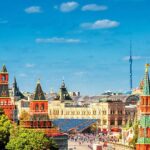
Whether viewed from Red Square or across the river, the Kremlin’s profile commands attention. Its golden domes, red-brick towers, and ivory-white cathedrals strike a harmony that is both solemn and majestic. The architectural diversity of the Kremlin is no accident—it reflects the political ambitions, foreign influences, and spiritual aspirations of a nation that has long balanced tradition with change.
The Origins of the Kremlin: Fortified Beginnings
The earliest reference to the Moscow Kremlin dates back to 1147, during the reign of Prince Yuri Dolgorukiy, who is often credited with founding the city itself. At that time, the Kremlin was a rudimentary wooden fort surrounded by earthen ramparts and a wooden palisade. This early fortification, known in Russian as a “detinets,” was built to defend the growing settlement from nomadic raids, especially by the Cumans and other Turkic tribes of the steppe. Positioned at the strategic confluence of the Moskva and Neglinnaya Rivers, it was an ideal spot for defense and trade.
By the early 14th century, under the rule of Ivan I Kalita, the Kremlin was upgraded to a stronger fortress with oak walls and watchtowers. In 1331, stone structures began to appear, signaling a shift toward more permanent and resilient architecture. However, these early defenses were still vulnerable. In 1382, the Mongol-Tatar forces under Khan Tokhtamysh breached the Kremlin, destroying much of it and reinforcing the need for sturdier construction. The architecture of this era bore strong Slavic and Byzantine influences, with modest ornamentation and practical layouts focused on defense.
A major turning point came during the reign of Ivan III (the Great), who ascended to power in 1462. Recognizing the need for a grander and more secure Kremlin, he initiated a massive reconstruction campaign between 1485 and 1495. It was during this period that the Kremlin walls were rebuilt using baked red bricks—an innovative material in Russia at the time. The triangular layout we recognize today took shape, complete with corner bastions and deep moats for added protection. This era laid the groundwork for the Kremlin’s architectural grandeur.
These early phases of the Kremlin’s development were not just about fortification; they were about establishing a center of religious and political power. Churches began to spring up within the walls, replacing older wooden chapels. Even in its formative years, the Kremlin was envisioned as more than a fortress—it was the spiritual and administrative heart of a rising Russian state.
The Italian Architects and Renaissance Influence
One of the most significant chapters in the Kremlin’s architectural history began in the late 15th century with the arrival of Italian architects invited by Ivan III. Desiring to modernize Russia’s infrastructure and break free from Mongol cultural legacies, Ivan turned westward to Europe. Among the first and most influential was Aristotle Fioravanti, a Florentine engineer and architect who came to Moscow in 1475. His task was to rebuild the Assumption Cathedral (Uspensky Sobor), and the result was a masterpiece of engineering and artistic synthesis.
Fioravanti’s cathedral, completed in 1479, combined traditional Russian forms with Renaissance principles like symmetry, proportion, and strong geometrical clarity. It was a revolutionary structure that set a new standard for religious buildings across Russia. Fioravanti didn’t just import ideas—he adapted them. He incorporated local techniques and materials, ensuring his designs suited the cold climate and Orthodox liturgical needs. The blend of East and West became a defining feature of Kremlin architecture from this point forward.
Following Fioravanti, other Italians contributed significantly to the Kremlin’s transformation. Pietro Antonio Solari and Marco Ruffo were instrumental in designing the new Kremlin walls and towers. Solari, in particular, was responsible for the striking Spasskaya and Nikolskaya towers, finished around 1491. These towers not only served military purposes but also added artistic flair, with decorative cornices, white-stone details, and spire-topped battlements that were rare in Russian architecture before then.
These Italian builders effectively introduced the Renaissance style to Russia, although it was heavily “Russified” in appearance. They brought innovations like brick vaulting, stone carving techniques, and more rational urban planning. Over time, their influence blended seamlessly into native styles, creating what could be described as a uniquely Muscovite interpretation of the Renaissance. The Italian Renaissance didn’t just reshape Russian architecture—it helped Russia assert itself as a successor to the Eastern Roman (Byzantine) Empire.
The Kremlin Walls and Towers: A Defensive Masterpiece
The red-brick walls and towers of the Kremlin are among its most defining features. Constructed between 1485 and 1495 under the supervision of Pietro Antonio Solari and other Italian engineers, the current walls replaced older white-stone fortifications. The walls stretch for approximately 2.2 kilometers and vary in height from 5 to 19 meters, depending on the terrain. They are punctuated by 20 towers, each with its own unique design, function, and history.
The wall system was designed for both defense and visibility. The base of each wall section is thicker and reinforced, narrowing slightly as it rises—a technique used in Italian fortresses of the time. The battlements feature merlons with loopholes, allowing archers and gunners to fire while being protected. The towers were placed at intervals to give overlapping fields of fire, and many of them were connected to underground tunnels or secret passages used during times of siege.
Each tower had its own role. The Spasskaya Tower, added in 1491 and later remodeled in 1625 with a clock and spire, served as the Kremlin’s main ceremonial gate. Troitskaya Tower, standing 80 meters tall, is the tallest of all and once connected to a bridge over the Neglinnaya River. Borovitskaya Tower, on the southwestern side, is one of the oldest and provided access from the riverbank. Nikolskaya and Senatskaya towers added symmetry and protected crucial inner zones of the Kremlin.
Five Famous Kremlin Towers:
- Spasskaya Tower – Iconic main gate with clock; built in 1491, remodeled with spire in 1625.
- Troitskaya Tower – Tallest tower at 80 meters; formerly connected to a drawbridge.
- Borovitskaya Tower – Southwest gate; built in 1490 for river access.
- Nikolskaya Tower – Eastern side; known for surviving the 1812 French invasion.
- Taynitskaya Tower – Contained secret waterway for escapes during sieges.
Though initially built for warfare, the towers eventually took on symbolic and ceremonial roles. Some housed bells, while others displayed coats of arms or military trophies. Their design reflects not just utility but the growing desire to present Moscow as a sophisticated, imperial capital.
Cathedral Square: The Spiritual Heart of the Kremlin
At the very center of the Kremlin lies Cathedral Square, the religious and ceremonial heart of Russia for centuries. This architectural ensemble consists of several major churches built between the 15th and early 17th centuries, each contributing to the visual and spiritual gravitas of the square. Their golden onion domes, white facades, and intricate frescoes provide a stark contrast to the red walls surrounding them, making this area a sanctuary within a fortress.
The Assumption Cathedral (Uspensky Sobor) is the oldest and most significant of the group. Designed by Aristotle Fioravanti and completed in 1479, it was the site of coronations for Russian tsars and emperors, as well as the burial place for metropolitans and patriarchs of the Russian Orthodox Church. Its austere limestone exterior hides a richly decorated interior filled with frescoes, icons, and carved iconostasis. The building’s five domes symbolize Jesus Christ and the Four Evangelists.
To the south stands the Archangel Cathedral (Arkhangelsky Sobor), completed in 1508 by Italian architect Aloisio the New. Unlike the Assumption Cathedral, it reflects more Renaissance detail, including decorative pilasters and Corinthian capitals. It served as the royal necropolis for members of the Rurik and early Romanov dynasties, including Ivan the Terrible. The atmosphere within the cathedral is solemn, steeped in the memory of dynastic power.
Next to it is the Annunciation Cathedral (Blagoveshchensky Sobor), constructed between 1484 and 1489 by Russian builders. Unlike the previous two, it features traditional Muscovite architecture with nine gilded domes and a more intimate scale. It functioned as the private chapel of the tsars and includes a beautiful porch added by Ivan the Terrible in 1564. Its interior contains a treasure trove of icons by famous Russian masters like Theophanes the Greek and Andrei Rublev.
Together, these cathedrals form a sacred triangle that defined religious life in Russia for over four centuries. Their placement, scale, and orientation reflect both theological symbolism and a calculated assertion of divine authority. Even today, religious processions and Orthodox festivals occasionally return life to this once-bustling spiritual center.
Ivan the Great Bell Tower: A Monument to Orthodoxy
Rising above all other structures in the Kremlin is the Ivan the Great Bell Tower, a towering white column that once served as both a spiritual beacon and a military watchtower. Commissioned by Grand Duke Ivan III and completed in stages between 1505 and 1600, the tower was designed by Italian architect Bon Fryazin. At 81 meters tall, it remained the tallest building in Moscow until the construction of modern skyscrapers centuries later. Its location at the geometric center of the Kremlin makes it a focal point of the entire complex.
The tower is composed of three ascending octagonal tiers, each narrowing as they rise. The base is constructed with thick limestone walls and features narrow slit windows, originally intended for defensive archery. The second and third tiers house the bells, including some of the largest in Russia. In 1600, Tsar Boris Godunov added the third tier to enhance its grandeur and visibility, and at the top sits a golden dome and Orthodox cross, glinting in the sunlight and symbolizing Russia’s connection between heaven and earth.
Adjacent to the tower is the Assumption Belfry, added in the 1530s, and the Filaret Annex, constructed in 1624 under Patriarch Filaret. Together, these buildings form a larger bell complex, designed to accommodate the expanding number of church bells used in liturgical services. In total, the bell tower ensemble contains 21 bells, each with unique tones and uses for different feasts and rituals. Some weigh several tons, including the famous 65-ton bell cast in the 17th century.
Nearby lies the Tsar Bell, the largest bell ever cast in history, though it has never been rung. Weighing approximately 200 tons, it was created between 1733 and 1735 by Ivan Motorin and his son Mikhail. A massive chunk broke off during a fire before it could be hoisted into place, leaving the bell as a monumental sculpture rather than a functional instrument. Today, the bell rests at the foot of the tower, symbolizing both the ambition and fragility of Russian imperial might.
The Grand Kremlin Palace: Imperial Splendor
The Grand Kremlin Palace, completed in 1849, was commissioned by Emperor Nicholas I as a grand residence for the Russian monarchy within the Kremlin. Designed by architect Konstantin Thon, the building was a triumph of eclecticism, combining elements of Russian Revival, Byzantine, and Baroque architecture. It stretches over 125 meters along the Kremlin’s southern wall and connects many earlier structures, including the Terem Palace, the Palace of Facets, and the Golden Tsarina’s Chamber, creating a vast imperial compound.
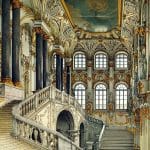
Inside, the palace is a dazzling display of wealth and authority. Lavish interiors include gilded staircases, marble columns, and elaborately painted ceilings. The St. George Hall features white marble and golden medallions listing the names of Russian military heroes. The St. Andrew Hall, once the throne room, has a blue-and-gold color scheme and houses the Order of St. Andrew, Russia’s highest chivalric order. These halls are still used today for state ceremonies and presidential inaugurations.
The exterior design incorporates arched windows, stylized kokoshniks (arched gables), and colored tiles meant to evoke traditional Russian aesthetics while signaling imperial grandeur. Despite being built in the 19th century, it was carefully integrated into the Kremlin’s medieval landscape. Its location near the Kremlin wall and close to Cathedral Square helped reinforce the symbolism of the Tsar as both ruler and protector of Orthodox Russia.
The palace was damaged during the early Soviet years but was restored in the mid-20th century. Today, it serves as a residence and ceremonial space for the President of the Russian Federation, while also functioning as a historical landmark. Though tourists cannot explore every room, several areas are occasionally opened to the public, offering a glimpse into the opulence of Russia’s imperial past.
The Kremlin Senate and Administrative Buildings
While the cathedrals and palaces draw most of the attention, the Kremlin Senate and other administrative buildings play a vital role in the architectural and political landscape of the Kremlin. Designed by Matvei Kazakov and built between 1776 and 1787, the Senate building is a Neoclassical masterpiece that reflects Enlightenment ideals and the ambitions of Empress Catherine the Great. Originally intended as a meeting hall for state councils, it now serves as the official workplace of the President of Russia.
The Senate is instantly recognizable by its triangular layout and central green dome topped with the Russian flag. The building has three façades, each emphasizing balance and symmetry with Ionic columns and rounded pediments. The central hall, known as the Round Hall, was inspired by Roman architectural models and features a vast dome supported by colonnades. This hall was used for major state functions and court proceedings in the imperial era.
During the Soviet period, the Senate became a hub of political activity. It housed the offices of key government figures, including Vladimir Lenin, whose private study has been preserved. In the post-Soviet era, it was converted into the administrative headquarters of the Russian presidency. The building is closed to the general public but remains an essential part of the Kremlin’s functioning as a seat of power.
Major Administrative Buildings in the Kremlin:
- Senate Building – Presidential residence and administrative HQ; Neoclassical design by Matvei Kazakov.
- Kremlin Arsenal – Originally a weapons depot (1702–1736); now houses Kremlin Guard regiments.
- Kremlin Presidium – Built in 1934, once housed the Soviet Supreme Council; currently closed for renovation.
- Commandant’s Office – Manages Kremlin operations and coordinates with the Federal Protective Service.
- State Kremlin Palace – Built in 1961 for Communist Party congresses; now a concert venue and public theater.
These buildings provide a glimpse into the bureaucratic machinery behind the grandeur. Though less decorative than the palaces or cathedrals, they embody the Kremlin’s role as a functional political complex, constantly evolving with the state it represents.
Preservation, Restoration, and Political Symbolism
The architecture of the Kremlin has not remained untouched by time, war, or ideology. Over the centuries, the complex has undergone numerous waves of restoration and preservation, each reflecting the priorities of its rulers. In the 17th century, tsars undertook renovations to harmonize different building styles. Later, during Napoleon’s invasion of 1812, several towers and buildings were damaged or destroyed by retreating French forces. The 19th-century restorations sought to recover lost heritage while adding new imperial structures like the Grand Kremlin Palace.
The 20th century brought dramatic changes. After the Bolshevik Revolution of 1917, many churches were closed or repurposed. Symbols of monarchy, such as double-headed eagles and imperial regalia, were removed or defaced. Under Joseph Stalin, the Kremlin became a strictly guarded seat of Communist power. The Chudov Monastery and Ascension Convent—historic religious structures—were demolished in 1929–30 to make way for administrative buildings. This loss was irreversible, though some plans exist today for archaeological exploration of the former monastery sites.
In the post-Soviet era, restoration has shifted toward recovering historical accuracy and architectural integrity. Between the 1990s and early 2000s, many buildings underwent extensive restoration, including the towers, cathedrals, and palace interiors. The Russian government has funded preservation efforts to maintain the Kremlin’s status as both a national monument and a functioning political center. Emphasis has been placed on using traditional materials and consulting historical documents to ensure authenticity.
Architecture has always been used as a symbol of political legitimacy in the Kremlin. Whether projecting the might of Tsarist autocracy, the asceticism of Orthodoxy, or the authoritarian modernism of the Soviet state, each regime has shaped the Kremlin in its image. Yet beneath those layers lies a continuous thread of architectural excellence, a commitment to preserving beauty and history even amid ideological upheaval.
Conclusion: A Living Fortress of Russian Identity
The Kremlin is far more than a collection of walls and buildings—it is the beating heart of Russian identity. Its architecture represents a unique blend of resilience, spirituality, and grandeur, echoing the long and complex history of the Russian state. From medieval fort to Renaissance cathedral square, from imperial palace to modern presidential headquarters, every stone of the Kremlin speaks to a different chapter of the nation’s story.
What makes the Kremlin extraordinary is not just its age or its scale, but its ability to adapt and endure. It has witnessed sieges and invasions, religious reformations, tsarist splendor, and totalitarian rule—yet its architecture remains remarkably coherent and majestic. The fortress has continually absorbed influences from Italy, Byzantium, and Western Europe while maintaining a distinctly Russian essence.
The structures within the Kremlin are not frozen relics; they continue to serve religious, ceremonial, and political functions today. The golden domes of Cathedral Square still gleam with spiritual significance, while the halls of the Grand Kremlin Palace resonate with state power. It is a living museum where past and present walk side by side, making it unlike any other architectural ensemble in the world.
In the end, the Kremlin stands as a mirror of Russia itself—rich in tradition, shaped by history, and constantly reasserting its place on the world stage. Its architecture tells a story of a people determined to guard their legacy while building toward the future, stone by enduring stone.
Key Takeaways
- The Kremlin’s architecture spans over 900 years and blends Russian, Byzantine, and Renaissance styles.
- Italian architects like Fioravanti and Solari revolutionized Kremlin design in the 15th century.
- Key structures include the Assumption Cathedral, Ivan the Great Bell Tower, and Grand Kremlin Palace.
- The Kremlin’s walls and towers were built between 1485–1495 for both defense and ceremonial use.
- Restoration and preservation efforts continue to honor the Kremlin’s historical and political importance.
FAQs
- When was the Moscow Kremlin first built?
The earliest version was built in 1147 as a wooden fort under Prince Yuri Dolgorukiy. - What is the tallest structure in the Kremlin?
The Ivan the Great Bell Tower, standing at 81 meters, is the tallest. - Who designed the Grand Kremlin Palace?
Russian architect Konstantin Thon designed it in the 1840s under Nicholas I. - Can visitors enter the Kremlin’s cathedrals?
Yes, several cathedrals, including the Assumption Cathedral, are open to the public. - Why is the Kremlin a UNESCO site?
It was designated in 1990 due to its architectural and historical significance.