There are cities whose beauty lies on the surface—grand facades, iconic skylines, postcard-ready scenes. Then there are cities like Amsterdam, where the soul of the place seeps out slowly, in the curve of a gabled roof, the glint of light on water, the subtle echo of history in cobblestone alleys. Amsterdam is not merely a city adorned with art—it is, itself, a work of art in progress. Its canals and bridges sketch a web of time, and its buildings rise like brushstrokes of epochs layered over one another. To study Amsterdam’s art history is to trace the evolution of a civic identity rooted in aesthetics, rebellion, innovation, and commerce.
Though relatively small in size, Amsterdam has punched far above its weight for centuries, particularly when it comes to cultural influence. By the 17th century, it was arguably the most important city in the world—a global hub of trade, finance, and ideas. The art that emerged from this milieu wasn’t just decoration or devotional. It was a form of negotiation between personal expression and civic pride, between wealth and morality, between the sacred and the secular. The unique social, religious, and economic makeup of the city meant that art was democratized in a way rare for its time. Patrons were not just kings or bishops, but merchants, shipbuilders, and bakers. As such, art became embedded in daily life, reflective of a citizenry that saw itself not as subjects of a monarch, but as participants in a republic.
This democratization fostered a vibrant, competitive art market. Unlike other European centers where artists relied on aristocratic commissions, Amsterdam’s artists catered to an open market—selling portraits, landscapes, and still lifes to a burgeoning middle class. This shift changed not only what art looked like but also what it meant. A still life of tulips could be both a symbol of wealth and a memento mori. A domestic interior painted with luminous detail could speak volumes about virtue, order, and the roles of women.
Of course, Amsterdam’s story doesn’t begin or end in the 17th century. The city’s medieval origins tell of a community shaped by Catholic devotion and later upended by Protestant iconoclasm. In the 19th century, it became a haven for Romantic painters and realist chroniclers of the Dutch landscape. In the 20th, it transformed again—this time into a crucible of modernism, experimentation, and eventually, countercultural expression. Today, Amsterdam is home to some of the most visited museums in the world, yet its most vibrant creative work may be found in squats, galleries tucked behind record shops, or murals wrapping the sides of tram stations.
Amsterdam’s art history is not just a sequence of styles or schools. It’s a living, breathing narrative of a city in constant dialogue with itself—sometimes harmonious, often tumultuous, but always deeply creative. From the golden gleam of a Rembrandt to the raw spray of street art in De Pijp, from the imposing grandeur of the Rijksmuseum to the intimate innovation of De Appel, every corner of Amsterdam tells a visual story. And like its canals, those stories loop back and cross over one another, creating an intricate, ever-flowing map of meaning.
In this deep dive, we’ll journey through the centuries—from Gothic spires to Expressionist housing blocks, from oil paint to digital projections—to understand how Amsterdam has continually reinvented itself through art. We’ll meet the masters, the rebels, the visionaries, and the anonymous hands who shaped the visual soul of the city. And we’ll ask, along the way, how a place so often associated with the picturesque became one of Europe’s most complex and vital centers of artistic thought.
Medieval Roots and the Rise of Civic Patronage
Before Amsterdam became synonymous with Rembrandt and the Dutch Golden Age, it was a modest fishing village straddling a dam on the Amstel River—a place defined more by mudflats and piety than by masterpieces. But even in its early centuries, the seeds of the city’s artistic character were being sown. In the Middle Ages, art in Amsterdam was inextricably linked with religion, craftsmanship, and the slow crystallization of civic identity. The result was a humble but growing visual culture that would set the stage for later revolutions in art and patronage.
By the late 13th century, Amsterdam had officially been granted city rights, and though still small, it was beginning to grow in influence thanks to its strategic location for trade. In these early years, art primarily served the Church. As in most of Europe, visual expression was inseparable from Catholic devotion: altarpieces, illuminated manuscripts, frescoes, and wood carvings filled the city’s growing number of chapels and monasteries. These works were didactic—tools for the illiterate faithful—and deeply symbolic, often following strict iconographic traditions.
The most important early artistic commission in the city likely centered around the Oude Kerk (Old Church), which remains Amsterdam’s oldest building, consecrated in 1306. The structure itself is a testament to the aesthetic language of the time, reflecting a mixture of Gothic architectural ambition and local pragmatism. Over the years, it was adorned with murals, stained glass, and funerary monuments—some of which still survive, faded but potent, despite later waves of Protestant iconoclasm.
But the Church wasn’t the only force shaping the visual landscape. From the 14th century onward, trade began to transform Amsterdam’s social structure. With merchants and craftsmen accumulating wealth, the first stirrings of civic pride began to influence public art. This is where the story of guilds becomes crucial. Guilds weren’t just labor unions; they were economic engines and social institutions, organizing everything from bakers and carpenters to painters and glassmakers. Many maintained their own altars or chapels within churches and funded artwork to affirm their place in society. It was common for guilds to commission paintings, sculptures, and architectural enhancements that reflected both religious devotion and their professional pride.
By the 15th century, the visual presence of the guilds had become integral to Amsterdam’s identity. Public spaces like the Waag (Weigh House), which had originally served as a city gate, were repurposed as spaces for guild activity. Here, one could see how architecture, function, and symbolism blended into civic art. Sculptural details, coats of arms, and painted emblems all communicated messages of order, hierarchy, and belonging.
It’s also important to note that during this period, the concept of the artist was undergoing transformation. While most creators were still seen as craftsmen rather than individual geniuses, the seeds of artistic self-awareness were sprouting. In guild records and legal documents, we begin to see names of painters emerging—not yet as celebrities, but as skilled professionals worthy of documentation and protection. One of the earliest known painters associated with Amsterdam is Jacob Cornelisz van Oostsanen, active in the late 15th and early 16th centuries. His workshop produced religious panels filled with Northern Renaissance detail, merging devotional intensity with increasing technical virtuosity.
Another major force influencing art during this time was pilgrimage and the miraculous. Amsterdam’s most famous medieval miracle—the “Miracle of the Host” in 1345—spurred the construction of the Heilige Stede (Holy Site) and inspired centuries of religious processions and artworks. Pilgrims flocked to the city, and with them came the need for relics, icons, devotional images, and souvenirs—all of which kept artists and artisans busy. These works were often small and portable but played a large role in shaping the popular visual imagination.
However, by the 16th century, the tide began to turn. Amsterdam, like much of the Low Countries, became a battleground of religious conflict. The Protestant Reformation brought with it a wave of iconoclasm—beeldenstorm—in which statues were smashed, murals were whitewashed, and centuries of religious art were destroyed in a matter of weeks. This was not only a spiritual reckoning but a profound artistic rupture. The destruction of sacred imagery forced artists to adapt, turning away from biblical themes and toward secular, private, and civic subjects. The vacuum left by the Church would soon be filled by a new patron class: the merchants, regents, and burghers of Amsterdam’s booming economy.
This shift marks the beginning of a new age in Amsterdam’s art history, where paintings would be made not for cathedrals, but for living rooms and city halls. But the medieval roots were never entirely erased. They provided the foundation—a visual grammar of craftsmanship, symbolism, and civic pride—that would echo even in the seemingly secular art of the Golden Age.
Today, vestiges of this period remain scattered around the city like half-buried memories: the vaulted ceiling of the Oude Kerk, the carved wooden figures in hidden Catholic churches, the gothic silhouettes behind renovated facades. They remind us that before Amsterdam dazzled the world with its oil paintings and avant-garde installations, it whispered its faith and pride in stone, glass, and gold leaf.
The Dutch Golden Age: Amsterdam as Art Capital
The 17th century was Amsterdam’s great unfolding, a time when its canals were dredged, its warehouses filled, and its imagination lit ablaze. This was the Dutch Golden Age, a period during which the Dutch Republic—newly freed from Spanish rule—established itself as an economic and naval superpower. Amsterdam was its beating heart: a port of global trade, a city of refugees and philosophers, and the epicenter of a revolutionary art world.
While many European cities in this period were dominated by monarchies and centralized patronage, Amsterdam stood apart. It had no court. No king. No Vatican. Instead, power was diffuse and civic, resting in the hands of merchants, regents, and guild leaders. It was this unique structure that allowed Amsterdam’s art market to flourish in a way that was at once decentralized and dynamic. Art became a commodity—bought, sold, and speculated upon not just by elites but by the middle classes as well. For perhaps the first time in Europe, the artist became an entrepreneur.
At its peak, Amsterdam’s art market was unprecedented in scale. Historians estimate that by mid-century, over five million paintings may have been produced in the Dutch Republic—a staggering figure, especially when considering the population at the time was only a few million. Streets were lined with dealers and workshops. Auctions were held in taverns. Art fairs traveled from city to city. Painters competed not just for fame but for market share. It was a cultural economy as much as an artistic one.
The kinds of paintings produced during this time reflect the unique desires of Amsterdam’s patrons. Without the Church or monarchy as dominant commissioners, themes shifted. Domestic interiors, still lifes, maritime scenes, landscapes, and group portraits filled the city’s homes and public buildings. These were not simply decorative—they were moral, allegorical, and reflective of Dutch values: modesty, industriousness, faith, and pride in civic life.
One of the defining features of this period was the rise of the schuttersstukken, or civic guard portraits—large, group paintings commissioned by militias and regents to display in guild halls and meeting spaces. The most famous of these, of course, is Rembrandt’s The Night Watch, but dozens of such works lined the walls of the Kloveniersdoelen and the Amsterdam Town Hall. These paintings were part vanity, part public record—a way for the city’s elite to assert their status while reinforcing the idea of collective responsibility.
Maritime art also flourished, unsurprisingly, in a city whose wealth flowed from the sea. Amsterdam-based painters like Ludolf Bakhuizen and the Van de Veldes created dramatic seascapes that celebrated Dutch naval prowess. At the same time, still life painters such as Willem Claesz Heda and Rachel Ruysch found poetry in oysters, lemons, and tulips—capturing both the sensual pleasures and the fragility of wealth. The famed “Vanitas” genre emerged here as well, using symbolic objects—watches, skulls, extinguished candles—to remind viewers of the inevitability of death, even amidst prosperity.
Another key dimension of this era was portraiture. Amsterdam’s citizens, increasingly literate and self-aware, commissioned portraits to record their likenesses and assert their identities. These ranged from sober individual studies to elaborate family scenes. The best of these works do more than record—they reveal. The slightly parted lips, the tension in a hand, the weight of a gaze. They give us access not just to faces, but to minds.
The city’s thriving publishing industry also played a vital role in its artistic development. Amsterdam was Europe’s printing capital, and the interplay between text and image flourished here. Engraving and etching became not only means of mass production, but art forms in their own right, with masters like Rembrandt exploiting the medium’s expressive potential. Illustrated scientific texts, religious pamphlets, political satire, and maps filled Amsterdam’s shops, feeding a population hungry for knowledge and novelty.
Importantly, Amsterdam’s artistic vibrancy was not born in isolation. The city was a magnet for talent—from all over the Republic and far beyond. Flemish refugees fleeing religious persecution, German artisans seeking work, and Sephardic Jews escaping the Inquisition all contributed to the city’s cultural makeup. This cosmopolitanism shaped not just the faces seen in paintings, but also the techniques and styles themselves. It was not uncommon for a single painting to bear the marks of multiple cultural influences, as artists borrowed freely from Italian chiaroscuro, Flemish realism, and local traditions.
The sheer accessibility of art in this period is perhaps its most radical feature. Paintings were not just for churches or palaces, but for bakeries, apothecaries, and the modest living rooms of ship captains and schoolmasters. Art was embedded in life, part of the visual rhythm of the city.
This period would eventually wane, as economic stagnation, military conflicts, and changing tastes shifted the city’s cultural currents. But for that golden stretch of decades, Amsterdam was not just an art capital—it was the blueprint for a new kind of art world. One in which artistic genius met commercial savvy, where ordinary citizens became collectors, and where painters reimagined what art could do and who it was for.
That spirit of innovation—restless, practical, and visually sophisticated—remains woven into the city’s DNA.
Rembrandt van Rijn: The City’s Eternal Shadow
If Amsterdam had a soul made visible, it might bear the rough, luminous texture of a Rembrandt painting—one part shadow, one part gold. Though born in Leiden in 1606, Rembrandt van Rijn would become Amsterdam’s most famous and tragic artistic resident, embodying the city’s Golden Age triumphs as well as its moral and financial contradictions. His life played out across its canal houses and alleys, a drama of ambition, genius, extravagance, grief, and eventual ruin. But above all, it was a life consumed by relentless looking—at faces, at bodies, at the human spirit beneath the flesh.
Rembrandt arrived in Amsterdam in the early 1630s, drawn by the city’s surging prosperity and open art market. It was an ideal place for a young artist with ambition and technical brilliance. By 1634, he had married Saskia van Uylenburgh, the cousin of a prominent art dealer, which further cemented his social and economic rise. The couple lived in grand fashion, commissioning portraits, collecting curiosities, and furnishing an elegant home in what is now the Rembrandt House Museum, nestled in the Jodenbreestraat. The house itself, with its tall windows and intimate studio space, remains a rare and tangible link to the artist’s peak.
Rembrandt’s early success was meteoric. His portraits were unlike anything the city had seen—full of psychological tension, dynamic composition, and a sensitivity to texture that made velvet, lace, and skin pulse with life. His 1632 painting The Anatomy Lesson of Dr. Nicolaes Tulp marked a breakout moment. A grisly group portrait of surgeons clustered around a cadaver, it captured the essence of Amsterdam’s self-image: intellectual, clinical, modern. From there, commissions flowed. Militia portraits, private likenesses, and biblical scenes—all bearing his signature chiaroscuro and empathy for human imperfection.
And yet, even at the height of his success, Rembrandt’s work was never purely celebratory. Where other artists idealized, Rembrandt exposed. His portraits could be brutally honest. His religious paintings, especially, deviated from orthodox representations. He depicted Christ and his apostles as humble, often worn figures—not the radiant icons of Catholic tradition but spiritual beings made flesh and doubt. This gave his work a haunting immediacy, especially in a Protestant city where faith was increasingly inward and introspective.
But Rembrandt’s boldness came at a price. His most famous commission, The Night Watch (1642), was a radical departure from the formal symmetry expected of a militia painting. Instead of lined-up figures, he gave movement and drama—figures emerging from darkness, faces half obscured, a girl with a chicken hanging from her belt. Though now celebrated as a masterpiece, it baffled contemporaries and marked the beginning of a decline in high-profile commissions.
His personal life began to fray as well. Saskia died in 1642, shortly after the birth of their son, Titus. Rembrandt’s household became entangled in romantic and legal turmoil, particularly surrounding his maid and later partner, Hendrickje Stoffels. He never remarried, possibly due to legal stipulations tied to Saskia’s inheritance, but he remained devoted to Hendrickje and Titus until their deaths.
Financial ruin followed. Rembrandt, ever the collector and spender, was terrible with money. In 1656, he declared bankruptcy, and an inventory of his possessions reads like a map of a visual mind: antique busts, weaponry, seashells, prints by Dürer and Raphael, Indonesian artifacts, and exotic costumes—all used as props and inspiration in his work. His beloved house was auctioned off, and he moved to more modest lodgings.
Yet in this period of decline, his art grew more profound. His self-portraits, of which he painted over 80 across his life, became astonishing documents of aging, defiance, and introspection. We see him as a young man full of swagger, as a middle-aged man encircled by shadow, and finally as an old man confronting his own mortality with unflinching candor. No other artist in Western history has left such a rich and emotionally raw visual autobiography.
In his final years, Rembrandt was largely forgotten by the market that once embraced him. He died in 1669 and was buried in an unmarked grave in the Westerkerk. And yet, his afterlife would be long and luminous.
Rembrandt’s rediscovery in the 19th century coincided with a resurgence of Dutch national pride. Art historians and Romantic writers hailed him as a misunderstood genius. The Rijksmuseum, opened in 1885, enshrined The Night Watch as its centerpiece. By the 20th century, his influence could be felt in everything from photography and cinema to expressionist painting and psychoanalysis. Today, his legacy looms large over Amsterdam. His house is a museum. His name adorns squares and bridges. His portraits—so full of light and shadow, tenderness and brutality—still seem to breathe.
To walk through Amsterdam today is to walk in Rembrandt’s footsteps, even if the cobblestones have been repaved and the guilds long dissolved. He understood the city’s dual nature—its confidence and fragility, its spectacle and intimacy. And in capturing the faces of its people—traders, doctors, lovers, beggars—he gave Amsterdam a visual memory of itself more lasting than any chronicle or census.
Vermeer, Frans Hals, and Genre Painting
While Rembrandt embodied the psychological depth and dramatic flair of Amsterdam’s artistic world, other painters—working sometimes outside the city, yet deeply intertwined with its tastes—explored quieter, more intimate terrain. Artists like Johannes Vermeer and Frans Hals crafted a vision of Dutch life that, though often set in Delft or Haarlem, spoke directly to the sensibilities of Amsterdam’s collectors. Their work was part of a broader phenomenon known as genre painting—art that depicted scenes of everyday life, domestic interiors, tavern scenes, and ordinary people engaged in ordinary acts. But there was nothing ordinary about how they painted them.
In the context of 17th-century Europe, genre painting was a radical turn. Most previous art had focused on biblical, mythological, or historical subjects—narratives that elevated the viewer and reinforced societal ideals. But in the Dutch Republic, a new middle class with money and literacy wanted something different. They wanted paintings that reflected their own lives: their homes, their work, their families, their pleasures, and their moral struggles. This was not escapism; it was visual affirmation.
Amsterdam, as the commercial capital of the Republic, became the primary marketplace for these images. Even artists based elsewhere often relied on Amsterdam’s dealers, auctions, and collectors to make a living. And Amsterdam patrons, for their part, were eager to surround themselves with mirrors of their world—not in the literal sense, but in art that flattered their taste for order, restraint, and understated luxury.
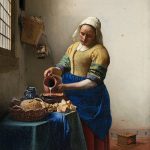
Few artists exemplify this ethos more than Johannes Vermeer. Though based in Delft and largely unknown in his own time, Vermeer’s work was perfectly attuned to Amsterdam’s cultural climate. His scenes—often a woman reading a letter, pouring milk, or gazing through a window—are acts of focused stillness. They depict not drama, but presence. Bathed in soft light and composed with near-mathematical precision, his interiors resonate with the values of domestic virtue, contemplation, and quiet material prosperity. His use of light and texture—how it moves across a tiled floor, glows on a blue dress, or hovers around a pearl earring—is less about realism than transcendence. The mundane becomes metaphysical.
Though Vermeer never lived in Amsterdam, several of his paintings passed through its art market. The city’s elite appreciated his refinement and subtlety, even if few truly understood his genius until centuries later. Today, the Rijksmuseum’s possession of The Milkmaid is a point of national pride, and its hushed power draws thousands of viewers into a dialogue with the Dutch past.
Frans Hals, meanwhile, operated primarily out of Haarlem, but his influence on Amsterdam portraiture and genre painting was profound. Where Vermeer whispered, Hals laughed. His brushwork was loose, quick, full of vitality. He painted jovial drinkers, smiling musicians, laughing children—figures caught in the moment, their expressions alive with spontaneity. His most famous works, like The Laughing Cavalier or The Merry Drinker, present a Republic that, while morally serious, also knew how to enjoy its pleasures.
Hals was also a master portraitist, and his lively depictions of regents, guardsmen, and matrons introduced a new kind of psychological realism—less formal than earlier portraiture, more focused on the sitter’s energy than their status. This approach influenced Amsterdam artists who sought to break free from rigid conventions. His portraits of Haarlem militia groups, painted with brio and asymmetry, provided a counterpoint to Rembrandt’s more brooding style, and his technique would echo in the looser brushwork of 19th-century impressionists.
But genre painting was not limited to a few star figures. It became an entire ecosystem. Amsterdam’s art market was flooded with depictions of kitchens, gardens, schoolrooms, and workshops—each one coded with symbolic meaning. A painting of a woman cleaning a home wasn’t just a record of labor; it was an emblem of moral purity. A tavern brawl could serve as a warning against excess. A young couple flirting might be a reminder of transience—or of social climbing.
Artists like Pieter de Hooch, Gerard ter Borch, and Jan Steen also found favor with Amsterdam’s buyers, each offering a different slice of Dutch life. De Hooch specialized in architectural serenity, often painting courtyards and rooms connected by open doors and glowing light. Ter Borch was a master of fabric and gesture—capturing silk gowns and quiet tension with unmatched finesse. Steen, by contrast, embraced chaos, filling his canvases with boisterous families, drunken revelry, and sly humor. His motto—“Soo de ouden songen, soo pijpen de jongen” (“As the old sing, so pipe the young”)—captured the Republic’s uneasy balance between libertine spirit and Calvinist conscience.
Through these genre scenes, a distinct visual identity of the Dutch Republic emerged—one that prized the everyday as worthy of art. In Amsterdam, this aesthetic found its spiritual home. The city’s merchant-class buyers wanted art that aligned with their Protestant ethic: modest, virtuous, instructive, and rooted in the real. And yet, these paintings often contained subtle contradictions—an invitation to contemplate the pleasure of surfaces, the slipperiness of meaning, the fragility of order.
In retrospect, genre painting allowed Dutch society to negotiate its own anxieties. It was a way to display wealth without ostentation, to reflect on vice without moralizing too heavily, and to find beauty in the structures of ordinary life. That these paintings remain compelling today—centuries after the shutters closed on their model homes—testifies to their enduring emotional truth.
Architecture as Art: The Canal Belt and Beyond
When one first arrives in Amsterdam, especially by foot or bicycle, it’s not a museum or a painting that takes the breath away—it’s the city itself. The orderly rows of tall, gabled houses standing shoulder-to-shoulder along glimmering canals form a living artwork. It’s as if the city were designed not just for habitation, but for contemplation. And in many ways, it was.
Amsterdam’s famous canal belt—de Grachtengordel—is more than a feat of urban engineering. It is the architectural embodiment of the Dutch Golden Age ethos: rational, harmonious, efficient, and beautiful. Developed in the early 17th century, at the height of the Republic’s wealth and confidence, the canal system was both a practical response to urban expansion and a utopian gesture. It offered space for trade, movement, water management, and, crucially, for the display of taste and status.
The architecture that rose along these canals was distinctive and deliberate. Tall, narrow buildings—constrained by plot taxes calculated by frontage—emphasized verticality and ingenuity. Their facades were adorned with elegant ornamentation: stepped, bell, and neck gables flourished, often crowned with symbolic motifs or the dates of construction. The restrained use of brick and stone, accented by large windows and decorative trim, reflected a sober Calvinist aesthetic that nevertheless left room for individual flair. In these homes, we see the tension at the heart of the Dutch Republic: a people suspicious of ostentation, yet deeply invested in material refinement.
Architects like Hendrick de Keyser, one of Amsterdam’s most influential early designers, helped shape this emerging identity. Trained as a sculptor and architect, de Keyser fused Northern Renaissance ideas with local traditions to produce works that balanced monumentality with human scale. His buildings—such as the Westerkerk (completed posthumously in 1631) and the Zuiderkerk—brought classical elegance to Protestant Amsterdam. The Westerkerk, in particular, with its soaring tower and sober interior, symbolized a new kind of sacred space: open, civic-minded, and unmediated by Catholic pomp.
De Keyser also worked on civic structures that elevated the city’s visual language—warehouses, exchange halls, and weigh houses—that married function to form. This blend of commercial pragmatism and architectural grace was uniquely Amsterdam. The city did not build pyramids to the ego of a king, but practical temples to trade and order. Even the Waag (Weigh House), originally a city gate and later used by various guilds, exudes a quiet grandeur.
This civic orientation was nowhere more apparent than in the construction of the Amsterdam Town Hall, now the Royal Palace on Dam Square. Designed by Jacob van Campen and completed in 1655, the building was conceived as a “Temple of the Republic”—a secular statement of power and virtue. Its façade is classical, its proportions idealized according to Renaissance theories of symmetry and balance. Inside, marble allegories and reliefs depicted Justice, Commerce, and the Oceans—an iconographic program that made the building a political message as much as an administrative center.
Unlike the royal courts of France or Spain, Amsterdam’s town hall expressed a collective authority: the rule of regents, not monarchs. The citizenry saw themselves reflected not just in the painting on their walls, but in the streets they walked. The visual logic of the city reinforced their place within a moral and civic order.
Even residential architecture participated in this broader aesthetic. Interiors were modest but carefully curated—wooden beams, Delft tiles, polished floors, and light filtered through tall windows. These interiors became the stages for many genre paintings, where women played lutes, children fed parrots, and letters were quietly read in morning light. The architecture didn’t just contain these lives—it shaped the artistic imagination that depicted them.
Amsterdam’s urban form also invited a new way of seeing. The concentric canals, the bridges, the changing reflections—these created a cityscape that constantly shifted perspective. Walking along the Herengracht or Prinsengracht, one is struck by the rhythmic repetition and subtle variation of the houses. The city moves not through dramatic shifts but through modulation and refinement. It is a visual experience that rewards slow looking, much like a Vermeer or a still life.
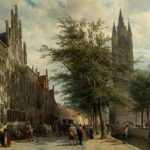
But the city’s architecture was never static. In the 18th and 19th centuries, neoclassical, neogothic, and eclectic styles began to appear, especially in public buildings. The Rijksmuseum, designed by Pierre Cuypers and completed in 1885, fused Gothic and Renaissance forms into a nationalistic cathedral for art—a deliberate contrast to the older Protestant sobriety. Around the same time, the Centraal Station, also designed by Cuypers, linked the city physically and symbolically to the rest of Europe.
The 20th century brought further experimentation. The Amsterdam School, a movement of expressionist architecture led by Michel de Klerk and others, sought to infuse public housing with artful individuality. Their buildings—most famously the Het Schip housing complex—used sculptural brickwork, unusual forms, and elaborate detailing to create poetic, humane environments for working-class residents. This was architecture as social vision, another echo of the city’s belief in the visual shaping of civic life.
Even today, the architecture of Amsterdam remains a living palimpsest. Modern insertions—glass-and-steel museums, minimalist apartment blocks, adaptive reuse of warehouses—coexist with centuries-old façades. The city continues to evolve visually while preserving its core logic: beauty grounded in function, creativity within constraint.
To understand Amsterdam as an artistic city is not just to walk through its museums, but to walk through its streets. The gables, canals, and courtyards form a kind of continuous canvas—one painted not by a single hand, but by generations of builders, thinkers, and citizens who saw the city as a moral and aesthetic project.
Art in the Age of Enlightenment and Decline
By the beginning of the 18th century, the light that had shone so brightly during Amsterdam’s Golden Age began to dim. The causes were complex: wars with England and France, shifting trade routes, growing competition from London, and the depletion of the merchant class’s easy wealth. The Dutch Republic entered what many historians call a period of decline—economically, politically, and culturally. But decline did not mean disappearance. Rather, it marked a transition: from exuberant innovation to quiet reflection, from bustling markets to curated salons, and from prolific artistic output to preservation and introspection.
In this period, Amsterdam’s role in the art world began to shift. No longer the vanguard of artistic invention, it became a city more concerned with cataloging, conserving, and contemplating its artistic heritage. The Enlightenment was spreading across Europe, and with it came new ways of thinking about art—not merely as adornment or moral instruction, but as a field of intellectual inquiry. Museums, encyclopedias, and academies emerged as places where knowledge was to be collected and systematized. Art, too, was pulled into this new epistemological order.
The taste of Amsterdam’s elite followed suit. Gone were the raucous genre scenes and moralizing still lifes of the previous century. In their place came a preference for classicism, portraiture with reserved dignity, and landscapes that emphasized harmony and control. Artists like Cornelis Troost, active in the early to mid-18th century, carried forward elements of Dutch tradition while subtly adapting to newer, more genteel sensibilities. His scenes of theater interiors, domestic comedy, and civic life retained the narrative spark of genre painting, but with softened edges and Rococo elegance.
Troost’s popularity signals a broader shift: a move away from the open market culture of the Golden Age to more elite, curated spaces of cultural consumption. Art was increasingly seen in drawing rooms and private salons—less subject to public auction, more embedded in the rituals of polite society. Collectors turned to drawings, engravings, and works by Old Masters rather than commissioning new works. The past, rather than the present, became the main object of aesthetic attention.
This retreat into the past was not entirely nostalgic. It also reflected Enlightenment values: a desire to catalog and classify, to preserve what was deemed valuable. The seeds of institutional collecting were planted in these years. In 1798, the Nationale Konst-Gallery was established in The Hague, eventually evolving into the Rijksmuseum, which would move to Amsterdam in the 19th century. Though small at first, this initiative marked a significant shift—the idea that art belonged not only to collectors, but to the nation.
Meanwhile, a different kind of visual culture was flourishing outside the elite spheres. Amsterdam remained a city of printers and publishers, and the 18th century saw an explosion of printed imagery: scientific illustrations, botanical prints, satirical cartoons, and architectural engravings. These works reflected the Enlightenment’s hunger for knowledge and visual clarity. They also made art more accessible to the growing educated bourgeoisie.
At the same time, Amsterdam’s multiculturalism persisted. The city remained a relatively tolerant hub for Jewish, Huguenot, and other diaspora communities, whose contributions to printing, publishing, and collecting continued to shape the city’s visual economy. Sephardic Jewish patrons, in particular, played important roles in commissioning and conserving works of art, architecture, and ceremonial objects—an often overlooked dimension of Amsterdam’s cultural life.
Yet the century was not without its visual grandeur. The Stadhuis (now the Royal Palace), though conceived in the previous century, remained a locus of ceremonial power. Wealthy families still built impressive canal houses, sometimes commissioning decorative panels, ceiling paintings, and elaborate interiors from lesser-known artists and decorative painters. The line between fine art and decorative art blurred, with marquetry, porcelain, and tapestries often commanding more attention than oil painting.
By the end of the 18th century, political upheaval began to rattle the city. The Batavian Revolution (inspired by the French Revolution) and subsequent Napoleonic occupation brought new rulers and new regimes. In 1806, Louis Bonaparte, Napoleon’s brother, was installed as King of Holland and made Amsterdam his capital. Ironically, this foreign imposition would lay the groundwork for a reinvigoration of the city’s cultural institutions in the 19th century.
Looking back, the Enlightenment era in Amsterdam was not one of grand artistic leaps, but of steady consolidation. It was a period of collecting rather than creating, of looking backward rather than forward. And yet, it was also a necessary bridge—a time when the foundations were laid for the city’s future as a guardian of art and history.
It is in this quiet century that Amsterdam began to conceive of itself not just as a maker of culture, but as a keeper of it. The great canvases of the Golden Age were still present, often hidden in private collections or municipal buildings, waiting to be reinterpreted and reinstalled in new, public narratives of national pride. The city, in a sense, was beginning to curate its own memory.
The 19th Century: Revival, Romanticism, and Realism
The 19th century marked a return of energy to Amsterdam’s artistic life—a reawakening after the contemplative calm of the Enlightenment. It was a century of contradictions: industrial progress and nostalgic yearning, imperial expansion and moral introspection, modernity and medieval revival. For Amsterdam, the century was less about a single defining style or movement than a gradual and layered rebuilding of artistic identity, grounded in history but oriented toward the future.
At the heart of this renewal was the spirit of Romanticism, which arrived in the Netherlands somewhat later than in France or Germany but left a distinct mark. Romanticism in the Dutch context was often linked to national memory. The trauma of foreign occupation under Napoleon, followed by the restoration of Dutch independence in 1815, created fertile ground for a cultural movement that idealized the past and sought to locate Dutch greatness in its Golden Age.
Artists like Barend Cornelis Koekkoek painted dreamy, idealized landscapes filled with castles, storms, and peasants—scenes steeped in emotional depth and historical atmosphere. Though often rural and removed from Amsterdam’s urban life, these works resonated with a city increasingly engaged in building a visual narrative of national pride. In their imagined pasts, these paintings offered a sense of cultural continuity, a way to root the present in a storied, majestic heritage.
Architecture followed suit. The latter half of the 19th century saw the rise of historicist revival styles, particularly neo-Gothic and neo-Renaissance. These were not simply stylistic choices; they were visual arguments about identity. Nowhere is this clearer than in the Rijksmuseum, designed by Pierre Cuypers and opened in 1885. Part cathedral, part fortress, the building fused Gothic arches with Renaissance ornament, creating a dramatic setting for the republic’s greatest artistic treasures. Its opening marked a watershed moment: art in Amsterdam was no longer just a private pleasure or a merchant’s investment—it was now a public right and a national symbol.
The Rijksmuseum also signaled the triumph of institutional collecting. Paintings that had long hung in city halls, private homes, and storage rooms were reclaimed and recontextualized as cultural patrimony. Works by Rembrandt, Vermeer, and Hals were now presented not just as examples of Dutch genius, but as pillars of Dutch identity. In this way, Amsterdam’s museums became shrines to both history and aspiration.
The museum boom didn’t stop there. The Stedelijk Museum was founded in 1874 to focus on modern and applied art, and plans were already being laid for what would become the Van Gogh Museum in the next century. These institutions reflected a growing belief in the social value of art—not just for education or nationalism, but for shaping public taste and morality.
But the 19th century wasn’t all about Romantic nostalgia and grand architecture. There was also a powerful movement toward realism, especially in painting. Inspired by French realists like Courbet and Millet, Dutch artists began turning their gaze back to the real, everyday lives of the working class. The so-called Hague School, often compared to the Barbizon School in France, emphasized muted colors, overcast skies, and scenes of fishing villages, farmland, and ordinary labor.
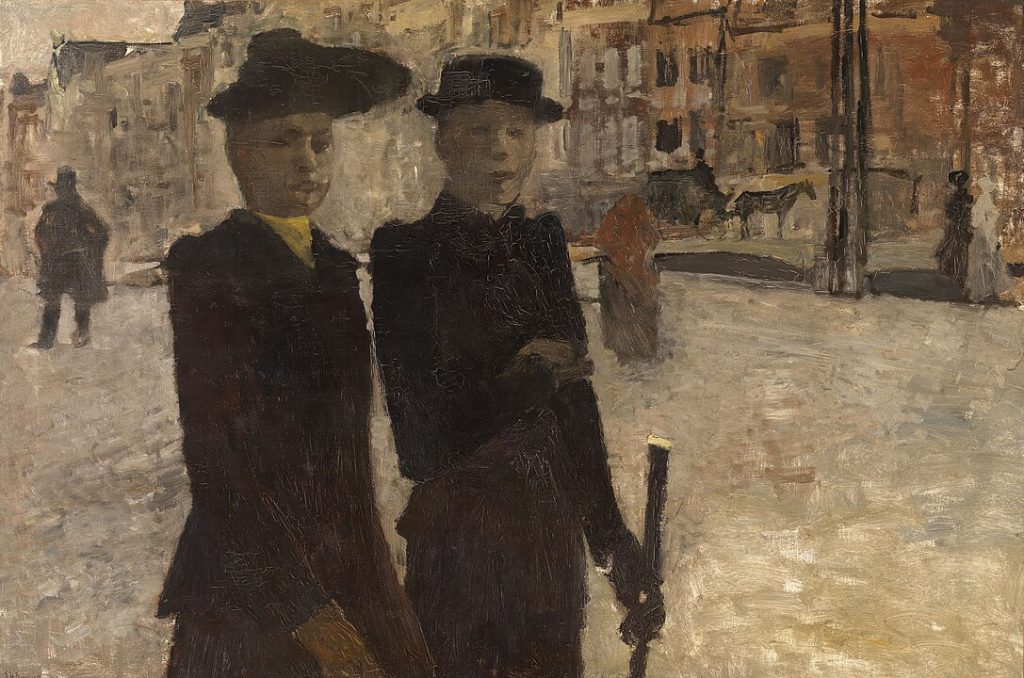
While the Hague was the center of this movement, its influence extended into Amsterdam, particularly through the careers of artists like George Hendrik Breitner. A true urban realist, Breitner brought the techniques and ethos of the Hague School into the city, painting Amsterdam’s streets, construction sites, and working-class women with a gritty immediacy. His paintings, often moody and atmospheric, captured the city in flux—bridging the gap between old-world charm and modern restlessness.
Breitner was also a pioneer in using photography as a reference for painting, marking an important shift toward modern artistic practice. His interest in Japanese prints, movement, and cropping techniques foreshadowed later modernist developments and showed that even as Amsterdam looked back to its past, it was also subtly preparing for the future.
Meanwhile, realism in portraiture experienced a revival as well. Artists like Thérèse Schwartze became sought-after portraitists for Amsterdam’s elite, combining technical precision with a sensitivity to personality and social context. Schwartze’s role as a prominent female artist also reflected broader societal changes—particularly the growing visibility of women in cultural life, though true equality was still far off.
Throughout the 19th century, public art and monuments proliferated. Statues of national heroes and allegorical figures dotted the city’s squares and parks. These sculptures weren’t just decorative—they were mnemonic devices, meant to instruct, inspire, and solidify a collective identity. In a time of rapid change—industrialization, urbanization, and expanding colonial ventures—art in public space became a kind of visual anchor.
The century closed with both a sense of cultural confidence and a creeping sense of dislocation. Amsterdam was growing, modernizing, and becoming more cosmopolitan. The art world was preparing for the next wave—Impressionism, Symbolism, and eventually the radical experiments of the 20th century. But even as styles changed, the 19th century had left its mark: it had built the museums, revived the stories, and redefined the role of art in civic life.
What began as a period of recovery ended as a foundation for reinvention. Amsterdam had reasserted itself not as the restless innovator of the 1600s, but as the custodian of a cultural lineage—a city where art was not only made, but remembered, displayed, and discussed.
Van Gogh and the Seeds of Modernism
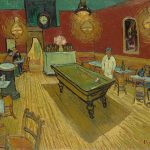
Few artists embody the tortured myth of the misunderstood genius more completely than Vincent van Gogh. And yet, in the context of Amsterdam’s art history, Van Gogh is more than just a tragic figure—he represents a seismic shift in how art was made, seen, and understood. Although his adult life unfolded far from the canals of Amsterdam, it is in Amsterdam that his legacy would be preserved, magnified, and woven into the very fabric of modern Dutch identity. Through Van Gogh, Amsterdam stepped into the age of emotional intensity, formal disruption, and individualistic expression—the age of modernism.
Born in 1853 in Zundert, a small village in the southern Netherlands, Van Gogh was never truly of Amsterdam, but the city was never far from his orbit. As a young man, he spent a brief stint studying theology here, and later enrolled at the Rijksakademie van Beeldende Kunsten, hoping to improve his technical skill. He quickly clashed with its conservative instruction and dropped out after a few months. The academy’s emphasis on academic draftsmanship, rigid composition, and idealized forms was antithetical to the expressive urgency that Van Gogh was already beginning to explore.
Instead, he took his education elsewhere: to the muddy fields of Brabant, the stark coasts of the Hague, the mining towns of Belgium, and eventually, the blazing light of Arles. Van Gogh’s style evolved rapidly—from the muted, moralistic tones of his early peasant scenes to the swirling, color-drenched canvases of his late French years. But throughout, he remained rooted in a deep engagement with humanity—its suffering, its beauty, its loneliness. He looked to art not for perfection, but for truth.
During his lifetime, Van Gogh sold almost nothing. His radical brushwork, vivid palette, and psychological intensity made him an outlier in a Dutch art scene that, even in the late 19th century, was still largely dominated by realism and restrained impressionism. He was viewed as unstable, erratic, and unmarketable. It wasn’t until after his death in 1890 that Amsterdam—and the art world more broadly—began to recognize the magnitude of his vision.
The turning point came thanks to two people: Van Gogh’s devoted brother Theo, an art dealer based in Paris, and Johanna van Gogh-Bonger, Theo’s widow. After both brothers died within a year of each other, Johanna took possession of hundreds of Vincent’s unsold works and began an extraordinary campaign to preserve, exhibit, and promote his legacy. Her efforts culminated in exhibitions across Europe and the gradual building of Van Gogh’s reputation as a visionary precursor to modern art.
In Amsterdam, his first significant posthumous exposure came through exhibitions at progressive galleries and through the growing influence of modernist collectors and critics. As modern art began to gain traction in the early 20th century, Van Gogh was increasingly positioned not as a madman, but as a prophet—one who had seen beyond the surfaces of things and rendered inner life visible through color and form.
This recognition would culminate in the creation of the Van Gogh Museum, which opened in 1973 in Amsterdam’s Museumplein, near the Rijksmuseum and the Stedelijk. Designed by architect Gerrit Rietveld and later expanded with a wing by Kisho Kurokawa, the museum was more than a home for paintings—it was a cultural reckoning. For the first time, a major European city built an entire museum around a single artist who had been marginalized during his life.
Today, the Van Gogh Museum houses the largest collection of his work in the world—over 200 paintings, 500 drawings, and hundreds of letters that provide intimate access to his thoughts, struggles, and visions. Visitors trace his evolution room by room: from the earthy solemnity of The Potato Eaters to the ecstatic turbulence of Starry Night Over the Rhône, from the vibrant portraits of provincial life to the desolate beauty of wheat fields and olive groves.
The museum’s presence in Amsterdam does more than celebrate a great artist; it reframes the city’s relationship to modern art. It bridges the gap between the civic grandeur of the Golden Age and the fractured, emotional terrain of the modern psyche. Where Rembrandt painted the human condition in chiaroscuro, Van Gogh carved it out with pure, living color. Where the Golden Age embraced harmony and surface, Van Gogh laid bare the chaos and depth beneath.
And in doing so, he helped make Amsterdam a center not just of art history, but of artistic future. His influence would echo through the generations of Dutch and international artists who passed through the Stedelijk Museum, the Rietveld Academie, and the vibrant gallery scene that blossomed in the 20th century.
Van Gogh’s presence in Amsterdam is a paradox. He did not thrive here during his lifetime. He was too raw, too unstable, too modern. And yet it is Amsterdam that gave him permanence, that turned his troubled genius into a cornerstone of national pride and international acclaim.
In the raw brushstrokes of Van Gogh, Amsterdam found not a mirror of its prosperity, but a revelation of its complexity—its undercurrents of doubt, passion, and longing. And from that revelation, a new kind of art city was born.
The Amsterdam School and Interwar Innovation
In the early decades of the 20th century, Amsterdam experienced a profound transformation—not only in the way people lived, but in how the city imagined itself. The trauma of World War I, though the Netherlands remained officially neutral, had shaken the European order. And in its wake, many artists and thinkers rejected the restrained elegance of 19th-century realism and classical revival. In Amsterdam, that rejection took on a distinctly architectural form: an explosion of brick, curve, and expression known as the Amsterdam School.
While modernism across Europe was trending toward minimalism, rationalism, and the clean lines of the Bauhaus or Le Corbusier’s “machines for living,” the Amsterdam School embraced a radically different vision. It was emotional. Symbolic. Even theatrical. It rejected the purely functional in favor of form as a statement—architecture not as background, but as public art. And yet, at its core, the movement was deeply socialist. Its wild forms served the common people.
The origins of the Amsterdam School lie in the early 1910s, when a group of architects—Michel de Klerk, Piet Kramer, and Johannes van der Mey—began experimenting with new forms of civic architecture, starting with the city’s expansion into new working-class neighborhoods. Their approach was influenced by Art Nouveau, Expressionism, and the ideals of the Arts and Crafts movement, but it quickly evolved into something uniquely Dutch.
The first major work that defined the Amsterdam School was the Scheepvaarthuis (Shipping House), designed primarily by Van der Mey and completed in 1916. Commissioned by a consortium of shipping companies, the building was meant to be a statement of Amsterdam’s maritime heritage and commercial power. What emerged was a monumental, brick-clad fantasy: intricate sculptures, stained-glass windows, symbolic carvings, and decorative ironwork infused every inch of its facade and interior. The Scheepvaarthuis wasn’t just a place of business—it was a Gesamtkunstwerk, a total work of art, uniting architecture, sculpture, and graphic design into a single, unified expression.
Following its success, the city saw an explosion of Amsterdam School buildings, particularly in social housing. One of the movement’s most iconic projects was Het Schip (“The Ship”), completed by Michel de Klerk in 1921 in the Spaarndammerbuurt neighborhood. Commissioned by a socialist housing cooperative, the building was meant to elevate the dignity of the working class—both in function and in form.
Het Schip looks like something out of a dream: curved walls, tapering towers, expressive masonry, circular windows, and even a tiny post office shaped like a ship’s prow. It defied the austere expectations of working-class housing and reimagined the cityscape as a stage for beauty, humor, and collective identity. In de Klerk’s vision, even the mailman could enter a piece of sculpture to do his job.
This commitment to public art was rooted in political conviction. The Amsterdam School was closely tied to the Dutch socialist movement, which saw the expansion of public housing as not just a social good, but a moral imperative. Housing was not to be merely functional—it was to uplift. Ornamentation was not indulgence—it was empowerment. In this way, the Amsterdam School’s maximalist style stood in direct opposition to the austerity of both capitalist efficiency and the later International Style of architecture.
Sculptors like Hildo Krop, the city’s official sculptor, played a central role in Amsterdam School projects. His stone carvings adorned bridges, facades, and doorways across the city—allegorical figures, mythical creatures, and social symbols that brought visual storytelling into the public sphere. Through his work, neighborhoods became art galleries.
The city itself became a kind of urban canvas. Entire districts, particularly to the west and north, were reshaped according to Amsterdam School principles. The new buildings were not just shells—they were holistic compositions, with custom furniture, lighting fixtures, stair railings, and even manhole covers designed to harmonize with the building’s aesthetic.
And yet, despite its visual exuberance, the Amsterdam School was always under pressure. Its craftsmanship was expensive. Its politics, while idealistic, were often viewed as impractical. And as economic conditions worsened in the 1930s, support for expressive housing waned. The Great Depression brought a shift toward more stripped-down, cost-effective modernism, and the rise of fascism in Europe cast doubt on the utopian dreams that had animated the movement.
By the time World War II broke out, the Amsterdam School was already giving way to Nieuwe Zakelijkheid (“New Objectivity”)—a Dutch variant of modernist functionalism. Buildings became boxier, simpler, and more anonymous. The sculptural whimsy of de Klerk and Kramer began to look like artifacts from another era.
And yet, the legacy of the Amsterdam School endures—not just in bricks and ornament, but in ideology. It was one of the few architectural movements that truly believed in beauty for the masses. It argued, powerfully and visually, that public infrastructure should inspire, not just shelter. That art and design are not luxuries, but necessities of a dignified civic life.
Today, Amsterdam’s west side is still filled with these expressionist jewels—sometimes weathered, often lovingly restored. The former socialist post office at Het Schip is now a museum dedicated to the movement. Urban planners and architects from around the world continue to study the Amsterdam School as a rare example of progressive politics expressed not through slogans, but through design.
Where earlier centuries in Amsterdam used painting to explore moral order or psychological depth, the interwar period used architecture to project social vision. In their fantastical, brick-born poetry, the architects of the Amsterdam School gave the city a modernism that was not cold and rational, but warm, idiosyncratic, and deeply human.
COBRA and the Postwar Avant-Garde
The end of World War II left Europe in ruins—physically, politically, and spiritually. Amsterdam, though spared the worst of the Allied bombings, had suffered deeply. The Nazi occupation had decimated its Jewish population, silenced its cultural institutions, and left its artistic community disoriented and traumatized. In the aftermath, the city’s art world stood at a crossroads: it could rebuild the past, or it could shatter it.
Into this vacuum burst COBRA—a furious, childlike, and defiantly radical art movement that rewrote the rules of modernism almost as soon as it arrived. Founded in 1948 in Paris by artists from Copenhagen, Brussels, and Amsterdam (hence the name), COBRA was a short-lived but seismic explosion of energy. For its members, logic, geometry, and classical beauty—all pillars of prewar culture—had failed. What was needed now was instinct, freedom, and raw, unfiltered emotion.
Amsterdam played a central role in COBRA’s birth and its legacy. One of its founding members, Karel Appel, was a native of the city, and his work would come to symbolize both the movement and the messy rebirth of Dutch postwar art. Appel’s early works were thick with impasto and chaos: howling figures, animal spirits, and crude shapes that recalled children’s drawings and tribal masks. “I paint like a barbarian in a barbaric time,” he once said. He wasn’t interested in polish or subtlety—he wanted to feel his way through the canvas.
COBRA artists rejected individual genius in favor of collective creation. In Amsterdam, this ethos was most famously realized in 1949, when Appel and his collaborators painted an enormous mural in the cafeteria of Amsterdam’s City Hall. Titled Questioning Children, the piece was a riot of color and distortion—disturbing, joyful, and deeply polarizing. Public outrage was swift. Critics called it primitive, ugly, even dangerous. The mural was so controversial that it was eventually covered up for years, only to be restored and reembraced decades later.
What COBRA proposed wasn’t a style—it was a way of being. Inspired by children’s art, outsider art, and prehistoric imagery, COBRA artists saw spontaneity as a form of resistance against conformity, repression, and fascist aesthetics. They published manifestos that denounced rationalism and embraced dream, myth, and play. They worked not just in painting, but in poetry, sculpture, ceramics, and collaborative books. Amsterdam’s postwar art scene, still reeling from the trauma of war and the Holocaust, provided both the pain and the freedom that allowed COBRA to flourish.
In this environment, Appel was joined by fellow Dutch artists like Corneille and Constant Nieuwenhuys, each contributing their own vocabulary to the movement. Constant, in particular, would evolve into one of the most complex figures in postwar art. While he began as a COBRA expressionist, he later turned toward architectural theory and speculative design, most famously with his project New Babylon—a visionary, utopian “city for the nomad,” built not around industry or labor, but creativity and movement.
COBRA’s reach extended beyond Amsterdam, but the city was its ideological home: open, anarchic, restless. It was in Amsterdam’s squats, cafes, and underground presses that COBRA’s ideas gained traction, influencing a new generation of artists who rejected the formalism of the Dutch academies and sought more primal, socially engaged ways of working.
Though the movement formally disbanded in 1951—just three years after it began—its influence was profound and lasting. The Stedelijk Museum, Amsterdam’s key institution for modern and contemporary art, played a crucial role in preserving and legitimizing COBRA’s legacy. Under the visionary direction of Willem Sandberg, the Stedelijk became not just a museum, but a laboratory of the avant-garde. Sandberg championed Appel, Constant, and other COBRA artists, giving them space in major exhibitions and placing their work alongside international modernists like Dubuffet, Picasso, and Jackson Pollock.
Importantly, COBRA also laid the groundwork for Amsterdam’s broader postwar cultural ethos: experimental, interdisciplinary, anti-authoritarian. It influenced not just visual art, but design, performance, and education. Its emphasis on collaboration and public engagement anticipated the happenings, performance art, and conceptual movements of the 1960s and ’70s.
Even today, COBRA’s fingerprints are all over Amsterdam. The COBRA Museum of Modern Art, located just outside the city in Amstelveen, is dedicated to the movement’s history and houses a rich collection of its paintings, drawings, and publications. The riotous energy of COBRA continues to attract young artists, especially those drawn to political critique, emotional authenticity, and the rejection of hierarchy in artmaking.
But COBRA also left behind a deeper message: that in the wake of devastation, art can be a form of healing, not through beauty or perfection, but through confrontation, messiness, and collective creation. For Amsterdam—a city rebuilding not just its infrastructure but its cultural psyche—this was a vital revelation.
COBRA was never meant to last. It was a spark, a rupture, a shout. But in that brief, brilliant moment, it redefined what art could be in a broken world. And Amsterdam, with its openness to reinvention and resistance, proved to be the perfect place for that shout to echo.
Street Art, Subcultures, and Countercultural Expression
By the 1970s, Amsterdam was no longer just a historic capital of oil paintings and avant-garde experiments—it had become a canvas of resistance. As economic instability, housing shortages, and rising inequality gripped the city, a generation of artists, punks, anarchists, and immigrants turned the streets themselves into a medium. This was a raw, visceral, and decentralized art world, one that rejected the institutional, embraced the ephemeral, and made its message impossible to ignore.
The seeds of this street-level revolution had been planted decades earlier, in the political and artistic ferment of the 1960s. Amsterdam was at the center of a European wave of student protests, anti-colonial activism, and anti-authoritarian politics. The city’s famously liberal attitude—toward drugs, sexuality, squatting, and expression—created fertile ground for alternative cultures. And art became one of the sharpest tools in this underground arsenal.
One of the most pivotal movements in this era was Provo, a Dutch anarchist collective active from 1965 to 1967. Though short-lived, Provo pioneered the fusion of street theater, public disruption, and graphic design to provoke social change. They staged happenings, mocked the monarchy, and distributed satirical pamphlets filled with bold typography, cheeky illustrations, and radical manifestos. Their White Bicycle Plan, which proposed free public bikes across the city, was both a political statement and a piece of conceptual art that prefigured later sustainability movements.
As the 1970s progressed, the city’s squatting movement (krakers) grew into a major social and artistic force. Fueled by a housing crisis and the abandonment of buildings by absentee landlords, thousands of young people occupied vacant structures and turned them into autonomous zones. These squats—places like the Vondelbunker, OT301, and ADM—became breeding grounds for creativity, where visual art, music, performance, and political organizing coexisted in chaotic harmony.
Walls inside and outside these spaces became canvases for graffiti, stencils, and murals. Often anti-capitalist, anti-fascist, or anti-gentrification, this street art wasn’t made for permanence—it was made for impact. Tags and symbols spread like wildfire, creating a visual language of resistance. Unlike the graffiti scenes in New York or London, Amsterdam’s version was deeply intertwined with its housing politics. A stencil of a keyhole, a broken heart, or a clenched fist could say more than a hundred words about who belonged—and who was being pushed out.
Meanwhile, the punk scene exploded across Amsterdam, especially in the late 1970s and early ’80s. Bands like The Ex, venues like Paradiso and Melkweg, and zines like Raket & Lont created a dense ecosystem of DIY publishing, performance, and visual culture. Flyers, album covers, and posters became artworks in their own right—collaged, Xeroxed, and hand-lettered to reflect a world of noise, urgency, and dissent. Graphic design in this era thrived outside of commercial studios, with artists like Anthon Beeke and collectives like Hard Werken injecting brutal honesty and irreverence into Dutch visual communication.
As hip hop arrived in Europe in the 1980s, Amsterdam’s street art scene expanded further. Graffiti crews emerged with names like NDSM, YS, and CMC—bringing bold letter styles and large-scale works to train cars, industrial sites, and canal walls. The city’s sprawling NDSM Wharf, once a shipyard, became an unofficial gallery of murals, installations, and collaborative public works, and remains one of the city’s most iconic street art hubs today.
Importantly, this was also a time when immigrant communities—particularly from Suriname, Turkey, and Morocco—began asserting their cultural voices in the city. Visual art became a space where diasporic identities could be explored and affirmed. Community centers, multicultural festivals, and alternative publications nurtured hybrid aesthetics that reflected Amsterdam’s shifting demographics. Murals in neighborhoods like De Baarsjes and Nieuw-West began to reflect a kaleidoscope of global influence—textile patterns, calligraphy, portraits, and political slogans merged into a rich visual patchwork.
By the 1990s, the boundary between street and gallery began to blur. Artists like Hugo Kaagman, one of the first stencil artists in the Netherlands, began showing work in museums and festivals while continuing to work illegally on the streets. Others, like FAKE and Laser 3.14, cultivated identities as anonymous poets and image-makers, operating in the gray zone between art, protest, and branding.
At the same time, the city began to grapple with how to regulate and commodify its street art. Some squats were legalized and turned into cultural institutions—like OT301, a former film academy turned into a legal art space with studios, events, and residencies. The NDSM Wharf was reimagined as a semi-official creative zone, where sanctioned street art coexisted with spontaneous expression. Meanwhile, companies began hiring graffiti artists to paint murals, blurring the line between radical art and Instagram-friendly branding.
Despite these shifts, the spirit of resistance remains alive. Today, political art continues to erupt on Amsterdam’s walls—denouncing surveillance, climate inaction, neocolonialism, and displacement. Street art festivals, like If Walls Could Speak, bring international artists to the city, while local crews keep innovating with paste-ups, projections, and augmented reality interventions.
In many ways, Amsterdam’s street art and countercultural legacy is a continuation of the city’s long-standing artistic ethos: decentralized, democratic, and deeply engaged with civic life. From guild paintings to squat murals, Amsterdam has always been a city where art emerges from the tension between public and private, rebellion and regulation, tradition and subversion.
And in the alleys behind museums, in abandoned industrial lots, or on the side of a tram tunnel, the story of that tension is still being spray-painted, one line at a time.
Contemporary Amsterdam: Museums, Markets, and Globalism
Walk through Amsterdam today, and you’ll find a city that wears its art history proudly on its sleeve—but never lets it gather dust. In the 21st century, Amsterdam’s art scene is a kaleidoscope of contradictions: elite and underground, institutional and improvised, historically saturated and future-obsessed. It is a city where Rembrandt hangs steps away from immersive digital installations, and where street art shares the sidewalk with private galleries and blockchain-backed NFTs. This is a cultural ecosystem at once rooted and restless—shaped by its past, but never defined by it.
The most visible pillar of Amsterdam’s contemporary art world remains its museum district, centered around the Museumplein. Here, three flagship institutions—the Rijksmuseum, the Van Gogh Museum, and the Stedelijk Museum of Modern Art—form a triad of historical, modern, and contemporary visual culture.
The Rijksmuseum, after a ten-year renovation completed in 2013, has reasserted itself not only as a temple to the Dutch Golden Age, but as a model for how to reinvigorate tradition. Its rehang placed Rembrandt’s Night Watch in dialogue with decorative arts, Asian artifacts, and colonial history, challenging the idea of a singular national narrative. The museum now also hosts contemporary exhibitions that explore race, gender, and decoloniality—embedding present-day debates in centuries-old spaces.
Next door, the Van Gogh Museum remains one of the most visited in the world. But its role has expanded: not just a home for Vincent’s tormented beauty, it now serves as a hub for mental health awareness, multimedia education, and interdisciplinary dialogue. Its exhibitions increasingly bridge Van Gogh’s legacy with contemporary themes like isolation, neurodiversity, and environmental angst.
Then there’s the Stedelijk Museum, Amsterdam’s boldest institution for modern and contemporary art. Known for its daring programming and controversial architecture (its 2012 extension is nicknamed “the bathtub”), the Stedelijk remains a touchstone for artists working in installation, video, sound, and socially engaged practice. It continues to showcase big names—Warhol, Kusama, Abramović—but also nurtures emerging Dutch and international artists whose work interrogates identity, technology, and the environment.
But Amsterdam’s contemporary art scene stretches far beyond these flagship spaces.
In Amsterdam-Noord, across the IJ River, former industrial zones have been transformed into creative districts. The NDSM Wharf, once a derelict shipyard, is now a vibrant arts complex housing studios, performance spaces, street art festivals, and experimental exhibitions. It’s here that many young artists, collectives, and designers find affordable space to work and show—away from the polished halls of Museumplein, but deeply in touch with global artistic currents.
Throughout the city, artist-run spaces and project-based initiatives thrive. Venues like De Appel, W139, Framer Framed, and Rozenstraat blur the lines between gallery, think tank, and community center. They champion critical art practices—centering voices from the diaspora, addressing climate collapse, confronting neo-colonial narratives, and experimenting with radical pedagogy. These are the places where Amsterdam’s legacy as a space for dissent and disruption continues in the digital age.
In tandem, the commercial gallery scene is booming. Blue-chip galleries like Annet Gelink, GRIMM, and Upstream connect Amsterdam to the international art market, showcasing work at Art Basel, Frieze, and beyond. Many of these galleries also represent a new generation of Dutch artists whose practices straddle photography, AI, sound art, and archival excavation.
The city is also a hub for art education and residency programs. Institutions like the Gerrit Rietveld Academie and Sandberg Instituut continue to draw talent from across the globe, offering progressive, cross-disciplinary training that merges art, design, theory, and activism. Their graduates often stay in Amsterdam, forming the backbone of the city’s experimental arts ecology.
Of course, contemporary Amsterdam is not immune to the tensions of the global art world. Gentrification, rising rents, and tourism threaten the survival of grassroots spaces. The city’s once-thriving squat scene has largely disappeared or been legalized, and independent collectives struggle against the commercial pressures of branding and bureaucratic funding structures.
Meanwhile, questions of decolonization and representation loom large. As a former imperial capital, Amsterdam’s museums and cultural institutions face increasing pressure to reckon with their collections—many of which contain artifacts acquired during the colonial era. Initiatives like the Rijksmuseum’s Slavery Exhibition (2021) and the Stedelijk’s focus on non-Western modernisms signal a shift toward more inclusive narratives, but there’s still a long road ahead.
At the same time, climate crisis, digital surveillance, and global migration have become key subjects for contemporary art in the city. Amsterdam artists are exploring the ethics of AI, the politics of water, the precarity of labor, and the fragility of memory. They’re staging interventions in public space, hacking museum formats, and experimenting with blockchain and posthuman aesthetics.
And yet, through all of this, Amsterdam retains its peculiar magic: the way its history remains visible, but never inert. The way Rembrandt’s brushstrokes, COBRA’s chaos, and a punk poster from 1979 can all seem equally alive. It’s a city that resists singular definition—a palimpsest of eras, styles, struggles, and revolutions. And in its contemporary art scene, that layered texture is not smoothed out—it’s embraced.
Here, in the 21st century, art in Amsterdam is not just made or shown. It’s contested, debated, mapped, and remade. It pulses from canal houses and warehouse lofts, from virtual platforms and brick alleys. It is, as ever, both mirror and provocation.
Conclusion: The Ever-Evolving Palette of Amsterdam
Amsterdam is a city that resists simplicity. It’s a city of paradoxes—where canals reflect centuries-old gables beside neon-lit galleries, where masterpieces hang a block away from protest murals, and where the past is ever-present, but never content to stay still. Its art history is not a linear narrative, but a palimpsest—a surface written, erased, and rewritten across centuries of transformation.
From its medieval origins, when religious art flickered in candlelight beneath Gothic arches, to the roaring crescendo of the Dutch Golden Age, Amsterdam’s visual culture has always been shaped by its unique civic structure. Without a king, without a church as the sole patron, art in Amsterdam has long thrived in the spaces between private and public—shaped by merchants, guilds, radicals, and citizens. That democratization of patronage, born in the 17th century, remains one of the city’s enduring legacies.
But Amsterdam has never rested on that legacy. Instead, it has allowed its creative identity to be challenged, disrupted, and rebuilt time and again. The Enlightenment brought a quieter reflection; the 19th century reasserted cultural nationalism; Van Gogh cracked open the modernist soul. The Amsterdam School sculpted civic dreams in brick. COBRA set fire to modernism with childlike fury. And the street artists, squatters, and subcultures of the late 20th century rewrote art’s rules entirely, making the city not just a site of culture, but of resistance.
What ties all these eras together is a spirit of visual argument. Art in Amsterdam has rarely been about passive beauty. It has been about posing questions—about power, place, identity, and memory. Whether through a group portrait, a crooked gable, a surreal mural, or a virtual installation, Amsterdam’s art seeks dialogue. It demands attention and response. It knows it is part of a civic fabric.
This is perhaps why the city has remained so creatively resilient. Amsterdam doesn’t flatten its contradictions—it embraces them. It allows the Rembrandt House to stand across the canal from a feminist zine archive, or the Rijksmuseum’s Golden Age galleries to be in conversation with decolonial video installations two blocks away. It makes space for both tradition and rupture, for the sacred and the defaced.
In today’s hyper-globalized world, where cities compete for cultural capital with biennials and blockbuster shows, Amsterdam’s art world offers something different: a culture of depth over spectacle. Yes, it has international clout—its museums, academies, and galleries are respected worldwide—but it also has an undercurrent of sincerity, curiosity, and critique. It is a city where art is still part of civic identity, still tied to lived experience, still local and layered, even as it expands onto global screens.
Looking ahead, Amsterdam’s artistic future seems poised to deepen rather than dilute. Artists here are wrestling with climate collapse, postcolonial restitution, digital intimacy, and economic inequality—not as trends, but as lived realities. Institutions are being forced to confront their collections and their roles. Grassroots projects are reclaiming space and voice. And in a time of rising precarity, many of the city’s creators are drawing on Amsterdam’s long history of radical imagination to envision new ways of living, making, and belonging.
So what does Amsterdam’s evolving palette look like now?
It’s a palette of contradiction: muted and vivid, formal and feral, golden-aged and neon-lit. It contains brushstrokes of empire and resistance, archival pigment and algorithmic light. And above all, it remains unfinished—open to new movements, new hands, and new visions.
In this way, Amsterdam is not just a city with a rich art history. It is a city still making art history—every day, in its streets, its studios, and its ever-shifting, ever-challenging sense of itself.