Few luxury watchmakers carry the same sense of quiet grandeur as A. Lange & Söhne. The company’s watches do not shout for attention with oversized cases or flashy gemstones. Instead, they draw people closer with balance, proportion, texture, and precision that feel almost architectural. The history of Lange and Söhne watches is not only the story of German engineering, but also the story of art shaped through metal, enamel, engraving, and disciplined design.
Founded in the small Saxon town of Glashütte in 1845, A. Lange & Söhne grew from a regional workshop into one of the most respected names in horology. The company survived economic hardship, wars, nationalization, and decades of disappearance before returning as a symbol of refined craftsmanship. Its watches became famous for movement symmetry, hand-engraved details, and restrained elegance that stood apart from many Swiss competitors. Even today, collectors often describe a Lange movement as something closer to sculpture than machinery.
What makes Lange especially fascinating is the way art and mechanics were treated as equal partners from the very beginning. Ferdinand Adolph Lange believed precision alone was not enough to create greatness. A watch also needed harmony, beauty, and visual discipline that could stir emotion every time the owner opened the case. That philosophy shaped generations of watchmakers and still defines the company nearly two centuries later.
The history of Lange and Söhne watches also reflects larger European history. The company rose during the industrial age, struggled during the destruction of World War II, vanished behind the Iron Curtain, and returned after German reunification in 1990. Through every stage, the artistic identity of the brand survived in sketches, surviving timepieces, and the memories of craftsmen. Few luxury companies have disappeared and returned with such remarkable force.
The Origins of A. Lange & Söhne in Saxony
Ferdinand Adolph Lange was born on February 18, 1815, in Dresden, Saxony. His father worked as a gunsmith, giving young Ferdinand early exposure to precision metalwork and disciplined craftsmanship. As a teenager, Lange apprenticed under master watchmaker Johann Christian Friedrich Gutkaes, who was famous for helping create the Five-Minute Clock at the Semper Opera House in Dresden. The influence of Gutkaes shaped Lange’s lifelong belief that beauty and engineering should exist together in perfect order.
During the 1830s, Lange traveled through France, England, and Switzerland to study advanced watchmaking methods. These years exposed him to the finest pocket watches in Europe and helped him understand the strengths and weaknesses of different national traditions. Swiss workshops often emphasized ornament and volume, while English makers favored durability and chronometric performance. Lange admired both approaches but believed German craftsmanship could create something more balanced and intellectually refined.
Ferdinand Adolph Lange and the Birth of German Watchmaking Excellence
In 1845, Ferdinand Adolph Lange established his workshop in Glashütte, a struggling mining town in Saxony. The Saxon government supported the move because the region desperately needed skilled employment after the collapse of local silver mining. Lange trained apprentices carefully and introduced precision manufacturing standards that were unusual for Germany at the time. Historical records strongly confirm these events, although some historians speculate that Lange also hoped the isolation of Glashütte would help create a unified artistic identity free from outside interference.
Lange married Antonia Schneider in 1847, and family life became deeply tied to the company’s growth. His sons Richard Lange and Emil Lange later entered the business and helped transform it into an international name. Early Lange pocket watches already displayed many features that became signatures of the brand, including balanced layouts and carefully decorated components. The watches looked restrained at first glance, yet under magnification they revealed delicate engraving, polished steel, and warm German silver surfaces that glowed softly in candlelight.
The Artistic Identity of Early Lange Pocket Watches
By the middle of the nineteenth century, the history of Lange and Söhne watches had become closely connected to Saxon artistry. Ferdinand Adolph Lange introduced the three-quarter plate movement design, which improved stability while creating a cleaner visual appearance inside the watch. The large uninterrupted plate gave movements an architectural quality that resembled carefully planned buildings rather than crowded machines. Collectors admired the calm symmetry of these movements, which contrasted sharply with more decorative Swiss layouts.
The company also developed a reputation for using untreated German silver, an alloy known for its warm golden tone. Over time, the material aged beautifully and developed a subtle patina that made each movement unique. Blued screws, polished gold chatons, and engraved balance cocks added visual rhythm to the watches without making them appear excessive. Lange craftsmen understood restraint, and that restraint became one of the company’s most powerful artistic tools.
Design Language, Engraving, and Saxon Craftsmanship
Hand engraving played a major role in defining the artistic identity of early Lange watches. Skilled engravers cut flowing floral patterns into balance cocks using small handheld tools and years of training. No two engravings were completely identical, which meant every watch carried traces of an individual artisan’s personality. Some historians responsibly speculate that these engravings reflected broader German Romantic influences popular during the nineteenth century, especially the fascination with nature and disciplined beauty.
Glashütte itself slowly transformed into a respected center of watchmaking excellence during the late nineteenth century. Regional craftsmen, jewelers, metalworkers, and engravers often collaborated with Lange workshops, creating a close artistic community. Wealthy collectors, scientists, and aristocrats began purchasing Lange pocket watches because they combined reliability with understated elegance. The watches did not rely on loud ornamentation, yet their careful finishing and proportional balance gave them a quiet authority that still feels modern today.
Family Legacy and Expansion Through the Late 19th Century
After Ferdinand Adolph Lange’s death on December 3, 1875, leadership passed to his sons Richard and Emil Lange. Richard Lange became known for scientific innovation and precision research, while Emil Lange focused more heavily on management and international business relationships. Their partnership worked remarkably well because each brother strengthened a different side of the company. Together, they expanded the reputation of Lange beyond Germany and into broader European markets.
Richard Lange devoted much of his career to improving chronometric accuracy. He developed new balance designs and pursued patents that enhanced precision under changing temperatures and conditions. Emil Lange, meanwhile, represented the company at international exhibitions and helped secure awards that increased global prestige. In 1900, Emil became the first watchmaker honored with the title of professor by the King of Saxony, reflecting the cultural importance of the industry.
Richard Lange, Emil Lange, and the Growth of the Brand
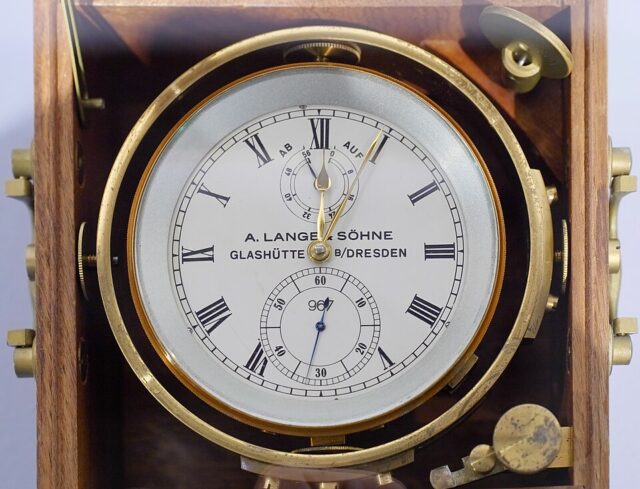
During this era, the company produced marine chronometers, observatory watches, and scientific instruments that earned respect among engineers and astronomers. Precision mattered deeply, but artistic presentation remained equally important inside every case. Lange movements retained their symmetrical structure and hand-finished decoration even as production volumes increased. This balance between industrial progress and artistic discipline became one of the defining themes in the history of Lange and Söhne watches.
The company also benefited from relationships with observatories and scientific institutions across Europe. Accurate timekeeping mattered greatly for navigation, astronomy, and rail transportation during the industrial age. Lange watches served practical purposes while still looking elegant enough for wealthy collectors and royal clients. The polished gold surfaces, engraved details, and carefully proportioned dials gave these instruments a sense of dignity that elevated them above ordinary tools.
War, Decline, and the Disappearance of the Original Company
The twentieth century brought turmoil that threatened the survival of Glashütte watchmaking. During World War I and the difficult years that followed, economic instability reduced demand for luxury goods throughout Europe. The company adapted as best it could, but the larger disaster arrived during World War II. On May 8, 1945, the Lange factory in Glashütte was heavily damaged during bombing near the end of the war.
After the war, Saxony fell under Soviet occupation, and private industries faced enormous political pressure. In 1948, the East German government nationalized the remaining watchmaking firms in Glashütte, including A. Lange & Söhne. The famous company name disappeared from the market entirely as workshops were absorbed into a state-controlled organization called GUB, short for Glashütter Uhrenbetriebe. Decades of family ownership and artistic independence suddenly ended under centralized control.
World War II and the Collapse of Saxon Watchmaking
The disappearance of the Lange name represented more than a business failure. It symbolized the collapse of an artistic culture built over generations by engravers, machinists, and designers. Many traditional finishing methods survived only in fragments because industrial production emphasized efficiency over handcrafted detail. Some elderly craftsmen quietly preserved old techniques and design philosophies, although records from this period remain limited and incomplete.
Collectors outside East Germany helped preserve the memory of Lange watches during the Cold War years. Surviving pocket watches from the nineteenth century became treasured artifacts among horology enthusiasts and museums. Their warm German silver movements and engraved balance cocks reminded collectors of a vanished world of disciplined craftsmanship. Responsible historical speculation suggests that without these collectors and preserved archives, the later revival of the company might have been impossible.
The Revival of A. Lange & Söhne After German Reunification
Walter Lange, born July 29, 1924, was the great-grandson of Ferdinand Adolph Lange and the man who eventually restored the family legacy. After World War II, Walter fled East Germany and settled in the western part of the country. For decades, the famous Lange name remained dormant while Glashütte existed behind the Iron Curtain. Yet Walter never abandoned the dream of rebuilding the company his ancestors had created in 1845.
German reunification in 1990 suddenly made revival possible. Walter Lange partnered with Günter Blümlein, a respected industry executive known for his leadership at LMH, which also oversaw Jaeger-LeCoultre and IWC. Together, they officially re-established A. Lange & Söhne on December 7, 1990. Their partnership combined Walter’s family heritage with Blümlein’s strategic vision and modern understanding of luxury watchmaking.
Walter Lange and Günter Blümlein Rebuild a Legend
The reborn company introduced its first modern collection in 1994, and the Lange 1 became the defining symbol of the revival. Its asymmetrical dial design looked daring yet strangely harmonious, with carefully balanced subdials and an oversized date inspired by the Semper Opera House clock in Dresden. The watch immediately stood apart from many Swiss luxury models that relied heavily on tradition and symmetry. Instead, the Lange 1 felt intellectual, artistic, and unmistakably German.
The revival also restored old hand-finishing traditions that had nearly vanished during the Cold War era. Every movement received engraved balance cocks, polished edges, and carefully assembled components that reflected nineteenth-century Saxon values. Lange introduced a double assembly process in which movements were built once, disassembled for cleaning and decoration, and then rebuilt again for final inspection. The process was expensive and time-consuming, but it reinforced the company’s reputation for obsessive craftsmanship and artistic perfection.
The Art and Design Philosophy Behind Modern Lange Watches
Modern Lange watches are often described as mechanical art because their beauty exists at every visible level. Cases, dials, hands, and movements all follow strict proportional logic that creates visual calm. Even complicated watches with multiple functions rarely appear cluttered because Lange designers treat empty space as carefully as decorated surfaces. This disciplined approach reflects broader German artistic traditions, including Bauhaus ideas about form, clarity, and purpose.
The company’s movements remain among the most admired in modern horology. German silver plates develop soft color variations over time, while polished gold chatons create points of visual contrast across the movement. Hand-engraved balance cocks ensure every watch retains a human touch despite modern manufacturing technology. Light moves gently across the surfaces, giving the impression of depth and warmth rather than cold machinery.
Why Lange Watches Are Considered Mechanical Art
Several modern collections helped strengthen the artistic identity of the brand after 1994. The Datograph became famous for its beautifully layered chronograph movement, which many collectors consider one of the most attractive ever created. The Zeitwerk introduced a mechanical digital display that blended futuristic engineering with architectural clarity. Meanwhile, the Richard Lange collection honored the scientific spirit of Ferdinand Adolph Lange’s son through highly precise regulator-style watches.
Collaboration between engineers, designers, engravers, and polishers remains central to the company today. Unlike mass luxury brands, Lange still emphasizes individual craftsmanship and patient finishing. Many collectors describe the experience of examining a Lange movement as similar to viewing a finely restored cathedral ceiling or classical sculpture. The watches combine strict geometry with emotional warmth, proving that technical precision and artistic expression do not need to compete with each other.
The Lasting Influence of A. Lange & Söhne on Luxury Watch Design
The history of Lange and Söhne watches continues to influence modern luxury watchmaking across the world. Independent brands and established Swiss companies alike have adopted greater emphasis on movement finishing, balanced design, and visible craftsmanship partly because of Lange’s success after 1990. The company proved that restrained elegance could compete with louder forms of luxury. Its watches demonstrated that collectors still valued discipline, symmetry, and hand artistry in an age increasingly dominated by mass production.
Auction houses and collectors now place vintage and modern Lange watches among the most respected timepieces in the world. Rare early pocket watches often command extraordinary prices because they represent both historical importance and artistic excellence. Modern models such as the Lange 1 and Datograph have already become classics despite their relatively recent introduction. Museums and horological exhibitions frequently highlight Lange movements as examples of mechanical beauty and traditional European craftsmanship.
Legacy, Collectors, and Cultural Importance
The company’s legacy also extends beyond watches themselves. Glashütte once again became a respected center of luxury watchmaking thanks in part to the revival of A. Lange & Söhne. Younger craftsmen learned engraving, polishing, and assembly techniques that might otherwise have disappeared forever. In many ways, the company restored not only a brand name, but also an entire regional artistic tradition rooted in patience and discipline.
Today, Lange watches are often treated as heirlooms meant to survive generations of ownership. Their restrained appearance allows them to age gracefully while trends rise and disappear around them. The soft glow of German silver, the tiny cuts of hand engraving, and the architectural balance of each dial continue to attract collectors searching for something deeper than status alone. Few companies have blended engineering and art so completely, and that achievement explains why the history of Lange and Söhne watches remains so compelling nearly two centuries after Ferdinand Adolph Lange opened his workshop in 1845.
Key Takeaways
- Ferdinand Adolph Lange founded A. Lange & Söhne in Glashütte in 1845 after studying European watchmaking traditions.
- The company became famous for artistic movement design, hand engraving, and balanced German aesthetics.
- Richard Lange and Emil Lange expanded the brand internationally during the late nineteenth century.
- The original company disappeared after World War II and East German nationalization in 1948.
- Walter Lange and Günter Blümlein revived the brand in 1990, restoring its global prestige and artistic identity.
FAQs
- When was A. Lange & Söhne founded?
- Who was Ferdinand Adolph Lange?
- Why are Lange watches considered artistic?
- What happened to the company after World War II?
- Which modern Lange watch is the most famous?