Mystery in art rarely comes from making everything confusing. More often, it comes from giving the viewer almost enough information. A doorway leads somewhere we cannot see. A figure looks at something outside the frame. An ordinary room contains one impossible object. From Vermeer to Magritte, artists discovered that curiosity grows in the gap between what an image reveals and what it refuses to explain.
1. Vermeer Hid the Story
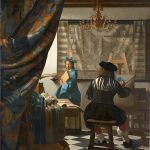
Johannes Vermeer’s interiors often look as though something has just happened—or is about to. A woman reads a letter. Another holds a wineglass. Someone pauses at a window. Yet Vermeer rarely supplies enough information to turn these moments into complete stories.
That missing information matters. In Woman in Blue Reading a Letter, we can see the letter and the woman’s concentration, but we cannot read the message or know who sent it. The painting gives us evidence without a solution, which quietly recruits the viewer as storyteller.
When an image feels too obvious, remove one piece of narrative information and see whether the missing answer makes the remaining clues more interesting.
2. Hopper Put Something Beyond the Frame
Edward Hopper repeatedly painted people staring through windows, sitting in rooms, or occupying spaces that continue beyond the picture. We often sense a larger situation without being allowed to see all of it.
In Nighthawks, for example, we can observe the late-night customers through enormous panes of glass, yet we know almost nothing about them. Even the diner’s entrance is visually elusive. Hopper turns the edge of the canvas into a psychological device: the world continues, but our access to it does not.
If you want to create curiosity, let an important gaze, doorway, shadow, or action point toward something the viewer cannot see.
3. Magritte Made One Thing Impossible
René Magritte understood that mystery becomes especially powerful when most of an image looks perfectly ordinary. A man wears a suit and bowler hat. A room contains familiar furniture. A landscape looks believable.
Then one thing refuses to cooperate. An apple floats in front of a face. A train emerges from a fireplace. A nighttime street sits beneath a bright daytime sky. Because the rest of the world appears calm and recognizable, the contradiction becomes harder to dismiss.
Instead of making an entire image strange, keep most of it believable and introduce one precise element that violates the rules of the world you have established.
4. Leonardo Refused to Finish the Emotion
The Mona Lisa has inspired centuries of speculation partly because her expression is difficult to pin down. She appears neither clearly happy nor unhappy, welcoming nor distant. Leonardo’s extremely subtle transitions around the eyes and mouth help prevent the face from resolving into one easily named emotion.
That ambiguity gives the portrait psychological movement. A broad grin would settle the question immediately. A neutral expression might offer too little. Leonardo occupies the unstable territory between them, where viewers keep checking the face for an answer.
When portraying emotion, try combining slightly contradictory signals rather than making every feature communicate exactly the same feeling.
5. De Chirico Made Empty Space Feel Suspicious
Giorgio de Chirico’s deserted plazas contain arcades, statues, towers, trains, long shadows, and fragments of architecture. None of those things is inherently frightening. Yet together they can produce an uncanny feeling that something has happened—or is about to.
Part of the effect comes from emptiness. Architecture implies human activity, but people are absent or reduced to tiny distant figures. Perspective can feel exaggerated, shadows stretch dramatically, and familiar public spaces become strangely theatrical. Absence becomes an event.
If a scene feels too comfortable, remove some of the activity you would normally expect there and let the empty space make the viewer wonder what is missing.
6. Velázquez Made the Viewer Part of the Puzzle
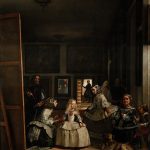
Diego Velázquez’s Las Meninas is filled with looking. The Infanta Margarita faces outward. Velázquez himself stands at a huge canvas. A mirror at the back appears to reflect King Philip IV and Queen Mariana. A man pauses in an illuminated doorway.
The mystery is created less by hidden objects than by uncertain relationships. Where exactly are the king and queen? What is Velázquez painting? Where are we standing in relation to everyone else? The painting turns viewpoint into a puzzle, making viewers conscious of their own position outside the canvas.
When composing a scene, decide exactly where the viewer is standing—and then consider whether making that position slightly uncertain could make the image more involving.
7. Caspar David Friedrich Turned People Away
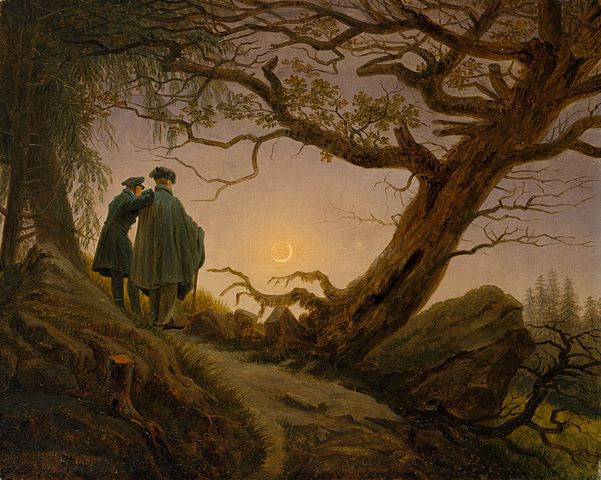
Artists normally use faces to establish emotional connection. Caspar David Friedrich frequently did the opposite.
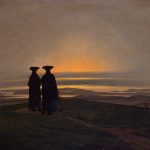
His landscapes often include a Rückenfigur: a figure seen from behind, looking into the landscape. In Wanderer above the Sea of Fog, the central man’s face is completely unavailable to us. Instead of reading his expression, we look in his direction and confront the landscape with him. The concealed face creates both distance and identification.
If a figure’s expression explains too much, turn the figure away and use posture, surroundings, and what they are looking at to carry the emotion instead.
8. Rembrandt Let Darkness Keep Secrets
Rembrandt often allowed large areas of his paintings to sink into shadow while concentrating light on a face, hand, piece of fabric, or important action. Darkness was not simply background; it controlled how much information the viewer received.
This is one reason his paintings can feel psychologically dense. Our eyes naturally search shadow for information, but Rembrandt does not always reward the search. Some details emerge slowly while others remain uncertain. The viewer becomes aware that the painting contains more than can immediately be seen.
Instead of illuminating every important detail equally, decide what the viewer should discover first, what should emerge later, and what can remain partially hidden.
9. Duchamp Never Gave Us the Final Answer
Marcel Duchamp spent years working on The Bride Stripped Bare by Her Bachelors, Even (The Large Glass), an elaborate construction involving two large glass panels populated by strange mechanical-looking forms. He also produced notes that offer clues to its peculiar world of brides, bachelors, desire, machinery, and frustrated communication.
The clues do not neatly solve the work. That is important. Duchamp understood that interpretation can become part of the experience itself. A work may establish enough internal logic to convince us that an answer exists while refusing to package that answer into a single explanation.
When creating ambiguity, give viewers recurring clues and relationships they can investigate rather than randomness they can only shrug at.
Mystery does not require fog, masked figures, abandoned houses, or surreal imagery. It can be created with something much simpler: controlled information.
Vermeer withheld the story. Hopper pushed information beyond the frame. Magritte inserted a contradiction. Friedrich hid the face. Rembrandt hid details in darkness. Velázquez made the viewer’s own position uncertain.
The useful principle behind all of them is that mystery needs clues. Show enough to make the viewer believe there is something worth discovering, then resist the temptation to explain the rest.